check oil DODGE DURANGO 2005 2.G User Guide
[x] Cancel search | Manufacturer: DODGE, Model Year: 2005, Model line: DURANGO, Model: DODGE DURANGO 2005 2.GPages: 416, PDF Size: 14.25 MB
Page 329 of 416
D. Maintain coolant concentration at 50% HOAT ethyl-
ene glycol engine coolant (minimum) and distilled water
for proper corrosion protection of your engine.
E. Make sure that the radiator and coolant bottle over-
flow hoses are not kinked or obstructed.
F. Keep the front of the radiator clean. If your vehicle is
equipped with air conditioning, keep the front of the
condenser clean also.
G. The thermostat should not be changed for summer or
winter operation. If replacement is ever necessary, install
ONLY the correct type thermostat. Other designs may
result in unsatisfactory cooling performance.
Emission Related Components
Fuel System Hoses And Vapor/Vacuum Harnesses
When the vehicle is serviced for scheduled maintenance,
inspect surface of hoses and nylon tubing for evidence of
heat and mechanical damage. Hard and brittle rubber,cracking, checking, tears, cuts, abrasions, and excessive
swelling suggest deterioration of the rubber. Particular
attention should be given to examining hose surfaces
nearest to high heat sources, such as the exhaust mani-
fold.
Insure nylon tubing in these areas has not melted or
collapsed.
Inspect all hose clamps and couplings to make sure they
are secure and no leaks are present.
NOTE:Fluids such as oil, power steering fluid, and
brake fluid are used during assembly plant operations to
ease the assembly of hoses to couplings. Therefore, oil
wetness at the hose-coupling area is not necessarily an
indication of leakage. Actual dripping of hot fluid when
systems are under pressure (during vehicle operation),
should be noted before hose is replaced based on leakage.
MAINTAINING YOUR VEHICLE 329
7
Page 331 of 416
Brake Master Cylinders
The fluid level in the master cylinders should be checked
whenever the vehicle is serviced, or immediately if the
brake system warning light is on. If necessary, add fluid
to bring level to the full mark on the side of the reservoir
of the brake master cylinder. Be sure to clean the top of
the master cylinder area before removing the cap. With
disc brakes, fluid level can be expected to fall as the brake
pads wear. Brake fluid level should be checked when
pads are replaced. If the brake fluid level is abnormally
low, check system for leaks.
Refer to Recommended Fluids, Lubricants and Genuine
Parts for correct fluid type.WARNING!
Use of brake fluid that may have a lower initial
boiling point, or is unidentified, as to specifications
may result in sudden brake failure during hard
prolonged braking. You could have an accident.
WARNING!
Overfilling the brake fluid reservoir can result in
spilling brake fluid on hot engine parts and the
brake fluid catching on fire.
Use only brake fluid that has been in a tightly closed
container to avoid contamination from foreign matter or
moisture.
MAINTAINING YOUR VEHICLE 331
7
Page 333 of 416
1. Operate the engine at idle speed and normal operating
temperature.
2. The vehicle must be on level ground.
3. Fully apply the parking brake and press the brake
pedal.
4. Place the gear selector momentarily in each gear
position ending with the lever in P (Park).
5. Remove the dipstick, wipe it clean and reinsert it until
seated.
6. Remove the dipstick again and note the fluid level on
both sides. The fluid level should be between the “HOT”
(upper) reference holes on the dipstick at normal operat-
ing temperature. Verify that solid coating of oil is seen on
both sides of the dipstick. If the fluid is low, add as
required into the dipstick tube.Do not overfill.After
adding any quantity of oil through the oil fill tube, waita minimum of two (2) minutes for the oil to fully drain
into the transmission before rechecking the fluid level.
NOTE:If it is necessary to check the transmissionbelow
the operating temperature, the fluid level should be
between the two “COLD” (lower) holes on the dipstick
with the fluid at approximately 70°F ( 21°C) (room
temperature). If the fluid level is correctly established at
room temperature, it should be between the “HOT”
(upper) reference holes when the transmission reaches
180°F ( 82°C). Remember it is best to check the level at the
normal operating temperature.
MAINTAINING YOUR VEHICLE 333
7
Page 364 of 416
Use the schedule that best describes your driving condi-
tions. Where time and mileage are listed, follow the
interval that occurs first.
NOTE:Under no circumstances should oil change in-
tervals exceed 6000 miles (10 000 km) or 6 months
whichever comes first.
CAUTION!
Failure to perform the required maintenance items
may result in damage to the vehicle.
At Each Stop for Fuel
•Check the engine oil level about 5 minutes after a fully
warmed engine is shut off. Checking the oil level while
the vehicle is on level ground will improve the accu-
racy of the oil level reading. Add oil only when the
level is at or below the ADD or MIN mark.
•Check the windshield washer solvent and add if
required.
364 MAINTENANCE SCHEDULES
8
M
A
I
N
T
E
N
A
N
C
E
S
C
H
E
D
U
L
E
S
Page 365 of 416
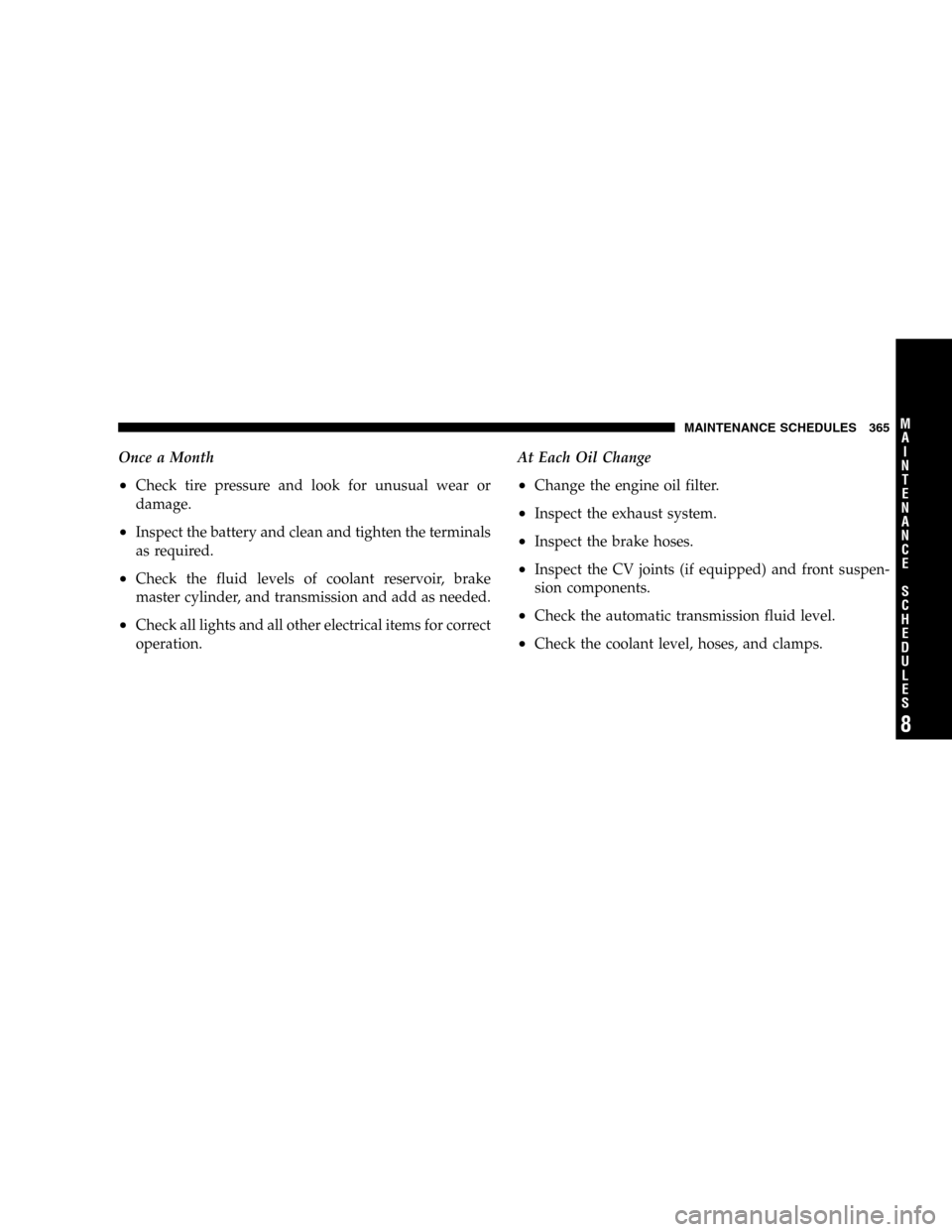
Once a Month
•Check tire pressure and look for unusual wear or
damage.
•Inspect the battery and clean and tighten the terminals
as required.
•Check the fluid levels of coolant reservoir, brake
master cylinder, and transmission and add as needed.
•Check all lights and all other electrical items for correct
operation.At Each Oil Change
•Change the engine oil filter.
•Inspect the exhaust system.
•Inspect the brake hoses.
•Inspect the CV joints (if equipped) and front suspen-
sion components.
•Check the automatic transmission fluid level.
•Check the coolant level, hoses, and clamps.
MAINTENANCE SCHEDULES 365
8
M
A
I
N
T
E
N
A
N
C
E
S
C
H
E
D
U
L
E
S
Page 368 of 416
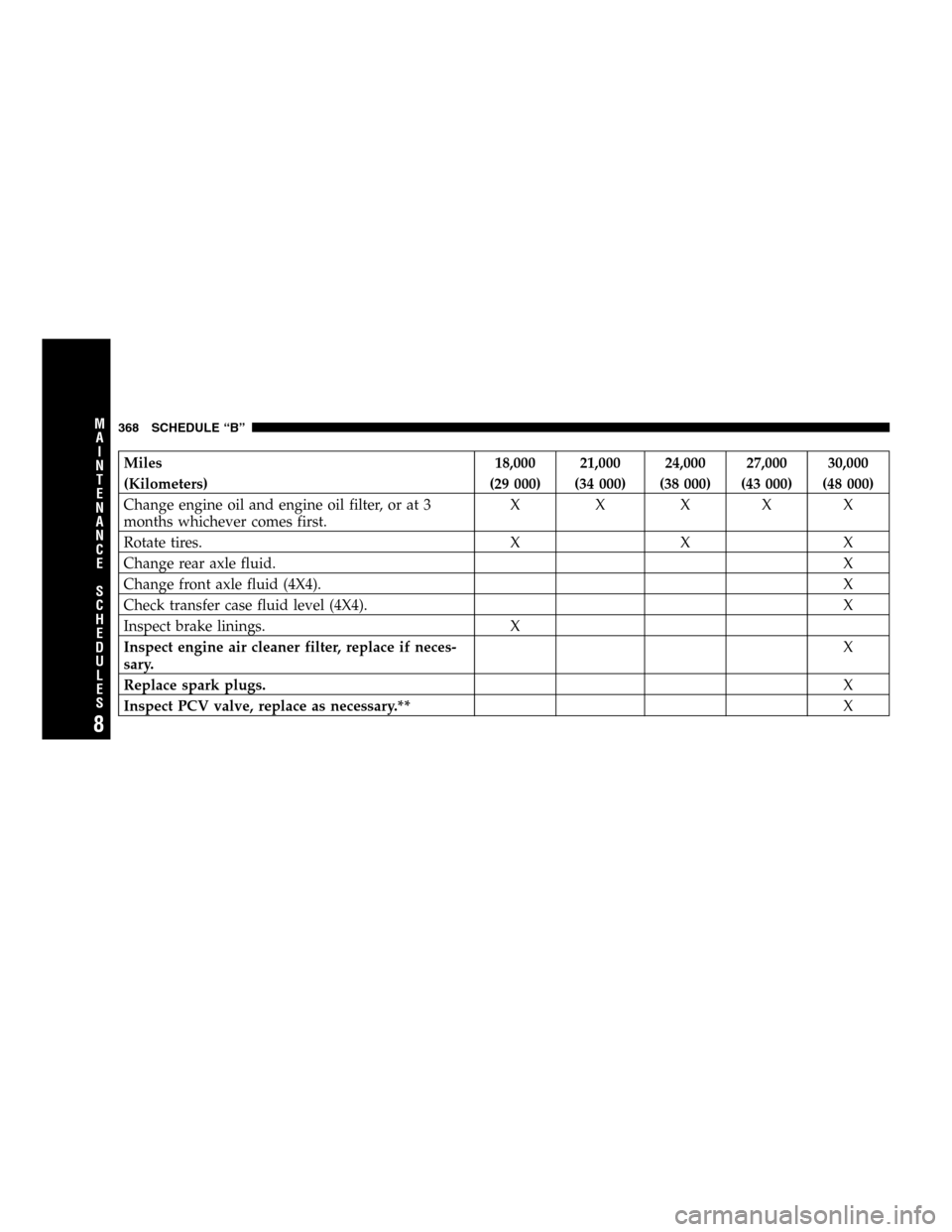
Miles 18,000 21,000 24,000 27,000 30,000
(Kilometers) (29 000) (34 000) (38 000) (43 000) (48 000)
Change engine oil and engine oil filter, or at 3
months whichever comes first.X X XXX
Rotate tires. X X X
Change rear axle fluid.X
Change front axle fluid (4X4).X
Check transfer case fluid level (4X4).X
Inspect brake linings. X
Inspect engine air cleaner filter, replace if neces-
sary.X
Replace spark plugs.X
Inspect PCV valve, replace as necessary.**X
368 SCHEDULE “B”
8
M
A
I
N
T
E
N
A
N
C
E
S
C
H
E
D
U
L
E
S
Page 373 of 416
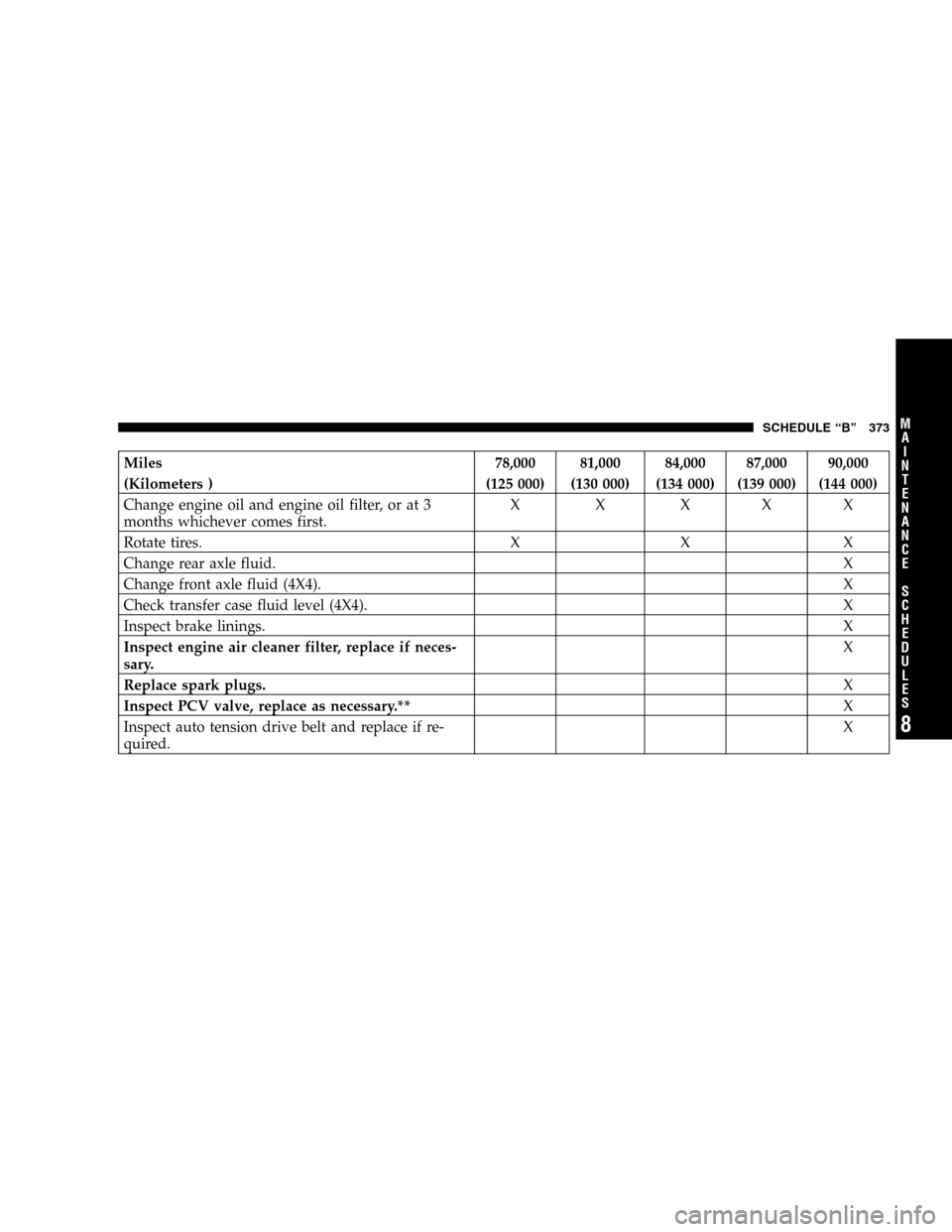
Miles 78,000 81,000 84,000 87,000 90,000
(Kilometers ) (125 000) (130 000) (134 000) (139 000) (144 000)
Change engine oil and engine oil filter, or at 3
months whichever comes first.X X XXX
Rotate tires. X X X
Change rear axle fluid.X
Change front axle fluid (4X4).X
Check transfer case fluid level (4X4).X
Inspect brake linings.X
Inspect engine air cleaner filter, replace if neces-
sary.X
Replace spark plugs.X
Inspect PCV valve, replace as necessary.**X
Inspect auto tension drive belt and replace if re-
quired.X
SCHEDULE “B” 373
8
M
A
I
N
T
E
N
A
N
C
E
S
C
H
E
D
U
L
E
S
Page 377 of 416
![DODGE DURANGO 2005 2.G User Guide Schedule “A”
Miles 6,000 12,000 18,000 24,000 30,000
(Kilometers) (10 000) (19 000) (29 000) (38 000) (48 000)
[Months] [6] [12] [18] [24] [30]
Change engine oil and engine oil filter. X X X X X
R](/img/12/5604/w960_5604-376.png "DODGE DURANGO 2005 2.G User Guide Schedule “A”
Miles 6,000 12,000 18,000 24,000 30,000
(Kilometers) (10 000) (19 000) (29 000) (38 000) (48 000)
[Months] [6] [12] [18] [24] [30]
Change engine oil and engine oil filter. X X X X X
R")
Schedule “A”
Miles 6,000 12,000 18,000 24,000 30,000
(Kilometers) (10 000) (19 000) (29 000) (38 000) (48 000)
[Months] [6] [12] [18] [24] [30]
Change engine oil and engine oil filter. X X X X X
Rotate tires. X X X X X
Check transfer case fluid level (4X4).X
Inspect brake linings. X
Inspect engine air cleaner filter, replace as neces-
sary.X
Replace spark plugs.X
SCHEDULE “A” 377
8
M
A
I
N
T
E
N
A
N
C
E
S
C
H
E
D
U
L
E
S
Page 378 of 416
![DODGE DURANGO 2005 2.G User Guide Miles 36,000 42,000 48,000 54000 60,000 66,000
(Kilometers) (58 000) (67 000) (77 000) (84 000) (96 000) (106 000)
[Months] [36] [42] [48] [54] [60] [66]
Change engine oil and engine oil filter. X X X](/img/12/5604/w960_5604-377.png "DODGE DURANGO 2005 2.G User Guide Miles 36,000 42,000 48,000 54000 60,000 66,000
(Kilometers) (58 000) (67 000) (77 000) (84 000) (96 000) (106 000)
[Months] [36] [42] [48] [54] [60] [66]
Change engine oil and engine oil filter. X X X")
Miles 36,000 42,000 48,000 54000 60,000 66,000
(Kilometers) (58 000) (67 000) (77 000) (84 000) (96 000) (106 000)
[Months] [36] [42] [48] [54] [60] [66]
Change engine oil and engine oil filter. X X X X X X
Rotate tires. X X X X X X
Check transfer case fluid level (4X4). X
Flush and replace engine coolant at 60
months, if not replaced at 102,000 miles (163
000 km).X
Inspect brake linings. X X
Inspect engine air cleaner filter, replace if
necessary.X
Replace spark plugs.X
Inspect PCV valve, replace as necessary. *X
Inspect and replace ignition cables if neces-
sary (5.7L only).X
Inspect auto tension drive belt and replace if
required.X
378 SCHEDULE “A”
8
M
A
I
N
T
E
N
A
N
C
E
S
C
H
E
D
U
L
E
S
Page 379 of 416
![DODGE DURANGO 2005 2.G User Guide Miles 72,000 78,000 84,000 90,000 96,000 100,000
(Kilometers) (115 000) (125 000) (134 000) (144 000) (154 000) (160 000)
[Months] [72] [78] [84] [90] [96]
Change engine oil and engine oil filter. X X](/img/12/5604/w960_5604-378.png "DODGE DURANGO 2005 2.G User Guide Miles 72,000 78,000 84,000 90,000 96,000 100,000
(Kilometers) (115 000) (125 000) (134 000) (144 000) (154 000) (160 000)
[Months] [72] [78] [84] [90] [96]
Change engine oil and engine oil filter. X X")
Miles 72,000 78,000 84,000 90,000 96,000 100,000
(Kilometers) (115 000) (125 000) (134 000) (144 000) (154 000) (160 000)
[Months] [72] [78] [84] [90] [96]
Change engine oil and engine oil filter. X X X X X
Rotate tires. X X X X X X
Check transfer case fluid level (4X4). X
Inspect brake linings. X X
Inspect engine air cleaner filter, replace if
necessary.X
Replace spark plugs.X
Inspect PCV valve, replace as necessary.**X
Inspect auto tension drive belt and replace if
required.X
SCHEDULE “A” 379
8
M
A
I
N
T
E
N
A
N
C
E
S
C
H
E
D
U
L
E
S