tire size DODGE DURANGO 2006 2.G User Guide
[x] Cancel search | Manufacturer: DODGE, Model Year: 2006, Model line: DURANGO, Model: DODGE DURANGO 2006 2.GPages: 440, PDF Size: 6.63 MB
Page 281 of 440
WARNING!
•Do not use a tire, wheel size or rating other than
that specified for your vehicle. Some combinations
of unapproved tires and wheels may change sus-
pension dimensions and performance characteris-
tics, resulting in changes to steering, handling, and
braking of your vehicle. This can cause unpredict-
able handling and stress to steering and suspen-
sion components. You could lose control and have
an accident resulting in serious injury or death. Use
only the tire and wheel sizes with load ratings
approved for your vehicle.
•Never use a tire with a smaller load index or
capacity, other than what was originally equipped
on your vehicle. Using a tire with a smaller load
index could result in tire overloading and failure.
You could lose control and have an accident.
•Failure to equip your vehicle with tires having
adequate speed capability can result in sudden tire
failure and loss of vehicle control.
CAUTION!
Replacing original tires with tires of a different size
may result in false speedometer and odometer read-
ings.
Alignment And Balance
Poor suspension alignment may result in:
•Fast tire wear.
•Uneven tire wear, such as feathering and one-sided
wear.
•Vehicle pull to right or left.
Tires may also cause the vehicle to pull to the left or right.
Alignment will not correct this condition. See your dealer
for proper diagnosis.
STARTING AND OPERATING 281
5
Page 282 of 440
Improper alignment will not cause vehicle vibration.
Vibration may be a result of tire and wheel out-of-
balance. Proper balancing will reduce vibration and
avoid tire cupping and spotty wear.
SUPPLEMENTAL TIRE PRESSURE INFORMATION
– IF EQUIPPED
A light load vehicle condition is defined as two passen-
gers {150 lbs (68 kg) each} plus 200 lbs (91kg) of cargo.
Cold tire inflation pressures for a lightly loaded vehicle
will be found on the face of the driver’s door.
TIRE CHAINS
Use “Class S” chains on Durango, or other traction aids
that meet SAE Type “S” specifications.
NOTE:Chains must be the proper size for the vehicle,
as recommended by the chain manufacturer.
CAUTION!
To avoid damage to your vehicle, tires or chains, observe the
following precautions:
•Because of limited chain clearance between tires and
other suspension components, it is important that only
chains in good condition are used. Broken chains can
cause serious vehicle damage. Stop the vehicle immedi-
ately if noise occurs that could suggest chain breakage.
Remove the damaged parts of the chain before further
use.
•Install chains as tightly as possible and then retighten
after driving about 1/2 mile (0.8 km).
•Do not exceed 45 mph (72 km/h).•Drive cautiously and avoid severe turns and large
bumps, especially with a loaded vehicle.
•Do not install tire chains on front wheels of 4x2 vehicles.•Do not drive for a prolonged period on dry pavement.•Observe the tire chain manufacturer’s instructions on
method of installation, operating speed, and conditions
for usage. Always use the lower suggested operating
speed of the chain manufacturer if different than the
speed recommended by the manufacturer.
282 STARTING AND OPERATING
Page 283 of 440
These cautions apply to all chain traction devices, includ-
ing link and cable (radial) chains.
Tire chain use is permitted only on the rear tires of
Durango trucks.
NOTE:The use of class “S” chains is permitted on
Durangos with P245/70R17 tires.
CAUTION!
Do not use tire chains on 4x4 Durango trucks
equipped with tires other than P245/70R17 tires.
There may not be adequate clearance for the chains
and you are risking structural or body damage to
your vehicle. Do not use tire chains on the 4X2 front
wheels of Durango models. There may not be ad-
equate clearance for the chains and you are risking
structural or body damage to your vehicle.
SNOW TIRES
Snow tires should be of the same size and type construc-
tion as the front tires. Consult the manufacturer of the
snow tire to determine any maximum vehicle speed
requirement associated with the tire. These tires should
always be operated at the vehicle maximum capacity
inflation pressures under any load condition.
While studded tires improve performance on ice, skid
and traction capability on wet or dry surfaces may be
poorer than that of non-studded tires. Some states pro-
hibit studded tires; therefore, local laws should be
checked before using these tire types.
STARTING AND OPERATING 283
5
Page 293 of 440
Rating (GAWR) front and rear, and Vehicle Identification
Number (VIN). A Month-Day-Hour (MDH) number is
included on this label and shows the Month, Day, and
Hour of manufacture. The bar code that appears on the
bottom of the label is your Vehicle Identification Number
(VIN).
Gross Vehicle Weight Rating (GVWR)
The GVWR is the total permissible weight of your vehicle
including driver, passengers, vehicle, options, and cargo.
The label also specifies maximum capacities of front and
rear axle systems. Total load must be limited so that
GVWR is not exceeded.
Payload
The payload of a vehicle is defined as the allowable load
weight a truck can carry including the weight of the
driver, all passengers, options, and cargo.
Gross Axle Weight Rating (GAWR)
The GAWR is the maximum permissible load on the front
and rear axles. The load must be distributed in the cargo
area so that the GAWR of each axle is not exceeded.
Each axle GAWR is determined by the component in the
system with the lowest load carrying capacity (axle,
springs, tires, or wheels).
Heavier axles or suspension components sometimes
specified by purchasers for increased durability do not
necessarily increase the vehicle’s GVWR.
Tire Size
This is the minimum allowable tire size for your vehicle.
Replacement tires must be equal to the load capacity of
this tire size.
Rim Size
This is the rim size that is appropriate for the tire size
listed.
STARTING AND OPERATING 293
5
Page 434 of 440
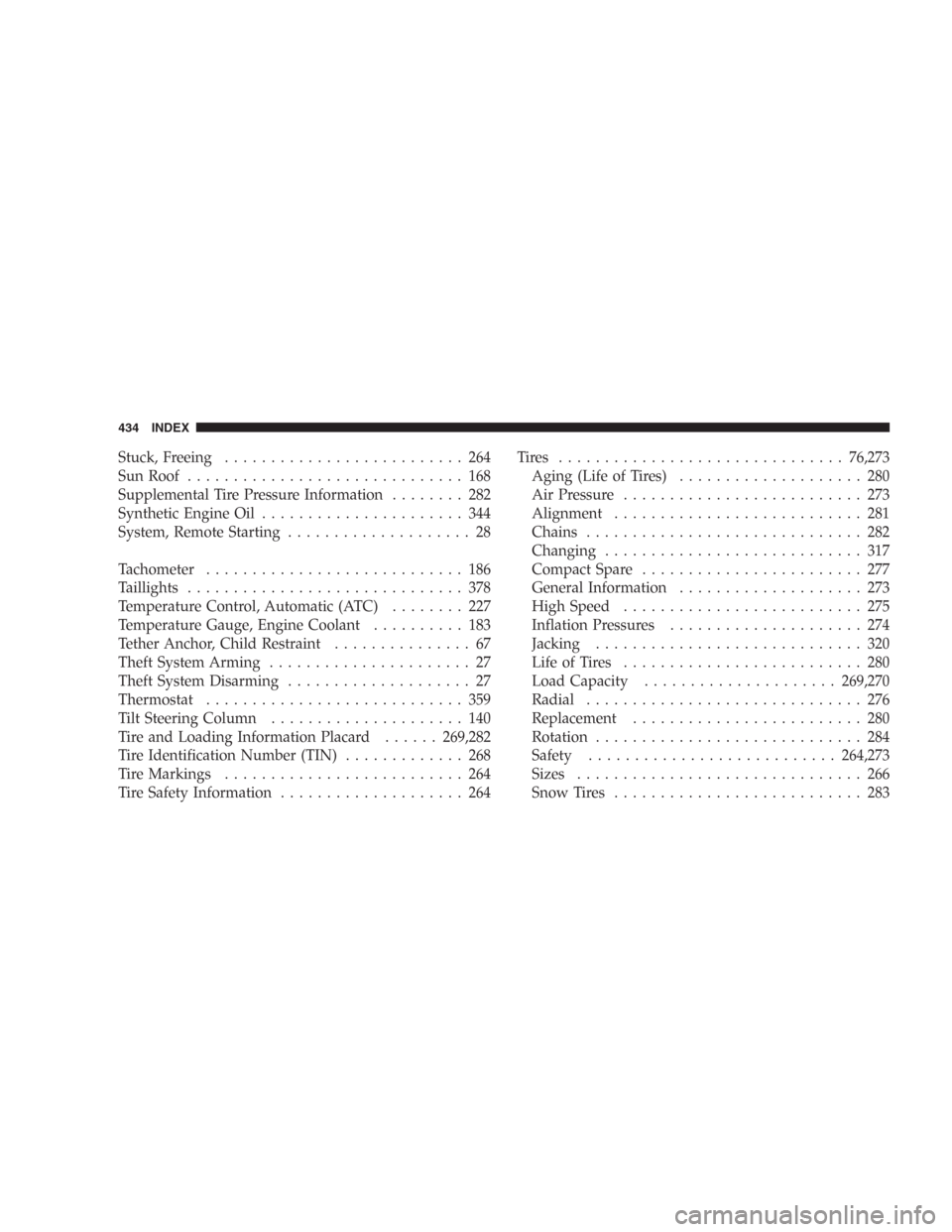
Stuck, Freeing.......................... 264
Sun Roof.............................. 168
Supplemental Tire Pressure Information........ 282
Synthetic Engine Oil...................... 344
System, Remote Starting.................... 28
Tachometer............................ 186
Taillights.............................. 378
Temperature Control, Automatic (ATC)........ 227
Temperature Gauge, Engine Coolant.......... 183
Tether Anchor, Child Restraint............... 67
Theft System Arming...................... 27
Theft System Disarming.................... 27
Thermostat............................ 359
Tilt Steering Column..................... 140
Tire and Loading Information Placard......269,282
Tire Identification Number (TIN)............. 268
Tire Markings.......................... 264
Tire Safety Information.................... 264Tires ...............................76,273
Aging (Life of Tires).................... 280
Air Pressure.......................... 273
Alignment........................... 281
Chains.............................. 282
Changing............................ 317
Compact Spare........................ 277
General Information.................... 273
High Speed.......................... 275
Inflation Pressures..................... 274
Jacking............................. 320
Life of Tires.......................... 280
Load Capacity.....................269,270
Radial.............................. 276
Replacement......................... 280
Rotation............................. 284
Safety...........................264,273
Sizes............................... 266
Snow Tires........................... 283
434 INDEX