ECU DODGE DURANGO 2006 2.G Owner's Manual
[x] Cancel search | Manufacturer: DODGE, Model Year: 2006, Model line: DURANGO, Model: DODGE DURANGO 2006 2.GPages: 440, PDF Size: 6.63 MB
Page 253 of 440
If the key is not ON then the shift will not take place and
no position indicator lights will be on or flashing.
NV 244 Generation II Transfer Case Operating
Information / Precautions
The NV 244 Generation II is an electric shift transfer case
and is operated by the 4WD Control Switch, which is
located on the instrument panel.
The NV 244 Generation II transfer case provides 4 mode
positions - Normal all-wheel-drive high range, four-
wheel-drive LOCK, four-wheel-drive low range, and
neutral.
This transfer case is equipped with an inter-axle differ-
ential that allows driving the vehicle in the normal
all-wheel-drive position (AWD) at all times on any given
road surface, including dry hard surfaced roads. The
AWD mode allows the front and rear wheels to rotate at
different speeds. This eliminates driveline binding and
component wear normally associated with driving thevehicle in the 4LOCK position on dry hard surfaced
roads. This feature provides the safety, security, and
convenience of operating in all-wheel drive at all times
regardless of road conditions.
When additional traction is required, the 4LOCK and
4LO positions can be used to lock the front and rear
driveshafts together through the transfer case inter-axle
differential and force the front and rear wheels to rotate
at the same speed. This is accomplished by rotating the
4WD Control Switch to these positions. The 4LOCK and
4LO positions are intended for loose, slippery road
surfaces only. Driving in the 4LOCK and 4LO positions
on dry hard surfaced roads may cause increased tire wear
and damage to the driveline components.
The transfer case Neutral (N) position is selected by
depressing the recessed button located on the lower left
hand corner of the 4WD Control Switch.
STARTING AND OPERATING 253
5
Page 294 of 440
Inflation Pressure (Cold)
This is the cold tire inflation pressure for your vehicle for
all loading conditions up to full GAWR.
Curb Weight
The curb weight of a vehicle is defined as the total weight
of the vehicle with all fluids, including vehicle fuel, at full
capacity conditions, and with no occupants or cargo
loaded into the vehicle. The front and rear curb weight
values are determined by weighing your vehicle on a
commercial scale before any occupants or cargo are
added.
Loading
The actual total weight and the weight of the front and
rear of your vehicle at the ground can best be determined
by weighing it when it is loaded and ready for operation.
The entire vehicle should first be weighed on a commer-
cial scale to insure that the GVWR has not been exceeded.
The weight on the front and rear of the vehicle shouldthen be determined separately to be sure that the load is
properly distributed over front and rear axle. Weighing
the vehicle may show that the GAWR of either the front
or rear axles has been exceeded but the total load is
within the specified GVWR. If so, weight must be shifted
from front to rear or rear to front as appropriate until the
specified weight limitations are met.
Store heavier items down low and be sure that the weight
is distributed equally. Stow all loose items securely before
driving.
Improper weight distribution can have an adverse effect
on the way your vehicle steers and handles and the way
the brakes operate.
294 STARTING AND OPERATING
Page 301 of 440
CAUTION!
•Avoid towing a trailer for the first 500 miles (805
km) of vehicle operation. Doing so may damage
your vehicle.
•During the first 500 miles (805 km) of trailer
towing, limit your speed to 50 mph (80 km/h).
Perform the maintenance listed in Section 8 of this
manual. When towing a trailer, never exceed the GAWR,
or GCWR, ratings.
WARNING!
Improper towing can lead to an injury accident.
Follow these guidelines to make your trailer towing
as safe as possible:
Make certain that the load is secured in the trailer
and will not shift during travel. When trailering
cargo that is not fully secured, dynamic load shifts
can occur that may be difficult for the driver to
control. You could lose control of your vehicle and
have an accident.
•When hauling cargo or towing a trailer, do not over-
load your vehicle or trailer. Overloading can cause a
loss of control, poor performance or damage to brakes,
axle, engine, transmission, steering, suspension, chas-
sis structure or tires.
STARTING AND OPERATING 301
5
Page 317 of 440
WARNING!
•Never allow any lit smoking materials near the
vehicles while removing the cap or filling the
tank.
•Never add fuel to the vehicle when the engine is
running.
•A fire may result if gasoline is pumped into a
portable container that is in a vehicle or on a truck
bed. You could be burned. Always place gas
containers on the ground while filling.
CHANGING A FLAT TIRE
Jack Location
In the Durango, the scissor jack and tire changing tools
are stowed under the second row seat.
The jack is secured in place with a winged stud and a
fixed stud. It is very important to secure the jack tightly
in place by engaging the slot in the base to the fixed stud
under the middle seat. The winged stud inserts through
the eyelet in the end of the jack’s worm screw.
WHAT TO DO IN EMERGENCIES 317
6
Page 324 of 440
WARNING!
A loose tire or jack thrown forward in a collision or
hard stop could injure someone in the vehicle.
Always stow the jack, tools and the extra tire and
wheel in the places provided.
7. Remove wheel blocks. Do not install chrome or alu-
minum wheel center caps on the spare wheel. This may
result in cap damage.
8. Lower the jack to its fully closed position. Stow the
replaced tire, jack, and tools as previously described.
9. Adjust the tire pressure when possible.
NOTE:Do not oil wheel studs. For chrome wheels, do
not substitute with chrome plated wheel nuts.
WARNING!
Carefully follow these tire changing warnings to help
prevent personal injury or damage to your vehicle:
•Always park on a firm, level surface as far from the edge
of the roadway as possible before raising the vehicle.
•Block the wheel diagonally opposite the wheel to be
raised.
•Apply the parking brake firmly before jacking.
•Never start the engine with the vehicle on a jack.
•Do not let anyone sit in the vehicle when it is on a jack.
•Do not get under the vehicle when it is on a jack.
•Only use the jack in the positions indicated.
•If working on or near a roadway, be extremely careful of
motor traffic.
•To assure that spare tires, flat or inflated are securely
stowed, spares must be stowed with the value stem
facing the ground.
324 WHAT TO DO IN EMERGENCIES
Page 359 of 440
D. Maintain coolant concentration at 50% HOAT ethyl-
ene glycol engine coolant (minimum) and distilled water
for proper corrosion protection of your engine.
E. Make sure that the radiator and coolant bottle over-
flow hoses are not kinked or obstructed.
F. Keep the front of the radiator clean. If your vehicle is
equipped with air conditioning, keep the front of the
condenser clean also.
G. The thermostat should not be changed for summer or
winter operation. If replacement is ever necessary, install
ONLY the correct type thermostat. Other designs may
result in unsatisfactory cooling performance.
Emission Related Components
Fuel System Hoses And Vapor/Vacuum Harnesses
When the vehicle is serviced for scheduled maintenance,
inspect surface of hoses and nylon tubing for evidence of
heat and mechanical damage. Hard and brittle rubber,cracking, checking, tears, cuts, abrasions, and excessive
swelling suggest deterioration of the rubber. Particular
attention should be given to examining hose surfaces
nearest to high heat sources, such as the exhaust mani-
fold.
Insure nylon tubing in these areas has not melted or
collapsed.
Inspect all hose clamps and couplings to make sure they
are secure and no leaks are present.
NOTE:Fluids such as oil, power steering fluid, and
brake fluid are used during assembly plant operations to
ease the assembly of hoses to couplings. Therefore, oil
wetness at the hose-coupling area is not necessarily an
indication of leakage. Actual dripping of hot fluid when
systems are under pressure (during vehicle operation),
should be noted before hose is replaced based on leakage.
MAINTAINING YOUR VEHICLE 359
7
Page 382 of 440
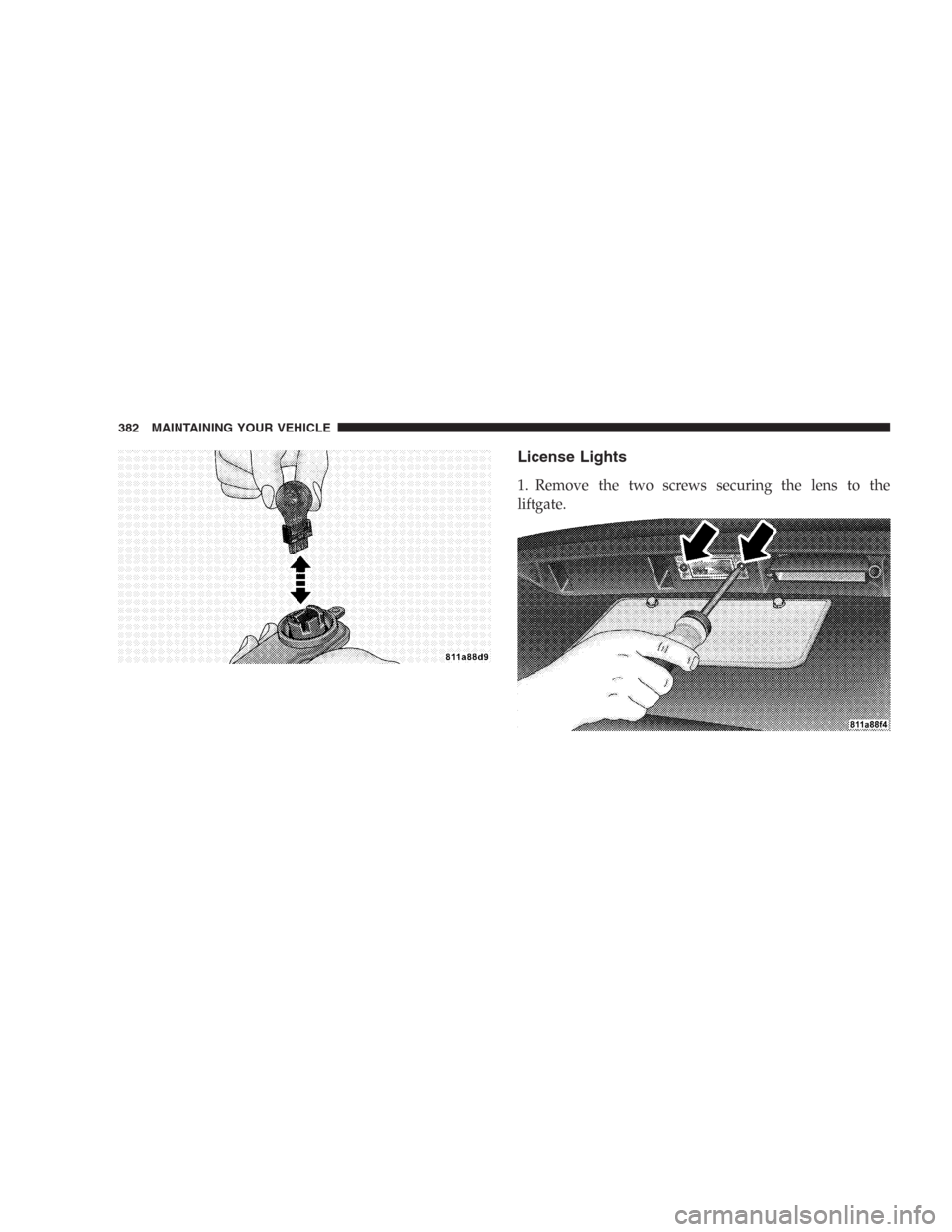
License Lights
1. Remove the two screws securing the lens to the
liftgate.
382 MAINTAINING YOUR VEHICLE
Page 383 of 440
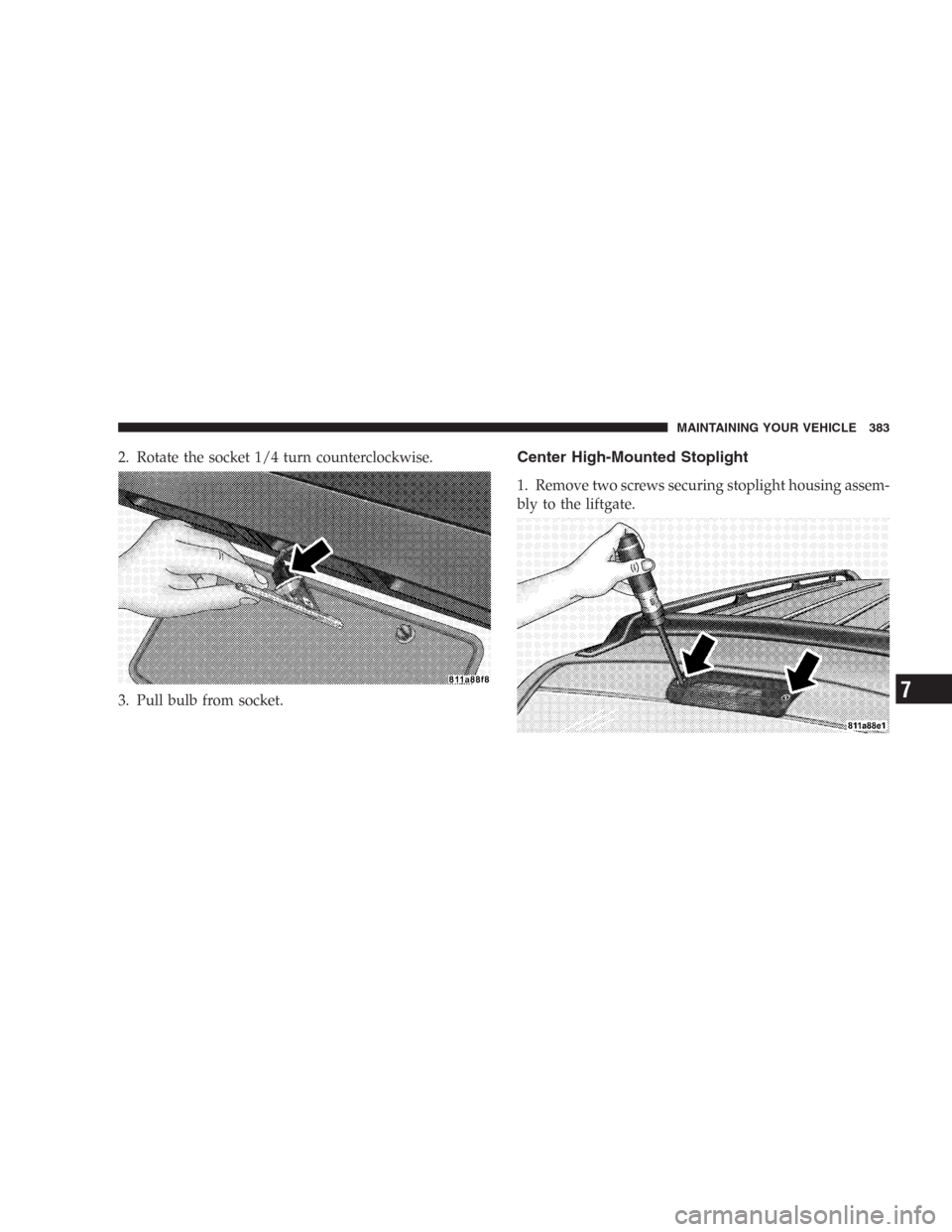
2. Rotate the socket 1/4 turn counterclockwise.
3. Pull bulb from socket.Center High-Mounted Stoplight
1. Remove two screws securing stoplight housing assem-
bly to the liftgate.
MAINTAINING YOUR VEHICLE 383
7
Page 420 of 440
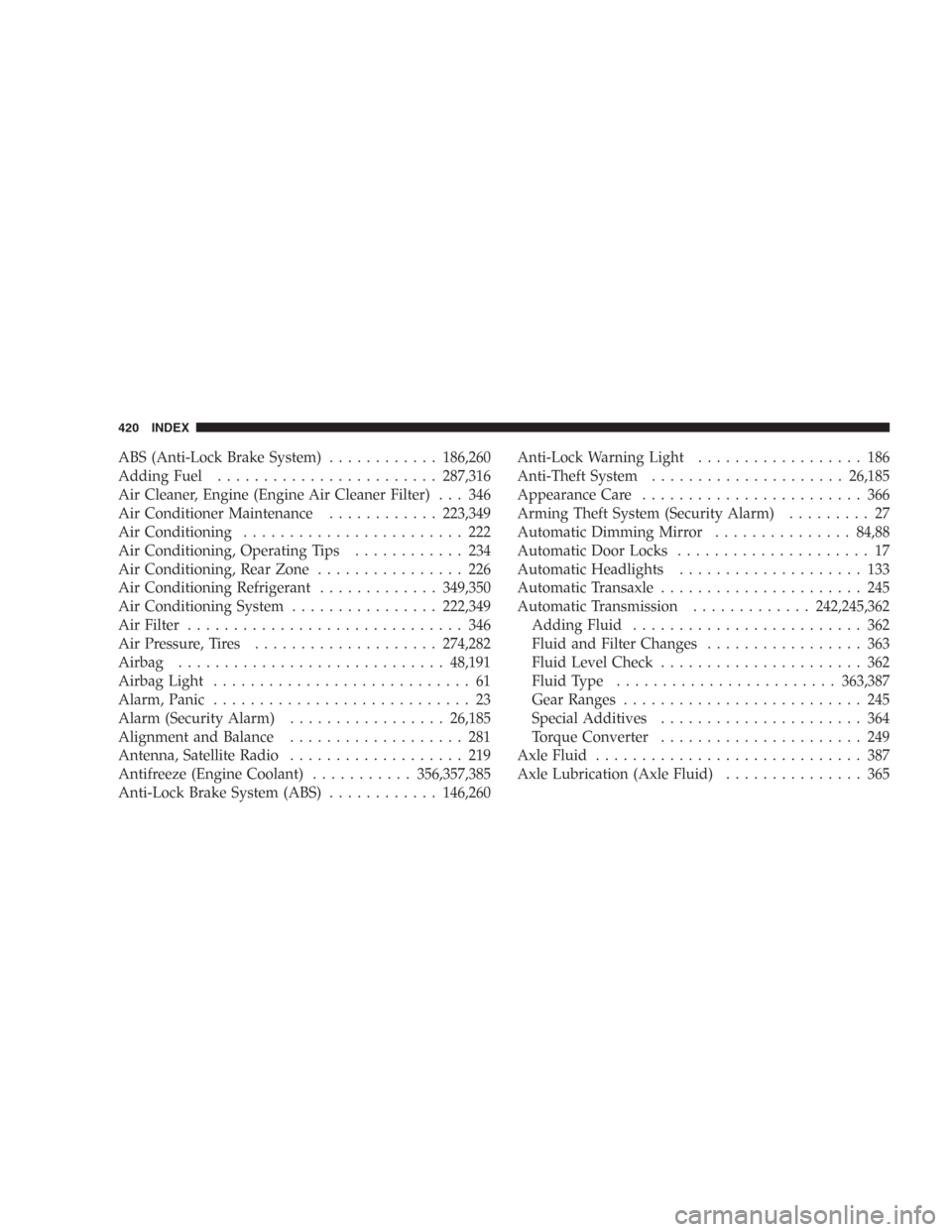
ABS (Anti-Lock Brake System)............186,260
Adding Fuel........................287,316
Air Cleaner, Engine (Engine Air Cleaner Filter) . . . 346
Air Conditioner Maintenance............223,349
Air Conditioning........................ 222
Air Conditioning, Operating Tips............ 234
Air Conditioning, Rear Zone................ 226
Air Conditioning Refrigerant.............349,350
Air Conditioning System................222,349
Air Filter.............................. 346
Air Pressure, Tires....................274,282
Airbag.............................48,191
Airbag Light............................ 61
Alarm, Panic............................ 23
Alarm (Security Alarm).................26,185
Alignment and Balance................... 281
Antenna, Satellite Radio................... 219
Antifreeze (Engine Coolant)...........356,357,385
Anti-Lock Brake System (ABS)............146,260Anti-Lock Warning Light.................. 186
Anti-Theft System.....................26,185
Appearance Care........................ 366
Arming Theft System (Security Alarm)......... 27
Automatic Dimming Mirror...............84,88
Automatic Door Locks..................... 17
Automatic Headlights.................... 133
Automatic Transaxle...................... 245
Automatic Transmission.............242,245,362
Adding Fluid......................... 362
Fluid and Filter Changes................. 363
Fluid Level Check...................... 362
Fluid Type........................363,387
Gear Ranges.......................... 245
Special Additives...................... 364
Torque Converter...................... 249
Axle Fluid............................. 387
Axle Lubrication (Axle Fluid)............... 365
420 INDEX
Page 432 of 440
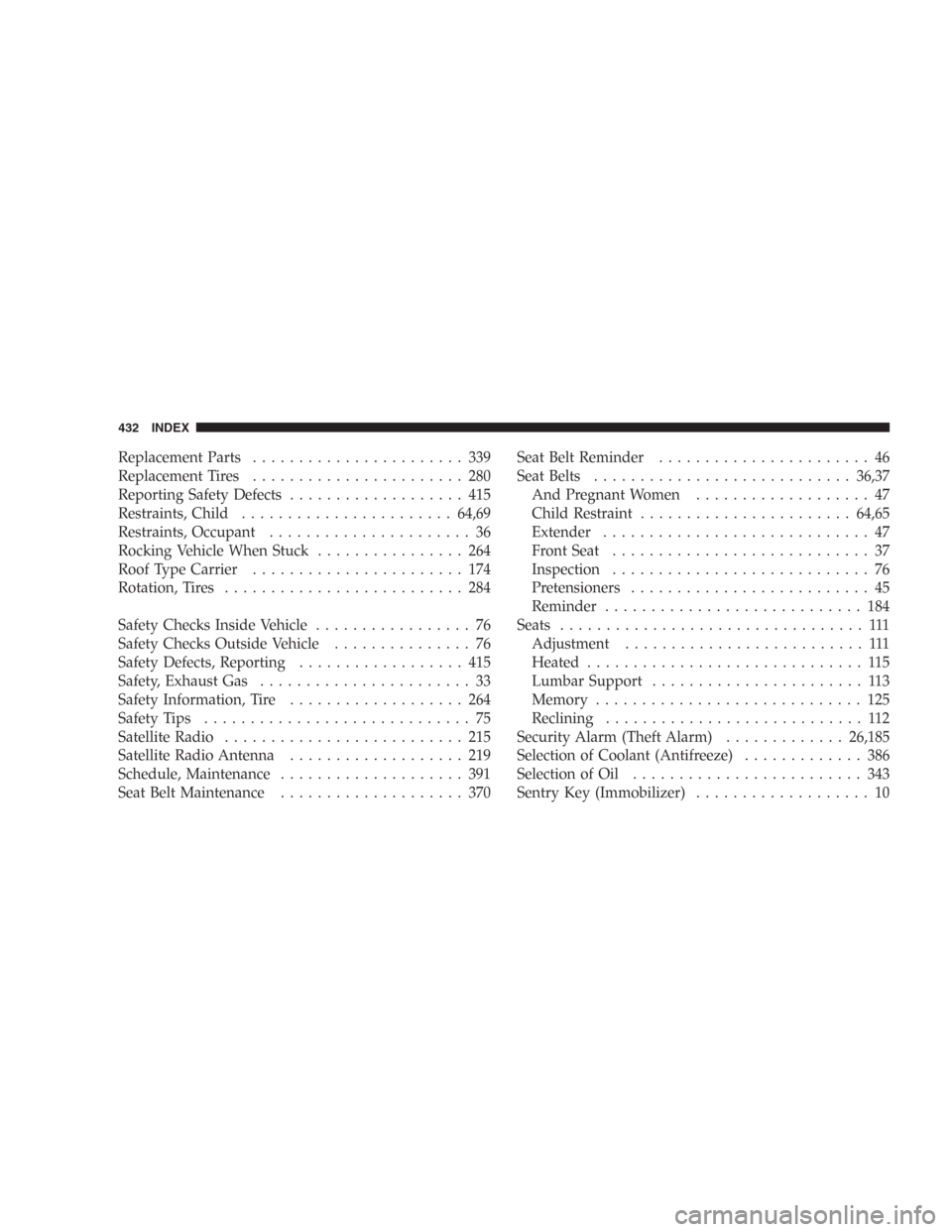
Replacement Parts....................... 339
Replacement Tires....................... 280
Reporting Safety Defects................... 415
Restraints, Child.......................64,69
Restraints, Occupant...................... 36
Rocking Vehicle When Stuck................ 264
Roof Type Carrier....................... 174
Rotation, Tires.......................... 284
Safety Checks Inside Vehicle................. 76
Safety Checks Outside Vehicle............... 76
Safety Defects, Reporting.................. 415
Safety, Exhaust Gas....................... 33
Safety Information, Tire................... 264
Safety Tips............................. 75
Satellite Radio.......................... 215
Satellite Radio Antenna................... 219
Schedule, Maintenance.................... 391
Seat Belt Maintenance.................... 370Seat Belt Reminder....................... 46
Seat Belts............................36,37
And Pregnant Women................... 47
Child Restraint.......................64,65
Extender............................. 47
Front Seat............................ 37
Inspection............................ 76
Pretensioners.......................... 45
Reminder............................ 184
Seats................................. 111
Adjustment.......................... 111
Heated.............................. 115
Lumbar Support....................... 113
Memory............................. 125
Reclining............................ 112
Security Alarm (Theft Alarm).............26,185
Selection of Coolant (Antifreeze)............. 386
Selection of Oil......................... 343
Sentry Key (Immobilizer)................... 10
432 INDEX