airbag DODGE DURANGO 2006 2.G Owner's Manual
[x] Cancel search | Manufacturer: DODGE, Model Year: 2006, Model line: DURANGO, Model: DODGE DURANGO 2006 2.GPages: 440, PDF Size: 6.63 MB
Page 65 of 440
LATCH child restraint anchorage system. (See the
LATCH - Child Seat Anchorage System section.)
•Rearward-facing child seats mustNEVERbe used in
the front seat of a vehicle with a front passenger
airbag. An airbag deployment could cause severe
injury or death to infants in this position.
Older Children and Child Restraints
Children who weigh more than 20 lbs (9 kg) and who are
older than one year can ride forward-facing in the
vehicle. Forward-facing child seats and convertible child
seats used in the forward-facing direction are for children
who weigh 20 to 40 lbs (9 to 18 kg) and who are older
than one year. These child seats are also held in the
vehicle by the lap/shoulder belt or the LATCH child
restraint anchorage system. (See the LATCH - Child Seat
Anchorage System Section.)
The belt-positioning booster seat is for children weighing
more than 40 lbs (18 kg), but who are still too small to fitthe vehicle’s seat belts properly. If the child cannot sit
with knees bent over the vehicle’s seat cushion while the
child’s back is against the seat back, they should use a
belt-positioning booster seat. The child and belt-
positioning booster seat are held in the vehicle by the
lap/shoulder belt.
Children Too Large for Booster Seats
Children who are large enough to wear the shoulder belt
comfortably, and whose legs are long enough to bend
over the front of the seat when their back is against the
seat back should use the lap/shoulder belt in a rear seat.
•Make sure that the child is upright in the seat.
•The lap portion should be low on the hips and as snug
as possible.
•Check belt fit periodically. A child’s squirming or
slouching can move the belt out of position.
THINGS TO KNOW BEFORE STARTING YOUR VEHICLE 65
2
Page 66 of 440
•If the shoulder belt contacts the face or neck, move the
child closer to the center of the vehicle. Never allow a
child to put the shoulder belt under an arm.
WARNING!
•Improper installation can lead to failure of an
infant or child restraint. It could come loose in a
collision. The child could be badly injured or
killed. Follow the manufacturer’s directions ex-
actly when installing an infant or child restraint.
•A rearward facing infant restraint should only be
used in a rear seat. A rearward facing infant
restraint in the front seat may be struck by a
deploying passenger airbag which may cause se-
vere or fatal to the infant.
Here are some tips for getting the most out of your child
restraint:
•Before buying any restraint system, make sure that it
has a label certifying that it meets all applicable Safety
Standards. The manufacturer recommends that you
try a child restraint in the vehicle seats where you will
use it before you buy it.
•The restraint must be appropriate for your child’s
weight and height. Check the label on the restraint for
weight and height limits.
•Carefully follow the instructions that come with the
restraint. If you install the restraint improperly, it may
not work when you need it.
•The second row outside seating positions and all third
row seats have cinching latch plates. The second row
center position has an automatic locking retractor.
These are designed to keep the lap portion tight
around the child restraint so that it is not necessary to
use a locking clip. If the seat belt has a cinching latch
plate, pulling up on the shoulder portion of the
66 THINGS TO KNOW BEFORE STARTING YOUR VEHICLE
Page 74 of 440
WARNING!
An incorrectly anchored tether strap could lead to
seat failure and injury to the child. In a collision, the
seat could come loose and allow the child to crash
into the inside of the vehicle or other passengers, or
even be thrown from the vehicle. Use only the
anchor positions directly behind the child seat to
secure a child restraint top tether strap. Follow the
instructions below. See your dealer for help if nec-
essary.
Transporting Pets
Airbags deploying in the front seat could harm your pet.
An unrestrained pet will be thrown about and possibly
injured, or injure a passenger during panic braking or in
a collision. Pets should be restrained in the rear seat in
pet harnesses or pet carriers that are secured by seat belts.
ENGINE BREAK-IN RECOMMENDATIONS
A long break-in period is not required for the engine in
your new vehicle. Drive moderately during the first 300
miles (500 km). After the initial 60 miles (100 km), speeds
up to 50 or 55 mph (80 or 90 km/h) are desirable. While
cruising, brief full-throttle acceleration, within the limits
of local traffic laws, contributes to a good break-in.
Avoid wide open throttle acceleration in low gear.
The engine oil installed in the engine at the factory is a
high-quality, energy-conserving type lubricant. Oil
changes should be consistent with anticipated climate
conditions under which vehicle operations will occur.
The recommended viscosity and quality grades are
shown in Section 7.
NON-DETERGENT OR STRAIGHT MINERAL OILS
MUST NEVER BE USED.
74 THINGS TO KNOW BEFORE STARTING YOUR VEHICLE
Page 142 of 440
Adjustment
1. Position the driver seat so that you are at least 10
inches (254 mm) away from the airbag located in the
center of the steering wheel.
2. Fasten and adjust the seatbelts.
3. Move the adjustable pedal switch, located to the left of
the steering column near the parking brake release, up to
move the pedals toward the driver or down to move the
pedals away from the driver.
4. The pedalscannotbe adjusted when the vehicle is in
R (Reverse) or when the Speed Control is SET.
CAUTION!
Do not place any article under the adjustable pedals
or impede its ability to move as it may cause damage
to the pedal controls. Pedal travel may become
limited if movement is stopped by an obstruction in
the adjustable pedal’s path.
ELECTRONIC SPEED CONTROL — IF EQUIPPED
When engaged, this device takes over accelerator opera-
tion at speeds greater than (refer to the table below for
the speed for your specific engine). The controls are
mounted on the steering wheel.
142 UNDERSTANDING THE FEATURES OF YOUR VEHICLE
Page 184 of 440
left/right turn signal is left on with the engine RPM
vehicle speed greater than 15 mph (24 km/h) for more
than one mile.
4. Low Fuel Warning Light
This indicator lights when the fuel gauge reads 1/8
of a tank or less.
5. High Beam Indicator
Indicates that headlights are on high beam.
6. Seat Belt Reminder Light
This light comes on for several seconds after the
ignition is turned ON as a reminder to “buckle
up.” This light will remain on as long as the seat
belt remains unbuckled. If this light flashes, it indicates a
fault in the airbag system. Have the system checked by
an authorized dealer.7. Fog Light Indicator — If Equipped
This light shows when the fog lights are ON.
8. Coolant Temperature Light
This light warns of an overheated engine condi-
tion. For a bulb check, this light will come on
momentarily when the ignition is turned On. If the
light turns on while driving, stop the vehicle, shift into N
(Neutral) and increase the engine speed for 2 to 3
minutes. If the temperature reading does not return to
normal, seek authorized service immediately.
184 INSTRUMENT PANEL AND CONTROLS
Page 191 of 440
27. Airbag Indicator
The indicator lights and remains lit for 6 to 8
seconds when the ignition is first turned ON. If
the light does not come on when the ignition is
first turned on, or the light stays on or comes
on while driving, have the airbag system checked by an
authorized dealer.
28. 4LO Indicator
Indicates when transfer case is in 4LO position.
29. SVC (Service) 4WD Indicator
The SVC 4WD lights will come on when the ignition key
is turned to the ON position and will stay on for 2
seconds. If the light stays on or comes on during driving,
it means that the 4WD system is not functioning properly
and that service is required.
30. Cruise Light (Speed Control)
This indicator lights when the electronic speed control
system is turned on.31. TOW/HAUL
The TOW/HAUL button is located at the end of the gear
shift lever. This light will illuminate when the TOW/
HAUL button has been selected.
32. 4LOCK Indicator
Indicates transfer case is in 4LOCK position.
33. Odometer/Trip Odometer Button
Press this button to toggle between the odometer and the
trip odometer display. Holding the button in resets the
trip odometer reading.
RADIO RECEPTION INFORMATION
AM Reception
AM radio signals usually travel longer distances than FM
signals, especially at night. These longer distance AM
signals can cause AM stations to interfere with one
INSTRUMENT PANEL AND CONTROLS 191
4
Page 307 of 440
Trailer Towing Mirrors — If Equipped
These mirrors are designed with an adjustable mirror
head to provide a greater vision range when towing
extra-wide loads. To change position inboard or out-
board, the mirror head should be rotated (flipped Out or
In). A small blindspot mirror is integrated onto the main
mirror surface.
SNOWPLOW
Dodge Durango Models
NOTE:Do not use Dodge Durango Models for snow-
plow applications.
WARNING!
Snowplows, winches, and other aftermarket equip-
ment should not be added to the front end or your
vehicle. The airbag crash sensors may be affected by
the change in the front end structure. The airbags
could deploy unexpectedly or could fail to deploy
during a collision resulting in serious injury or
death.
CAUTION!
Using this vehicle for snowplow applications can
cause damage to the vehicle.
STARTING AND OPERATING 307
5
Page 308 of 440
WARNING!
Attaching a snowplow to this vehicle could ad-
versely affect performance of the airbag system in an
accident. Do not expect that the airbag will perform
as described earlier in this manual
RECREATIONAL TOWING (BEHIND
MOTORHOME, ETC.)
Recreational Towing 2WD Models
Recreational towing of 2WD models is not allowable.
Towing the vehicle with the transmission in Neutral can
cause severe transmission damage. Removal of the drive-
shaft for towing is not recommended since this allows
transmission fluid to leak out.
Recreational Towing 4WD Models
CAUTION!
Vehicles equipped with an NV 144 Transfer Case
(which has no neutral position) may NOT be used
for recreational towing.
308 STARTING AND OPERATING
Page 372 of 440
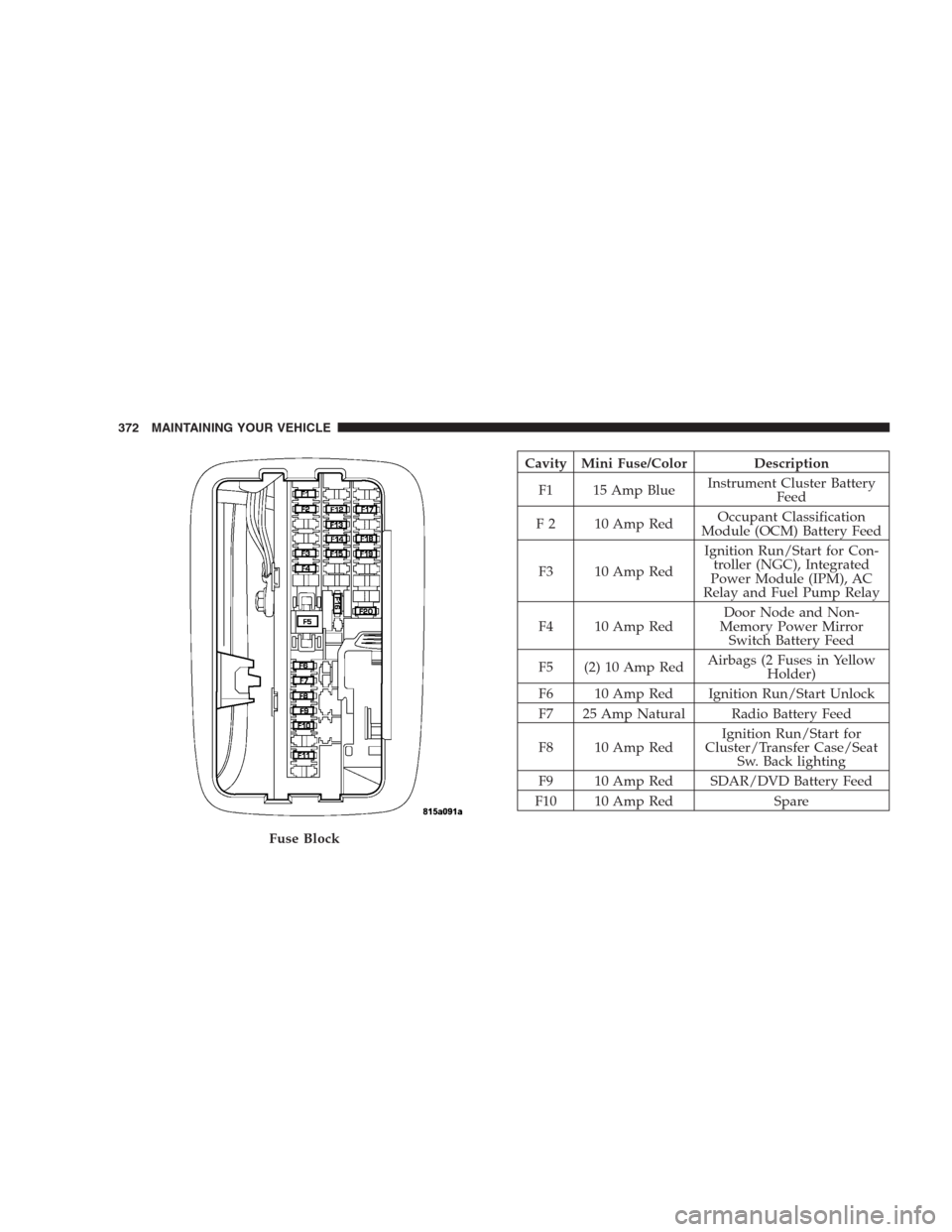
Cavity Mini Fuse/Color Description
F1 15 Amp BlueInstrument Cluster Battery
Feed
F 2 10 Amp RedOccupant Classification
Module (OCM) Battery Feed
F3 10 Amp RedIgnition Run/Start for Con-
troller (NGC), Integrated
Power Module (IPM), AC
Relay and Fuel Pump Relay
F4 10 Amp RedDoor Node and Non-
Memory Power Mirror
Switch Battery Feed
F5 (2) 10 Amp RedAirbags (2 Fuses in Yellow
Holder)
F6 10 Amp Red Ignition Run/Start Unlock
F7 25 Amp Natural Radio Battery Feed
F8 10 Amp RedIgnition Run/Start for
Cluster/Transfer Case/Seat
Sw. Back lighting
F9 10 Amp Red SDAR/DVD Battery Feed
F10 10 Amp Red Spare
Fuse Block
372 MAINTAINING YOUR VEHICLE
Page 420 of 440
ABS (Anti-Lock Brake System)............186,260
Adding Fuel........................287,316
Air Cleaner, Engine (Engine Air Cleaner Filter) . . . 346
Air Conditioner Maintenance............223,349
Air Conditioning........................ 222
Air Conditioning, Operating Tips............ 234
Air Conditioning, Rear Zone................ 226
Air Conditioning Refrigerant.............349,350
Air Conditioning System................222,349
Air Filter.............................. 346
Air Pressure, Tires....................274,282
Airbag.............................48,191
Airbag Light............................ 61
Alarm, Panic............................ 23
Alarm (Security Alarm).................26,185
Alignment and Balance................... 281
Antenna, Satellite Radio................... 219
Antifreeze (Engine Coolant)...........356,357,385
Anti-Lock Brake System (ABS)............146,260Anti-Lock Warning Light.................. 186
Anti-Theft System.....................26,185
Appearance Care........................ 366
Arming Theft System (Security Alarm)......... 27
Automatic Dimming Mirror...............84,88
Automatic Door Locks..................... 17
Automatic Headlights.................... 133
Automatic Transaxle...................... 245
Automatic Transmission.............242,245,362
Adding Fluid......................... 362
Fluid and Filter Changes................. 363
Fluid Level Check...................... 362
Fluid Type........................363,387
Gear Ranges.......................... 245
Special Additives...................... 364
Torque Converter...................... 249
Axle Fluid............................. 387
Axle Lubrication (Axle Fluid)............... 365
420 INDEX