engine DODGE DURANGO 2006 2.G Repair Manual
[x] Cancel search | Manufacturer: DODGE, Model Year: 2006, Model line: DURANGO, Model: DODGE DURANGO 2006 2.GPages: 440, PDF Size: 6.63 MB
Page 286 of 440
and durability for your vehicle. We recommend the use
of gasolines that meet the WWFC specifications if they
are available.
Reformulated Gasoline
Many areas of the country require the use of cleaner
burning gasoline referred to as “Reformulated Gasoline.”
Reformulated gasolines contain oxygenates, and are spe-
cifically blended to reduce vehicle emissions and im-
prove air quality.
We strongly support the use of reformulated gasolines.
Properly blended reformulated gasolines will provide
excellent performance and durability for the engine and
fuel system components.
Gasoline/Oxygenate Blends
Some fuel suppliers blend unleaded gasoline with oxy-
genates such as 10% ethanol, MTBE and ETBE. Oxygen-
ates are required in some areas of the country during the
winter months to reduce carbon monoxide emissions.
Fuels blended with these oxygenates may be used in
your vehicle.
CAUTION!
DO NOT use gasolines containing METHANOL.
Gasoline containing methanol may damage critical
fuel system components.
286 STARTING AND OPERATING
Page 289 of 440
CAUTION!
Damage to the fuel system or emission control
system could result from using an improper fuel
tank filler tube cap (gas cap). A poorly fitting cap
could let impurities into the fuel system.
WARNING!
•Never allow any lit smoking materials near the
vehicles while removing the cap or filling the
tank.
•Never add fuel to the vehicle when the engine is
running.
Fuel System Cautions
CAUTION!
Follow these guidelines to maintain your vehicle’s performance:
•The use of leaded gas is prohibited by Federal law. Using
leaded gasoline can impair engine performance, damage the
emission control system.
•An out-of-tune engine, or certain fuel or ignition malfunc-
tions, can cause the catalytic converter to overheat. If you
notice a pungent burning odor or some light smoke, your
engine may be out of tune or malfunctioning and may
require immediate service. Contact your dealer for service
assistance.
•When pulling a heavy load or driving a fully loaded vehicle
when the humidity is low and the temperature is high, use a
premium unleaded fuel to help prevent spark knock. If spark
knock persists, lighten the load, or engine piston damage
may result.
•The use of fuel additives which are now being sold as octane
enhancers is not recommended. Many of these products contain
high concentrations of methanol. Fuel system damage or vehicle
performance problems resulting from the use of such fuels or
additives is not the responsibility of the manufacturer.
STARTING AND OPERATING 289
5
Page 290 of 440
NOTE:Intentional tampering with emissions control
systems can result in civil penalties being assessed
against you.Carbon Monoxide Warnings
WARNING!
Carbon monoxide (CO) in exhaust gases is deadly. Follow the
precautions below to prevent carbon monoxide poisoning:
•Do not inhale exhaust gases. They contain carbon mon-
oxide, a colorless and odorless gas which can kill. Never
run the engine in a closed area, such as a garage, and
never sit in a parked vehicle with the engine running
for an extended period. If the vehicle is stopped in an
open area with the engine running for more than a short
period, adjust the ventilation system to force fresh,
outside air into the vehicle.
•Guard against carbon monoxide with proper mainte-
nance. Have the exhaust system inspected every time
the vehicle is raised. Have any abnormal conditions
repaired promptly. Until repaired, drive with all side
windows fully open.
•Keep the liftgate closed when driving your vehicle to
prevent carbon monoxide and other poisonous exhaust
gases from entering the vehicle.
290 STARTING AND OPERATING
Page 291 of 440
CATALYTIC CONVERTER
The catalytic converter requires the use of unleaded fuel
only. Leaded gasoline will destroy the effectiveness of the
catalyst as an emission control device. Under normal
operating conditions, the catalytic converter will not
require maintenance. However, you must keep the en-
gine maintained to assure proper operation and prevent
possible damage.
NOTE:Intentional tampering with emissions control
systems can result in civil penalties being assessed
against you.CAUTION!
Damage to the catalytic converter can result if your
vehicle is not kept in proper operating condition. In
the event of engine malfunction, particularly involv-
ing engine misfire or other apparent loss of perfor-
mance, have your vehicle serviced promptly. Contin-
ued operation of your vehicle with a severe
malfunction could cause the converter to overheat,
resulting in possible damage to the converter and
vehicle.
As with any vehicle, do not park or operate this vehicle in
areas where combustible materials such as grass or leaves
can come in contact with a hot exhaust system.
A scorching odor may be detected if you continue to run
a malfunctioning engine. The odor may indicate severe
and abnormal catalyst overheating. If this occurs, the
STARTING AND OPERATING 291
5
Page 292 of 440
vehicle should be stopped, the engine shut off and the
vehicle allowed to cool. Service, including a tune-up to
manufacturer’s specifications should be obtained imme-
diately.
To minimize the possibility of catalyst damage:
•Do not shut off the engine or interrupt the ignition
when the transmission is in gear and the vehicle is in
motion.
•Do not try to start engine by pushing or towing the
vehicle.
•Do not idle the engine with any spark plug wires
disconnected or removed, such as when diagnostic
testing, or for prolonged periods during very rough
idling or malfunctioning operating conditions.
VEHICLE LOADING
Certification Label
As required by National Highway Traffic Safety Admin-
istration Regulations, your vehicle has a certification
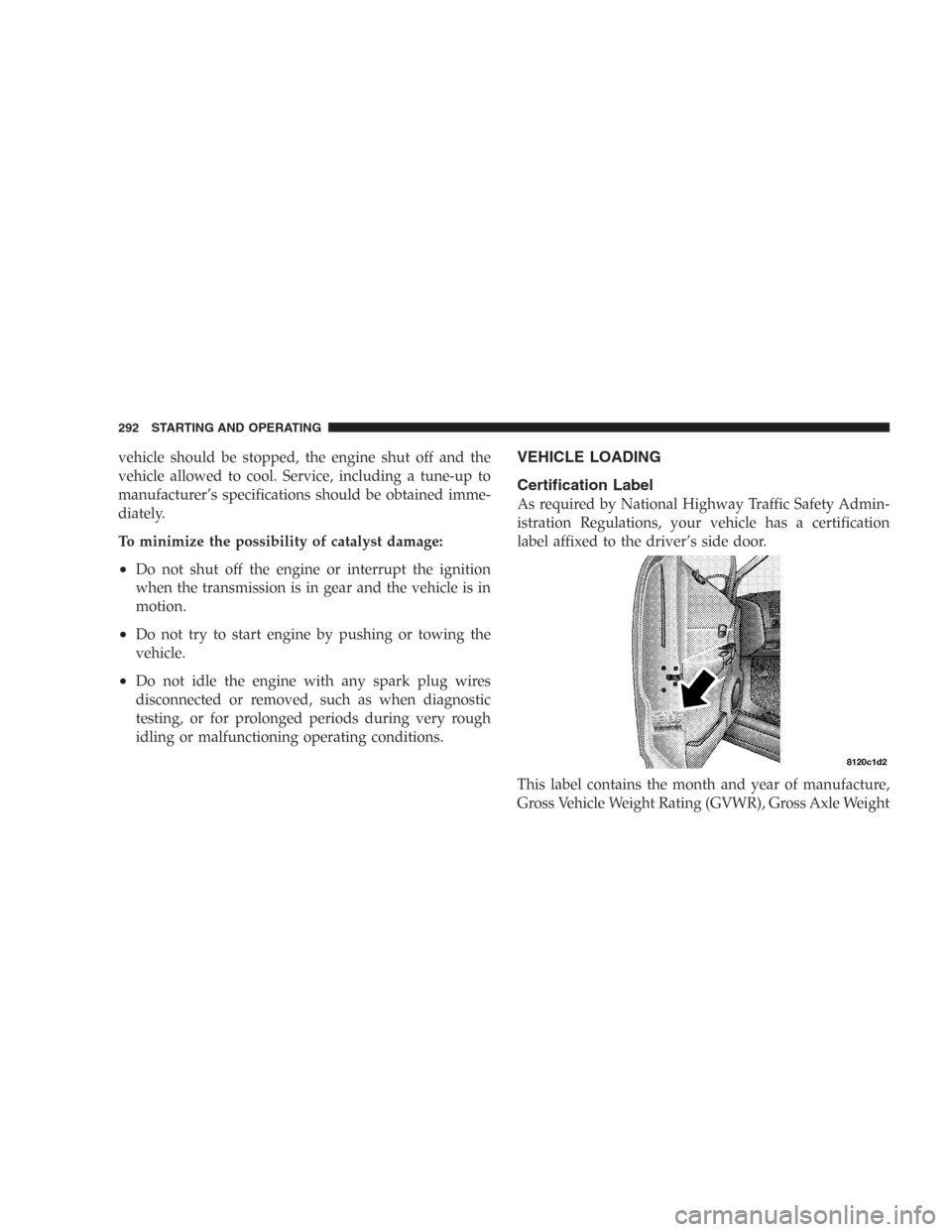
label affixed to the driver’s side door.
This label contains the month and year of manufacture,
Gross Vehicle Weight Rating (GVWR), Gross Axle Weight
292 STARTING AND OPERATING
Page 301 of 440
CAUTION!
•Avoid towing a trailer for the first 500 miles (805
km) of vehicle operation. Doing so may damage
your vehicle.
•During the first 500 miles (805 km) of trailer
towing, limit your speed to 50 mph (80 km/h).
Perform the maintenance listed in Section 8 of this
manual. When towing a trailer, never exceed the GAWR,
or GCWR, ratings.
WARNING!
Improper towing can lead to an injury accident.
Follow these guidelines to make your trailer towing
as safe as possible:
Make certain that the load is secured in the trailer
and will not shift during travel. When trailering
cargo that is not fully secured, dynamic load shifts
can occur that may be difficult for the driver to
control. You could lose control of your vehicle and
have an accident.
•When hauling cargo or towing a trailer, do not over-
load your vehicle or trailer. Overloading can cause a
loss of control, poor performance or damage to brakes,
axle, engine, transmission, steering, suspension, chas-
sis structure or tires.
STARTING AND OPERATING 301
5
Page 305 of 440
Towing Tips
Before setting out on a trip, practice turning, stopping
and backing the trailer in an area away from heavy
traffic.If using a manual transmission vehicle for trailer towing,
all starts must be in FIRST gear to avoid excessive clutch
slippage.
Towing Tips — Automatic Transmission
The “D” range can be selected when towing. However, if
frequent shifting occurs while in this range, the “TOW
HAUL” or “OD/OFF” range should be selected.
NOTE:Using the “TOW HAUL” or “OD/OFF” range
while operating the vehicle under heavy operating con-
ditions will improve performance and extend transmis-
sion life by reducing excessive shifting and heat build up.
This action will also provide better engine braking.
The automatic transmission fluid and filter should be
changed if you REGULARLY tow a trailer for more than
45 minutes of continuous operation. See Schedule “B” in
section 8 of this manual for transmission fluid change
intervals.
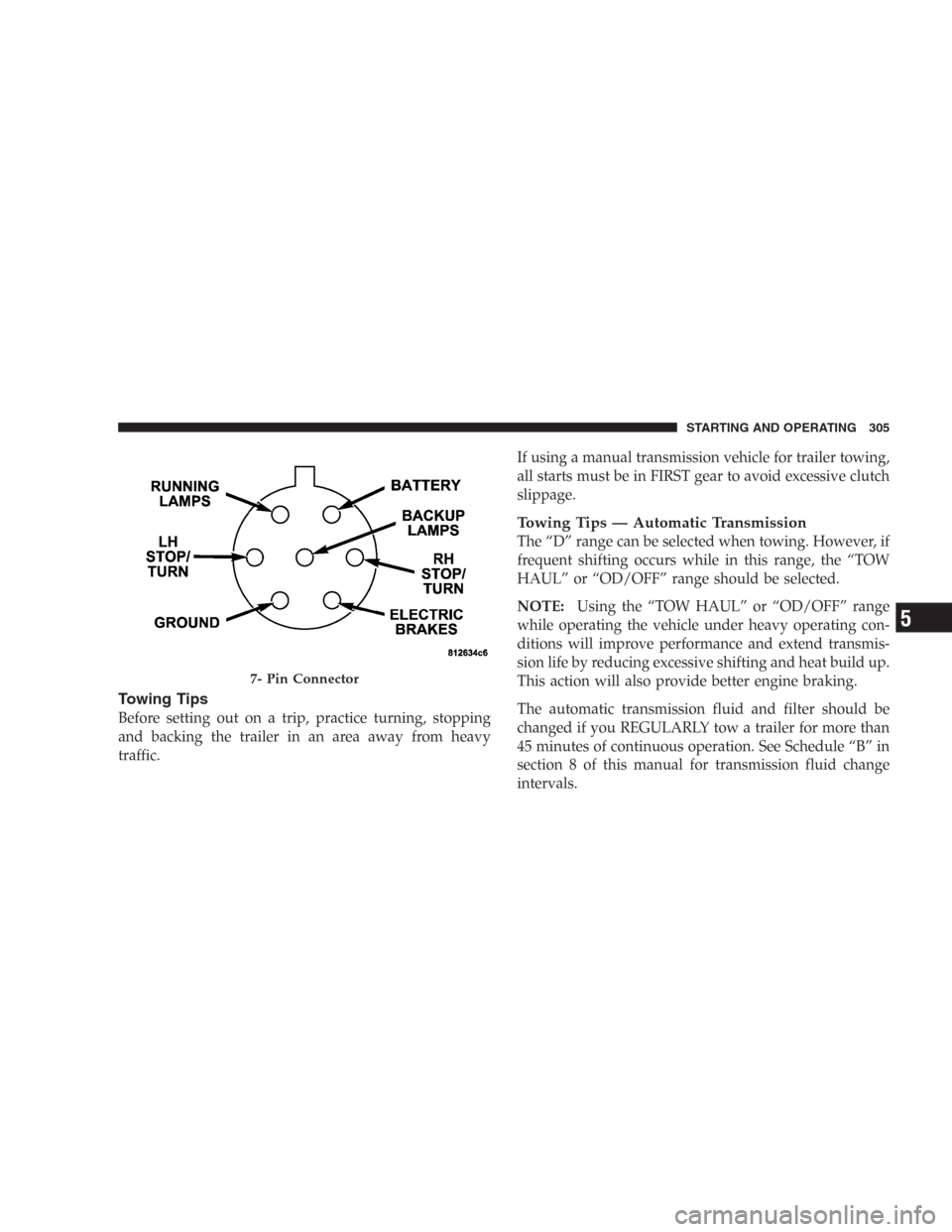
7- Pin Connector
STARTING AND OPERATING 305
5
Page 306 of 440
NOTE:Check the automatic transmission fluid level
before towing.
Towing Tips — Tow/Haul (If Equipped)
To reduce potential for automatic transmission overheat-
ing, turn the “TOW HAUL OD/OFF” feature ON when
driving in hilly areas or shift the transmission to Drive
position 2 on more severe grades.
Towing Tips — Electronic Speed Control (If
Equipped)
Don’t use in hilly terrain or with heavy loads.
When using the speed control, if you experience speed
drops greater than 10 mph (16 km/h), disengage until
you can get back to cruising speed.
Use speed control in flat terrain and with light loads to
maximize fuel efficiency.
Towing Tips — Cooling System
To reduce potential for engine and transmission over-
heating, take the following actions:
City Driving
When stopped for short periods of time, put transmission
in neutral and increase engine idle speed.
Highway Driving
Reduce speed.
Air Conditioning
Turn off temporarily.
refer to Cooling System Operating information in the
Maintenance section of this manual for more informa-
tion.
306 STARTING AND OPERATING
Page 310 of 440
2. Shut engine OFF.
3. Turn the ignition key to the ON position without
starting the engine.
4. Depress brake pedal.
5. Shift automatic transmission to Neutral (N).
6. Using the point of a ballpoint pen or similar object,
depress the recessed transfer case Neutral (N) button for
4 seconds.
7. After shift is completed and the Neutral (N) light
comes on release Neutral (N) button.
8. Start engine.
9. Shift automatic transmission into Reverse (R).
10. Release brake pedal for five seconds and ensure that
there is no vehicle movement.11. Repeat steps 9 and 10 with the transmission in Drive
(D).
12. Turn ignition key to the unlocked OFF position.
13. Shift automatic transmission into Park (P).
14. Attach vehicle to tow vehicle with tow bar.
NOTE:Items 1 through 5 are requirements that must be
met prior to depressing the Neutral (N) selection button,
and must continue to be met until the 4 seconds elaspes
and the shift has been completed.
If any of these requirements (with the exception of3-Key
ON) are not met prior to depressing the Neutral (N)
button or are no longer met during the 4 second timer,
then the Neutral (N) indicator light will flash continu-
ously until all requirements are met or until the Neutral
(N) button is released.
310 STARTING AND OPERATING
Page 311 of 440
NOTE:The ignition key must be ON for a shift to take
place and for the position indicator lights to be operable.
If the key is not ON, the shift will not take place and no
position indicator lights will be on or flashing.
CAUTION!
Damage to the transmission may occur if the trans-
mission is shifted into Park (P) with the transfer case
in Neutral (N) and the engine RUNNING. With the
transfer case in Neutral (N) ensure that the engine is
OFF prior to shifting the transmission into Park (P)
Shifting OUT of Neutral (N)
Use the following procedure to prepare your vehicle for
normal usage.
1. Bring vehicle to a complete stop.
2. Shut engine OFF.3. Turn the ignition key to the ON position without
starting the engine.
4. Depress brake pedal.
5. Shift automatic transmission to Neutral (N).
6. Using the point of a ballpoint pen or similar object,
depress the recessed transfer case Neutral (N) button for
1 second.
7. After the Neutral (N) indicator light turns off release
the Neutral (N) button.
8. After the Neutral (N) button has been released the
transfer case will shift to the position identified by the
selector switch.
9. Shift automatic transmission into Park (P).
10. Start the engine.
11. Shift automatic transmission into Drive (D).
STARTING AND OPERATING 311
5