climate control DODGE DURANGO 2013 3.G User Guide
[x] Cancel search | Manufacturer: DODGE, Model Year: 2013, Model line: DURANGO, Model: DODGE DURANGO 2013 3.GPages: 699, PDF Size: 5.53 MB
Page 427 of 699
9. Passenger Temperature Control Down Button
Provides the passenger with independent temperature
control. Push the button for cooler temperature settings.
10. Auto Temperature Control Button
Controls airflow temperature, distribution, volume, and
the amount of air recirculation automatically. Press and
release to select. Refer to “Automatic Operation” for
more information. Performing this function will cause
the ATC to switch between manual mode and automatic
modes.
11. Blower Control
There are seven blower speeds, the blower speed in-
creases as you move the control to the right from the
lowest blower setting. Performing this function will
cause the ATC to switch into manual mode.12. Climate Control OFF Button
Press and release to turn the Climate Control OFF.
13. Mode Control Button
Press and release to select between Modes (Panel, Bi-
Level, Floor, Mix). Performing this function will cause the
ATC to switch into manual mode.
14. SYNC Button
Press and release to control the temperature setting for
both zones from the driver temperature control.
15. Driver Temperature Control Down Button
Provides the driver with independent temperature con-
trol. Push the button for cooler temperature settings.
16. Driver Temperature Control Up Button
Provides the driver with independent temperature con-
trol. Push the button for warmer temperature settings.
4
UNDERSTANDING YOUR INSTRUMENT PANEL 425
Page 428 of 699
17. Rear Control Button
Provides the rear seat occupants with independent
blower and temperature control. Push the button to
activate the rear climate control and allow the rear seat
occupants control of the rear blower and temperature
settings.
Automatic Operation
1. Press the AUTO button on the Automatic TemperatureControl (ATC) Panel.
2. Next, adjust the temperature you would like the system to maintain by adjusting the driver and front
passenger temperature control buttons. Once the de-
sired temperature is displayed, the system will
achieve and automatically maintain that comfort level. 3. When the system is set up for your comfort level, it is
not necessary to change the settings. You will experi-
ence the greatest efficiency by simply allowing the
system to function automatically.
NOTE:
• It is not necessary to move the temperature settings for
cold or hot vehicles. The system automatically adjusts
the temperature, mode and fan speed to provide
comfort as quickly as possible.
• The temperature can be displayed in U.S. or Metric
units by selecting the US/M customer-programmable
feature. Refer to the “Electronic Vehicle Information
Center (EVIC) — Customer-Programmable Features
(SETUP)” in this section of the manual.
To provide you with maximum comfort in the Automatic
mode, during cold start-ups, the blower fan will remain
426 UNDERSTANDING YOUR INSTRUMENT PANEL
Page 432 of 699
Rear Climate Control — If Equipped
The Rear Climate Control system has floor air outlets,
and overhead outlets at each outboard rear seating
position. The unit provides warm or cool air through the
floor and upper outlets.
The rear blower and temperature controls for the rear
seat passengers are located in the headliner, near the
center of the vehicle.
If the rear system is off, changing the rear setting to a
position other than off will turn the rear system on. If
both the front and rear systems are off, the rear system
will not turn on. The rear system will not operate with
the front system off.
Rear Blower Control
The primary control for the rear blower is on the front
climate control unit, located on the instrument panel.
Rear Manual Climate Controls
1 – Rear Blower3 – Rear Temperature
2 – Rear Climate Control Icon
430 UNDERSTANDING YOUR INSTRUMENT PANEL
Page 433 of 699
Only when the Rear Control Icon is illuminated do the
second row seat occupants have control of the rear
blower speed.
The rear blower control, located in the rear overhead
console, has an off position and a range of blower speeds.
This allows the second row seat occupants to control the
volume of air circulated in the rear of the vehicle.
CAUTION!
Interior air enters the Rear Manual Climate Control
system through an intake grille, located in the right
side trim panel behind the third row seats. The
heater outlets are located in the right side trim panel,
just behind the sliding door. Do not block or place
objects directly in front of the inlet grille or heater
outlets. The electrical system could overload, causing
damage to the blower motor.
Rear Temperature Control
Only when the Rear Control Icon is illuminated do the
second row seat occupants have control of the rear
temperature control knob.
To change the temperature in the rear of the vehicle,
rotate the temperature control knob counterclockwise for
cold air, and clockwise for heated air.
Rear Mode Control
Headliner ModeAir comes from the outlets in the headliner. Each
of these outlets can be individually adjusted to
direct the flow of air. Moving the air vanes of the outlets
to one side will shut off the airflow.
Bi-Level Mode
Air comes from both the headliner outlets and the
floor outlets.
4
UNDERSTANDING YOUR INSTRUMENT PANEL 431
Page 576 of 699
HAZARD WARNING FLASHERS
The Hazard Warning flasher switch is located on the
switch bank just above the climate controls.Press the switch to turn on the Hazard Warning
flasher. When the switch is activated, all direc-
tional turn signals will flash on and off to warn oncoming
traffic of an emergency. Press the switch a second time to
turn off the Hazard Warning flashers.
This is an emergency warning system and it should not
be used when the vehicle is in motion. Use it when your
vehicle is disabled and it is creating a safety hazard for
other motorists.
When you must leave the vehicle to seek assistance, the
Hazard Warning flashers will continue to operate even
though the ignition is placed in the OFF position.
NOTE: With extended use the Hazard Warning flashers
may wear down your battery.
IF YOUR ENGINE OVERHEATS
In any of the following situations, you can reduce the
potential for overheating by taking the appropriate ac-
tion.
• On the highways — slow down.
• In city traffic — while stopped, place the transmission
in NEUTRAL, but do not increase the engine idle
speed.
NOTE: There are steps that you can take to slow down
an impending overheat condition:
• If your air conditioner (A/C) is on, turn it off. The A/C
system adds heat to the engine cooling system and
turning the A/C off can help remove this heat.
574 WHAT TO DO IN EMERGENCIES
Page 649 of 699
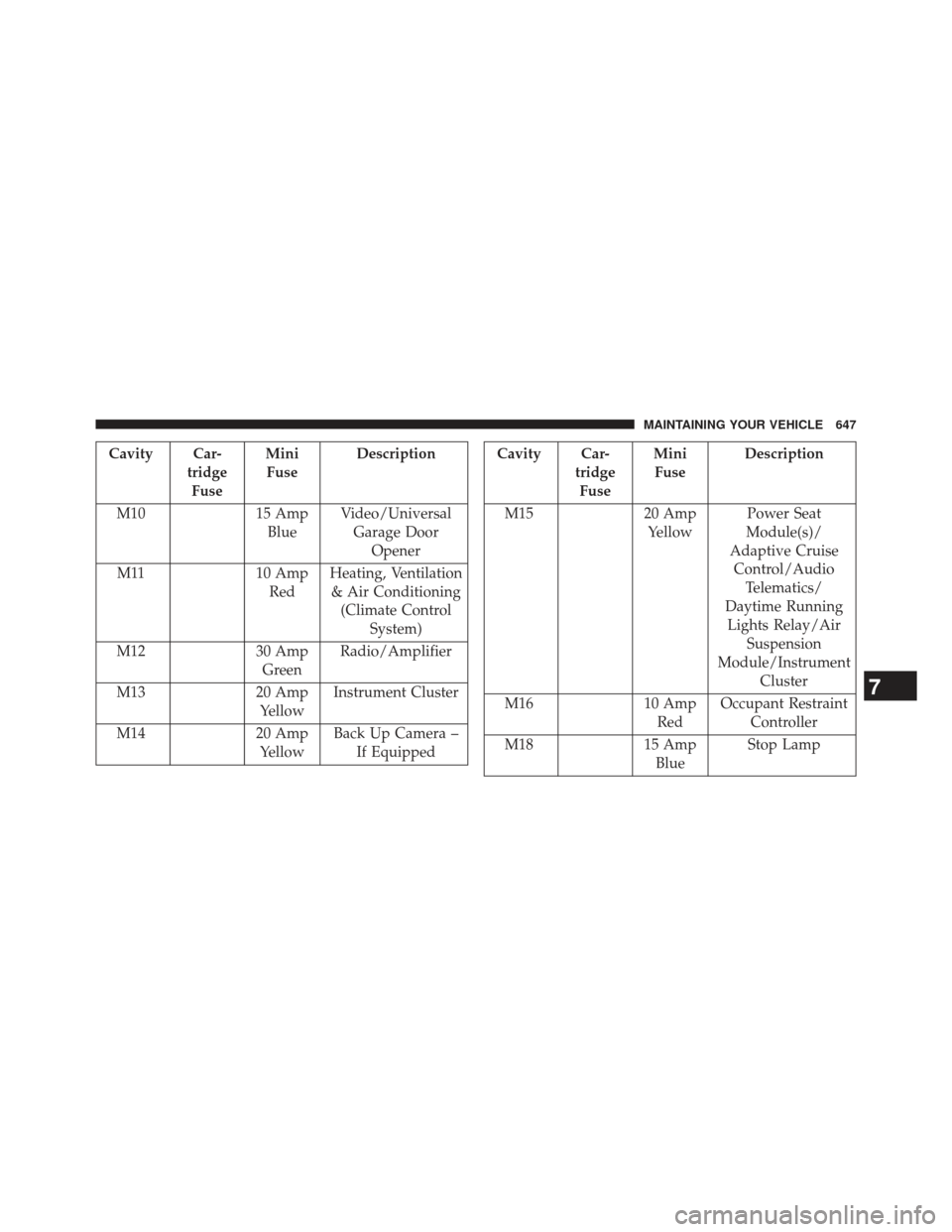
Cavity Car-tridgeFuse Mini
Fuse Description
M10 15 Amp
Blue Video/Universal
Garage Door Opener
M11 10 Amp
Red Heating, Ventilation
& Air Conditioning (Climate Control System)
M12 30 Amp
Green Radio/Amplifier
M13 20 Amp
Yellow Instrument Cluster
M14 20 Amp
Yellow Back Up Camera –
If EquippedCavity Car- tridgeFuse Mini
Fuse Description
M15 20 Amp
Yellow Power Seat
Module(s)/
Adaptive Cruise Control/Audio Telematics/
Daytime Running Lights Relay/Air Suspension
Module/Instrument Cluster
M16 10 Amp
Red Occupant Restraint
Controller
M18 15 Amp
Blue Stop Lamp
7
MAINTAINING YOUR VEHICLE 647
Page 651 of 699
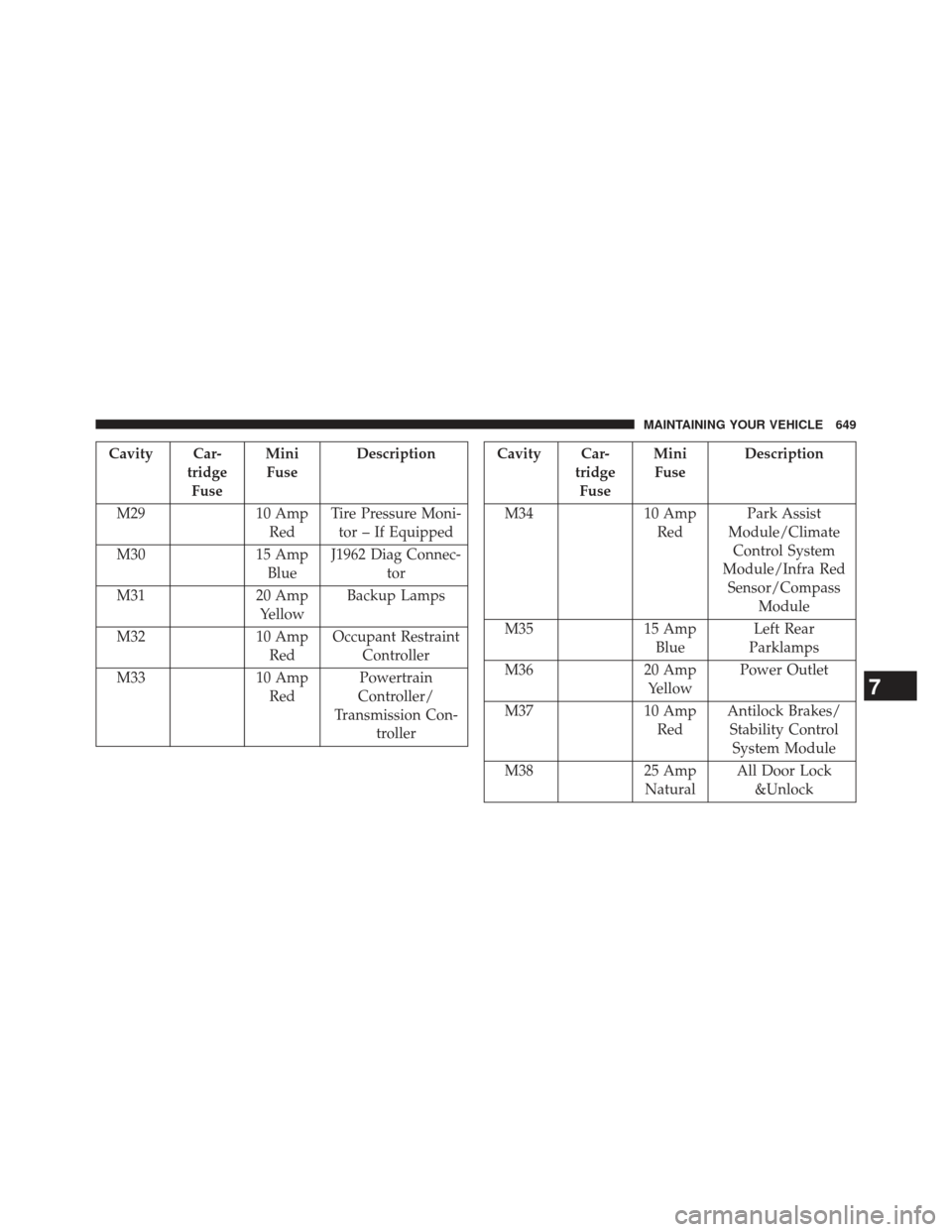
Cavity Car-tridgeFuse Mini
Fuse Description
M29 10 Amp
Red Tire Pressure Moni-
tor – If Equipped
M30 15 Amp
Blue J1962 Diag Connec-
tor
M31 20 Amp
Yellow Backup Lamps
M32 10 Amp
Red Occupant Restraint
Controller
M33 10 Amp
Red Powertrain
Controller/
Transmission Con- trollerCavity Car- tridgeFuse Mini
Fuse Description
M34 10 Amp
Red Park Assist
Module/Climate Control System
Module/Infra Red Sensor/Compass Module
M35 15 Amp
Blue Left Rear
Parklamps
M36 20 Amp
Yellow Power Outlet
M37 10 Amp
Red Antilock Brakes/
Stability Control System Module
M38 25 Amp
Natural All Door Lock
&Unlock
7
MAINTAINING YOUR VEHICLE 649
Page 677 of 699
Call toll free at:
•1–800–890–4038 (U.S.)
• 1–800–387–1143 (Canada)
Or
Visit us on the Worldwide Web at:
• www.techauthority.com
DEPARTMENT OF TRANSPORTATION UNIFORM
TIRE QUALITY GRADES
The following tire grading categories were established by
the National Highway Traffic Safety Administration. The
specific grade rating assigned by the tire’s manufacturer
in each category is shown on the sidewall of the tires on
your vehicle.
All passenger car tires must conform to Federal safety
requirements in addition to these grades.
Treadwear
The Treadwear grade is a comparative rating, based on
the wear rate of the tire when tested under controlled
conditions on a specified government test course. For
example, a tire graded 150 would wear one and one-half
times as well on the government course as a tire graded
100. The relative performance of tires depends upon the
actual conditions of their use, however, and may depart
significantly from the norm due to variations in driving
habits, service practices, and differences in road charac-
teristics and climate.
9
IF YOU NEED CONSUMER ASSISTANCE 675
Page 682 of 699
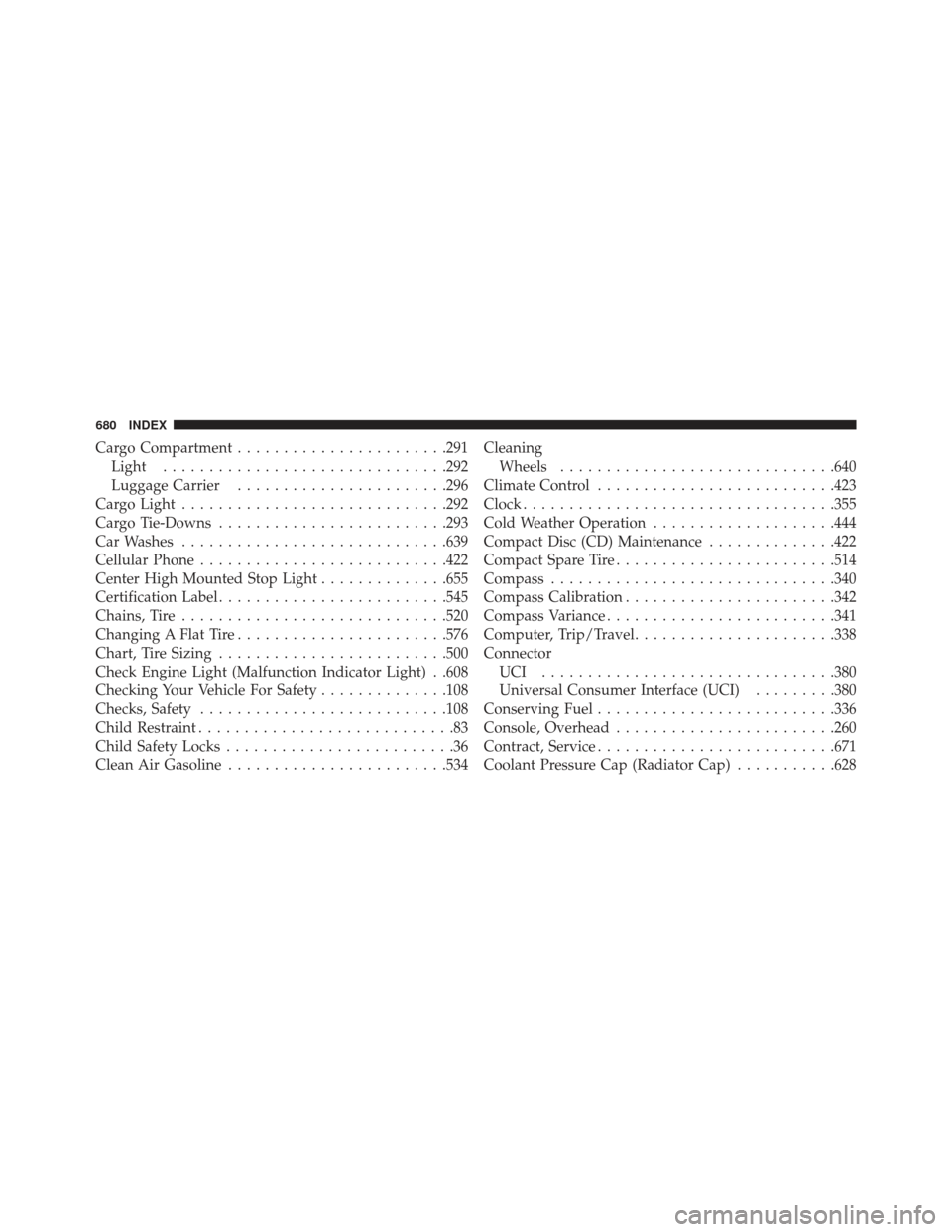
Cargo Compartment...................... .291
Light .............................. .292
Luggage Carrier ...................... .296
Cargo Light ............................ .292
Cargo Tie-Downs ........................ .293
Car Washes ............................ .639
Cellular Phone .......................... .422
Center High Mounted Stop Light ..............655
Certification Label ........................ .545
Chains, Tire ............................ .520
Changing A Flat Tire ...................... .576
Chart, Tire Sizing ........................ .500
Check Engine Light (Malfunction Indicator Light) . .608
Checking Your Vehicle For Safety ..............108
Checks, Safety .......................... .108
Child Restraint ............................83
Child Safety Locks .........................36
Clean Air Gasoline ....................... .534Cleaning
Wheels ............................. .640
Climate Control ......................... .423
Clock ................................. .355
Cold Weather Operation ....................444
Compact Disc (CD) Maintenance ..............422
Compact Spare Tire ....................... .514
Compass .............................. .340
Compass Calibration ...................... .342
Compass Variance ........................ .341
Computer, Trip/Travel ..................... .338
Connector UCI ............................... .380
Universal Consumer Interface (UCI) .........380
Conserving Fuel ......................... .336
Console, Overhead ....................... .260
Contract, Service ......................... .671
Coolant Pressure Cap (Radiator Cap) ...........628
680 INDEX