No power DODGE DURANGO 2015 3.G User Guide
[x] Cancel search | Manufacturer: DODGE, Model Year: 2015, Model line: DURANGO, Model: DODGE DURANGO 2015 3.GPages: 689, PDF Size: 20.05 MB
Page 39 of 689
If one of the vehicle doors is open, and the door panel
switch is used to lock the vehicle, once all open doors
have been closed, the vehicle checks the inside and
outside of the vehicle for any valid Passive Entry RKE
transmitters. If one of the vehicle’s Passive Entry RKE
transmitters is detected inside the vehicle, and no other
valid Passive Entry RKE transmitters are detected out-
side the vehicle, the Passive Entry System automatically
unlocks all vehicle doors and chirps the horn three times
(on the third attempt, ALL doors will lock, and the
Passive Entry RKE transmitter can be locked in the
vehicle).
To Unlock/Enter The Liftgate
The liftgate passive entry unlock feature is built into the
electronic liftgate handle. With a valid Passive Entry RKE
transmitter within 3 ft (1.0 m) of the liftgate, push the
electronic liftgate handle for a power open on vehicles
equipped with Power Liftgate. Push the electronic lift-
gate handle and lift for Manual Liftgate vehicles.
NOTE:If the vehicle is unlocked, the liftgate will open
with the handle and no RKE Transmitter is required.
2
THINGS TO KNOW BEFORE STARTING YOUR VEHICLE 37
Page 42 of 689
NOTE:
•After pushing the door handle button, you must wait
two seconds before you can lock or unlock the doors,
using either Passive Entry door handle. This is done to
allow you to check if the vehicle is locked by pulling
the door handle, without the vehicle reacting and
unlocking.
•The Passive Entry system will not operate if the RKE
transmitter battery is dead.
The vehicle doors can also be locked by using the RKE
transmitter lock button or the lock button located on the
vehicle’s interior door panel.
WINDOWS
Power Windows
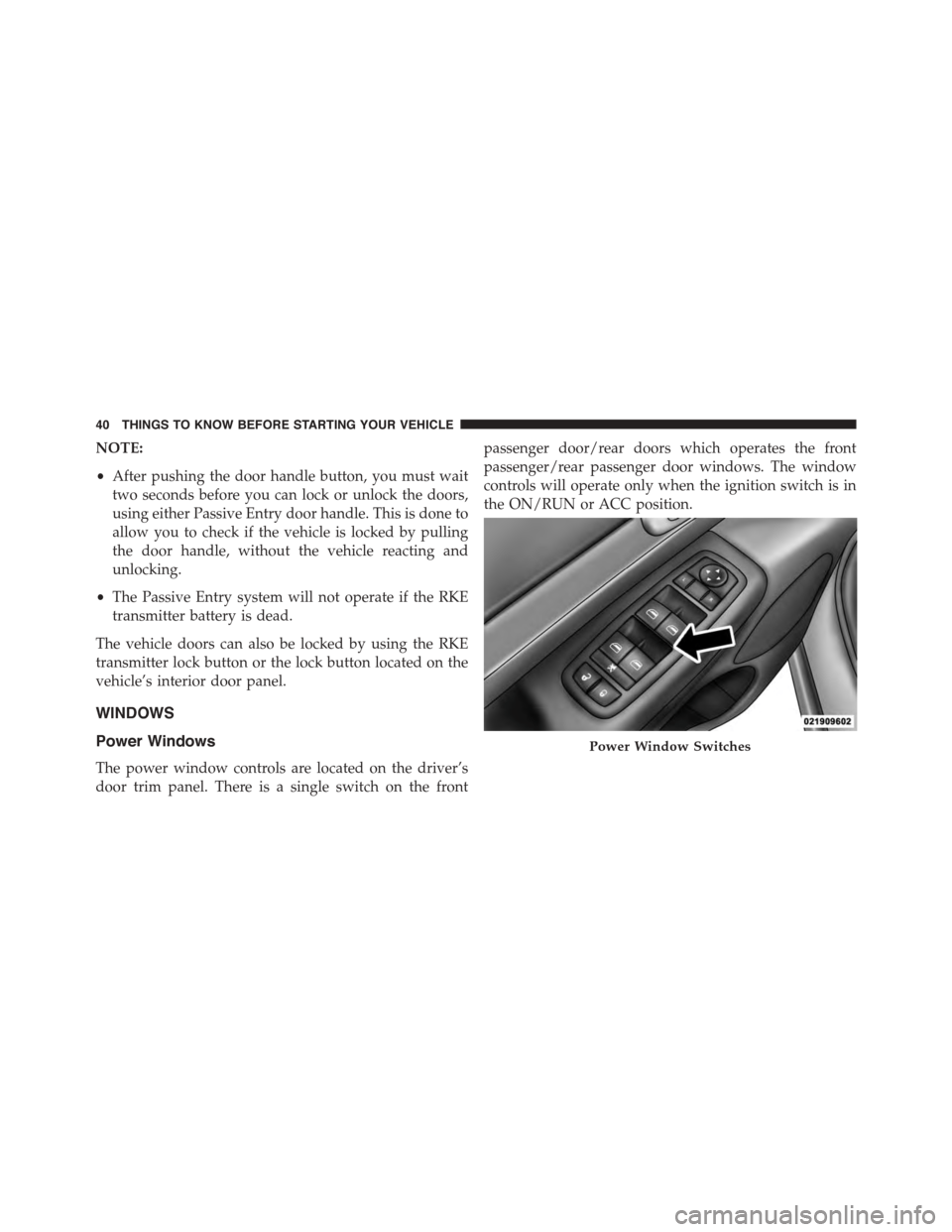
The power window controls are located on the driver’s
door trim panel. There is a single switch on the front
passenger door/rear doors which operates the front
passenger/rear passenger door windows. The window
controls will operate only when the ignition switch is in
the ON/RUN or ACC position.
Power Window Switches
40 THINGS TO KNOW BEFORE STARTING YOUR VEHICLE
Page 43 of 689
The power window switches remain active for up to 10
minutes after the ignition switch has been turned OFF.
Opening a vehicle front door will cancel this feature.
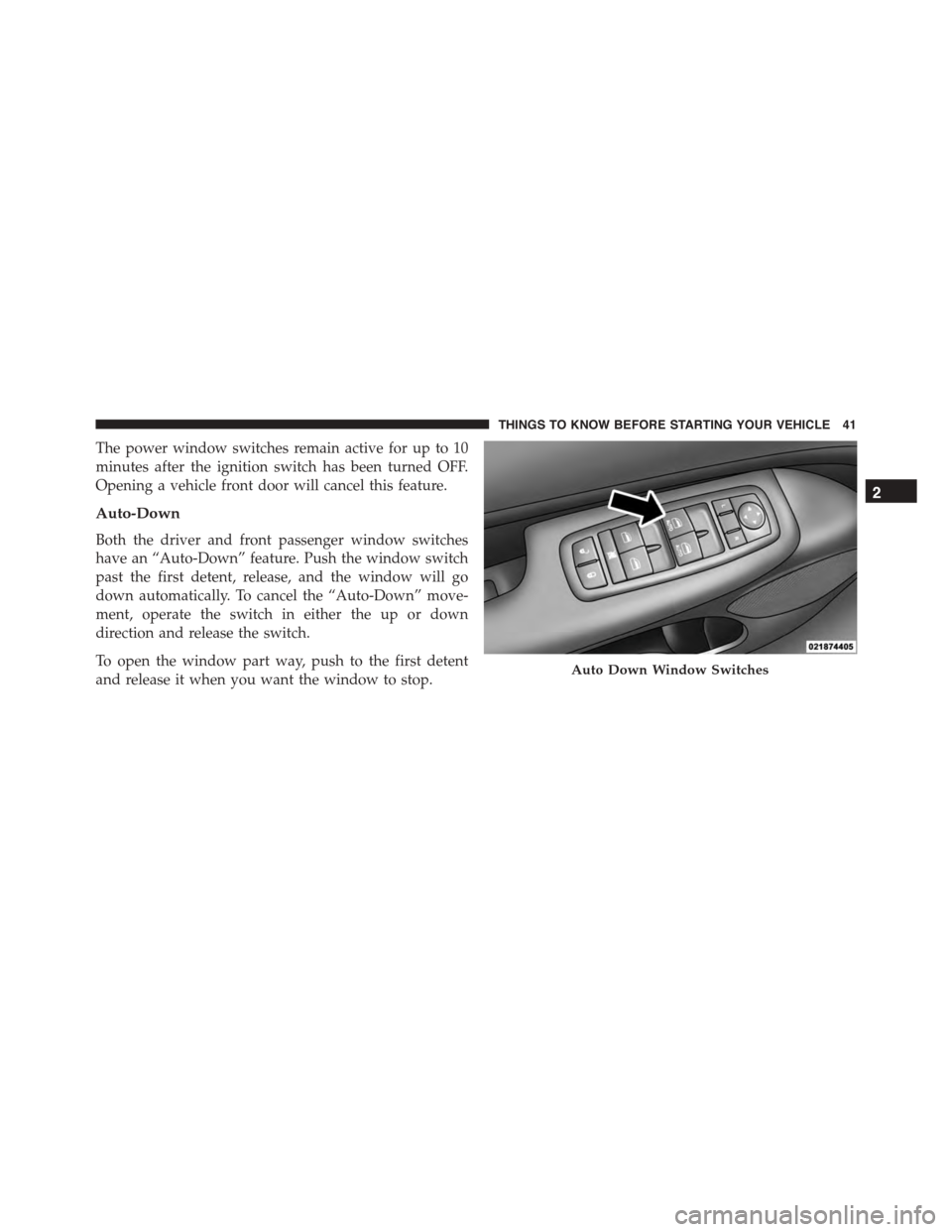
Auto-Down
Both the driver and front passenger window switches
have an “Auto-Down” feature. Push the window switch
past the first detent, release, and the window will go
down automatically. To cancel the “Auto-Down” move-
ment, operate the switch in either the up or down
direction and release the switch.
To open the window part way, push to the first detent
and release it when you want the window to stop.Auto Down Window Switches
2
THINGS TO KNOW BEFORE STARTING YOUR VEHICLE 41
Page 48 of 689
WARNING!
Driving with the liftgate open can allow poisonous
exhaust gases into your vehicle. You and your pas-
sengers could be injured by these fumes. Keep the
liftgate closed when you are operating the vehicle.
Power Liftgate — If Equipped
The power liftgate may be opened by pushing
the electronic liftgate release located handle
(refer to “Keyless Enter-N-Go™” located in
“Things To Know Before Starting”) or by push-
ing the LIFTGATE button on the Remote Keyless Entry
(RKE) transmitter. Push the LIFTGATE button on the
RKE transmitter twice within five seconds to open the
power liftgate. Once the liftgate is open, pushing the
button twice within five seconds a second time will close
the liftgate.
The power liftgate may also be opened or closed by
pushing the LIFTGATE button located on the front
overhead console, or closed by pushing the LIFTGATE
button located on left rear trim panel, near the liftgate
opening. Pushing the LIFTGATE button located on left
rear trim panel once will close the liftgate only. This
button cannot be used to open the liftgate.
When the LIFTGATE button on the RKE transmitter is
pushed two times, the turn signals will flash twice to
signal that the liftgate is preparing open or close (if Flash
Lamps with Lock is enabled in the Uconnect® Settings)
and the liftgate chime (Selectable in Uconnect® Settings)
will be audible. For further information, refer to
#Uconnect® Settings#in#Understanding Your Instrument
Panel.”
46 THINGS TO KNOW BEFORE STARTING YOUR VEHICLE
Page 49 of 689
NOTE:
•In the event of a power malfunction to the liftgate, an
emergency liftgate latch release can be used to open
the liftgate. The emergency liftgate latch release can be
accessed through a snap-in cover located on the lift-
gate trim panel.
•If the liftgate is left open for an extended period of
time, the liftgate may need to be closed manually to
reset power liftgate functionality.
WARNING!
During power operation, personal injury or cargo
damage may occur. Ensure the liftgate travel path is
clear. Make sure the liftgate is closed and latched
before driving away.
NOTE:
•The power liftgate buttons will not operate if the
vehicle is in gear or the vehicle speed is above 0 MPH
(0 km/h).
•The power liftgate will not operate in temperatures
below−22°F (−30°C) or temperatures above 150°F
(65°C). Be sure to remove any buildup of snow or ice
from the liftgate before pushing any of the power
liftgate switches.
•If anything obstructs the power liftgate while it is
closing or opening, the liftgate will automatically
reverse to the closed or open position, provided it
meets sufficient resistance.
•There are also pinch sensors attached to the side of the
liftgate. Light pressure anywhere along these strips
will cause the liftgate to return to the open position.
2
THINGS TO KNOW BEFORE STARTING YOUR VEHICLE 47
Page 50 of 689
•The power liftgate must be in the full open position for
rear liftgate close button on the left rear trim, near the
liftgate opening, to operate. If the liftgate is not fully
open, push the Liftgate button on the Key Fob to fully
open the liftgate, and then push it again to close.
•If the liftgate handle switch is pushed while the power
liftgate is closing, the liftgate will reverse to the full
open position.
•If the liftgate handle switch is pushed while the power
liftgate is opening, the liftgate motor will disengage to
allow manual operation.
•If the power liftgate encounters multiple obstructions
within the same cycle, the system will automatically
stop and the liftgate must be opened or closed manu-
ally.
•If your liftgate is power closing and you put the
vehicle in gear, the liftgate will continue to power
close. However, vehicle movement may result in a
detection of an obstruction.
WARNING!
•Driving with the liftgate open can allow poisonous
exhaust gases into your vehicle. You and your
passengers could be injured by these fumes. Keep
the liftgate closed when you are operating the
vehicle.
•If you are required to drive with the liftgate open,
make sure that all windows are closed, and the
climate control blower switch is set at high speed.
Do not use the recirculation mode.
48 THINGS TO KNOW BEFORE STARTING YOUR VEHICLE
Page 79 of 689
continues, see your doctor. If these particles settle on
your clothing, follow the garment manufacturer ’s in-
structions for cleaning.
Do not drive your vehicle after the air bags have de-
ployed. If you are involved in another collision, the air
bags will not be in place to protect you.
WARNING!
Deployed air bags and seat belt pretensioners cannot
protect you in another collision. Have the air bags,
seat belt pretensioners, and the seat belt retractor
assemblies replaced by an authorized dealer imme-
diately. Also, have the Occupant Restraint Controller
System serviced as well.
NOTE:
•Air bag covers may not be obvious in the interior trim,
but they will open during air bag deployment.
•After any collision, the vehicle should be taken to an
authorized dealer immediately.
Enhanced Accident Response System
In the event of an impact, if the communication network
remains intact, and the power remains intact, depending
on the nature of the event, the ORC will determine
whether to have the Enhanced Accident Response Sys-
tem perform the following functions:
•Cut off fuel to the engine.
•Flash hazard lights as long as the battery has power or
until the ignition is placed in the “OFF” position.
•Turn on the interior lights, which remain on as long as
the battery has power or until the ignition is placed in
the “OFF” position.
•Unlock the doors automatically.
2
THINGS TO KNOW BEFORE STARTING YOUR VEHICLE 77
Page 80 of 689
System Reset Procedure
In order to reset the Enhanced Accident Response System
functions after an event, the ignition switch must be
changed from ignition START or ON/RUN to ignition
OFF.
Air Bag Warning Light
The air bags must be ready to inflate for your
protection in a collision. The Occupant Re-
straint Controller (ORC) monitors the internal
circuits and interconnecting wiring associated
with air bag system electrical components.
The ORC monitors the readiness of the electronic parts of
the air bag system whenever the ignition is in the START
or ON/RUN position. If the ignition is in the OFF
position or in the ACC position, the air bag system is not
on and the air bags will not inflate.
The ORC contains a backup power supply system that
may deploy the air bags even if the battery loses power or
it becomes disconnected prior to deployment.
The ORC turns on the Air Bag Warning Light in the
instrument panel for approximately four to eight seconds
for a self-check when the ignition is first placed in the
ON/RUN position. After the self-check, the Air Bag
Warning Light will turn off. If the ORC detects a mal-
function in any part of the system, it turns on the Air Bag
Warning Light, either momentarily or continuously. A
single chime will sound to alert you if the light comes on
again after initial startup.
The ORC also includes diagnostics that will illuminate
the instrument panel Air Bag Warning Light if a malfunc-
tion is detected that could affect the air bag system. The
diagnostics also record the nature of the malfunction.
While the air bag system is designed to be maintenance
78 THINGS TO KNOW BEFORE STARTING YOUR VEHICLE
Page 114 of 689
WARNING!(Continued)
•Always make sure that objects cannot fall into the
driver footwell while the vehicle is moving. Ob-
jects can become trapped under the brake pedal
and accelerator pedal causing a loss of vehicle
control.
•If required, mounting posts must be properly in-
stalled, if not equipped from the factory.
Failure to properly follow floor mat installation or
mounting can cause interference with the brake
pedal and accelerator pedal operation causing loss of
control of the vehicle.
Periodic Safety Checks You Should Make Outside
The Vehicle
Tires
Examine tires for excessive tread wear and uneven wear
patterns. Check for stones, nails, glass, or other objects
lodged in the tread or sidewall. Inspect the tread for cuts
and cracks. Inspect sidewalls for cuts, cracks, and bulges.
Check the wheel nuts for tightness. Check the tires
(including spare) for proper cold inflation pressure.
Lights
Have someone observe the operation of brake lights and
exterior lights while you work the controls. Check turn
signal and high beam indicator lights on the instrument
panel.
Door Latches
Check for proper closing, latching, and locking.
Fluid Leaks
Check area under vehicle after overnight parking for fuel,
engine coolant, oil, or other fluid leaks. Also, if gasoline
fumes are detected or if fuel, power steering fluid (if
equipped), or brake fluid leaks are suspected. The cause
should be located and corrected immediately.
11 2 T H I N G S TO K N O W B E F O R E S TA R T I N G Y O U R V E H I C L E
Page 115 of 689
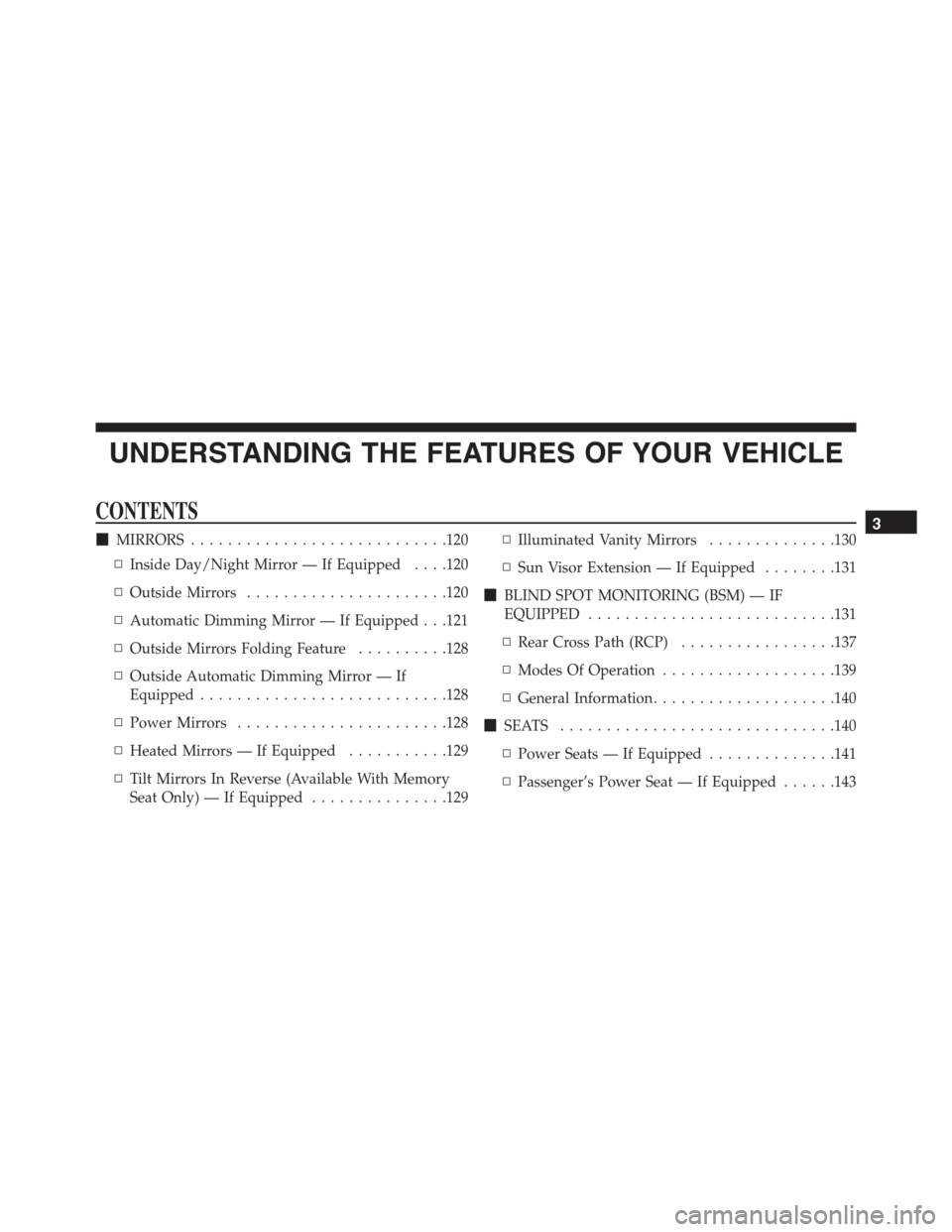
UNDERSTANDING THE FEATURES OF YOUR VEHICLE
CONTENTS
!MIRRORS............................120
▫Inside Day/Night Mirror — If Equipped . . . .120
▫Outside Mirrors......................120
▫Automatic Dimming Mirror — If Equipped . . .121
▫Outside Mirrors Folding Feature..........128
▫Outside Automatic Dimming Mirror — If
Equipped...........................128
▫Power Mirrors.......................128
▫Heated Mirrors — If Equipped...........129
▫Tilt Mirrors In Reverse (Available With Memory
Seat Only) — If Equipped...............129
▫Illuminated Vanity Mirrors..............130
▫Sun Visor Extension — If Equipped........131
!BLIND SPOT MONITORING (BSM) — IF
EQUIPPED...........................131
▫Rear Cross Path (RCP).................137
▫Modes Of Operation...................139
▫General Information....................140
!SEATS . . . . . . . . . . . . . . . . . . . . . . . . . . . . ..140
▫Power Seats — If Equipped..............141
▫Passenger’s Power Seat — If Equipped......143
3