alarm DODGE DURANGO 2015 3.G User Guide
[x] Cancel search | Manufacturer: DODGE, Model Year: 2015, Model line: DURANGO, Model: DODGE DURANGO 2015 3.GPages: 689, PDF Size: 20.05 MB
Page 72 of 689
On the other hand, depending on the type and location of
impact, Advanced Front Air Bags may deploy in crashes
with little vehicle front-end damage but that produce a
severe initial deceleration.
Because air bag sensors measure vehicle deceleration
over time, vehicle speed and damage by themselves are
not good indicators of whether or not an air bag should
have deployed.
Seat belts are necessary for your protection in all colli-
sions, and also are needed to help keep you in position,
away from an inflating air bag.
When the ORC detects a collision requiring the Ad-
vanced Front Air Bags, it signals the inflator units. A large
quantity of non-toxic gas is generated to inflate the
Advanced Front Air Bags.
The steering wheel hub trim cover and the upper right
side of the instrument panel separate and fold out of the
way as the air bags inflate to their full size. The Advanced
Front Air Bags fully inflate in less time than it takes to
blink your eyes. The air bags then quickly deflate while
helping to restrain the driver and front passenger.
Knee Impact Bolsters
The Knee Impact Bolsters help protect the knees of the
driver and front passenger, and position the front occu-
pants for improved interaction with the Advanced Front
Air Bags.
WARNING!
•Do not drill, cut, or tamper with the knee impact
bolsters in any way.
•Do not mount any accessories to the knee impact
bolsters such as alarm lights, stereos, citizen band
radios, etc.
70 THINGS TO KNOW BEFORE STARTING YOUR VEHICLE
Page 140 of 689
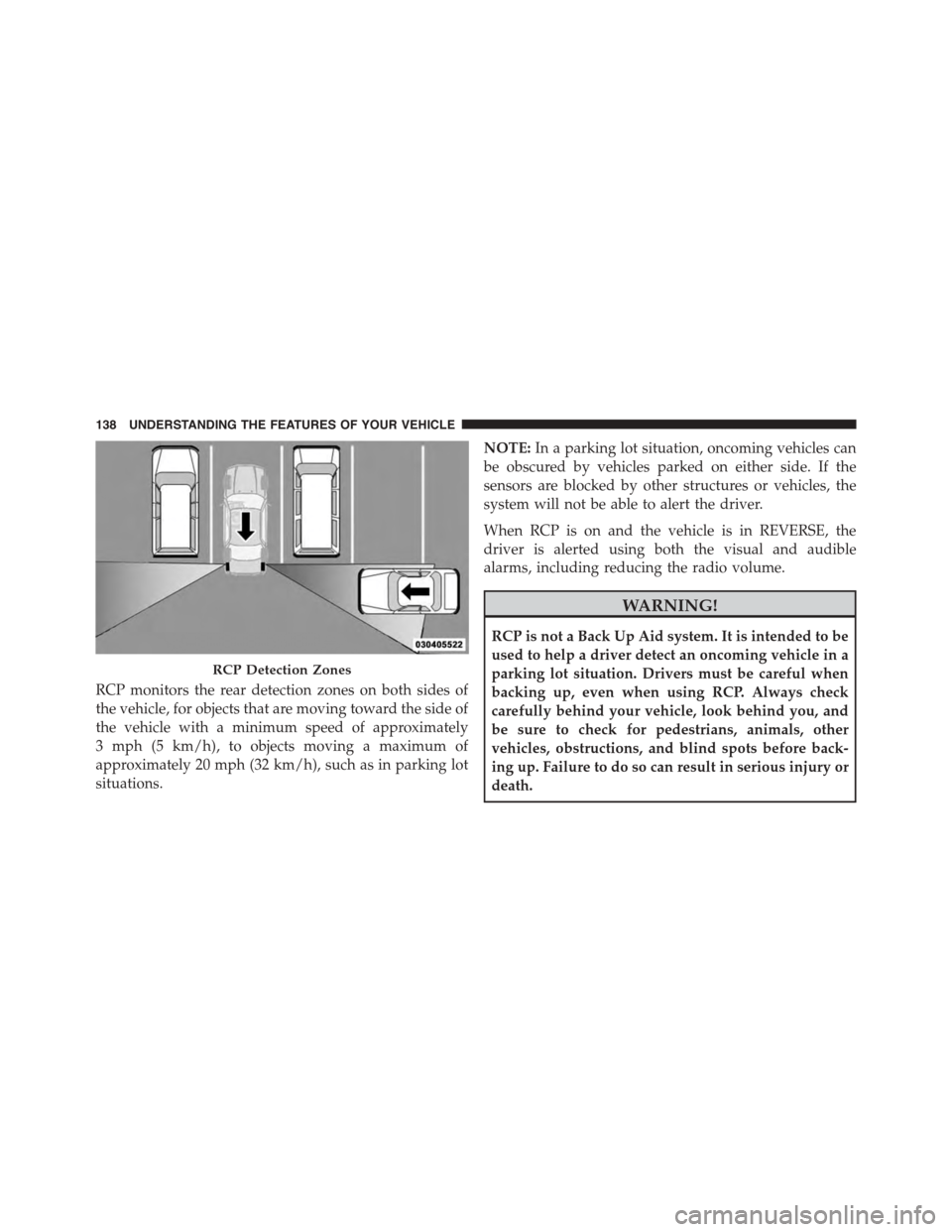
RCP monitors the rear detection zones on both sides of
the vehicle, for objects that are moving toward the side of
the vehicle with a minimum speed of approximately
3 mph (5 km/h), to objects moving a maximum of
approximately 20 mph (32 km/h), such as in parking lot
situations.
NOTE:In a parking lot situation, oncoming vehicles can
be obscured by vehicles parked on either side. If the
sensors are blocked by other structures or vehicles, the
system will not be able to alert the driver.
When RCP is on and the vehicle is in REVERSE, the
driver is alerted using both the visual and audible
alarms, including reducing the radio volume.
WARNING!
RCP is not a Back Up Aid system. It is intended to be
used to help a driver detect an oncoming vehicle in a
parking lot situation. Drivers must be careful when
backing up, even when using RCP. Always check
carefully behind your vehicle, look behind you, and
be sure to check for pedestrians, animals, other
vehicles, obstructions, and blind spots before back-
ing up. Failure to do so can result in serious injury or
death.
RCP Detection Zones
138 UNDERSTANDING THE FEATURES OF YOUR VEHICLE
Page 222 of 689
WARNING!
In the normal Cruise Control mode, the system will
not react to vehicles ahead. In addition, the proximity
warning does not activate and no alarm will sound
even if you are too close to the vehicle ahead since
neither the presence of the vehicle ahead nor the
vehicle-to vehicle distance is detected. Be sure to
maintain a safe distance between your vehicle and
the vehicle ahead. Always be aware which mode is
selected.
To Set A Desired Speed
Turn the Normal (Fixed Speed) Electronic
Speed Control ON. When the vehicle has
reached the desired speed, push the SET (+) or
SET (-) button and release. Release the accel-
erator and the vehicle will operate at the selected speed.
Once a speed has been set a message (CRUISE CON-
TROL SET TO MPH/KM) will appear indicating what
speed was set. This light will turn on when the electronic
speed control is SET.
To Vary The Speed Setting
To Increase Speed
When the Normal (Fixed Speed) Electronic Speed Con-
trol is set, you can increase speed by pushing the SET+
button.
220 UNDERSTANDING THE FEATURES OF YOUR VEHICLE
Page 245 of 689
NOTE:HomeLink® is disabled when the Vehicle Secu-
rity Alarm is active.
Before You Begin Programming HomeLink®
Be sure that your vehicle is parked outside of the garage
before you begin programming.
For more efficient programming and accurate transmis-
sion of the radio-frequency signal it is recommended that
a new battery be placed in the hand-held transmitter of
the device that is being programmed to the HomeLink®
system.
To erase the channels place the ignition in the ON/RUN
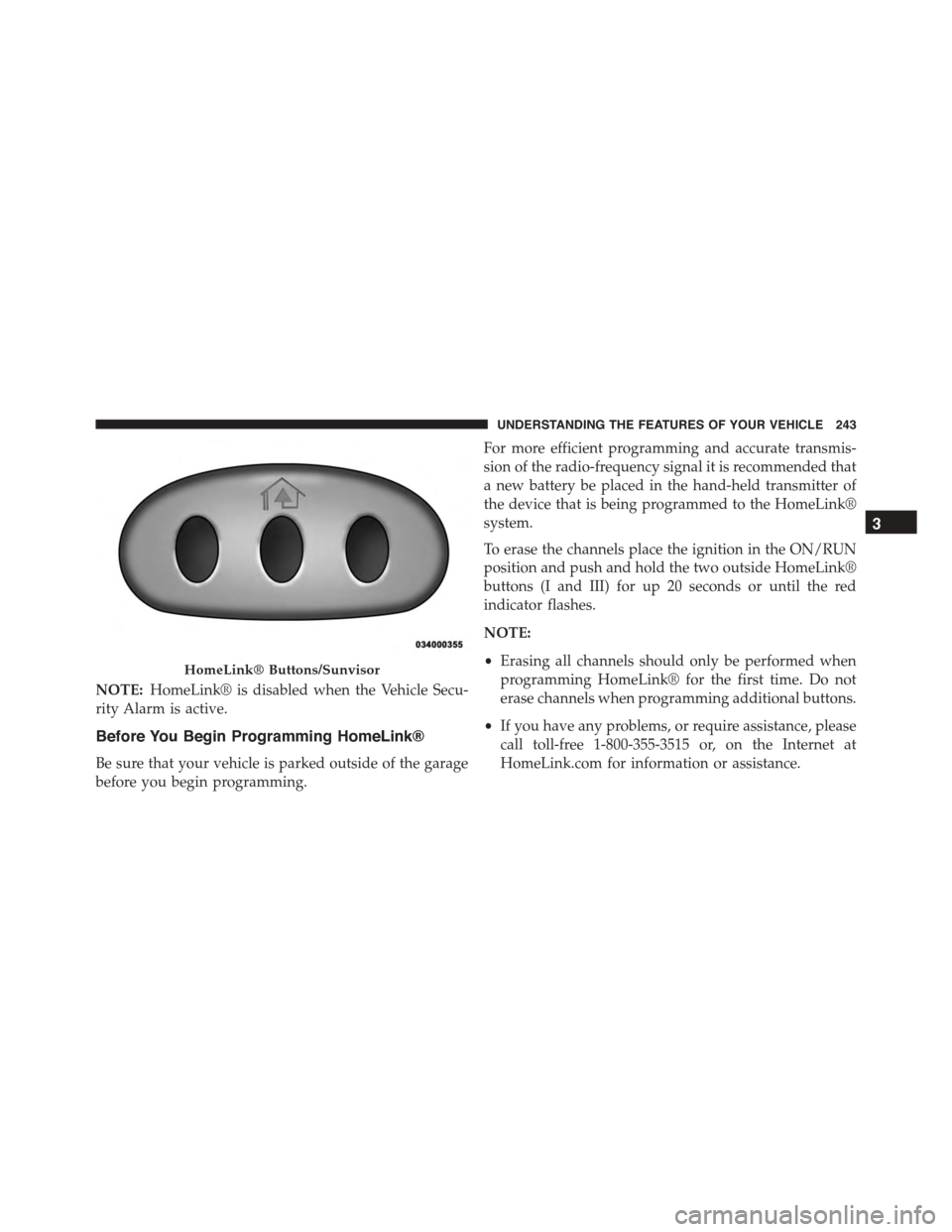
position and push and hold the two outside HomeLink®
buttons (I and III) for up 20 seconds or until the red
indicator flashes.
NOTE:
•Erasing all channels should only be performed when
programming HomeLink® for the first time. Do not
erase channels when programming additional buttons.
•If you have any problems, or require assistance, please
call toll-free 1-800-355-3515 or, on the Internet at
HomeLink.com for information or assistance.
HomeLink® Buttons/Sunvisor
3
UNDERSTANDING THE FEATURES OF YOUR VEHICLE 243
Page 251 of 689
Using HomeLink®
To operate, press and release the programmed
HomeLink® button. Activation will now occur for the
trained device (i.e., garage door opener, gate operator,
security system, entry door lock, home/office lighting,
etc.,). The handheld transmitter of the device may also be
used at any time.
Security
It is advised to erase all channels before you sell or turn
in your vehicle.
To do this, push and hold the two outside buttons for 20
seconds until the red indicator flashes. Note that all
channels will be erased. Individual channels cannot be
erased.
The HomeLink® Universal Transceiver is disabled when
the Vehicle Security Alarm is active.
Troubleshooting Tips
If you are having trouble programming HomeLink®,
here are some of the most common solutions:
•Replace the battery in the original transmitter.
•Press the LEARN button on the Garage Door Opener
to complete the training for a Rolling Code.
•Did you unplug the device for training, and remember
to plug it back in?
If you have any problems, or require assistance, please
call toll-free 1-800-355-3515 or, on the Internet at
www.HomeLink.com for information or assistance.
WARNING!
Vehicle exhaust contains carbon monoxide, a danger-
ous gas. Do not run your vehicle in the garage while
programming the transceiver. Exhaust gas can cause
serious injury or death.
3
UNDERSTANDING THE FEATURES OF YOUR VEHICLE 249
Page 302 of 689
18. Vehicle Security Light
This light will flash rapidly for approximately
15 seconds when the vehicle theft alarm is
arming. The light will flash at a slower speed
continuously after the alarm is set. The security
light will also come on for about three seconds when the
ignition is first turned on.
19. Electronic Stability Control (ESC) OFF Indicator
Light — If Equipped
This light indicates the Electronic Stability Con-
trol (ESC) is off.
20. Electronic Stability Control (ESC) Activation/
Malfunction Indicator Light — If Equipped
The “ESC Activation/Malfunction Indicator
Light” in the instrument cluster will come on
when the ignition switch is turned to the
ON/RUN position. It should go out with the engine
running. If the “ESC Activation/Malfunction Indicator
Light” comes on continuously with the engine running, a
malfunction has been detected in the ESC system. If this
light remains on after several ignition cycles, and the
vehicle has been driven several miles (kilometers) at
speeds greater than 30 mph (48 km/h), see your autho-
rized dealer as soon as possible to have the problem
diagnosed and corrected.
NOTE:
•The “ESC Off Indicator Light” and the “ESC
Activation/Malfunction Indicator Light” come on
momentarily each time the ignition switch is turned
to ON/RUN.
•Each time the ignition is turned to ON/RUN, the
ESC system will be ON, even if it was turned off
previously.
300 UNDERSTANDING YOUR INSTRUMENT PANEL
Page 412 of 689
Uconnect® Access* (8.4A/8.4AN)
An included trial and/or subscription is required to take
advantage of the Uconnect® Access services in the next
section of this guide. To register with Uconnect® Access,
press the Apps button on the 8.4-inch touchscreen to get
started. Detailed registration instructions can be found
on the next page.
*Uconnect® Access is available only on equipped ve-
hicles purchased within the continental United States and
Alaska. Services can only be used where coverage is
available; see coverage map for details.
9-1-1 Call
Theft Alarm Notification
Remote Door Lock/Unlock
Stolen Vehicle Assistance
Remote Vehicle Start**
Remote Horn and Lights
Yelp® Search
Voice Texting
Roadside Assistance Call
Wi-Fi Hotspot***
**If vehicle is equipped.
***Extra charges apply.
410 UNDERSTANDING YOUR INSTRUMENT PANEL
Page 668 of 689
About Your Brakes........................459
Adaptive Cruise Control (ACC) (Cruise Control) . . .196
Adding Engine Coolant (Antifreeze)............609
Adding Fuel.............................515
Additives, Fuel...........................509
Air bag . . . . . . . . . . . . . . . . . . . . . . . . . . . . . . . . .66
Air Bag
Advance Front Air Bag....................67
Air Bag Components.....................66
Air bag Operation.......................69
Air Bag Warning Light....................78
Driver Knee Air Bag......................71
Enhanced Accident Response................77
Event Data Recorder (EDR).................81
Front Air Bag . . . . . . . . . . . . . . . . . . . . . . . . . . .66
If A Deployment Occurs...................76
Knee Impact Bolsters.....................70
Maintaining Your Air Bag System............80
Side Air Bags...........................71
Transporting Pets.......................107
Air bag Deployment........................66
Air bag Light.............................78
Air bag Maintenance........................80
Air Cleaner, Engine (Engine Air Cleaner Filter) . . . .594
Air Conditioner Maintenance.................596
Air Conditioning Filter.....................397
Air Conditioning, Operating Tips..............396
Air Conditioning, Rear Zone.................391
Air Conditioning Refrigerant.................596
Air Conditioning System....................390
Air Pressure, Tires.........................485
Alarm
Arm The System........................19
Disarm The System.......................20
Tamper Alert...........................21
Alarm, Panic.............................24
Alarm (Security Alarm)......................19
All Wheel Drive (AWD).....................440
666 INDEX
Page 676 of 689
Hood Release............................170
Ignition
Key . . . . . . . . . . . . . . . . . . . . . . . . . . . . . . . . . .13
Illuminated Entry..........................21
Immobilizer (Sentry Key)....................16
Inside Rearview Mirror.....................120
Instrument Cluster........................292
Instrument Panel and Controls................290
Instrument Panel Lens Cleaning...............624
Interior Appearance Care....................623
Intermittent Wipers (Delay Wipers).............183
Introduction..............................4
Inverter, Power...........................259
iPod®/USB/MP3 Control...................354
Jacking And Tire Changing Instructions.........557
Jacking Instructions........................558
Jack Location............................552
Jack Operation...........................551
Jump Starting............................567
Key Fob . . . . . . . . . . . . . . . . . . . . . . . . . . . . . . . . .14
Arm The Alarm.........................19
Disarm The Alarm.......................20
Panic Alarm............................24
Programming Additional Key Fobs...........18
Programming Additional Transmitters.........18
Unlock Liftgate.........................44
Key-In Reminder..........................15
Keyless Enter-N-Go........................424
Keyless Enter-N-Go™
Lock The Vehicle’s Doors..................326
Passive Entry...........................35
Passive Entry Programming.................35
Unlock Liftgate.........................44
Keyless Entry System.......................22
Keyless Go...............................13
674 INDEX
Page 678 of 689
Security Alarm.........................292
Service...............................636
Service Engine Soon (Malfunction Indicator) . . . .292
Side Marker...........................639
Tire Pressure Monitoring (TPMS)............292
Traction Control........................470
Turn Signal............................112
Vanity Mirror..........................130
Loading Vehicle..........................518
Ti re s . . . . . . . . . . . . . . . . . . . . . . . . . . . . . . ..478
Locks..................................31
Child Protection.........................33
Door.................................31
Power Door............................32
Lubrication, Body.........................601
Luggage Rack (Roof Rack)...................276
Lug Nuts...............................549
Maintenance Free Battery....................595
Maintenance Procedures....................590
Maintenance Schedule......................648
Malfunction Indicator Light (Check Engine).......292
Manual, Service..........................662
Memory Feature (Memory Seat)...............164
Memory Seat............................164
Memory Seats and Radio....................164
Methanol...............................508
Mirrors................................120
Electric Powered........................128
Electric Remote.........................128
Exterior Folding........................128
Heated...............................129
Outside..............................120
Rearview.............................120
Vanity...............................130
Modifications/Alterations, Vehicle...............9
Monitor, Tire Pressure System................498
MOPAR® Parts...........................589
676 INDEX