load capacity DODGE DURANGO 2015 3.G User Guide
[x] Cancel search | Manufacturer: DODGE, Model Year: 2015, Model line: DURANGO, Model: DODGE DURANGO 2015 3.GPages: 689, PDF Size: 20.05 MB
Page 524 of 689
Gross Combination Weight Rating (GCWR)
The GCWR is the total permissible weight of your vehicle
and trailer when weighed in combination.
Gross Axle Weight Rating (GAWR)
The GAWR is the maximum capacity of the front and rear
axles. Distribute the load over the front and rear axles
evenly. Make sure that you do not exceed either front or
rear GAWR. Refer to “Vehicle Loading/Vehicle Certifica-
tion Label” in “Starting And Operating” for further
information.
WARNING!
It is important that you do not exceed the maximum
front or rear GAWR. A dangerous driving condition
can result if either rating is exceeded. You could lose
control of the vehicle and have a collision.
Tongue Weight (TW)
The tongue weight is the downward force exerted on the
hitch ball by the trailer. The recommended tongue weight is
10% to 15% of the vehicle’s GTW for a conventional hitch.
You must consider this as part of the load on your vehicle.
Frontal Area
The frontal area is the maximum height multiplied by the
maximum width of the front of a trailer.
Trailer Sway Control
The trailer sway control can be a mechanical telescoping
link that can be installed between the hitch receiver and the
trailer tongue that typically provides adjustable friction
associated with the telescoping motion to dampen any
unwanted trailer swaying motions while traveling.
If equipped, the electronic Trailer Sway Control (TSC)
recognizes a swaying trailer and automatically applies
individual wheel brakes and/or reduces engine power to
attempt to eliminate the trailer sway.
522 STARTING AND OPERATING
Page 534 of 689
•When replacing tires, refer to “Tires – General Infor-
mation” in “Starting And Operating” for the proper
tire replacement procedures. Replacing tires with a
higher load carrying capacity will not increase the
vehicle’s GVWR and GAWR limits.
Towing Requirements — Trailer Brakes
•Donotinterconnect the hydraulic brake system or
vacuum system of your vehicle with that of the trailer.
This could cause inadequate braking and possible
personal injury.
•An electronically actuated trailer brake controller is
required when towing a trailer with electronically
actuated brakes. When towing a trailer equipped with
a hydraulic surge actuated brake system, an electronic
brake controller is not required.
•Trailer brakes are recommended for trailers over
1,000 lbs (454 kg) and required for trailers in excess of
2,000 lbs (907 kg).
WARNING!
•Do not connect trailer brakes to your vehicle’s
hydraulic brake lines. It can overload your brake
system and cause it to fail. You might not have
brakes when you need them and could have a
collision.
(Continued)
532 STARTING AND OPERATING
Page 535 of 689
WARNING!(Continued)
•Towing any trailer will increase your stopping
distance. When towing you should allow for addi-
tional space between your vehicle and the vehicle
in front of you. Failure to do so could result in a
collision.
CAUTION!
If the trailer weighs more than 1,000 lbs (454 kg)
loaded, it should have its own brakes and they
should be of adequate capacity. Failure to do this
could lead to accelerated brake lining wear, higher
brake pedal effort, and longer stopping distances.
Towing Requirements — Trailer Lights And Wiring
Whenever you pull a trailer, regardless of the trailer size,
stoplights and turn signals on the trailer are required for
motoring safety.
The Trailer Tow Package may include a four- and seven-
pin wiring harness. Use a factory approved trailer har-
ness and connector.
NOTE:Do not cut or splice wiring into the vehicles
wiring harness.
5
STARTING AND OPERATING 533
Page 679 of 689
MTBE/ETBE............................508
Multi-Function Control Lever.................171
New Vehicle Break-In Period.................107
Occupant Restraints........................49
Octane Rating, Gasoline (Fuel)................506
Odometer...............................292
Tr i p . . . . . . . . . . . . . . . . . . . . . . . . . . . . . . . ..292
Oil, Engine..............................305
Capacity.............................640
Change Interval........................592
Dipstick..............................591
Disposal..............................594
Filter................................594
Filter Disposal.........................594
Identification Logo......................592
Materials Added to......................594
Recommendation.......................592
Viscosity.............................593
Oil Filter, Selection........................594
Onboard Diagnostic System..................587
Opener, Garage Door (HomeLink®)............242
Operating Precautions......................587
Operator Manual (Owner’s Manual).............6
Outside Rearview Mirrors...................120
Overhead Console.........................239
Overheating, Engine.......................548
Owner’s Manual (Operator Manual).............6
Paint Care..............................619
Panic Alarm..............................24
Parking Brake............................456
ParkSense® System, Rear....................228
Passing Light............................181
Passive Entry.............................35
Pets...................................107
Placard, Tire and Loading Information..........479
10
INDEX 677
Page 684 of 689
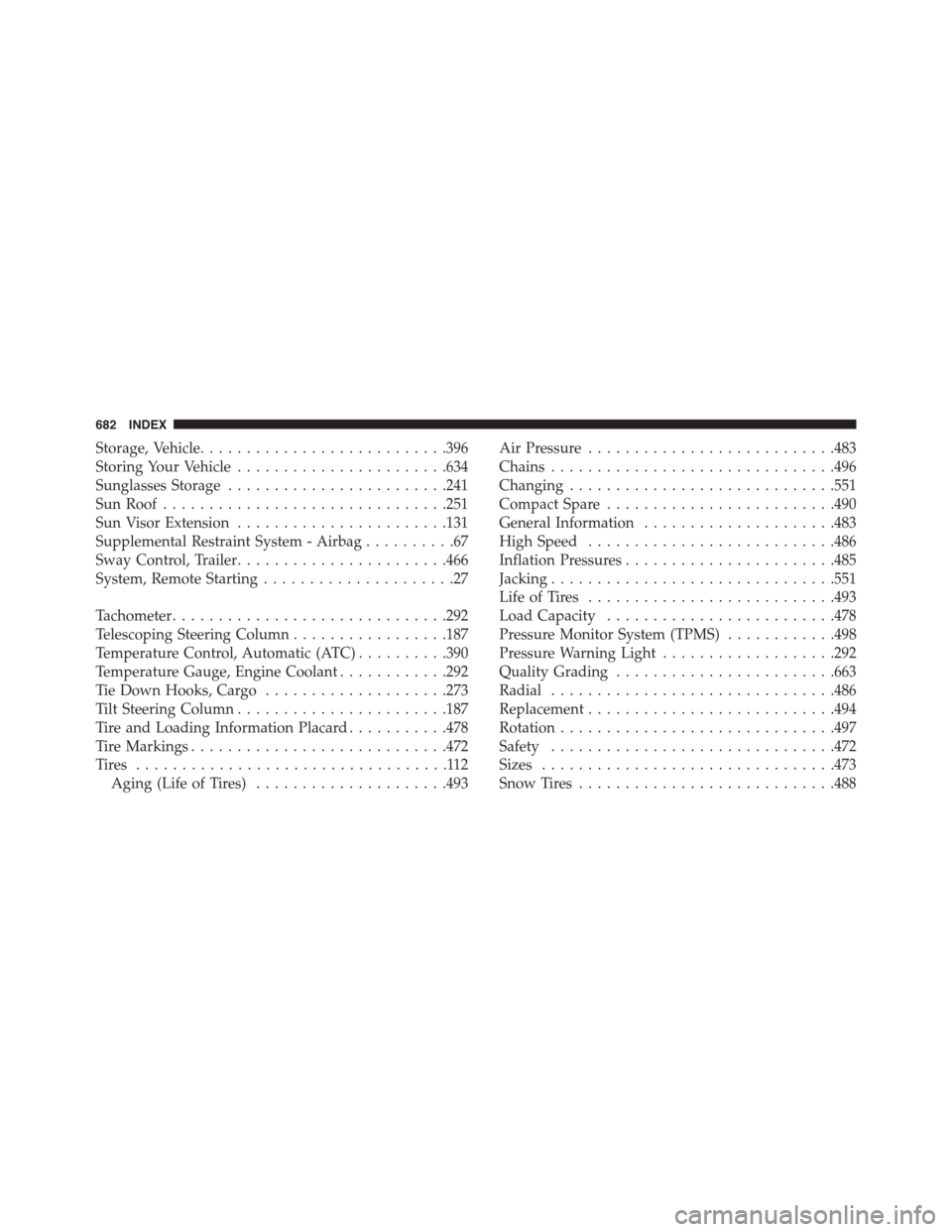
Storage, Vehicle...........................396
Storing Your Vehicle.......................634
Sunglasses Storage........................241
Sun Roof...............................251
Sun Visor Extension.......................131
Supplemental Restraint System - Airbag..........67
Sway Control, Trailer.......................466
System, Remote Starting.....................27
Tachometer..............................292
Telescoping Steering Column.................187
Temperature Control, Automatic (ATC)..........390
Temperature Gauge, Engine Coolant............292
Tie Down Hooks, Cargo....................273
Tilt Steering Column.......................187
Tire and Loading Information Placard...........478
Tire Markings............................472
Ti re s . . . . . . . . . . . . . . . . . . . . . . . . . . . . . . . . . . 11 2
Aging (Life of Tires).....................493
Air Pressure...........................483
Chains...............................496
Changing.............................551
Compact Spare.........................490
General Information.....................483
High Speed...........................486
Inflation Pressures.......................485
Jacking...............................551
Life of Tires...........................493
Load Capacity.........................478
Pressure Monitor System (TPMS)............498
Pressure Warning Light...................292
Quality Grading........................663
Radial...............................486
Replacement...........................494
Rotation..............................497
Safety...............................472
Sizes................................473
SnowTires............................488
682 INDEX