tire type DODGE DURANGO 2015 3.G User Guide
[x] Cancel search | Manufacturer: DODGE, Model Year: 2015, Model line: DURANGO, Model: DODGE DURANGO 2015 3.GPages: 689, PDF Size: 20.05 MB
Page 499 of 689
CAUTION!(Continued)
•Observe the traction device manufacturer ’s instruc-
tions on the method of installation, operating
speed, and conditions for use. Always use the
suggested operating speed of the device manufac-
turer ’s if it is less than 30 mph (48 km/h).
•Do not use traction devices on a compact spare tire.
TIRE ROTATION RECOMMENDATIONS
The tires on the front and rear of your vehicle operate at
different loads and perform different steering, handling,
and braking functions. For these reasons, they wear at
unequal rates.
These effects can be reduced by timely rotation of tires.
The benefits of rotation are especially worthwhile with
aggressive tread designs such as those on On/Off-Road
type tires. Rotation will increase tread life, help to main-
tain mud, snow, and wet traction levels, and contribute to
a smooth, quiet ride.
Refer to the “Maintenance Schedule” for the proper
maintenance intervals. More frequent rotation is permis-
sible if desired. The reasons for any rapid or unusual
wear should be corrected prior to rotation being per-
formed.
5
STARTING AND OPERATING 497
Page 502 of 689
updated tire pressures have been received. The vehicle
may need to be driven for up to 20 minutes above 15 mph
(24 km/h) to receive this information.
For example, your vehicle has a recommended cold
(parked for more than three hours) tire placard pressure
of 33 psi (227 kPa). If the ambient temperature is 68°F
(20°C) and the measured tire pressure is 28 psi (193 kPa),
a temperature drop to 20°F (-7°C) will decrease the tire
pressure to approximately 24 psi (165 kPa). This tire
pressure is sufficiently low enough to turn ON the Tire
Pressure Monitoring Telltale Light. Driving the vehicle
may cause the tire pressure to rise to approximately 28
psi (193 kPa), but the Tire Pressure Monitoring Telltale
Light will still be ON. In this situation, the Tire Pressure
Monitoring Telltale Light will turn OFF only after the
tires have been inflated to the vehicle’s recommended
cold tire pressure value.
CAUTION!
•The TPMS has been optimized for the original
equipment tires and wheels. TPMS pressures have
been established for the tire size equipped on your
vehicle. Undesirable system operation or sensor
damage may result when using replacement equip-
ment that is not of the same size, type, and/or style.
Aftermarket wheels can cause sensor damage. Do
not use aftermarket tire sealants or balance beads if
your vehicle is equipped with a TPMS, as damage
to the sensors may result.
•After inspecting or adjusting the tire pressure al-
ways reinstall the valve stem cap. This will prevent
moisture and dirt from entering the valve stem,
which could damage the Tire Pressure Monitoring
Sensor.
500 STARTING AND OPERATING
Page 522 of 689
determined by weighing your vehicle on a commercial
scale before any occupants or cargo are added.
Loading
The actual total weight and the weight of the front and
rear of your vehicle at the ground can best be determined
by weighing it when it is loaded and ready for operation.
The entire vehicle should first be weighed on a commer-
cial scale to insure that the GVWR has not been exceeded.
The weight on the front and rear of the vehicle should
then be determined separately to be sure that the load is
properly distributed over the front and rear axle. Weigh-
ing the vehicle may show that the GAWR of either the
front or rear axles has been exceeded but the total load is
within the specified GVWR. If so, weight must be shifted
from front to rear or rear to front as appropriate until the
specified weight limitations are met. Store the heavier
items down low and be sure that the weight is distributed
equally. Stow all loose items securely before driving.
Improper weight distributions can have an adverse effect
on the way your vehicle steers and handles and the way
the brakes operate.
CAUTION!
Do not load your vehicle any heavier than the GVWR
or the maximum front and rear GAWR. If you do,
parts on your vehicle can break, or it can change the
way your vehicle handles. This could cause you to
lose control. Also overloading can shorten the life of
your vehicle.
TRAILER TOWING
In this section you will find safety tips and information
on limits to the type of towing you can reasonably do
with your vehicle. Before towing a trailer, carefully
review this information to tow your load as efficiently
and safely as possible.
520 STARTING AND OPERATING
Page 554 of 689
Jack Location
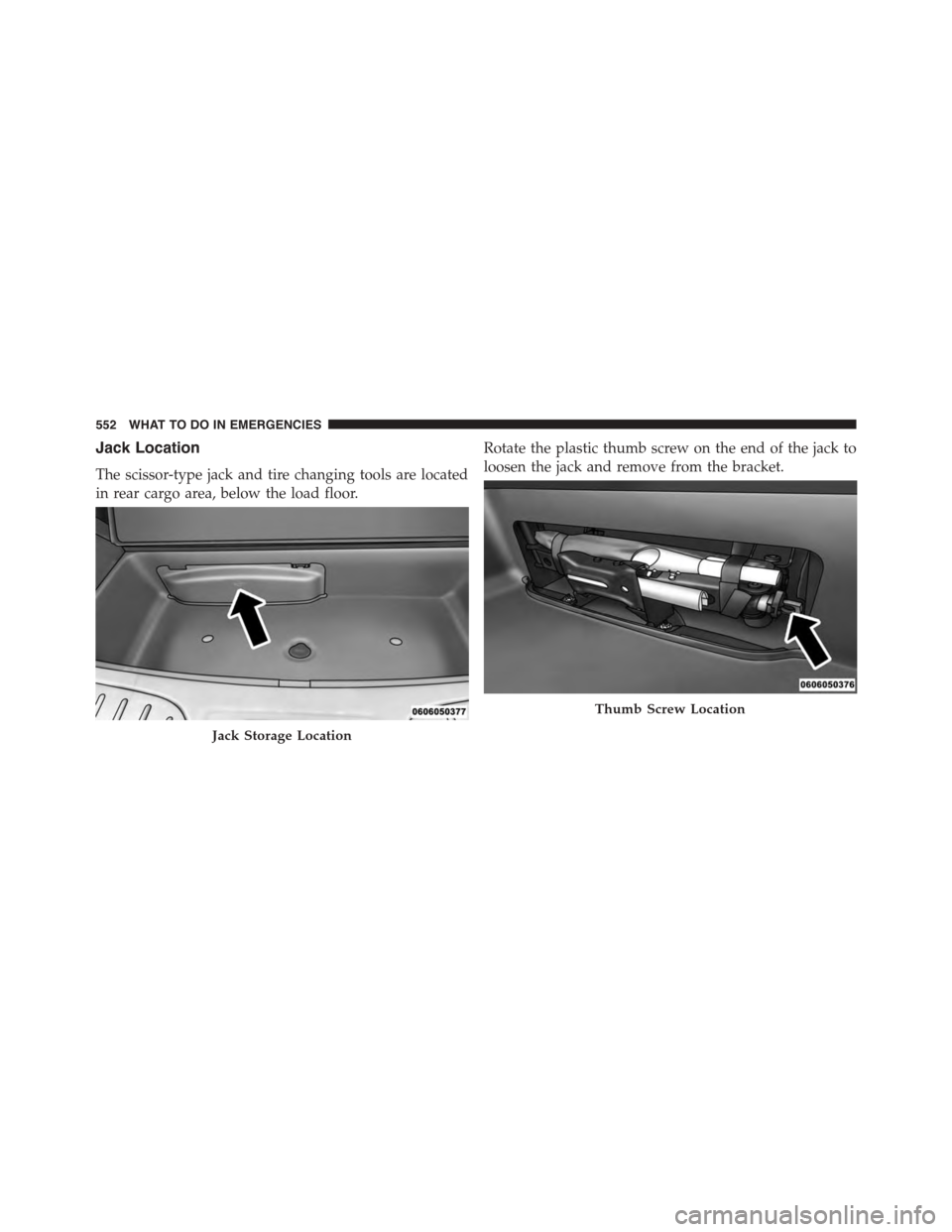
The scissor-type jack and tire changing tools are located
in rear cargo area, below the load floor.
Rotate the plastic thumb screw on the end of the jack to
loosen the jack and remove from the bracket.
Jack Storage Location
Thumb Screw Location
552 WHAT TO DO IN EMERGENCIES
Page 555 of 689
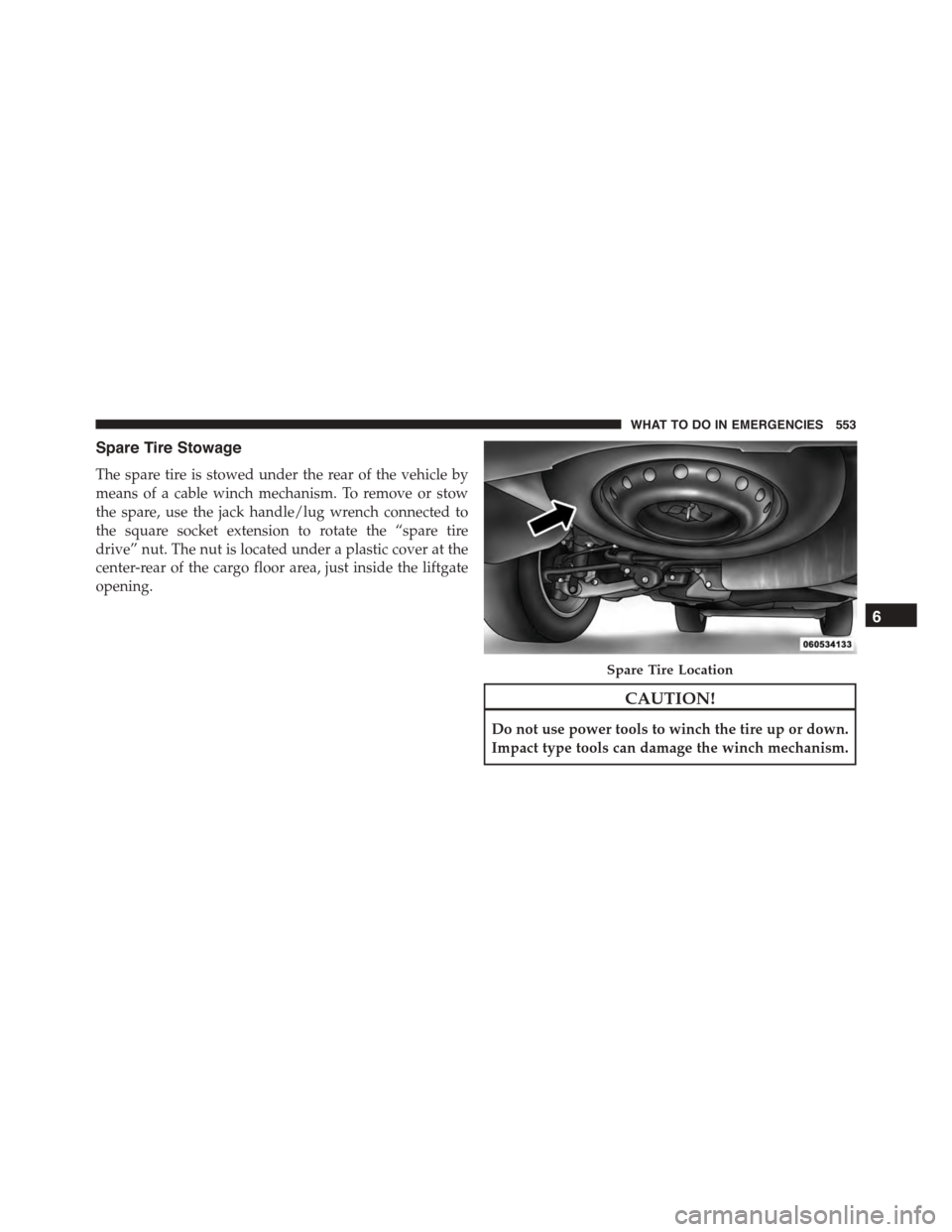
Spare Tire Stowage
The spare tire is stowed under the rear of the vehicle by
means of a cable winch mechanism. To remove or stow
the spare, use the jack handle/lug wrench connected to
the square socket extension to rotate the “spare tire
drive” nut. The nut is located under a plastic cover at the
center-rear of the cargo floor area, just inside the liftgate
opening.
CAUTION!
Do not use power tools to winch the tire up or down.
Impact type tools can damage the winch mechanism.
Spare Tire Location
6
WHAT TO DO IN EMERGENCIES 553
Page 567 of 689
NOTE:Double check to ensure the tire is snug against the
underbody of the vehicle. Damage to the winch cable
may result if the vehicle is driven with the tire loose.
WARNING!
Do not use power tools to winch the tire up or down.
Impact-type tools may damage the winch mecha-
nism.
13. Lower the jack to the fully closed position. Return the
tools to the proper positions in the tool bag. Fold the
flap on the tool bag under the tools and roll the tools
in the bag underneath the others. Use the Velcro
straps to secure the tool bag to the jack with the lug
wrench on the forward side of the jack. Expand the
jack on the bracket by turning the thumb screw
clockwise until it is tight to prevent rattles.
14. Reinstall the plastic plug into the floor of the cargo
area. Roll up and store the Jack, Tool Kit and Tire
Changing Instructions. Reinstall the cover for the jack
in the rear storage bin.
15. Have the aluminum road wheel and tire repaired as
soon as possible and properly secure the spare tire,
jack and tool kit.
WARNING!
A loose tire or jack thrown forward in a collision or
hard stop could endanger the occupants of the ve-
hicle. Always stow the jack parts and the spare tire in
the places provided.
6
WHAT TO DO IN EMERGENCIES 565
Page 650 of 689
MAINTENANCE SCHEDULE
Your vehicle is equipped with an automatic oil change
indicator system. The oil change indicator system will
remind you that it is time to take your vehicle in for
scheduled maintenance.
Based on engine operation conditions, the oil change
indicator message will illuminate. This means that ser-
vice is required for your vehicle. Operating conditions
such as frequent short-trips, trailer tow, extremely hot or
cold ambient temperatures, and E85 fuel usage will
influence when the “Oil Change Required” message is
displayed. Severe Operating Conditions can cause the
change oil message to illuminate as early as 3,500 miles
(5,600 km) since last reset. Have your vehicle serviced as
soon as possible, within the next 500 miles (805 km).
Your authorized dealer will reset the oil change indicator
message after completing the scheduled oil change.
NOTE:Under no circumstances should oil change inter-
vals exceed 10,000 miles (16,000 km) or twelve months,
whichever comes first.
Severe Duty All Models
•Change Engine Oil at 4000 miles (6,500 km) if the vehicle
is operated in a dusty and off road environment. This
type of vehicle use is considered Severe Duty.
Once A Month Or Before A Long Trip:
•Check engine oil level
•Check windshield washer fluid level
•Check the tire inflation pressures and look for unusual
wear or damage
•Check the fluid levels of the coolant reservoir, brake
master cylinder and power steering, and fill as needed.
•Check function of all interior and exterior lights
648 MAINTENANCE SCHEDULES
Page 681 of 689
Recreational Towing.......................537
Shifting into Transfer Case Neutral (N)........540
Shifting out of Transfer Case Neutral (N)......543
Reformulated Gasoline.....................507
Refrigerant..............................597
Reminder, Seat Belt.........................51
Remote Control
Starting System.........................27
Remote Keyless Entry (RKE)..................22
Arm The Alarm.........................19
Disarm The Alarm.......................20
FCC General Information..................26
Panic Alarm............................24
Programming Additional Key Fobs...........18
Programming Additional Transmitters.........18
Remote Sound System (Radio) Controls.........377
Remote Starting
Exit Remote Start Mode...................29
Uconnect® Customer Programmable Features....30
Uconnect® Settings.......................30
Remote Starting System......................27
Replacement Bulbs........................634
Replacement Keys.........................18
Replacement Parts.........................589
Replacement Tires.........................494
Reporting Safety Defects....................661
Restraints, Child...........................82
Retractable Cargo Area Cover................272
Roll Over Warning..........................5
Roof Type Carrier.........................276
Rotation, Tires...........................497
Safety Checks Inside Vehicle..................110
Safety Checks Outside Vehicle................112
Safety Defects, Reporting....................661
Safety, Exhaust Gas........................109
Safety Information, Tire.....................472
Safety Tips..............................108
10
INDEX 679