tow DODGE DURANGO 2015 3.G Manual PDF
[x] Cancel search | Manufacturer: DODGE, Model Year: 2015, Model line: DURANGO, Model: DODGE DURANGO 2015 3.GPages: 689, PDF Size: 20.05 MB
Page 567 of 689
NOTE:Double check to ensure the tire is snug against the
underbody of the vehicle. Damage to the winch cable
may result if the vehicle is driven with the tire loose.
WARNING!
Do not use power tools to winch the tire up or down.
Impact-type tools may damage the winch mecha-
nism.
13. Lower the jack to the fully closed position. Return the
tools to the proper positions in the tool bag. Fold the
flap on the tool bag under the tools and roll the tools
in the bag underneath the others. Use the Velcro
straps to secure the tool bag to the jack with the lug
wrench on the forward side of the jack. Expand the
jack on the bracket by turning the thumb screw
clockwise until it is tight to prevent rattles.
14. Reinstall the plastic plug into the floor of the cargo
area. Roll up and store the Jack, Tool Kit and Tire
Changing Instructions. Reinstall the cover for the jack
in the rear storage bin.
15. Have the aluminum road wheel and tire repaired as
soon as possible and properly secure the spare tire,
jack and tool kit.
WARNING!
A loose tire or jack thrown forward in a collision or
hard stop could endanger the occupants of the ve-
hicle. Always stow the jack parts and the spare tire in
the places provided.
6
WHAT TO DO IN EMERGENCIES 565
Page 568 of 689
Road Tire Installation
1. Mount the road tire on the axle.
2. Install the remaining lug nuts with the cone shaped
end of the nut toward the wheel. Lightly tighten the
lug nuts.
WARNING!
To avoid the risk of forcing the vehicle off the jack,
do not tighten the lug nuts fully until the vehicle has
been lowered. Failure to follow this warning may
result in personal injury.
3. Lower the vehicle to the ground by turning the jack
handle counterclockwise.
4. Refer to Torque Table for proper lug nut torque.
5. After 25 miles (40 km) check the lug nut torque with a
torque wrench to ensure that all lug nuts are properly
seated against the wheel.
CAP-LESS FUEL FILL FUNNEL
The funnel for the Cap-Less Fuel System is located with
the jack and tire changing tools. If your vehicle is out of
fuel and an auxiliary fuel can is needed, insert the funnel
into the filler neck and proceed to fill the vehicle.
566 WHAT TO DO IN EMERGENCIES
Page 575 of 689

WARNING!
Fast spinning tires can be dangerous. Forces gener-
ated by excessive wheel speeds may cause damage, or
even failure, of the axle and tires. A tire could
explode and injure someone. Do not spin your vehi-
cle’s wheels faster than 30 mph (48 km/h) or for
longer than 30 seconds continuously without stop-
ping when you are stuck and do not let anyone near
a spinning wheel, no matter what the speed.
CAUTION!
•When “rocking” a stuck vehicle by shifting be-
tween DRIVE and REVERSE, do not spin the
wheels faster than 15 mph (24 km/h), or drivetrain
damage may result.
(Continued)
CAUTION!(Continued)
•Revving the engine or spinning the wheels too fast
may lead to transmission overheating and failure.
It can also damage the tires. Do not spin the wheels
above 30 mph (48 km/h) while in gear (no trans-
mission shifting occurring).
EMERGENCY TOW HOOKS — IF EQUIPPED
If your vehicle is equipped with tow hooks, there will be
one in the rear and two mounted on the front of the
vehicle. The rear hook will be located on the driver’s side
of the vehicle.
NOTE:For off-road recovery, it is recommended to use
both of the front tow hooks to minimize the risk of
damage to the vehicle.
6
WHAT TO DO IN EMERGENCIES 573
Page 576 of 689
WARNING!
•Do not use a chain for freeing a stuck vehicle.
Chains may break, causing serious injury or death.
•Stand clear of vehicles when pulling with tow
hooks. Tow straps may become disengaged, caus-
ing serious injury.
CAUTION!
Tow hooks are for emergency use only, to rescue a
vehicle stranded off road. Do not use tow hooks for
tow truck hookup or highway towing. You could
damage your vehicle.
MANUAL PARK RELEASE
WARNING!
Always secure your vehicle by fully applying the
parking brake, before activating the Manual Park
Release. Activating the Manual Park Release will
allow your vehicle to roll away if it is not secured by
the parking brake or by proper connection to a tow
vehicle. Activating the Manual Park Release on an
unsecured vehicle could lead to serious injury or
death for those in or around the vehicle.
In order to move the vehicle in cases where the transmis-
sion will not shift out of PARK (such as a dead battery),
a Manual Park Release is available.
Follow these steps to use the Manual Park Release:
1. Firmly apply the parking brake.
574 WHAT TO DO IN EMERGENCIES
Page 577 of 689
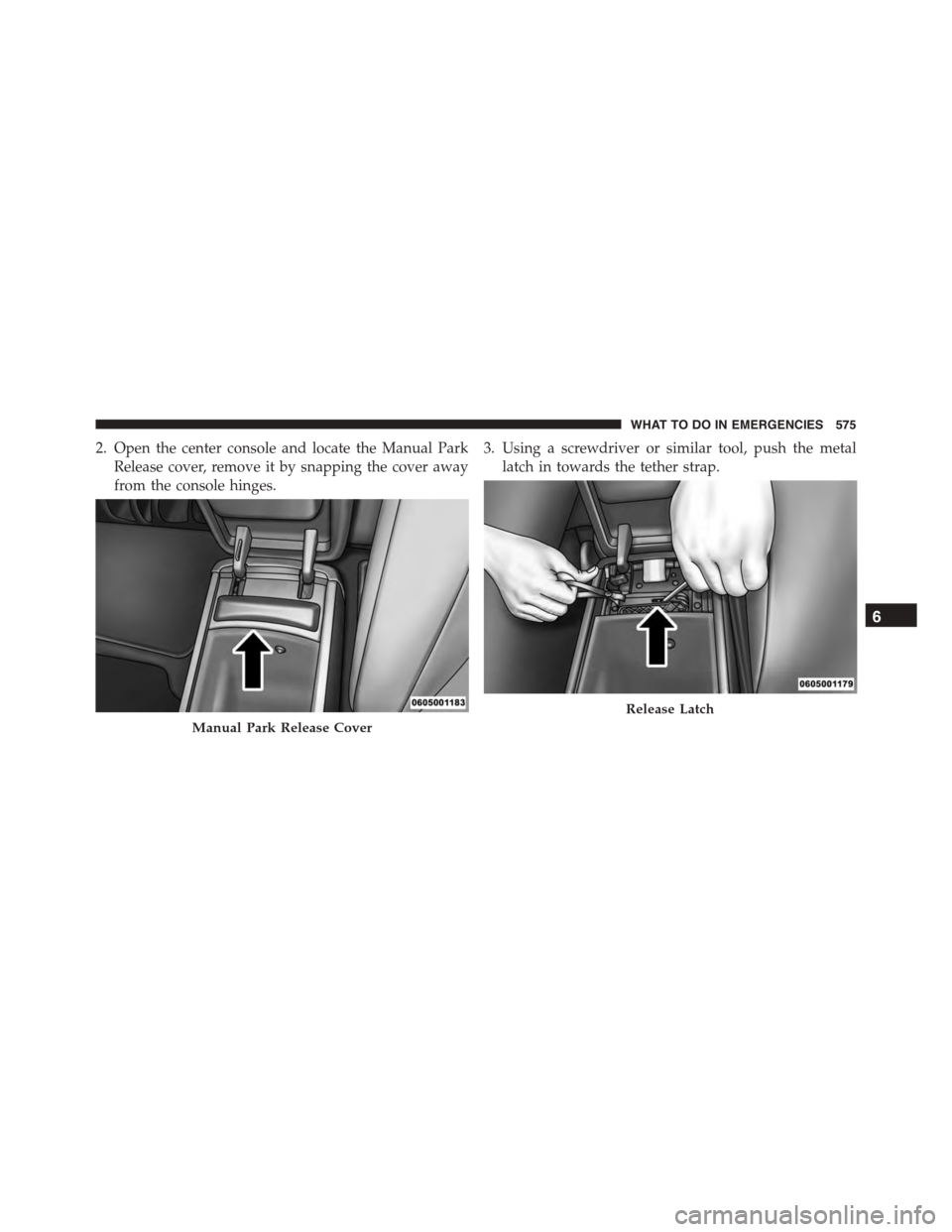
2. Open the center console and locate the Manual Park
Release cover, remove it by snapping the cover away
from the console hinges.
3. Using a screwdriver or similar tool, push the metal
latch in towards the tether strap.
Manual Park Release Cover
Release Latch
6
WHAT TO DO IN EMERGENCIES 575
Page 578 of 689
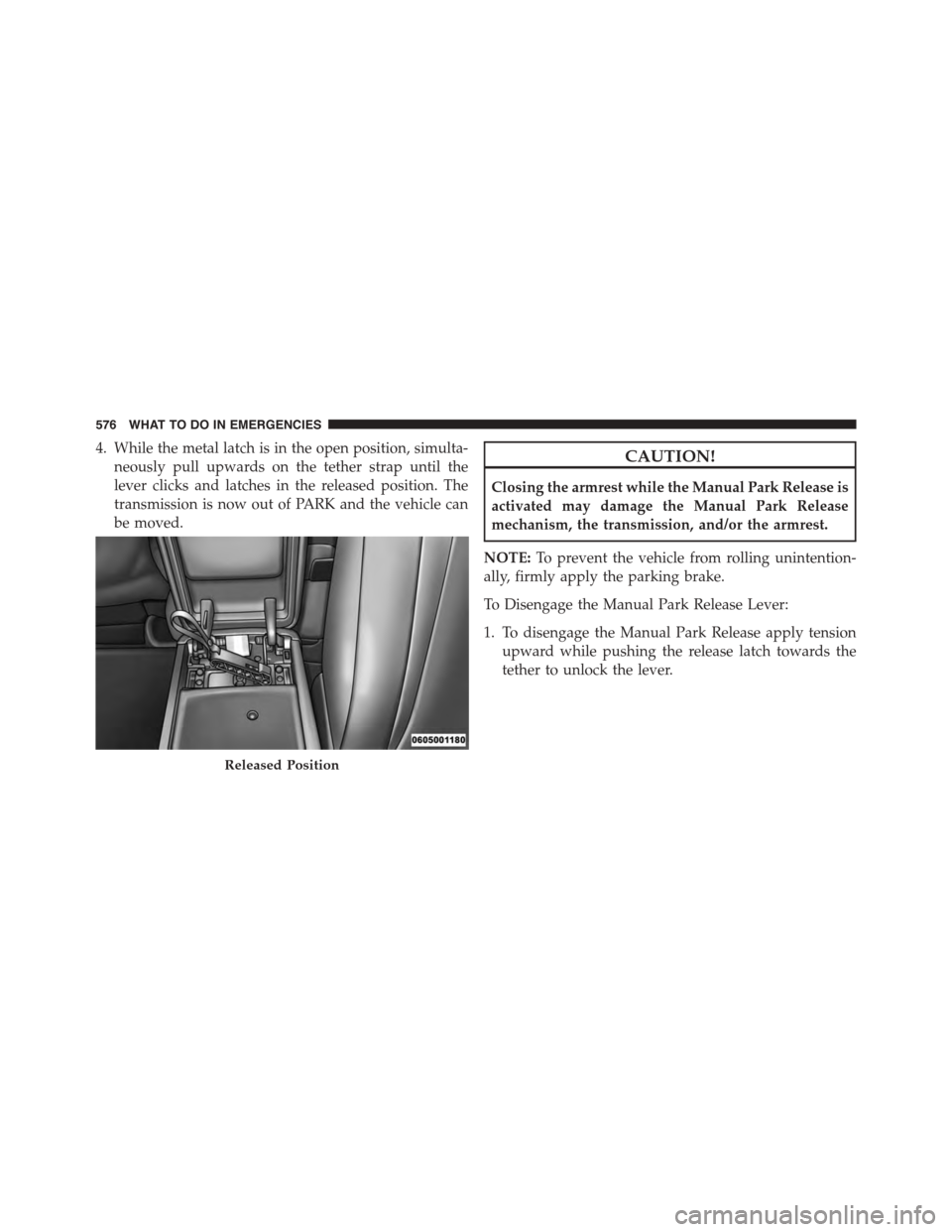
4. While the metal latch is in the open position, simulta-
neously pull upwards on the tether strap until the
lever clicks and latches in the released position. The
transmission is now out of PARK and the vehicle can
be moved.
CAUTION!
Closing the armrest while the Manual Park Release is
activated may damage the Manual Park Release
mechanism, the transmission, and/or the armrest.
NOTE:To prevent the vehicle from rolling unintention-
ally, firmly apply the parking brake.
To Disengage the Manual Park Release Lever:
1. To disengage the Manual Park Release apply tension
upward while pushing the release latch towards the
tether to unlock the lever.
Released Position
576 WHAT TO DO IN EMERGENCIES
Page 579 of 689
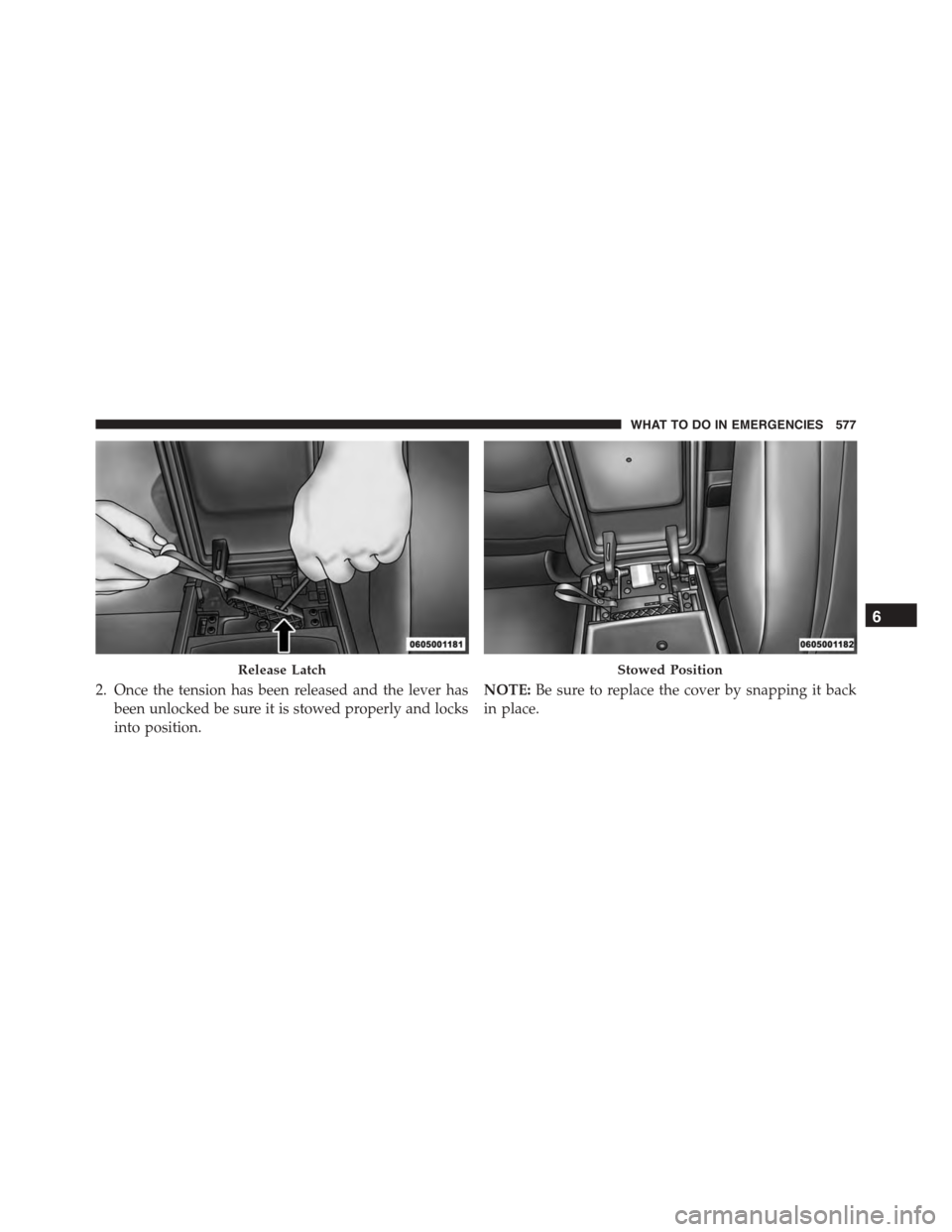
2. Once the tension has been released and the lever has
been unlocked be sure it is stowed properly and locks
into position.
NOTE:Be sure to replace the cover by snapping it back
in place.
Release LatchStowed Position
6
WHAT TO DO IN EMERGENCIES 577
Page 580 of 689
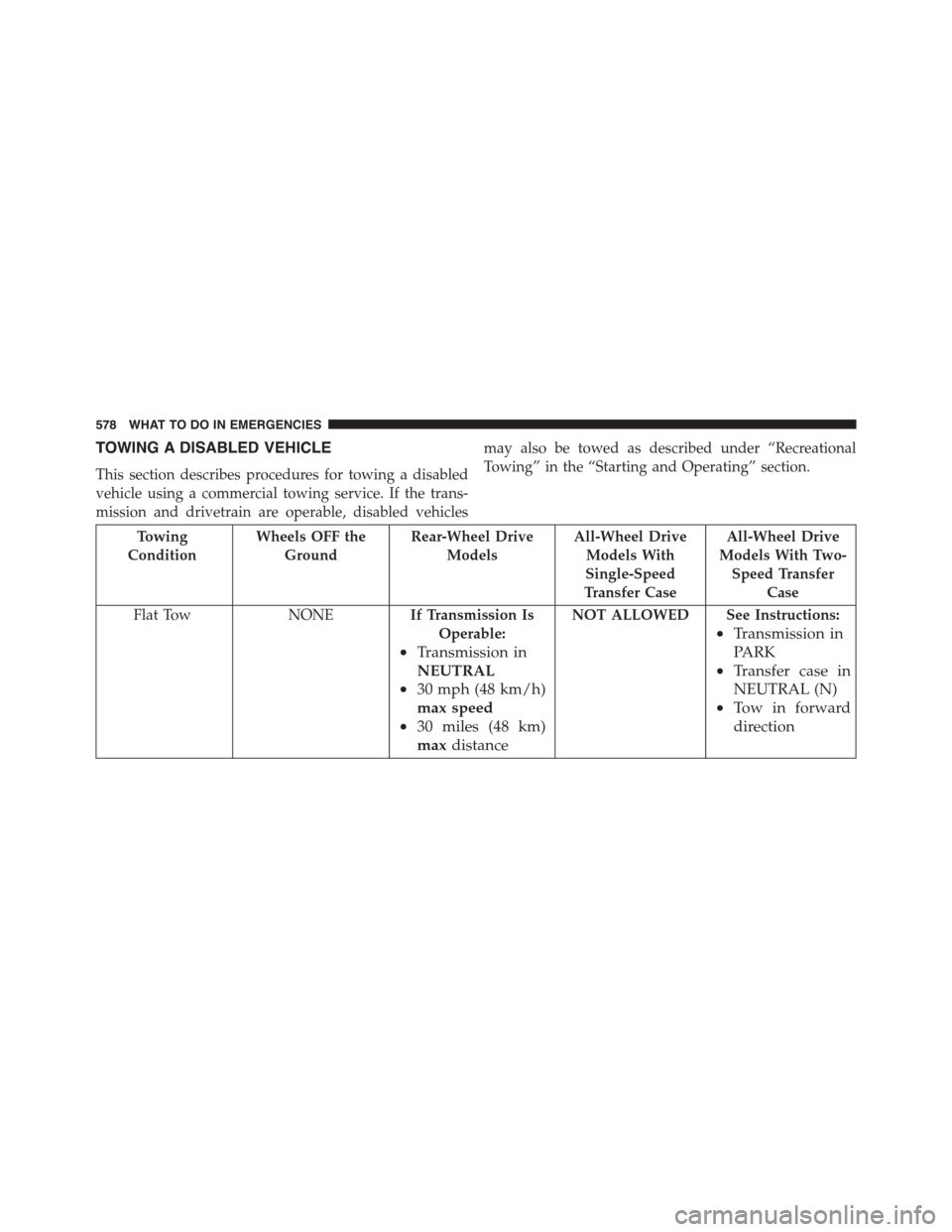
TOWING A DISABLED VEHICLE
This section describes procedures for towing a disabled
vehicle using a commercial towing service. If the trans-
mission and drivetrain are operable, disabled vehicles
may also be towed as described under “Recreational
Towing” in the “Starting and Operating” section.
Towing
Condition
Wheels OFF the
Ground
Rear-Wheel Drive
Models
All-Wheel Drive
Models With
Single-Speed
Transfer Case
All-Wheel Drive
Models With Two-
Speed Transfer
Case
Flat TowNONEIf Transmission Is
Operable:
•Transmission in
NEUTRAL
•30 mph (48 km/h)
max speed
•30 miles (48 km)
maxdistance
NOT ALLOWED See Instructions:
•Transmission in
PARK
•Transfer case in
NEUTRAL (N)
•Tow in forward
direction
578 WHAT TO DO IN EMERGENCIES
Page 581 of 689
Towing
Condition
Wheels OFF the
Ground
Rear-Wheel Drive
Models
All-Wheel Drive
Models With
Single-Speed
Transfer Case
All-Wheel Drive
Models With Two-
Speed Transfer
Case
Wheel Lift or
Dolly Tow
FrontIf Transmission Is
Operable:
•Transmission in
NEUTRAL
•30 mph (48 km/h)
max speed
•30 miles (48 km)
maxdistance
NOT ALLOWED NOT ALLOWED
Rear OKNOT ALLOWED NOT ALLOWED
FlatbedALL BEST METHOD OK BEST METHOD
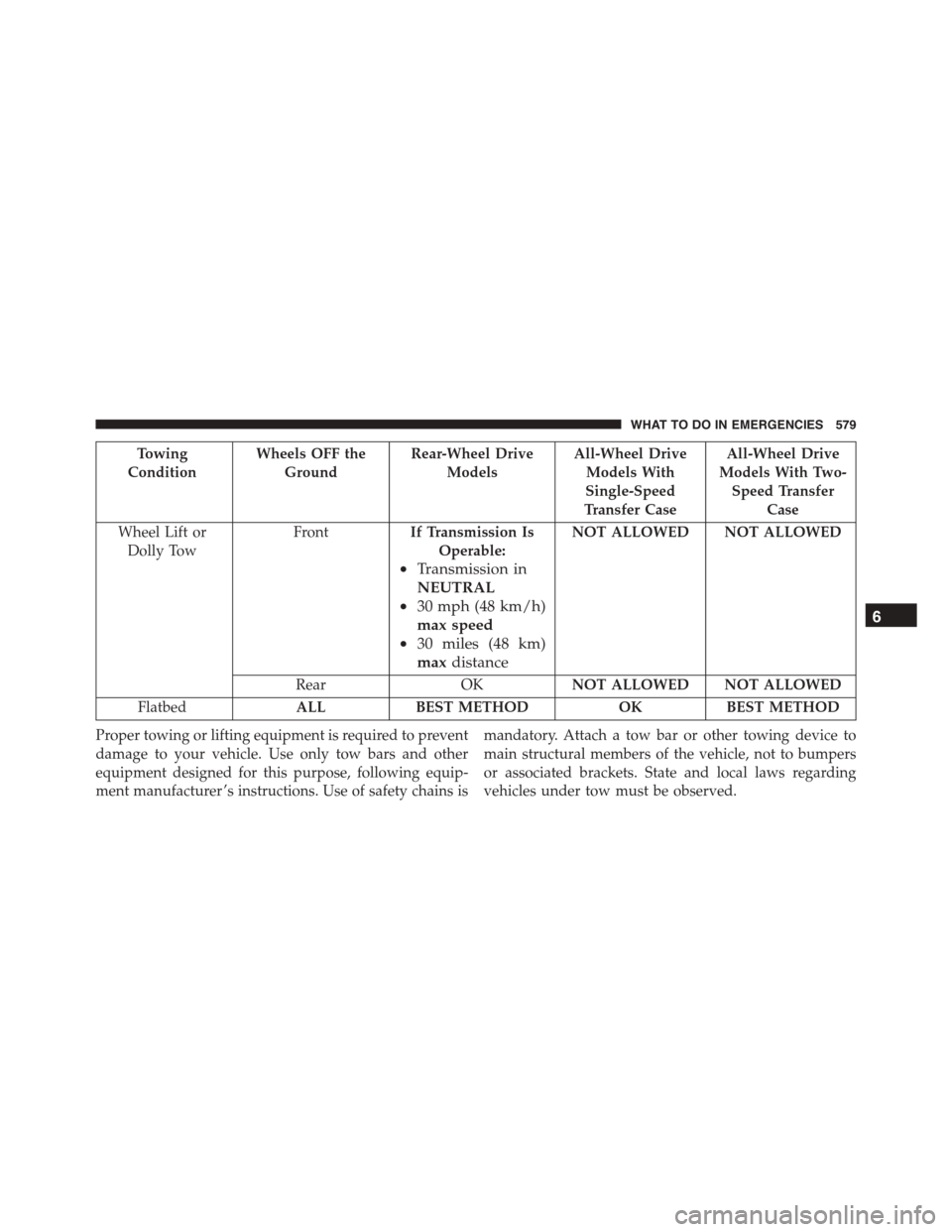
Proper towing or lifting equipment is required to prevent
damage to your vehicle. Use only tow bars and other
equipment designed for this purpose, following equip-
ment manufacturer ’s instructions. Use of safety chains is
mandatory. Attach a tow bar or other towing device to
main structural members of the vehicle, not to bumpers
or associated brackets. State and local laws regarding
vehicles under tow must be observed.
6
WHAT TO DO IN EMERGENCIES 579
Page 582 of 689
If you must use the accessories (wipers, defrosters, etc.)
while being towed, the ignition must be in the ON/RUN
position, not the ACC position.
If the key fob is unavailable or the vehicle’s battery is
discharged, refer to “Manual Park Release” in this section
for instructions on shifting the transmission out of PARK
for towing.
CAUTION!
•Do not use sling type equipment when towing.
Vehicle damage may occur.
•When securing the vehicle to a flat bed truck, do
not attach to front or rear suspension components.
Damage to your vehicle may result from improper
towing.
Rear Wheel Drive Models
The manufacturer recommends towing your vehicle with
all four wheelsOFFthe ground using a flatbed.
If flatbed equipment is not available, and the transmis-
sion is operable, the vehicle may be towed (with rear
wheels on the ground) with the transmission inNEU-
TRAL. Speed must not exceed 30 mph (48 km/h) and the
distance must not exceed 30 miles (48 km).
CAUTION!
Towing faster than 30 mph (48 km/h) or farther than
30 miles (48 km) with rear wheels on the ground can
cause severe transmission damage. Damage from
improper towing is not covered under the New
Vehicle Limited Warranty.
580 WHAT TO DO IN EMERGENCIES