alarm DODGE DURANGO 2017 3.G User Guide
[x] Cancel search | Manufacturer: DODGE, Model Year: 2017, Model line: DURANGO, Model: DODGE DURANGO 2017 3.GPages: 584, PDF Size: 5.14 MB
Page 109 of 584
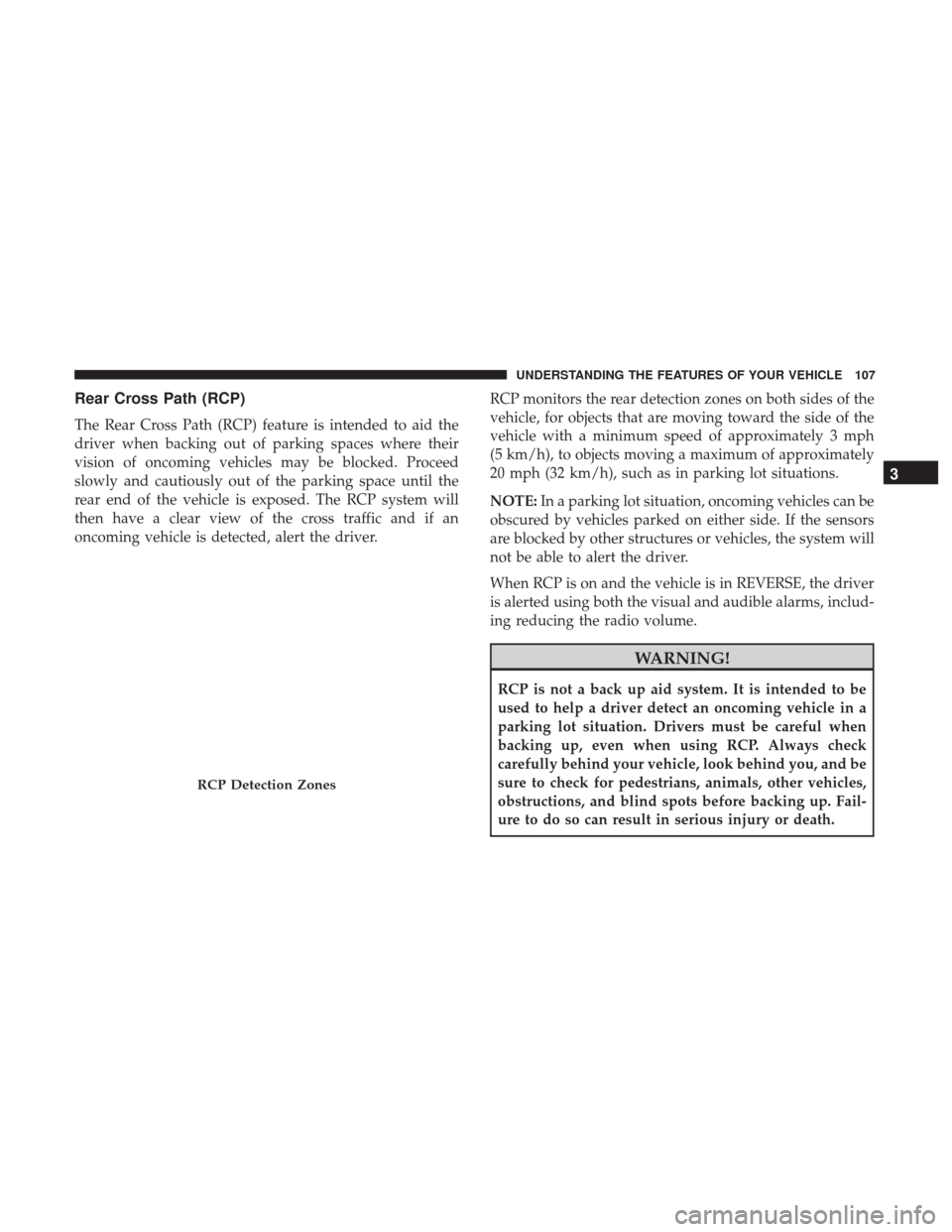
Rear Cross Path (RCP)
The Rear Cross Path (RCP) feature is intended to aid the
driver when backing out of parking spaces where their
vision of oncoming vehicles may be blocked. Proceed
slowly and cautiously out of the parking space until the
rear end of the vehicle is exposed. The RCP system will
then have a clear view of the cross traffic and if an
oncoming vehicle is detected, alert the driver.RCP monitors the rear detection zones on both sides of the
vehicle, for objects that are moving toward the side of the
vehicle with a minimum speed of approximately 3 mph
(5 km/h), to objects moving a maximum of approximately
20 mph (32 km/h), such as in parking lot situations.
NOTE:
In a parking lot situation, oncoming vehicles can be
obscured by vehicles parked on either side. If the sensors
are blocked by other structures or vehicles, the system will
not be able to alert the driver.
When RCP is on and the vehicle is in REVERSE, the driver
is alerted using both the visual and audible alarms, includ-
ing reducing the radio volume.
WARNING!
RCP is not a back up aid system. It is intended to be
used to help a driver detect an oncoming vehicle in a
parking lot situation. Drivers must be careful when
backing up, even when using RCP. Always check
carefully behind your vehicle, look behind you, and be
sure to check for pedestrians, animals, other vehicles,
obstructions, and blind spots before backing up. Fail-
ure to do so can result in serious injury or death.
RCP Detection Zones
3
UNDERSTANDING THE FEATURES OF YOUR VEHICLE 107
Page 173 of 584
General Information
This vehicle has systems that operate on radio frequency
that comply with Part 15 of the Federal Communications
Commission (FCC) rules and with Industry Canada Stan-
dards RSS- GEN/210/220/310.
Operation is subject to the following two conditions:
1. The device may not cause harmful interference.
2. The device must accept any interference received, in-cluding interference that may cause undesired operation
of the device.
Changes or modifications to any of these systems by other
than an authorized service facility could void authorization
to use this equipment.
Normal (Fixed Speed) Electronic Speed Control
Mode
In addition to Adaptive Cruise Control mode, a Normal
(Fixed Speed) Electronic Speed Control mode is available
for cruising at fixed speeds. The Normal (Fixed Speed)
Electronic Speed Control mode is designed to maintain a
set cruising speed without requiring the driver to operate
the accelerator. Electronic Speed Control can only be oper-
ated if the vehicle speed is above 20 mph (32 km/h).
To change between the different control modes, push the
ADAPTIVE CRUISE CONTROL (ACC) ON/OFF button
which turns the ACC and the NORMAL (Fixed Speed)
ELECTRONIC SPEED CONTROL OFF. Pushing of the NOR-
MAL (Fixed Speed) ELECTRONIC SPEED CONTROL ON/
OFF button will result in turning ON (changing to) the
Normal (Fixed Speed) Electronic Speed Control mode.
WARNING!
In the normal Cruise Control mode, the system will not
react to vehicles ahead. In addition, the proximity warn-
ing does not activate and no alarm will sound even if you
are too close to the vehicle ahead since neither the
presence of the vehicle ahead nor the vehicle-to vehicle
distance is detected. Be sure to maintain a safe distance
between your vehicle and the vehicle ahead. Always be
aware which mode is selected.
3
UNDERSTANDING THE FEATURES OF YOUR VEHICLE 171
Page 199 of 584
NOTE:HomeLink is disabled when the Vehicle Security
Alarm is active.
Before You Begin Programming HomeLink
Be sure that your vehicle is parked outside of the garage
before you begin programming.
For more efficient programming and accurate transmission
of the radio-frequency signal, it is recommended that a new
battery be placed in the hand-held transmitter of the device
that is being programmed to the HomeLink system. To erase the channels, place the ignition in the ON/RUN
position and push and hold the two outside HomeLink
buttons (I and III) for up 20 seconds or until the red
indicator flashes.
NOTE:
•
Erasing all channels should only be performed when
programming HomeLink for the first time. Do not erase
channels when programming additional buttons.
• If you have any problems, or require assistance, please
call toll-free 1-800-355-3515 or, on the Internet at
HomeLink.com for information or assistance.
Programming A Rolling Code
For programming garage door openers that were manufac-
tured after 1995:
These garage door openers can be identified by the
“LEARN” or “TRAIN” button located where the hanging
antenna is attached to the garage door opener. It is NOT the
button that is normally used to open and close the door.
The name and color of the button may vary by manufac-
turer.
HomeLink Buttons/Sunvisor
3
UNDERSTANDING THE FEATURES OF YOUR VEHICLE 197
Page 203 of 584
If you unplugged the garage door opener/device for
programming, plug it back in at this time.
Reprogramming A Single HomeLink Button
(Canadian/Gate Operator)
To reprogram a channel that has been previously trained,
follow these steps:
1. Cycle the ignition to the ON/RUN position.
2. Push and hold the desired HomeLink button until theindicator light begins to flash after 20 seconds. Do not
release the button.
3. Without releasing the button, proceed with
“Canadian/Gate Operator Programming” step 2 and
follow all remaining steps.
Using HomeLink
To operate, push and release the programmed HomeLink
button. Activation will now occur for the trained device
(i.e., garage door opener, gate operator, security system,
entry door lock, home/office lighting, etc.). The handheld
transmitter of the device may also be used at any time.
Security
It is advised to erase all channels before you sell or turn in
your vehicle.
To do this, push and hold the two outside buttons for 20
seconds until the red indicator flashes.
NOTE: All channels will be erased. Individual channels
cannot be erased.
The HomeLink Universal Transceiver is disabled when the
Vehicle Security Alarm is active.
Troubleshooting Tips
If you are having trouble programming HomeLink, here
are some of the most common solutions:
• Replace the battery in the original transmitter.
• Push the LEARN button on the Garage Door Opener to
complete the training for a Rolling Code.
• Did you unplug the device for training, and remember
to plug it back in?
If you have any problems, or require assistance, please call
toll-free 1-800-355-3515 or, on the Internet at HomeLink.com
for information or assistance.
3
UNDERSTANDING THE FEATURES OF YOUR VEHICLE 201
Page 242 of 584
WARNING!
Driving a vehicle with the red brake light on is
dangerous. Part of the brake system may have failed. It
will take longer to stop the vehicle. You could have a
collision. Have the vehicle checked immediately.
Vehicles equipped with the Anti-Lock Brake System (ABS)
are also equipped with Electronic Brake Force Distribution
(EBD). In the event of an EBD failure, the Brake Warning
Light will turn on along with the ABS Light. Immediate
repair to the ABS system is required. Operation of the Brake Warning Light can be checked by
placing the ignition in the ON/RUN position. The light
should illuminate for approximately two seconds. The light
should then turn off unless the parking brake is applied or
a brake fault is detected. If the light does not illuminate,
have the light inspected by an authorized dealer.
The light also will turn on when the parking brake is
applied with the ignition placed in the ON/RUN position.
NOTE:
This light shows only that the parking brake is
applied. It does not show the degree of brake application.
Vehicle Security Warning Light — If Equipped
Red Telltale Light What It Means
Vehicle Security Warning Light — If Equipped
This light will flash at a fast rate for approximately 15 seconds when the vehicle security alarm is
arming, and then will flash slowly until the vehicle is disarmed.
240 UNDERSTANDING YOUR INSTRUMENT PANEL
Page 272 of 584
When load reduction is activated, the message “Battery
Saver On” or “Battery Saver Mode” will appear in the
Instrument Cluster Display.
These messages indicate the vehicle battery has a low state
of charge and continues to lose electrical charge at a rate
that the charging system cannot sustain.
NOTE:
•The charging system is independent from load reduc-
tion. The charging system performs a diagnostic on the
charging system continuously.
• If the Battery Charge Warning Light is on it may indicate
a problem with the charging system. Refer to “Battery
Charge Warning Light” in “Understanding Your Instru-
ment Panel” for further information.
The electrical loads that may be switched off (if equipped),
and vehicle functions which can be effected by load reduction:
• Heated Seat/Vented Seats/Heated Wheel
• Heated/Cooled Cup Holders — If Equipped
• Rear Defroster And Heated Mirrors
• HVAC System •
115V AC Power Inverter System
• Audio and Telematics System
Loss of the battery charge may indicate one or more of the
following conditions:
• The charging system cannot deliver enough electrical
power to the vehicle system because the electrical loads
are larger than the capability of charging system. The
charging system is still functioning properly.
• Turning on all possible vehicle electrical loads (e.g.
HVAC to max settings, exterior and interior lights,
overloaded power outlets +12V, 115V AC, USB ports)
during certain driving conditions (city driving, towing,
frequent stopping).
•
Installing options like additional lights, upfitter electrical
accessories, audio systems, alarms and similar devices.
• Unusual driving cycles (short trips separated by long
parking periods).
• The vehicle was parked for an extended period of time
(weeks, months).
• The battery was recently replaced and was not charged
completely.
270 UNDERSTANDING YOUR INSTRUMENT PANEL
Page 273 of 584
•The battery was discharged by an electrical load left on
when the vehicle was parked.
• The battery was used for an extended period with the
engine not running to supply radio, lights, chargers,
+12V portable appliances like vacuum cleaners, game
consoles and similar devices.
What to do when an electrical load reduction action message
is present (“Battery Saver On” or “Battery Saver Mode”)
During a trip:
• Reduce power to unnecessary loads if possible:
– Turn off redundant lights (interior or exterior)
– Check what may be plugged in to power outlets +12V, 115V AC, USB ports
– Check HVAC settings (blower, temperature)
– Check the audio settings (volume)
After a trip:
• Check if any aftermarket equipment was installed (ad-
ditional lights, upfitter electrical accessories, audio sys-
tems, alarms) and review specifications if any (load and
Ignition Off Draw currents). •
Evaluate the latest driving cycles (distance, driving time
and parking time).
• The vehicle should have service performed if the mes-
sage is still present during consecutive trips and the
evaluation of the vehicle and driving pattern did not
help to identify the cause.
CYBERSECURITY
Your vehicle may be a connected vehicle and may be
equipped with both wired and wireless networks. These
networks allow your vehicle to send and receive informa-
tion. This information allows systems and features in your
vehicle to function properly.
Your vehicle may be equipped with certain security fea-
tures to reduce the risk of unauthorized and unlawful
access to vehicle systems and wireless communications.
Vehicle software technology continues to evolve over time
and FCA US LLC, working with its suppliers, evaluates
and takes appropriate steps as needed. Similar to a com-
puter or other devices, your vehicle may require software
updates to improve the usability and performance of your
systems or to reduce the potential risk of unauthorized and
unlawful access to your vehicle systems.
4
UNDERSTANDING YOUR INSTRUMENT PANEL 271
Page 365 of 584
Uconnect Access (8.4/8.4 NAV)
WARNING!
ALWAYS obey traffic laws and pay attention to the
road. Some Uconnect Access services, including 9-1-1
and Assist, will NOT work without an operable
1X(voice/data) or 3G(data) network connection.
NOTE: Your vehicle may be transmitting data as autho-
rized by the subscriber.
An included trial and/or subscription is required to take
advantage of the Uconnect Access services in the next
section of this guide. To register with Uconnect Access,
press the Apps button on the 8.4-inch touchscreen to get
started. Detailed registration instructions can be found on
the next page. NOTE:
Uconnect Access is available only on equipped
vehicles purchased within the continental United States,
Alaska and Hawaii. Services can only be used where
coverage is available; see coverage map for details.9-1-1 Call
Security Alarm Notification
Remote Door Lock/Unlock
Stolen Vehicle Assistance
Remote Vehicle Start**
Remote Horn and Lights
Yelp Search
Voice Texting
Roadside Assistance Call
3G Wi-Fi Hotspot***
**If vehicle is equipped.
***Extra charges apply.
4
UNDERSTANDING YOUR INSTRUMENT PANEL 363
Page 568 of 584
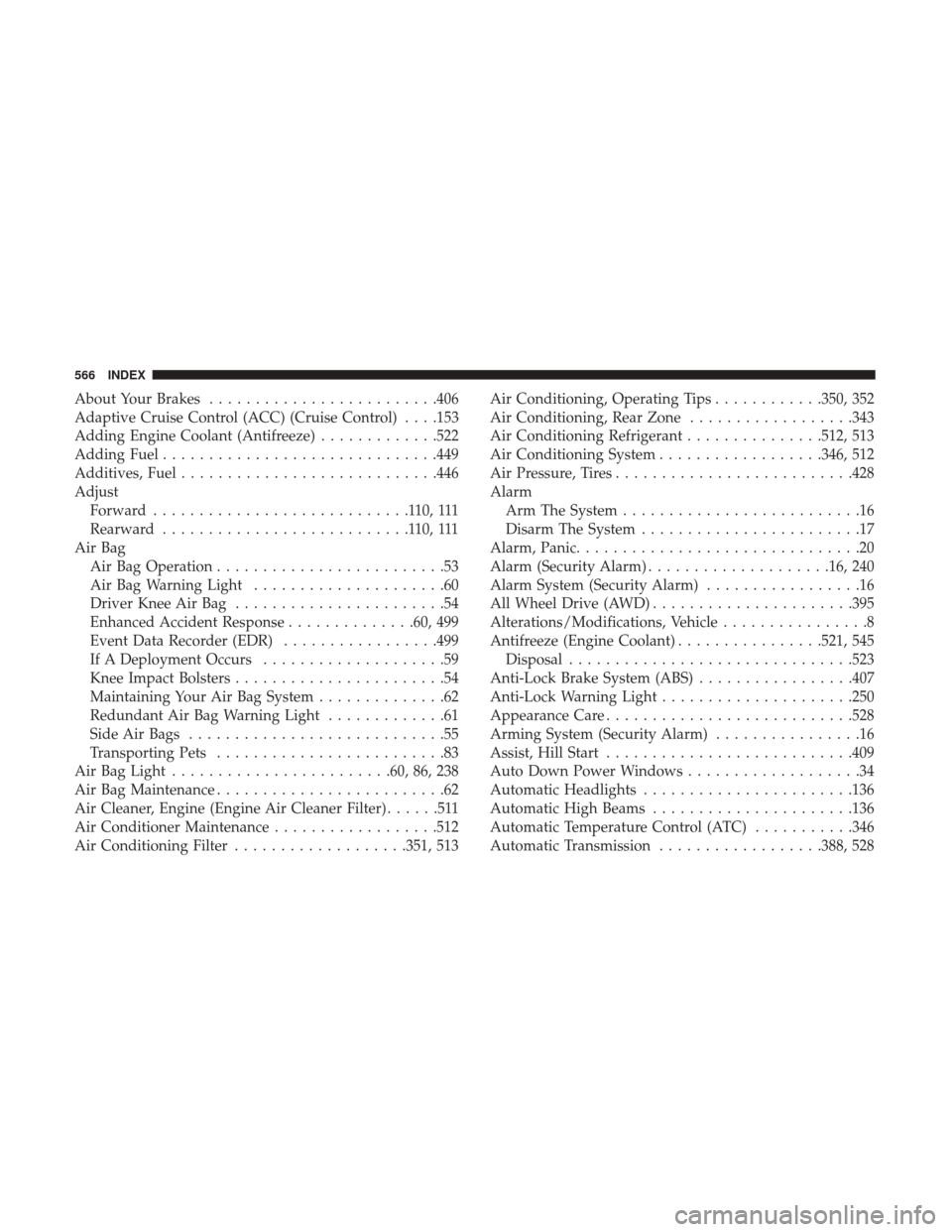
About Your Brakes........................ .406
Adaptive Cruise Control (ACC) (Cruise Control) . . . .153
Adding Engine Coolant (Antifreeze) .............522
Adding Fuel ............................. .449
Additives, Fuel ........................... .446
Adjust Forward ............................110,111
Rearward ...........................110,111
Air Bag Air Bag Operation .........................53
Air Bag Warning Light .....................60
Driver Knee Air Bag .......................54
Enhanced Accident Response ..............60, 499
Event Data Recorder (EDR) .................499
If A Deployment Occurs ....................59
Knee Impact Bolsters .......................54
Maintaining Your Air Bag System ..............62
Redundant Air Bag Warning Light .............61
Side Air Bags ............................55
Transporting Pets .........................83
Air Bag Light ....................... .60, 86, 238
Air Bag Maintenance .........................62
Air Cleaner, Engine (Engine Air Cleaner Filter) ......511
Air Conditioner Maintenance ..................512
Air Conditioning Filter ...................351, 513 Air Conditioning, Operating Tips
............350, 352
Air Conditioning, Rear Zone ..................343
Air Conditioning Refrigerant ...............512, 513
Air Conditioning System ..................346, 512
Air Pressure, Tires ......................... .428
Alarm Arm The System ..........................16
Disarm The System ........................17
Alarm, Panic ...............................20
Alarm (Security Alarm) ....................16, 240
Alarm System (Security Alarm) .................16
All Wheel Drive (AWD) ..................... .395
Alterations/Modifications, Vehicle ................8
Antifreeze (Engine Coolant) ................521, 545
Disposal .............................. .523
Anti-Lock Brake System (ABS) .................407
Anti-Lock Warning Light .....................250
Appearance Care .......................... .528
Arming
System (Security Alarm) ................16
Assist, Hill Start .......................... .409
Auto Down Power Windows ...................34
Automatic Headlights ...................... .136
Automatic High Beams ..................... .136
Automatic Temperature Control (ATC) ...........346
Automatic Transmission ..................388, 528
566 INDEX
Page 574 of 584
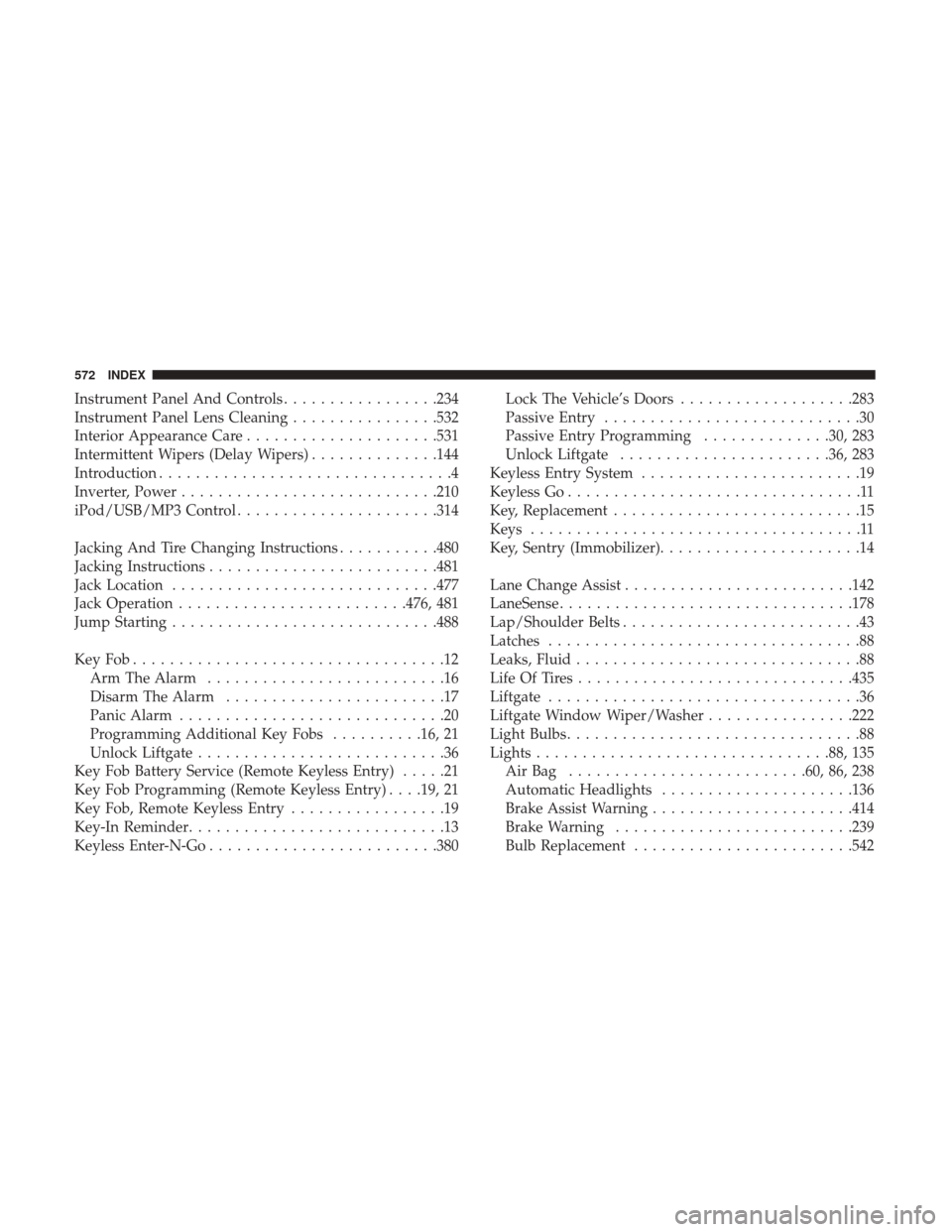
Instrument Panel And Controls.................234
Instrument Panel Lens Cleaning ................532
Interior Appearance Care .....................531
Intermittent Wipers (Delay Wipers) ..............144
Introduction ................................4
Inverter, Power ........................... .210
iPod/USB/MP3 Control ..................... .314
Jacking And Tire Changing Instructions ...........480
Jacking Instructions ........................ .481
Jack Location ............................ .477
Jack Operation ........................ .476, 481
Jump Starting ............................ .488
KeyFob..................................12 Arm The Alarm ..........................16
Disarm The Alarm ........................17
Panic Alarm .............................20
Programming Additional Key Fobs ..........16, 21
Unlock Liftgate ...........................36
Key Fob Battery Service (Remote Keyless Entry) .....21
Key Fob Programming (Remote Keyless Entry) . . . .19, 21
Key Fob, Remote Keyless Entry .................19
Key-In Reminder ............................13
Keyless Enter-N-Go ........................ .380Lock The Vehicle’s Doors
...................283
Passive Entry ............................30
Passive Entry Programming ..............30, 283
Unlock Liftgate ...................... .36, 283
Keyless Entry System ........................19
Keyless Go ................................11
Key, Replacement ...........................15
Keys ....................................11
Key, Sentry (Immobilizer) ......................14
Lane Change Assist ........................ .142
LaneSense ............................... .178
Lap/Shoulder Belts ..........................43
Latches ..................................88
Leaks, Fluid ...............................88
Life Of Tires ............................. .435
Liftgate ..................................36
Liftgate Window Wiper/Washer ................222
Light Bulbs ................................88
Lights ............................... .88,
135
AirBag ......................... .60, 86, 238
Automatic Headlights .....................136
Brake Assist Warning ..................... .414
Brake Warning ......................... .239
Bulb Replacement ....................... .542
572 INDEX