warning DODGE DURANGO 2018 Vehicle Warranty
[x] Cancel search | Manufacturer: DODGE, Model Year: 2018, Model line: DURANGO, Model: DODGE DURANGO 2018Pages: 316, PDF Size: 3.15 MB
Page 308 of 316
REPLACEMENT TIRES FOR LIGHT TRUCKS – P-METRIC VS.
LT-TRUCK
Tire installers should exercise extreme caution when replacing tires on
light trucks.
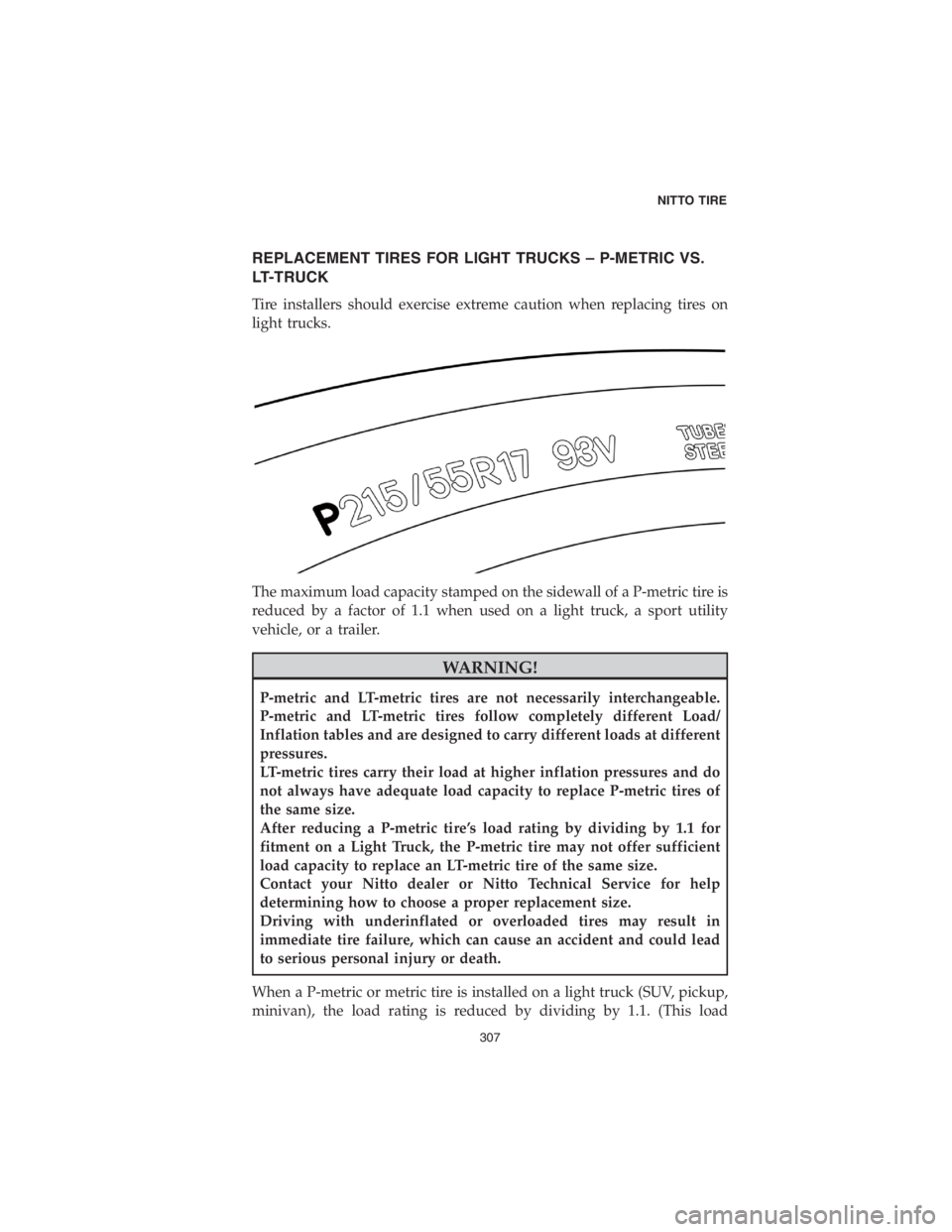
The maximum load capacity stamped on the sidewall of a P-metric tire is
reduced by a factor of 1.1 when used on a light truck, a sport utility
vehicle, or a trailer.
WARNING!
P-metric and LT-metric tires are not necessarily interchangeable.
P-metric and LT-metric tires follow completely different Load/
Inflation tables and are designed to carry different loads at different
pressures.
LT-metric tires carry their load at higher inflation pressures and do
not always have adequate load capacity to replace P-metric tires of
the same size.
After reducing a P-metric tire’s load rating by dividing by 1.1 for
fitment on a Light Truck, the P-metric tire may not offer sufficient
load capacity to replace an LT-metric tire of the same size.
Contact your Nitto dealer or Nitto Technical Service for help
determining how to choose a proper replacement size.
Driving with underinflated or overloaded tires may result in
immediate tire failure, which can cause an accident and could lead
to serious personal injury or death.
When a P-metric or metric tire is installed on a light truck (SUV, pickup,
minivan), the load rating is reduced by dividing by 1.1. (This load
NITTO TIRE
307
Page 309 of 316
reduction factor is prescribed by Federal Motor Vehicle Safety Standards
(FMVSS) and is based on the expectation that passenger-type tires may
experience more severe loading and usage conditions when applied to
light trucks.) For example, 305/50R20 has a maximum load capacity of
3086 lbs. If this tire is fitted to a light truck, the actual allowable load for
the tire is 2805 lbs. (3086 lbs. divided by 1.1).
Consult the load and inflation charts that can be found at
www.nittotire.com. Contact Nitto Technical Service with any tire re-
placement questions:
888-529-8200
Pacific Time.
VEHICLES WITH MODIFIED SUSPENSION
WARNING!
ROLLOVER HAZARD
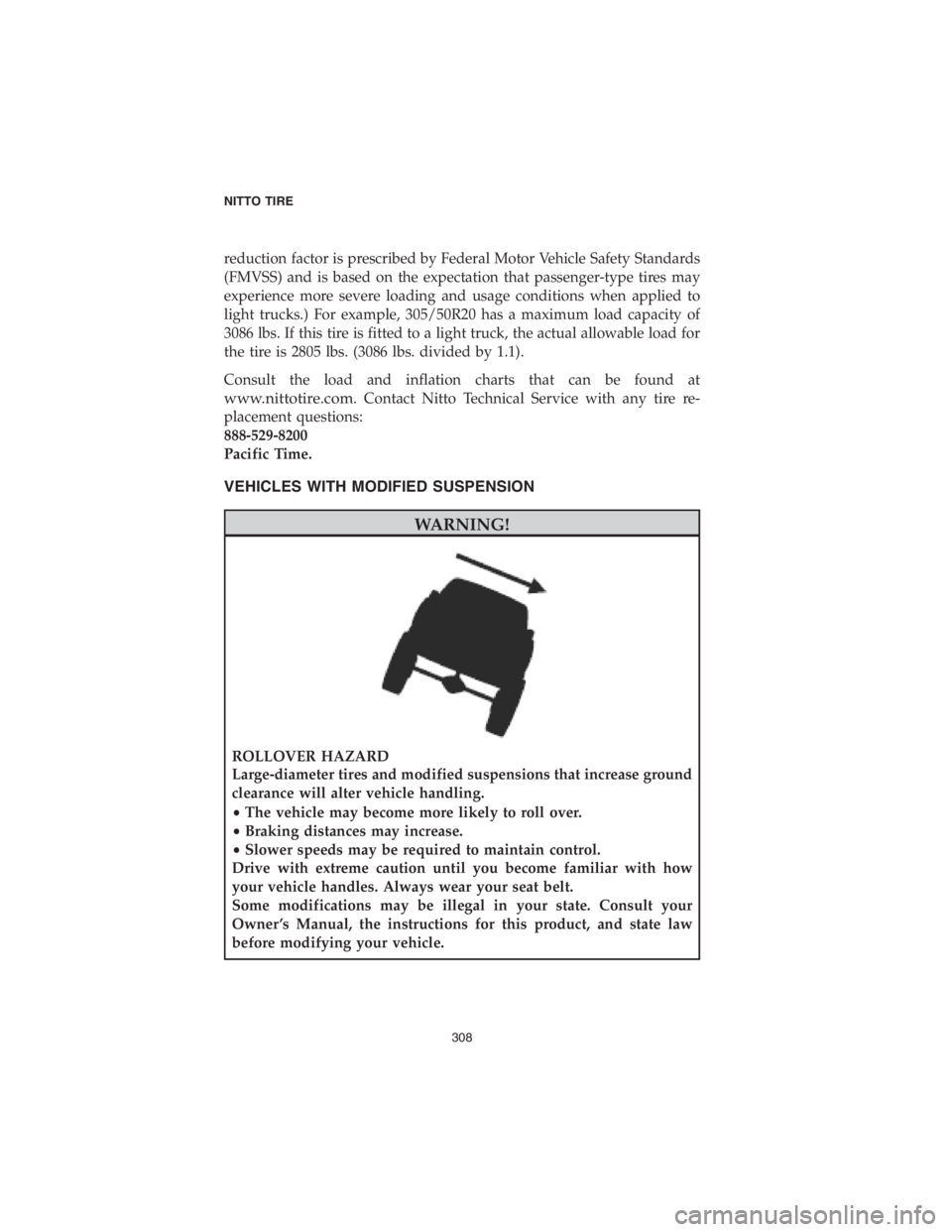
Large-diameter tires and modified suspensions that increase ground
clearance will alter vehicle handling.
•The vehicle may become more likely to roll over.
•Braking distances may increase.
•Slower speeds may be required to maintain control.
Drive with extreme caution until you become familiar with how
your vehicle handles. Always wear your seat belt.
Some modifications may be illegal in your state. Consult your
Owner ’s Manual, the instructions for this product, and state law
before modifying your vehicle.
NITTO TIRE
308
Page 310 of 316
USEFUL TIRE INFORMATION
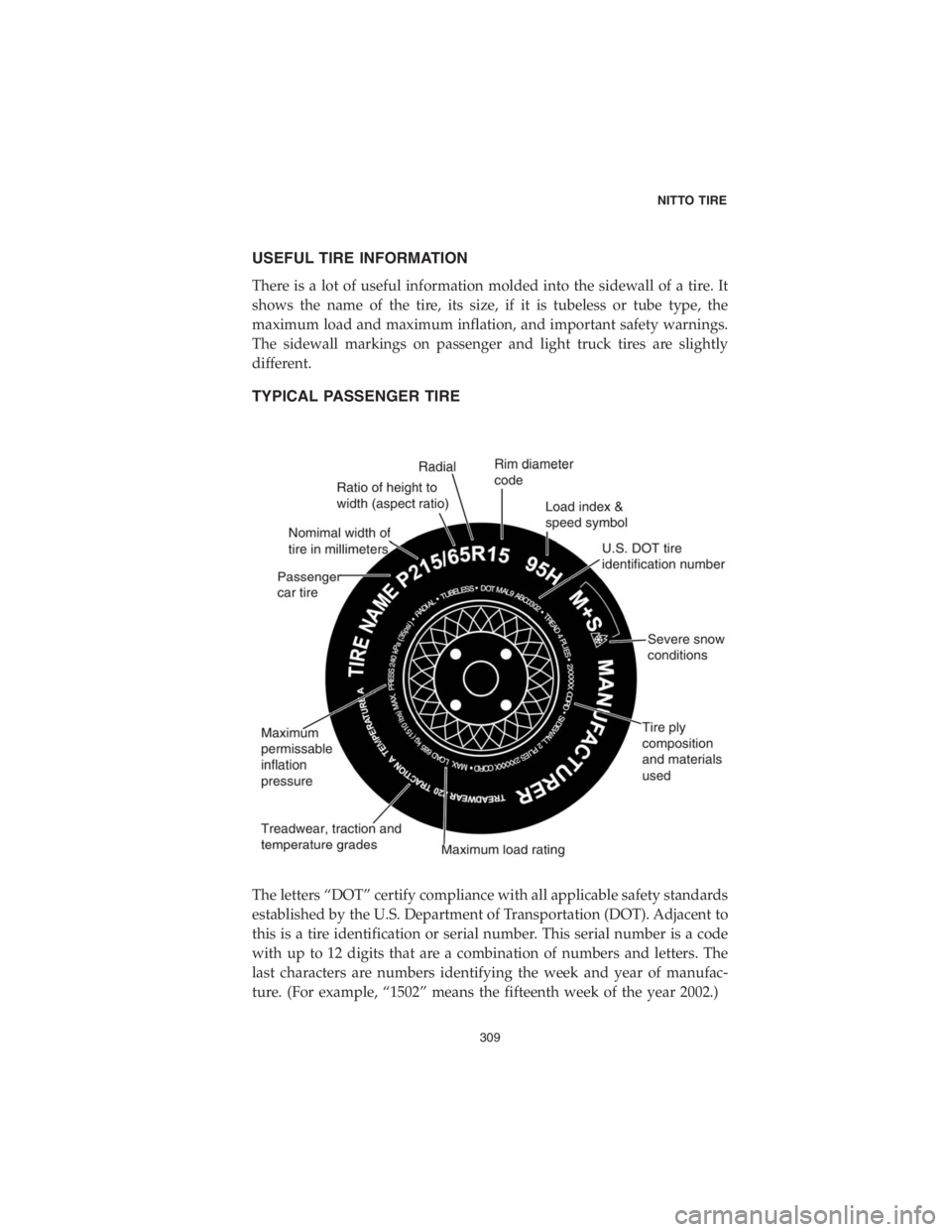
There is a lot of useful information molded into the sidewall of a tire. It
shows the name of the tire, its size, if it is tubeless or tube type, the
maximum load and maximum inflation, and important safety warnings.
The sidewall markings on passenger and light truck tires are slightly
different.
TYPICAL PASSENGER TIRE
The letters “DOT” certify compliance with all applicable safety standards
established by the U.S. Department of Transportation (DOT). Adjacent to
this is a tire identification or serial number. This serial number is a code
with up to 12 digits that are a combination of numbers and letters. The
last characters are numbers identifying the week and year of manufac-
ture. (For example, “1502” means the fifteenth week of the year 2002.)
NITTO TIRE
309
Page 312 of 316
•Treadwear - The treadwear grade is a comparative rating based on the
wear rate of the tire tested under controlled conditions on a specified
government test track. For example, a tire graded 200 would wear
twice as long on the government course as a tire graded 100. It is
wrong to link treadwear grades with your projected tire mileage. The
relative performance of the tires depends upon the actual conditions of
their use and may vary due to driving habits, service practices,
differences in road characteristics, and climate.
•Traction - The traction grades from highest to lowest are AA, A, B, and
C, and they represent the tire’s ability to stop on wet pavement as
measured under controlled conditions on specified government test
surfaces of asphalt and concrete.
mNOTICE!
The traction grade assigned to tires is based on locked braking (straight
ahead) traction tests and does not include cornering (turning) traction.
•Temperature - The temperature grades are A (the highest), B, and C,
representing the tire’s resistance to the generation of heat and its ability
to dissipate heat when tested under controlled conditions on a
specified indoor laboratory test wheel. Sustained high temperatures
can cause the materials of the tire to degenerate and reduce tire life,
and excessive temperature can lead to sudden tire failure. The grade C
corresponds to a level of performance that all passenger car tires must
meet under the Federal Motor Vehicle Safety Standard No. 139. Grades
B and A represent higher levels of performance on the laboratory test
wheel than the minimum required by law.
WARNING!
The temperature grade is established for a tire that is properly
inflated and not overloaded. Excessive speed, underinflation, or
excessive loading either separately or in combination can cause heat
buildup and possible tire failure. This can cause an accident, which
could lead to serious personal injury or death.
•DOT Quality Grades - All passenger car tires must conform to federal
requirements in addition to these grades.
NITTO TIRE
311