lug DODGE DURANGO 2018 Vehicle Warranty
[x] Cancel search | Manufacturer: DODGE, Model Year: 2018, Model line: DURANGO, Model: DODGE DURANGO 2018Pages: 316, PDF Size: 3.15 MB
Page 231 of 316
•Inspect your tires for adequate tread depth. When the tire is worn to
the built-in indicators at 2/32” (1.6 mm) or less tread groove depth, the
tire is worn out and must be replaced. Never drive on tires to the point
that the tire cord or the fabric is exposed.
•Inspect your tires for uneven wear. Wear on one side of the tread or flat
spots in the tread may indicate alignment or other problems with the
tires or the vehicle. Consult your authorized Toyo Tires dealer.
WARNING!
Never drive on a tire if there is any evidence of damage. Driving on
a damaged tire is dangerous. A damaged tire could suddenly fail,
which may result in loss of vehicle control and lead to serious
personal injury or death. Do not attempt to dismount, mount, or
repair a tire yourself. See your Toyo Tires dealer immediately if you
detect damage.
IDENTIFYING DAMAGED WHEELS
Periodically check to see if any of the following symptoms exist, in which
case the wheel must be replaced:
•If the flange is bent.
•If welds or rivets are leaking.
•If the stud holes are elongated and not round. (Improper lug nut
tightening could cause this.)
•If there are cracks in the wheel.
WORN OUT TIRES
Tires must be replaced when tread is worn to 2/32” (1.6 mm). Treadwear
indicators on Toyo tire treads show the 2/32” depth (1.6 mm). Most states
require that tires be replaced when the tread depth is worn to 2/32”
(1.6 mm). Tires may lose sufficient wet and snow traction before reaching
2/32” (1.6 mm) of wear. Many wet weather accidents result from
skidding on worn out tires.
Excessively worn tires are more susceptible to penetrations. Consider
replacing your tires earlier if you drive in snow or wet conditions.
TOYO TIRES – LIMITED WARRANTY
230
Page 232 of 316
WARNING!
Continued operation of your vehicle with excessively worn tires
may lead to loss of vehicle control in adverse weather conditions,
tire failure, and serious personal injury or death.
Any retail tire dealer will be glad to measure your tire’s tread depth for you.
Toyo Tires recommends that tires be replaced in matched sets of four.
TIRE REPAIRS
If any tire has sustained a puncture, have the tire dismounted and
inspected internally by an authorized Toyo Tires dealer for possible
damage that may have occurred. Only specially trained personnel using
the proper tools and procedures should repair tires.
WARNING!
•Before having your tire repaired, tell your authorized Toyo Tires
dealer if you have used an aerosol puncture sealant to inflate/ seal
the tire. Aerosol puncture sealants could contain a highly flam-
mable, explosive gas.
•Driving on an improperly repaired tire is dangerous. An improper
repair can cause further damage to the tire. It could fail suddenly,
which can result in loss of vehicle control and lead to serious
personal injury or death. To insure safety, go to your authorized
Toyo Tires dealer for professional inspection and proper tire
repairs.
•Cosmetic Tire Alterations Can Be Dangerous! Remember — Do not
perform or allow anyone to perform any alterations to your tires.
Alterations may prevent proper performance, leading to tire dam-
age, which could result in sudden tire failure and loss of vehicle
control and lead to serious personal injury or death.
•Never repair a tire with 2/32” (1.6 mm) or less tread remaining. At this
tread depth, the tire is worn out and must be replaced.
•Never repair a tire with a puncture larger than 1/4” (6.4 mm) in
diameter. Such tires cannot be properly repaired and must be replaced.
•Repairs of all tires (radial and non-radial) must be of the plug and
inside patch type. Using plugs alone on any type of tire is not a safe
repair.
TOYO TIRES – LIMITED WARRANTY
231
Page 233 of 316
•Do not use a rope type plug for repair. A tire must be removed from the
wheel and inspected for interior damage. Any tire repair done without
removing the tire from the wheel is improper and unsafe.
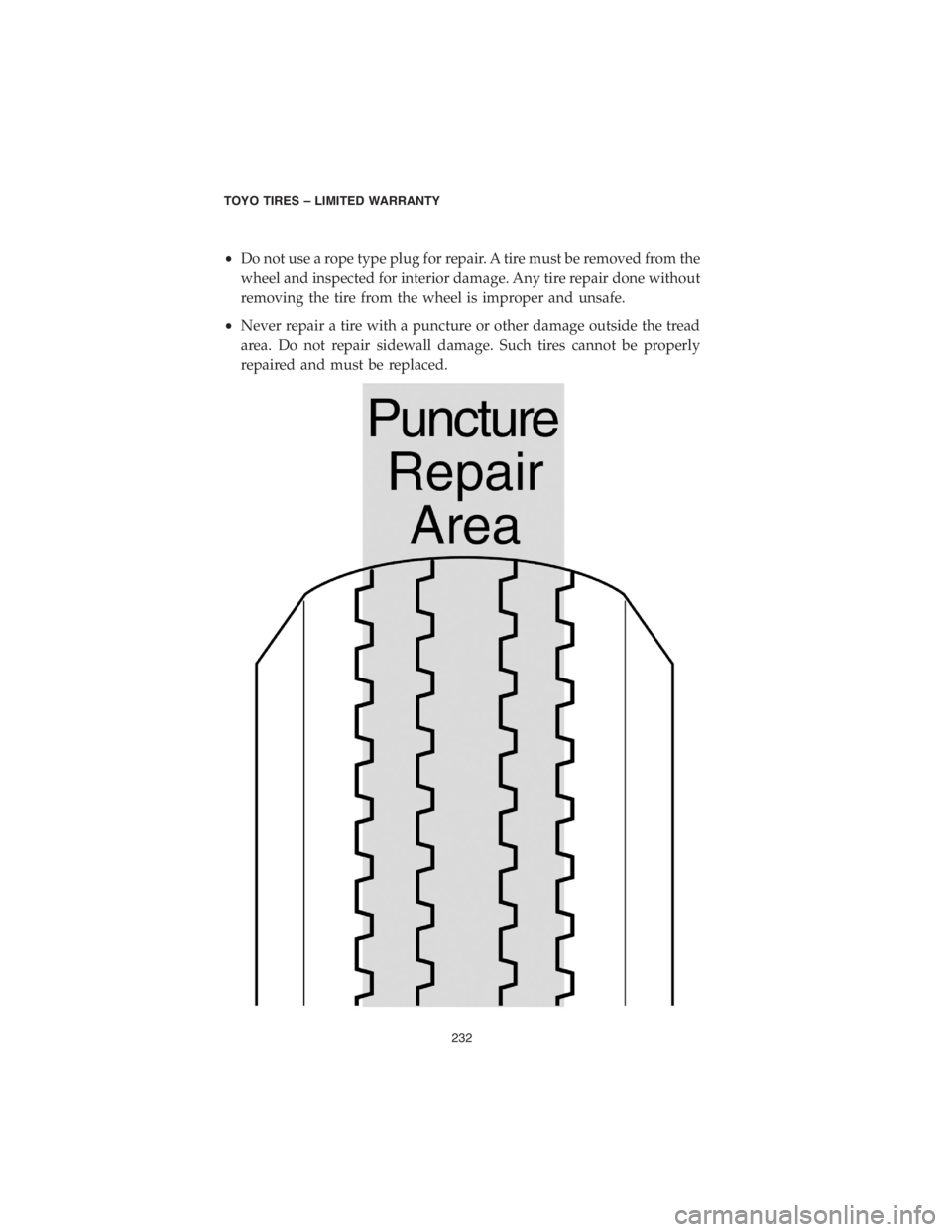
•Never repair a tire with a puncture or other damage outside the tread
area. Do not repair sidewall damage. Such tires cannot be properly
repaired and must be replaced.
TOYO TIRES – LIMITED WARRANTY
232
Page 285 of 316
•Inspect your tires for adequate tread depth. When the tire is worn to
the built-in indicators at 2/32” (1.6 mm) or less tread groove depth, the
tire is worn out and must be replaced. Never drive on tires to the point
that the tire cord or the fabric is exposed.
•Inspect your tires for uneven wear. Wear on one side of the tread or flat
spots in the tread may indicate alignment or other problems with the
tires or the vehicle. Consult your authorized Nitto dealer.
WARNING!
Never drive on a tire if there is any evidence of damage. Driving on
a damaged tire is dangerous. A damaged tire could suddenly fail,
which may result in loss of vehicle control and lead to serious
personal injury or death. Do not attempt to dismount, mount, or
repair a tire yourself. See your Nitto dealer immediately if you
detect damage.
IDENTIFYING DAMAGED WHEELS
Periodically check to see if any of the following symptoms exist, in which
case the wheel must be replaced:
•If the flange is bent.
•If welds or rivets are leaking.
•If the stud holes are elongated and not round. (Improper lug nut
tightening could cause this.)
•If there are cracks in the wheel.
WORN OUT TIRES
Tires must be replaced when tread is worn to 2/32” (1.6 mm). Treadwear
indicators on Nitto tire treads show the 2/32” depth (1.6 mm). Most
states require that tires be replaced when the tread depth is worn to 2/32”
(1.6 mm). Tires may lose sufficient wet and snow traction before reaching
2/32” (1.6 mm) of wear. Many wet weather accidents result from
skidding on worn out tires.
Excessively worn tires are more susceptible to penetrations. Consider
replacing your tires earlier if you drive in snow or wet conditions.
NITTO TIRE
284
Page 286 of 316
WARNING!
Continued operation of your vehicle with excessively worn tires
may lead to loss of vehicle control in adverse weather conditions,
tire failure, and serious personal injury or death.
Any retail tire dealer will be glad to measure your tire’s tread depth for
you. Nitto recommends that tires be replaced in matched sets of four.
TIRE REPAIRS
If any tire has sustained a puncture, have the tire dismounted and
inspected internally by an authorized Nitto dealer for possible damage
that may have occurred. Only specially trained personnel using the
proper tools and procedures should repair tires.
WARNING!
Before having your tire repaired, tell your authorized Nitto dealer if
you have used an aerosol puncture sealant to inflate/seal the tire.
Aerosol puncture sealants could contain a highly flammable,
explosive gas.
Driving on an improperly repaired tire is dangerous. An improper
repair can cause further damage to the tire. It could fail suddenly,
which can result in loss of vehicle control and lead to serious
personal injury or death. To insure safety, go to your authorized
Nitto dealer for professional inspection and proper tire repairs.
Cosmetic Tire Alterations Can Be Dangerous! Remember — Do not
perform or allow anyone to perform any alterations to your tires.
Alterations may prevent proper performance, leading to tire
damage, which could result in sudden tire failure and loss of vehicle
control and lead to serious personal injury or death.
•Never repair a tire with 2/32” (1.6 mm) or less tread remaining. At this
tread depth, the tire is worn out and must be replaced.
•Never repair a tire with a puncture larger than ¼” (6.4 mm) in
diameter. Such tires cannot be properly repaired and must be replaced.
•Repairs of all tires (radial and non-radial) must be of the plug and
inside patch type. Using plugs alone on any type of tire is not a safe
repair.
NITTO TIRE
285
Page 287 of 316
•Do not use a rope type plug for repair. A tire must be removed from the
wheel and inspected for interior damage. Any tire repair done without
removing the tire from the wheel is improper and unsafe.
•Never repair a tire with a puncture or other damage outside the tread
area. Do not repair sidewall damage. Such tires cannot be properly
repaired and must be replaced.
“See illustration on next page”
NITTO TIRE
286