tires DODGE DURANGO 2018 Vehicle Warranty
[x] Cancel search | Manufacturer: DODGE, Model Year: 2018, Model line: DURANGO, Model: DODGE DURANGO 2018Pages: 316, PDF Size: 3.15 MB
Page 237 of 316
WARNING!(Continued)
•Exceeding the maximum bead seating pressure of 40 psi. Be
absolutely certain beads are fully seated before adjusting the
inflation pressure to the level recommended for vehicle operation.
Never put flammable substances in the tire/wheel assemblies at any
time. Never put any flammable substance into a tire/wheel assembly
and attempt to ignite it in order to seat the beads.
TIRE MIXING
CAUTION!
Driving your vehicle with an improper mix of tire sizes,
constructions, and speed ratings can be dangerous. Your car ’s
handling characteristics can be adversely affected. You could have
an accident resulting in serious personal injury or death. Consult
your vehicle Owner ’s Manual or an authorized Toyo Tires dealer for
proper tire replacement.
•Toyo Tires recommends that all four tires be of the same size, speed
rating, and construction (radial or non-radial). In some cases the
vehicle manufacturer may require different sized tires for the front or
rear axles. Never mix P-metric or European Metric passenger tires with
LT-metric tires on the same vehicle.
•Match tire size designations in pairs on an axle, except during the
temporary use of a spare tire.
•If two radial tires and two non-radial tires are used on a vehicle, put
the radials on the rear axle. If radial and non-radial tires are used on a
vehicle equipped with dual rear tires, the radial tires may be used on
either axle.
SPEED-RATED TIRE
•If the vehicle Tire Information Placard and/or the vehicle Owner ’s
Manual specifies speed-rated tires, the replacement tires must have the
same or higher speed rating to maintain vehicle speed capability.
•If a replacement tire has a lower speed capability than that specified by
the vehicle manufacturer, the vehicle’s speed must be restricted to that
TOYO TIRES – LIMITED WARRANTY
236
Page 238 of 316
of the replacement tire. Vehicle handling could also be affected.
Consult the vehicle Owner ’s Manual or tire manufacturer for
recommendations.
•If tires with different speed ratings are used, it is recommended that
the lowerspeed- rated tires always be placed on the front axle. This is
to prevent a potential oversteer condition.
FOUR-WHEEL DRIVE (4WD) AND ALL-WHEEL DRIVE (AWD)
VEHICLES
If no instructions for tire mixing appear in the vehicle Owner ’s Manual,
follow these guidelines:
•Do not mix tire sizes. All four tires must be marked with the same tire
size, unless otherwise specified by the vehicle manufacturer. This also
applies to winter/snow tires.
•Do not mix tread pattern types such as all-terrain and all- season.
STUDLESS WINTER/SNOW TIRES
•It is always preferable to apply winter/snow tires to all wheel
positions, including dual tires, to maintain vehicle mobility and
control.
•If winter/snow tires are applied to the front axle of any vehicle,
winter/snow tires must also be installed on the rear axle. DO NOT
apply winter/snow tires only to the front axle. This applies to all
passenger and light truck vehicles, including front-wheel- drive, 4WD,
and AWD vehicles.
•If winter/snow tires are installed on the rear axle of any vehicle, it is
recommended (but not required) that they also be installed on the front
axle.
WARNING!
Unless winter/snow tires on the rear axle have comparable traction
qualities to the tires on the front axle, the vehicle may experience
adverse handling characteristics. This may result in loss of vehicle
control, which can lead to serious personal injury or death.
TOYO TIRES – LIMITED WARRANTY
237
Page 239 of 316
STUDDED WINTER/SNOW TIRES
•Studded winter/snow tires have higher traction qualities under most
winter weather conditions.
•If studded winter/snow tires are installed on the front axle of any
vehicle, studded winter/snow tires must also be installed on the rear
axle. DO NOT apply studded winter/snow tires only to the front axle.
•If studded winter/snow tires are installed on the rear axle of any
vehicle, it is strongly recommended that they should also be installed
on the front axle. Only if studded winter/snow tires are installed on all
wheel positions of a vehicle will optimum handling characteristics be
achieved.
WARNING!
Installing only two studded winter/snow tires on the front axle of
any vehicle (including front-wheel-drive vehicles) without studded
winter/snow tires on the rear axle can cause adverse vehicle
handling characteristics. This can result in a loss of vehicle control,
which could cause serious personal injury or death.
mNOTICE!
In some cases, the vehicle manufacturer may specifically advise against
replacing fewer than all four tires. Always check and follow the
recommendations in the vehicle Owner’s Manual. For 4WD and AWD
vehicles, even small differences in outside diameter may cause drivetrain
damage or mechanical malfunction.
REPLACING TWO TIRES
•When a pair of replacement tires is selected in the same size and
construction as those on the vehicle, the two newer tires must be
installed on the rear axle and must be of equal or higher speed rating
than the front tires. Generally, new tires with deeper tread will provide
better grip and evacuate water more effectively, which is important as
a driver approaches hydroplaning situations. Placing greater traction
on the rear axle on wet surfaces is necessary to prevent a possible
oversteer condition and loss of vehicle stability.
TOYO TIRES – LIMITED WARRANTY
238
Page 240 of 316
•When two new tires have been installed onto the rear axle positions,
they are to be kept on the rear but rotated from side to side. This is
recommended after installing two new tires to the rear position, or if
you discover significant tread depth differences between the front and
rear positions during rotation intervals.
REPLACING ONE TIRE
•Replacing a single tire on a vehicle can have an adverse effect on
suspension systems, gear ratios, transmission, and tire treadwear.
•If single tire replacement is unavoidable, it is recommended that the
single new tire be paired with the tire that has the deepest tread and
both be placed on the rear axle. Placing greater traction on the rear axle
on wet surfaces is necessary to prevent a possible oversteer condition
and loss of vehicle stability.
WHEEL ALIGNMENT AND BALANCING
•Proper wheel alignment and balance are very important consider-
ations for safety and getting the maximum mileage from your tires.
You need to check how your tires are wearing at least once a month.
•Your vehicle may be out of alignment if your tires are wearing
unevenly, such as when the inside shoulder of the tire is wearing faster
than the rest of the tread. This condition not only shortens the life of
your tires, it adversely affects the handling characteristics of your
vehicle, which could be dangerous. If your tires show irregular wear,
have your vehicle’s alignment checked immediately.
TOYO TIRES – LIMITED WARRANTY
239
Page 241 of 316
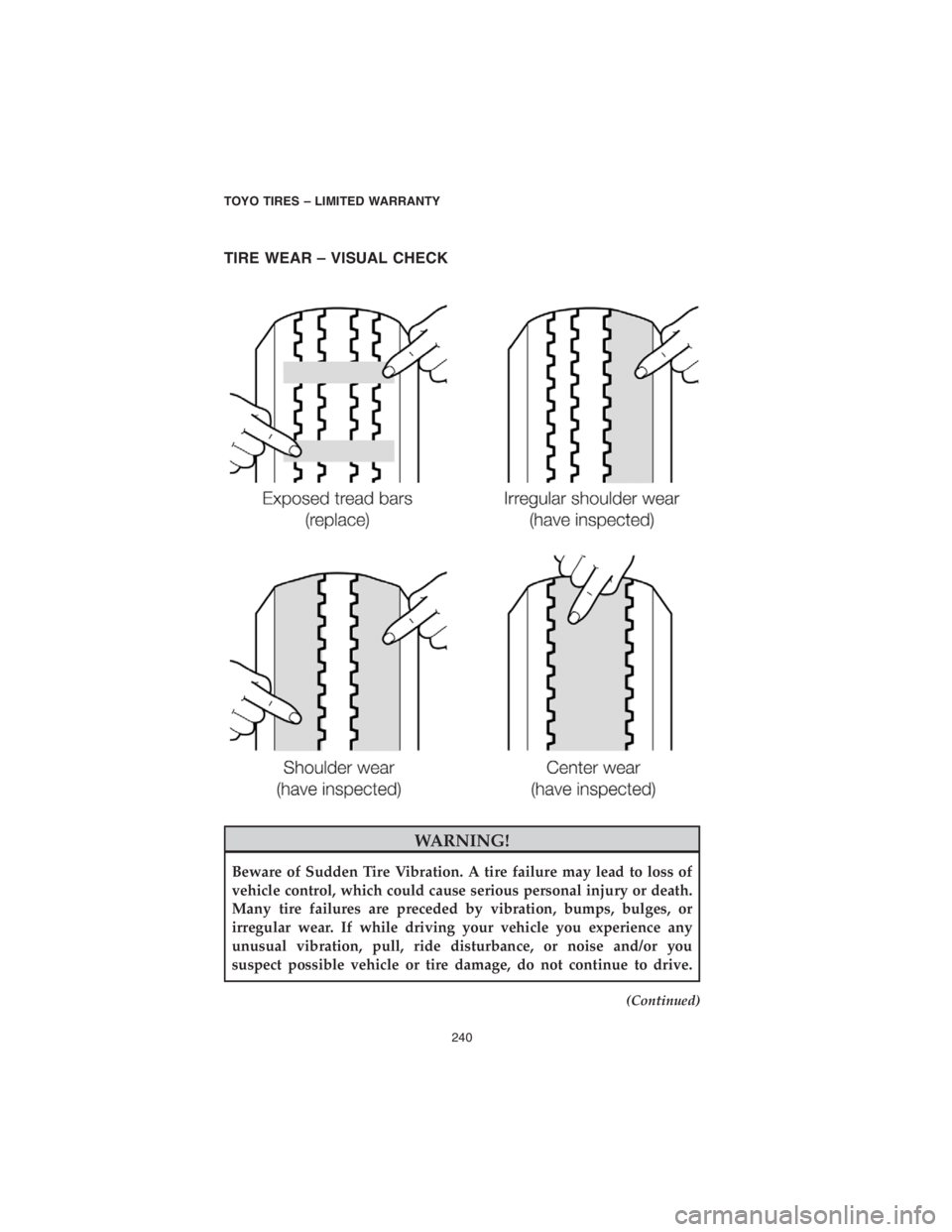
TIRE WEAR – VISUAL CHECK
WARNING!
Beware of Sudden Tire Vibration. A tire failure may lead to loss of
vehicle control, which could cause serious personal injury or death.
Many tire failures are preceded by vibration, bumps, bulges, or
irregular wear. If while driving your vehicle you experience any
unusual vibration, pull, ride disturbance, or noise and/or you
suspect possible vehicle or tire damage, do not continue to drive.
(Continued)
TOYO TIRES – LIMITED WARRANTY
240
Page 242 of 316
WARNING!(Continued)
Pull over to a safe area as soon as possible and inspect the tires for
signs of bulges, blisters, or separations. Seek roadside assistance or
change the damaged tire with your spare tire.
If you experience a blowout or a sudden tire failure, the following
information should be helpful:
•When the tire failure occurs, you may hear a loud noise, or feel a
vibration, and/or the vehicle may pull toward the side of the failed
tire. Do not abruptly brake or turn.
•Maintain steady pressure on the accelerator pedal.
•Hold the steering wheel firmly and steer to maintain your lane
position.
•Find a safe place to pull off the road and allow the vehicle to gradually
decelerate. Apply light braking as required to stop safely.
•Gradually pull over to the shoulder and come to a stop. Look for a
damaged tire on your vehicle.
•Seek roadside assistance or change the damaged tire with your spare
tire.
•Have all of your tires and the vehicle thoroughly inspected by a tire
professional.
TIRE ROTATION
The purpose for rotating tires is to achieve more uniform wear for all tires
on a vehicle. Your tires should be thoroughly examined on a lift by a tire
dealer for any abnormalities. If tires show uneven treadwear, ask the
service person to check and/or correct any vehicle wheel alignment or
other mechanical problem before rotation.
The following rotation patterns are acceptable. Please refer to your
vehicle Owner ’s Manual for rotation advice.
TOYO TIRES – LIMITED WARRANTY
241
Page 243 of 316
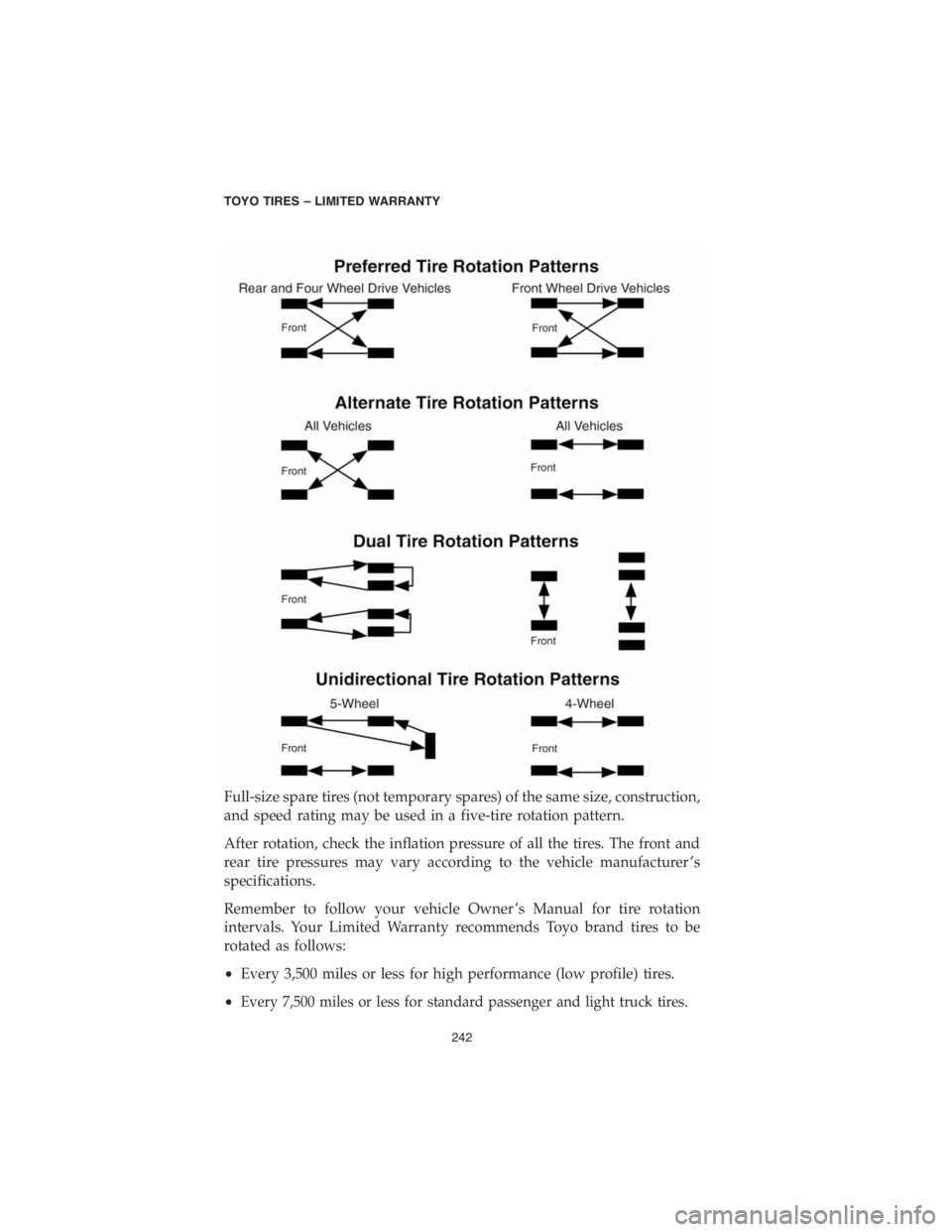
Full-size spare tires (not temporary spares) of the same size, construction,
and speed rating may be used in a five-tire rotation pattern.
After rotation, check the inflation pressure of all the tires. The front and
rear tire pressures may vary according to the vehicle manufacturer ’s
specifications.
Remember to follow your vehicle Owner ’s Manual for tire rotation
intervals. Your Limited Warranty recommends Toyo brand tires to be
rotated as follows:
•Every 3,500 miles or less for high performance (low profile) tires.
•
Every 7,500 miles or less for standard passenger and light truck tires.
TOYO TIRES – LIMITED WARRANTY
242
Page 244 of 316
More frequent rotation or a thorough vehicle inspection may be necessary
if, upon inspection, irregular or erratic treadwear is beginning to appear.
It is important to remember the following:
•These tire rotation recommendations do not take into account different
tire and construction types mixed on the vehicle.
•Some tires cannot be rotated in the manner described. Such tires
include unidirectional tires. Unidirectional tread patterns must be
rotated front-to-rear only so that the direction of revolution does not
change.
•Some vehicles are designed with different tire sizes on the front and
rear axles. Normally, such combinations will not allow rotation. Prior
to rotating, consult the vehicle Owner ’s Manual.
•For vehicles with dual rear wheels, see the vehicle Owner ’s Manual for
the vehicle manufacturer ’s procedures. If your vehicle Owner ’s
Manual is not available, please contact the vehicle manufacturer.
•Some vehicles are equipped with wheels that limit the choice of
rotation pattern. Consult the vehicle Owner ’s Manual.
•Do not include temporary spare tires in the rotation pattern. However,
if your spare tire is the same size and type as a road tire (for LT tires
of the same size, type, and load rating), it should be included in the tire
rotation process. The proper procedure is to use the vehicle manufac-
turer ’s recommended tire rotation procedures, or if not available, to
use the appropriate rotation pattern shown, inserting the spare in the
right rear position. Place the tire that would have gone to the right rear
in the spare tire storage position as the new spare.
•Important! After rotation, adjust the pressure of the individual tires to
the vehicle manufacturer ’s recommendation or the inflation pressure
recommended by Toyo Tires for an optional fitment according to the
tire’s new location on the vehicle.
•Do not mix speed-rated tires on the same axle. Higher speed-rated tires
must remain on the rear axle. Consult your authorized Toyo Tires
dealer.
TOYO TIRES – LIMITED WARRANTY
243
Page 245 of 316
TIRE SPEED RATING
All Toyo Tires passenger, light truck, and truck tires have a maximum
speed rating based on size and type. Tires must never be operated in
excess of their rated speed limit! Consult your tire dealer or contact Toyo
Tires at 1-800-442-8696 (Pacific Time) or 1-888-444-8696 (Eastern Time) if
you are not sure about the maximum speed rating of your tires.
WARNING!
No tire, regardless of its design or speed rating, has an unlimited
capacity for speed. Exceeding the tire’s speed capability could cause
overheating and sudden tire failure, possibly leading to loss of
vehicle control and serious personal injury or death.
Toyo Tires does not endorse the operation of any vehicle in an unsafe or
unlawful manner. Obey all local speed limits.
Tire speed ratings do not imply that a vehicle can be safely driven at the
speed for which the tire is rated. Speed ratings are based on laboratory
tests and relate to performance on the road, but are not applicable if tires
are underinflated, overloaded, worn out, damaged, or altered.
WARNING!
High-speed driving with underinflated or overloaded tires may
result in immediate tire failure, possibly leading to loss of vehicle
control, which could cause an accident, including serious personal
injury or death.
TOYO TIRES – LIMITED WARRANTY
244
Page 246 of 316
EXPLANATION OF TIRE SPEED SYMBOLS
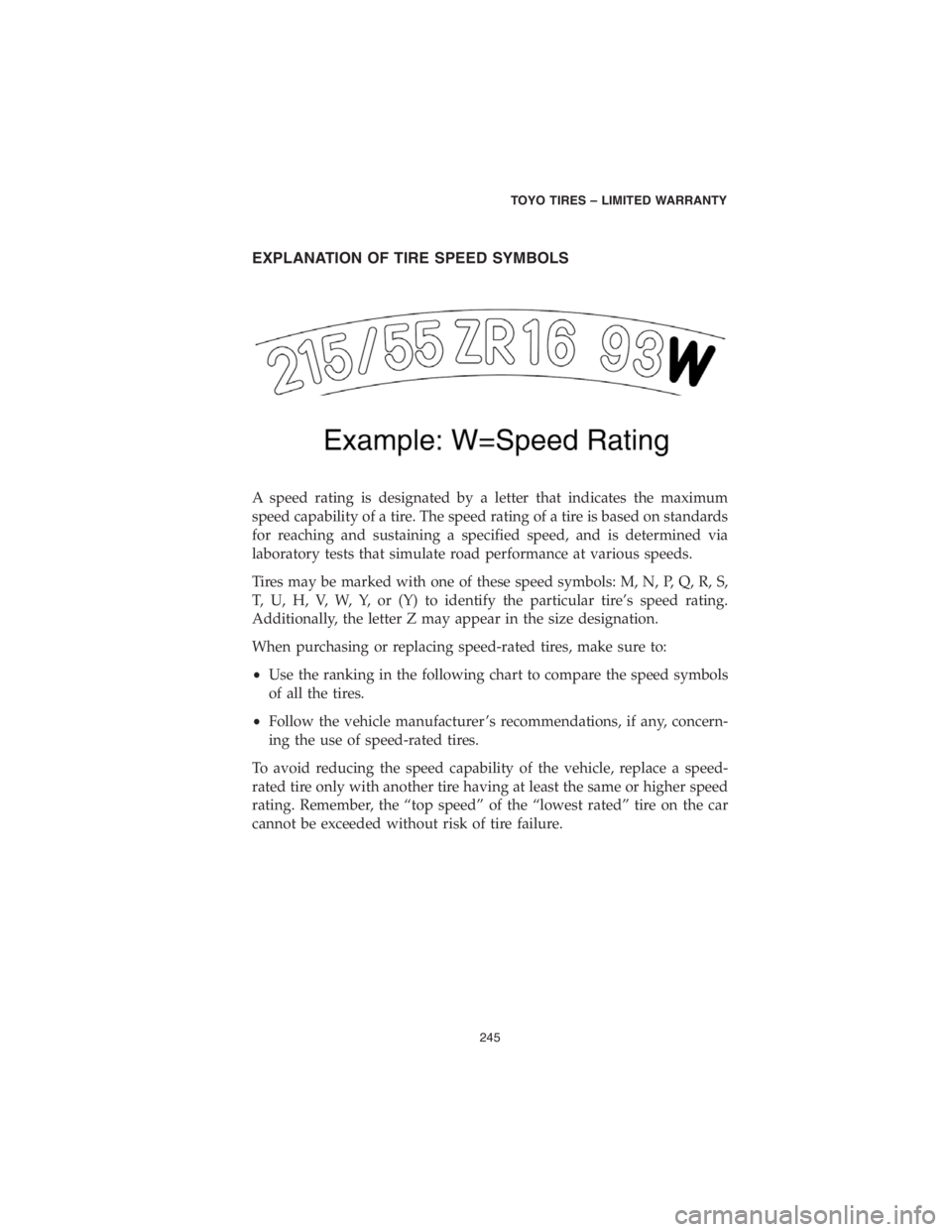
A speed rating is designated by a letter that indicates the maximum
speed capability of a tire. The speed rating of a tire is based on standards
for reaching and sustaining a specified speed, and is determined via
laboratory tests that simulate road performance at various speeds.
Tires may be marked with one of these speed symbols: M, N, P, Q, R, S,
T, U, H, V, W, Y, or (Y) to identify the particular tire’s speed rating.
Additionally, the letter Z may appear in the size designation.
When purchasing or replacing speed-rated tires, make sure to:
•Use the ranking in the following chart to compare the speed symbols
of all the tires.
•Follow the vehicle manufacturer ’s recommendations, if any, concern-
ing the use of speed-rated tires.
To avoid reducing the speed capability of the vehicle, replace a speed-
rated tire only with another tire having at least the same or higher speed
rating. Remember, the “top speed” of the “lowest rated” tire on the car
cannot be exceeded without risk of tire failure.
TOYO TIRES – LIMITED WARRANTY
245