air condition DODGE DURANGO 2018 Vehicle Warranty
[x] Cancel search | Manufacturer: DODGE, Model Year: 2018, Model line: DURANGO, Model: DODGE DURANGO 2018Pages: 316, PDF Size: 3.15 MB
Page 223 of 316
TIRE SAFETY AND MAINTENANCE INFORMATION
IMPORTANT SAFETY INFORMATION
This manual is not intended to provide proper training or service
procedures for tire mounting, dismounting, balancing, rotation, or repair.
Please leave these tasks to qualified tire service professionals.
mNOTICE!
•Toyo brand tires are designed and built with great care. Any tire, no matter
how well constructed, can fail as a result of punctures, impact damage,
underinflation/overloading or other conditions resulting from use. Tire
failures may create a risk of property damage or personal injury. To obtain
the highest possible performance, tires must be maintained properly.
•Remember, you are ultimately responsible for the tires installed on your
vehicle.
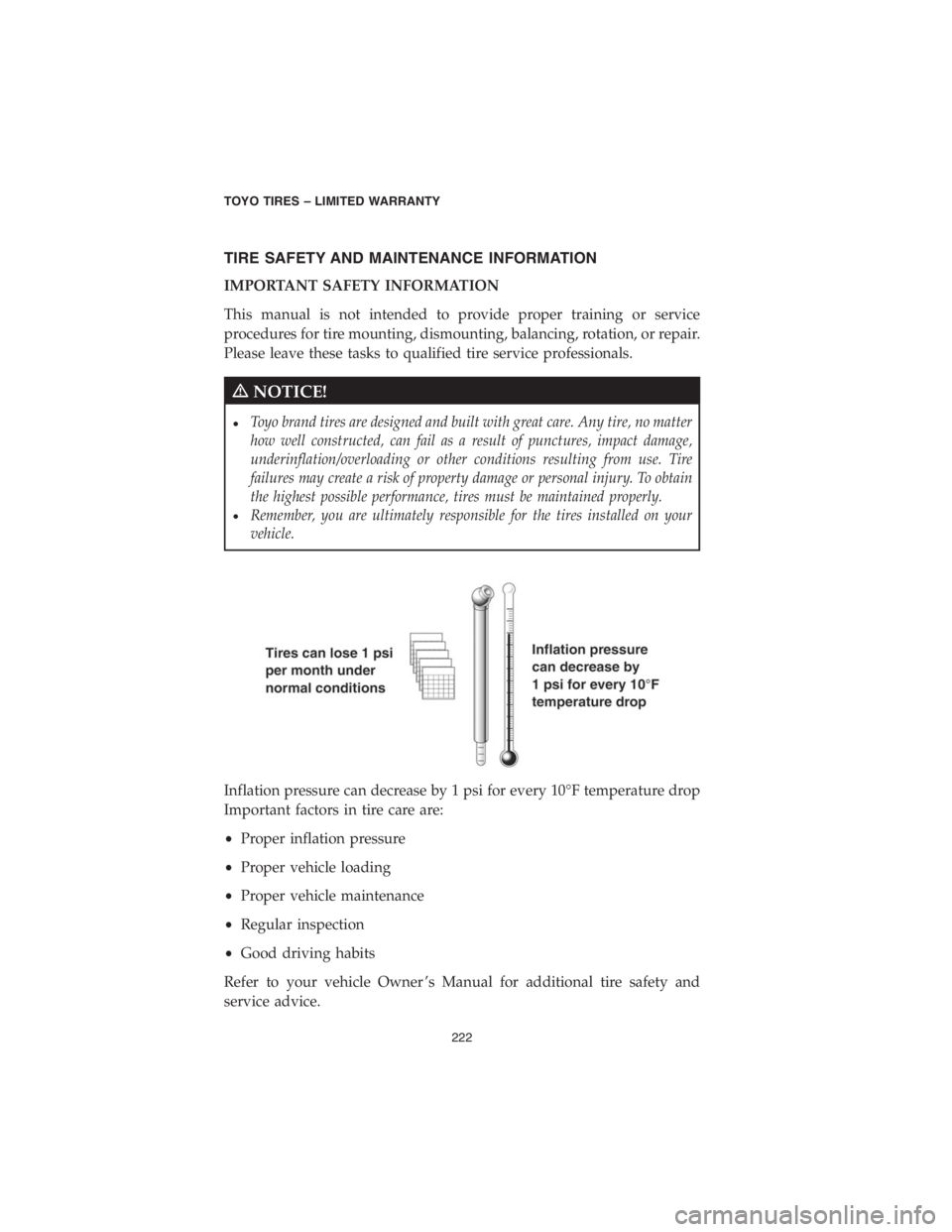
Inflation pressure can decrease by 1 psi for every 10°F temperature drop
Important factors in tire care are:
•Proper inflation pressure
•Proper vehicle loading
•Proper vehicle maintenance
•Regular inspection
•Good driving habits
Refer to your vehicle Owner ’s Manual for additional tire safety and
service advice.
TOYO TIRES – LIMITED WARRANTY
222
Page 231 of 316
•Inspect your tires for adequate tread depth. When the tire is worn to
the built-in indicators at 2/32” (1.6 mm) or less tread groove depth, the
tire is worn out and must be replaced. Never drive on tires to the point
that the tire cord or the fabric is exposed.
•Inspect your tires for uneven wear. Wear on one side of the tread or flat
spots in the tread may indicate alignment or other problems with the
tires or the vehicle. Consult your authorized Toyo Tires dealer.
WARNING!
Never drive on a tire if there is any evidence of damage. Driving on
a damaged tire is dangerous. A damaged tire could suddenly fail,
which may result in loss of vehicle control and lead to serious
personal injury or death. Do not attempt to dismount, mount, or
repair a tire yourself. See your Toyo Tires dealer immediately if you
detect damage.
IDENTIFYING DAMAGED WHEELS
Periodically check to see if any of the following symptoms exist, in which
case the wheel must be replaced:
•If the flange is bent.
•If welds or rivets are leaking.
•If the stud holes are elongated and not round. (Improper lug nut
tightening could cause this.)
•If there are cracks in the wheel.
WORN OUT TIRES
Tires must be replaced when tread is worn to 2/32” (1.6 mm). Treadwear
indicators on Toyo tire treads show the 2/32” depth (1.6 mm). Most states
require that tires be replaced when the tread depth is worn to 2/32”
(1.6 mm). Tires may lose sufficient wet and snow traction before reaching
2/32” (1.6 mm) of wear. Many wet weather accidents result from
skidding on worn out tires.
Excessively worn tires are more susceptible to penetrations. Consider
replacing your tires earlier if you drive in snow or wet conditions.
TOYO TIRES – LIMITED WARRANTY
230
Page 232 of 316
WARNING!
Continued operation of your vehicle with excessively worn tires
may lead to loss of vehicle control in adverse weather conditions,
tire failure, and serious personal injury or death.
Any retail tire dealer will be glad to measure your tire’s tread depth for you.
Toyo Tires recommends that tires be replaced in matched sets of four.
TIRE REPAIRS
If any tire has sustained a puncture, have the tire dismounted and
inspected internally by an authorized Toyo Tires dealer for possible
damage that may have occurred. Only specially trained personnel using
the proper tools and procedures should repair tires.
WARNING!
•Before having your tire repaired, tell your authorized Toyo Tires
dealer if you have used an aerosol puncture sealant to inflate/ seal
the tire. Aerosol puncture sealants could contain a highly flam-
mable, explosive gas.
•Driving on an improperly repaired tire is dangerous. An improper
repair can cause further damage to the tire. It could fail suddenly,
which can result in loss of vehicle control and lead to serious
personal injury or death. To insure safety, go to your authorized
Toyo Tires dealer for professional inspection and proper tire
repairs.
•Cosmetic Tire Alterations Can Be Dangerous! Remember — Do not
perform or allow anyone to perform any alterations to your tires.
Alterations may prevent proper performance, leading to tire dam-
age, which could result in sudden tire failure and loss of vehicle
control and lead to serious personal injury or death.
•Never repair a tire with 2/32” (1.6 mm) or less tread remaining. At this
tread depth, the tire is worn out and must be replaced.
•Never repair a tire with a puncture larger than 1/4” (6.4 mm) in
diameter. Such tires cannot be properly repaired and must be replaced.
•Repairs of all tires (radial and non-radial) must be of the plug and
inside patch type. Using plugs alone on any type of tire is not a safe
repair.
TOYO TIRES – LIMITED WARRANTY
231
Page 234 of 316
Toyo Tires speed-rated passenger car tires may be repaired and
returned to service under the following conditions:
•Proper repair materials and procedures have been used.
•The damage or puncture is not larger than 1/4” (6.4 mm) in diameter.
•The repair will be the first repair performed on that tire. (Only one
repair per tire is permitted in order to maintain a limited speed rating.)
•The tire must have more than 2/32” (1.6 mm) of tread remaining.
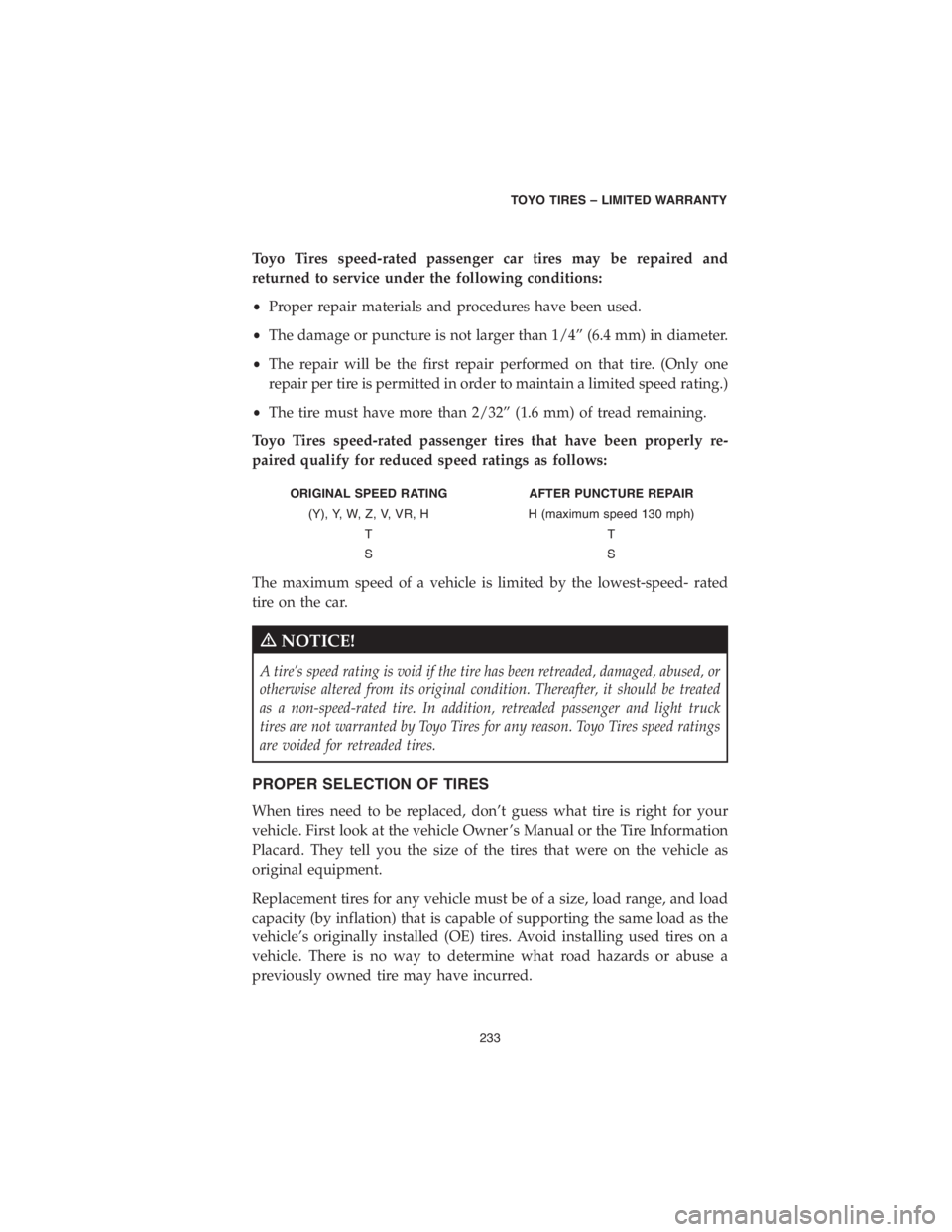
Toyo Tires speed-rated passenger tires that have been properly re-
paired qualify for reduced speed ratings as follows:
ORIGINAL SPEED RATING AFTER PUNCTURE REPAIR
(Y), Y, W, Z, V, VR, H H (maximum speed 130 mph)
TT
SS
The maximum speed of a vehicle is limited by the lowest-speed- rated
tire on the car.
mNOTICE!
A tire’s speed rating is void if the tire has been retreaded, damaged, abused, or
otherwise altered from its original condition. Thereafter, it should be treated
as a non-speed-rated tire. In addition, retreaded passenger and light truck
tires are not warranted by Toyo Tires for any reason. Toyo Tires speed ratings
are voided for retreaded tires.
PROPER SELECTION OF TIRES
When tires need to be replaced, don’t guess what tire is right for your
vehicle. First look at the vehicle Owner ’s Manual or the Tire Information
Placard. They tell you the size of the tires that were on the vehicle as
original equipment.
Replacement tires for any vehicle must be of a size, load range, and load
capacity (by inflation) that is capable of supporting the same load as the
vehicle’s originally installed (OE) tires. Avoid installing used tires on a
vehicle. There is no way to determine what road hazards or abuse a
previously owned tire may have incurred.
TOYO TIRES – LIMITED WARRANTY
233
Page 239 of 316
STUDDED WINTER/SNOW TIRES
•Studded winter/snow tires have higher traction qualities under most
winter weather conditions.
•If studded winter/snow tires are installed on the front axle of any
vehicle, studded winter/snow tires must also be installed on the rear
axle. DO NOT apply studded winter/snow tires only to the front axle.
•If studded winter/snow tires are installed on the rear axle of any
vehicle, it is strongly recommended that they should also be installed
on the front axle. Only if studded winter/snow tires are installed on all
wheel positions of a vehicle will optimum handling characteristics be
achieved.
WARNING!
Installing only two studded winter/snow tires on the front axle of
any vehicle (including front-wheel-drive vehicles) without studded
winter/snow tires on the rear axle can cause adverse vehicle
handling characteristics. This can result in a loss of vehicle control,
which could cause serious personal injury or death.
mNOTICE!
In some cases, the vehicle manufacturer may specifically advise against
replacing fewer than all four tires. Always check and follow the
recommendations in the vehicle Owner’s Manual. For 4WD and AWD
vehicles, even small differences in outside diameter may cause drivetrain
damage or mechanical malfunction.
REPLACING TWO TIRES
•When a pair of replacement tires is selected in the same size and
construction as those on the vehicle, the two newer tires must be
installed on the rear axle and must be of equal or higher speed rating
than the front tires. Generally, new tires with deeper tread will provide
better grip and evacuate water more effectively, which is important as
a driver approaches hydroplaning situations. Placing greater traction
on the rear axle on wet surfaces is necessary to prevent a possible
oversteer condition and loss of vehicle stability.
TOYO TIRES – LIMITED WARRANTY
238
Page 240 of 316
•When two new tires have been installed onto the rear axle positions,
they are to be kept on the rear but rotated from side to side. This is
recommended after installing two new tires to the rear position, or if
you discover significant tread depth differences between the front and
rear positions during rotation intervals.
REPLACING ONE TIRE
•Replacing a single tire on a vehicle can have an adverse effect on
suspension systems, gear ratios, transmission, and tire treadwear.
•If single tire replacement is unavoidable, it is recommended that the
single new tire be paired with the tire that has the deepest tread and
both be placed on the rear axle. Placing greater traction on the rear axle
on wet surfaces is necessary to prevent a possible oversteer condition
and loss of vehicle stability.
WHEEL ALIGNMENT AND BALANCING
•Proper wheel alignment and balance are very important consider-
ations for safety and getting the maximum mileage from your tires.
You need to check how your tires are wearing at least once a month.
•Your vehicle may be out of alignment if your tires are wearing
unevenly, such as when the inside shoulder of the tire is wearing faster
than the rest of the tread. This condition not only shortens the life of
your tires, it adversely affects the handling characteristics of your
vehicle, which could be dangerous. If your tires show irregular wear,
have your vehicle’s alignment checked immediately.
TOYO TIRES – LIMITED WARRANTY
239
Page 250 of 316
These tires are marked with the “M&S” designation plus a mountain/
snowflake symbol . Even the best all-season tires will not provide
acceptable levels of traction if you drive too fast in snow or ice
conditions and if you do not allow more stopping distance on icy roads
compared to dry road surfaces. Your ability to safely maneuver your
vehicle in snow or ice conditions is considerably reduced if your tires
are too worn to provide adequate road grip.
SAFE USE OF TEMPORARY SPARE TIRES
WARNING!
The spare tire your car is equipped with may be of a different size
and construction from the other tires on your vehicle. When using
any temporary type spare tire, be sure to follow the vehicle
manufacturer ’s instructions. Failure to observe recommended
precautions could lead to erratic vehicle behavior and/or tire
damage, possibly resulting in an accident and serious personal
injury or death.
•The temporary spare tire is designed for temporary use only. It must
not be used continuously as a standard tire. The temporary spare tire
should be returned to the trunk as soon as it is convenient to have your
standard tire repaired or replaced.
•The temporary spare tire should not be used for speeds exceeding
50 mph.
•Never use chains on temporary spare tires, because it could cause
damage to your vehicle.
•When you replace the temporary tire, replace it only with the same
type of tire.
•A full-size spare tire in your vehicle is intended for use as a spare when
needed. Please see the “Tire Rotation” section for the proper proce-
dures for including the same size construction and speed-rated tire (for
LT tires of the same size, type, and load rating) in the rotation pattern.
(Do not rotate a temporary spare tire.)
TOYO TIRES – LIMITED WARRANTY
249
Page 252 of 316
2. Avoid moving these tires in conditions below 15° F (-9° C).
3. Before mounting and dismounting, store these tires for at least 24
hours in a temperature-controlled environment of 68° F (20° C) or
warmer.
4. Remove these tires from the vehicle and deflate to half the normal
air-pressure during prolonged periods of non-use or storage.
Always inspect tires for signs of cracking and never use tires that have
cracked.
WARNING!
Improper storage can damage your tires in ways that may not be
visible and could lead to serious personal injury or death.
SPECIAL ADVICE FOR LIGHT TRUCKS
Never exceed the speed limit as indicated by the speed symbol on the
tire’s sidewall. See the chart and explanation of speed ratings in this
manual.
If you do not know the speed rating of your Toyo brand tire, contact your
Toyo Tires dealer or Toyo Tire U.S.A. Corp. for current information.
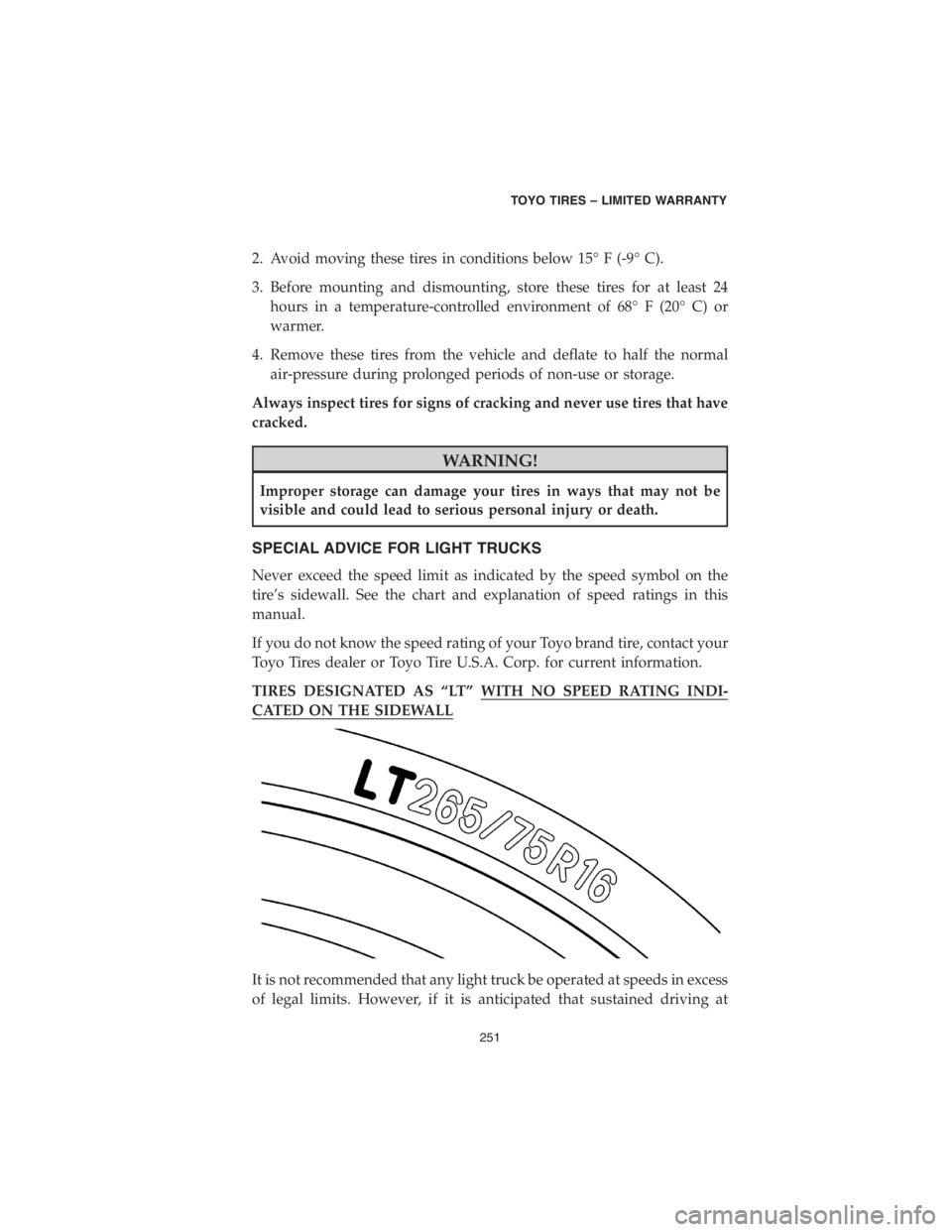
TIRES DESIGNATED AS “LT” WITH NO SPEED RATING INDI-
CATED ON THE SIDEWALL
It is not recommended that any light truck be operated at speeds in excess
of legal limits. However, if it is anticipated that sustained driving at
TOYO TIRES – LIMITED WARRANTY
251
Page 263 of 316
2. WHAT IS NOT WARRANTED
Tires that have become unserviceable for the following reasons:
•Road hazard injuries or damages, caused to the tire by obstacles and
debris such as cuts, punctures (whether repairable or not), snags,
bruises, tears, or impact breaks.
•Improper repairs or repairs that have failed.
•Improper inflation or other maintenance abuses.
•Incorrect mounting of the tire, or tire/wheel imbalance.
•Mechanical irregularities in the vehicle such as wheel misalignment,
worn, or faulty parts.
•Accident, corrosion, vandalism, fire, or damage caused by nature.
•Tires used on vehicles in racing or special applications.
•Non-speed-rated temporary spare tires used over 50 mph (80 km/h).
•Tires worn out [2/32 inch (1.6 mm) or less of tread remaining] .
•Tires that have been retreaded.
•Tires transferred from the vehicle on which they were originally
installed.
•Improper storage
3. WHAT IS WARRANTED
Tires that have become unserviceable for reasons other than stated above
will be replaced in accordance with this warranty.
If a warrantable condition is found, tires will be replaced as follows:
A) Passenger Car and Light Truck Tires (Other than Temporary Spare
Tires)
When a tire becomes unserviceable during the first 2/32 inch (1.6 mm) of
original usable tread depth or 12 months from date of vehicle purchase,
whichever comes first, it will be replaced with a comparable new
YOKOHAMA tire free of charge. During this period, tires will be
mounted and balanced without charge. Other service charges such as tire
rotation, alignment or applicable taxes are payable by the customer.
YOKOHAMA TIRES — LIMITED WARRANTY
262
Page 266 of 316
4. A tread life of up to 3,000 miles (4,800 km) can be expected depending
on road conditions and your driving habits. To conserve tire tread life,
the spare should be returned to the trunk as soon as the standard tire
can be repaired or replaced.
5. Because the YOKOHAMA high pressure spare tire was specifically
designed for your car, it should not be used on any other vehicle.
6. Do not use snow chains on your YOKOHAMA high pressure spare.
This could cause damage to your vehicle.
7. When the tread wear indicator appears on the tire, replace it only with
the same type spare tire.
8. Check the tire’s cold inflation pressure monthly and maintain at 60 psi
(4.2 kg/cm2) even when not in use. Do not inflate over 60 psi.
9. The YOKOHAMA high pressure spare tire should not be used with
any other rim nor should standard tires, wheel covers, or trim rings be
used on the YOKOHAMA high pressure spare tire rim on which the
YOKOHAMA high pressure spare tire was originally installed.
IMPORTANT SAFETY INFORMATION
All tires require owner maintenance regardless of how well a tire is
constructed. Operational damages such as punctures, impact damage, cuts,
incorrect inflation, etc., may cause tire failure and subsequent personal
injury and/or property damage. Simple operational and maintenance
practices, as listed below, will reduce the chances of tire problems.
Tire Inspection
Visually inspect your tires frequently for any tire damage such as scrapes,
bulges, cuts, nails, irregular wear, etc. resulting from operation. This must
be done immediately after any known or suspected contact with an object
in the road, a pothole, road irregularity or after severe braking. Refer
these conditions to a reputable tire service center for repair or replace-
ment. Never drive on a tire if such conditions appear.
Tire Loading
Never exceed the maximum vehicle load limit listed on the vehicle
placard, tire information label or in the owners manual. Be aware of the
load carrying limits molded into the tire’s sidewall and do not exceed
those limits. Maximum load can only be carried at the maximum cold
inflation pressure indicated on the tire’s sidewall.
YOKOHAMA TIRES — LIMITED WARRANTY
265