tire size DODGE DURANGO 2018 Vehicle Warranty
[x] Cancel search | Manufacturer: DODGE, Model Year: 2018, Model line: DURANGO, Model: DODGE DURANGO 2018Pages: 316, PDF Size: 3.15 MB
Page 250 of 316
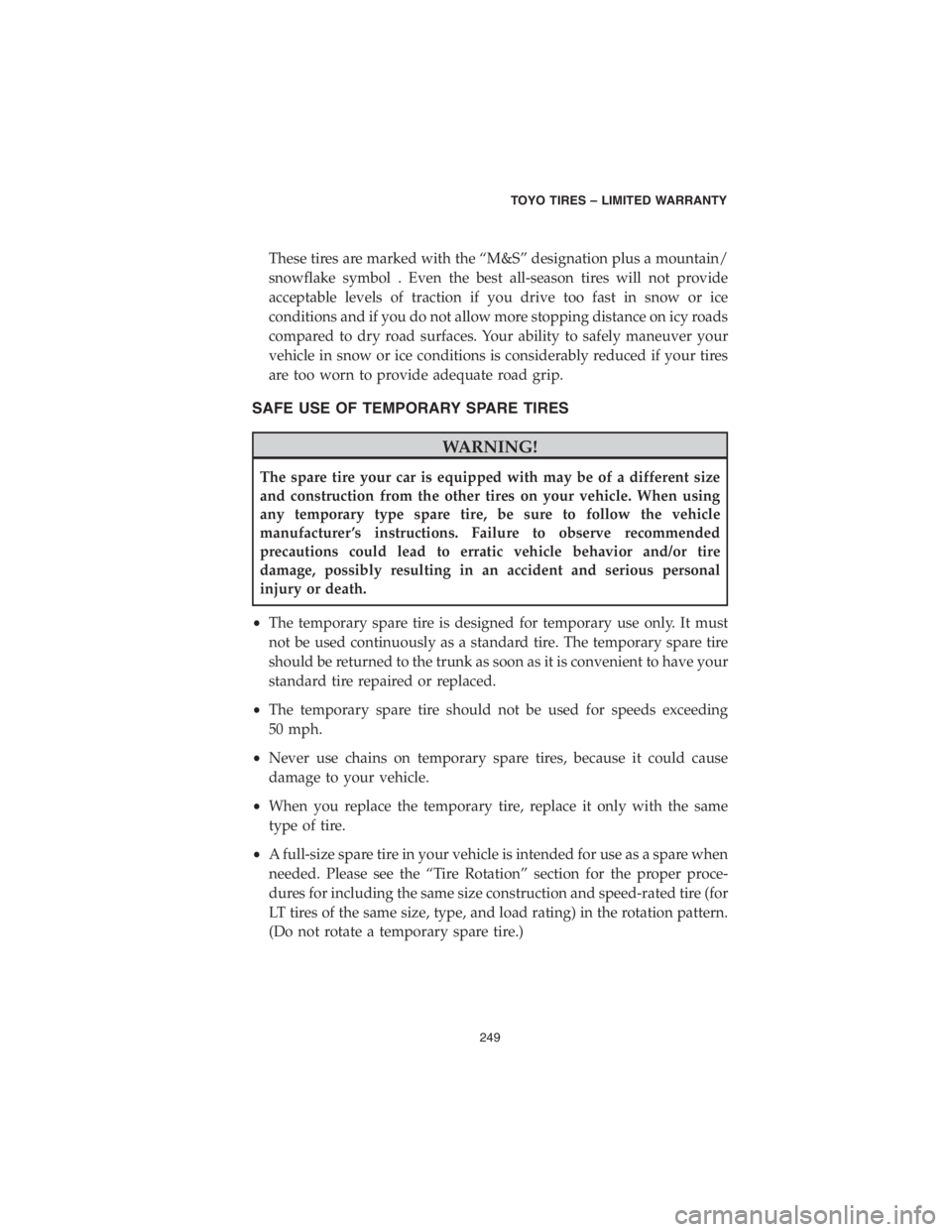
These tires are marked with the “M&S” designation plus a mountain/
snowflake symbol . Even the best all-season tires will not provide
acceptable levels of traction if you drive too fast in snow or ice
conditions and if you do not allow more stopping distance on icy roads
compared to dry road surfaces. Your ability to safely maneuver your
vehicle in snow or ice conditions is considerably reduced if your tires
are too worn to provide adequate road grip.
SAFE USE OF TEMPORARY SPARE TIRES
WARNING!
The spare tire your car is equipped with may be of a different size
and construction from the other tires on your vehicle. When using
any temporary type spare tire, be sure to follow the vehicle
manufacturer ’s instructions. Failure to observe recommended
precautions could lead to erratic vehicle behavior and/or tire
damage, possibly resulting in an accident and serious personal
injury or death.
•The temporary spare tire is designed for temporary use only. It must
not be used continuously as a standard tire. The temporary spare tire
should be returned to the trunk as soon as it is convenient to have your
standard tire repaired or replaced.
•The temporary spare tire should not be used for speeds exceeding
50 mph.
•Never use chains on temporary spare tires, because it could cause
damage to your vehicle.
•When you replace the temporary tire, replace it only with the same
type of tire.
•A full-size spare tire in your vehicle is intended for use as a spare when
needed. Please see the “Tire Rotation” section for the proper proce-
dures for including the same size construction and speed-rated tire (for
LT tires of the same size, type, and load rating) in the rotation pattern.
(Do not rotate a temporary spare tire.)
TOYO TIRES – LIMITED WARRANTY
249
Page 251 of 316
WARNING!
•Check inflation pressure before using your spare tire. Failure to
have proper inflation pressure when using your spare tire may
cause loss of vehicle control, which could result in serious personal
injury or death. Maintain spare tire inflation pressures based on
the vehicle Owner ’s Manual or the Tire Information Placard.
•
“T” Type high-pressure temporary spare tires should not be used
with any other wheel, nor should standard tires, snow tires, wheel
covers, or trim rings be used on the high-pressure spare tire wheel. If
you fail to follow this warning, your vehicle’s handling characteris-
tics can be seriously affected. You could have an accident resulting in
serious personal injury or death. Consult your vehicle Owner ’s
Manual for the proper use of your “temporary use” spare tire.
•Do not operate your vehicle with more than one temporary spare in
use (this does not apply to a full size spare), and only operate it at
limited speeds and distances as indicated on the sidewall of the tire.
•The “T” Type temporary spare tire may lower ground clearance
when used. Avoid driving over large obstacles and other road
hazards. Check your vehicle Owner ’s Manual for other special
clearance precautions when using the “T” Type temporary spare
tire provided in your vehicle.
TIRE STORAGE
Tires should be stored indoors in a cool dry place where water cannot
collect inside the tires. The tires should be placed away from harmful
ozone-producing electric generators and motors and sources of heat such
as hot pipes. Storage surfaces should be clean and free of grease, gasoline,
or other substances, which can deteriorate the rubber.
COMPETITION TIRE STORAGE
The rubber compounds used in these tires have unique properties that,
when compared to other tires, can cause them to lose some of their
flexibility when used or handled in conditions below 15° F (-9° C). This
loss in flexibility can lead to potential cracking and other damage to the
tire. To minimize the chances of this happening, you are advised to follow
these instructions:
1. Do not move or operate the car with these tires in conditions below
15° F (-9° C).
TOYO TIRES – LIMITED WARRANTY
250
Page 254 of 316
WARNING!(Continued)
•LT-metric tires carry their load at higher inflation pressures and do
not always have adequate load capacity to replace P-metric tires of
the same size.
•After reducing a P-metric tire’s load rating by dividing by 1.1 for
fitment on a Light Truck, the P-metric tire may not offer sufficient
load capacity to replace an LT-metric tire of the same size.
•Contact your Toyo Tires dealer or Toyo Tires Technical Service for
help determining how to choose a proper replacement size.
•Driving with underinflated or overloaded tires may result in
immediate tire failure, which can cause an accident and could lead
to serious personal injury or death.
When a P-metric or metric tire is installed on a light truck (SUV, pickup,
minivan), the load rating is reduced by dividing by 1.1. (This load
reduction factor is prescribed by Federal Motor Vehicle Safety Standards
(FMVSS) and is based on the expectation that passenger-type tires may
experience more severe loading and usage conditions when applied to
light trucks.) For example, 305/50R20 has a maximum load capacity of
3086 lbs. If this tire is fitted to a light truck, the actual allowable load for
the tire is 2805 lbs. (3086 lbs. divided by 1.1).
Consult the load and inflation charts that can be found at
www.toyotires.com. Contact Toyo Tires Technical Service with any tire
replacement questions: 1-800-442-8696 (Pacific Time) or 1-888-444-8696
(Eastern Time).
TOYO TIRES – LIMITED WARRANTY
253
Page 255 of 316
VEHICLES WITH MODIFIED SUSPENSION
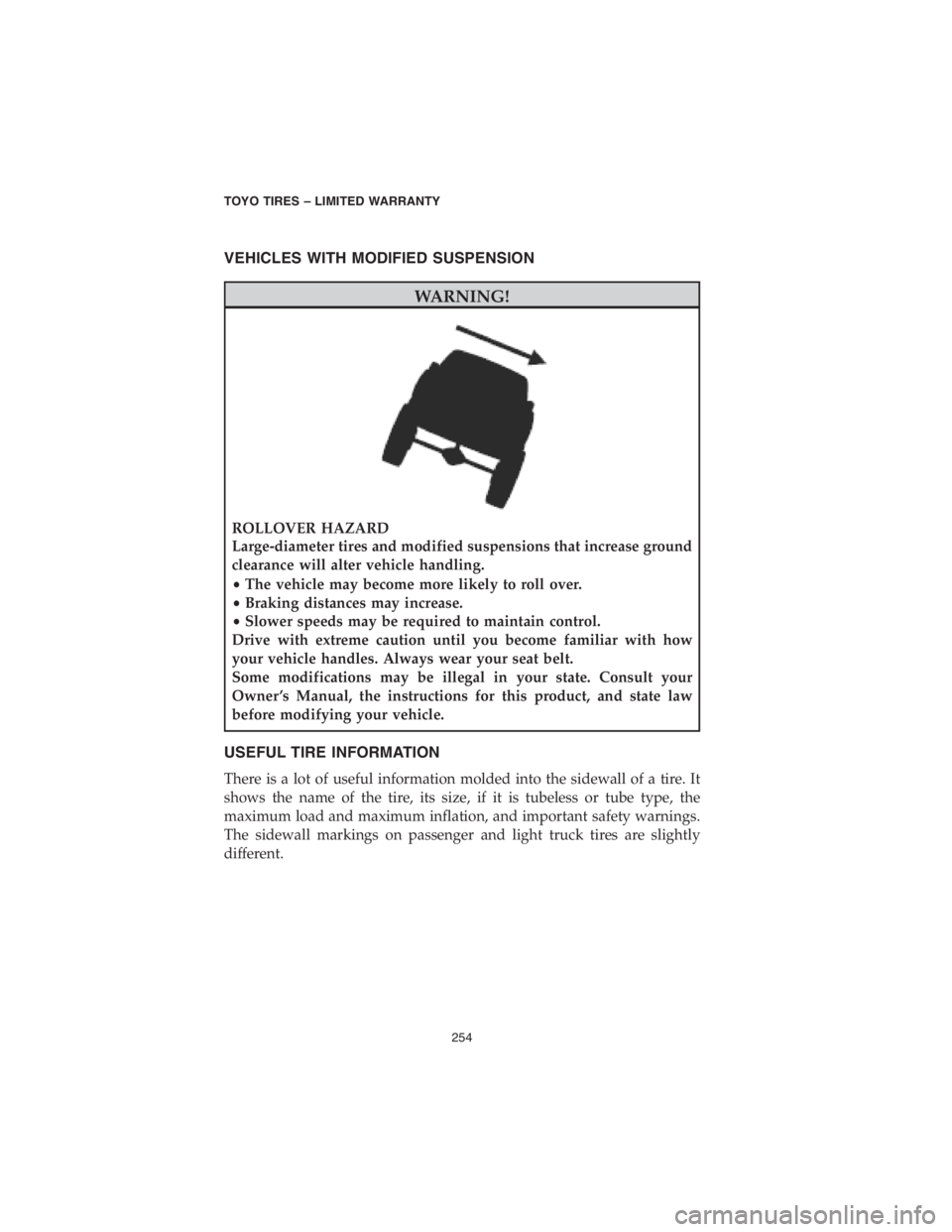
WARNING!
ROLLOVER HAZARD
Large-diameter tires and modified suspensions that increase ground
clearance will alter vehicle handling.
•The vehicle may become more likely to roll over.
•Braking distances may increase.
•Slower speeds may be required to maintain control.
Drive with extreme caution until you become familiar with how
your vehicle handles. Always wear your seat belt.
Some modifications may be illegal in your state. Consult your
Owner ’s Manual, the instructions for this product, and state law
before modifying your vehicle.
USEFUL TIRE INFORMATION
There is a lot of useful information molded into the sidewall of a tire. It
shows the name of the tire, its size, if it is tubeless or tube type, the
maximum load and maximum inflation, and important safety warnings.
The sidewall markings on passenger and light truck tires are slightly
different.
TOYO TIRES – LIMITED WARRANTY
254
Page 271 of 316
WHAT IS NOT COVERED?
This Limited Warranty does not cover the following categories of claims:
Rapid Treadwear: Original equipment tires are not guaranteed to last a
specified number of miles.
Damage from road hazards (not limited to cuts, snags, bruises, impact
breaks, bulges, punctures, stone drills, chips, and scales), fire, theft, or
collision.
NOTE:* Vehicles purchased before July 2017 may be covered by an
earlier warranty. See your Nitto retailer or contact Nitto for more
information.
Conditions arising from improper tire/vehicle maintenance or use, not
limited to:
•Irregular or excessive treadwear due to: Incorrect inflation; overload-
ing; vehicle misalignment; failure to rotate tires; and poor or defective
mechanical condition of brakes, shocks, and wheels; or other factors
attributable to the vehicle or wheel.
•Any tire which has been run with low air pressure or while flat.
•Damage due to abuse; vandalism; tire alteration; tire spinning; racing;
or other competitive activities.
•Damage, corrosion, or deterioration from using oil-based chemicals,
water-based sealers, balancing substances, or flammable gases.
•Damage from improper use of tire chains.
Tires with the DOT identification number removed or rendered illegible.
Improper mounting, balancing or repair, not limited to:
•Improper tire mounting, or tire/wheel assembly imbalance.
•Damage from incorrect mounting or dismounting of the tire, incorrect
wheel size, water or other material trapped inside the tire during
mounting, or failure to keep the tires balanced.
•Damage resulting from improper repair materials or procedures.
NITTO TIRE
270
Page 289 of 316
•The repair will be the first repair performed on that tire. (Only one
repair per tire is permitted in order to maintain a limited speed rating.)
•The tire must have more than 2/32” (1.6 mm) of tread remaining.
Nitto speed-rated passenger tires that have been properly repaired
qualify for reduced speed ratings as follows:
ORIGINAL SPEED RATING AFTER PUNCTURE REPAIR
(Y), Y, W, Z, V, VR, H H (maximum speed 130 mph)
TT
SS
The maximum speed of a vehicle is limited by the lowest-speed- rated
tire on the car.
mNOTICE!
A tire’s speed rating is void if the tire has been retreaded, damaged, abused, or
otherwise altered from its original condition. Thereafter, it should be treated
as a non-speed-rated tire. In addition, retreaded passenger and light truck
tires are not warranted by Nitto for any reason. Nitto speed ratings are
voided for retreaded tires.
PROPER SELECTION OF TIRES
When tires need to be replaced, don’t guess what tire is right for your
vehicle. First look at the vehicle Owner ’s Manual or the Tire Information
Placard. They tell you the size of the tires that were on the vehicle as
original equipment.
Replacement tires for any vehicle must be of a size, load range, and load
capacity (by inflation) that is capable of supporting the same load as the
vehicle’s originally installed (OE) tires. Avoid installing used tires on a
vehicle. There is no way to determine what road hazards or abuse a
previously owned tire may have incurred.
WARNING!
Failure to install tires with adequate load capacity will result in tire
fatigue and sudden tire failure. This could lead to loss of vehicle
control, possibly resulting in personal injury or death.
(Continued)
NITTO TIRE
288
Page 290 of 316
WARNING!(Continued)
Certain vehicle performance parameters, including ride comfort and
handling, may be affected by substitute tire sizes. In some cases,
particularly for SUVs and light trucks, a failure to follow the vehicle
manufacturer ’s recommendations for tire replacement could
adversely affect the safe handling of the vehicle, possibly resulting
in a loss of vehicle control leading to personal injury or death.
The following procedures concerning replacement tires must be fol-
lowed:
•Confirm that the load-carrying capacity is greater than or equal to the
load-carrying capacity of the OE tire size at the pressure indicated on
the vehicle Tire Information Placard.
•Carefully note any differences between recommendations for front and
rear axle positions regarding the tire size and/ or inflation pressure.
•The speed rating must be equal to or greater than what is specified by
the vehicle manufacturer if the speed capability of the vehicle is to be
maintained.
•Tires should be mounted on approved wheel widths. If changing tire
sizes, check to make sure the wheel has adequate load and inflation
pressure capacity.
•Body and chassis clearance must be checked on the vehicle’s front and
rear axles.
In addition to the above, light truck tire replacements should take into
consideration the following:
•Proper spacing between dual tires is necessary for optimum tire
performance. If chains are used, particular care must be taken to assure
adequate clearance between loaded tires to avoid damage from the
chains. The allowable outside diameter difference between a tire and
its dual mate is ¼” (6.4 mm) for light truck tires.
CONSIDERATIONS IN PLUS SIZING
Always refer to and follow the vehicle manufacturer ’s replacement tire
recommendations. In some cases, a vehicle manufacturer may specifically
advise against the application of replacement tires that are not of the
original size or type.
NITTO TIRE
289
Page 291 of 316
TIRE AND WHEEL MATCHING AND MOUNTING
WARNING!
Any attempt to mount a tire on a wheel with a different diameter
will result in an explosion of the tire/wheel assembly that could
cause severe personal injury or death.
Prior to mounting any tire, always check the wheel identification
stamp to verify the correct wheel diameter. Always check the tire
size molded onto the sidewall.
Never exceed 40 psi when seating the tire beads onto the wheel.
Always stand well clear of any tire mounting operation. This is
especially important when the service operator inflates the tire. If
the tire has been improperly mounted, it could burst with explosive
force causing serious personal injury or death.
A new valve stem must be installed on the wheel each time a
worn-out passenger or light truck tire is replaced.
Removing and replacing tires on wheels can be dangerous.
Attempting to mount tires with improper tools or procedures could
result in a tire explosion, causing serious personal injury or death.
This is a job for your authorized Nitto dealer or other qualified tire
service location only.
Serious personal injury or death can result from:
•Failure to select the proper tire and wheel. The tire must match the
width and diameter requirements of the wheel. When mounting
truck type radial tires use only wheels approved for radial tires.
•Failure to inspect both the tire and wheel. The wheel must be free
of cracks, dents, chips, and rust. The tire must be free of bead
damage, cuts, and punctures.
•Failure to follow proper procedures. For proper mounting proce-
dures, consult the Rubber Manufacturers Association’s publication
“Care and Service of Automobile and Light Truck Tires” (ref.:
www.rma.org).
•Exceeding the maximum bead seating pressure of 40 psi. Be
absolutely certain beads are fully seated before adjusting the
inflation pressure to the level recommended for vehicle operation.
Never put flammable substances in the tire/wheel assemblies at any
time. Never put any flammable substance into a tire/wheel assembly
and attempt to ignite it in order to seat the beads.
NITTO TIRE
290
Page 292 of 316
TIRE MIXING
WARNING!
Driving your vehicle with an improper mix of tire sizes,
constructions, and speed ratings can be dangerous. Your car ’s
handling characteristics can be adversely affected. You could have
an accident resulting in serious personal injury or death. Consult
your vehicle Owner ’s Manual or an authorized Nitto dealer for
proper tire replacement.
•Nitto recommends that all four tires be of the same size, speed rating,
and construction (radial or non-radial). In some cases the vehicle
manufacturer may require different sized tires for the front or rear
axles. Never mix P-metric or European Metric passenger tires with
LT-metric tires on the same vehicle.
•Match tire size designations in pairs on an axle, except during the
temporary use of a spare tire.
•If two radial tires and two non-radial tires are used on a vehicle, put
the radials on the rear axle. If radial and non-radial tires are used on a
vehicle equipped with dual rear tires, the radial tires may be used on
either axle.
SPEED-RATED TIRES
•If the vehicle Tire Information Placard and/or the vehicle Owner ’s
Manual specifies speed-rated tires, the replacement tires must have the
same or higher speed rating to maintain vehicle speed capability.
•If a replacement tire has a lower speed capability than that specified by
the vehicle manufacturer, the vehicle’s speed must be restricted to that
of the replacement tire. Vehicle handling could also be affected.
Consult the vehicle Owner ’s Manual or tire manufacturer for
recommendations.
•If tires with different speed ratings are used, it is recommended that
the lower-speed-rated tires always be placed on the front axle. This is
to prevent a potential oversteer condition.
NITTO TIRE
291
Page 293 of 316
FOUR-WHEEL DRIVE (4WD) AND ALL-WHEEL DRIVE (AWD)
VEHICLES
If no instructions for tire mixing appear in the vehicle Owner ’s Manual,
follow these guidelines:
•Do not mix tire sizes. All four tires must be marked with the same tire
size, unless otherwise specified by the vehicle manufacturer. This also
applies to winter/snow tires.
•Do not mix tread pattern types such as all-terrain and all- season.
STUDLESS WINTER/SNOW TIRES
•It is always preferable to apply winter/snow tires to all wheel
positions, including dual tires, to maintain vehicle mobility and
control.
•If winter/snow tires are applied to the front axle of any vehicle,
winter/snow tires must also be installed on the rear axle. DO NOT
apply winter/snow tires only to the front axle. This applies to all
passenger and light truck vehicles, including front-wheel- drive, 4WD,
and AWD vehicles.
•If winter/snow tires are installed on the rear axle of any vehicle, it is
recommended (but not required) that they also be installed on the front
axle.
WARNING!
Unless winter/snow tires on the rear axle have comparable traction
qualities to the tires on the front axle, the vehicle may experience
adverse handling characteristics. This may result in loss of vehicle
control, which can lead to serious personal injury or death.
STUDDED WINTER/SNOW TIRES
•Studded winter/snow tires have higher traction qualities under most
winter weather conditions.
•If studded winter/snow tires are installed on the front axle of any
vehicle, studded winter/snow tires must also be installed on the rear
axle. DO NOT apply studded winter/snow tires only to the front axle.
•If studded winter/snow tires are installed on the rear axle of any
vehicle, it is strongly recommended that they should also be installed
NITTO TIRE
292