alarm DODGE DURANGO 2019 User Guide
[x] Cancel search | Manufacturer: DODGE, Model Year: 2019, Model line: DURANGO, Model: DODGE DURANGO 2019Pages: 598, PDF Size: 4.32 MB
Page 159 of 598
NOTE:
•The charging system is independent from load reduc-
tion. The charging system performs a diagnostic on the
charging system continuously.
• If the Battery Charge Warning Light is on it may indicate
a problem with the charging system. Refer to “Battery
Charge Warning Light” in “Getting To Know Your
Instrument Panel” for further information.
The electrical loads that may be switched off (if equipped),
and vehicle functions which can be affected by load
reduction:
• Heated Seat/Vented Seats/Heated Wheel
• Rear Defroster And Heated Mirrors
• HVAC System
• 115V AC Power Inverter System
• Audio and Telematics System
Loss of the battery charge may indicate one or more of the
following conditions:
• The charging system cannot deliver enough electrical
power to the vehicle system because the electrical loads
are larger than the capability of charging system. The
charging system is still functioning properly. •
Turning on all possible vehicle electrical loads (e.g.
HVAC to max settings, exterior and interior lights,
overloaded power outlets +12V, 115V AC, USB ports)
during certain driving conditions (city driving, towing,
frequent stopping, etc.).
• Installing options like additional lights, upfitter electri-
cal accessories, audio systems, alarms and similar de-
vices.
• Unusual driving cycles (short trips separated by long
parking periods).
• The vehicle was parked for an extended period of time
(weeks, months).
• The battery was recently replaced and was not charged
completely.
• The battery was discharged by an electrical load left on
when the vehicle was parked.
• The battery was used for an extended period with the
engine not running to supply radio, lights, chargers,
+12V portable appliances like vacuum cleaners, game
consoles and similar devices.
4
GETTING TO KNOW YOUR INSTRUMENT PANEL 157
Page 160 of 598
What to do when an electrical load reduction action
message is present (“Battery Saver On” or “Battery Saver
Mode”)
During a trip:
•Reduce power to unnecessary loads if possible:
– Turn off redundant lights (interior or exterior)
– Check what may be plugged in to power outlets +12V, 115V AC, USB ports
– Check HVAC settings (blower, temperature)
– Check the audio settings (volume)
After a trip:
• Check if any aftermarket equipment was installed (ad-
ditional lights, upfitter electrical accessories, audio sys-
tems, alarms) and review specifications if any (load and
Ignition Off Draw currents).
• Evaluate the latest driving cycles (distance, driving time
and parking time).
• The vehicle should have service performed if the mes-
sage is still present during consecutive trips, and if the
evaluation and driving pattern of the vehicle did not
help to identify the cause.WARNING LIGHTS AND MESSAGES
The warning/indicator lights will illuminate in the instru-
ment panel together with a dedicated message and/or
acoustic signal when applicable. These indications are
indicative and precautionary and as such must not be
considered as exhaustive and/or alternative to the infor-
mation contained in the Owner ’s Manual, which you are
advised to read carefully in all cases. Always refer to the
information in this chapter in the event of a failure indica-
tion. All active telltales will display first if applicable. The
system check menu may appear different based upon
equipment options and current vehicle status. Some tell-
tales are optional and may not appear.
Red Warning Lights
— Seat Belt Reminder Warning Light
This warning light indicates when the driver or passenger
seat belt is unbuckled. When the ignition is first placed in
the ON/RUN or ACC/ON/RUN position and if the
driver ’s seat belt is unbuckled, a chime will sound and the
light will turn on. When driving, if the driver or front
passenger seat belt remains unbuckled, the Seat Belt Re-
minder Light will flash or remain on continuously and a
chime will sound.
158 GETTING TO KNOW YOUR INSTRUMENT PANEL
Page 165 of 598
CAUTION!
Continuous driving with the Transmission Tempera-
ture Warning Light illuminated will eventually cause
severe transmission damage or transmission failure.
— Vehicle Security Warning Light — If Equipped
This light will flash at a fast rate for approximately 15
seconds when the vehicle security alarm is arming, and
then will flash slowly until the vehicle is disarmed.
Yellow Warning Lights
— Engine Check/Malfunction Indicator Warning
Light (MIL)
The Engine Check/Malfunction Indicator Light (MIL) is a
part of an Onboard Diagnostic System called OBD II that
monitors engine and automatic transmission control sys-
tems. This warning light will illuminate when the ignition
is in the ON/RUN position before engine start. If the bulb
does not come on when turning the ignition switch from
OFF to ON/RUN, have the condition checked promptly.
Certain conditions, such as a loose or missing gas cap, poor
quality fuel, etc., may illuminate the light after engine start.
The vehicle should be serviced if the light stays on through several typical driving styles. In most situations, the ve-
hicle will drive normally and will not require towing.
When the engine is running, the MIL may flash to alert
serious conditions that could lead to immediate loss of
power or severe catalytic converter damage. The vehicle
should be serviced by an authorized dealer as soon as
possible if this occurs.
WARNING!
A malfunctioning catalytic converter, as referenced
above, can reach higher temperatures than in normal
operating conditions. This can cause a fire if you drive
slowly or park over flammable substances such as dry
plants, wood, cardboard, etc. This could result in death
or serious injury to the driver, occupants or others.
CAUTION!
Prolonged driving with the Malfunction Indicator
Light (MIL) on could cause damage to the vehicle
control system. It also could affect fuel economy and
driveability. If the MIL is flashing, severe catalytic
converter damage and power loss will soon occur.
Immediate service is required.
4
GETTING TO KNOW YOUR INSTRUMENT PANEL 163
Page 191 of 598
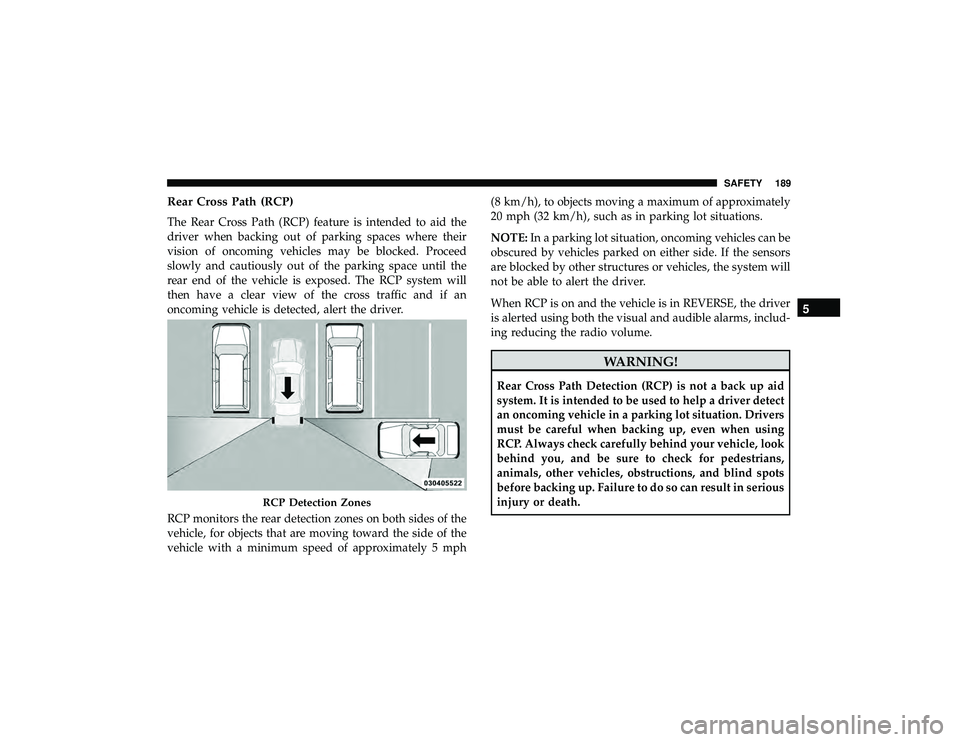
Rear Cross Path (RCP)
The Rear Cross Path (RCP) feature is intended to aid the
driver when backing out of parking spaces where their
vision of oncoming vehicles may be blocked. Proceed
slowly and cautiously out of the parking space until the
rear end of the vehicle is exposed. The RCP system will
then have a clear view of the cross traffic and if an
oncoming vehicle is detected, alert the driver.
RCP monitors the rear detection zones on both sides of the
vehicle, for objects that are moving toward the side of the
vehicle with a minimum speed of approximately 5 mph(8 km/h), to objects moving a maximum of approximately
20 mph (32 km/h), such as in parking lot situations.
NOTE:
In a parking lot situation, oncoming vehicles can be
obscured by vehicles parked on either side. If the sensors
are blocked by other structures or vehicles, the system will
not be able to alert the driver.
When RCP is on and the vehicle is in REVERSE, the driver
is alerted using both the visual and audible alarms, includ-
ing reducing the radio volume.
WARNING!
Rear Cross Path Detection (RCP) is not a back up aid
system. It is intended to be used to help a driver detect
an oncoming vehicle in a parking lot situation. Drivers
must be careful when backing up, even when using
RCP. Always check carefully behind your vehicle, look
behind you, and be sure to check for pedestrians,
animals, other vehicles, obstructions, and blind spots
before backing up. Failure to do so can result in serious
injury or death.
RCP Detection Zones
5
SAFETY 189
Page 221 of 598
WARNING!(Continued)
•Relying on the air bags alone could lead to more
severe injuries in a collision. The air bags work with
your seat belt to restrain you properly. In some
collisions, air bags won’t deploy at all. Always wear
your seat belts even though you have air bags.
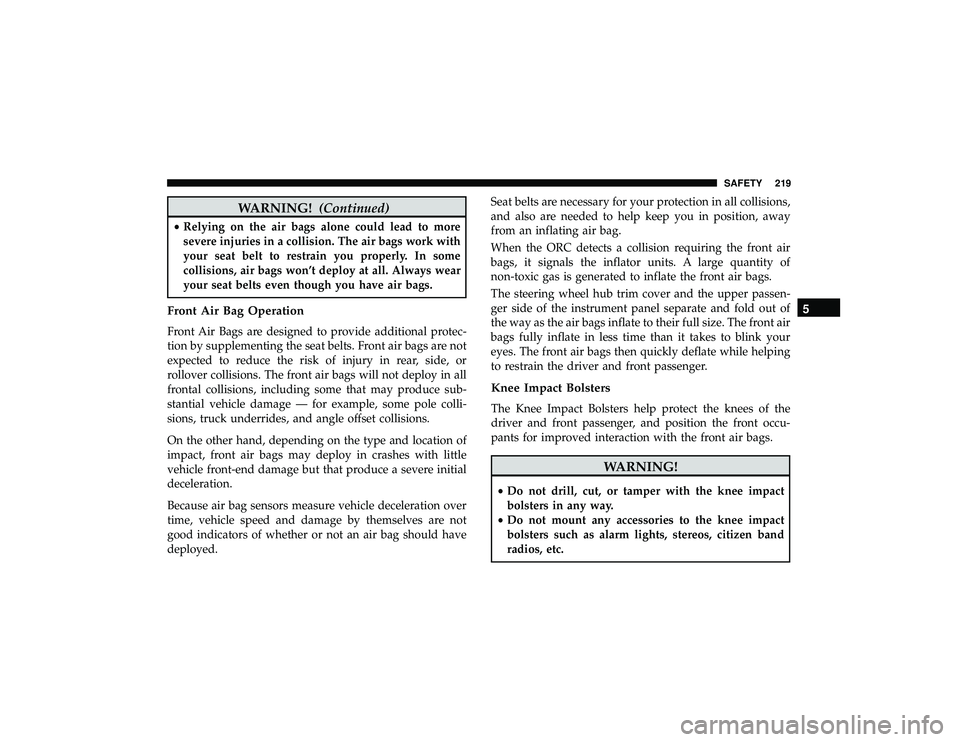
Front Air Bag Operation
Front Air Bags are designed to provide additional protec-
tion by supplementing the seat belts. Front air bags are not
expected to reduce the risk of injury in rear, side, or
rollover collisions. The front air bags will not deploy in all
frontal collisions, including some that may produce sub-
stantial vehicle damage — for example, some pole colli-
sions, truck underrides, and angle offset collisions.
On the other hand, depending on the type and location of
impact, front air bags may deploy in crashes with little
vehicle front-end damage but that produce a severe initial
deceleration.
Because air bag sensors measure vehicle deceleration over
time, vehicle speed and damage by themselves are not
good indicators of whether or not an air bag should have
deployed. Seat belts are necessary for your protection in all collisions,
and also are needed to help keep you in position, away
from an inflating air bag.
When the ORC detects a collision requiring the front air
bags, it signals the inflator units. A large quantity of
non-toxic gas is generated to inflate the front air bags.
The steering wheel hub trim cover and the upper passen-
ger side of the instrument panel separate and fold out of
the way as the air bags inflate to their full size. The front air
bags fully inflate in less time than it takes to blink your
eyes. The front air bags then quickly deflate while helping
to restrain the driver and front passenger.
Knee Impact Bolsters
The Knee Impact Bolsters help protect the knees of the
driver and front passenger, and position the front occu-
pants for improved interaction with the front air bags.
WARNING!
•
Do not drill, cut, or tamper with the knee impact
bolsters in any way.
• Do not mount any accessories to the knee impact
bolsters such as alarm lights, stereos, citizen band
radios, etc.
5
SAFETY 219
Page 314 of 598
WARNING!
In the Normal (Fixed Speed) Cruise Control mode, the
system will not react to vehicles ahead. In addition, the
proximity warning does not activate and no alarm will
sound even if you are too close to the vehicle ahead
since neither the presence of the vehicle ahead nor the
vehicle-to-vehicle distance is detected. Be sure to main-
tain a safe distance between your vehicle and the
vehicle ahead. Always be aware which mode is se-
lected.
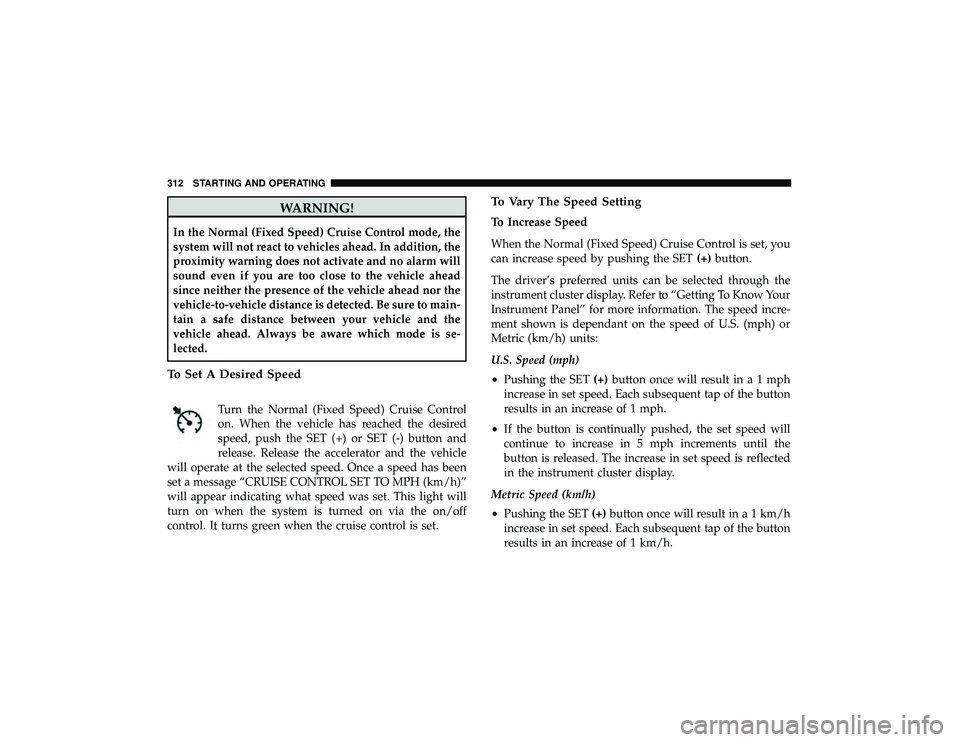
To Set A Desired Speed
Turn the Normal (Fixed Speed) Cruise Control
on. When the vehicle has reached the desired
speed, push the SET (+) or SET (-) button and
release. Release the accelerator and the vehicle
will operate at the selected speed. Once a speed has been
set a message “CRUISE CONTROL SET TO MPH (km/h)”
will appear indicating what speed was set. This light will
turn on when the system is turned on via the on/off
control. It turns green when the cruise control is set.
To Vary The Speed Setting
To Increase Speed
When the Normal (Fixed Speed) Cruise Control is set, you
can increase speed by pushing the SET (+)button.
The driver’s preferred units can be selected through the
instrument cluster display. Refer to “Getting To Know Your
Instrument Panel” for more information. The speed incre-
ment shown is dependant on the speed of U.S. (mph) or
Metric (km/h) units:
U.S. Speed (mph)
• Pushing the SET (+)button once will result ina1mph
increase in set speed. Each subsequent tap of the button
results in an increase of 1 mph.
• If the button is continually pushed, the set speed will
continue to increase in 5 mph increments until the
button is released. The increase in set speed is reflected
in the instrument cluster display.
Metric Speed (km/h)
• Pushing the SET (+)button once will result in a 1 km/h
increase in set speed. Each subsequent tap of the button
results in an increase of 1 km/h.
312 STARTING AND OPERATING
Page 565 of 598
SiriusXM Guardian (4C/4C NAV) — If Equipped
CAUTION!
Some SiriusXM Guardian services, including SOS Call
and Roadside Assistance Call will NOT work without
an operable LTE (voice/data) or 3G or 4G (data) net-
work connection compatible with your device.
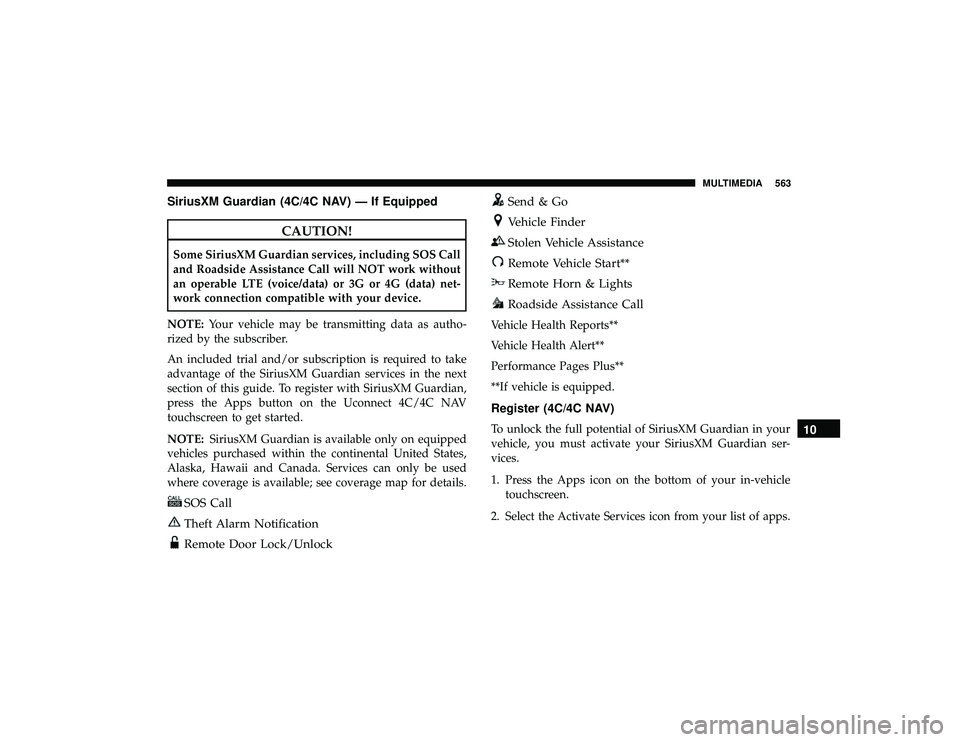
NOTE: Your vehicle may be transmitting data as autho-
rized by the subscriber.
An included trial and/or subscription is required to take
advantage of the SiriusXM Guardian services in the next
section of this guide. To register with SiriusXM Guardian,
press the Apps button on the Uconnect 4C/4C NAV
touchscreen to get started.
NOTE: SiriusXM Guardian is available only on equipped
vehicles purchased within the continental United States,
Alaska, Hawaii and Canada. Services can only be used
where coverage is available; see coverage map for details.
SOS Call
Theft Alarm Notification
Remote Door Lock/Unlock
Send & Go
Vehicle Finder
Stolen Vehicle Assistance
Remote Vehicle Start**
Remote Horn & Lights
Roadside Assistance Call
Vehicle Health Reports**
Vehicle Health Alert**
Performance Pages Plus**
**If vehicle is equipped.
Register (4C/4C NAV)
To unlock the full potential of SiriusXM Guardian in your
vehicle, you must activate your SiriusXM Guardian ser-
vices.
1. Press the Apps icon on the bottom of your in-vehicle touchscreen.
2. Select the Activate Services icon from your list of apps.10
MULTIMEDIA 563
Page 582 of 598
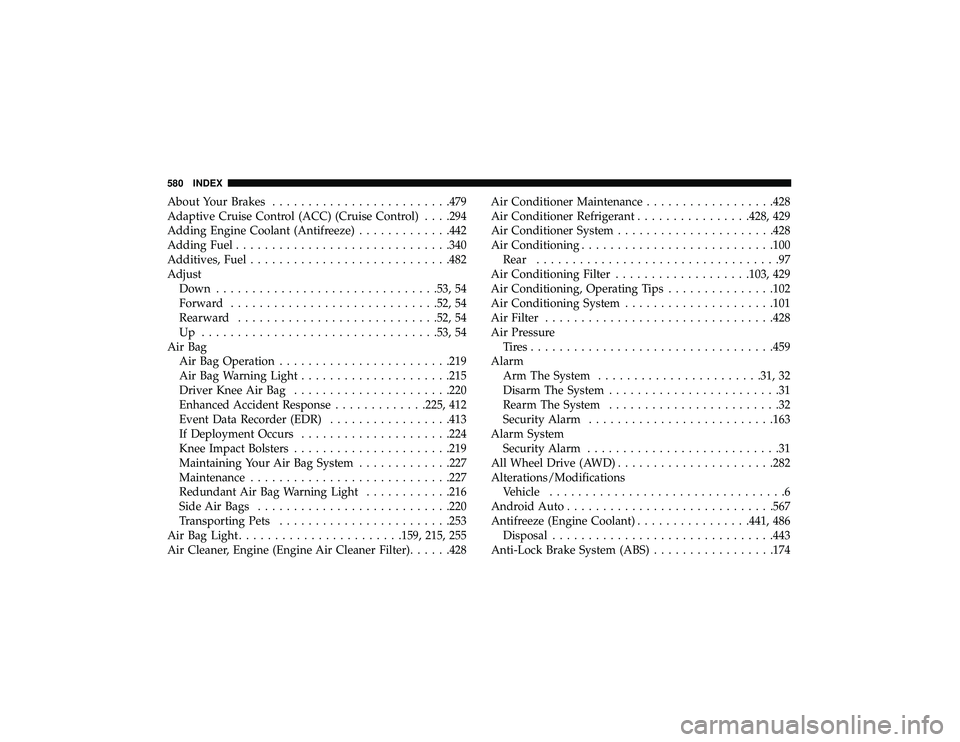
About Your Brakes........................ .479
Adaptive Cruise Control (ACC) (Cruise Control) . . . .294
Adding Engine Coolant (Antifreeze) .............442
Adding Fuel ............................. .340
Additives, Fuel ........................... .482
Adjust Down .............................. .53, 54
Forward ............................ .52, 54
Rearward ........................... .52, 54
Up ................................ .53, 54
Air Bag Air Bag Operation ....................... .219
Air Bag Warning Light .....................215
Driver Knee Air Bag ..................... .220
Enhanced Accident Response .............225, 412
Event Data Recorder (EDR) .................413
If Deployment Occurs .....................224
Knee Impact Bolsters ..................... .219
Maintaining Your Air Bag System .............227
Maintenance ........................... .227
Redundant Air Bag Warning Light ............216
Side Air Bags .......................... .220
Transporting Pets ....................... .253
Air Bag Light .......................159, 215, 255
Air Cleaner, Engine (Engine Air Cleaner Filter) ......428Air Conditioner Maintenance
..................428
Air Conditioner Refrigerant ................428, 429
Air Conditioner System ..................... .428
Air Conditioning .......................... .100
Rear ..................................97
Air Conditioning Filter .................. .103, 429
Air Conditioning, Operating Tips ...............102
Air Conditioning System .....................101
Air Filter ............................... .428
Air Pressure Tires................................. .459
Alarm Arm The System .......................31, 32
Disarm The
System ........................31
Rearm The System ........................32
Security Alarm ......................... .163
Alarm System Security Alarm ...........................31
All Wheel Drive (AWD) ..................... .282
Alterations/Modifications Vehicle .................................6
Android Auto ............................ .567
Antifreeze (Engine Coolant) ................441, 486
Disposal .............................. .443
Anti-Lock Brake System (ABS) .................174
580 INDEX
Page 583 of 598
Anti-Lock Warning Light.....................166
Apple CarPlay ........................... .569
Arming System Security Alarm ...........................31
Assist, Hill Start .......................... .176
Audio Systems (Radio) .......................493
Auto Down Power Windows ..................105
Automatic Headlights ........................76
Automatic High Beams .......................75
Automatic Temperature Control (ATC) ...........101
Automatic Transmission ..................263, 274
Adding Fluid .......................... .447
Fluid And Filter Change ...................447
Fluid Change .......................... .447
Fluid Level Check .....................446, 447
Fluid Type ......................... .446, 489
Special Additives ........................ .446
Automatic Transmission Limp Home Mode ........280
Auxiliary Driving Systems ....................184
Auxiliary Electrical Outlet (Power Outlet) .........130
Auxiliary Power Outlet ..................... .130
Axle Fluid .............................. .489
Battery .............................. .160, 424
Charging System Light ................... .160Keyless Key Fob Replacement
................21
Battery Saver Feature .........................78
Belts, Seat ............................... .255
Blind Spot Monitoring .......................184
Body Mechanism Lubrication ..................433
B-Pillar Location .......................... .454
Brake Assist System ........................ .176
Brake Control System, Electronic ................175
Brake Fluid .......................... .445, 489
Brake System ......................... .445, 479
Anti-Lock (ABS) ........................ .479
Fluid Check ........................... .445
Master Cylinder ........................ .445
Parking .............................. .270
W arning
Light.......................... .159
Brake/Transmission Interlock ..................273
Bulb Replacement .......................378, 380
Bulbs, Light ............................. .257
Camera, Rear ............................ .338
Capacities, Fluid .......................... .486
Caps, Filler Oil (Engine) ........................ .422, 427
Radiator (Coolant Pressure) .................443
Carbon Monoxide Warning ................254, 485
12
INDEX 581
Page 589 of 598
Center Mounted Stop..................... .382
Cruise ............................ .168, 169
Daytime Running .........................75
Dimmer Switch, Headlight ...................74
Electronic Stability Program(ESP) Indicator ......161
Exterior ............................ .74, 257
Fog ................................. .381
Hazard Warning Flasher ...................372
Headlights ............................ .380
Headlights On With Wipers ..................77
High Beam/Low Beam Select .................75
Interior ................................79
Lights On Reminder .......................77
Malfunction Indicator (Check Engine) ..........163
Park .............................. .76, 168
Passing ................................76
Reading ................................79
Rear Servicing .......................... .382
Rear Tail Lamps ........................ .382
Seat Belt Reminder .......................158
Security Alarm ......................... .163
Service ............................ .378, 380
Side Marker ........................... .382
Traction Control ........................ .181
Turn Signals ................74, 169, 257, 381, 382 Vanity Mirror
............................73
Warning Instrument Cluster Descriptions . . . .161, 169
Loading Vehicle ........................... .343
Tires................................. .454
Load Shed Battery Saver Mode .................156
Load Shed Battery Saver On ...................156
Load Shed Electrical Load Reduction .............156
Load Shed Intelligent Battery Sensor .............156
Locks Child Protection ..........................40
Manual ................................33
Power Door .............................34
Lubrication, Body ......................... .433
Luggage Carrier .......................... .135
Lug Nuts/Bolts ........................... .479
Maintenance ............................. .109
Maintenance Fr
ee Battery .....................424
Maintenance Schedule .......................417
Malfunction Indicator Light (Check Engine) . . . .163, 171
Manual Service ............................... .577
Memory Feature (Memory Seats) ................55
Memory Seat ..............................55
Memory Seats And Radio .....................55
12
INDEX 587