tire nut DODGE DURANGO 2019 User Guide
[x] Cancel search | Manufacturer: DODGE, Model Year: 2019, Model line: DURANGO, Model: DODGE DURANGO 2019Pages: 598, PDF Size: 4.32 MB
Page 403 of 598
WARNING!
A loose tire or jack thrown forward in a collision or
hard stop, could endanger the occupants of the vehicle.
Always stow the jack parts and the spare tire in the
places provided.
Road Tire Installation
1. Mount the road tire on the axle.
2. Install the remaining lug nuts with the cone shaped endof the nut toward the wheel. Lightly tighten the lug
nuts.
WARNING!
To avoid the risk of forcing the vehicle off the jack, do
not tighten the wheel nuts fully until the vehicle has
been lowered. Failure to follow this warning may
result in serious injury.
3. Lower the vehicle to the ground by turning the jack handle counterclockwise.
4. Refer to “Torque Specifications” in “Technical Specifica- tions” for proper lug nut torque. 5. After 25 miles (40 km), check the lug nut torque with a
torque wrench to ensure that all lug nuts are properly
seated against the wheel.
JUMP STARTING
If your vehicle has a discharged battery, it can be jump
started using a set of jumper cables and a battery in another
vehicle, or by using a portable battery booster pack. Jump
starting can be dangerous if done improperly, so please
follow the procedures in this section carefully.
WARNING!
Do not attempt jump starting if the battery is frozen. It
could rupture or explode and cause personal injury.
CAUTION!
Do not use a portable battery booster pack or any other
booster source with a system voltage greater than 12
Volts or damage to the battery, starter motor, alternator
or electrical system may occur.
NOTE: When using a portable battery booster pack, follow
the manufacturer’s operating instructions and precautions.
7
IN CASE OF EMERGENCY 401
Page 411 of 598
WARNING!
Fast spinning tires can be dangerous. Forces generated
by excessive wheel speeds may cause damage, or even
failure, of the axle and tires. A tire could explode and
injure someone. Do not spin your vehicle’s wheels
faster than 30 mph (48 km/h) or for longer than 30
seconds continuously without stopping when you are
stuck and do not let anyone near a spinning wheel, no
matter what the speed.
CAUTION!
•Racing the engine or spinning the wheels may lead
to transmission overheating and failure. Allow the
engine to idle with the transmission in NEUTRAL
for at least one minute after every five rocking-
motion cycles. This will minimize overheating and
(Continued)
CAUTION! (Continued)
reduce the risk of transmission failure during pro-
longed efforts to free a stuck vehicle.
• When “rocking” a stuck vehicle by shifting between
DRIVE and REVERSE, do not spin the wheels faster
than 15 mph (24 km/h), or drivetrain damage may
result.
• Revving the engine or spinning the wheels too fast
may lead to transmission overheating and failure. It
can also damage the tires. Do not spin the wheels
above 30 mph (48 km/h) while in gear (no transmis-
sion shifting occurring).
TOWING A DISABLED VEHICLE
This section describes procedures for towing a disabled
vehicle using a commercial towing service. If the transmis-
sion and drivetrain are operable, disabled vehicles may
also be towed as described under “Recreational Towing” in
“Starting And Operating”.
7
IN CASE OF EMERGENCY 409
Page 474 of 598
Sustained high temperature can cause the material of
the tire to degenerate and reduce tire life, and excessive
temperature can lead to sudden tire failure. The grade C
corresponds to a level of performance, which all pas-
senger vehicle tires must meet under the Federal Motor
Vehicle Safety Standard No. 109. Grades B and A
represent higher levels of performance on the laboratory
test wheel, than the minimum required by law.
WARNING!
The temperature grade for this tire is established for
a tire that is properly inflated and not overloaded.
Excessive speed, under-inflation, or excessive load-
ing, either separately or in combination, can cause
heat buildup and possible tire failure.
STORING THE VEHICLE
If you are storing your vehicle for more than 21 days, we
recommend that you take the following steps to minimize
the drain on your vehicle’s battery:
• Disconnect the negative cable from battery. •
Any time you store your vehicle or keep it out of service
(i.e., vacation) for two weeks or more, run the air condi-
tioning system at idle for about five minutes in the fresh air
and high blower setting. This will ensure adequate system
lubrication to minimize the possibility of compressor dam-
age when the system is started again.
BODYWORK
Protection From Atmospheric Agents
Vehicle body care requirements vary according to geo-
graphic locations and usage. Chemicals that make roads
passable in snow and ice and those that are sprayed on
trees and road surfaces during other seasons are highly
corrosive to the metal in your vehicle. Outside parking,
which exposes your vehicle to airborne contaminants, road
surfaces on which the vehicle is operated, extreme hot or
cold weather and other extreme conditions will have an
adverse effect on paint, metal trim, and underbody protec-
tion.
The following maintenance recommendations will enable
you to obtain maximum benefit from the corrosion resis-
tance built into your vehicle.
472 SERVICING AND MAINTENANCE
Page 481 of 598
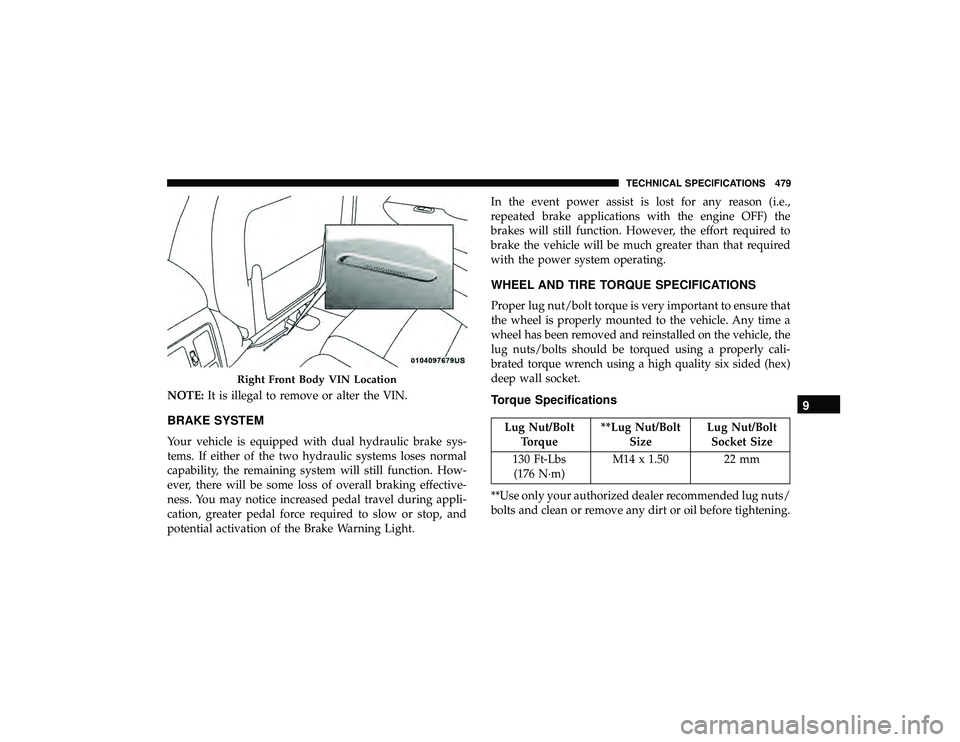
NOTE:It is illegal to remove or alter the VIN.
BRAKE SYSTEM
Your vehicle is equipped with dual hydraulic brake sys-
tems. If either of the two hydraulic systems loses normal
capability, the remaining system will still function. How-
ever, there will be some loss of overall braking effective-
ness. You may notice increased pedal travel during appli-
cation, greater pedal force required to slow or stop, and
potential activation of the Brake Warning Light. In the event power assist is lost for any reason (i.e.,
repeated brake applications with the engine OFF) the
brakes will still function. However, the effort required to
brake the vehicle will be much greater than that required
with the power system operating.
WHEEL AND TIRE TORQUE SPECIFICATIONS
Proper lug nut/bolt torque is very important to ensure that
the wheel is properly mounted to the vehicle. Any time a
wheel has been removed and reinstalled on the vehicle, the
lug nuts/bolts should be torqued using a properly cali-
brated torque wrench using a high quality six sided (hex)
deep wall socket.
Torque Specifications
Lug Nut/Bolt
Torque **Lug Nut/Bolt
Size Lug Nut/Bolt
Socket Size
130 Ft-Lbs (176 N·m) M14 x 1.50 22 mm
**Use only your authorized dealer recommended lug nuts/
bolts and clean or remove any dirt or oil before tightening.
Right Front Body VIN Location
9
TECHNICAL SPECIFICATIONS 479
Page 482 of 598
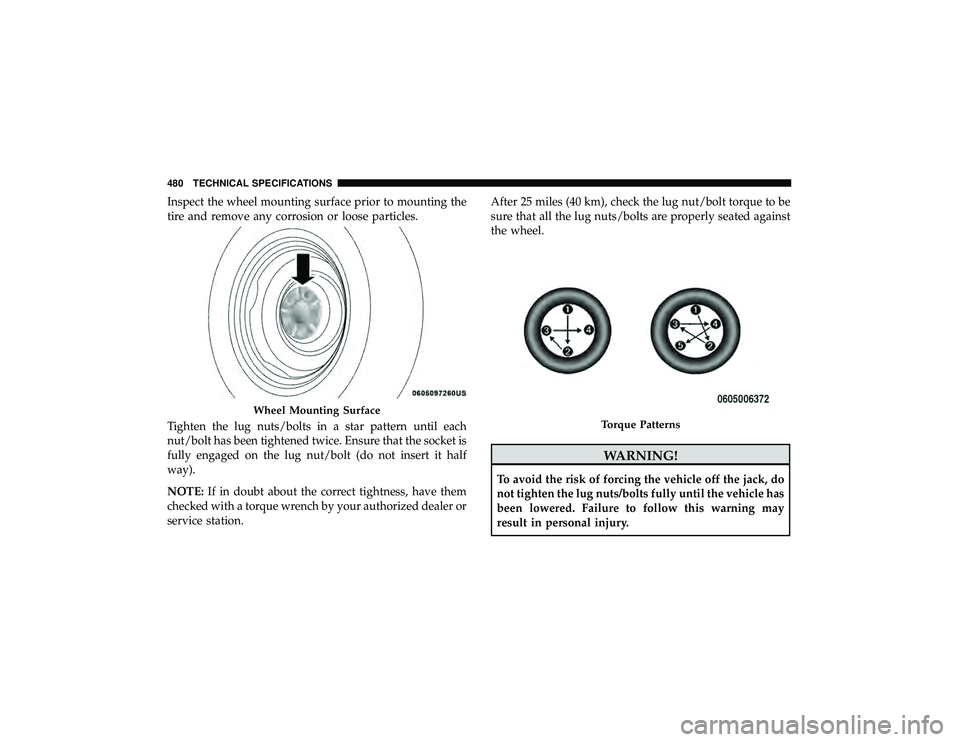
Inspect the wheel mounting surface prior to mounting the
tire and remove any corrosion or loose particles.
Tighten the lug nuts/bolts in a star pattern until each
nut/bolt has been tightened twice. Ensure that the socket is
fully engaged on the lug nut/bolt (do not insert it half
way).
NOTE:If in doubt about the correct tightness, have them
checked with a torque wrench by your authorized dealer or
service station. After 25 miles (40 km), check the lug nut/bolt torque to be
sure that all the lug nuts/bolts are properly seated against
the wheel.
WARNING!
To avoid the risk of forcing the vehicle off the jack, do
not tighten the lug nuts/bolts fully until the vehicle has
been lowered. Failure to follow this warning may
result in personal injury.
Wheel Mounting Surface
Torque Patterns
480 TECHNICAL SPECIFICATIONS
Page 589 of 598
Center Mounted Stop..................... .382
Cruise ............................ .168, 169
Daytime Running .........................75
Dimmer Switch, Headlight ...................74
Electronic Stability Program(ESP) Indicator ......161
Exterior ............................ .74, 257
Fog ................................. .381
Hazard Warning Flasher ...................372
Headlights ............................ .380
Headlights On With Wipers ..................77
High Beam/Low Beam Select .................75
Interior ................................79
Lights On Reminder .......................77
Malfunction Indicator (Check Engine) ..........163
Park .............................. .76, 168
Passing ................................76
Reading ................................79
Rear Servicing .......................... .382
Rear Tail Lamps ........................ .382
Seat Belt Reminder .......................158
Security Alarm ......................... .163
Service ............................ .378, 380
Side Marker ........................... .382
Traction Control ........................ .181
Turn Signals ................74, 169, 257, 381, 382 Vanity Mirror
............................73
Warning Instrument Cluster Descriptions . . . .161, 169
Loading Vehicle ........................... .343
Tires................................. .454
Load Shed Battery Saver Mode .................156
Load Shed Battery Saver On ...................156
Load Shed Electrical Load Reduction .............156
Load Shed Intelligent Battery Sensor .............156
Locks Child Protection ..........................40
Manual ................................33
Power Door .............................34
Lubrication, Body ......................... .433
Luggage Carrier .......................... .135
Lug Nuts/Bolts ........................... .479
Maintenance ............................. .109
Maintenance Fr
ee Battery .....................424
Maintenance Schedule .......................417
Malfunction Indicator Light (Check Engine) . . . .163, 171
Manual Service ............................... .577
Memory Feature (Memory Seats) ................55
Memory Seat ..............................55
Memory Seats And Radio .....................55
12
INDEX 587
Page 594 of 598
Tilt Column.......................... .67, 68
Wheel, Heated ...........................69
Wheel, Tilt .......................... .67, 68
Steering Wheel Audio Controls .................532
Steering Wheel Mounted Sound System Controls . . . .532
Storage ................................. .122
Door ................................ .122
Storage, Vehicle ....................... .102, 472
Storing Your Vehicle ....................... .472
Sunglasses Storage ......................... .135
Sun Roof ............................ .107, 109
Sunshade Operation ........................ .109
Sun Visor .................................73
Sway Control, Trailer ....................... .182
Synthetic Engine Oil ....................... .427
System, Remote Starting ......................26
Telescoping Steering Column ................67, 68
Temperature Control, Automatic (ATC) ...........101
Tie Down Hooks, Cargo ......................114
Tilt Steering Column ..................... .67, 68
Tire And Loading Information Placard ............454
Tire Markings ............................ .449
Tires......................... .257, 458, 465, 471
Aging (Life Of Tires) ..................... .462Air Pressure
........................... .458
Chains ............................... .469
Changing .......................390, 401, 448
Compact Spare ......................... .466
Flat Changing .......................... .401
General Information .................. .458, 465
High Speed ............................ .460
Inflation Pressure ....................... .459
Jacking ............................... .448
Life Of Tires ........................... .462
Load Capacity .......................454, 455
Pressure Monitoring System (TPMS) ........164, 194
Quality Grading ........................ .471
Radial ............................... .460
Replacement ........................ .401,
463
Rotation .............................. .470
Safety ............................ .449, 458
Sizes ................................ .450
Snow Tires ............................ .465
Spare Tires ..................... .392, 465, 467
Spinning .............................. .461
Trailer Towing .......................... .352
Tread Wear Indicators .....................462
Wheel Mounting ........................ .401
Wheel Nut Torque ....................... .479
592 INDEX