spark DODGE DURANGO 2019 Owners Manual
[x] Cancel search | Manufacturer: DODGE, Model Year: 2019, Model line: DURANGO, Model: DODGE DURANGO 2019Pages: 598, PDF Size: 4.32 MB
Page 404 of 598
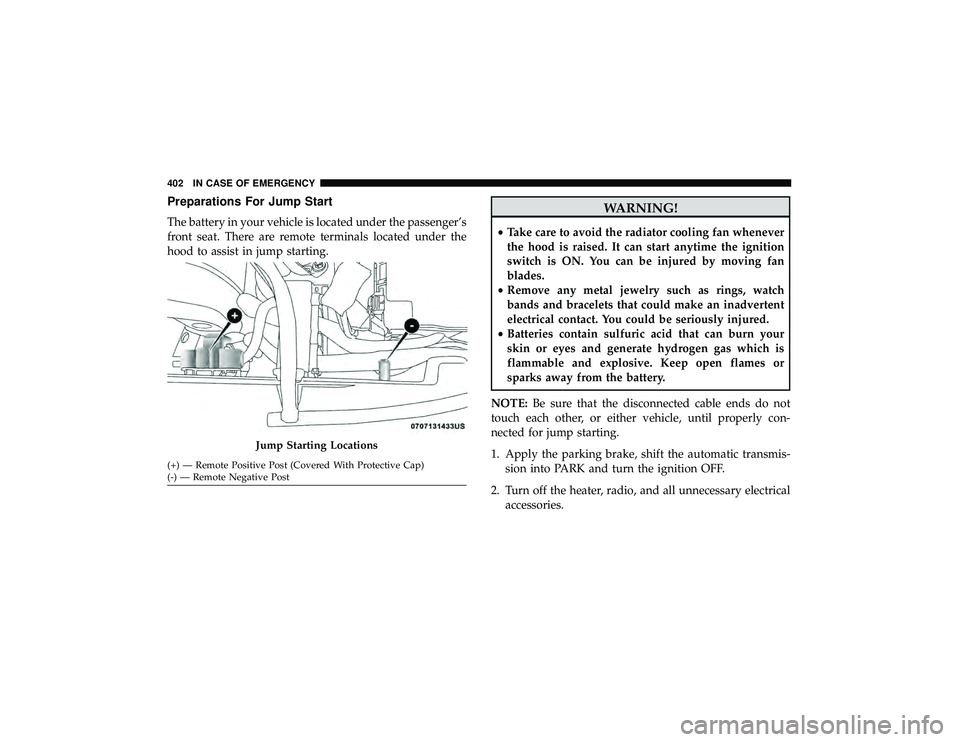
Preparations For Jump Start
The battery in your vehicle is located under the passenger’s
front seat. There are remote terminals located under the
hood to assist in jump starting.
WARNING!
•Take care to avoid the radiator cooling fan whenever
the hood is raised. It can start anytime the ignition
switch is ON. You can be injured by moving fan
blades.
• Remove any metal jewelry such as rings, watch
bands and bracelets that could make an inadvertent
electrical contact. You could be seriously injured.
• Batteries contain sulfuric acid that can burn your
skin or eyes and generate hydrogen gas which is
flammable and explosive. Keep open flames or
sparks away from the battery.
NOTE: Be sure that the disconnected cable ends do not
touch each other, or either vehicle, until properly con-
nected for jump starting.
1. Apply the parking brake, shift the automatic transmis- sion into PARK and turn the ignition OFF.
2. Turn off the heater, radio, and all unnecessary electrical accessories.
Jump Starting Locations
(+) — Remote Positive Post (Covered With Protective Cap)
(-) — Remote Negative Post 402 IN CASE OF EMERGENCY
Page 405 of 598
3. Remove the protective cover over the remote positive(+) battery post. Pull upward on the cover to remove it.
4. If using another vehicle to jump start the battery, park the vehicle within the jumper cables reach, apply the
parking brake and make sure the ignition is OFF.
WARNING!
Do not allow vehicles to touch each other as this could
establish a ground connection and personal injury
could result.
Jump Starting Procedure
WARNING!
Failure to follow this jump starting procedure could
result in personal injury or property damage due to
battery explosion.
CAUTION!
Failure to follow these procedures could result in
damage to the charging system of the booster vehicle
or the discharged vehicle. NOTE:
Make sure at all times that unused ends of jumper
cables are not contacting each other or either vehicle while
making connections.
Connecting The Jumper Cables
1. Connect the positive (+)end of the jumper cable to the
remote positive (+)post of the discharged vehicle.
2. Connect the opposite end of the positive (+)jumper
cable to the positive (+)post of the booster battery.
3. Connect the negative end (-)of the jumper cable to the
negative (-)post of the booster battery.
4. Connect the opposite end of the negative (-)jumper
cable to the remote negative (-)post of the vehicle with
the discharged battery.
WARNING!
Do not connect the jumper cable to the negative (-) post
of the discharged battery. The resulting electrical spark
could cause the battery to explode and could result in
personal injury. Only use the specific ground point, do
not use any other exposed metal parts.
7
IN CASE OF EMERGENCY 403
Page 421 of 598
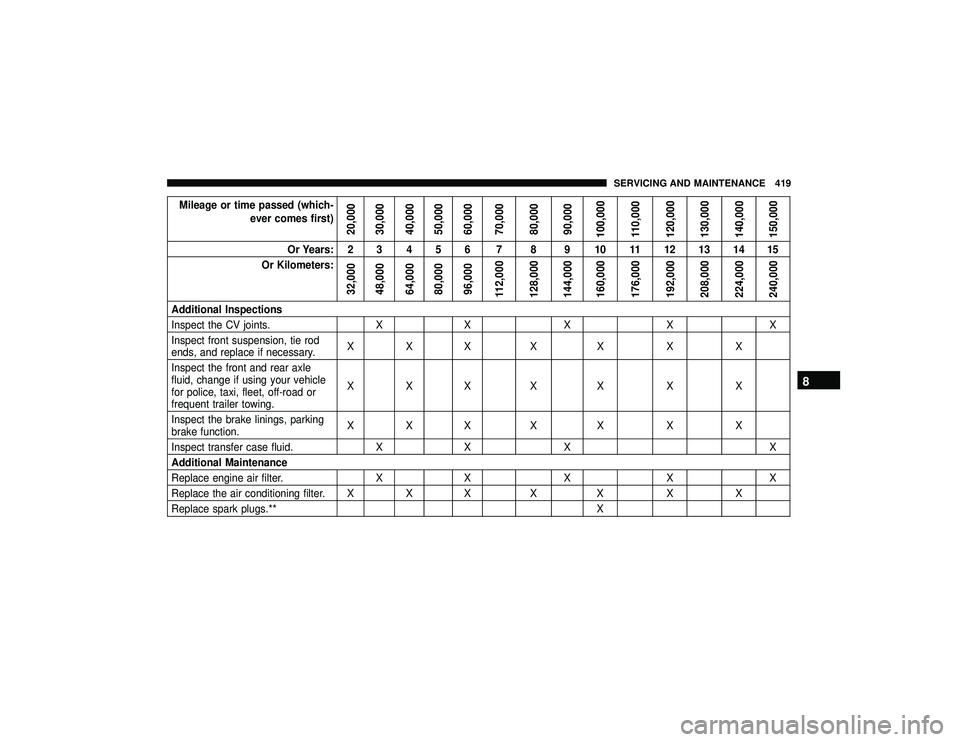
Mileage or time passed (which-ever comes first)
20,000
30,000
40,000
50,000
60,000
70,000
80,000
90,000
100,000
110,000
120,000
130,000
140,000
150,000
Or Years: 2 3 4 5 6 7 8 9 10 11 12 13 14 15
Or Kilometers:
32,000
48,000
64,000
80,000
96,000
112,000
128,000
144,000
160,000
176,000
192,000
208,000
224,000
240,000
Additional Inspections
Inspect the CV joints. X X X X X
Inspect front suspension, tie rod
ends, and replace if necessary. XXX X X X X
Inspect the front and rear axle
fluid, change if using your vehicle
for police, taxi, fleet, off-road or
frequent trailer towing. XXX X X X X
Inspect the brake linings, parking
brake function. XXX X X X X
Inspect transfer case fluid. X X X X
Additional Maintenance
Replace engine air filter. X X X X X
Replace the air conditioning filter. X X X X X X X
Replace spark plugs.** X
8
SERVICING AND MAINTENANCE 419
Page 422 of 598
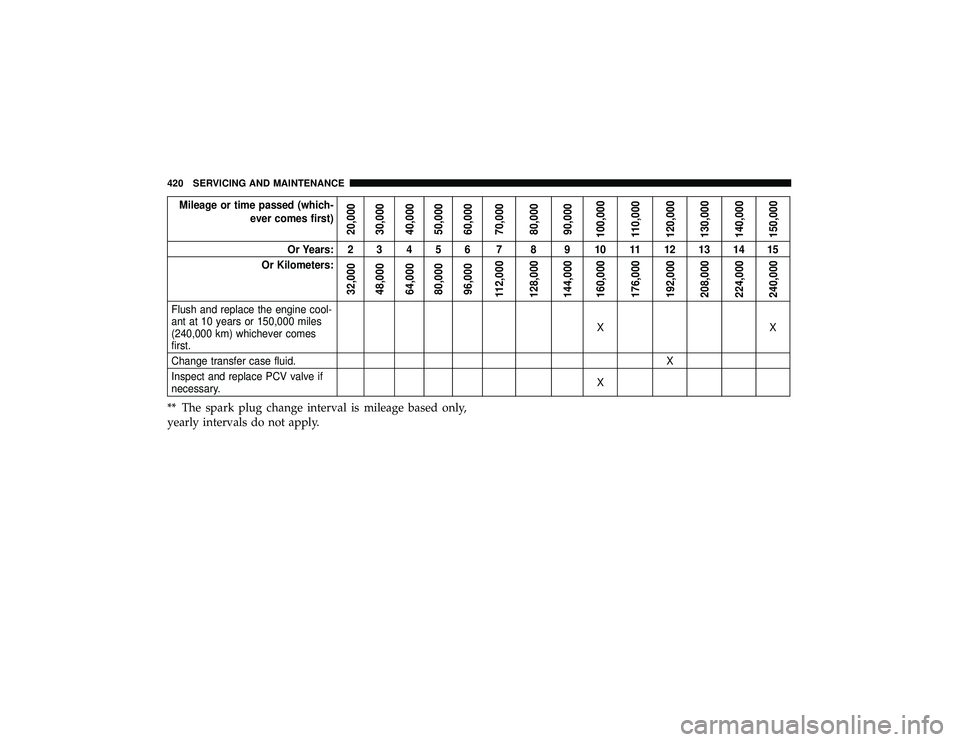
Mileage or time passed (which-ever comes first)
20,000
30,000
40,000
50,000
60,000
70,000
80,000
90,000
100,000
110,000
120,000
130,000
140,000
150,000
Or Years: 2 3 4 5 6 7 8 9 10 11 12 13 14 15
Or Kilometers:
32,000
48,000
64,000
80,000
96,000
112,000
128,000
144,000
160,000
176,000
192,000
208,000
224,000
240,000
Flush and replace the engine cool-
ant at 10 years or 150,000 miles
(240,000 km) whichever comes
first. XX
Change transfer case fluid. X
Inspect and replace PCV valve if
necessary. X
** The spark plug change interval is mileage based only,
yearly intervals do not apply.
420 SERVICING AND MAINTENANCE
Page 427 of 598
WARNING!
•Battery fluid is a corrosive acid solution and can
burn or even blind you. Do not allow battery fluid to
contact your eyes, skin, or clothing. Do not lean over
a battery when attaching clamps. If acid splashes in
eyes or on skin, flush the area immediately with
large amounts of water. Refer to “Jump Starting
Procedure” in “In Case Of Emergency” for further
information.
• Battery gas is flammable and explosive. Keep flame
or sparks away from the battery. Do not use a booster
battery or any other booster source with an output
greater than 12 Volts. Do not allow cable clamps to
touch each other.
• Battery posts, terminals, and related accessories con-
tain lead and lead compounds. Wash hands after
handling.
CAUTION!
•It is essential when replacing the cables on the
battery that the positive cable is attached to the
positive post and the negative cable is attached to the
negative post. Battery posts are marked positive (+)
and negative (-) and are identified on the battery
case. Cable clamps should be tight on the terminal
posts and free of corrosion.
• If a “fast charger” is used while the battery is in the
vehicle, disconnect both vehicle battery cables before
connecting the charger to the battery. Do not use a
“fast charger” to provide starting voltage.
DEALER SERVICE
An authorized dealer has the qualified service personnel,
special tools, and equipment to perform all service opera-
tions in an expert manner. Service Manuals are available
which include detailed service information for your ve-
hicle. Refer to these Service Manuals before attempting any
procedure yourself.
NOTE: Intentional tampering with emissions control sys-
tems may void your warranty and could result in civil
penalties being assessed against you.
8
SERVICING AND MAINTENANCE 425
Page 486 of 598
MMT In Gasoline
Methylcyclopentadienyl Manganese Tricarbonyl (MMT) is
a manganese-containing metallic additive that is blended
into some gasoline to increase octane. Gasoline blended
with MMT provides no performance advantage beyond
gasoline of the same octane number without MMT. Gaso-
line blended with MMT reduces spark plug life and
reduces emissions system performance in some vehicles.
The manufacturer recommends that gasoline without
MMT be used in your vehicle. The MMT content of
gasoline may not be indicated on the gasoline pump;
therefore, you should ask your gasoline retailer whether
the gasoline contains MMT. MMT is prohibited in Federal
and California reformulated gasoline.
Fuel System Cautions
CAUTION!
Follow these guidelines to maintain your vehicle’s
performance:
•The use of leaded gasoline is prohibited by Federal
law. Using leaded gasoline can impair engine perfor-
mance and damage the emissions control system.
• An out-of-tune engine or certain fuel or ignition
malfunctions can cause the catalytic converter to
overheat. If you notice a pungent burning odor or
some light smoke, your engine may be out of tune or
malfunctioning and may require immediate service.
Contact an authorized dealer for service assistance.
• The use of fuel additives, which are now being sold
as octane enhancers, is not recommended. Most of
these products contain high concentrations of metha-
nol. Fuel system damage or vehicle performance
problems resulting from the use of such fuels or
additives is not the responsibility of the manufac-
turer and may void or not be covered under the New
Vehicle Limited Warranty.
484 TECHNICAL SPECIFICATIONS
Page 489 of 598
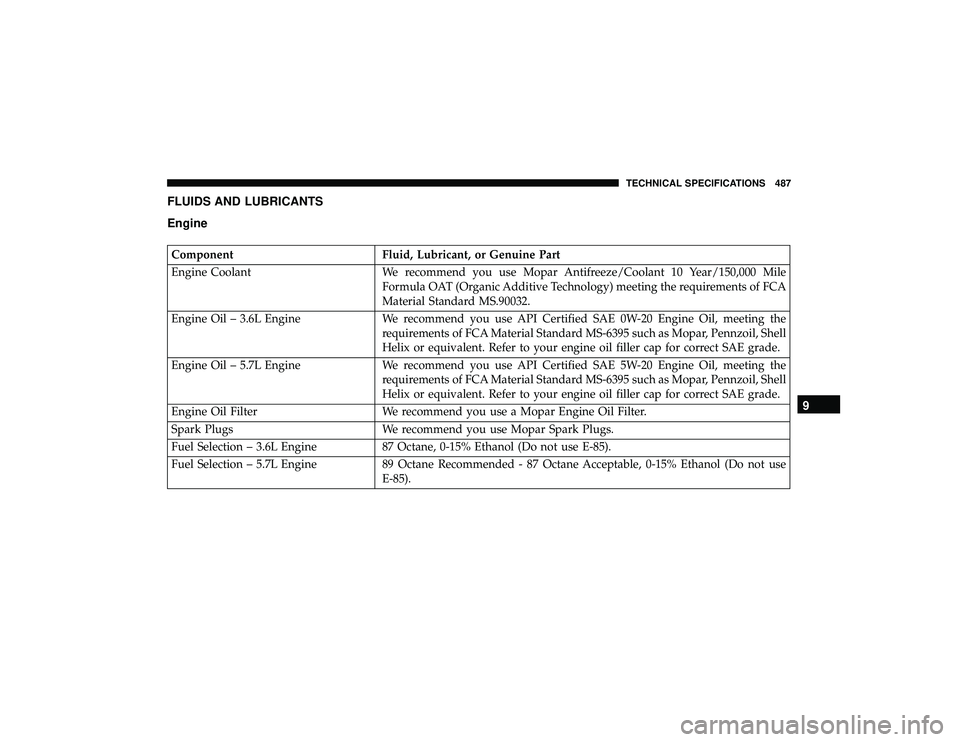
FLUIDS AND LUBRICANTS
Engine
ComponentFluid, Lubricant, or Genuine Part
Engine Coolant We recommend you use Mopar Antifreeze/Coolant 10 Year/150,000 Mile
Formula OAT (Organic Additive Technology) meeting the requirements of FCA
Material Standard MS.90032.
Engine Oil – 3.6L Engine We recommend you use API Certified SAE 0W-20 Engine Oil, meeting the
requirements of FCA Material Standard MS-6395 such as Mopar, Pennzoil, Shell
Helix or equivalent. Refer to your engine oil filler cap for correct SAE grade.
Engine Oil – 5.7L Engine We recommend you use API Certified SAE 5W-20 Engine Oil, meeting the
requirements of FCA Material Standard MS-6395 such as Mopar, Pennzoil, Shell
Helix or equivalent. Refer to your engine oil filler cap for correct SAE grade.
Engine Oil Filter We recommend you use a Mopar Engine Oil Filter.
Spark Plugs We recommend you use Mopar Spark Plugs.
Fuel Selection – 3.6L Engine 87 Octane, 0-15% Ethanol (Do not use E-85).
Fuel Selection – 5.7L Engine 89 Octane Recommended - 87 Octane Acceptable, 0-15% Ethanol (Do not use
E-85).
9
TECHNICAL SPECIFICATIONS 487
Page 593 of 598
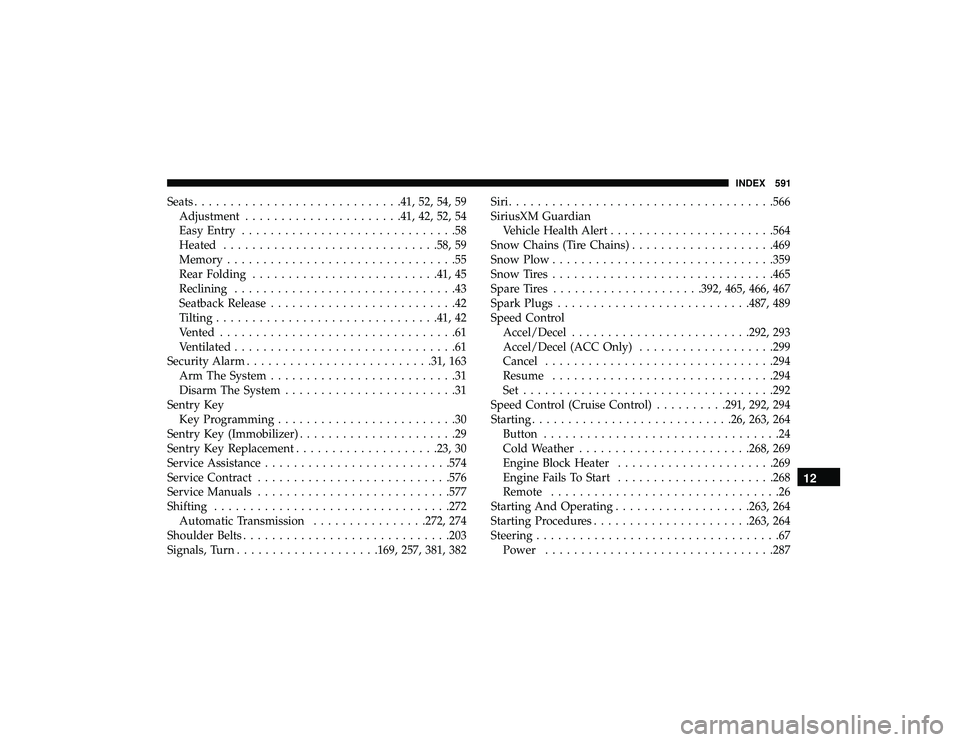
Seats............................ .41, 52, 54, 59
Adjustment ..................... .41, 42, 52, 54
Easy Entry ..............................58
Heated ............................. .58, 59
Memory ................................55
Rear Folding ......................... .41, 45
Reclining ...............................43
Seatback Release ..........................42
Tilting .............................. .41, 42
Vented .................................61
Ventilated ...............................61
Security Alarm ......................... .31, 163
Arm The System ..........................31
Disarm The System ........................31
Sentry Key Key Programming .........................30
Sentry Key (Immobilizer) ......................29
Sentry Key Replacement ................... .23, 30
Service Assistance ......................... .574
Service Contract .......................... .576
Service Manuals .......................... .577
Shifting ................................ .272
Automatic Transmission ................272, 274
Shoulder Belts ............................ .203
Signals, Turn ................... .169, 257, 381, 382Siri
.................................... .566
SiriusXM Guardian Vehicle Health Alert .......................564
Snow Chains (Tire Chains) ....................469
Snow Plow .............................. .359
Snow Tires .............................. .465
Spare Tires .....................392, 465, 466, 467
Spark Plugs .......................... .487, 489
Speed Control Accel/Decel ........................ .292, 293
Accel/Decel (ACC Only) ...................299
Cancel ............................... .294
Resume .............................. .294
Set .................................. .292
Speed Control (Cruise Control) ..........291,292,
294
Starting ........................... .26, 263, 264
Button .................................24
Cold Weather ....................... .268, 269
Engine Block Heater ..................... .269
Engine Fails To Start ..................... .268
Remote ................................26
Starting And Operating .................. .263, 264
Starting Procedures ..................... .263, 264
Steering ..................................67
Power ............................... .287
12
INDEX 591