spare tire DODGE DURANGO 2019 Vehicle Warranty
[x] Cancel search | Manufacturer: DODGE, Model Year: 2019, Model line: DURANGO, Model: DODGE DURANGO 2019Pages: 270, PDF Size: 2.52 MB
Page 57 of 270
TIPS FOR SAFE TIRE INFLATION
WARNING!
Inflating an unsecured tire is dangerous. If it bursts, it could be
hurled into the air with explosive force resulting in serious personal
injury or death. Never inflate a tire unless it is secured to the vehicle
or a tire mounting machine.
• Check your tire pressures, including your spare tire, monthly and
before long trips or carrying extra weight. Be sure to use an accurate
pressure gauge.
• Check inflation pressure when the tires are “cold.” Tires are considered
“cold” when the vehicle has been parked for three hours or more, or if
the vehicle has been driven less than a mile at moderate speed.
• Never release pressure from a hot tire in order to reach the recom-
mended cold tire pressure. Normal driving causes tires to run hotter
and inflation pressure to increase. If you reduce inflation pressure
when your tires are hot, you may dangerously underinflate your tires.
• If it is necessary to adjust inflation pressure when your tires are “hot,”
set their pressure to 4 psi (28 kPa) above the recommended cold
inflation pressure. Recheck the inflation pressure when the tires are
cold.
• If your tires lose more than 2 psi (14 kPa) per month, the tire, the valve,
or wheel may be damaged. Consult a qualified tire service professional
for an inspection.
• Use valve caps to keep the valves clear of debris and to help guard
against inflation pressure loss.
BRIDGESTONE® - FIRESTONE®
56
Page 58 of 270
TIPS FOR SAFE LOADING
WARNING!
Driving your vehicle in an overloaded condition is dangerous.
Overloading causes excessive tire heat build-up and internal
structural damage. This can cause a tire failure, even at a later date,
which could lead to serious personal injury or death. Consult the
vehicle tire information placard, certification label, and owner ’s
manual for the recommended vehicle load limits and loading
recommendations.
• Always keep the vehicle manufacturer ’s recommended inflation pres-
sure in all your tires, including the spare. Check their pressure monthly
and before long trips or carrying extra weight.
• Never exceed the maximum load rating stamped on the sidewall of
your tire.
• Never exceed the gross vehicle weight rating (GVWR) or front/rear
gross axle weight ratings (GAWR) of your vehicle.
• Consult your vehicle owner ’s manual for load recommendations and
special instructions (such as for trailer/towing and snow plow
installations).
TIRE DAMAGE, INSPECTION AND SERVICE LIFE
Evaluation and maintenance of your tires is important to their perfor-
mance and the service they provide to you. Over time and/or through
use, the condition of a tire can change from exposure to everyday road
conditions, the environment, damaging events such as punctures, and
other external factors.
WARNING!
Driving on damaged tires is dangerous. A damaged tire can
suddenly fail causing serious personal injury or death. Have your
tires regularly inspected by a qualified tire service professional.
You should visually inspect your tires on a regular basis throughout their
life, and you should have your tires periodically evaluated by a qualified
tire service professional when your vehicle is serviced such as routine
BRIDGESTONE® - FIRESTONE®
57
Page 59 of 270
maintenance intervals, oil changes, and tire rotations. In particular, note
the following tips for spotting tire damage:
•After striking anything unusual in the roadway, have a qualified tire
service professional demount the tire and inspect it for damage. A tire
may not have visible signs of damage on the tire surface. Yet, the tire
may suddenly fail without warning, a day, a week, or even months
later.
• Inspect your tires for cuts, cracks, splits or bruises in the tread and
sidewall areas. Bumps or bulges may indicate a separation within the
tire body. Have your tire inspected by a qualified tire service profes-
sional. It may be necessary to have it removed from the wheel for a
complete inspection.
• Inspect your tires for adequate tread depth. When the tire is worn to
the built-in indicators at 2/32 inch (1.6 mm) or less tread groove depth,
or the tire cord or fabric is exposed, the tire is dangerously worn and
must be replaced immediately.
• Inspect your tires for uneven wear. Wear on one side of the tread or flat
spots in the tread may indicate a problem with the tire or vehicle.
Consult a qualified tire service professional.
• Inspect your wheels also. If you have a bent or cracked wheel, it must
be replaced.
• Don’t forget to check the spare tire.
Make sure your tires, including the spare tire, continue to be regularly
inspected after 5 years of service to determine if they can continue in
service. Even when your tires appear to be usable from their external
appearance or the tread depth may have not reached the minimum wear
out depth, it is recommended that all tires (including spare tires and
“temporary use” spares) more than 10 years old be replaced with new
tires.
The 10 year period after the date of production is not an indicator of
actual service life for any individual tire. Some tires will need to be
replaced before 10 years due to conditions such as punctures, impact
damage, improper inflation, overloading, tread wear or other conditions
involving use or misuse of the tire. If a tire is worn out or otherwise
unserviceable from damage or conditions of use, it should be replaced
regardless of when it was produced or placed in service.
BRIDGESTONE® - FIRESTONE®
58
Page 69 of 270
TIRE SPINNING
WARNING!
Spinning a tire to remove a vehicle stuck in mud, ice, snow, or wet
grass can be dangerous. A tire spinning at a speedometer reading
above 35 mph (55 km/h) can in a matter of seconds reach a speed
capable of disintegrating a tire with explosive force. Under some
conditions, a tire may be spinning at a speed twice that shown on
the speedometer. This could cause serious personal injury or death
to a bystander or passenger. Never spin a tire above a speedometer
reading of 35 mph (55 km/h).
RADIAL TIRE ROTATION
The purpose of tire rotation is to minimize irregular or uneven wear
caused by maintaining a tire in one rotation direction and one position
over an extended period. Rotate tires as recommended by the vehicle
manufacturer or every 5,000 miles. Individual tire pressures must be
checked after rotation and adjusted to the vehicle manufacturer ’s recom-
mendation for the tire’s new location on the vehicle. Vehicle alignment
should be checked if irregular wear is evident.
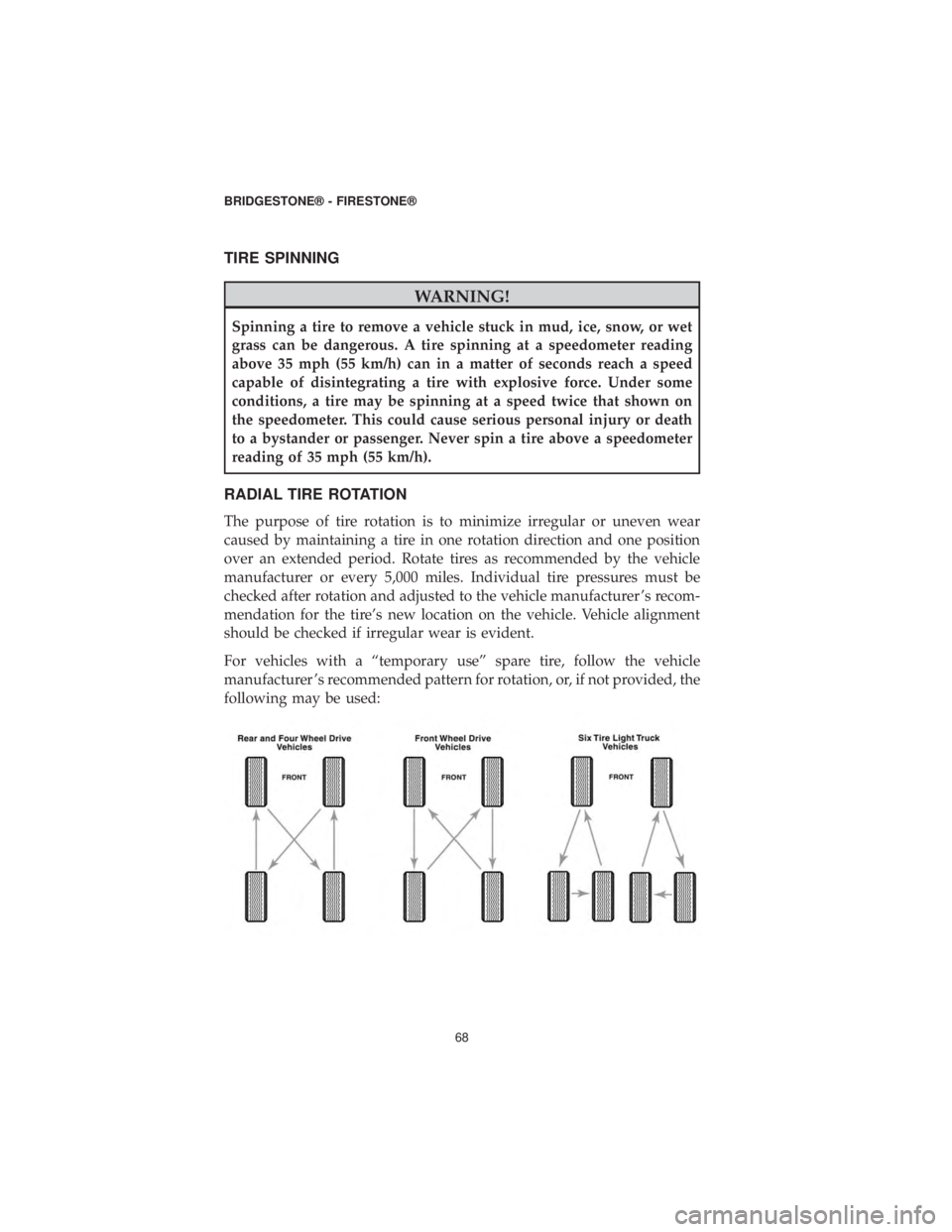
For vehicles with a “temporary use” spare tire, follow the vehicle
manufacturer ’s recommended pattern for rotation, or, if not provided, the
following may be used:
BRIDGESTONE® - FIRESTONE®68
Page 70 of 270
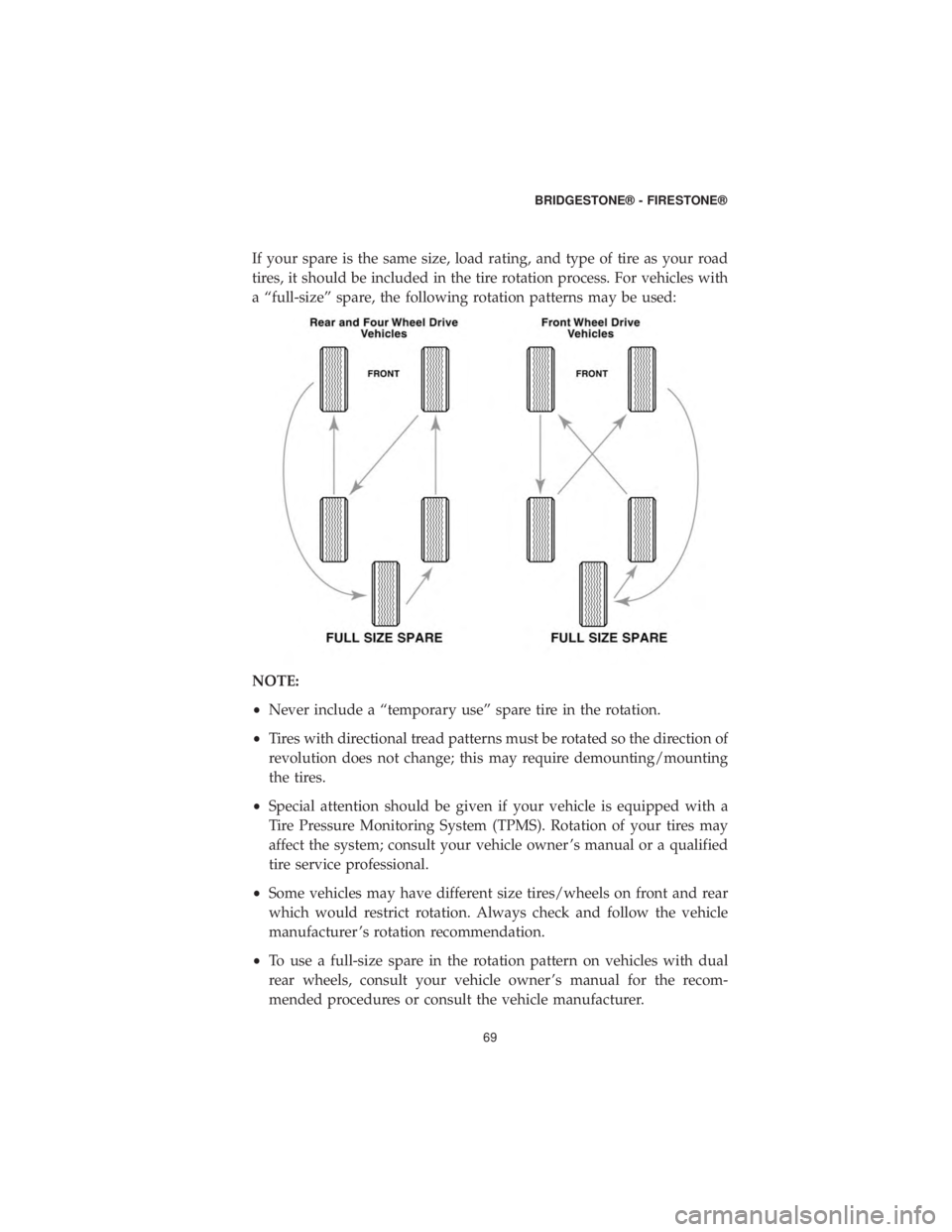
If your spare is the same size, load rating, and type of tire as your road
tires, it should be included in the tire rotation process. For vehicles with
a “full-size” spare, the following rotation patterns may be used:
NOTE:
•Never include a “temporary use” spare tire in the rotation.
• Tires with directional tread patterns must be rotated so the direction of
revolution does not change; this may require demounting/mounting
the tires.
• Special attention should be given if your vehicle is equipped with a
Tire Pressure Monitoring System (TPMS). Rotation of your tires may
affect the system; consult your vehicle owner ’s manual or a qualified
tire service professional.
• Some vehicles may have different size tires/wheels on front and rear
which would restrict rotation. Always check and follow the vehicle
manufacturer ’s rotation recommendation.
• To use a full-size spare in the rotation pattern on vehicles with dual
rear wheels, consult your vehicle owner ’s manual for the recom-
mended procedures or consult the vehicle manufacturer.
BRIDGESTONE® - FIRESTONE®
69
Page 71 of 270
YOUR SPARE TIRE
Consult your vehicle owner ’s manual for proper application of your
spare tire. Your car may be equipped with a “temporary use” spare tire;
this spare may differ in size and construction from the other tires on your
vehicle.
WARNING!
Check inflation pressure before use. Failure to have proper inflation
pressure when using your spare tire can result in serious personal
injury or death. See Tire Inflation Pressure in this manual.
WARNING!
Mounting a “temporary use” tire on a wheel which is not
specifically designed for it, or placing another type tire on a wheel
designated for temporary use can be dangerous. Your vehicle’s
handling characteristics can be seriously affected. You could have an
accident resulting in serious personal injury or death. Consult your
vehicle owner ’s manual for proper application of your “temporary
use” spare tire.
The spare tire in your vehicle is intended to be used as a spare when
needed. The spare tire carrier is not intended to be used for long term
storage, except for “temporary use” tires. If your spare is the same size,
load rating, and type of tire as your road tires, it should be included in the
tire rotation process; see “Radial Tire Rotation” in this manual for more
information.
The spare should be included in regular tire inspections and inflation
pressure checks. In addition, it should be replaced 10 years after date of
manufacture, regardless of condition or tread depth. For more informa-
tion, see the “Tire Damage, Inspection and Service Life” in this manual.
TIRE STORAGE
Tires should be stored indoors in a cool, dry place where water cannot
collect inside them. Tires should be placed away from electric
generators/motors and sources of heat such as hot pipes. Storage
surfaces should be clean and free of grease, gasoline or other substances
which can deteriorate the rubber.
BRIDGESTONE® - FIRESTONE®
70
Page 72 of 270
WARNING!
Improper storage can damage your tires in ways that may not be
visible and can lead to a failure resulting in serious personal injury
or death.
The spare tire in your vehicle is intended to be used as a spare when
needed. The spare tire carrier is not intended to be used for long term
storage, except for “temporary use” tires. For more information, see
“Your Spare Tire” and “Radial Tire Rotation” in this manual.
TIRE SERVICE CUSTOMER SATISFACTION
Normal tire maintenance and Limited Warranty services are available at
locations across the U.S.A. and Canada. For more information, visit us on
the internet at
www.bridgestonetire.com, or please call the Technical
Service Department:
U.S.A.: 800-356-4644 or Canada: 800-267-1318 .
Additional information on the care and service of automobile and light
truck tires is available from the following organizations:
Rubber Manufacturers Association 1400 K Street, N.W. Washington, DC
20005-2403
www.rma.org
Rubber Association of Canada 2000 Argentia Road, Plaza 4, Suite 250
Mississauga, Ontario L5N 1W1
www.rubberassociation.ca
TIRE REGISTRATION
Registration of your tires is an important safety precaution since it
enables the manufacturer to notify you in the event of a recall. When you
purchase replacement tires, the retailer will provide a registration card on
which the tire identification numbers have been recorded; fill in your
name and address on the card and mail it promptly. Some retailers may
submit the registration for you. You do not need to register tires which
come as original equipment on new vehicles—the vehicle and tire
manufacturers handle that for you.
BRIDGESTONE® - FIRESTONE®
71
Page 73 of 270
RFT TIRES WITH RUN-FLAT TECHNOLOGY
If your vehicle is equipped with
Bridgestone or Firestone brand RFT
tires, this chapter presents specific
maintenance and safety issues asso-
ciated with these tires that are in addition to those covered elsewhere in
this manual.
What is RFT? Run-Flat Technology tires are extraordinary tires that
utilize specially designed components to temporarily support your
vehicle in the event of inflation pressure loss, such as from a puncture.
This gives you the ability to drive to a convenient and safe location to
change your tire (if equipped with a spare) or have it inspected for
possible repair or replacement.
Naturally, certain run-flat and low pressure operating limitations apply,
which varies according to the specific self-supporting tire design. Like all
tires, during normal operation, they must be properly inflated and
maintained. Regardless of the design or quality, no tire is indestructible.
RFT—How to Identify: Bridgestone and Firestone brand tires are
marked on the sidewalls, near the wheel, with the RFT logo (shown
above).
RFT INFLATION PRESSURE
Like other tires, RFT tires need proper inflation pressure maintenance for
safe operation and to achieve the maximum tire life and performance.
Check inflation pressures monthly and before long trips or carrying extra
weight. Use an accurate tire gauge and check pressures when the tires are
cold. Follow the vehicle manufacturer ’s recommendation for inflation
pressure settings as indicated on the vehicle tire information placard
and/or in the vehicle owner ’s manual. Do not forget the spare, if
applicable. See “Tire Inflation Pressure” in this manual.
TIRE PRESSURE MONITORING SYSTEM (TPMS)
A functioning tire pressure monitoring system (TPMS) must be used with
your RFT tires. Because these tires ride so well even without inflation
pressure, the TPMS may be necessary to alert you of an inflation pressure
loss condition. When alerted, follow the instructions in your vehicle
owner ’s manual and see “Run-Flat or Low Tire Pressure Operation,” the
following section in this manual.
BRIDGESTONE® - FIRESTONE®
72
Page 82 of 270
LIMITED WARRANTY
ORIGINAL EQUIPMENT
PASSENGER AND LIGHT TRUCK TIRES
Including
Tires with Run-Flat Technology
ELIGIBILITY
This Limited Warranty covers BRIDGESTONE and FIRESTONE brand
passenger and light truck tires, including RFT and temporary spare tires,
originally installed by the vehicle manufacturer on a new vehicle. You are
covered under the terms of this Limited Warranty if the tire was
produced after July 4, 2004 (DOT serial 2704 or later) and has been used
only on the vehicle on which it was originally installed in non-
commercial service.
WHAT IS WARRANTED AND FOR HOW LONG
Before wearing down to 2/32 inch (1.6 mm) remaining original tread
depth (i.e. worn down to the top of the built-in indicators in the tread
grooves) and within 6 years from the date of purchase (proof of purchase
date required; without proof of purchase date, then within 6 years from
the date of tire manufacture), for any reason other than those excluded in
the section entitled “What This Limited Warranty Does Not Cover,” any
eligible tire that becomes unusable for any reason within the manufac-
turer ’s control will be replaced with an equivalent new tire on the basis
set forth in this Limited Warranty.
WHAT THIS LIMITED WARRANTY DOES NOT COVER
This Limited Warranty does not cover the following:
1. Tire damage or irregular wear due to: A. Road hazards, including, without limitation: Puncture, cut, impact
break, stone drill, bruise, bulge, snag, etc.
BRIDGESTONE® - FIRESTONE®
81
Page 88 of 270
CONTINENTAL TIRE
LIMITED WARRANTY AND ADJUSTMENT POLICY FOR ORIGI-
NAL EQUIPMENT PASSENGER CAR & LIGHT TRUCK TIRES
(Including TEMPORARY SPARE Tires)
This booklet also includes important safety warnings.
1.ELIGIBILITY
This Limited Warranty and Adjustment Policy applies to the original
owner of new Continental brand passenger and light truck (LT) tires
that are the new vehicle original equipment tires bearing the Conti-
nental brand name and D.O.T. Tire Identification Number, operated in
normal service, and used on the same vehicle on which they were
originally installed according to the vehicle manufacturer ’s recom-
mendations.
Tire(s) on any vehicle registered and normally operated outside the
United States and Canada are excluded from eligibility under this
Limited Warranty and Adjustment Policy.
2. WHAT IS THE ADJUSTMENT POLICY AND HOW LONG IS IT
APPLICABLE? BASIC COVERAGE:
Eligible Tires are covered by this Warranty for a maximum of 72
months from the date of purchase, determined by the new vehicle
registration date or new vehicle sales invoice showing date of pur-
chase.
Where to Go for Warranty Replacement: Contact the dealer from
where you purchased the vehicle or an alternate authorized Continen-
tal brand tire dealer (Authorized Dealer) to determine the eligible
warranty coverage for your tires and how to proceed from there.
Free Replacement Period: PASS & LT If an eligible Continental brand
PASS or LT tire becomes unserviceable from a warrantable condition,
other than those listed under Section 3, during the first 12 months or
first 2/32nds of an inch (1.6 mm) of treadwear (whichever comes first),
it will be replaced with a **comparable new Continental brand tire
FREE OF CHARGE, including mounting and balancing (excluding on
line orders). Owner pays all applicable taxes.
CONTINENTAL TIRE
87