maintenance DODGE DURANGO 2021 Repair Manual
[x] Cancel search | Manufacturer: DODGE, Model Year: 2021, Model line: DURANGO, Model: DODGE DURANGO 2021Pages: 340, PDF Size: 20.38 MB
Page 312 of 340
310SERVICING AND MAINTENANCE
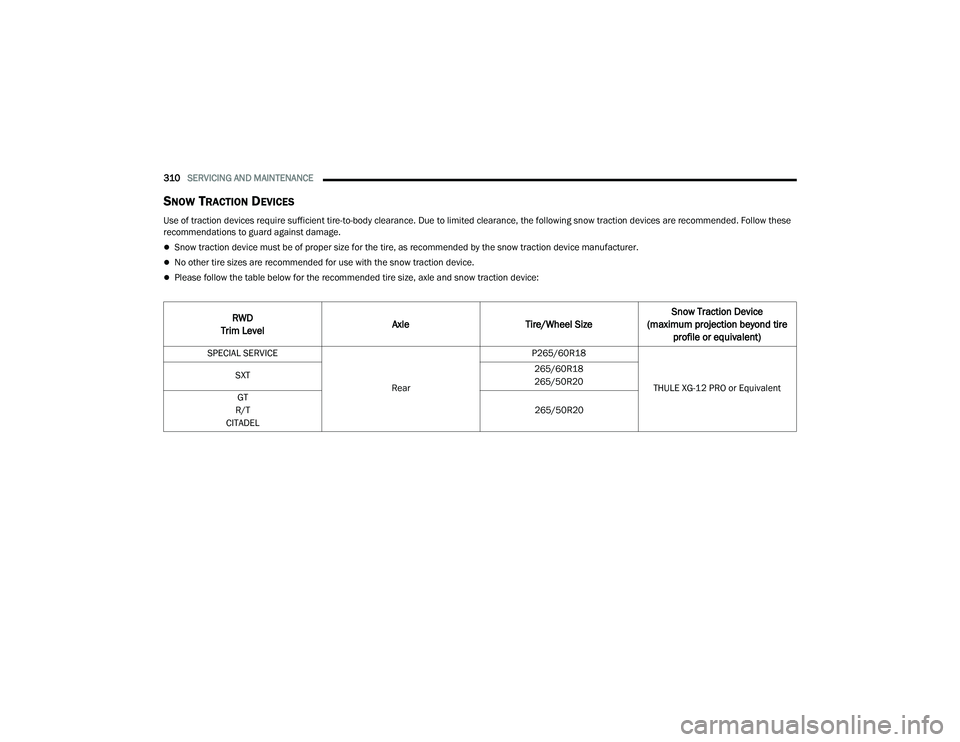
SNOW TRACTION DEVICES
Use of traction devices require sufficient tire-to-body clearance. Due to limited clearance, the following snow traction devices are recommended. Follow these
recommendations to guard against damage.
Snow traction device must be of proper size for the tire, as recommended by the snow traction device manufacturer.
No other tire sizes are recommended for use with the snow traction device.
Please follow the table below for the recommended tire size, axle and snow traction device:
RWD
Trim Level Axle
Tire/Wheel Size Snow Traction Device
(maximum projection beyond tire profile or equivalent)
SPECIAL SERVICE
RearP265/60R18
THULE XG-12 PRO or Equivalent
SXT
265/60R18
265/50R20
GT
R/T
CITADEL 265/50R20
21_WD_OM_EN_USC_t.book Page 310
Page 313 of 340
SERVICING AND MAINTENANCE311
(Continued)
(Continued)
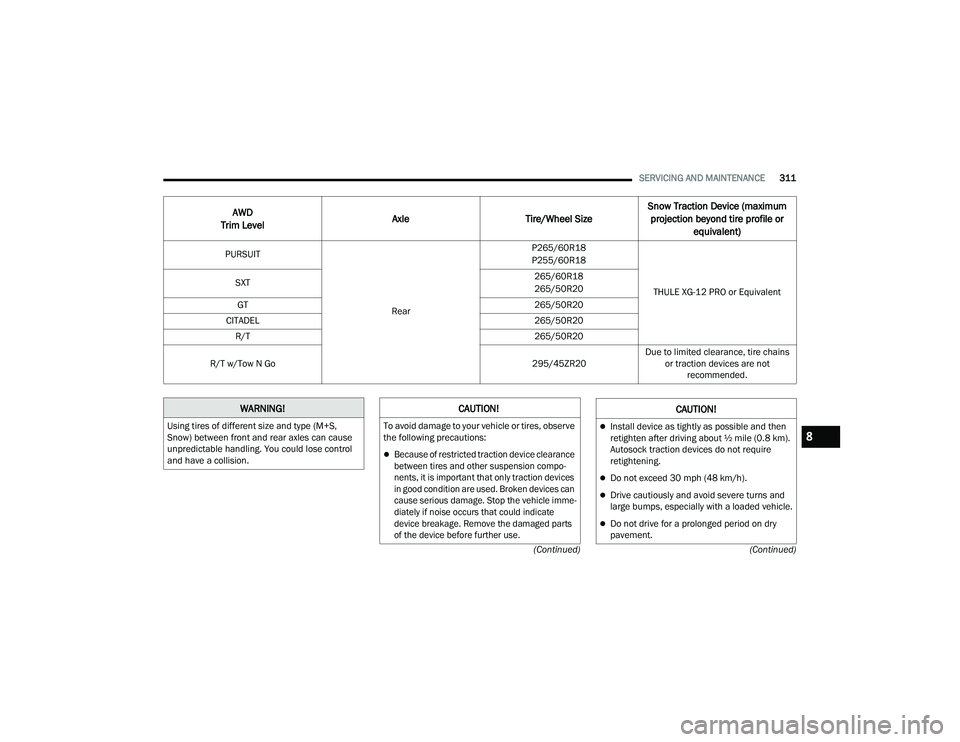
AWD
Trim Level Axle
Tire/Wheel SizeSnow Traction Device (maximum
projection beyond tire profile or equivalent)
PURSUIT
RearP265/60R18
P255/60R18
THULE XG-12 PRO or Equivalent
SXT
265/60R18
265/50R20
GT 265/50R20
CITADEL 265/50R20
R/T 265/50R20
R/T w/Tow N Go 295/45ZR20Due to limited clearance, tire chains
or traction devices are not recommended.
WARNING!
Using tires of different size and type (M+S,
Snow) between front and rear axles can cause
unpredictable handling. You could lose control
and have a collision.
CAUTION!
To avoid damage to your vehicle or tires, observe
the following precautions:
Because of restricted traction device clearance
between tires and other suspension compo -
nents, it is important that only traction devices
in good condition are used. Broken devices can
cause serious damage. Stop the vehicle imme -
diately if noise occurs that could indicate
device breakage. Remove the damaged parts
of the device before further use.
Install device as tightly as possible and then
retighten after driving about ½ mile (0.8 km).
Autosock traction devices do not require
retightening.
Do not exceed 30 mph (48 km/h).
Drive cautiously and avoid severe turns and
large bumps, especially with a loaded vehicle.
Do not drive for a prolonged period on dry
pavement.
CAUTION!
8
21_WD_OM_EN_USC_t.book Page 311
Page 314 of 340
312SERVICING AND MAINTENANCE
TIRE ROTATION RECOMMENDATIONS
The tires on the front and rear of your vehicle
operate at different loads and perform different
steering, handling, and braking functions. For
these reasons, they wear at unequal rates.
These effects can be reduced by timely rotation of
tires. The benefits of rotation are especially
worthwhile with aggressive tread designs such as
those on On/Off-Road type tires. Rotation will
increase tread life, help to maintain mud, snow,
and wet traction levels, and contribute to a
smooth, quiet ride.
For the proper maintenance intervals Úpage 265.
The reasons for any rapid or unusual wear should
be corrected prior to rotation being performed.
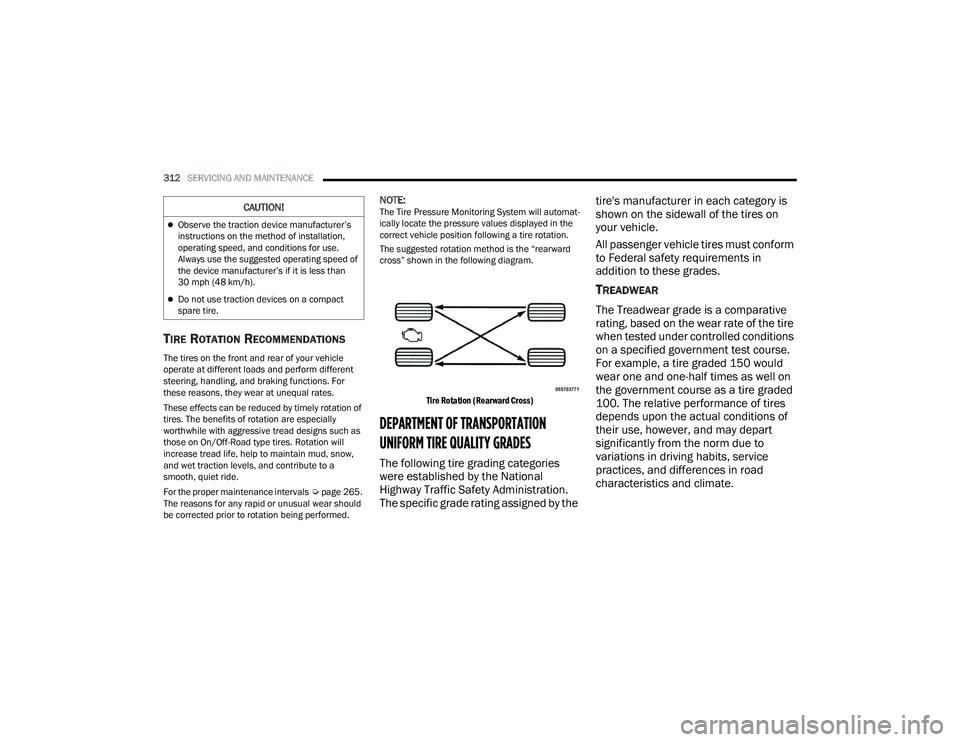
NOTE:The Tire Pressure Monitoring System will automat -
ically locate the pressure values displayed in the
correct vehicle position following a tire rotation.
The suggested rotation method is the “rearward
cross” shown in the following diagram.
Tire Rotation (Rearward Cross)
DEPARTMENT OF TRANSPORTATION
UNIFORM TIRE QUALITY GRADES
The following tire grading categories
were established by the National
Highway Traffic Safety Administration.
The specific grade rating assigned by the tire's manufacturer in each category is
shown on the sidewall of the tires on
your vehicle.
All passenger vehicle tires must conform
to Federal safety requirements in
addition to these grades.
TREADWEAR
The Treadwear grade is a comparative
rating, based on the wear rate of the tire
when tested under controlled conditions
on a specified government test course.
For example, a tire graded 150 would
wear one and one-half times as well on
the government course as a tire graded
100. The relative performance of tires
depends upon the actual conditions of
their use, however, and may depart
significantly from the norm due to
variations in driving habits, service
practices, and differences in road
characteristics and climate.
Observe the traction device manufacturer’s
instructions on the method of installation,
operating speed, and conditions for use.
Always use the suggested operating speed of
the device manufacturer’s if it is less than
30 mph (48 km/h).
Do not use traction devices on a compact
spare tire.
CAUTION!
21_WD_OM_EN_USC_t.book Page 312
Page 315 of 340
SERVICING AND MAINTENANCE313
TRACTION GRADES
The Traction grades, from highest to
lowest, are AA, A, B, and C. These grades
represent the tire's ability to stop on wet
pavement, as measured under
controlled conditions on specified
government test surfaces of asphalt and
concrete. A tire marked C may have poor
traction performance.
TEMPERATURE GRADES
The Temperature grades are A (the
highest), B, and C, representing the tire's
resistance to the generation of heat and
its ability to dissipate heat, when tested
under controlled conditions on a
specified indoor laboratory test wheel. Sustained high temperature can cause
the material of the tire to degenerate
and reduce tire life, and excessive
temperature can lead to sudden tire
failure. The grade C corresponds to a
level of performance, which all
passenger vehicle tires must meet
under the Federal Motor Vehicle Safety
Standard No. 109. Grades B and A
represent higher levels of performance
on the laboratory test wheel, than the
minimum required by law.
STORING THE VEHICLE
If you are storing your vehicle for more than three
weeks, we recommend that you take the following
steps to minimize the drain on your vehicle's
battery:
Disconnect the negative cable from battery.
Any time you store your vehicle or keep it out of
service (i.e., vacation) for two weeks or more,
run the air conditioning system at idle for about
five minutes in the fresh air and high blower
setting. This will ensure adequate system lubri-
cation to minimize the possibility of compressor
damage when the system is started again.
BODYWORK
PROTECTION FROM ATMOSPHERIC
A
GENTS
Vehicle body care requirements vary according to
geographic locations and usage. Chemicals that
make roads passable in snow and ice and those
that are sprayed on trees and road surfaces during
other seasons are highly corrosive to the metal in
your vehicle. Outside parking, which exposes your
vehicle to airborne contaminants, road surfaces on
which the vehicle is operated, extreme hot or cold
WARNING!
The traction grade assigned to this tire is based
on straight-ahead braking traction tests, and
does not include acceleration, cornering,
hydroplaning, or peak traction characteristics.
WARNING!
The temperature grade for this tire is
established for a tire that is properly inflated and
not overloaded. Excessive speed, underinflation,
or excessive loading, either separately or in
combination, can cause heat buildup and
possible tire failure.
8
21_WD_OM_EN_USC_t.book Page 313
Page 316 of 340
314SERVICING AND MAINTENANCE
weather and other extreme conditions will have an
adverse effect on paint, metal trim, and underbody
protection.
The following maintenance recommendations will
enable you to obtain maximum benefit from the
corrosion resistance built into your vehicle.
What Causes Corrosion?
Corrosion is the result of deterioration or removal
of paint and protective coatings from your vehicle.
The most common causes are:
Road salt, dirt and moisture accumulation
Stone and gravel impact
Insects, tree sap and tar
Salt in the air near seacoast localities
Atmospheric fallout/industrial pollutants
BODY AND UNDERBODY MAINTENANCE
Cleaning Headlights
Your vehicle is equipped with plastic headlights
and fog lights that are lighter and less susceptible
to stone breakage than glass headlights.
Plastic is not as scratch resistant as glass and
therefore different lens cleaning procedures must
be followed. To minimize the possibility of scratching the lenses
and reducing light output, avoid wiping with a dry
cloth. To remove road dirt, wash with a mild soap
solution followed by rinsing.
Do not use abrasive cleaning components,
solvents, steel wool or other aggressive material to
clean the lenses.
PRESERVING THE BODYWORK
Washing
Wash your vehicle regularly. Always wash your
vehicle in the shade using Mopar® Car Wash, or
a mild car wash soap, and rinse the panels
completely with water.
If insects, tar, or other similar deposits have
accumulated on your vehicle, use Mopar®
Super Kleen Bug and Tar Remover to remove.
Use a high quality cleaner wax, such as Mopar®
Cleaner Wax to remove road film, stains and to
protect your paint finish. Use precautions to not
scratch the paint.
Avoid using abrasive compounds and power
buffing that may diminish the gloss or thin out
the paint finish.
Special Care
If you drive on salted or dusty roads or if you
drive near the ocean, hose off the undercarriage
at least once a month.
It is important that the drain holes in the lower
edges of the doors, rocker panels, and trunk be
kept clear and open.
If you detect any stone chips or scratches in the
paint, touch them up immediately.
If your vehicle is damaged due to a collision or
similar cause that destroys the paint and protec
-
tive coating, have your vehicle repaired as soon
as possible.
CAUTION!
Do not use abrasive or strong cleaning mate -
rials such as steel wool or scouring powder
that will scratch metal and painted surfaces.
Use of power washers exceeding 1,200 psi
(8,274 kPa) can result in damage or removal
of paint and decals.
21_WD_OM_EN_USC_t.book Page 314
Page 317 of 340
SERVICING AND MAINTENANCE315
If you carry special cargo such as chemicals,
fertilizers, de-icer salt, etc., be sure that such
materials are well packaged and sealed.
If a lot of driving is done on gravel roads,
consider mud or stone shields behind each
wheel.
Use Mopar® Touch Up Paint on scratches as
soon as possible. An authorized dealer has
touch up paint to match the color of your
vehicle.
INTERIORS
SEATS AND FABRIC PARTS
Use Mopar® Total Clean to clean fabric upholstery
and carpeting.
Seat Belt Maintenance
Do not bleach, dye or clean the belts with chemical
solvents or abrasive cleaners. This will weaken the
fabric.
If the belts need cleaning, use a mild soap solution
or lukewarm water. Do not remove the belts from
the vehicle to wash them. Dry with a soft cloth.
Sun damage can also weaken the fabric. Replace
the belts if they appear frayed or worn or if the
buckles do not work properly.
PLASTIC AND COATED PARTS
Use Mopar® Total Clean to clean vinyl upholstery.
Cleaning Plastic Instrument Cluster
Lenses
The lenses in front of the instruments in this
vehicle are molded in clear plastic. When cleaning
the lenses, care must be taken to avoid scratching
the plastic.
Clean with a wet soft cloth. A mild soap solution
may be used, but do not use high alcohol content
or abrasive cleaners. If soap is used, wipe clean
with a clean damp cloth. Dry with a soft cloth.WARNING!
Do not use volatile solvents for cleaning
purposes. Many are potentially flammable, and
if used in closed areas they may cause
respiratory harm.
WARNING!
A frayed or torn seat belt could rip apart in a
collision and leave you with no protection.
Inspect the seat belt system periodically,
checking for cuts, frays, or loose parts.
Damaged parts must be replaced immediately.
Do not disassemble or modify the seat belt
system. If your vehicle is involved in a collision,
or if you have questions regarding seat belt or
retractor conditions, take your vehicle to an
authorized FCA dealer or authorized FCA
Certified Collision Care Program facility for
inspection.
CAUTION!
Direct contact of air fresheners, insect repel -
lents, suntan lotions, or hand sanitizers to the
plastic, painted, or decorated surfaces of the
interior may cause permanent damage. Wipe
away immediately.
Damage caused by these type of products
may not be covered by your New Vehicle
Limited Warranty.
8
21_WD_OM_EN_USC_t.book Page 315
Page 318 of 340
316SERVICING AND MAINTENANCE
LEATHER SURFACES
Mopar® Total Clean is specifically recommended
for leather upholstery.
The leather upholstery can be best preserved by
regular cleaning with a damp soft cloth. Small
particles of dirt can act as an abrasive and damage
the leather upholstery and should be removed
promptly with a damp cloth. Stubborn soils can be
removed easily with a soft cloth and Mopar® Total
Clean. Care should be taken to avoid soaking your
leather upholstery with any liquid. Please do not
use polishes, oils, cleaning fluids, solvents,
detergents, or ammonia-based cleaners to clean
your leather upholstery.
NOTE:If equipped with light colored leather, it tends to
show any foreign material, dirt, and fabric dye
transfer more so than darker colors. The leather is
designed for easy cleaning, and the manufacturer
recommends Mopar® total care leather cleaner
applied on a cloth to clean the leather seats as
needed.GLASS SURFACES
All glass surfaces should be cleaned on a regular
basis with Mopar® Glass Cleaner, or any
commercial household-type glass cleaner. Never
use an abrasive type cleaner. Use caution when
cleaning the inside rear window equipped with
electric defrosters or windows equipped with radio
antennas. Do not use scrapers or other sharp
instruments that may scratch the elements.
When cleaning the rear view mirror, spray cleaner
on the towel or cloth that you are using. Do not
spray cleaner directly on the mirror.
CAUTION!
Do not use Alcohol and Alcohol-based and/or
Ketone based cleaning products to clean leather
upholstery, as damage to the upholstery may
result.
21_WD_OM_EN_USC_t.book Page 316
Page 326 of 340
324
CUSTOMER ASSISTANCE
SUGGESTIONS FOR OBTAINING SERVICE
FOR YOUR VEHICLE
PREPARE FOR THE APPOINTMENT
All work to be performed may not be covered by the
warranty. Discuss additional charges with the
service manager. Keep a maintenance log of your
vehicle's service history. This can often provide a
clue to the current problem.
PREPARE A LIST
Make a written list of your vehicle's problems or the
specific work you want done. If you've had an
accident or work done that is not on your
maintenance log, let the service advisor know.
BE REASONABLE WITH REQUESTS
If you list a number of items and you must have
your vehicle by the end of the day, discuss the
situation with the service advisor and list the items
in order of priority. At many authorized dealers, you
may obtain a rental vehicle (additional charges
may apply). If you need a rental, it is advisable to
make these arrangements when you call for an
appointment.
IF YOU NEED ASSISTANCE
FCA US LLC and its authorized dealers are vitally
interested in your satisfaction. We want you to be
happy with our products and services.
Warranty service must be done by an authorized
dealer. We strongly recommend that you take the
vehicle to an authorized dealer. They know your
vehicle the best, and are most concerned that you
get prompt and high quality service. FCA US LLC’s
authorized dealers have the facilities,
factory-trained technicians, special tools, and the
latest information to ensure the vehicle is fixed
correctly and in a timely manner.
This is why you should always talk to an authorized
dealer’s service manager first. If for some reason
you are still not satisfied, talk to the general
manager or owner of the authorized dealer. They
want to know if you need assistance. If an
authorized dealer is unable to resolve the concern,
you may contact FCA US LLC's Customer
Assistance center.Any communication to FCA US LLC’s customer
center should include the following information:Owner's name and address
Owner's telephone number
(home, mobile, and office)
Authorized dealer name
Vehicle Identification Number (VIN)
Vehicle delivery date and mileage
FCA U S LLC CUSTOMER CENTER
P.O. Box 21–8004
Auburn Hills, MI 48321–8004
Phone: (800) 423-6343
FCA CANADA INC. CUSTOMER CENTER
P.O. Box 1621
Windsor, Ontario N9A 4H6
Phone: (800) 465-2001 English /
(800) 387-9983 French
21_WD_OM_EN_USC_t.book Page 324
Page 330 of 340
328
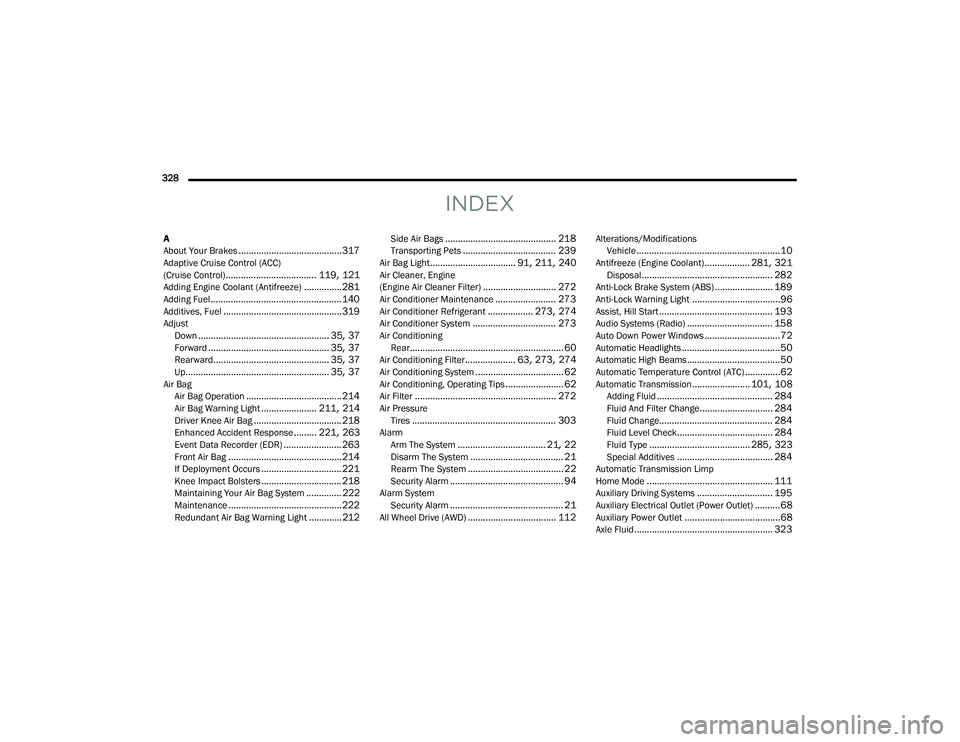
INDEX
A
About Your Brakes......................................... 317Adaptive Cruise Control (ACC)
(Cruise Control).................................... 119, 121Adding Engine Coolant (Antifreeze)............... 281Adding Fuel.................................................... 140Additives, Fuel............................................... 319AdjustDown.................................................... 35, 37Forward................................................ 35, 37Rearward.............................................. 35, 37Up......................................................... 35, 37Air BagAir Bag Operation...................................... 214Air Bag Warning Light...................... 211, 214Driver Knee Air Bag................................... 218Enhanced Accident Response......... 221, 263Event Data Recorder (EDR)....................... 263Front Air Bag............................................. 214If Deployment Occurs................................ 221Knee Impact Bolsters................................ 218Maintaining Your Air Bag System.............. 222Maintenance............................................. 222Redundant Air Bag Warning Light.............212
Side Air Bags............................................ 218Transporting Pets..................................... 239Air Bag Light.................................. 91, 211, 240Air Cleaner, Engine
(Engine Air Cleaner Filter)............................. 272Air Conditioner Maintenance........................ 273Air Conditioner Refrigerant.................. 273, 274Air Conditioner System................................. 273Air ConditioningRear............................................................. 60Air Conditioning Filter.................... 63, 273, 274Air Conditioning System................................... 62Air Conditioning, Operating Tips....................... 62Air Filter........................................................ 272Air PressureTires......................................................... 303AlarmArm The System................................... 21, 22Disarm The System..................................... 21Rearm The System...................................... 22Security Alarm............................................. 94Alarm SystemSecurity Alarm............................................. 21All Wheel Drive (AWD)................................... 112
Alterations/ModificationsVehicle.........................................................10Antifreeze (Engine Coolant).................. 281, 321Disposal.................................................... 282Anti-Lock Brake System (ABS)....................... 189Anti-Lock Warning Light...................................96Assist, Hill Start............................................. 193Audio Systems (Radio).................................. 158Auto Down Power Windows..............................72Automatic Headlights.......................................50Automatic High Beams.....................................50Automatic Temperature Control (ATC)..............62Automatic Transmission....................... 101, 108Adding Fluid.............................................. 284Fluid And Filter Change............................. 284Fluid Change............................................. 284Fluid Level Check...................................... 284Fluid Type........................................ 285, 323Special Additives...................................... 284Automatic Transmission Limp
Home Mode.................................................. 111Auxiliary Driving Systems.............................. 195Auxiliary Electrical Outlet (Power Outlet)..........68Auxiliary Power Outlet......................................68Axle Fluid....................................................... 323
21_WD_OM_EN_USC_t.book Page 328
Page 332 of 340
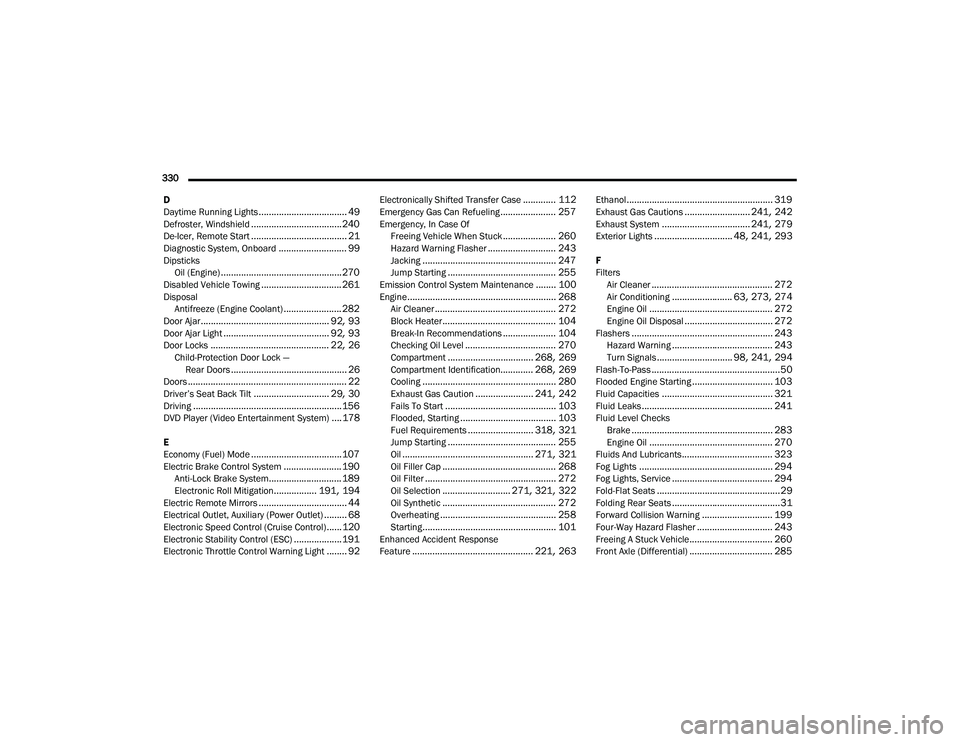
330 D
Daytime Running Lights
................................... 49Defroster, Windshield.................................... 240De-Icer, Remote Start...................................... 21Diagnostic System, Onboard........................... 99Dipsticks Oil (Engine)................................................ 270Disabled Vehicle Towing................................ 261DisposalAntifreeze (Engine Coolant)....................... 282Door Ajar................................................... 92, 93Door Ajar Light.......................................... 92, 93Door Locks............................................... 22, 26Child-Protection Door Lock —Rear Doors.............................................. 26Doors............................................................... 22Driver’s Seat Back Tilt.............................. 29, 30Driving........................................................... 156DVD Player (Video Entertainment System).... 178
E
Economy (Fuel) Mode.................................... 107Electric Brake Control System....................... 190Anti-Lock Brake System............................. 189Electronic Roll Mitigation................. 191, 194Electric Remote Mirrors................................... 44Electrical Outlet, Auxiliary (Power Outlet)......... 68Electronic Speed Control (Cruise Control)...... 120Electronic Stability Control (ESC)...................191Electronic Throttle Control Warning Light........ 92
Electronically Shifted Transfer Case............. 112Emergency Gas Can Refueling...................... 257Emergency, In Case OfFreeing Vehicle When Stuck..................... 260Hazard Warning Flasher........................... 243Jacking..................................................... 247Jump Starting........................................... 255Emission Control System Maintenance........ 100Engine........................................................... 268Air Cleaner................................................ 272Block Heater............................................. 104Break-In Recommendations..................... 104Checking Oil Level.................................... 270Compartment.................................. 268, 269Compartment Identification............. 268, 269Cooling..................................................... 280Exhaust Gas Caution....................... 241, 242Fails To Start............................................ 103Flooded, Starting...................................... 103Fuel Requirements.......................... 318, 321Jump Starting........................................... 255Oil.................................................... 271, 321Oil Filler Cap............................................. 268Oil Filter.................................................... 272Oil Selection........................... 271, 321, 322Oil Synthetic............................................. 272Overheating.............................................. 258Starting..................................................... 101Enhanced Accident Response
Feature................................................ 221, 263
Ethanol.......................................................... 319Exhaust Gas Cautions.......................... 241, 242Exhaust System................................... 241, 279Exterior Lights............................... 48, 241, 293
F
FiltersAir Cleaner
................................................ 272Air Conditioning........................ 63, 273, 274Engine Oil................................................. 272Engine Oil Disposal................................... 272Flashers........................................................ 243Hazard Warning........................................ 243Turn Signals.............................. 98, 241, 294Flash-To-Pass...................................................50Flooded Engine Starting................................ 103Fluid Capacities............................................ 321Fluid Leaks.................................................... 241Fluid Level ChecksBrake........................................................ 283Engine Oil................................................. 270Fluids And Lubricants.................................... 323Fog Lights..................................................... 294Fog Lights, Service........................................ 294Fold-Flat Seats.................................................29Folding Rear Seats...........................................31Forward Collision Warning............................ 199Four-Way Hazard Flasher.............................. 243Freeing A Stuck Vehicle................................. 260Front Axle (Differential)................................. 285
21_WD_OM_EN_USC_t.book Page 330