tire type DODGE DURANGO 2021 Vehicle Warranty
[x] Cancel search | Manufacturer: DODGE, Model Year: 2021, Model line: DURANGO, Model: DODGE DURANGO 2021Pages: 262, PDF Size: 10.42 MB
Page 69 of 262
BRIDGESTONE® - FIRESTONE®
68
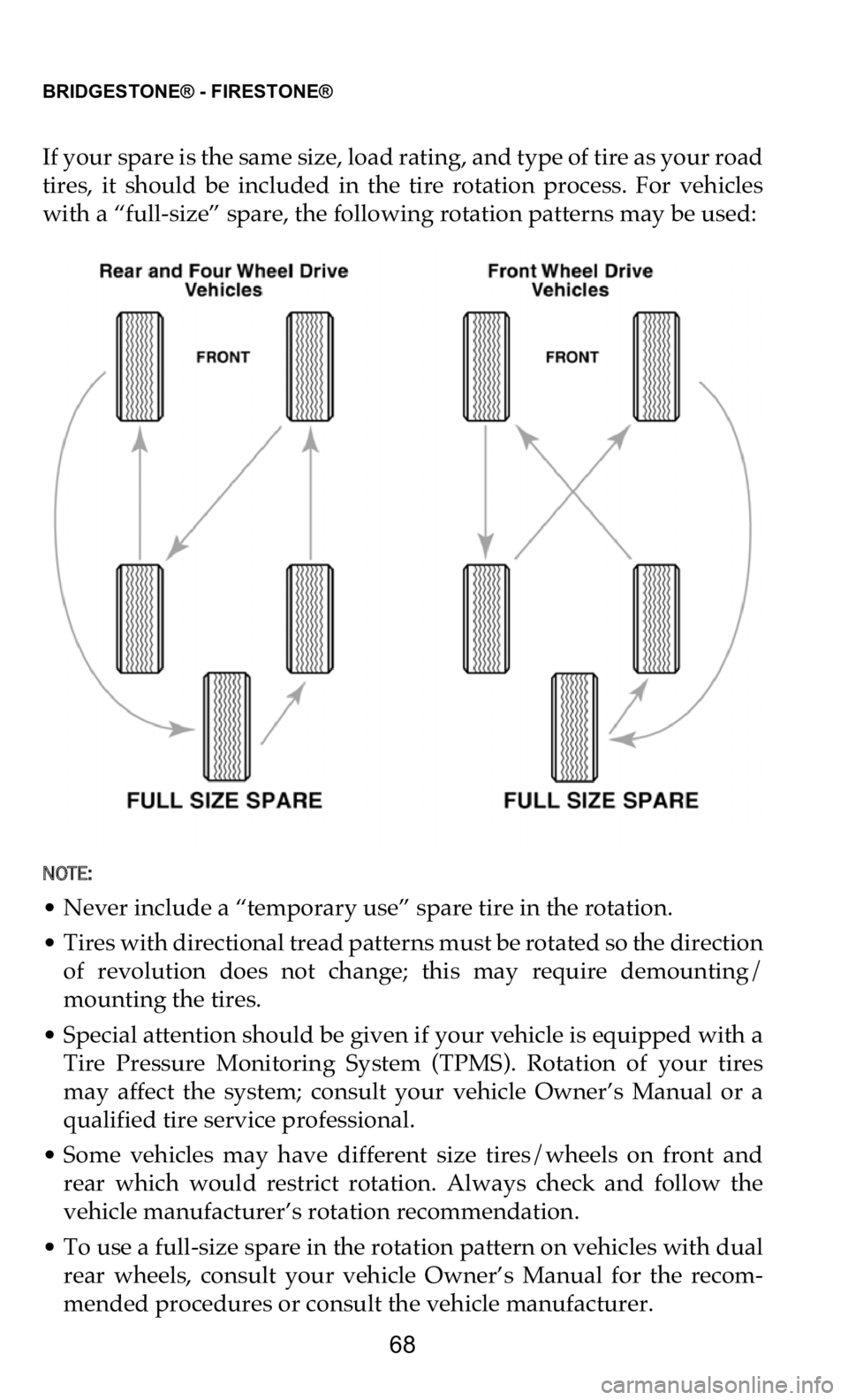
If your spare is the same size, load rating, and type of tire as your road
tires, it should be included in the tire rotation process. For vehicles
with a “full-size” spare, the following rotation patterns may be used:
NOTE:
• Never include a “temporary use” spare tire in the rotation.
• Tires with directional tread patterns must be rotated so the direction
o
f revolution does not change; this may require demounting/
mounting the tires.
• Special attention should be given if your vehicle is equipped with a
T
ire Pressure Monitoring System (TPMS). Rotation of your tires
may affect the system; consult your vehicle Owner’s Manual or a
qualified tire service professional.
• Some vehicles may have different size tires/wheels on front and
r
ear which would restrict rotation. Always check and follow the
vehicle manufacturer’s rotation recommendation.
• To use a full-size spare in the rotation pattern on vehicles with dual
r
ear wheels, consult your vehicle Owner’s Manual for the recom -
mended procedures or consult the vehicle manufacturer.
Page 70 of 262

BRIDGESTONE® - FIRESTONE®
69
YOUR SPARE TIRE
Consult your vehicle Owner’s Manual for proper application of your
sp
are tire. Your car may be equipped with a “temporary use” spare
tire; this spare may differ in size and construction from the other tires
on your vehicle.
The spare tire in your vehicle is intended to be used as a spare when
n e
eded. The spare tire carrier is not intended to be used for long term
storage, except for “temporary use” tires. If your spare is the same
size, load rating, and type of tire as your road tires, it should be
included in the tire rotation process; see “Radial Tire Rotation” in this
manual for more information.
The spare should be included in regular tire inspections and inflation
pr
essure checks. In addition, it should be replaced 10 years after date
of manufacture, regardless of condition or tread depth. For more
information, see the “Tire Damage, Inspection and Service Life” in this
manual.
TIRE STORAGE
Tires should be stored indoors in a cool, dry place where water cannot
co
llect inside them. Tires should be placed away from electric
generators/motors and sources of heat such as hot pipes. Storage
surfaces should be clean and free of grease, gasoline or other
substances which can deteriorate the rubber.
WARNING!
Check inflation pressure before use. Failure to have proper
in
flation pressure when using your spare tire can result in serious
personal injury or death. See Tire Inflation Pressure in this
manual.
WARNING!
Mounting a “temporary use” tire on a wheel which is not
sp
ecifically designed for it, or placing another type tire on a wheel
designated for temporary use can be dangerous. Your vehicle’s
handling characteristics can be seriously affected. You could have
an accident resulting in serious personal injury or death. Consult
your vehicle owner’s manual for proper application of your
“temporary use” spare tire.
Page 79 of 262

BRIDGESTONE® - FIRESTONE®
78
Ply Composition and Materials: The actual number of plies in the
sidewall and tread area and the generic name(s) of their cord
material(s) are marked on at least one sidewall. For example:
• TREAD 2 PLY POLYESTER + 2 STEEL
•
SIDEWALL 2 PLY POLYESTER
R
adial: Radial ply tires will have the word "radial" on at least one
s
idewall. An “R” in the tire size designation also indicates radial ply
construction.
Tubeless or Tube Type: T
ires are marked as either “tubeless” or “tube
type,” whichever is applicable, on at least one sidewall.
UNIFORM TIRE QUALITY GRADING
The Uniform Tire Quality Grading (“UTQG”) standards are intended
to
assist you in making an informed choice in your purchase of
passenger car tires by providing information indicating relative
performance of these tires in the areas of tread wear, wet braking
traction (straight-ahead), and temperature resistance. All passenger
car tires must conform to federal safety requirements in addition to
these grades.
Treadwear
The treadwear grade is a comparative rating based on the wear rate of
th
e tire when tested under controlled conditions on a specified
government test course. For example, a tire graded 150 would wear
one and one half (1 1/2) times as well on the government course as a
tire graded 100. The relative performance of tires depends upon the
actual conditions of their use, however, and may depart significantly
from the norm due to variation in driving habits, service practices and
differences in road characteristics and climate.
Traction
The traction grades, from highest to lowest, are AA, A, B, and C. Those
gr
ades represent the tire’s ability to stop on wet pavement as
measured under controlled conditions on specified government test
surfaces of asphalt and concrete.
NOTE:
The traction grade assigned to a tire is based on straight-ahead
br
aking traction tests, and does not include acceleration, cornering,
hydroplaning, or peak traction characteristics.
Page 99 of 262

FALKEN TIRE CORPORATION
98
TIRE REPAIRS
In the event that you get a flat tire while driving, it is best to find a
ne
arby, safe place to stop and install your spare tire or call a tow truck.
The less distance that you drive on your low or flat tire, the better
chances your tire has of being repairable. Once you are able to get to
your local servicing tire dealer, have them dismount the tire from the
rim and thoroughly inspect the inside of the tire. It is important to
know the difference between a proper tire repair and an improper one
because it can be critical to you and your vehicle’s safety. An improper
repair could pose a safety threat to you and your family and could also
affect your tire’s manufacturer warranty. Here are some tips in
determining if your damaged tire can be properly repaired or not:
• A lways have the tire removed from the wheel and inspected before
a
ny repair is performed.
• Tires with less than 1.6
mm (2/32 of an inch) of tread should NOT
be
repaired.
• Never repair a tire with a puncture larger than 6
mm (1/4 of an
in
ch).
• Repairs should be limited to the tread area only.
•
Repairs cannot overlap one another.
•
A plug and patch or plug/patch combo should be used to effectively
r
epair a tire puncture.
• If anything seems questionable at any time during the repair
p
rocess, ask your service advisor for more details and/or call the
tire manufacturer to make sure the tire’s warranty is not being
voided.
TIRE MIX USAGE
WARNING!
Never mix tires of different size or construction and/or type on
an
y axle. (Except for temporary use as a spare tire.) Always refer to
the vehicle’s owner manual for proper tire fitments.
Page 126 of 262

GOODYEAR® DUNLOP® TIRES
125
•TIRE SPINNING. On slippery surfaces such as snow, mud, ice, etc.,
do not spin tires in excess of 35 mph (55 km/h), as indicated on the
sp
eedometer.
• EXCESSIVE WHEEL SPINNING.
This can also result in tire disin-
tegration or axle failure.
TIRE CARE AND MAINTENANCE GUIDE
The easiest way to help ensure satisfactory mileage and performance
f r
om your Goodyear® or Dunlop® tires is to give them a simple but
frequent (at least monthly) inspection for proper inflation, even tread
wear and the presence of any damage.
DO MAINTAIN PROPER INFLATION PRESSURE IN YOUR TIRES
Proper inflation pressure is necessary for optimum tire performance,
sa
fety and fuel economy. Check inflation pressures at least once a
month and before long trips. Use an accurate tire pressure gauge.
Always check pressures when the tires are cold (when the vehicle has
been driven less than one mile). If you must check inflation when the
tires are hot, add 4 psi (27 kPa) to the recommended cold inflation
pressure. It is difficult to tell just by looking at radial tires whether
they are underinflated.*
WARNING!
Vehicle handling, traction, ride comfort and other performance
pa
rameters may be significantly affected by a change in tire size
or type. Before replacing tires, always consult and follow the
vehicle owner’s manual because some vehicle manufacturers
prohibit changing tire size. When selecting tires that are different
from the original equipment size make certain:
1. The tires have adequate load-carrying capacity based on the
v
ehicle placard,
2. The tires have sufficient inflation pressure to carry the load and
3
. There is proper clearance with no interference points between
t
he tire and vehicle.
The consumer must be aware to always drive safely and obey all
tr
affic laws. Avoid sudden, sharp turns or aggressive lane
changes. Failure to follow any of these warnings may result in
loss of control of the vehicle, leading to an accident and serious
injury or death.
Page 127 of 262

GOODYEAR® DUNLOP® TIRES
126
Furthermore, when operating a vehicle equipped with radial tires, it
is difficult to notice when a tire has gone flat or nearly flat since the
“feel” of the vehicle does not change significantly.
*Evidence of air loss or repeated underinflation always requires
ex
pert inspection to determine the source of leakage and tire
removal to determine repairability. To avoid injury, NEVER attempt
to reinflate a tire that has been run severely underinflated. Progressive
air loss may result from punctures, cuts, curbing, impacts or partial
bead unseating. Some fitment causes for air loss are (1) incomplete
bead seating, (2) bead tearing caused by a machine tool due to
insufficient lubrication or improper adjustment. Leaking valve core or
rubber valve components should be replaced when problems are
detected and whenever tires are replaced.
Always maintain inflation pressure at the level recommended by
t h
e vehicle manufacturer as shown on the vehicle placard, vehicle
certification label or in the vehicle Owner’s Manual:
Under inflation is the leading cause of tire failure and may result in
se
vere cracking, component separation or “blowout.” It reduces tire
load capacity, allows excessive sidewall flexing and increases rolling
resistance, resulting in heat and mechanical damage. Maintaining
proper inflation pressure is the single most important thing you can
do to promote tire durability and maximize tread life.
Over inflation increases stiffness, which may deteriorate ride and
ge
nerate unwanted vibration. Over inflation also increases the
chances of impact damage.
DON’T OVERLOAD YOUR VEHICLE
Check your vehicle Owner’s Manual to determine the load limits.
Ov
erloading your vehicle places stress on your tires and other critical
vehicle components. Overloading a vehicle can cause poor handling
or increased fuel consumption and may cause tire failure.
Overloading your tires can result in severe cracking, component
separation or “blowout.”
Never fit your vehicle with new tires that have less load capacity than
sh
own on the vehicle tire placard and remember that optimum rim
width is important for proper tire load distribution and function. The
maximum load capacity stamped on the sidewalls of P-Metric &
European Metric tires is reduced by 10% when used on a light truck,
utility vehicle or trailer. Never fit P-Metric or European Metric tires to
light trucks that specify LT-type replacement tires.
Page 129 of 262

GOODYEAR® DUNLOP® TIRES
128
THE CONVENIENCE (TEMPORARY) SPARE
The Convenience (Temporary) Spare is designed, built and tested to
th
e high engineering standards set by North America’s leading car
manufacturers and to Goodyear’s own high standards of quality
control. It is designed to take up a minimum of storage space and, at
the same time, fulfill the function of a spare tire when needed. The
spare is kept in its storage space, fully inflated at 60 psi. To be sure it
is always ready for use, the air pressure should be checked on a
regular basis.
The Convenience (Temporary) Spare can be used in combination with
th
e original tires on your vehicle. You can expect a tire tread life of up
to 3,000 miles (4,800 kilometers), depending on road conditions and
yo
ur driving habits. To conserve tire tread life, return the spare to the
storage area as soon as it is convenient to have the standard tire
repaired or replaced.
The Convenience (Temporary) Spare weighs less than a standard tire
so
it’s easier to handle. It also helps reduce the total car weight, which
contributes to fuel economy. The wheels used with the Convenience
(Temporary) Spare are specifically designed for use with high
pressure spares and should never be used with any other type tire.
DO NOT ATTEMPT TO MOUNT YOUR OWN TIRES
Serious injury or death may result from explosion of tire/rim
as
sembly due to improper mounting procedures. Follow tire
manufacturer’s instructions and match tire diameter to rim diameter.
Mount light truck radials on rims approved for radial service. Do not
apply bead sealer. This can inhibit bead seating. Lubricate beads and
tire rim (including tube or flap) contact surfaces. Lock assembly on
mounting machine or place in safety cage. STAND BACK and never
exceed 40 psi to seat beads. Never use a volatile substance or a rubber
“donut” (also known as a bead expander or “O-Ring”) to aid bead
seating. Only specially trained persons should mount tires.
DO NOT MIX TIRES OF DIFFERENT SIZES AND TYPES ON THE
SA
ME AXLE
For optimum handling and control, Goodyear® recommends fitment
of
four tires of the same type and size unless otherwise specified by the
vehicle manufacturer.
Page 130 of 262

GOODYEAR® DUNLOP® TIRES
129
When replacing tires, you must maintain the outside diameter and
load-carrying capacity of the Original Equipment tire. Inflation
pressure may need to be adjusted to avoid overloading the tire.
Consult the Tire & Rim Association Load and Inflation Tables,
European Tire and Rim Technical Organization (ETRTO) or Japan
Automobile Tyre Manufacturers Association (JATMA) standards for
correct load and inflation information.
NEVER FIT TIRES TO A VEHICLE THAT HAVE LESS
LO
AD-CARRYING CAPACITY THAN REQUIRED BY THE
ORIGINAL EQUIPMENT MANUFACTURER
Examples: Many vehicles, such as large passenger vans, require Load
Ra
nge E tires as designated by the vehicle manufacturer. Fitment of a
tire, such as a Load Range D, with less carrying capacity is not
allowed. In other cases, tires of the same size may carry different load
indexes in the service description. You must make certain the
replacement tires fitted to the vehicle have a load-carrying capacity
equal to or greater than what the Original Equipment manufacturer
specifies.
NOTE:
Goodyear® manufactured and/or marketed European- Metric
pa
ssenger tires and P-Metric passenger tires are interchangeable as
long as they have the same section width, same aspect ratio, same rim
diameter.
WARNING!
Before you replace your tires, always consult the vehicle owner’s
ma
nual and follow the vehicle manufacturer’s replacement tire
recommendations. Vehicle handling may be significantly affected
by a change in tire size or type. When selecting tires that are
different from the Original Equipment size, see a professional
installer in order to make certain that proper clearance,
load-carrying capacity and inflation pressure are selected. Never
exceed the maximum load capacity and inflation pressure listed
on the sidewall of the tire. Always drive safely and obey all traffic
laws. Avoid sudden, sharp turns or aggressive lane changes.
Failure to follow this warning may result in loss of control of the
vehicle, leading to an accident and serious injury or death.
Page 166 of 262

MICHELIN®
165
all provisions of the limited warranty are void. For a list of approved
systems, see an authorized PAX® System retailer, or call toll free:
1-877-PAX TIRE or 1-877-729-8473
For all types of tires, consult your vehicle tire placard or owner’s
ma
nual for recommended operating pressures. If the tires are
purchased as replacement tires, operating instructions for the low
pressure warning system will be provided by the manufacturer of that
system. Recommended operating pressures will be provided by a
participating Michelin® tire retailer for self supporting ZP tires.
Recommended operating pressure for PAX® System Tires will be
provided by a PAX System retailer. These inflation pressures must be
maintained as a minimum. However, do not exceed the maximum
pressure rating indicated on the tire sidewall.
CHECK THE COLD INFLATION PRESSURES IN ALL YOUR
T I
RES, INCLUDING THE SPARE, AT LEAST ONCE EACH
MONTH
Failure to maintain correct inflation may result in improper vehicle
ha
ndling and may cause rapid and irregular tire wear, sudden tire
destruction, loss of vehicle control and serious personal injury.
Therefore, inflation pressures should be checked at least once each
month and always prior to long distance trips. This applies to all tires,
including sealant types, and Self-Supporting Zero Pressure (ZP) tires
which are as susceptible to losing air pressure as any other type of tire
if not properly maintained.
UNDERINFLATION
It is impossible to determine whether tires are properly inflated by
si
mply looking at them. It is almost impossible to “feel or hear” when
a tire is being run underinflated or nearly flat. Tires must be checked
monthly with a tire pressure gauge.
Pressures should be checked when tires are cold, in other words,
be
fore they have been driven on. Driving, even for a short distance,
causes tires to heat up and air pressure to increase.
Checking pressure when tires are hot:
If pressures are checked after tires have been driven for more than
th
ree minutes or more than one mile, (2 km) the tires become hot and
th
e pressures will increase by approximately 4 psi. Therefore when the
tire pressure is adjusted under these conditions, it should be increased
to a gauge reading of 4 psi greater than the recommended cold
inflation pressure.
Page 173 of 262

MICHELIN®
172
DO NOT OVERLOAD - DRIVING ON ANY OVERLOADED TIRE IS
DANGEROUS
The maximum load rating of your tires is molded on the tire sidewall.
Do
not exceed this rating. Follow the loading instructions of FCA US
LLC for your vehicle and this will ensure that your tires are not
overloaded. Tires which are loaded beyond their maximum allowable
loads for the particular application will build up excessive heat that
may result in sudden tire destruction.
Do not exceed the gross axle weight rating for any axle on your
ve
hicle.
TRAILER TOWING
If you anticipate towing a trailer, you should visit any Michelin® tire
re
tailer for advice concerning the correct size tire and pressures. Tire
size and pressures will depend upon the type and size of trailer and
hitch utilized, but in no case must the maximum cold inflation
pressure or tire load rating be exceeded. Check the tire decal and the
owner’s manual supplied by FCA US LLC for your vehicle for further
recommendations on trailer towing.
MICHELIN® PAX® System Tires/Self-Supporting Zero Pressure
(Z
P) Tires and Trailer Towing
Operation of Pax® or ZP tires at low or zero air pressure with a trailer
in
tow, is dangerous and is not recommended. If the low pressure
warning indicator is activated when a trailer is in tow, stop, disconnect
the trailer, and do not continue to tow the trailer until the tire has been
repaired and re-inflated to the proper air pressure. If the tire cannot be
repaired, it must be replaced with a new full size, PAX®/ZP tire, and
inflated to the proper air pressure, before the trailer can be safely
towed again.
WHEEL ALIGNMENT AND BALANCING ARE IMPORTANT
FO
R SAFETY AND MAXIMUM MILEAGE FROM YOUR TIRES.
CHECK HOW YOUR TIRES ARE WEARING AT LEAST ONCE
EA
CH MONTH
If your tires are wearing unevenly, such as the inside shoulder of the
ti
re wearing faster than the rest of the tread, or if you detect excessive
vibration, your vehicle may be out of alignment or balance. These
conditions not only shorten the life of your tires but adversely affect
the handling characteristics of your vehicle, which could be
dangerous. If you detect irregular wear or vibration, have your