wheel alignment DODGE DURANGO 2021 Vehicle Warranty
[x] Cancel search | Manufacturer: DODGE, Model Year: 2021, Model line: DURANGO, Model: DODGE DURANGO 2021Pages: 262, PDF Size: 10.42 MB
Page 137 of 262

HANKOOK TIRES
136
WHAT IS NOT COVERED BY THE WARRANTY
NON ADJUSTABLE CONDITIONS
1. Irregular wear or tire damage due to:
•
Road hazards such as punctures, cuts, snags, scuffs, carcass
b
ruises or impact breaks.
• Fire, wreck or collision
•
Improper inflation, overloading, high speed spinning, improper
m
ounting or demounting, running flat, off-road use, racing,
vandalism, willful damage or abuse
• Misalignment, wheel imbalance, defective brakes or shock
a
bsorber, use of tire chains
• Any tire which has failed as a result of adding materials (e.g. tire
f
illers, sealant, or balancing substances)
• Mechanical failure or design of vehicle
2
. Tires fitted to anything other than the original vehicles
3
. Tire worn beyond tread wear indicator (2/32 nds inch or 1.6
mm
tr
ead remaining)
4. Tire presented by other than the actual owner-user
5
. Tire branded “NA” (meaning no adjustment) or “blem” (meaning
b
lemished)
6. Loss of time inconvenience, loss of use of the vehicle or consequen -
t
ial damage
7. Ride disturbance caused by damaged wheels or after free-replace -
m
ent conditions
8. Tire with weather cracking which was purchased more than four
y
ears prior to presentation for adjustment
GENERAL EXCLUSIONS
1. No Hankook Tire employee, retailer or dealer has the authority to
m
ake any warranty, representation, promise or agreement on
behalf of Hankook Tire except as stated in this policy.
2. Tires used in racing related activities or competitive events are not
c
overed by this warranty.
3. Limitation of remedy: to the extent permitted by law, Hankook
d
isclaims liability for all consequential and incidental damages.
Some provinces and states do not allow the exclusion or limitation
Page 145 of 262

KUMHO TIRES
144
4. The cost of applicable taxes and mounting and balancing and any
other service charges.
5. Tire damage or irregular wear due to: 1
. Road hazard, including puncture, cut, impact break, bulge,
s
nag, stone drill, collision.
2. Continued use while run flat or under acute under-inflation.
3
. Improper use or operation, without limitation, improper infla -
t
ion pressure, overloading, use of an improper rim, tire/wheel
as
sembly imbalance or other vehicle condition, worn suspen -
sion components, improper mounting or de-mounting, misuse,
mi
sapplication, fire or other externally generated heat, water or
other material trapped inside the tire during mounting, tire
alteration, racing or competition purposes, improper inserting
of sealant, balance or filler materials.
4. Improper repair, or with repairs not conforming to the Rubber
M
anufacturers Association standards, or with section repairs,
or with self-vulcanizing plug only.
5. Failure to rotate the tire at least every 5,000
miles (8,047 km) as
ev
idenced by Kumho’s Mileage Warranty/Tire Rotation Card
(printed in this brochure) or vehicle misalignment.
6. Uneven or rapid wear which is caused by mechanical irregu -
l
arity in the vehicle such as misalignment, (a measured tread
di
fference of 2/32nds of an inch or more across the tread on the
same tire).
6. Ozone or weather cracking on tires over four (4) years from the
d
ate of manufacture.
7. Tires that have been recapped, or retreaded, regrooved.
8
. Ride disturbance (out-of-round, vibration, pulling, etc.) claims
s
ubmitted after the first 2/32" of tread wear.
9. Loss of time, or use, inconvenience, or any incidental or consequen -
t
ial damage.
10. Tires that have been modified by the addition or removal of mate -
r
ial or any tire intentionally altered to change its appearance.
11. Tires unserviceability caused by the tire operation in excess of tire/ w
heel manufacturers specifications and recommendations.
Page 153 of 262
KUMHO TIRES
152
(Continued)
• Use an accurate tire gauge to check tire air pressures. Always
maintain the proper recommended air inflation pressure in all
tires. If there is an indication that one of your tires has lost four
or more pounds of air pressure, immediately look for signs of
penetration through the tire, valve leaks or wheel damage that
may account for the air loss. You should also have your tires
inspected by a tire retailer immediately.
• Air pressure should be checked when tires are cold (before they
h
ave been driven), ideally in the early morning. Driving, regard -
less of distance, causes tires to heat up and simultaneously
in
crease air pressure.
• Never exceed the maximum inflation pressure for the tire.
•
Never bleed air from hot tires as this may result in underinfla -
t
ion.
• Inspect your tires daily. If you notice any damage to your tires or
w
heels, replace them with a spare and immediately visit any tire
retailer for advice. Driving over potholes, curbs, wood debris,
metal, etc., can damage a tire and should be safely avoided.
Contact with such hazards requires an immediate and thorough
tire inspection by your tire retailer.
• Always examine your tires for penetrations, bulges, cracks, cuts,
a
nd abnormal wear – particularly at the tire edges – which may
be caused by, for example, vehicle misalignment or tire underin -
flation. Failure to properly control a vehicle when one or more
ti
res are underinflated may result in an accident. Use of a
damaged tire may result in rapid air loss, including sudden tire
failure.
• An explosion of the tire/rim assembly may occur due to improper
m
ounting. Only specially trained persons should mount tires.
• Failure to store tires in accordance with the following recom -
m
endations may result in damage to your tires, reduction in tire
du
rability, or sudden tire failure.
WARNING! (Continued)
Page 159 of 262

MICHELIN®
158
has complied with the terms and conditions of the warranty,
Michelin® will replace the tires as described under “How
Replacement Charges are calculated”.
Temporary Spares
Michelin® temporary spare tires are covered by this warranty for six
ye
ars from the date of purchase or until the first 2/32 nds of an inch
(1.6 mm) of the original tread is worn off. Date of purchase is
do
cumented by new vehicle registration or tire sales invoice. If no
proof of purchase is available, coverage will be based on date of
manufacture. At that time, all warranties, express or implied, expire.
WHAT IS NOT COVERED
Tires which become unserviceable due to:
• Road hazard injury (e.g., a cut, snag, bruise, impact damage or
p
uncture)
• Incorrect mounting of the tire, tire/wheel imbalance or improper
r
epair
• Misapplication, improper maintenance, racing, underinflation,
o
verinflation or other abuse
• Uneven or rapid wear which is caused by mechanical irregularity in
t
he vehicle such as wheel misalignment, (a measured tread differ -
ence of 2/32 nds of an inch (1.6 mm) or more across the tread on the
sa
me tire)
• Accident, fire, chemical corrosion, tire alteration, or vandalism
•
Use in commercial applications for tread wear; by this warranty for
s
ix years
• Flat spotting caused by improper storage or brake lock
•
The addition of liquid, solid or gaseous materials other than air,
n
itrogen or carbon dioxide (for example, waterbase sealers or
balancing substances)
• Cosmetic ozone or weather cracking
•
Use of Michelin® Self-Supporting Zero Pressure (ZP) tires without
a
properly operating low air pressure warning system
Page 172 of 262

MICHELIN®
171
IMPACT DAMAGE
A tire impacted by a road hazard (curb, pothole, debris) may be
da
maged but not have visible signs of damage on its surface. A tire
damaged by an impact may sustain a sudden failure a day, week, or
even months later. You may not recall hitting an object that damaged
or injured your tires. Air loss, unusual tire wear, localized wear or
vibrations can also be signs of internal tire damage.
If you suspect any damage to your tire or wheel from an impact with
a
curb, pothole or debris on the road or any other road hazard, or if
you feel or hear any unusual vibration, replace with a properly
inflated spare at once and immediately visit any qualified tire
technician.
INSPECTION
When inspecting your tires, including the spare, check the air
pr
essures. If the pressure check indicates that one of your tires has lost
pressure of two pounds or more, look for signs of penetration, valve
leakage or wheel damage that may account for the air loss.
Always look for bulges, cracks, cuts, penetrations, and abnormal
ti
re wear, particularly on the edges of the tire tread, which may be
caused by misalignment or underinflation. If any such damage is
found, the tire must be inspected by any Michelin® tire retailer at
once. Use of a damaged tire could result in tire destruction.
All tires will wear out faster when subjected to high speeds as well as
ha
rd cornering, rapid starts, sudden stops, frequent driving on roads
which are in poor condition, and off road use. Roads with holes and
rocks or other objects can damage tires and cause misalignment of
your vehicle. When driving on such roads, drive carefully and slowly,
and before driving again at normal or highway speeds, examine your
tires for any damage, such as cuts, bulges, penetrations, unusual wear
patterns, etc.
WEAR-BARS
Michelin® tires contain “Wear-Bars” in the grooves of the tire tread
wh
ich show up when only 2/32nds of an inch (1.6 mm) of tread is
re
maining. At this stage, your tires must be replaced. Tires worn
beyond this stage are extremely dangerous.
Page 173 of 262

MICHELIN®
172
DO NOT OVERLOAD - DRIVING ON ANY OVERLOADED TIRE IS
DANGEROUS
The maximum load rating of your tires is molded on the tire sidewall.
Do
not exceed this rating. Follow the loading instructions of FCA US
LLC for your vehicle and this will ensure that your tires are not
overloaded. Tires which are loaded beyond their maximum allowable
loads for the particular application will build up excessive heat that
may result in sudden tire destruction.
Do not exceed the gross axle weight rating for any axle on your
ve
hicle.
TRAILER TOWING
If you anticipate towing a trailer, you should visit any Michelin® tire
re
tailer for advice concerning the correct size tire and pressures. Tire
size and pressures will depend upon the type and size of trailer and
hitch utilized, but in no case must the maximum cold inflation
pressure or tire load rating be exceeded. Check the tire decal and the
owner’s manual supplied by FCA US LLC for your vehicle for further
recommendations on trailer towing.
MICHELIN® PAX® System Tires/Self-Supporting Zero Pressure
(Z
P) Tires and Trailer Towing
Operation of Pax® or ZP tires at low or zero air pressure with a trailer
in
tow, is dangerous and is not recommended. If the low pressure
warning indicator is activated when a trailer is in tow, stop, disconnect
the trailer, and do not continue to tow the trailer until the tire has been
repaired and re-inflated to the proper air pressure. If the tire cannot be
repaired, it must be replaced with a new full size, PAX®/ZP tire, and
inflated to the proper air pressure, before the trailer can be safely
towed again.
WHEEL ALIGNMENT AND BALANCING ARE IMPORTANT
FO
R SAFETY AND MAXIMUM MILEAGE FROM YOUR TIRES.
CHECK HOW YOUR TIRES ARE WEARING AT LEAST ONCE
EA
CH MONTH
If your tires are wearing unevenly, such as the inside shoulder of the
ti
re wearing faster than the rest of the tread, or if you detect excessive
vibration, your vehicle may be out of alignment or balance. These
conditions not only shorten the life of your tires but adversely affect
the handling characteristics of your vehicle, which could be
dangerous. If you detect irregular wear or vibration, have your
Page 174 of 262
MICHELIN®
173
alignment and balance checked immediately. Tires which have been
ran underinflated will show more wear on the shoulders than in the
center of the tread.
TIRE MIXING
Michelin® tires are radial tires and for best performance it is
re
commended that the same size and type of tire be used on all four
wheel positions. Before mixing tires of different types in any
configuration on any vehicle, be sure to check the vehicle
manufacturer’s owner‘s manual for its recommendations.
It is especially important to check the vehicle manufacturer’s Owner’s
Ma
nual when mixing, matching, or replacing tires on 4-wheel drive
vehicles, as this may require special precautions.
MICHELIN® DOES NOT RECOMMEND MIXING PAX® SYSTEM
TI
RES WITH NON-PAX TIRES/SELF-SUPPORTING ZERO
PRESSURE (ZP) TIRES WITH NON-ZP TIRES OTHER THAN THE
TEMPORARY USE OF THE SPARE IF THE VEHICLE IS SO
EQUIPPED.
WINTER DRIVING
Tires which meet the US Tire Manufacturers Association (USMTA)
de
finition of snow tires are marked M/S, or M&S. On such tires, this
designation is molded into the sidewall. Tires without this notation
are not recommended or Winter driving.
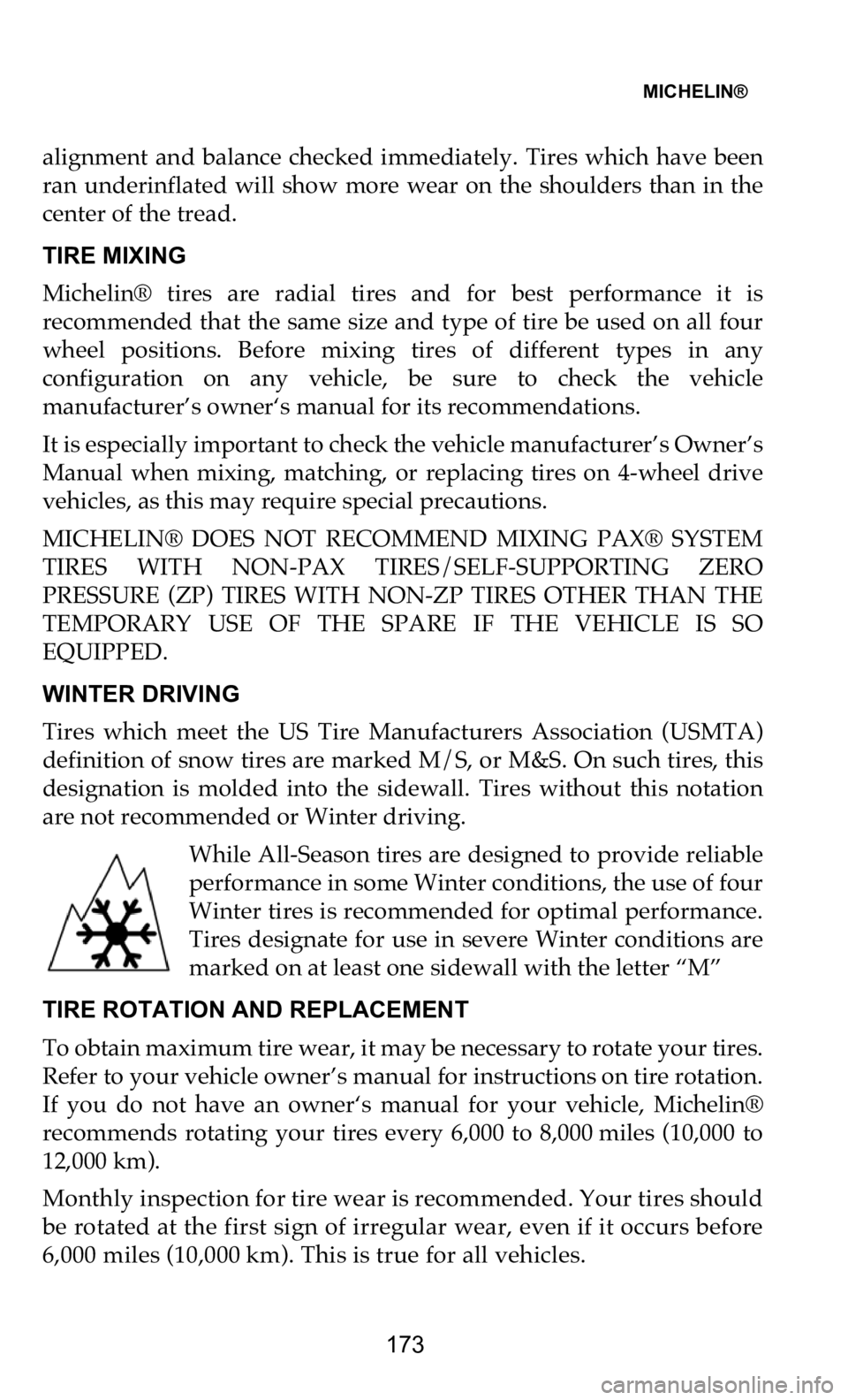
While All-Season tires are designed to provide reliable
performance in some Winter conditions, the use of four
Wi
nter tires is recommended for optimal performance.
Tires designate for use in severe Winter conditions are
marked on at least one sidewall with the letter “M”
TIRE ROTATION AND REPLACEMENT
To obtain maximum tire wear, it may be necessary to rotate your tires.
Re
fer to your vehicle owner’s manual for instructions on tire rotation.
If you do not have an owner‘s manual for your vehicle, Michelin®
recommends rotating your tires every 6,000 to 8,000 miles (10,000 to
12
,000 km).
Monthly inspection for tire wear is recommended. Your tires should
be
rotated at the first sign of irregular wear, even if it occurs before
6,000 miles (10,000 km). This is true for all vehicles.
Page 188 of 262

NEXEN TIRE
187
to a toll free phone number to call in case of a flat tire. A qualified
professional will change your flat tire with your spare tire free of
charge. If a working spare is not available, towing will be provided
free of charge to the nearest NEXEN TIRE dealer or authorized place
of repair.
*Nexen Tire reserves the right to change the terms and conditions of
al
l warranties at any time.
TIRE CARE AND MAINTENANCE GUIDE
Tire failure can result in serious damage and/or personal injury. To
re
duce the risk of tire failure we recommend the following:
• Maintain proper inflation pressure and do not use at under inflation
o
r over inflation. Pressure should be set at the level recommended
by vehicle manufacturer.
• Wheel alignment and balancing should be checked at regular inter -
v
als.
• Do not overload. The maximum load carrying capacity is molded on
t
he sidewall of the tire.
• Do not spin your tires excessively and avoid driving over curbs,
p
otholes, obstacles and edges of pavement.
• Never drive on smooth (bald) tires. By law, tires must be replaced
w
hen 2/32" of tread depth remained, as indicated by tread wear
indicator molded in the tread grooves.
• Check your tires frequently for any scrapes, cuts, foreign objects,
s
eparations or bulges. If damage is found, do not attempt to
dismount a tire yourself. Change damaged tire with the spare and
contact a local authorized NEXEN TIRE dealer immediately.
• Do not drive in excess of speed limits allowed by law or the
m
aximum speed justified by driving conditions.
• To achieve proper even wear and gain maximum tread life, tire rota -
t
ion at regular intervals is required.
Page 199 of 262

PIRELLI TIRES
198
What Is Not Covered By The Warranty?
• Tires on any vehicle registered and normally operated outside the
U
nited States of America or Canada.
• Tires transferred from the vehicle on which they were originally
i
nstalled.
• Tires misapplied due to insufficient Speed Rating, Load Index,
u
ndersized or oversized tires.
• Tires damaged from improper mounting/dismounting practices,
a
buse, misuse, or neglect.
• Tire dealer/retailer services: mounting, dismounting, balancing,
s
tudding, tire rotation, or wheel alignment.
• Mileage warranty on tires fitted as Original Equipment (Pirelli
b
rand tires supplied as original equipment on new vehicles).
• Passenger tires ( Euro-metric / P-metric ) used on commercial vehi -
c
les or used in commercial applications.
• Tires in which anything other than air or nitrogen has been used as
t
he support medium.
• Tires injected with liquid balancer or sealant or any other balancing
m
aterial.
• Tires which have been modified by the addition or removal of mate -
r
ial or any tire intentionally altered to change its appearance.
• Tires improperly repaired or with repairs not conforming to Tire
a
nd Rubber Association of Canada standards, or with section
repairs, or with a self-vulcanizing plug only or patch only.
• Tires which have been recapped, or retreaded, or regrooved.
•
Tires used in racing or other competitive events.
•
Tires removed in multiples when only one tire can be claimed, or is
s
uspect of a claim.
• Ride related anomalies after the first 2/32” of treadwear.
•
Tires which become unserviceable because of tire operation in
e
xcess of tire/wheel manufacturers’ specifications and recommen -
dations, including spinning.
• Tires which become unserviceable because of a mechanical irregu -
l
arity in the vehicle such as misalignment, defective brakes, defec -
tive shock absorbers or struts, or improper rims.
Page 211 of 262

PIRELLI TIRES
210
12. Storage
Should you need to store tires after removal from a vehicle (as in the
ca
se of winter tires), they should be stored in a cool, dry place. To
protect your tires from damage related to: heat, water, ozone and
direct sunlight, it is suggested you place them in opaque, waterproof
containers (e.g., plastic trash bags).
13. Tubes in Tubeless Tires
Under no circumstances are tubes to be used in Pirelli tires marked
“T
ubeless”. This includes tires that have been repaired. If the tire’s
pressure retention ability has been affected, so as to necessitate a tube
being installed, the tire must be replaced.
14. Tire Valves
Whenever new tires are installed on your wheels, new tire valves of
th
e correct type must be installed. During your routine tire inspection,
verify that all your valves have proper valve caps. Replace as
necessary, since the valve cap is also a seal against pressure loss.
15. Tire Demounting and Mounting
Tire fitting is best left to professionals who have the proper tools and
eq
uipment to perform the task properly and safely. Your tires should
be mounted or demounted, using Tire and Rubber Association of
Canada procedures or the vehicle manufacturers’ recommendations.
Your wheels should be in good, clean condition. Wheels should be
inspected for distortion, dents, cracks, rust and foreign matter, and be
replaced as necessary. NEVER EXCEED 40 PSI WHEN SEATING
BEADS.
16. Tire/Wheel Alignment and Balancing
Tire/Wheel alignment specifications are issued by your vehicle
ma
nufacturer and your vehicle must be kept within these tolerances.
You should have your alignment checked annually or whenever you
notice any irregular wear or vibrations. Tire/Wheel assemblies should
be balanced each time a tire is fitted to a wheel. Tire/Wheel alignment
and balancing are important for safety and maximum performance
and mileage from your tires.