tire size DODGE DURANGO 2021 Vehicle Warranty
[x] Cancel search | Manufacturer: DODGE, Model Year: 2021, Model line: DURANGO, Model: DODGE DURANGO 2021Pages: 262, PDF Size: 10.42 MB
Page 67 of 262

BRIDGESTONE® - FIRESTONE®
66
(including alignment), driving conditions, and duration at which the
speed is sustained. Use the following chart to compare the speed
ratings of tires.
The tire’s speed rating designation appears on the tire sidewall with
t h
e tire size. Examples:
* In standardized laboratory tests that relate to highway speeds.
Ac
tual tire speed and performance capability depend on factors such
as inflation pressure, load, tire condition, wear, and driving
conditions.
** Any tire having a maximum speed capability above 149 mph
(2
40 km/h) may, at the tire manufacturer’s discretion, include a “Z” in
th
e size designation (i.e. P275/40ZR17).
*** For tires having a maximum speed capability above 186 mph
(3
00 km/h), a “Z” must appear in the size designation and a “Y”
ma
rked in brackets (as shown) in the service description.
**** Consult the tire manufacturer for maximum speed capability.
Speed
Symbol Speed Category*
mph km/h
M 81130
Q 99160
R 106 170
S 112 180
T 118 190
U 124 200
H 130 210
V 149 240
Z** >149 >240
W 168 270
Y 186 300
(Y)** >186
P275/40ZR17 max > 149 mph (240 km/h)****
P275/40R17 93Wmax = 168 mph (270 km/h)
P275/40ZR17 93Wmax = 168 mph (270 km/h)
P275/40ZR17 93Ymax = 186 mph (300 km/h)
P275/40ZR17 93(Y)max > 186 mph (300 km/h)****
Page 69 of 262
BRIDGESTONE® - FIRESTONE®
68
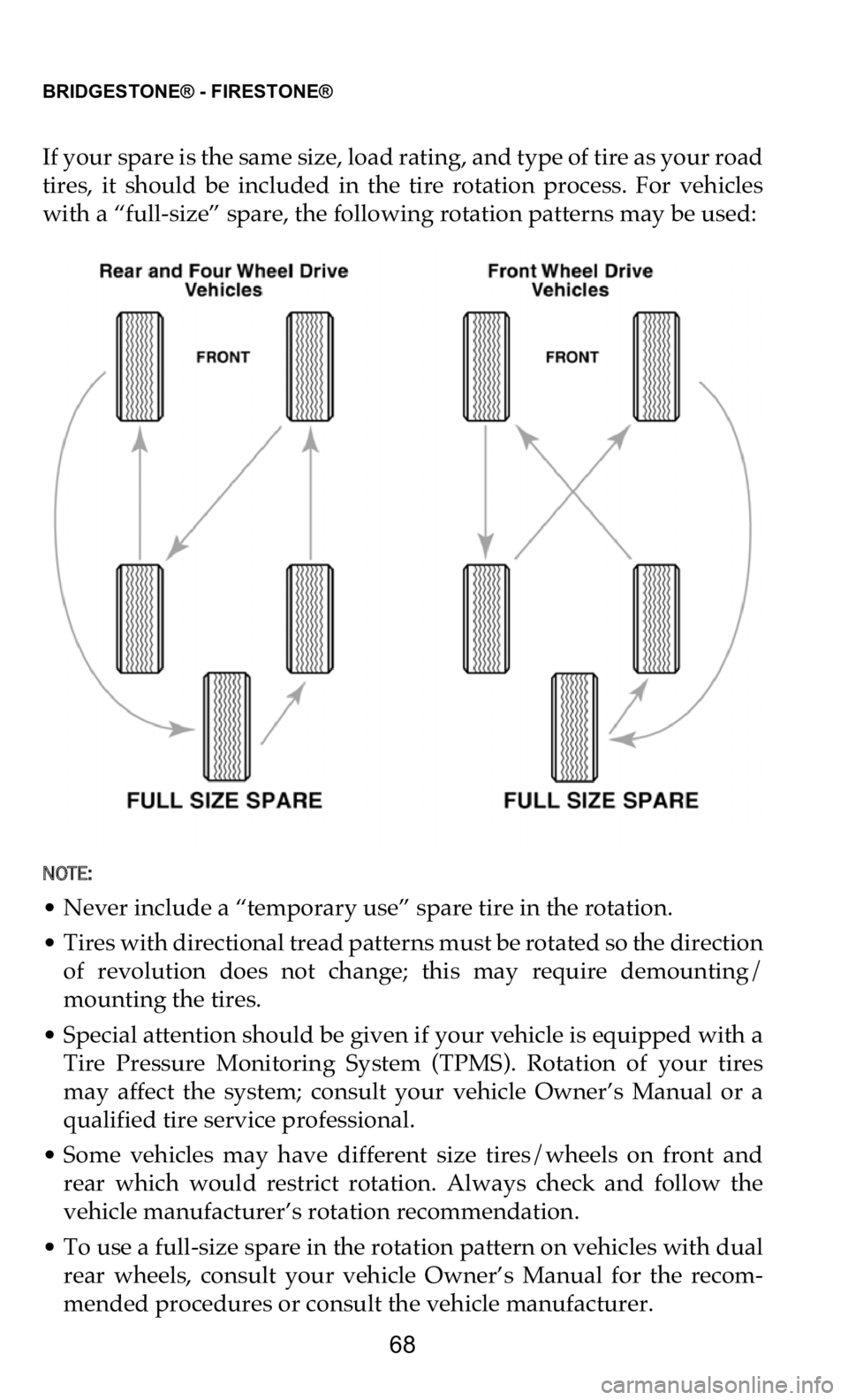
If your spare is the same size, load rating, and type of tire as your road
tires, it should be included in the tire rotation process. For vehicles
with a “full-size” spare, the following rotation patterns may be used:
NOTE:
• Never include a “temporary use” spare tire in the rotation.
• Tires with directional tread patterns must be rotated so the direction
o
f revolution does not change; this may require demounting/
mounting the tires.
• Special attention should be given if your vehicle is equipped with a
T
ire Pressure Monitoring System (TPMS). Rotation of your tires
may affect the system; consult your vehicle Owner’s Manual or a
qualified tire service professional.
• Some vehicles may have different size tires/wheels on front and
r
ear which would restrict rotation. Always check and follow the
vehicle manufacturer’s rotation recommendation.
• To use a full-size spare in the rotation pattern on vehicles with dual
r
ear wheels, consult your vehicle Owner’s Manual for the recom -
mended procedures or consult the vehicle manufacturer.
Page 70 of 262

BRIDGESTONE® - FIRESTONE®
69
YOUR SPARE TIRE
Consult your vehicle Owner’s Manual for proper application of your
sp
are tire. Your car may be equipped with a “temporary use” spare
tire; this spare may differ in size and construction from the other tires
on your vehicle.
The spare tire in your vehicle is intended to be used as a spare when
n e
eded. The spare tire carrier is not intended to be used for long term
storage, except for “temporary use” tires. If your spare is the same
size, load rating, and type of tire as your road tires, it should be
included in the tire rotation process; see “Radial Tire Rotation” in this
manual for more information.
The spare should be included in regular tire inspections and inflation
pr
essure checks. In addition, it should be replaced 10 years after date
of manufacture, regardless of condition or tread depth. For more
information, see the “Tire Damage, Inspection and Service Life” in this
manual.
TIRE STORAGE
Tires should be stored indoors in a cool, dry place where water cannot
co
llect inside them. Tires should be placed away from electric
generators/motors and sources of heat such as hot pipes. Storage
surfaces should be clean and free of grease, gasoline or other
substances which can deteriorate the rubber.
WARNING!
Check inflation pressure before use. Failure to have proper
in
flation pressure when using your spare tire can result in serious
personal injury or death. See Tire Inflation Pressure in this
manual.
WARNING!
Mounting a “temporary use” tire on a wheel which is not
sp
ecifically designed for it, or placing another type tire on a wheel
designated for temporary use can be dangerous. Your vehicle’s
handling characteristics can be seriously affected. You could have
an accident resulting in serious personal injury or death. Consult
your vehicle owner’s manual for proper application of your
“temporary use” spare tire.
Page 75 of 262

BRIDGESTONE® - FIRESTONE®
74
SPECIAL SERVICE AND REPAIR ISSUES
Run-Flat Certified Retailers
Because of the advanced technology and design of Run-Flat tires and
th
e required Tire Pressure Monitoring Systems (TPMS), Bridgestone®
Firestone® Run-Flat Certified Retailers are specially trained to sell and
service RFT tires.
Run-Flat Certified Retailers have the necessary equipment and are
sp
ecially trained to properly mount and demount RFT tires and to
handle TPMS devices. Conventional mounting equipment may
irreparably damage RFT tires and an improper repair is unsafe and
will void the Limited Warranty. Accordingly, it is important to go to
a Bridgestone® Firestone® Run-Flat Certified Retailer for tire
maintenance and replacement.
Call toll-free 1-877-BFS-4RFT or, 87
7-237-4738 or visit
www.bridgestonetire.com
to locate the nearest Bridgestone®
Firestone® Run-Flat Certified Retailer.
Inspection after Run-Flat or Low Pressure Operation
Following run-flat or low tire pressure operation, or in the event of
an
y other tire damage or unusual condition, it is very important to
obtain a proper and complete tire evaluation as soon as possible.
Rotation
Follow the vehicle manufacturer’s recommendations, or rotate every
5,
000 miles per the recommendations in this manual (see “Radial Tire
Ro
tation”). In some cases, TPMS devices require reprogramming with
each tire rotation.
RFT Tire Replacement
Do not replace or mix RFT tires with conventional tires, unless on an
em
ergency/temporary basis. Conventional tires do not have run-flat
capability and the handling characteristics of the vehicle with these
tires may be different. If a conventional tire is used on an emergency/
temporary basis, verify that its size, load capacity, inflation pressure,
and speed rating specifications meet the requirements of the vehicle.
Replace any conventional tire with the proper RFT tire as soon as
possible.
Page 77 of 262
BRIDGESTONE® - FIRESTONE®
76
REFERENCE INFORMATION
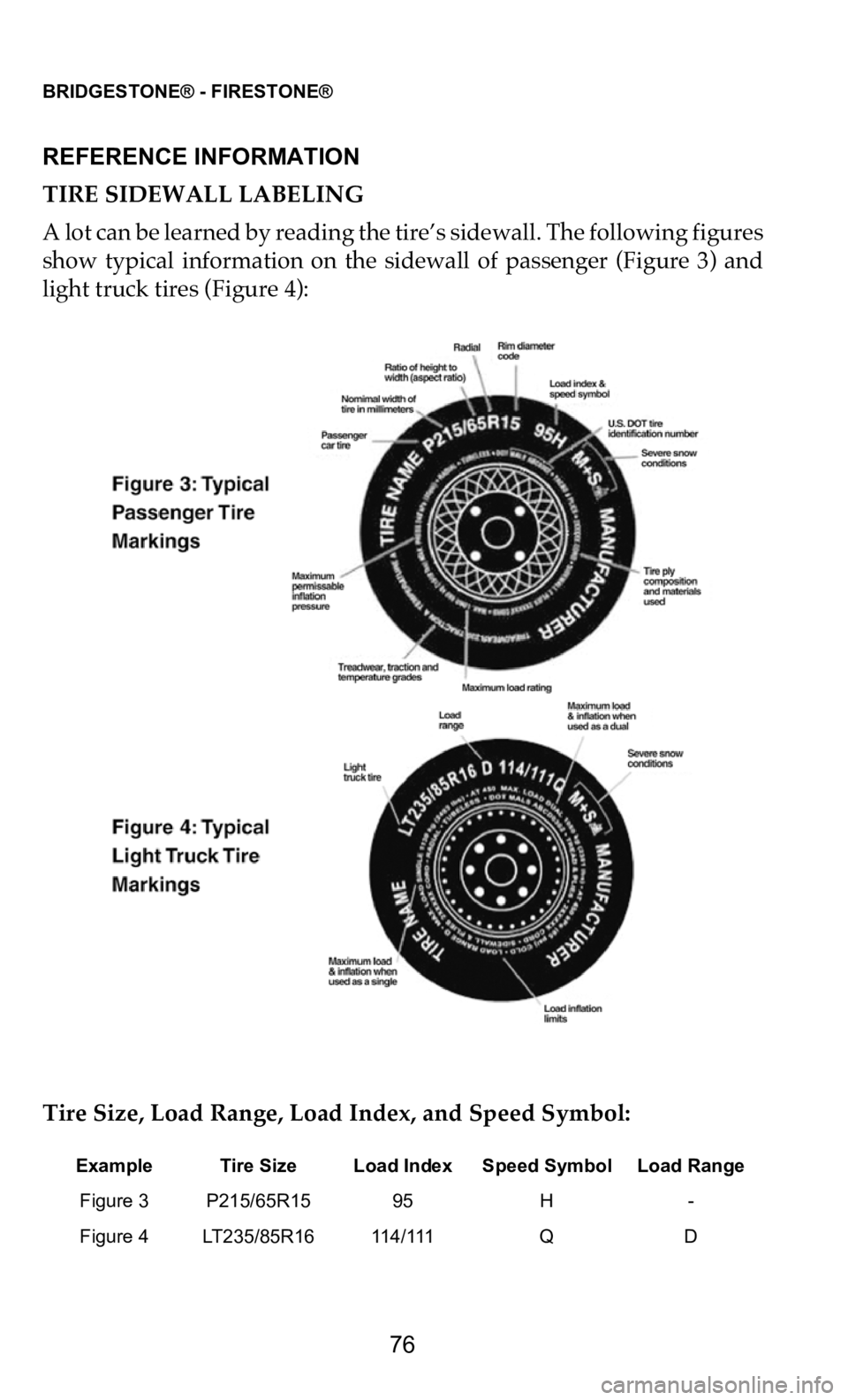
TIRE SIDEWALL LABELING
A lot can be learned by reading the tire’s sidewall. The following figures
sh
ow typical information on the sidewall of passenger (Figure 3) and
light truck tires (Figure 4):
Tire Size, Load Range, Load Index, and Speed Symbol:
Example Tire SizeLoad IndexSpeed Symbol Load Range
Figure 3 P215/65R15 95H-
Figure 4 LT235/85R16 114/111 QD
Page 78 of 262
BRIDGESTONE® - FIRESTONE®
77
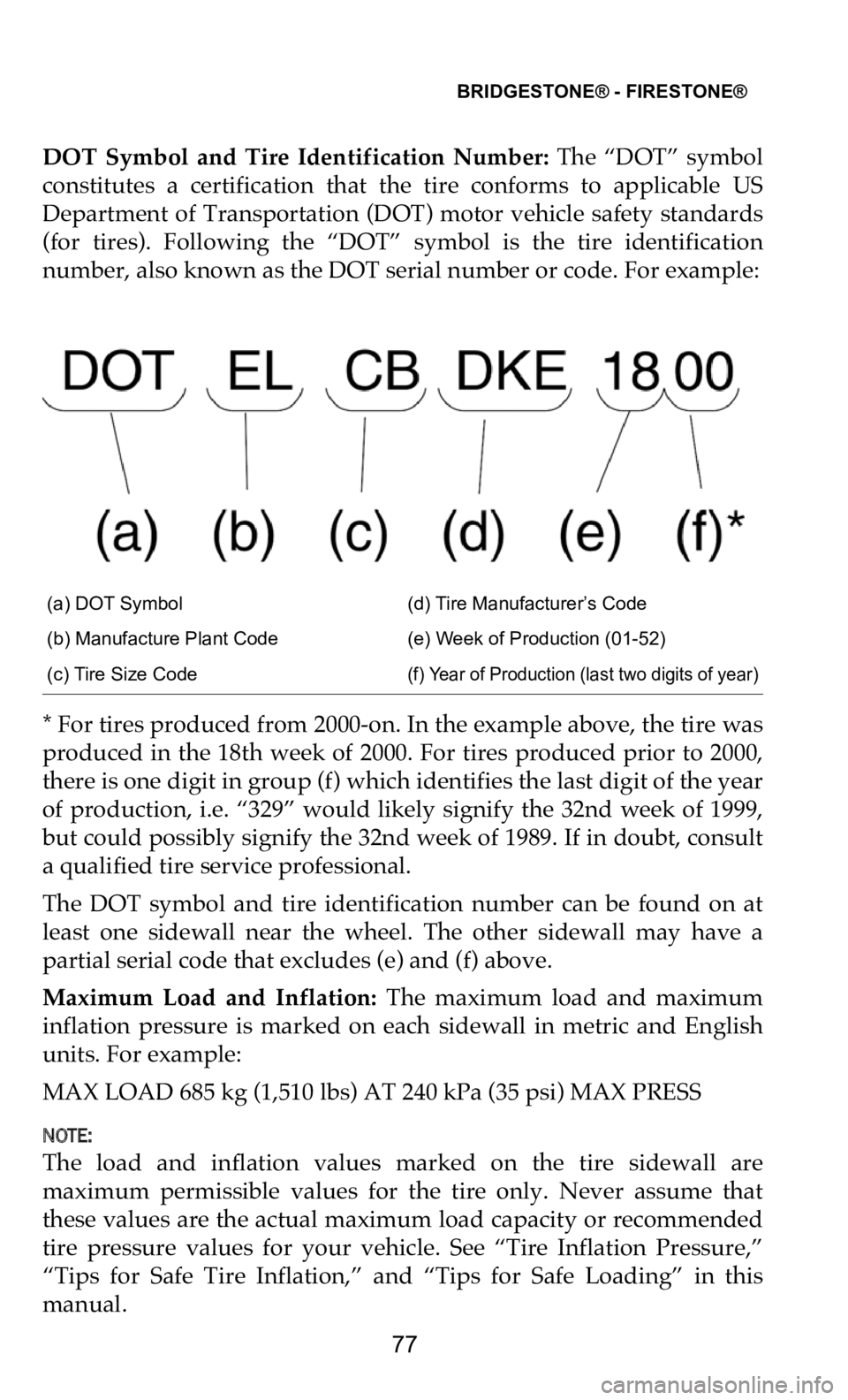
DOT Symbol and Tire Identification Number: The “DOT” symbol
constitutes a certification that the tire conforms to applicable US
Department of Transportation (DOT) motor vehicle safety standards
(for tires). Following the “DOT” symbol is the tire identification
number, also known as the DOT serial number or code. For example:
* For tires produced from 2000-on. In the example above, the tire was
p r
oduced in the 18th week of 2000. For tires produced prior to 2000,
there is one digit in group (f) which identifies the last digit of the year
of production, i.e. “329” would likely signify the 32nd week of 1999,
but could possibly signify the 32nd week of 1989. If in doubt, consult
a qualified tire service professional.
The DOT symbol and tire identification number can be found on at
le
ast one sidewall near the wheel. The other sidewall may have a
partial serial code that excludes (e) and (f) above.
Maximum Load and Inflation: T
he maximum load and maximum
inflation pressure is marked on each sidewall in metric and English
units. For example:
MAX LOAD 685 kg (1,510 lbs) AT 240 kPa (35 psi) MAX PRESS
NOTE:
The load and inflation values marked on the tire sidewall are
ma
ximum permissible values for the tire only. Never assume that
these values are the actual maximum load capacity or recommended
tire pressure values for your vehicle. See “Tire Inflation Pressure,”
“Tips for Safe Tire Inflation,” and “Tips for Safe Loading” in this
manual.
(a) DOT Symbol (d) Tire Manufacturer’s Code
(b) Manufacture Plant Code (e) Week of Production (01-52)
(c) Tire Size Code
(f) Year of Production (last two digits of year)
Page 79 of 262

BRIDGESTONE® - FIRESTONE®
78
Ply Composition and Materials: The actual number of plies in the
sidewall and tread area and the generic name(s) of their cord
material(s) are marked on at least one sidewall. For example:
• TREAD 2 PLY POLYESTER + 2 STEEL
•
SIDEWALL 2 PLY POLYESTER
R
adial: Radial ply tires will have the word "radial" on at least one
s
idewall. An “R” in the tire size designation also indicates radial ply
construction.
Tubeless or Tube Type: T
ires are marked as either “tubeless” or “tube
type,” whichever is applicable, on at least one sidewall.
UNIFORM TIRE QUALITY GRADING
The Uniform Tire Quality Grading (“UTQG”) standards are intended
to
assist you in making an informed choice in your purchase of
passenger car tires by providing information indicating relative
performance of these tires in the areas of tread wear, wet braking
traction (straight-ahead), and temperature resistance. All passenger
car tires must conform to federal safety requirements in addition to
these grades.
Treadwear
The treadwear grade is a comparative rating based on the wear rate of
th
e tire when tested under controlled conditions on a specified
government test course. For example, a tire graded 150 would wear
one and one half (1 1/2) times as well on the government course as a
tire graded 100. The relative performance of tires depends upon the
actual conditions of their use, however, and may depart significantly
from the norm due to variation in driving habits, service practices and
differences in road characteristics and climate.
Traction
The traction grades, from highest to lowest, are AA, A, B, and C. Those
gr
ades represent the tire’s ability to stop on wet pavement as
measured under controlled conditions on specified government test
surfaces of asphalt and concrete.
NOTE:
The traction grade assigned to a tire is based on straight-ahead
br
aking traction tests, and does not include acceleration, cornering,
hydroplaning, or peak traction characteristics.
Page 95 of 262

FALKEN TIRE CORPORATION
94
FALKEN TIRE CORPORATION
FALKEN
MADE BY SUMITOMO RUBBER INDUSTRIES
Congratulations!
Your new vehicle is fitted with high performance and high quality
Fa
lken tires.
In order to guarantee that you receive the best performance and
qu
ality from your new Falken tires, we recommend that you read and
follow all of the maintenance and safety tips provided in this
document. We also suggest that you have your Falken tires
periodically inspected and maintained by a qualified tire service
professional.
A) TIRE CARE AND RECOMMENDATIONS
PROPER INFLATION AND FUEL ECONOMY
Ensure maximum performance and a long life from your tires by
ch
ecking the air pressures at least once a month and set them to the
vehicle manufacturer’s recommended pressure(s) listed on the
vehicle’s tire placard or in your Owner’s Manual. Always check and
adjust your air pressure when your tires are cold, preferably first thing
in the morning before driving. Never release air pressure from tires
when they are hot. Wait until the tires cool down and recheck, adding
air or releasing as required. Falken endorses the use of nitrogen in
your tires because it helps your tires maintain optimal pressure for
longer periods of time and reduces the amount of moisture inside of
the tire and wheel assembly.
*Some plus size applications may require different air pressure(s)
t h
an what is listed on your vehicle’s placard or Owner’s Manual. In
this case, please consult your tire dealer or Falken Tire for proper
inflation pressure(s).
Page 99 of 262

FALKEN TIRE CORPORATION
98
TIRE REPAIRS
In the event that you get a flat tire while driving, it is best to find a
ne
arby, safe place to stop and install your spare tire or call a tow truck.
The less distance that you drive on your low or flat tire, the better
chances your tire has of being repairable. Once you are able to get to
your local servicing tire dealer, have them dismount the tire from the
rim and thoroughly inspect the inside of the tire. It is important to
know the difference between a proper tire repair and an improper one
because it can be critical to you and your vehicle’s safety. An improper
repair could pose a safety threat to you and your family and could also
affect your tire’s manufacturer warranty. Here are some tips in
determining if your damaged tire can be properly repaired or not:
• A lways have the tire removed from the wheel and inspected before
a
ny repair is performed.
• Tires with less than 1.6
mm (2/32 of an inch) of tread should NOT
be
repaired.
• Never repair a tire with a puncture larger than 6
mm (1/4 of an
in
ch).
• Repairs should be limited to the tread area only.
•
Repairs cannot overlap one another.
•
A plug and patch or plug/patch combo should be used to effectively
r
epair a tire puncture.
• If anything seems questionable at any time during the repair
p
rocess, ask your service advisor for more details and/or call the
tire manufacturer to make sure the tire’s warranty is not being
voided.
TIRE MIX USAGE
WARNING!
Never mix tires of different size or construction and/or type on
an
y axle. (Except for temporary use as a spare tire.) Always refer to
the vehicle’s owner manual for proper tire fitments.
Page 104 of 262

FALKEN TIRE CORPORATION
103
3. OWNER’S OBLIGATIONS
At least monthly, the vehicle owner(s) should check the tires’ air
pr
essure with a gauge and inflate to the recommended cold air
pressure level listed on the driver door placard. Do not rely on car
servicers to perform the checks. The tires should be rotated at least
every 8,000km (5,000 miles) or earlier if uneven wear is occurring,
an
d proof of maintenance records should be kept. The owner(s)
should have the tires rebalanced if vibration is experienced, and the
vehicle’s alignment should be checked if uneven or rapid wear is
occurring, or when suggested by the vehicle’s manufacturer.
All warranty claims must be presented to an authorized Falken
de
aler or participating car dealership. The owner(s) must present
any supporting maintenance records and documentation neces -
sary to help determine if the tire(s) in question are deemed covered
by
the limited warranty or not.
4. LEGAL RIGHTS A
ll implied warranties, including warranties of merchantability
an
d fitness for a particular purpose shall be limited in duration to
the above period. To the extent permitted by law, Falken Tire Cor -
poration shall not be responsible for incidental or consequential
da
mages, such as loss of use of the tire or the vehicle on which it is
used, inconvenience, or commercial loss, some states do not allow
limitations on how long an implied warranty lasts, or the exclusion
or limitation of incidental or consequential damages, so the above
limitations or exclusions may not apply to you. This warranty gives
you specific legal rights and you may also have other rights, which
vary from state to state. This is the only express warranty applica -
ble to Falken brand tires and supersedes the terms of any previous
wa
rranty. Falken neither assumes nor authorizes anyone to make
or assume for it any other warranty.
C) UNDERSTANDING YOUR TIRES
TIRE SPEED SYMBOLS
Tires that are speed-rated are identified by the following letter
sy
mbols: Q, S, T, U, H, V, W, Y, (Y), or (ZR). The Speed Rating’s
Symbol can be found as a part of the tire size designation (ex: 215/
65HR16) or after the load index immediately following the tire size
designation (ex: 215/65R16 97H). The Speed Rating’s Symbol
indicates the maximum speed that a tire can handle when properly
inflated and loaded.