flat tire DODGE DURANGO 2021 Vehicle Warranty
[x] Cancel search | Manufacturer: DODGE, Model Year: 2021, Model line: DURANGO, Model: DODGE DURANGO 2021Pages: 262, PDF Size: 10.42 MB
Page 89 of 262

CONTINENTAL TIRE
88
•Improper operation or maintenance: This includes, but is not
limited to, effects caused by:
1. Improper tire inflation and/or improper load/speed prac -
t
ices: These practices can cause excessive operational
t
emperatures and stresses that exceed the tire’s capabilities.
2. Improper or insufficient tire rotation
3
. Improper vehicle alignment
4
. D amage due to:
–
Rim irregularities or rim damage
–
Snow chains
–
Vehicle mechanical problems, including brake problems,
a
nd vehicle wheel alignment
– Extreme temperature exposure
–
Negligent and abusive driving such as tire spinning, or
r
acing
– Improper tire storage
–
Automotive accident
–
Chemical corrosion or fire
–
Use contrary to the vehicle manufacturer’s tire recommen -
d
ations
– Misuse or misapplication
•
Improper Mounting or Demounting
•Alteration: such as, but not limited to, adding a white inlay on
black wall, tread regrooving, tire truing or siping, or adding
sealant materials to the tire.
•
Weather checking/cracking: Not covered after 48 months from
th
e date of purchase.
• Failure to observe safety and maintenance precautions set forth
i
n the Safety Warning Section.
ATTENTION AUTHORIZED DEALERS: CONTINENTAL TIRE
TH
E AMERICAS, LLC (CTA) RESERVES THE RIGHT TO THE
FINAL INSPECTION DECISION FOR ALL RETURNED TIRES
ON CONDITIONS UNDER SECTION 3.
THIS WARRANTY IS MADE IN LIEU OF ALL OTHER
WA
RRANTIES, EXPRESS OR IMPLIED, AND CTA EXPRESSLY
DISCLAIMS ALL IMPLIED WARRANTIES, INCLUDING, BUT
Page 91 of 262

CONTINENTAL TIRE
90
Owner must present new vehicle registration form or new vehicle
sales invoice indicating the date of purchase. Owner will be re -
quired to sign the CTA Limited Warranty Claim Form or dealer re -
placement sales receipt.
Owner is responsible for paying all applicable taxes charged by the
se
rvicing dealer and is also responsible for paying shipping, local
tire-disposal fees and parts or service regardless of mileage or
months of service. This includes payment for tire rotation, align -
ment, towing, road service, valve stems and tire repairs.
Owner is responsible for maintaining proper tire air pressure and
fo
r proper maintenance of the tire.
6. SAFETY WARNING:
I
gnoring any of the safety and information contained in this war -
ranty may result in tire failure, causing serious injury or death.
• Tire failure due to under inflation/overloading. Follow vehicle
o
wner’s manual or tire placard in vehicle for proper inflation and
loading.
• Explosion of tire/rim assembly due to improper tire mounting.
T
ire mounting / demounting can be dangerous. It should be
performed only by a trained tire specialist using proper tools and
procedures. Prior to tire mounting/demounting, the Rubber
Manufacturers Association (RMA) wall charts and manuals
should be read to obtain the proper procedures. The failure to
follow these procedures may result in faulty positioning of the
tire and/or rim, which may cause the assembly to burst with
force sufficient to cause injury or death.
• Tire failure due to damage.
Inspect your tires frequently for
scrapes, bulges, separations, cuts, snags and other damage from
road hazards. Damage from impact can occur to the inner
portions of your tire without being visible to the outside. If you
suspect a tire has been damaged from striking anything unusual
in the road, you must have the tire removed from the rim and
inspected both inside and out by a trained tire specialist. Air loss
or unusual tire wear can also be warning signs that a tire may
have internal damage. If you notice these conditions, have your
tire inspected by a trained individual.
• Tire failure due to excessive tire spinning.
Avoid tire spinning.
The centrifugal force generated by a free-spinning tire/rim
assembly may cause a sudden tire explosion resulting in vehicle
Page 92 of 262
CONTINENTAL TIRE
91
damage and/or serious injury or death. Never exceed 35 mph
(5
5km/h) as indicated on your speedometer when your vehicle
is stuck in snow, mud, or sand and your tire(s) is/are spinning.
Use a gentle backward and forward rocking motion to free your
vehicle for continued driving. Never stand or permit anyone else
to stand near or behind a tire spinning while attempting to push
a vehicle that is stuck.
SELF SUPPORTING RUNFLAT (SSR) TIRE OWNERS
Continental Tire the Americas, LLC (CTA) does not recommend any
re
pair to or reuse of punctured Continental SSR tires.
Even a trained tire specialist may be unable to recognize internal
st
ructural damage to a Self Supporting Run-flat (SSR) tire resulting
from having been driven in an under inflated or zero inflation
pressure condition. Such damage may not be visible on the surface of
the inner liner or sidewall making it impossible to determine the tire
suitability for repair or reuse. CTA does not recommend any repair to
or reuse of Continental SSR tires. You may visit
www.continentaltire.com
or
www.continentaltire.ca
and select
Customer Care FAQs to obtain additional SSR information.
TEMPORARY SPARE TIRE OWNERS
CTA does not recommend any repair to or reuse of punctured
T e
mporary Spare Tires.
CONTISEAL™ TIRE OWNERS A ContiSeal™ tire differs from a
non-ContiSeal™ tire in that it has
a
sticky, viscous layer from
shoulder to shoulder along the
inner liner. This layer is an integral part of the ContiSeal™ tires. It is
not designed or intended to act as a permanent puncture repair (See
information below). If an object up to 3/16ths (5 mm) diameter
pe
netrates the tread of the ContiSeal™ tire, this sticky, viscous layer is
designed to surround and adhere to the puncturing object and prevent
air loss from the tire by providing a near instantaneous seal. If the
puncturing object becomes dislodged from the tire, the material is
designed to seal most holes made by objects up to 3/16” (5 mm)
di
ameter. While ContiSeal™ tires significanty reduce the incidence of
flats they are not designed to be driven under inflated or in a flat
condition. In all other aspects, ContiSeal™ tires perform exactly like
Page 93 of 262
CONTINENTAL TIRE
92
non-ContiSeal™ tires. As with any tire, regularly inspect ContiSeal™
tires for evidence of cuts, punctures, and loss of inflation pressure. At
a minimum, ContiSeal™ tires should be inspected once or twice a
month and always before a long trip. Punctures or damage not
attended to promptly can result in loss of inflation pressure and/or
damage to the tire. ContiSeal™ tires with cuts and punctures must be
inspected by a trained tire specialist as soon as possible. The trained
specialist, must inspect the tire carefully and, according to industry
standards, to determine whether a permanent repair can be made or
whether the tire must be removed from service and scrapped. A
permanent repair will require removal of the tire from the rim and
application of a repair method specifically approved for the
ContiSeal™ tires.
ContiSeal™ tires are identified by a symbol on the tire sidewall.
CONTISILENT™ TIRE OWNERS
ContiSilent™ tires are designed to
reduce noise generated while
d r
iving. A ContiSilent™ tire is
lined with a noise reducing foam
insert. It is not designed or intended to act as a puncture repair.
USING ContiSilent™ Tires
In aspects such as mounting, demounting, inflating and balancing,
Co
ntiSilent™ tires do not differ from non-ContiSilent™ tires. As with
any tire, regularly inspect ContiSilent™ tires for evidence of cuts,
punctures, and loss of inflation pressure. At a minimum,
ContiSilent™ tires should be inspected once or twice a month and
always before a long trip. Punctures or damage not attended to
promptly can result in loss of inflation pressure and/or damage to the
tire. ContiSilent™ tires with cuts and punctures must be inspected by
a trained tire specialist as soon as possible. The trained tire specialist
must inspect the tire carefully and, according to industry standards,
determine whether a permanent repair can be made or whether the
tire must be removed from service and scrapped.
Page 95 of 262

FALKEN TIRE CORPORATION
94
FALKEN TIRE CORPORATION
FALKEN
MADE BY SUMITOMO RUBBER INDUSTRIES
Congratulations!
Your new vehicle is fitted with high performance and high quality
Fa
lken tires.
In order to guarantee that you receive the best performance and
qu
ality from your new Falken tires, we recommend that you read and
follow all of the maintenance and safety tips provided in this
document. We also suggest that you have your Falken tires
periodically inspected and maintained by a qualified tire service
professional.
A) TIRE CARE AND RECOMMENDATIONS
PROPER INFLATION AND FUEL ECONOMY
Ensure maximum performance and a long life from your tires by
ch
ecking the air pressures at least once a month and set them to the
vehicle manufacturer’s recommended pressure(s) listed on the
vehicle’s tire placard or in your Owner’s Manual. Always check and
adjust your air pressure when your tires are cold, preferably first thing
in the morning before driving. Never release air pressure from tires
when they are hot. Wait until the tires cool down and recheck, adding
air or releasing as required. Falken endorses the use of nitrogen in
your tires because it helps your tires maintain optimal pressure for
longer periods of time and reduces the amount of moisture inside of
the tire and wheel assembly.
*Some plus size applications may require different air pressure(s)
t h
an what is listed on your vehicle’s placard or Owner’s Manual. In
this case, please consult your tire dealer or Falken Tire for proper
inflation pressure(s).
Page 96 of 262
FALKEN TIRE CORPORATION
95
TIRE INFLATION PRESSURE
Tires need to be properly inflated to effectively operate and perform
as
intended. Tires carry the weight of the vehicle, passengers, and
cargo as well as bear the forces of braking, accelerating, and turning.
The vehicle manufacturer sets the inflation pressures for the original
equipment tires that are on your vehicle.
Driving with improperly inflated tires is dangerous. An under
in
flated tire will generate excessive heat build-up that will cause
damage to the internal structure and inner liner of the tire. Besides tire
damage, improper tire inflation pressures can also affect your
vehicle’s ride and handling, tire tread wear, and fuel economy. It is
recommended to always keep all of your tires, including the spare, at
the vehicle manufacturer’s recommended inflation pressures and be
sure to check the air pressure monthly and before going on long road
trips or carrying extra weight in your vehicle.
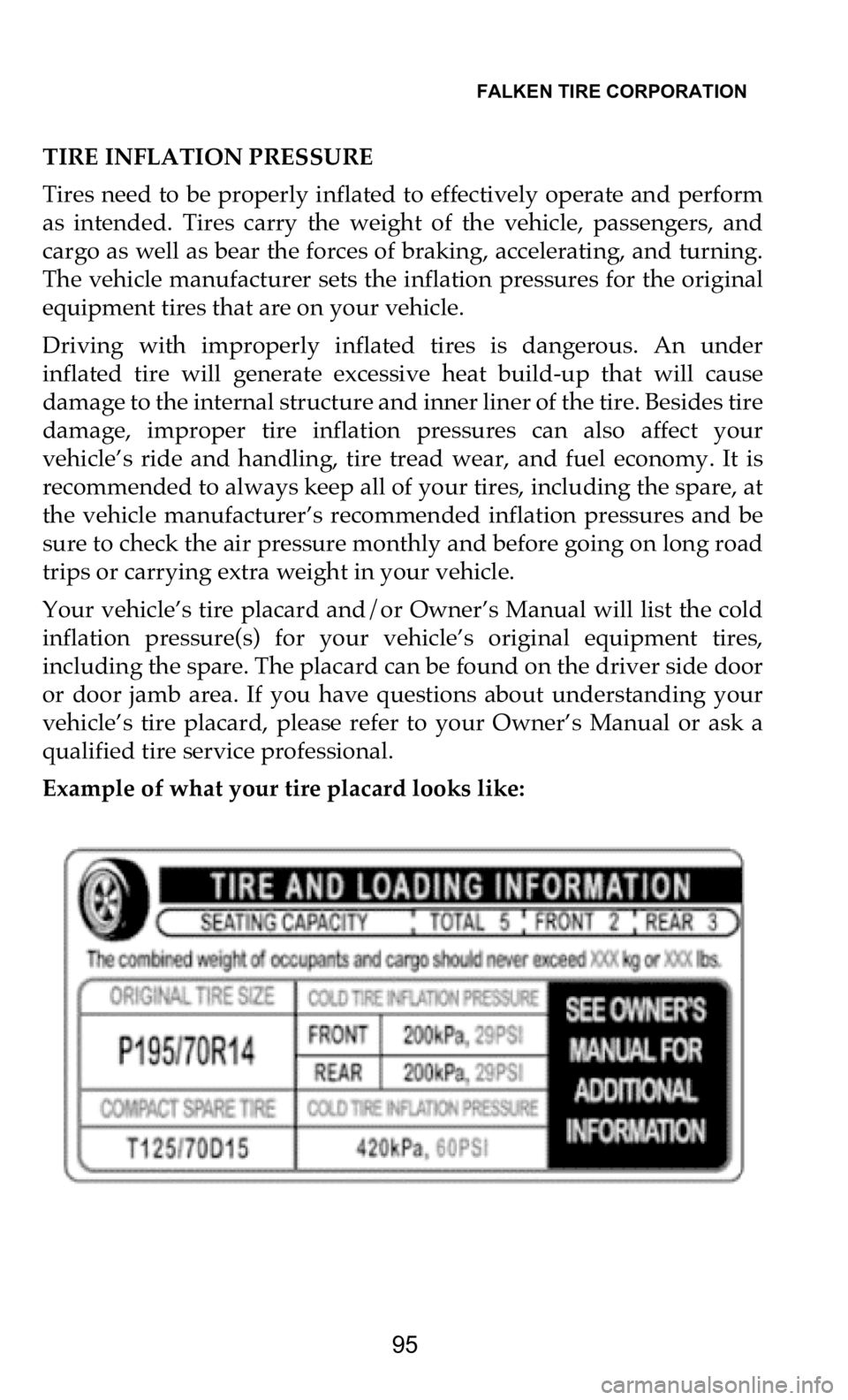
Your vehicle’s tire placard and/or Owner’s Manual will list the cold
in
flation pressure(s) for your vehicle’s original equipment tires,
including the spare. The placard can be found on the driver side door
or door jamb area. If you have questions about understanding your
vehicle’s tire placard, please refer to your Owner’s Manual or ask a
qualified tire service professional.
Example of what your tire placard looks like:
Page 97 of 262

FALKEN TIRE CORPORATION
96
CHECKING YOUR TIRE’S AIR PRESSURE
Checking your air pressure at least once a month is vital to help your
ti
res perform properly and help you get the best gas mileage possible.
Tires can lose up to 7 kPa (1 psi) per month under normal conditions
and lose up to 7 kPa (1 PSI) per every 9°C (16°F) drop in temperature.
Here are some simple steps on how to check the air pressures in your
tires:
1. Remove the valve stem cap.
2
. Place the end of the tire gauge firmly against the tire’s valve stem.
3
. Read the current pressure displayed on the gauge that is currently
i
n the tire.
4. Increase pressure at this time (if needed) and recheck with your tire
g
auge.
5. Replace the valve stem cap.
6
. Repeat until all of your tires have been checked and adjusted
a
ccordingly.
TIRE PRESSURE MONITORING SYSTEM (TPMS) A Tire Pressure Monitoring System (TPMS) is a safety
system found in most vehicles manufactured after 2005.
Th
ere are pressure sensing transmitters mounted inside of
each tire that sends readings to the central computer in your
vehicle. The TPMS system will alert you when one or more
of your tires are underinflated by 25% or more by turning on
a warning light on your vehicle’s dashboard or Heads Up Display
(HUD) screen. This means that one or more of your tires may have a
low-pressure condition. Follow the instructions in your Owner’s
Manual.
Page 99 of 262

FALKEN TIRE CORPORATION
98
TIRE REPAIRS
In the event that you get a flat tire while driving, it is best to find a
ne
arby, safe place to stop and install your spare tire or call a tow truck.
The less distance that you drive on your low or flat tire, the better
chances your tire has of being repairable. Once you are able to get to
your local servicing tire dealer, have them dismount the tire from the
rim and thoroughly inspect the inside of the tire. It is important to
know the difference between a proper tire repair and an improper one
because it can be critical to you and your vehicle’s safety. An improper
repair could pose a safety threat to you and your family and could also
affect your tire’s manufacturer warranty. Here are some tips in
determining if your damaged tire can be properly repaired or not:
• A lways have the tire removed from the wheel and inspected before
a
ny repair is performed.
• Tires with less than 1.6
mm (2/32 of an inch) of tread should NOT
be
repaired.
• Never repair a tire with a puncture larger than 6
mm (1/4 of an
in
ch).
• Repairs should be limited to the tread area only.
•
Repairs cannot overlap one another.
•
A plug and patch or plug/patch combo should be used to effectively
r
epair a tire puncture.
• If anything seems questionable at any time during the repair
p
rocess, ask your service advisor for more details and/or call the
tire manufacturer to make sure the tire’s warranty is not being
voided.
TIRE MIX USAGE
WARNING!
Never mix tires of different size or construction and/or type on
an
y axle. (Except for temporary use as a spare tire.) Always refer to
the vehicle’s owner manual for proper tire fitments.
Page 103 of 262

FALKEN TIRE CORPORATION
102
2. WHAT IS NOT COVERED BY THE WARRANTY
• Tires that becomes unserviceable due to road hazard damages
(
cuts, snags, punctures, bruises, impact breaks, etc.) improper
repair technique or materials, improper inflation, overload,
irregular wear, wheel imbalance, defective mechanical vehicle
components (brakes, suspension, wheels, etc.) improper suspen -
sion alignment, accident, fire, chemical damage, damage from
ch
ain use, racing, off-road use, run flat, improper installation,
vandalism, or abuse.
• Tires branded “NA” or a tire in which the DOT numbering has
b
een removed.
• Tires presented for a warranty claim by someone other than by
t
he original purchaser, or tires that were transferred to another
vehicle from the vehicle in which the tires were originally
installed.
• Tires having a failure or failures caused by a previous damages
o
r repairs.
• The cost of tire repair or retreading is not covered by this
w
arranty and will be the sole responsibility of the tire owner.
Possible NON Covered Reasons/Conditions due to:
Chipping/Chunking/Tearing Puncture
Corrosion/Wreck Racing or any Competition
Fire Repair Failure
Impact Break or Concussions Road Hazards
Improper Inflation Pressure Sidewall Cut or Damage
Improper Mounting/Dismount Theft or Vandalism
Mechanical Defects of the Vehicle Tread Cuts
Misalignment Wheel Imbalance
Misapplication Willful Abuse
Overloading
Page 104 of 262

FALKEN TIRE CORPORATION
103
3. OWNER’S OBLIGATIONS
At least monthly, the vehicle owner(s) should check the tires’ air
pr
essure with a gauge and inflate to the recommended cold air
pressure level listed on the driver door placard. Do not rely on car
servicers to perform the checks. The tires should be rotated at least
every 8,000km (5,000 miles) or earlier if uneven wear is occurring,
an
d proof of maintenance records should be kept. The owner(s)
should have the tires rebalanced if vibration is experienced, and the
vehicle’s alignment should be checked if uneven or rapid wear is
occurring, or when suggested by the vehicle’s manufacturer.
All warranty claims must be presented to an authorized Falken
de
aler or participating car dealership. The owner(s) must present
any supporting maintenance records and documentation neces -
sary to help determine if the tire(s) in question are deemed covered
by
the limited warranty or not.
4. LEGAL RIGHTS A
ll implied warranties, including warranties of merchantability
an
d fitness for a particular purpose shall be limited in duration to
the above period. To the extent permitted by law, Falken Tire Cor -
poration shall not be responsible for incidental or consequential
da
mages, such as loss of use of the tire or the vehicle on which it is
used, inconvenience, or commercial loss, some states do not allow
limitations on how long an implied warranty lasts, or the exclusion
or limitation of incidental or consequential damages, so the above
limitations or exclusions may not apply to you. This warranty gives
you specific legal rights and you may also have other rights, which
vary from state to state. This is the only express warranty applica -
ble to Falken brand tires and supersedes the terms of any previous
wa
rranty. Falken neither assumes nor authorizes anyone to make
or assume for it any other warranty.
C) UNDERSTANDING YOUR TIRES
TIRE SPEED SYMBOLS
Tires that are speed-rated are identified by the following letter
sy
mbols: Q, S, T, U, H, V, W, Y, (Y), or (ZR). The Speed Rating’s
Symbol can be found as a part of the tire size designation (ex: 215/
65HR16) or after the load index immediately following the tire size
designation (ex: 215/65R16 97H). The Speed Rating’s Symbol
indicates the maximum speed that a tire can handle when properly
inflated and loaded.