light DODGE DURANGO 2022 Owners Manual
[x] Cancel search | Manufacturer: DODGE, Model Year: 2022, Model line: DURANGO, Model: DODGE DURANGO 2022Pages: 332, PDF Size: 19.82 MB
Page 306 of 332
304SERVICING AND MAINTENANCE
STORING THE VEHICLE
If you are storing your vehicle for more than three
weeks, we recommend that you take the following
steps to minimize the drain on your vehicle's battery:
Disconnect the negative cable from battery.
Any time you store your vehicle or keep it out of
service (i.e., vacation) for two weeks or more,
run the air conditioning system at idle for about
five minutes in the fresh air and high blower
setting. This will ensure adequate system lubri-
cation to minimize the possibility of compressor
damage when the system is started again.
BODYWORK
PROTECTION FROM ATMOSPHERIC
A
GENTS
Vehicle body care requirements vary according to
geographic locations and usage. Chemicals that
make roads passable in snow and ice and those
that are sprayed on trees and road surfaces during
other seasons are highly corrosive to the metal in
your vehicle. Outside parking, which exposes your
vehicle to airborne contaminants, road surfaces on
which the vehicle is operated, extreme hot or cold
weather and other extreme conditions will have an
adverse effect on paint, metal trim, and underbody
protection. The following maintenance recommendations will
enable you to obtain maximum benefit from the
corrosion resistance built into your vehicle.
What Causes Corrosion?
Corrosion is the result of deterioration or removal
of paint and protective coatings from your vehicle.
The most common causes are:
Road salt, dirt and moisture accumulation.
Stone and gravel impact.
Insects, tree sap and tar.
Salt in the air near seacoast localities
Atmospheric fallout/industrial pollutants.
BODY AND UNDERBODY MAINTENANCE
Cleaning Headlights
Your vehicle is equipped with plastic headlights
and fog lights that are lighter and less susceptible
to stone breakage than glass headlights.
Plastic is not as scratch resistant as glass and
therefore different lens cleaning procedures must
be followed.
To minimize the possibility of scratching the lenses
and reducing light output, avoid wiping with a dry
cloth. To remove road dirt, wash with a mild soap
solution followed by rinsing.
Do not use abrasive cleaning components,
solvents, steel wool or other aggressive material to
clean the lenses.
PRESERVING THE BODYWORK
Washing
Wash your vehicle regularly. Always wash your
vehicle in the shade using Mopar® Car Wash, or
a mild car wash soap, and rinse the panels
completely with water.
If insects, tar, or other similar deposits have
accumulated on your vehicle, use Mopar®
Super Kleen Bug and Tar Remover to remove.
Use a high quality cleaner wax, such as Mopar®
Cleaner Wax to remove road film, stains and to
protect your paint finish. Use precautions to not
scratch the paint.
Avoid using abrasive compounds and power
buffing that may diminish the gloss or thin out
the paint finish.
CAUTION!
Do not use abrasive or strong cleaning mate
-
rials such as steel wool or scouring powder
that will scratch metal and painted surfaces.
Use of power washers exceeding 1,200 psi
(8,274 kPa) can result in damage or removal
of paint and decals.
22_WD_OM_EN_USC_t.book Page 304
Page 308 of 332
306SERVICING AND MAINTENANCE
PLASTIC AND COATED PARTS
Use Mopar® Total Clean to clean vinyl upholstery.
Cleaning Plastic Instrument Cluster
Lenses
The lenses in front of the instruments in this
vehicle are molded in clear plastic. When cleaning
the lenses, care must be taken to avoid scratching
the plastic.
Clean with a wet soft cloth. A mild soap solution
may be used, but do not use high alcohol content
or abrasive cleaners. If soap is used, wipe clean
with a clean damp cloth. Dry with a soft cloth.
LEATHER SURFACES
Mopar® Total Clean is specifically recommended
for leather upholstery.
The leather upholstery can be best preserved by
regular cleaning with a damp soft cloth. Small
particles of dirt can act as an abrasive and damage
the leather upholstery and should be removed
promptly with a damp cloth. Stubborn soils can be
removed easily with a soft cloth and Mopar® Total
Clean. Care should be taken to avoid soaking your
leather upholstery with any liquid. Please do not
use polishes, oils, cleaning fluids, solvents,
detergents, or ammonia-based cleaners to clean
your leather upholstery.
NOTE:If equipped with light colored leather, it tends to
show any foreign material, dirt, and fabric dye
transfer more so than darker colors. The leather is
designed for easy cleaning, and the manufacturer
recommends Mopar® total care leather cleaner
applied on a cloth to clean the leather seats as
needed.
GLASS SURFACES
All glass surfaces should be cleaned on a regular
basis with Mopar® Glass Cleaner, or any
commercial household-type glass cleaner. Never
use an abrasive type cleaner. Use caution when
cleaning the inside rear window equipped with
electric defrosters or windows equipped with radio
antennas. Do not use scrapers or other sharp
instruments that may scratch the elements.
When cleaning the rearview mirror, spray cleaner
on the towel or cloth that you are using. Do not
spray cleaner directly on the mirror.
CAUTION!
Direct contact of air fresheners, insect repel -
lents, suntan lotions, or hand sanitizers to the
plastic, painted, or decorated surfaces of the
interior may cause permanent damage. Wipe
away immediately.
Damage caused by these type of products
may not be covered by your New Vehicle
Limited Warranty.
CAUTION!
Do not use Alcohol and Alcohol-based and/or
Ketone based cleaning products to clean leather
upholstery, as damage to the upholstery may
result.
22_WD_OM_EN_USC_t.book Page 306
Page 309 of 332
307
TECHNICAL SPECIFICATIONS
VEHICLE IDENTIFICATION NUMBER (VIN)
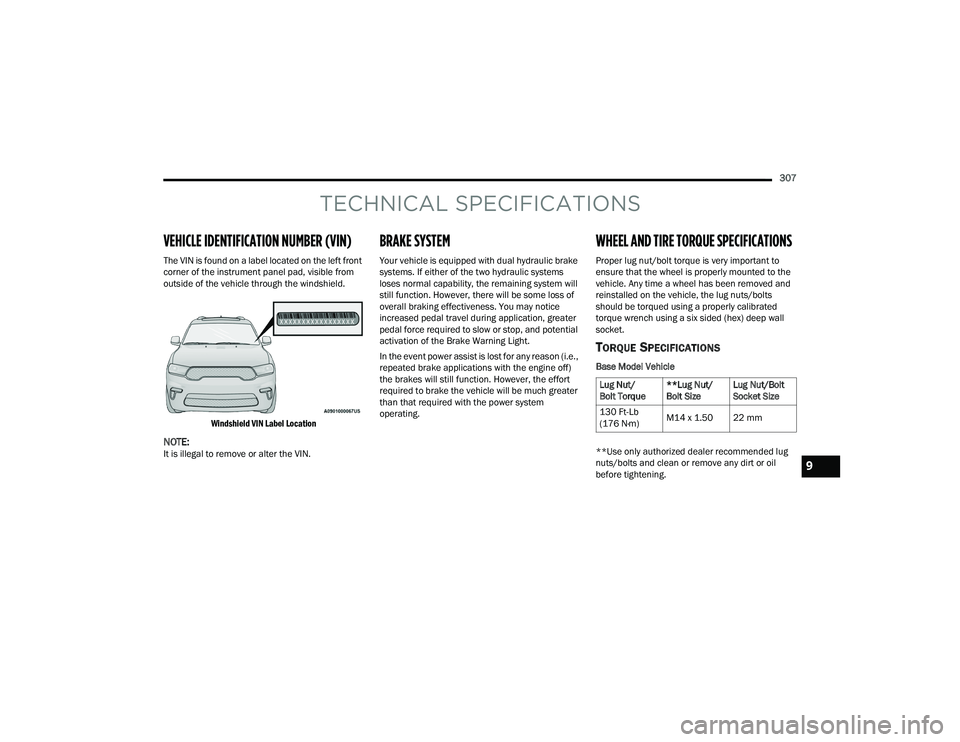
The VIN is found on a label located on the left front
corner of the instrument panel pad, visible from
outside of the vehicle through the windshield.
Windshield VIN Label Location
NOTE:It is illegal to remove or alter the VIN.
BRAKE SYSTEM
Your vehicle is equipped with dual hydraulic brake
systems. If either of the two hydraulic systems
loses normal capability, the remaining system will
still function. However, there will be some loss of
overall braking effectiveness. You may notice
increased pedal travel during application, greater
pedal force required to slow or stop, and potential
activation of the Brake Warning Light.
In the event power assist is lost for any reason (i.e.,
repeated brake applications with the engine off)
the brakes will still function. However, the effort
required to brake the vehicle will be much greater
than that required with the power system
operating.
WHEEL AND TIRE TORQUE SPECIFICATIONS
Proper lug nut/bolt torque is very important to
ensure that the wheel is properly mounted to the
vehicle. Any time a wheel has been removed and
reinstalled on the vehicle, the lug nuts/bolts
should be torqued using a properly calibrated
torque wrench using a six sided (hex) deep wall
socket.
TORQUE SPECIFICATIONS
Base Model Vehicle
**Use only authorized dealer recommended lug
nuts/bolts and clean or remove any dirt or oil
before tightening.
Lug Nut/
Bolt Torque **Lug Nut/
Bolt SizeLug Nut/Bolt
Socket Size
130 Ft-Lb
(176 N·m) M14 x 1.50 22 mm
9
22_WD_OM_EN_USC_t.book Page 307
Page 310 of 332
308TECHNICAL SPECIFICATIONS
Inspect the wheel mounting surface prior to
mounting the tire and remove any corrosion or
loose particles.
Wheel Mounting Surface
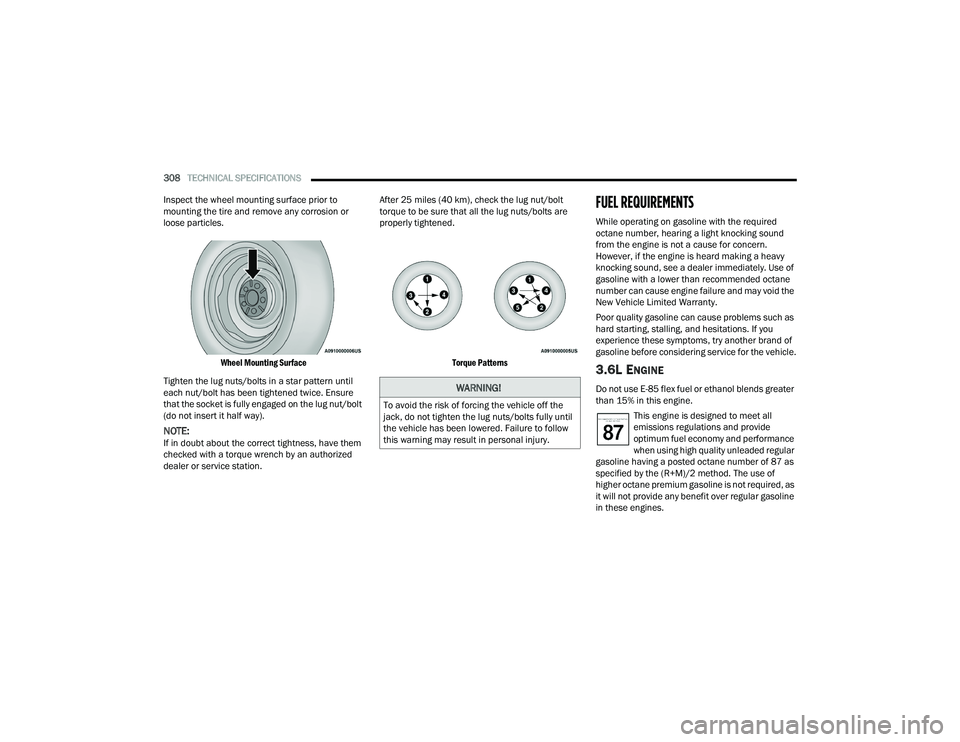
Tighten the lug nuts/bolts in a star pattern until
each nut/bolt has been tightened twice. Ensure
that the socket is fully engaged on the lug nut/bolt
(do not insert it half way).
NOTE:If in doubt about the correct tightness, have them
checked with a torque wrench by an authorized
dealer or service station. After 25 miles (40 km), check the lug nut/bolt
torque to be sure that all the lug nuts/bolts are
properly tightened.
Torque Patterns
FUEL REQUIREMENTS
While operating on gasoline with the required
octane number, hearing a light knocking sound
from the engine is not a cause for concern.
However, if the engine is heard making a heavy
knocking sound, see a dealer immediately. Use of
gasoline with a lower than recommended octane
number can cause engine failure and may void the
New Vehicle Limited Warranty.
Poor quality gasoline can cause problems such as
hard starting, stalling, and hesitations. If you
experience these symptoms, try another brand of
gasoline before considering service for the vehicle.
3.6L ENGINE
Do not use E-85 flex fuel or ethanol blends greater
than 15% in this engine.This engine is designed to meet all
emissions regulations and provide
optimum fuel economy and performance
when using high quality unleaded regular
gasoline having a posted octane number of 87 as
specified by the (R+M)/2 method. The use of
higher octane premium gasoline is not required, as
it will not provide any benefit over regular gasoline
in these engines.WARNING!
To avoid the risk of forcing the vehicle off the
jack, do not tighten the lug nuts/bolts fully until
the vehicle has been lowered. Failure to follow
this warning may result in personal injury.
22_WD_OM_EN_USC_t.book Page 308
Page 311 of 332
TECHNICAL SPECIFICATIONS309
5.7L ENGINE
Do not use E-85 flex fuel or ethanol blends greater
than 15% in this engine.
This engine is designed to meet all
emissions regulations and provide
satisfactory fuel economy and
performance when using high-quality
unleaded gasoline having an octane range of 87 to
89 as specified by the (R+M)/2 method. The use of
89 octane plus gasoline is recommended for
optimum performance and fuel economy.
REFORMULATED GASOLINE
Many areas of the country require the use of
cleaner burning gasoline referred to as
“reformulated gasoline”. Reformulated gasoline
contains oxygenates and are specifically blended
to reduce vehicle emissions and improve air
quality.
The use of reformulated gasoline is recommended.
Properly blended reformulated gasoline will
provide improved performance and durability of
engine and fuel system components.
MATERIALS ADDED TO FUEL
Besides using unleaded gasoline with the proper
octane rating, gasolines that contain detergents,
corrosion and stability additives are
recommended. Using gasolines that have these
additives will help improve fuel economy, reduce
emissions, and maintain vehicle performance.
Designated TOP TIER Detergent Gasoline
contains a higher level of detergents to
further aide in minimizing engine and
fuel system deposits. When available,
the usage of TOP TIER Detergent Gasoline is
recommended. Visit
www.toptiergas.com for a list
of TOP TIER Detergent Gasoline retailers.
Indiscriminate use of fuel system cleaning agents
should be avoided. Many of these materials
intended for gum and varnish removal may contain
active solvents or similar ingredients. These can
harm fuel system gasket and diaphragm materials.
GASOLINE/OXYGENATE BLENDS
Some fuel suppliers blend unleaded gasoline with
oxygenates such as ethanol.
Problems that result from using gasoline
containing more than 15% ethanol (E-15) or
gasoline containing methanol are not the
responsibility of the manufacturer and may void
the New Vehicle Limited Warranty.
CAUTION!
DO NOT use E-85, gasoline containing methanol,
or gasoline containing more than 15% ethanol
(E-15). Use of these blends may result in starting
and drivability problems, damage critical fuel
system components, cause emissions to exceed
the applicable standard, and/or cause the
Malfunction Indicator Light to illuminate. Please
observe pump labels as they should clearly
communicate if a fuel contains greater than
15% ethanol (E-15).
9
22_WD_OM_EN_USC_t.book Page 309
Page 312 of 332
310TECHNICAL SPECIFICATIONS
(Continued)
DO NOT USE E-85 IN NON-FLEX FUEL
V
EHICLES
Non-Flex Fuel Vehicles (FFV) are compatible with
gasoline containing up to 15% ethanol (E-15). Use
of gasoline with higher ethanol content may void
the New Vehicle Limited Warranty.
If a Non-FFV vehicle is inadvertently fueled with
E-85 fuel, the engine will have some or all of these
symptoms:
Operate in a lean mode.
OBD II Malfunction Indicator Light on.
Poor engine performance.
Poor cold start and cold drivability.
Increased risk for fuel system component corro -
sion.
CNG AND LP FUEL SYSTEM
M
ODIFICATIONS
Modifications that allow the engine to run on
Compressed Natural Gas (CNG) or Liquid Propane
(LP) may result in damage to the engine,
emissions, and fuel system components. Problems
that result from running CNG or LP are not the
responsibility of the manufacturer and may void
the New Vehicle Limited Warranty.
METHYLCYCLOPENTADIENYL
M
ANGANESE TRICARBONYL (MMT) IN
G
ASOLINE
MMT is a manganese-containing metallic additive
that is blended into some gasoline to increase
octane. Gasoline blended with MMT provides no
performance advantage beyond gasoline of the
same octane number without MMT. Gasoline
blended with MMT reduces spark plug life and
reduces emissions system performance in some
vehicles. The manufacturer recommends that
gasoline without MMT be used in your vehicle. The
MMT content of gasoline may not be indicated on
the gasoline pump; therefore, you should ask your
gasoline retailer whether the gasoline contains
MMT. MMT is prohibited in Federal and California
reformulated gasoline.
FUEL SYSTEM CAUTIONSNOTE:Intentional tampering with the emissions control
system can result in civil penalties being assessed
against you.CAUTION!
Follow these guidelines to maintain your
vehicle’s performance:
The use of leaded gasoline is prohibited by
Federal law. Using leaded gasoline can impair
engine performance and damage the emis -
sions control system.
An out-of-tune engine or certain fuel or ignition
malfunctions can cause the catalytic
converter to overheat. If you notice a pungent
burning odor or some light smoke, your engine
may be out of tune or malfunctioning and may
require immediate service. Contact an autho -
rized dealer for service assistance.
The use of fuel additives, which are now being
sold as octane enhancers, is not recom -
mended. Most of these products contain high
concentrations of methanol. Fuel system
damage or vehicle performance problems
resulting from the use of such fuels or addi -
tives is not the responsibility of the manufac-
turer and may void or not be covered under
the New Vehicle Limited Warranty.
CAUTION!
22_WD_OM_EN_USC_t.book Page 310
Page 316 of 332
314CUSTOMER ASSISTANCE
MEXICO
Av. Prolongacion Paseo de la Reforma, 1240
Sante Fe C.P. 05109
Mexico, D.F.
In Mexico City: (800) 505-1300
Outside Mexico City: +(52) 55 50817568
PUERTO RICO AND US VIRGIN ISLANDS
FCA Caribbean LLC
P.O. Box 191857
San Juan 00919-1857
Phone: (800) 423-6343
Fax: (787) 782-3345
CUSTOMER ASSISTANCE FOR THE
H
EARING OR SPEECH IMPAIRED
(TDD/TTY)
To assist customers who have hearing difficulties,
FCA US LLC has installed special Telecommu -
nication Devices for the Deaf (TDD) equipment at
its customer center. Any hearing or speech
impaired customer, who has access to a TDD or a
conventional teletypewriter (TTY) in the United
States, can communicate with FCA US LLC by
dialing 1-800-380-2479. Canadian residents with hearing difficulties that
require assistance can use the special needs relay
service offered by Bell Canada. For TTY
teletypewriter users, dial 711 and for Voice callers,
dial 1-800-855-0511 to connect with a Bell Relay
Service operator.
SERVICE CONTRACT
You may have purchased a service contract for a
vehicle to help protect you from the high cost of
unexpected repairs after FCA US LLC's New Vehicle
Limited Warranty expires. The Mopar® Vehicle
Protection plans are the ONLY vehicle extended
protection plans authorized, endorsed and backed
by FCA US LLC to provide additional protection
beyond your vehicle’s warranty. If you purchased a
Mopar® Vehicle Protection Plan, you will receive
Plan Provisions and an Owner Identification Card in
the mail within three weeks of the vehicle delivery
date. If you have any questions about the service
contract, call FCA US LLC’s Service Contract
National Customer Hotline at 1-800-521-9922
(Canadian residents, call (800) 465-2001
English / (800) 387-9983 French).
FCA US LLC is not responsible for any service
contract you may have purchased from another
manufacturer. If you require service after the
FCA US LLC New Vehicle Limited Warranty expires,
please refer to the contract documents, and
contact the person listed in those documents.
We appreciate that you have made a major
investment when you purchased the vehicle.
An authorized dealer has also made a major
investment in facilities, tools, and training to
assure that you are absolutely delighted with the
ownership experience.
22_WD_OM_EN_USC_t.book Page 314
Page 319 of 332
317
INDEX
A
About Your Brakes......................................... 307Adaptive Cruise Control (ACC)
(Cruise Control).................................... 116, 118Adding Engine Coolant (Antifreeze)............... 273Adding Fuel.................................................... 137Additives, Fuel............................................... 309AdjustDown.................................................... 34, 35Forward................................................ 34, 35Rearward.............................................. 34, 35Up......................................................... 34, 35Air BagAir Bag Operation...................................... 206Air Bag Warning Light...................... 204, 207Driver Knee Air Bag................................... 211Enhanced Accident Response......... 214, 254Event Data Recorder (EDR)....................... 254Front Air Bag............................................. 207If Deployment Occurs................................ 213Knee Impact Bolsters................................ 211Maintaining Your Air Bag System.............. 215Maintenance............................................. 215
Redundant Air Bag Warning Light............. 205Side Air Bags............................................ 211Transporting Pets..................................... 232Air Bag Light.................................. 89, 204, 232Air Cleaner, Engine
(Engine Air Cleaner Filter)............................. 263Air Conditioner Maintenance........................ 264Air Conditioner Refrigerant.................. 264, 265Air Conditioner System................................. 264Air ConditioningRear............................................................. 59Air Conditioning Filter.................... 61, 264, 265Air Conditioning System................................... 60Air Conditioning, Operating Tips....................... 61Air Filter........................................................ 263Air PressureTires......................................................... 293AlarmArm The System................................... 21, 22Disarm The System..................................... 21Rearm The System...................................... 22Security Alarm............................................. 92Alarm SystemSecurity Alarm............................................. 21
All Wheel Drive (AWD)................................... 109Alterations/ModificationsVehicle.........................................................10Antifreeze (Engine Coolant).................. 272, 311Disposal.................................................... 273Anti-Lock Brake System (ABS)....................... 182Anti-Lock Warning Light...................................92Assist, Hill Start............................................. 186Audio Systems (Radio).................................. 156Auto Down Power Windows..............................70Automatic Headlights.......................................49Automatic High Beams.....................................48Automatic Temperature Control (ATC)..............60Automatic Transmission......................... 99, 105Adding Fluid.............................................. 275Fluid And Filter Change............................. 275Fluid Change............................................. 275Fluid Level Check...................................... 275Fluid Type........................................ 276, 312Special Additives...................................... 275Automatic Transmission Limp Home Mode... 108Auxiliary Driving Systems.............................. 188Auxiliary Electrical Outlet (Power Outlet)..........66Auxiliary Power Outlet......................................66Axle Fluid....................................................... 31211
22_WD_OM_EN_USC_t.book Page 317
Page 320 of 332
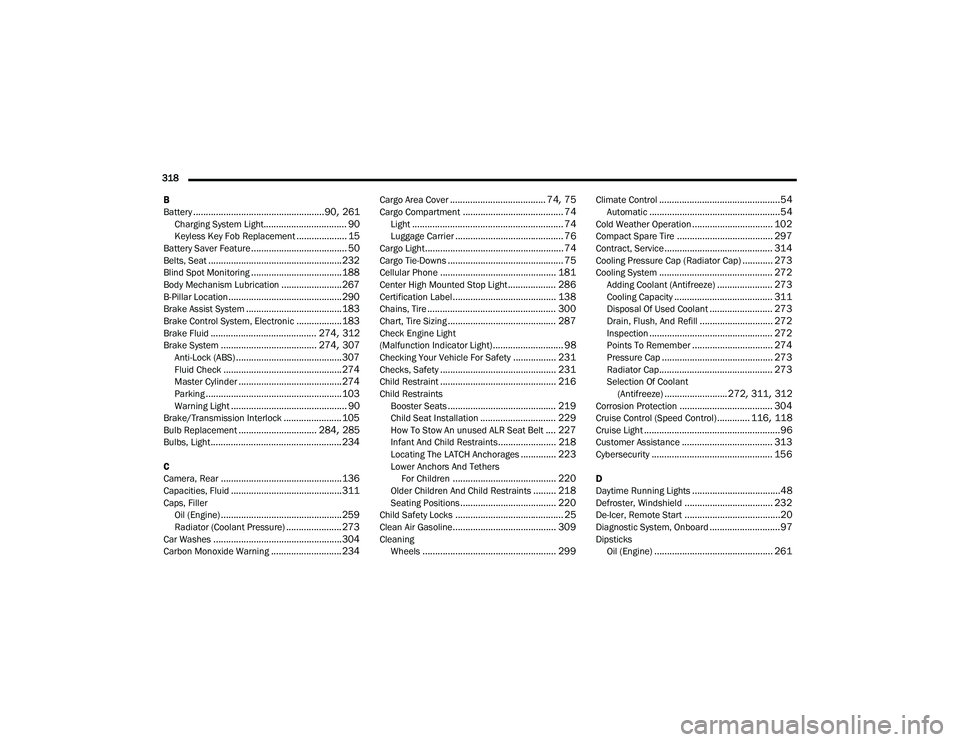
318 B
Battery
.................................................... 90, 261Charging System Light................................. 90Keyless Key Fob Replacement.................... 15Battery Saver Feature...................................... 50Belts, Seat..................................................... 232Blind Spot Monitoring.................................... 188Body Mechanism Lubrication........................ 267B-Pillar Location............................................. 290Brake Assist System...................................... 183Brake Control System, Electronic.................. 183Brake Fluid.......................................... 274, 312Brake System...................................... 274, 307Anti-Lock (ABS).......................................... 307Fluid Check............................................... 274Master Cylinder......................................... 274Parking...................................................... 103Warning Light.............................................. 90Brake/Transmission Interlock....................... 105Bulb Replacement............................... 284, 285Bulbs, Light.................................................... 234
C
Camera, Rear................................................ 136Capacities, Fluid............................................ 311Caps, Filler Oil (Engine)................................................ 259Radiator (Coolant Pressure)...................... 273Car Washes................................................... 304Carbon Monoxide Warning............................ 234
Cargo Area Cover...................................... 74, 75Cargo Compartment........................................ 74Light............................................................ 74Luggage Carrier........................................... 76Cargo Light....................................................... 74Cargo Tie-Downs.............................................. 75Cellular Phone.............................................. 181Center High Mounted Stop Light................... 286Certification Label......................................... 138Chains, Tire................................................... 300Chart, Tire Sizing........................................... 287Check Engine Light
(Malfunction Indicator Light)............................ 98Checking Your Vehicle For Safety................. 231Checks, Safety.............................................. 231Child Restraint.............................................. 216Child RestraintsBooster Seats........................................... 219Child Seat Installation.............................. 229How To Stow An unused ALR Seat Belt.... 227Infant And Child Restraints....................... 218Locating The LATCH Anchorages.............. 223Lower Anchors And TethersFor Children......................................... 220Older Children And Child Restraints......... 218Seating Positions...................................... 220Child Safety Locks........................................... 25Clean Air Gasoline......................................... 309CleaningWheels..................................................... 299
Climate Control................................................54Automatic....................................................54Cold Weather Operation................................ 102Compact Spare Tire...................................... 297Contract, Service........................................... 314Cooling Pressure Cap (Radiator Cap)............ 273Cooling System............................................. 272Adding Coolant (Antifreeze)...................... 273Cooling Capacity....................................... 311Disposal Of Used Coolant......................... 273Drain, Flush, And Refill............................. 272Inspection................................................. 272Points To Remember................................ 274Pressure Cap............................................ 273Radiator Cap............................................. 273Selection Of Coolant(Antifreeze)......................... 272, 311, 312Corrosion Protection..................................... 304Cruise Control (Speed Control)............. 116, 118Cruise Light......................................................96Customer Assistance.................................... 313Cybersecurity................................................ 156
D
Daytime Running Lights...................................48Defroster, Windshield................................... 232De-Icer, Remote Start......................................20Diagnostic System, Onboard............................97DipsticksOil (Engine)............................................... 261
22_WD_OM_EN_USC_t.book Page 318
Page 321 of 332
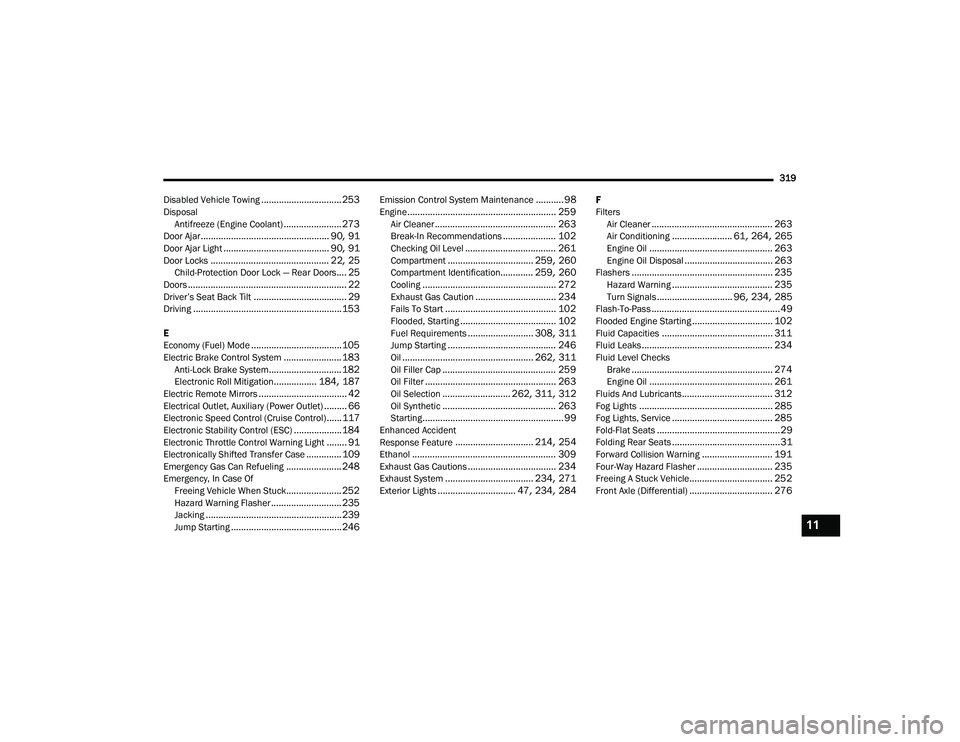
319
Disabled Vehicle Towing
................................ 253Disposal Antifreeze (Engine Coolant)....................... 273Door Ajar................................................... 90, 91Door Ajar Light.......................................... 90, 91Door Locks............................................... 22, 25Child-Protection Door Lock — Rear Doors.... 25Doors............................................................... 22Driver’s Seat Back Tilt..................................... 29Driving........................................................... 153
E
Economy (Fuel) Mode.................................... 105Electric Brake Control System....................... 183Anti-Lock Brake System............................. 182Electronic Roll Mitigation................. 184, 187Electric Remote Mirrors................................... 42Electrical Outlet, Auxiliary (Power Outlet)......... 66Electronic Speed Control (Cruise Control)...... 117Electronic Stability Control (ESC)...................184Electronic Throttle Control Warning Light........ 91Electronically Shifted Transfer Case.............. 109Emergency Gas Can Refueling...................... 248Emergency, In Case OfFreeing Vehicle When Stuck...................... 252Hazard Warning Flasher............................ 235Jacking...................................................... 239Jump Starting............................................ 246
Emission Control System Maintenance........... 98Engine........................................................... 259Air Cleaner................................................ 263Break-In Recommendations..................... 102Checking Oil Level.................................... 261Compartment.................................. 259, 260Compartment Identification............. 259, 260Cooling..................................................... 272Exhaust Gas Caution................................ 234Fails To Start............................................ 102Flooded, Starting...................................... 102Fuel Requirements.......................... 308, 311Jump Starting........................................... 246Oil.................................................... 262, 311Oil Filler Cap............................................. 259Oil Filter.................................................... 263Oil Selection........................... 262, 311, 312Oil Synthetic............................................. 263Starting........................................................ 99Enhanced Accident
Response Feature............................... 214, 254Ethanol......................................................... 309Exhaust Gas Cautions................................... 234Exhaust System................................... 234, 271Exterior Lights............................... 47, 234, 284
F
FiltersAir Cleaner
................................................ 263Air Conditioning........................ 61, 264, 265Engine Oil................................................. 263Engine Oil Disposal................................... 263Flashers........................................................ 235Hazard Warning........................................ 235Turn Signals.............................. 96, 234, 285Flash-To-Pass...................................................49Flooded Engine Starting................................ 102Fluid Capacities............................................ 311Fluid Leaks.................................................... 234Fluid Level ChecksBrake........................................................ 274Engine Oil................................................. 261Fluids And Lubricants.................................... 312Fog Lights..................................................... 285Fog Lights, Service........................................ 285Fold-Flat Seats.................................................29Folding Rear Seats...........................................31Forward Collision Warning............................ 191Four-Way Hazard Flasher.............................. 235Freeing A Stuck Vehicle................................. 252Front Axle (Differential)................................. 276
11
22_WD_OM_EN_USC_t.book Page 319