mileage DODGE DURANGO 2022 Vehicle Warranty
[x] Cancel search | Manufacturer: DODGE, Model Year: 2022, Model line: DURANGO, Model: DODGE DURANGO 2022Pages: 200, PDF Size: 6.72 MB
Page 152 of 200

PIRELLI TIRES
151
Scorpion Verde All Season Mileage Warranty
• A ll Scorpion Verde All Season tires produced in the year 2013 will be eligible for
8
0,000 kilometers limited treadwear warranty for H and V rated, and 105,000 kilome -
ters limited treadwear for T rated.
• A ll Scorpion Verde All Season tires produced after the year 2013 are not eligible for
m
ileage warranty coverage.
Road Hazard Policy For Run Flat Tires Only
Pirelli Run Flat tires are manufactured with technology that allows limited low-inflation
operation in the event of sudden loss of pressure. Pirelli does not recommend the repair
of run flat tires and as a result, Pirelli provides road hazard coverage on all Pirelli
produced tires that are manufactured with run flat technology. To qualify for Run Flat
Road Hazard coverage, a completed claim form along with the tire exhibiting the road
hazard must be returned to Pirelli through an authorized Pirelli dealer.
If a Run Flat tire becomes unserviceable due to workmanship or materials anomalies or
ro
ad hazard injury during the initial warranty period, which is one year from the date of
original retail purchase of the vehicle or purchase of replacement tires (purchase receipt
required) or within the first 2/32of an inch of the original usable tread, whichever occurs
first, the tire will be replaced with the same or comparable tire at no charge for the tire
to the owner. After the initial warranty period, if a Run Flat tire becomes unserviceable
due to workmanship or materials anomalies or road hazard injury, the owner must pay
the cost of a comparable new Pirelli brand or PTI private brand replacement tire on a
pro-rata basis. The authorized Pirelli dealer will determine the cost by multiplying the
percentage of the original usable tread worn by the current dealer selling price. The
owner must pay for any associated service charges, including costs associated with
mounting and balancing of the tire. This Road Hazard Policy is not a warranty. PTI does
not warranty that a Pirelli tire will not fail due to road hazard and does not authorize any
person, including authorized Pirelli dealers, to make such a warranty.
Pirelli “Seal Inside” Technology
Select Pirelli tires incorporate “Seal Inside” technology, a construction designed to stop
the loss of air from a tire when punctured by an object. Providing the puncture does not
compromise the structural integrity of the tire, a sealing material layer prevents possible
air leakage in the event of a carcass puncture.
The “Seal Inside” technology is not designed or intended to be a permanent repair, and
i s
only meant to allow the consumer to go to a Pirelli dealer for an inspection to determine
if repair or replacement is needed.
Visit www.ca.pirelli.com for more information.
What Is Not Covered By The Warranty?
• Tires on any vehicle registered and normally operated outside the United States of
America or Canada.
• T ires transferred from the vehicle on which they were originally installed.
Page 158 of 200
PIRELLI TIRES
157
identified with a pictograph of a mountain with a snowflake on the sidewalls and must
meet specific snow performance test requirements. Pirelli Winter tires do not carry a
mileage warranty.
The information provided above is an overview of tire types. Tread patterns and rubber
c o
mpounds vary among the seasonal tire types and provide varying performance
characteristics and limitations based on your individual needs and vehicle specifications.
Summer performance tires are different than winter and all season types. To determine
which Pirelli lines carry a Limited Treadwear Warranty, please refer to The PTI Treadwear
Mileage Warranty Conditions and Mileage Warranty sections found in this document.
3. Pressure Recommendations
Recommended tire inflation pressures for your vehicle can be found either on your
vehicle’s tire placard or in your vehicle owner’s manual. Correct pressures are related to
load, speed and vehicle handling and are vital for even braking, maximum traction and
good tire life. Under no circumstances should your tire’s cold inflation pressure be less
than that indicated on your vehicle’s tire placard or in your vehicle owner’s manual or
higher than the maximum cold inflation pressure molded on to the tire’s sidewall.
Underinflation causes excessive flexing, deterioration of the tire and rapid wear of the
tread edges. Overinflation results in an uncomfortable ride, a reduced area of tire contact
with the road surface (i.e., smaller tire footprint), higher susceptibility to impact damage
and rapid wear on the tread center.
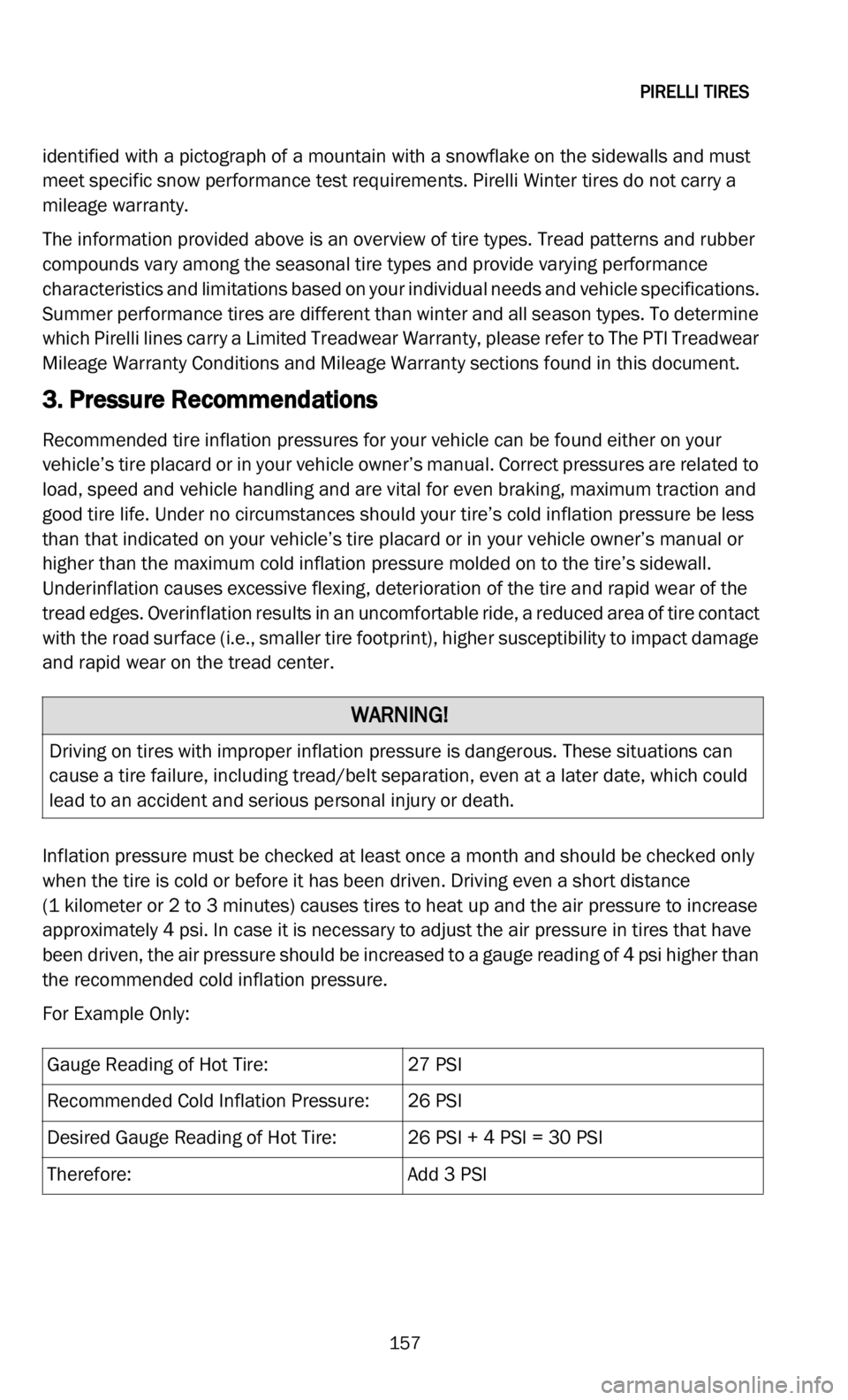
Inflation pressure must be checked at least once a month and should be checked only
w h
en the tire is cold or before it has been driven. Driving even a short distance
(1 kilometer or 2 to 3 minutes) causes tires to heat up and the air pressure to increase
a p
proximately 4 psi. In case it is necessary to adjust the air pressure in tires that have
been driven, the air pressure should be increased to a gauge reading of 4 psi higher than
the recommended cold inflation pressure.
For Example Only:
WARNING!
Driving on tires with improper inflation pressure is dangerous. These situations can
cause a tire failure, including tread/belt separation, even at a later date, which could
lead to an accident and serious personal injury or death.
Gauge Reading of Hot Tire: 27 PSI
Recommended Cold Inflation Pressure: 26 PSI
Desired Gauge Reading of Hot Tire: 26 PSI + 4 PSI = 30 PSI
Therefore: Add 3 PSI
Page 162 of 200

PIRELLI TIRES
161
PIRELLI TIRE DOES NOT ENDORSE:
• T he use of tire sealants in Pirelli tires to repair, even temporarily, a puncture
•
The repairing of V, W, Y or Z Speed Rated tires
•
The repairing of Run Flat tires
12. Storage
Should you need to store tires after removal from a vehicle (as in the case of winter tires),
they should be stored in a cool, dry place. To protect your tires from damage related to:
heat, water, ozone and direct sunlight, it is suggested you place them in opaque,
waterproof containers (e.g., plastic trash bags).
13. Tubes in Tubeless Tires
Under no circumstances are tubes to be used in Pirelli tires marked “Tubeless”. This
includes tires that have been repaired. If the tire’s pressure retention ability has been
affected, so as to necessitate a tube being installed, the tire must be replaced.
14. Tire Valves
Whenever new tires are installed on your wheels, new tire valves of the correct type must
be installed. During your routine tire inspection, verify that all your valves have proper
valve caps. Replace as necessary, since the valve cap is also a seal against pressure
loss.
15. Tire Demounting and Mounting
Tire fitting is best left to professionals who have the proper tools and equipment to
perform the task properly and safely. Your tires should be mounted or demounted, using
Tire and Rubber Association of Canada procedures or the vehicle manufacturers’
recommendations. Your wheels should be in good, clean condition. Wheels should be
inspected for distortion, dents, cracks, rust and foreign matter, and be replaced as
necessary. NEVER EXCEED 40 PSI WHEN SEATING BEADS.
16. Tire/Wheel Alignment and Balancing
Tire/Wheel alignment specifications are issued by your vehicle manufacturer and your
vehicle must be kept within these tolerances. You should have your alignment checked
annually or whenever you notice any irregular wear or vibrations. Tire/Wheel assemblies
should be balanced each time a tire is fitted to a wheel. Tire/Wheel alignment and
balancing are important for safety and maximum performance and mileage from your
tires.
For more information or service regarding Pirelli tires, please contact your nearest
A u
thorized Pirelli Dealer. To locate an authorized Pirelli Dealer in your area, refer to the
Dealer Locator section on the Pirelli web site at www.ca.pirelli.com.
P ZERO, P ZERO CORSA, P ZERO ROSSO, P ZERO NERO, CINTURATO, SCORPION,
S C
ORPION ZERO, SCORPION VERDE, P3000, P1, P4, P5, P6, P7 are trademarks of Pirelli
Tyre S.p.A.
“Confidence Program” is a trademark of Pirelli Tire Inc.
Page 165 of 200

TOYO TIRES® – LIMITED WARRANTY
164
• Any tire which has been run with low air pressure or while flat.
• Damage due to abuse; vandalism; tire alteration; tire spinning; racing; or other
c
ompetitive activities.
• D amage, corrosion, or deterioration from using oil-based chemicals, water-based
s
ealers, balancing substances, or flammable gases.
• D amage from improper use of tire chains.
T
ires with the DOT identification number removed or rendered illegible.
Improper mounting, balancing or repair, not limited to:
• I mproper tire mounting, or tire/wheel assembly imbalance.
•
Damage from incorrect mounting or dismounting of the tire, incorrect wheel size,
w
ater or other material trapped inside the tire during mounting, or failure to keep the
tires balanced.
• D amage resulting from improper repair materials or procedures.
F
ailure to meet conditions of this Limited Warranty, not limited to:
• A ny tire that is not an Eligible Tire.
•
Any tire for which mileage and tire rotation records are not available or verifiable.
•
Any tire not presented and available for Toyo Tires® inspection.
•
Any tire worn beyond the treadwear indicators (less than 2/32 of an inch of remaining
t
read).
• U niformity issues after the first 25% of treadwear.
T
emporary spare tires that are used at speeds over 50 miles per hour.
Nothing in this Limited Warranty is intended to be a representation that tire failures
c a
nnot occur.
WHAT TOYO TIRES® WILL DO
For every Eligible Tire, Toyo Tires® will do the following:
Regular OE Tires
1. I f less than 25% Worn: Toyo Tires® will replace, free of charge, any Eligible Tire when
t
he original usable tread is worn by 25% or less, and within 5 years from the date you
purchased the vehicle new. If you cannot provide a copy of the new vehicle registra -
tion or vehicle purchase receipt, the manufacture date of the tire, as indicated by the
t i
re DOT code, will be used instead to determine if a tire is within the warranty period.
Tire mounting and balancing costs are covered by Toyo Tires®. You are responsible
for taxes and all other costs, fees and expenses.
2. I f more than 25% Worn: Toyo Tires® will replace any Eligible Tire when the original
u
sable tread is worn by more than 25%, and within 5 years from the date you
purchased the vehicle new. If you cannot provide a copy of the new vehicle registra -
tion or vehicle purchase receipt, the manufacture date of the tire, as indicated by the
Page 179 of 200

TOYO TIRES® – LIMITED WARRANTY
178
REPLACING TWO TIRES
• When a pair of replacement tires is selected in the same size and construction as those on the vehicle, the two newer tires must be installed on the rear axle and must
be of equal or higher speed rating than the front tires. Generally, new tires with deeper
tread will provide better grip and evacuate water more effectively, which is important
as a driver approaches hydroplaning situations. Placing greater traction on the rear
axle on wet surfaces is necessary to prevent a possible oversteer condition and loss
of vehicle stability.
• W hen two new tires have been installed onto the rear axle positions, they are to be
k
ept on the rear but rotated from side to side. This is recommended after installing two
new tires to the rear position, or if you discover significant tread depth differences
between the front and rear positions during rotation intervals.
REPLACING ONE TIRE
• Replacing a single tire on a vehicle can have an adverse effect on suspension systems, gear ratios, transmission, and tire treadwear.
• I f single tire replacement is unavoidable, it is recommended that the single new tire
b
e paired with the tire that has the deepest tread and both be placed on the rear axle.
Placing greater traction on the rear axle on wet surfaces is necessary to prevent a
possible oversteer condition and loss of vehicle stability.
WHEEL ALIGNMENT AND BALANCING
• Proper wheel alignment and balance are very important considerations for safety and getting the maximum mileage from your tires. You need to check how your tires are
wearing at least once a month.
• Y our vehicle may be out of alignment if your tires are wearing unevenly, such as when
t
he inside shoulder of the tire is wearing faster than the rest of the tread. This condi -
tion not only shortens the life of your tires, it adversely affects the handling character -
istics of your vehicle, which could be dangerous. If your tires show irregular wear, have
y o
ur vehicle’s alignment checked immediately.
CAUTION!
In some cases, the vehicle manufacturer may specifically advise against replacing
fewer than all four tires. Always check and follow the recommendations in the vehicle
Owner’s Manual. For 4WD and AWD vehicles, even small differences in outside
diameter may cause drivetrain damage or mechanical malfunction.
Page 191 of 200
TOYO TIRES® – LIMITED WARRANTY
190
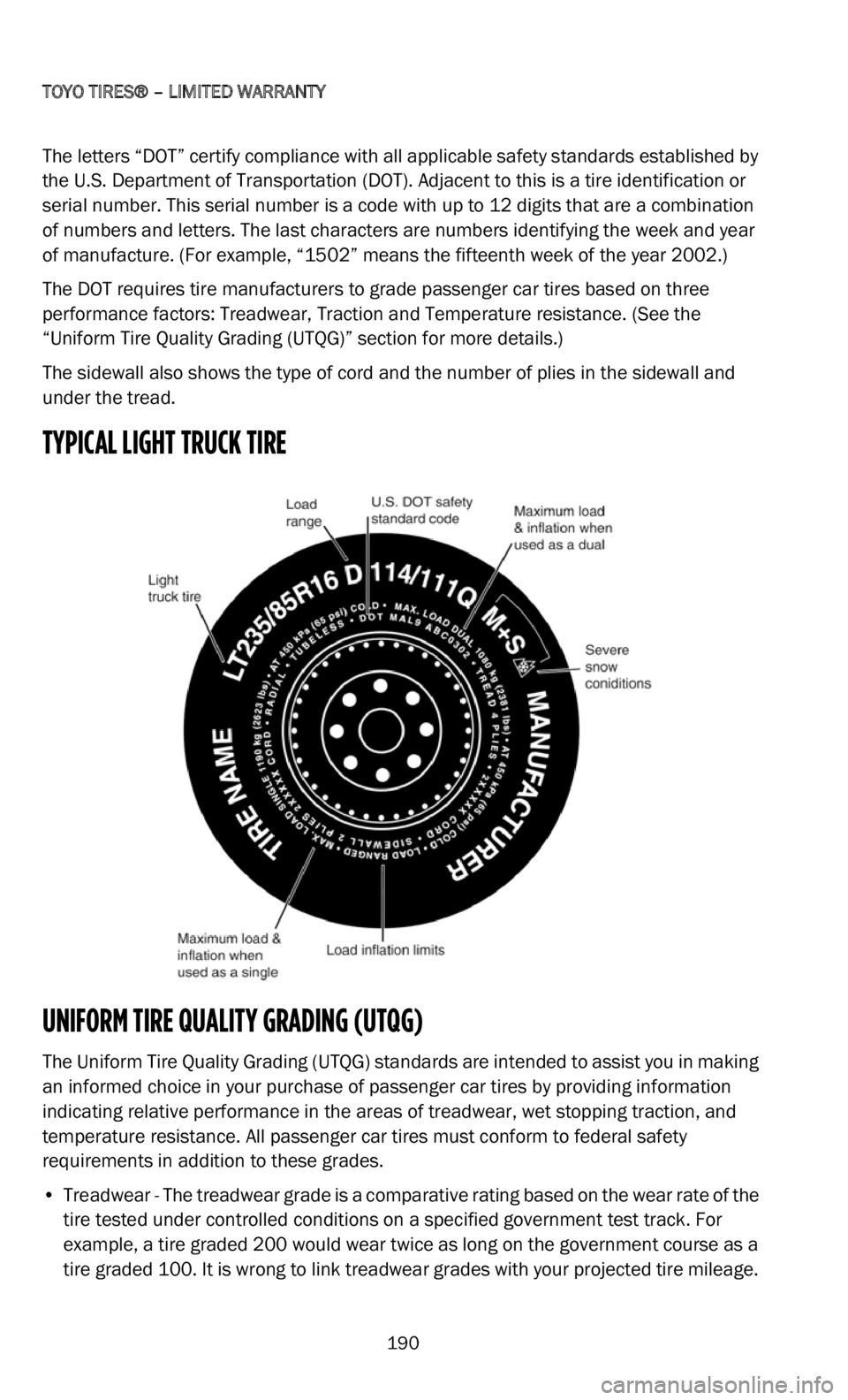
The letters “DOT” certify compliance with all applicable safety standards established by
the U.S. Department of Transportation (DOT). Adjacent to this is a tire identification or
serial number. This serial number is a code with up to 12 digits that are a combination
of numbers and letters. The last characters are numbers identifying the week and year
of manufacture. (For example, “1502” means the fifteenth week of the year 2002.)
The DOT requires tire manufacturers to grade passenger car tires based on three
pe
rformance factors: Treadwear, Traction and Temperature resistance. (See the
“Uniform Tire Quality Grading (UTQG)” section for more details.)
The sidewall also shows the type of cord and the number of plies in the sidewall and
u n
der the tread.
TYPICAL LIGHT TRUCK TIRE
UNIFORM TIRE QUALITY GRADING (UTQG)
The Uniform Tire Quality Grading (UTQG) standards are intended to assist you in making
an informed choice in your purchase of passenger car tires by providing information
indicating relative performance in the areas of treadwear, wet stopping traction, and
temperature resistance. All passenger car tires must conform to federal safety
requirements in addition to these grades.
• Treadwear - The treadwear grade is a comparative rating based on the wear rate of the t
ire tested under controlled conditions on a specified government test track. For
example, a tire graded 200 would wear twice as long on the government course as a
tire graded 100. It is wrong to link treadwear grades with your projected tire mileage.