oil level DODGE DURANGO 2023 User Guide
[x] Cancel search | Manufacturer: DODGE, Model Year: 2023, Model line: DURANGO, Model: DODGE DURANGO 2023Pages: 328, PDF Size: 13.82 MB
Page 270 of 328
268SERVICING AND MAINTENANCE
(Continued)
Make sure that the coolant expansion bottle
overflow hoses are not kinked or obstructed.
Keep the front of the radiator clean. If your
vehicle is equipped with air conditioning, keep
the front of the condenser clean.
Do not change the thermostat for Summer or
Winter operation. If replacement is ever neces-
sary, install ONLY the correct type thermostat.
Other designs may result in unsatisfactory
engine cooling performance, poor gas mileage,
and increased emissions.
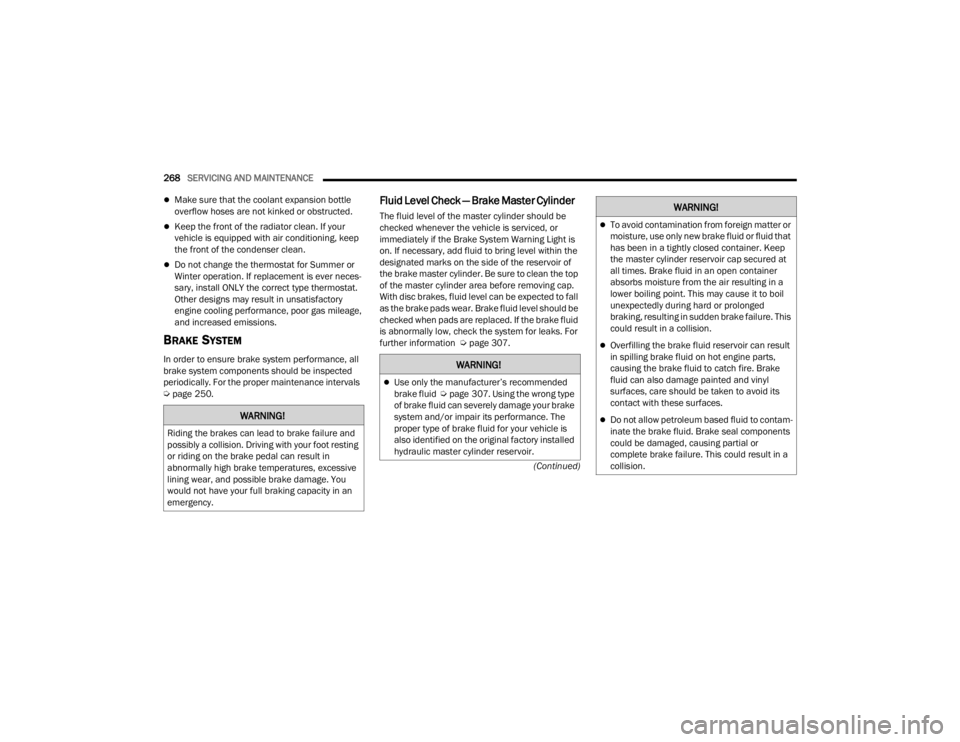
BRAKE SYSTEM
In order to ensure brake system performance, all
brake system components should be inspected
periodically. For the proper maintenance intervals
Ú page 250.
Fluid Level Check — Brake Master Cylinder
The fluid level of the master cylinder should be
checked whenever the vehicle is serviced, or
immediately if the Brake System Warning Light is
on. If necessary, add fluid to bring level within the
designated marks on the side of the reservoir of
the brake master cylinder. Be sure to clean the top
of the master cylinder area before removing cap.
With disc brakes, fluid level can be expected to fall
as the brake pads wear. Brake fluid level should be
checked when pads are replaced. If the brake fluid
is abnormally low, check the system for leaks. For
further information Ú page 307.
WARNING!
Riding the brakes can lead to brake failure and
possibly a collision. Driving with your foot resting
or riding on the brake pedal can result in
abnormally high brake temperatures, excessive
lining wear, and possible brake damage. You
would not have your full braking capacity in an
emergency.
WARNING!
Use only the manufacturer’s recommended
brake fluid Úpage 307. Using the wrong type
of brake fluid can severely damage your brake
system and/or impair its performance. The
proper type of brake fluid for your vehicle is
also identified on the original factory installed
hydraulic master cylinder reservoir.
To avoid contamination from foreign matter or
moisture, use only new brake fluid or fluid that
has been in a tightly closed container. Keep
the master cylinder reservoir cap secured at
all times. Brake fluid in an open container
absorbs moisture from the air resulting in a
lower boiling point. This may cause it to boil
unexpectedly during hard or prolonged
braking, resulting in sudden brake failure. This
could result in a collision.
Overfilling the brake fluid reservoir can result
in spilling brake fluid on hot engine parts,
causing the brake fluid to catch fire. Brake
fluid can also damage painted and vinyl
surfaces, care should be taken to avoid its
contact with these surfaces.
Do not allow petroleum based fluid to contam -
inate the brake fluid. Brake seal components
could be damaged, causing partial or
complete brake failure. This could result in a
collision.
WARNING!
23_WD_OM_EN_USC_t.book Page 268
Page 271 of 328
SERVICING AND MAINTENANCE269
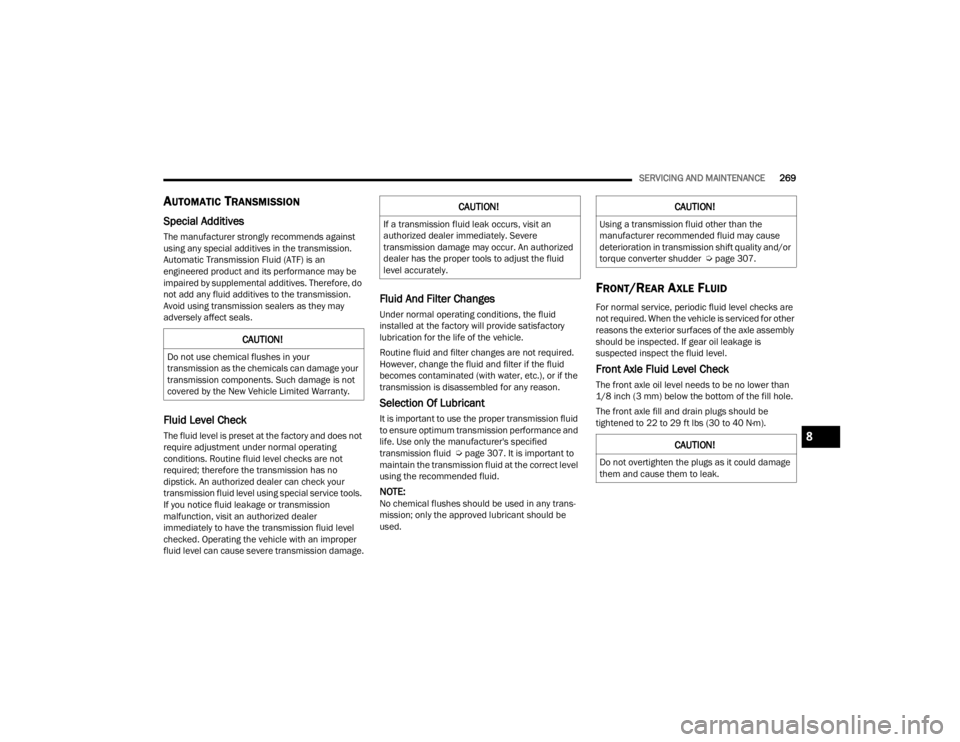
AUTOMATIC TRANSMISSION
Special Additives
The manufacturer strongly recommends against
using any special additives in the transmission.
Automatic Transmission Fluid (ATF) is an
engineered product and its performance may be
impaired by supplemental additives. Therefore, do
not add any fluid additives to the transmission.
Avoid using transmission sealers as they may
adversely affect seals.
Fluid Level Check
The fluid level is preset at the factory and does not
require adjustment under normal operating
conditions. Routine fluid level checks are not
required; therefore the transmission has no
dipstick. An authorized dealer can check your
transmission fluid level using special service tools.
If you notice fluid leakage or transmission
malfunction, visit an authorized dealer
immediately to have the transmission fluid level
checked. Operating the vehicle with an improper
fluid level can cause severe transmission damage.
Fluid And Filter Changes
Under normal operating conditions, the fluid
installed at the factory will provide satisfactory
lubrication for the life of the vehicle.
Routine fluid and filter changes are not required.
However, change the fluid and filter if the fluid
becomes contaminated (with water, etc.), or if the
transmission is disassembled for any reason.
Selection Of Lubricant
It is important to use the proper transmission fluid
to ensure optimum transmission performance and
life. Use only the manufacturer's specified
transmission fluid Úpage 307. It is important to
maintain the transmission fluid at the correct level
using the recommended fluid.
NOTE:No chemical flushes should be used in any trans -
mission; only the approved lubricant should be
used.
FRONT/REAR AXLE FLUID
For normal service, periodic fluid level checks are
not required. When the vehicle is serviced for other
reasons the exterior surfaces of the axle assembly
should be inspected. If gear oil leakage is
suspected inspect the fluid level.
Front Axle Fluid Level Check
The front axle oil level needs to be no lower than
1/8 inch (3 mm) below the bottom of the fill hole.
The front axle fill and drain plugs should be
tightened to 22 to 29 ft lbs (30 to 40 N·m).
CAUTION!
Do not use chemical flushes in your
transmission as the chemicals can damage your
transmission components. Such damage is not
covered by the New Vehicle Limited Warranty.
CAUTION!
If a transmission fluid leak occurs, visit an
authorized dealer immediately. Severe
transmission damage may occur. An authorized
dealer has the proper tools to adjust the fluid
level accurately.
CAUTION!
Using a transmission fluid other than the
manufacturer recommended fluid may cause
deterioration in transmission shift quality and/or
torque converter shudder Ú page 307.
CAUTION!
Do not overtighten the plugs as it could damage
them and cause them to leak.
8
23_WD_OM_EN_USC_t.book Page 269
Page 272 of 328
270SERVICING AND MAINTENANCE
(Continued)
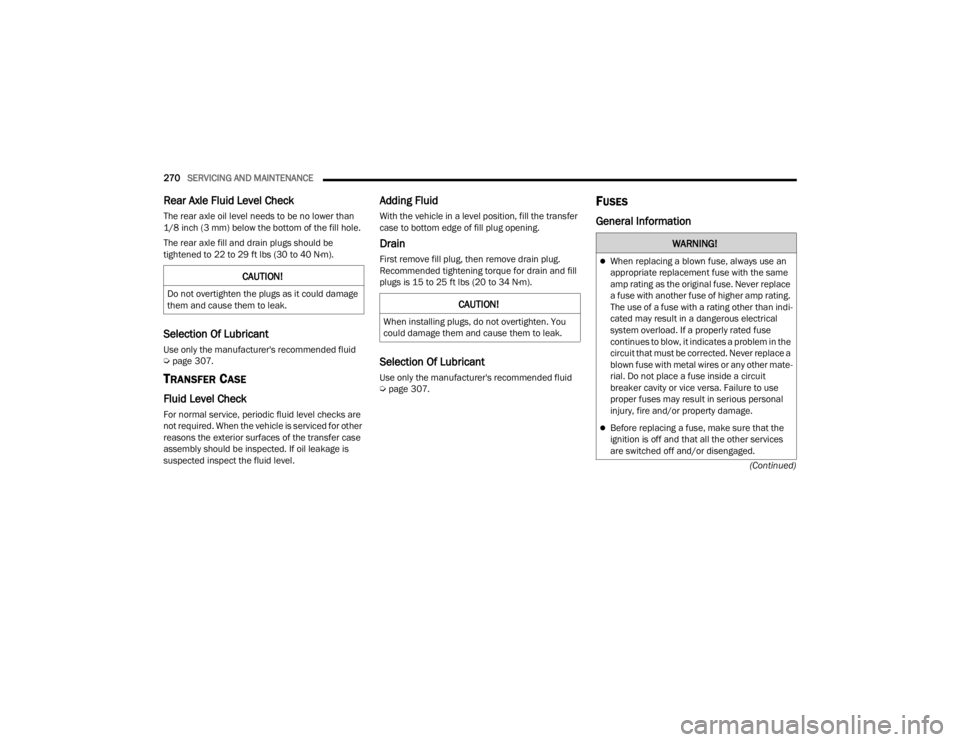
Rear Axle Fluid Level Check
The rear axle oil level needs to be no lower than
1/8 inch (3 mm) below the bottom of the fill hole.
The rear axle fill and drain plugs should be
tightened to 22 to 29 ft lbs (30 to 40 N·m).
Selection Of Lubricant
Use only the manufacturer's recommended fluid
Úpage 307.
TRANSFER CASE
Fluid Level Check
For normal service, periodic fluid level checks are
not required. When the vehicle is serviced for other
reasons the exterior surfaces of the transfer case
assembly should be inspected. If oil leakage is
suspected inspect the fluid level.
Adding Fluid
With the vehicle in a level position, fill the transfer
case to bottom edge of fill plug opening.
Drain
First remove fill plug, then remove drain plug.
Recommended tightening torque for drain and fill
plugs is 15 to 25 ft lbs (20 to 34 N·m).
Selection Of Lubricant
Use only the manufacturer's recommended fluid
Úpage 307.
FUSES
General Information
CAUTION!
Do not overtighten the plugs as it could damage
them and cause them to leak.CAUTION!
When installing plugs, do not overtighten. You
could damage them and cause them to leak.
WARNING!
When replacing a blown fuse, always use an
appropriate replacement fuse with the same
amp rating as the original fuse. Never replace
a fuse with another fuse of higher amp rating.
The use of a fuse with a rating other than indi -
cated may result in a dangerous electrical
system overload. If a properly rated fuse
continues to blow, it indicates a problem in the
circuit that must be corrected. Never replace a
blown fuse with metal wires or any other mate -
rial. Do not place a fuse inside a circuit
breaker cavity or vice versa. Failure to use
proper fuses may result in serious personal
injury, fire and/or property damage.
Before replacing a fuse, make sure that the
ignition is off and that all the other services
are switched off and/or disengaged.
23_WD_OM_EN_USC_t.book Page 270
Page 294 of 328
292SERVICING AND MAINTENANCE
NOTE:Wheel valve stem must be replaced as well when
installing new tires due to wear and tear in existing
tires.
Keep dismounted tires in a cool, dry place with as
little exposure to light as possible. Protect tires
from contact with oil, grease, and gasoline.
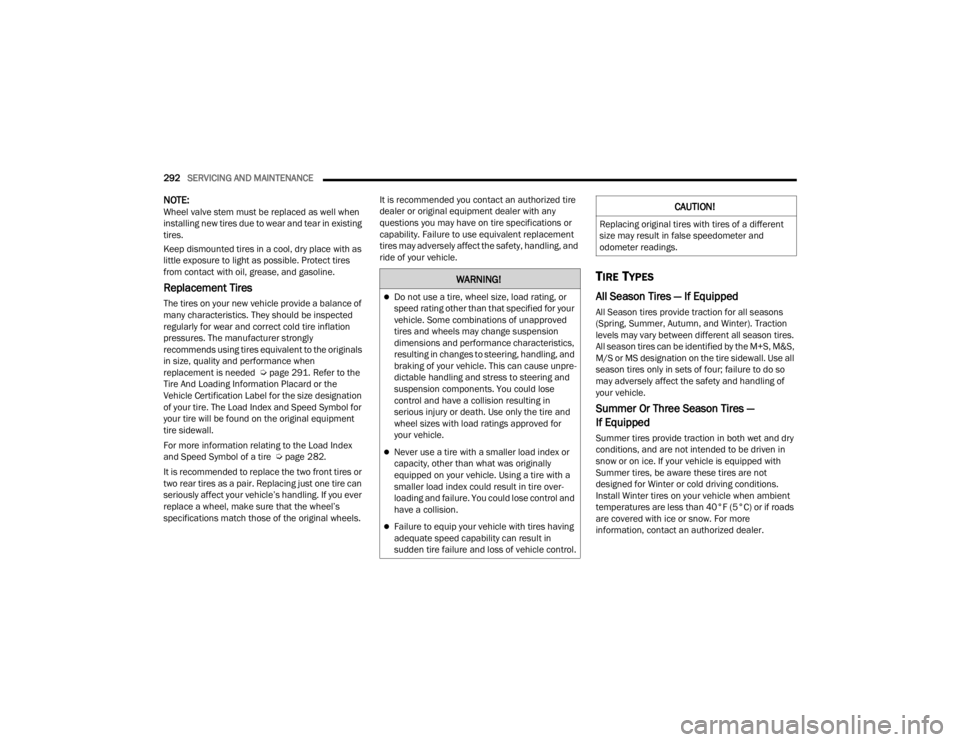
Replacement Tires
The tires on your new vehicle provide a balance of
many characteristics. They should be inspected
regularly for wear and correct cold tire inflation
pressures. The manufacturer strongly
recommends using tires equivalent to the originals
in size, quality and performance when
replacement is needed Úpage 291. Refer to the
Tire And Loading Information Placard or the
Vehicle Certification Label for the size designation
of your tire. The Load Index and Speed Symbol for
your tire will be found on the original equipment
tire sidewall.
For more information relating to the Load Index
and Speed Symbol of a tire Ú page 282.
It is recommended to replace the two front tires or
two rear tires as a pair. Replacing just one tire can
seriously affect your vehicle’s handling. If you ever
replace a wheel, make sure that the wheel’s
specifications match those of the original wheels. It is recommended you contact an authorized tire
dealer or original equipment dealer with any
questions you may have on tire specifications or
capability. Failure to use equivalent replacement
tires may adversely affect the safety, handling, and
ride of your vehicle.
TIRE TYPES
All Season Tires — If Equipped
All Season tires provide traction for all seasons
(Spring, Summer, Autumn, and Winter). Traction
levels may vary between different all season tires.
All season tires can be identified by the M+S, M&S,
M/S or MS designation on the tire sidewall. Use all
season tires only in sets of four; failure to do so
may adversely affect the safety and handling of
your vehicle.
Summer Or Three Season Tires —
If Equipped
Summer tires provide traction in both wet and dry
conditions, and are not intended to be driven in
snow or on ice. If your vehicle is equipped with
Summer tires, be aware these tires are not
designed for Winter or cold driving conditions.
Install Winter tires on your vehicle when ambient
temperatures are less than 40°F (5°C) or if roads
are covered with ice or snow. For more
information, contact an authorized dealer.
WARNING!
Do not use a tire, wheel size, load rating, or
speed rating other than that specified for your
vehicle. Some combinations of unapproved
tires and wheels may change suspension
dimensions and performance characteristics,
resulting in changes to steering, handling, and
braking of your vehicle. This can cause unpre
-
dictable handling and stress to steering and
suspension components. You could lose
control and have a collision resulting in
serious injury or death. Use only the tire and
wheel sizes with load ratings approved for
your vehicle.
Never use a tire with a smaller load index or
capacity, other than what was originally
equipped on your vehicle. Using a tire with a
smaller load index could result in tire over -
loading and failure. You could lose control and
have a collision.
Failure to equip your vehicle with tires having
adequate speed capability can result in
sudden tire failure and loss of vehicle control.
CAUTION!
Replacing original tires with tires of a different
size may result in false speedometer and
odometer readings.
23_WD_OM_EN_USC_t.book Page 292
Page 308 of 328
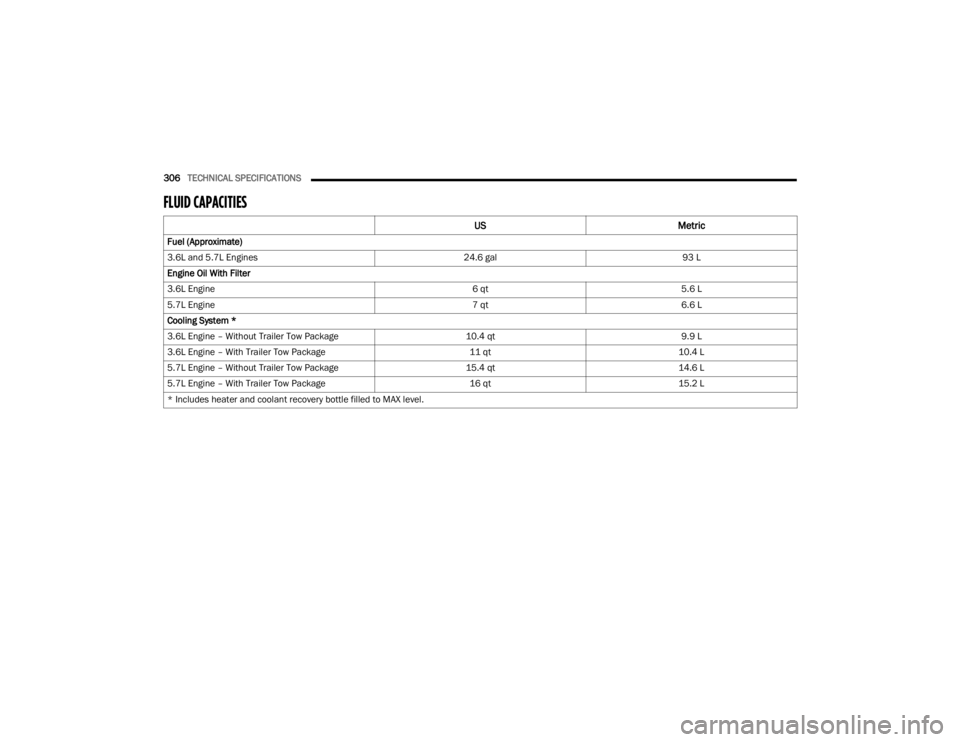
306TECHNICAL SPECIFICATIONS
FLUID CAPACITIES
US Metric
Fuel (Approximate)
3.6L and 5.7L Engines 24.6 gal93 L
Engine Oil With Filter
3.6L Engine 6 qt5.6 L
5.7L Engine 7 qt6.6 L
Cooling System *
3.6L Engine – Without Trailer Tow Package 10.4 qt9.9 L
3.6L Engine – With Trailer Tow Package 11 qt10.4 L
5.7L Engine – Without Trailer Tow Package 15.4 qt14.6 L
5.7L Engine – With Trailer Tow Package 16 qt15.2 L
* Includes heater and coolant recovery bottle filled to MAX level.
23_WD_OM_EN_USC_t.book Page 306
Page 317 of 328

315
Door Locks
............................................... 21, 25Child-Protection Door Lock — Rear Doors.... 25Doors............................................................... 21Driver’s Seat Back Tilt..................................... 28Driving........................................................... 150
E
Economy (Fuel) Mode.................................... 104Electric Brake Control System....................... 178Anti-Lock Brake System............................. 177Electronic Roll Mitigation................. 179, 182Electric Remote Mirrors................................... 41Electrical Outlet, Auxiliary (Power Outlet)......... 65Electronic Speed Control (Cruise Control)...... 116Electronic Stability Control (ESC)...................180Electronic Throttle Control Warning Light........ 89Electronically Shifted Transfer Case.... 108, 109Emergency Gas Can Refueling...................... 242Emergency, In Case Of Freeing Vehicle When Stuck...................... 245Hazard Warning Flasher............................ 229Jacking...................................................... 232Jump Starting............................................ 239Emission Control System Maintenance........... 96
Engine........................................................... 253Air Cleaner................................................ 257Break-In Recommendations..................... 101Checking Oil Level.................................... 255Compartment.................................. 253, 254Compartment Identification............. 253, 254Cooling..................................................... 265Exhaust Gas Caution................................ 228Fails To Start............................................ 101Flooded, Starting...................................... 101Fuel Requirements.......................... 303, 306Jump Starting........................................... 239Oil.................................................... 256, 306Oil Filler Cap............................................. 253Oil Filter.................................................... 257Oil Selection........................... 256, 306, 307Oil Synthetic............................................. 257Starting........................................................ 98Engine Oil Life Reset
b
.................................. 82
Enhanced Accident Response Feature...209, 248
Ethanol......................................................... 304Exhaust Gas Cautions................................... 228Exhaust System................................... 228, 264Exterior Lights............................... 45, 227, 278
F
FiltersAir Cleaner
................................................ 257Air Conditioning........................ 60, 257, 259Engine Oil................................................. 257Engine Oil Disposal................................... 257Flashers........................................................ 229Hazard Warning........................................ 229Turn Signals.............................. 95, 227, 280Flash-To-Pass...................................................47Flooded Engine Starting................................ 101Fluid Capacities............................................ 306Fluid Leaks.................................................... 228Fluid Level ChecksBrake........................................................ 268Engine Oil................................................. 255Fluids And Lubricants.................................... 307Fog Lights..................................................... 280Fog Lights, Service........................................ 280Fold-Flat Seats.................................................28Folding Rear Seats...........................................30Forward Collision Warning............................ 186Four-Way Hazard Flasher.............................. 229Freeing A Stuck Vehicle................................. 245Front Axle (Differential)................................. 269
11
23_WD_OM_EN_USC_t.book Page 315