engine oil DODGE DURANGO 2023 Owner's Manual
[x] Cancel search | Manufacturer: DODGE, Model Year: 2023, Model line: DURANGO, Model: DODGE DURANGO 2023Pages: 328, PDF Size: 13.82 MB
Page 260 of 328
258SERVICING AND MAINTENANCE
2. Lift the engine air cleaner filter cover to access the engine air cleaner filter.
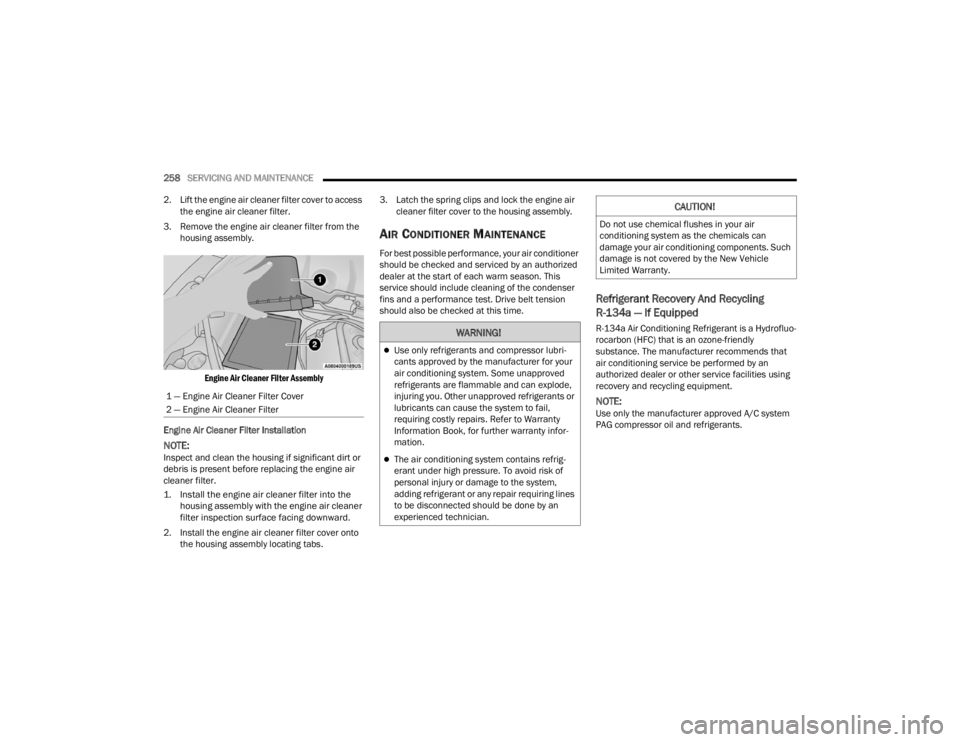
3. Remove the engine air cleaner filter from the housing assembly.
Engine Air Cleaner Filter Assembly
Engine Air Cleaner Filter Installation
NOTE:Inspect and clean the housing if significant dirt or
debris is present before replacing the engine air
cleaner filter.
1. Install the engine air cleaner filter into the housing assembly with the engine air cleaner
filter inspection surface facing downward.
2. Install the engine air cleaner filter cover onto the housing assembly locating tabs. 3. Latch the spring clips and lock the engine air
cleaner filter cover to the housing assembly.
AIR CONDITIONER MAINTENANCE
For best possible performance, your air conditioner
should be checked and serviced by an authorized
dealer at the start of each warm season. This
service should include cleaning of the condenser
fins and a performance test. Drive belt tension
should also be checked at this time.
Refrigerant Recovery And Recycling
R-134a — If Equipped
R-134a Air Conditioning Refrigerant is a Hydrofluo -
rocarbon (HFC) that is an ozone-friendly
substance. The manufacturer recommends that
air conditioning service be performed by an
authorized dealer or other service facilities using
recovery and recycling equipment.
NOTE:Use only the manufacturer approved A/C system
PAG compressor oil and refrigerants.
1 — Engine Air Cleaner Filter Cover
2 — Engine Air Cleaner Filter
WARNING!
Use only refrigerants and compressor lubri
-
cants approved by the manufacturer for your
air conditioning system. Some unapproved
refrigerants are flammable and can explode,
injuring you. Other unapproved refrigerants or
lubricants can cause the system to fail,
requiring costly repairs. Refer to Warranty
Information Book, for further warranty infor -
mation.
The air conditioning system contains refrig -
erant under high pressure. To avoid risk of
personal injury or damage to the system,
adding refrigerant or any repair requiring lines
to be disconnected should be done by an
experienced technician.
CAUTION!
Do not use chemical flushes in your air
conditioning system as the chemicals can
damage your air conditioning components. Such
damage is not covered by the New Vehicle
Limited Warranty.
23_WD_OM_EN_USC_t.book Page 258
Page 263 of 328
SERVICING AND MAINTENANCE261
Conditions that would require replacement:
Rib chunking (one or more ribs has separated
from belt body)
Rib or belt wear
Longitudinal belt cracking (cracks between two
ribs)
Belt slips
Groove jumping (belt does not maintain correct
position on pulley)
Belt broken (identify and correct problem before
new belt is installed)
Noise (objectionable squeal, squeak, or rumble
is heard or felt while drive belt is in operation)
Some conditions can be caused by a faulty
component such as a belt pulley. Belt pulleys
should be carefully inspected for damage and
proper alignment.
Belt replacement on some models requires the
use of special tools. We recommend having your
vehicle serviced at an authorized dealer.
BODY LUBRICATION
Locks and all body pivot points, including such
items as seat tracks, door hinge pivot points and
rollers, liftgate, tailgate, decklid, sliding doors and
hood hinges, should be lubricated periodically. Use
a lithium-based grease, such as Mopar® Spray
White Lube to ensure quiet, easy operation and to protect against rust and wear. Prior to the
application of any lubricant, the parts concerned
should be wiped clean to remove dust and grit;
after lubricating excess oil and grease should be
removed. Particular attention should also be given
to hood latching components to ensure proper
function. When performing other underhood
services, the hood latch, release mechanism and
safety catch should be cleaned and lubricated.
The external lock cylinders should be lubricated
twice a year, preferably in the Autumn and Spring.
Apply a small amount of a high quality lubricant,
such as Mopar® Lock Cylinder Lubricant directly
into the lock cylinder.
WINDSHIELD WIPER BLADES
Clean the rubber edges of the wiper blades and the
windshield periodically with a sponge or soft cloth
and a mild nonabrasive cleaner. This will remove
accumulations of salt or road film.
Operation of the wipers on dry glass for long
periods may cause deterioration of the wiper
blades. Always use washer fluid when using the
wipers to remove salt or dirt from a dry windshield.
Avoid using the wiper blades to remove frost or ice
from the windshield. Keep the blade rubber out of
contact with petroleum products such as engine
oil, gasoline, etc.
NOTE:Life expectancy of wiper blades varies depending
on geographical area and frequency of use. If chat
-
tering, marks, water lines or wet spots are present,
clean the wiper blades or replace as necessary.
The wiper blades and wiper arms should be
inspected periodically, not just when wiper
performance problems are experienced. This
inspection should include the following points:
Wear or uneven edges
Foreign material
Hardening or cracking
Deformation or fatigue
If a wiper blade or wiper arm is damaged, replace
the affected wiper arm or blade with a new unit. Do
not attempt to repair a wiper arm or blade that is
damaged.
Front Wiper Blade Removal/Installation
CAUTION!
Do not allow the wiper arm to spring back
against the glass without the wiper blade in
place or the glass may be damaged.
8
23_WD_OM_EN_USC_t.book Page 261
Page 266 of 328
264SERVICING AND MAINTENANCE
NOTE:Resistance will be accompanied by an audible
snap.
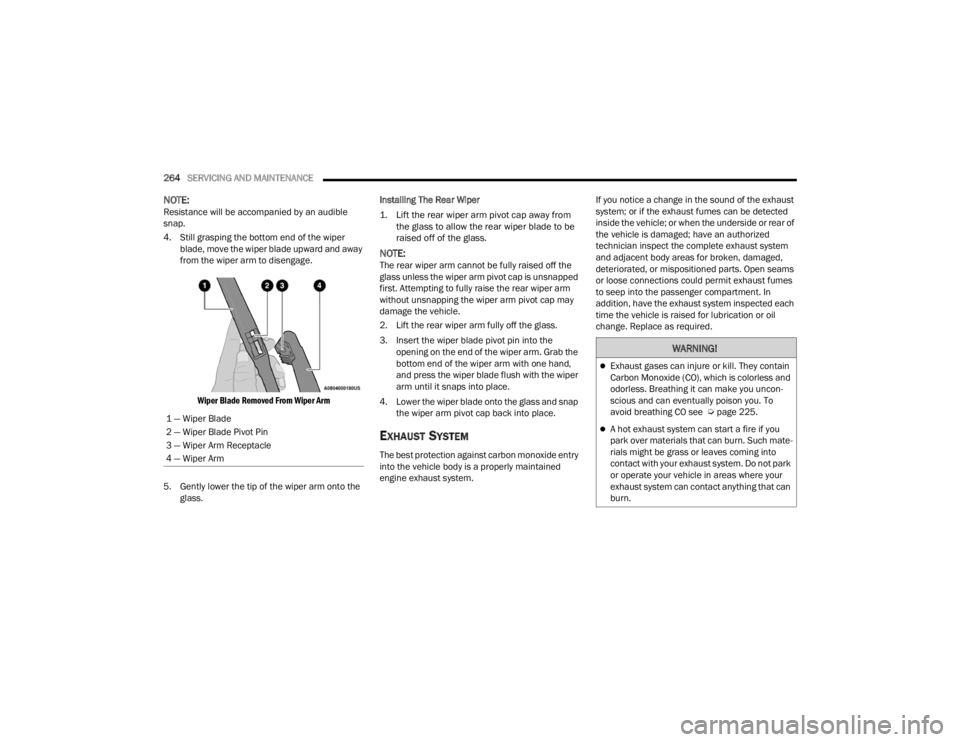
4. Still grasping the bottom end of the wiper
blade, move the wiper blade upward and away
from the wiper arm to disengage.
Wiper Blade Removed From Wiper Arm
5. Gently lower the tip of the wiper arm onto the glass. Installing The Rear Wiper
1. Lift the rear wiper arm pivot cap away from
the glass to allow the rear wiper blade to be
raised off of the glass.
NOTE:The rear wiper arm cannot be fully raised off the
glass unless the wiper arm pivot cap is unsnapped
first. Attempting to fully raise the rear wiper arm
without unsnapping the wiper arm pivot cap may
damage the vehicle.
2. Lift the rear wiper arm fully off the glass.
3. Insert the wiper blade pivot pin into the opening on the end of the wiper arm. Grab the
bottom end of the wiper arm with one hand,
and press the wiper blade flush with the wiper
arm until it snaps into place.
4. Lower the wiper blade onto the glass and snap the wiper arm pivot cap back into place.
EXHAUST SYSTEM
The best protection against carbon monoxide entry
into the vehicle body is a properly maintained
engine exhaust system. If you notice a change in the sound of the exhaust
system; or if the exhaust fumes can be detected
inside the vehicle; or when the underside or rear of
the vehicle is damaged; have an authorized
technician inspect the complete exhaust system
and adjacent body areas for broken, damaged,
deteriorated, or mispositioned parts. Open seams
or loose connections could permit exhaust fumes
to seep into the passenger compartment. In
addition, have the exhaust system inspected each
time the vehicle is raised for lubrication or oil
change. Replace as required.
1 — Wiper Blade
2 — Wiper Blade Pivot Pin
3 — Wiper Arm Receptacle
4 — Wiper Arm
WARNING!
Exhaust gases can injure or kill. They contain
Carbon Monoxide (CO), which is colorless and
odorless. Breathing it can make you uncon -
scious and can eventually poison you. To
avoid breathing CO see Ú page 225.
A hot exhaust system can start a fire if you
park over materials that can burn. Such mate -
rials might be grass or leaves coming into
contact with your exhaust system. Do not park
or operate your vehicle in areas where your
exhaust system can contact anything that can
burn.
23_WD_OM_EN_USC_t.book Page 264
Page 270 of 328
268SERVICING AND MAINTENANCE
(Continued)
Make sure that the coolant expansion bottle
overflow hoses are not kinked or obstructed.
Keep the front of the radiator clean. If your
vehicle is equipped with air conditioning, keep
the front of the condenser clean.
Do not change the thermostat for Summer or
Winter operation. If replacement is ever neces-
sary, install ONLY the correct type thermostat.
Other designs may result in unsatisfactory
engine cooling performance, poor gas mileage,
and increased emissions.
BRAKE SYSTEM
In order to ensure brake system performance, all
brake system components should be inspected
periodically. For the proper maintenance intervals
Ú page 250.
Fluid Level Check — Brake Master Cylinder
The fluid level of the master cylinder should be
checked whenever the vehicle is serviced, or
immediately if the Brake System Warning Light is
on. If necessary, add fluid to bring level within the
designated marks on the side of the reservoir of
the brake master cylinder. Be sure to clean the top
of the master cylinder area before removing cap.
With disc brakes, fluid level can be expected to fall
as the brake pads wear. Brake fluid level should be
checked when pads are replaced. If the brake fluid
is abnormally low, check the system for leaks. For
further information Ú page 307.
WARNING!
Riding the brakes can lead to brake failure and
possibly a collision. Driving with your foot resting
or riding on the brake pedal can result in
abnormally high brake temperatures, excessive
lining wear, and possible brake damage. You
would not have your full braking capacity in an
emergency.
WARNING!
Use only the manufacturer’s recommended
brake fluid Úpage 307. Using the wrong type
of brake fluid can severely damage your brake
system and/or impair its performance. The
proper type of brake fluid for your vehicle is
also identified on the original factory installed
hydraulic master cylinder reservoir.
To avoid contamination from foreign matter or
moisture, use only new brake fluid or fluid that
has been in a tightly closed container. Keep
the master cylinder reservoir cap secured at
all times. Brake fluid in an open container
absorbs moisture from the air resulting in a
lower boiling point. This may cause it to boil
unexpectedly during hard or prolonged
braking, resulting in sudden brake failure. This
could result in a collision.
Overfilling the brake fluid reservoir can result
in spilling brake fluid on hot engine parts,
causing the brake fluid to catch fire. Brake
fluid can also damage painted and vinyl
surfaces, care should be taken to avoid its
contact with these surfaces.
Do not allow petroleum based fluid to contam -
inate the brake fluid. Brake seal components
could be damaged, causing partial or
complete brake failure. This could result in a
collision.
WARNING!
23_WD_OM_EN_USC_t.book Page 268
Page 271 of 328
SERVICING AND MAINTENANCE269
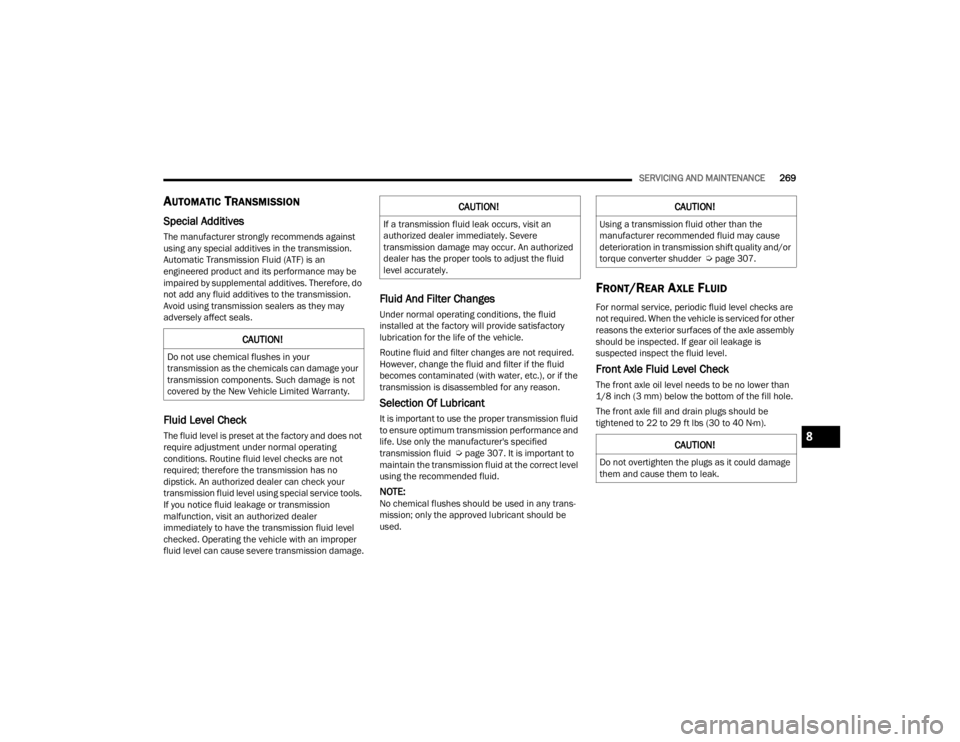
AUTOMATIC TRANSMISSION
Special Additives
The manufacturer strongly recommends against
using any special additives in the transmission.
Automatic Transmission Fluid (ATF) is an
engineered product and its performance may be
impaired by supplemental additives. Therefore, do
not add any fluid additives to the transmission.
Avoid using transmission sealers as they may
adversely affect seals.
Fluid Level Check
The fluid level is preset at the factory and does not
require adjustment under normal operating
conditions. Routine fluid level checks are not
required; therefore the transmission has no
dipstick. An authorized dealer can check your
transmission fluid level using special service tools.
If you notice fluid leakage or transmission
malfunction, visit an authorized dealer
immediately to have the transmission fluid level
checked. Operating the vehicle with an improper
fluid level can cause severe transmission damage.
Fluid And Filter Changes
Under normal operating conditions, the fluid
installed at the factory will provide satisfactory
lubrication for the life of the vehicle.
Routine fluid and filter changes are not required.
However, change the fluid and filter if the fluid
becomes contaminated (with water, etc.), or if the
transmission is disassembled for any reason.
Selection Of Lubricant
It is important to use the proper transmission fluid
to ensure optimum transmission performance and
life. Use only the manufacturer's specified
transmission fluid Úpage 307. It is important to
maintain the transmission fluid at the correct level
using the recommended fluid.
NOTE:No chemical flushes should be used in any trans -
mission; only the approved lubricant should be
used.
FRONT/REAR AXLE FLUID
For normal service, periodic fluid level checks are
not required. When the vehicle is serviced for other
reasons the exterior surfaces of the axle assembly
should be inspected. If gear oil leakage is
suspected inspect the fluid level.
Front Axle Fluid Level Check
The front axle oil level needs to be no lower than
1/8 inch (3 mm) below the bottom of the fill hole.
The front axle fill and drain plugs should be
tightened to 22 to 29 ft lbs (30 to 40 N·m).
CAUTION!
Do not use chemical flushes in your
transmission as the chemicals can damage your
transmission components. Such damage is not
covered by the New Vehicle Limited Warranty.
CAUTION!
If a transmission fluid leak occurs, visit an
authorized dealer immediately. Severe
transmission damage may occur. An authorized
dealer has the proper tools to adjust the fluid
level accurately.
CAUTION!
Using a transmission fluid other than the
manufacturer recommended fluid may cause
deterioration in transmission shift quality and/or
torque converter shudder Ú page 307.
CAUTION!
Do not overtighten the plugs as it could damage
them and cause them to leak.
8
23_WD_OM_EN_USC_t.book Page 269
Page 304 of 328
302
TECHNICAL SPECIFICATIONS
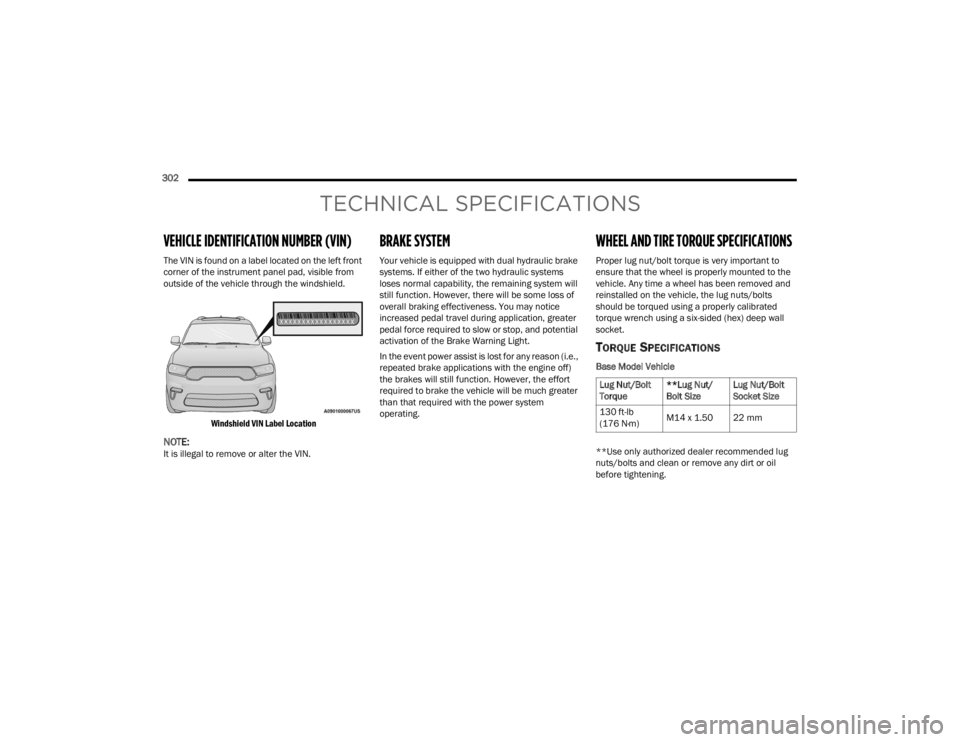
VEHICLE IDENTIFICATION NUMBER (VIN)
The VIN is found on a label located on the left front
corner of the instrument panel pad, visible from
outside of the vehicle through the windshield.
Windshield VIN Label Location
NOTE:It is illegal to remove or alter the VIN.
BRAKE SYSTEM
Your vehicle is equipped with dual hydraulic brake
systems. If either of the two hydraulic systems
loses normal capability, the remaining system will
still function. However, there will be some loss of
overall braking effectiveness. You may notice
increased pedal travel during application, greater
pedal force required to slow or stop, and potential
activation of the Brake Warning Light.
In the event power assist is lost for any reason (i.e.,
repeated brake applications with the engine off)
the brakes will still function. However, the effort
required to brake the vehicle will be much greater
than that required with the power system
operating.
WHEEL AND TIRE TORQUE SPECIFICATIONS
Proper lug nut/bolt torque is very important to
ensure that the wheel is properly mounted to the
vehicle. Any time a wheel has been removed and
reinstalled on the vehicle, the lug nuts/bolts
should be torqued using a properly calibrated
torque wrench using a six-sided (hex) deep wall
socket.
TORQUE SPECIFICATIONS
Base Model Vehicle
**Use only authorized dealer recommended lug
nuts/bolts and clean or remove any dirt or oil
before tightening.
Lug Nut/Bolt
Torque **Lug Nut/
Bolt SizeLug Nut/Bolt
Socket Size
130 ft-lb
(176 N·m) M14 x 1.50 22 mm
23_WD_OM_EN_USC_t.book Page 302
Page 308 of 328
306TECHNICAL SPECIFICATIONS
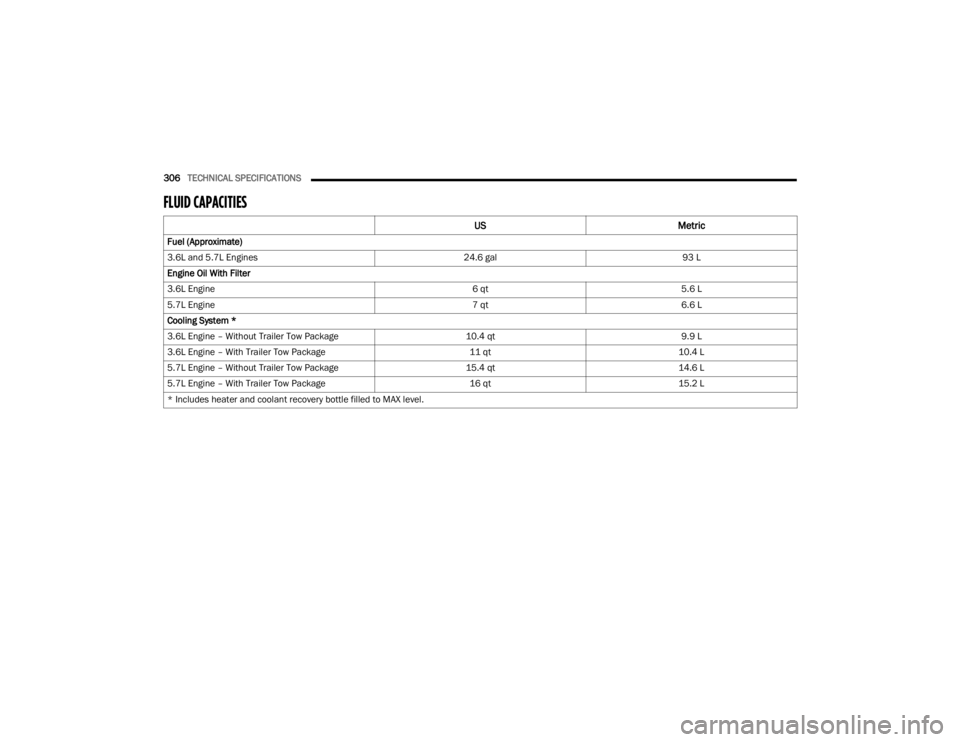
FLUID CAPACITIES
US Metric
Fuel (Approximate)
3.6L and 5.7L Engines 24.6 gal93 L
Engine Oil With Filter
3.6L Engine 6 qt5.6 L
5.7L Engine 7 qt6.6 L
Cooling System *
3.6L Engine – Without Trailer Tow Package 10.4 qt9.9 L
3.6L Engine – With Trailer Tow Package 11 qt10.4 L
5.7L Engine – Without Trailer Tow Package 15.4 qt14.6 L
5.7L Engine – With Trailer Tow Package 16 qt15.2 L
* Includes heater and coolant recovery bottle filled to MAX level.
23_WD_OM_EN_USC_t.book Page 306
Page 309 of 328
TECHNICAL SPECIFICATIONS307
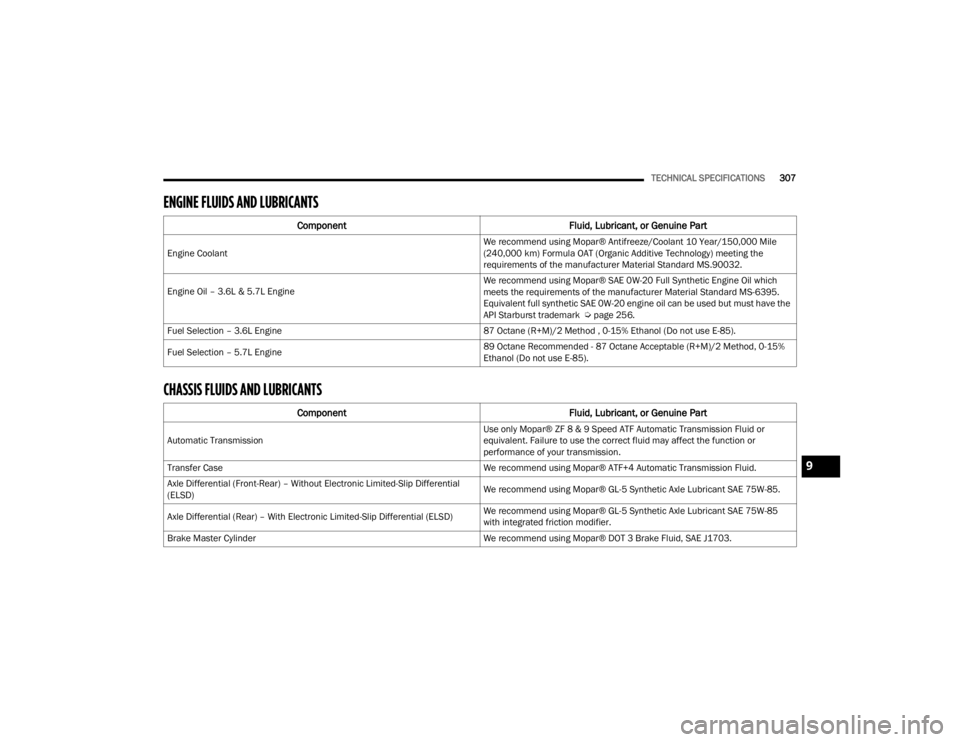
ENGINE FLUIDS AND LUBRICANTS
CHASSIS FLUIDS AND LUBRICANTS
Component Fluid, Lubricant, or Genuine Part
Engine Coolant We recommend using Mopar® Antifreeze/Coolant 10 Year/150,000 Mile
(240,000 km) Formula OAT (Organic Additive Technology) meeting the
requirements of the manufacturer Material Standard MS.90032.
Engine Oil – 3.6L & 5.7L Engine
We recommend using Mopar® SAE 0W-20 Full Synthetic Engine Oil which
meets the requirements of the manufacturer Material Standard MS-6395.
Equivalent full synthetic SAE 0W-20 engine oil can be used but must have the
API Starburst trademark Ú
page 256.
Fuel Selection – 3.6L Engine 87 Octane (R+M)/2 Method , 0-15% Ethanol (Do not use E-85).
Fuel Selection – 5.7L Engine 89 Octane Recommended - 87 Octane Acceptable (R+M)/2 Method, 0-15%
Ethanol (Do not use E-85).
Component
Fluid, Lubricant, or Genuine Part
Automatic Transmission Use only Mopar® ZF 8 & 9 Speed ATF Automatic Transmission Fluid or
equivalent. Failure to use the correct fluid may affect the function or
performance of your transmission.
Transfer Case We recommend using Mopar® ATF+4 Automatic Transmission Fluid.
Axle Differential (Front-Rear) – Without Electronic Limited-Slip Differential
(ELSD) We recommend using Mopar® GL-5 Synthetic Axle Lubricant SAE 75W-85.
Axle Differential (Rear) – With Electronic Limited-Slip Differential (ELSD) We recommend using Mopar® GL-5 Synthetic Axle Lubricant SAE 75W-85
with integrated friction modifier.
Brake Master Cylinder We recommend using Mopar® DOT 3 Brake Fluid, SAE J1703.
9
23_WD_OM_EN_USC_t.book Page 307
Page 316 of 328

314 Blind Spot Monitoring
.................................... 183Body Mechanism Lubrication........................ 261B-Pillar Location............................................. 286Brake Assist System...................................... 178Brake Control System, Electronic.................. 178Brake Fluid.......................................... 268, 307Brake System...................................... 268, 302Anti-Lock (ABS).......................................... 302Fluid Check............................................... 268Master Cylinder......................................... 268Parking...................................................... 102Warning Light.............................................. 88Brake/Transmission Interlock....................... 104Bulb Replacement............................... 278, 280Bulbs, Light.................................................... 227
C
Camera, Rear................................................ 134Capacities, Fluid............................................ 306Caps, Filler Oil (Engine)................................................ 253Radiator (Coolant Pressure)...................... 267Car Washes................................................... 299Carbon Monoxide Warning............................ 228Cargo Area Cover............................................. 73Cargo Compartment........................................ 73Light............................................................ 73Luggage Carrier........................................... 74Cargo Light...................................................... 73Cargo Tie-Downs.............................................. 74
Cellular Phone.............................................. 176Center High Mounted Stop Light................... 280Certification Label......................................... 136Chains, Tire................................................... 296Chart, Tire Sizing........................................... 282Check Engine Light
(Malfunction Indicator Light)............................ 96Checking Your Vehicle For Safety................. 225Checks, Safety.............................................. 225Child Restraint.............................................. 210Child RestraintsBooster Seats........................................... 213Child Seat Installation.............................. 222How To Stow An unused ALR Seat Belt.... 220Infant And Child Restraints....................... 212Locating The LATCH Anchorages.............. 217Lower Anchors And Tethers For Children.. 214Older Children And Child Restraints......... 212Seating Positions...................................... 214Child Safety Locks........................................... 25Clean Air Gasoline......................................... 304CleaningWheels..................................................... 295Climate Control................................................ 53Automatic.................................................... 53Cold Weather Operation............................... 101Compact Spare Tire...................................... 293Contract, Service.......................................... 310Cooling Pressure Cap (Radiator Cap)............ 267
Cooling System............................................. 265Adding Coolant (Antifreeze)...................... 266Cooling Capacity....................................... 306Disposal Of Used Coolant......................... 267Drain, Flush, And Refill............................. 266Inspection................................................. 266Points To Remember................................ 267Pressure Cap............................................ 267Radiator Cap............................................. 267Selection Of Coolant(Antifreeze)......................... 266, 306, 307Corrosion Protection..................................... 299Cruise Control (Speed Control)............. 115, 117Cruise Light............................................... 94, 95Customer Assistance.................................... 308Cybersecurity................................................ 153
D
Daytime Running Lights...................................46Defroster, Windshield................................... 226De-Icer, Remote Start......................................20Diagnostic System, Onboard............................96DipsticksOil (Engine)............................................... 255Disabled Vehicle Towing............................... 246DisposalAntifreeze (Engine Coolant)...................... 267Door Ajar...................................................89, 90Door Ajar Light..........................................89, 90
23_WD_OM_EN_USC_t.book Page 314
Page 317 of 328

315
Door Locks
............................................... 21, 25Child-Protection Door Lock — Rear Doors.... 25Doors............................................................... 21Driver’s Seat Back Tilt..................................... 28Driving........................................................... 150
E
Economy (Fuel) Mode.................................... 104Electric Brake Control System....................... 178Anti-Lock Brake System............................. 177Electronic Roll Mitigation................. 179, 182Electric Remote Mirrors................................... 41Electrical Outlet, Auxiliary (Power Outlet)......... 65Electronic Speed Control (Cruise Control)...... 116Electronic Stability Control (ESC)...................180Electronic Throttle Control Warning Light........ 89Electronically Shifted Transfer Case.... 108, 109Emergency Gas Can Refueling...................... 242Emergency, In Case Of Freeing Vehicle When Stuck...................... 245Hazard Warning Flasher............................ 229Jacking...................................................... 232Jump Starting............................................ 239Emission Control System Maintenance........... 96
Engine........................................................... 253Air Cleaner................................................ 257Break-In Recommendations..................... 101Checking Oil Level.................................... 255Compartment.................................. 253, 254Compartment Identification............. 253, 254Cooling..................................................... 265Exhaust Gas Caution................................ 228Fails To Start............................................ 101Flooded, Starting...................................... 101Fuel Requirements.......................... 303, 306Jump Starting........................................... 239Oil.................................................... 256, 306Oil Filler Cap............................................. 253Oil Filter.................................................... 257Oil Selection........................... 256, 306, 307Oil Synthetic............................................. 257Starting........................................................ 98Engine Oil Life Reset
b
.................................. 82
Enhanced Accident Response Feature...209, 248
Ethanol......................................................... 304Exhaust Gas Cautions................................... 228Exhaust System................................... 228, 264Exterior Lights............................... 45, 227, 278
F
FiltersAir Cleaner
................................................ 257Air Conditioning........................ 60, 257, 259Engine Oil................................................. 257Engine Oil Disposal................................... 257Flashers........................................................ 229Hazard Warning........................................ 229Turn Signals.............................. 95, 227, 280Flash-To-Pass...................................................47Flooded Engine Starting................................ 101Fluid Capacities............................................ 306Fluid Leaks.................................................... 228Fluid Level ChecksBrake........................................................ 268Engine Oil................................................. 255Fluids And Lubricants.................................... 307Fog Lights..................................................... 280Fog Lights, Service........................................ 280Fold-Flat Seats.................................................28Folding Rear Seats...........................................30Forward Collision Warning............................ 186Four-Way Hazard Flasher.............................. 229Freeing A Stuck Vehicle................................. 245Front Axle (Differential)................................. 269
11
23_WD_OM_EN_USC_t.book Page 315