roof DODGE DURANGO SRT 2018 User Guide
[x] Cancel search | Manufacturer: DODGE, Model Year: 2018, Model line: DURANGO SRT, Model: DODGE DURANGO SRT 2018Pages: 568, PDF Size: 6.54 MB
Page 130 of 568
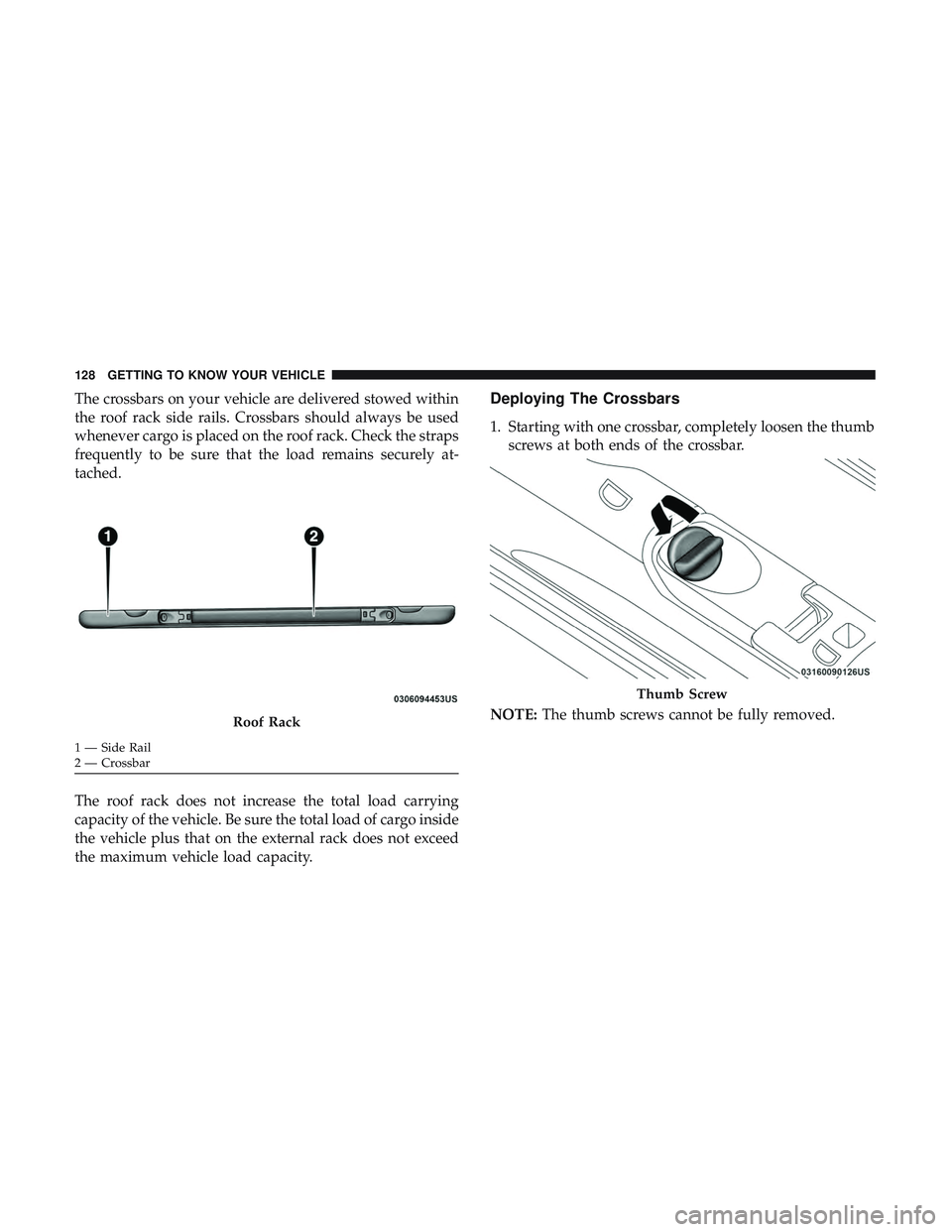
The crossbars on your vehicle are delivered stowed within
the roof rack side rails. Crossbars should always be used
whenever cargo is placed on the roof rack. Check the straps
frequently to be sure that the load remains securely at-
tached.
The roof rack does not increase the total load carrying
capacity of the vehicle. Be sure the total load of cargo inside
the vehicle plus that on the external rack does not exceed
the maximum vehicle load capacity.Deploying The Crossbars
1. Starting with one crossbar, completely loosen the thumbscrews at both ends of the crossbar.
NOTE: The thumb screws cannot be fully removed.
Roof Rack
1 — Side Rail
2 — Crossbar
Thumb Screw
128 GETTING TO KNOW YOUR VEHICLE
Page 131 of 568
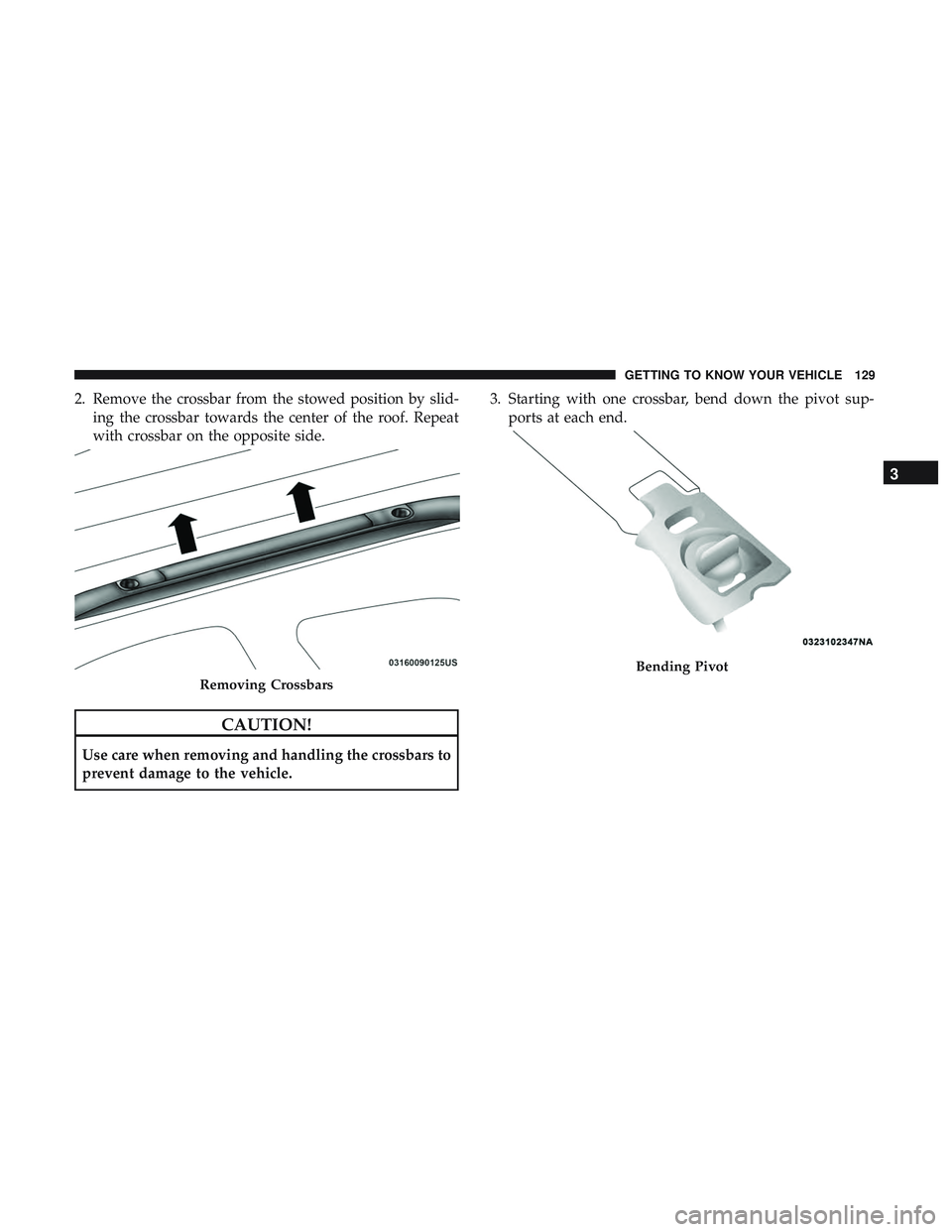
2. Remove the crossbar from the stowed position by slid-ing the crossbar towards the center of the roof. Repeat
with crossbar on the opposite side.
CAUTION!
Use care when removing and handling the crossbars to
prevent damage to the vehicle. 3. Starting with one crossbar, bend down the pivot sup-
ports at each end.
Removing Crossbars
Bending Pivot
3
GETTING TO KNOW YOUR VEHICLE 129
Page 132 of 568
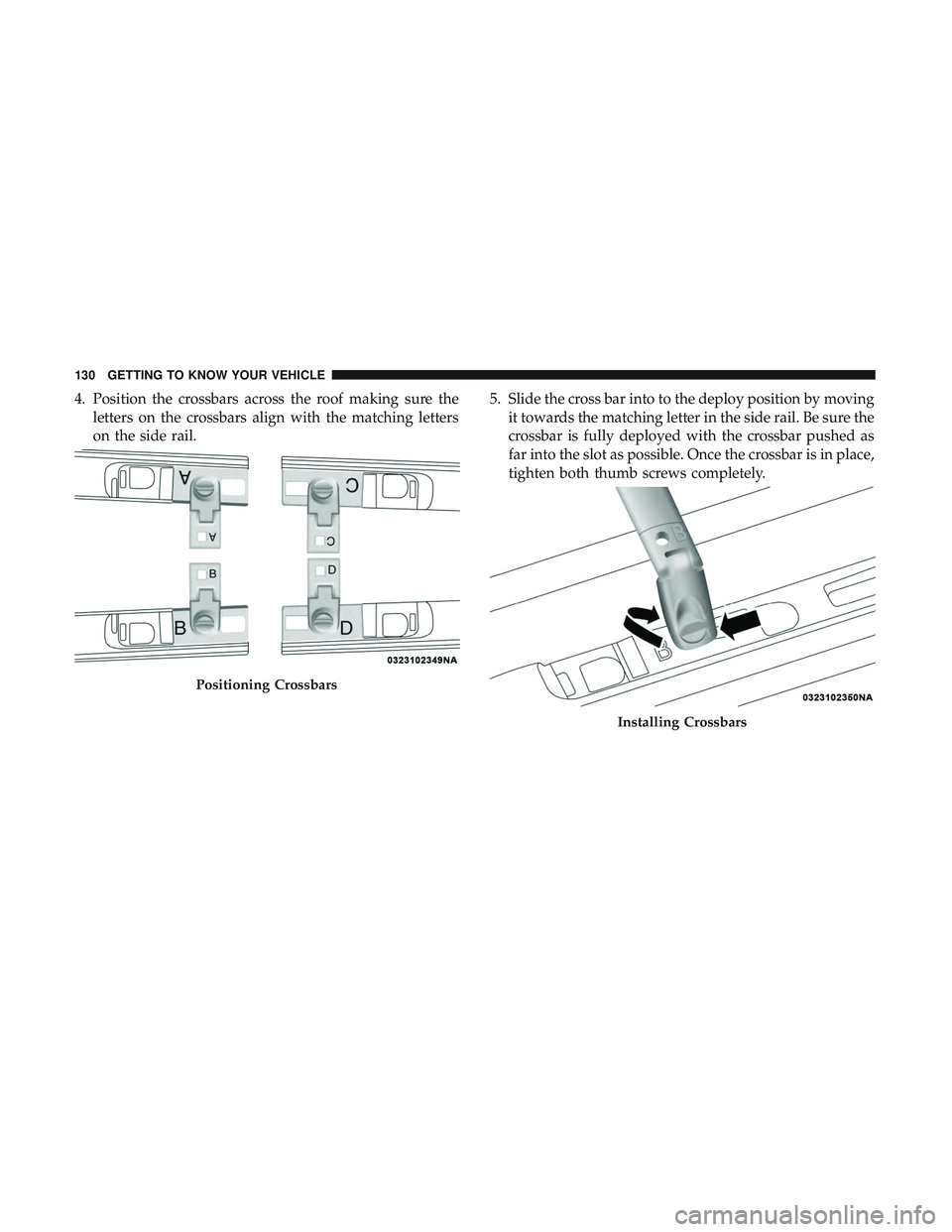
4. Position the crossbars across the roof making sure theletters on the crossbars align with the matching letters
on the side rail. 5. Slide the cross bar into to the deploy position by moving
it towards the matching letter in the side rail. Be sure the
crossbar is fully deployed with the crossbar pushed as
far into the slot as possible. Once the crossbar is in place,
tighten both thumb screws completely.
Positioning Crossbars
Installing Crossbars
130 GETTING TO KNOW YOUR VEHICLE
Page 134 of 568
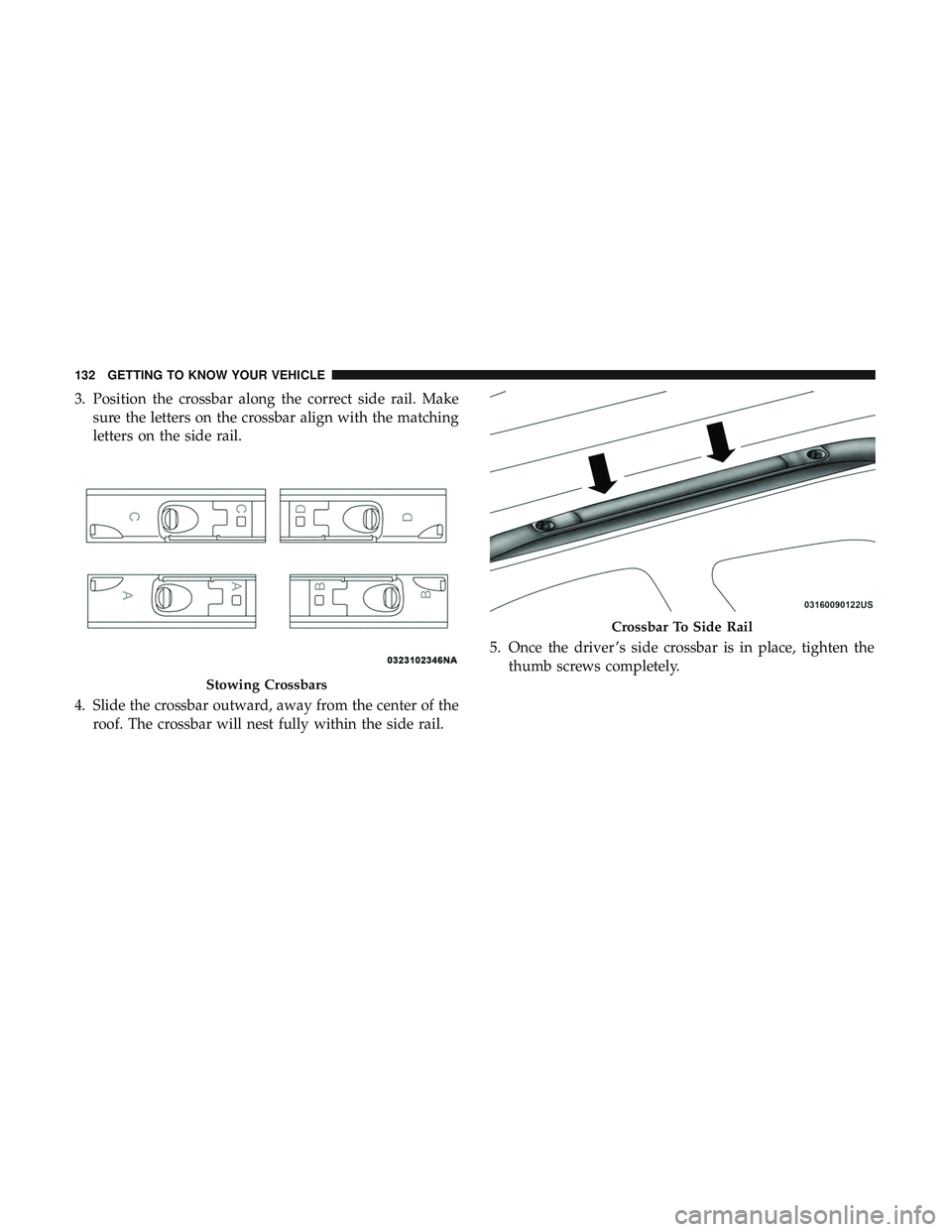
3. Position the crossbar along the correct side rail. Makesure the letters on the crossbar align with the matching
letters on the side rail.
4. Slide the crossbar outward, away from the center of the roof. The crossbar will nest fully within the side rail. 5. Once the driver ’s side crossbar is in place, tighten the
thumb screws completely.
Stowing Crossbars
Crossbar To Side Rail
132 GETTING TO KNOW YOUR VEHICLE
Page 136 of 568
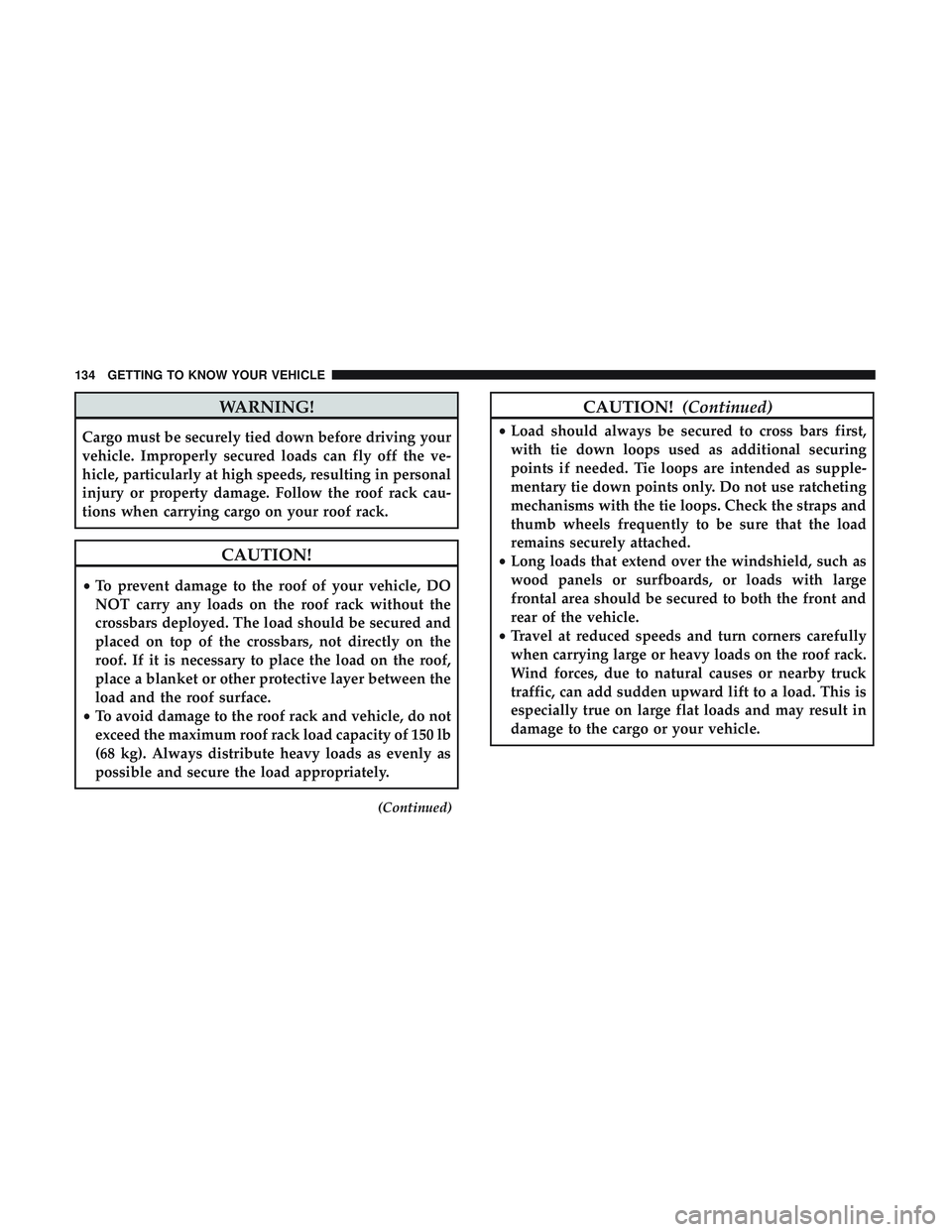
WARNING!
Cargo must be securely tied down before driving your
vehicle. Improperly secured loads can fly off the ve-
hicle, particularly at high speeds, resulting in personal
injury or property damage. Follow the roof rack cau-
tions when carrying cargo on your roof rack.
CAUTION!
•To prevent damage to the roof of your vehicle, DO
NOT carry any loads on the roof rack without the
crossbars deployed. The load should be secured and
placed on top of the crossbars, not directly on the
roof. If it is necessary to place the load on the roof,
place a blanket or other protective layer between the
load and the roof surface.
• To avoid damage to the roof rack and vehicle, do not
exceed the maximum roof rack load capacity of 150 lb
(68 kg). Always distribute heavy loads as evenly as
possible and secure the load appropriately.
(Continued)
CAUTION! (Continued)
•Load should always be secured to cross bars first,
with tie down loops used as additional securing
points if needed. Tie loops are intended as supple-
mentary tie down points only. Do not use ratcheting
mechanisms with the tie loops. Check the straps and
thumb wheels frequently to be sure that the load
remains securely attached.
• Long loads that extend over the windshield, such as
wood panels or surfboards, or loads with large
frontal area should be secured to both the front and
rear of the vehicle.
• Travel at reduced speeds and turn corners carefully
when carrying large or heavy loads on the roof rack.
Wind forces, due to natural causes or nearby truck
traffic, can add sudden upward lift to a load. This is
especially true on large flat loads and may result in
damage to the cargo or your vehicle.
134 GETTING TO KNOW YOUR VEHICLE
Page 220 of 568
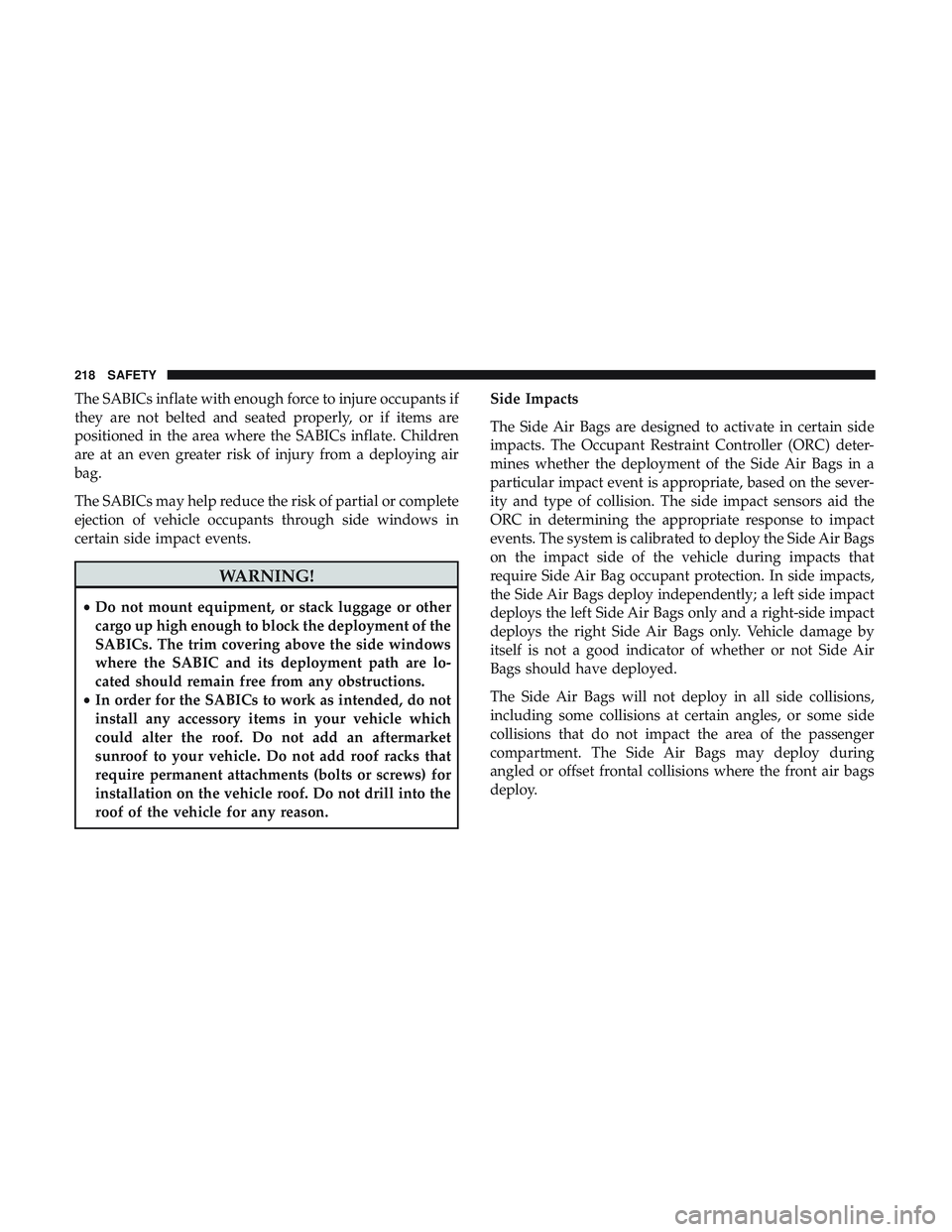
The SABICs inflate with enough force to injure occupants if
they are not belted and seated properly, or if items are
positioned in the area where the SABICs inflate. Children
are at an even greater risk of injury from a deploying air
bag.
The SABICs may help reduce the risk of partial or complete
ejection of vehicle occupants through side windows in
certain side impact events.
WARNING!
•Do not mount equipment, or stack luggage or other
cargo up high enough to block the deployment of the
SABICs. The trim covering above the side windows
where the SABIC and its deployment path are lo-
cated should remain free from any obstructions.
• In order for the SABICs to work as intended, do not
install any accessory items in your vehicle which
could alter the roof. Do not add an aftermarket
sunroof to your vehicle. Do not add roof racks that
require permanent attachments (bolts or screws) for
installation on the vehicle roof. Do not drill into the
roof of the vehicle for any reason. Side Impacts
The Side Air Bags are designed to activate in certain side
impacts. The Occupant Restraint Controller (ORC) deter-
mines whether the deployment of the Side Air Bags in a
particular impact event is appropriate, based on the sever-
ity and type of collision. The side impact sensors aid the
ORC in determining the appropriate response to impact
events. The system is calibrated to deploy the Side Air Bags
on the impact side of the vehicle during impacts that
require Side Air Bag occupant protection. In side impacts,
the Side Air Bags deploy independently; a left side impact
deploys the left Side Air Bags only and a right-side impact
deploys the right Side Air Bags only. Vehicle damage by
itself is not a good indicator of whether or not Side Air
Bags should have deployed.
The Side Air Bags will not deploy in all side collisions,
including some collisions at certain angles, or some side
collisions that do not impact the area of the passenger
compartment. The Side Air Bags may deploy during
angled or offset frontal collisions where the front air bags
deploy.
218 SAFETY
Page 367 of 568
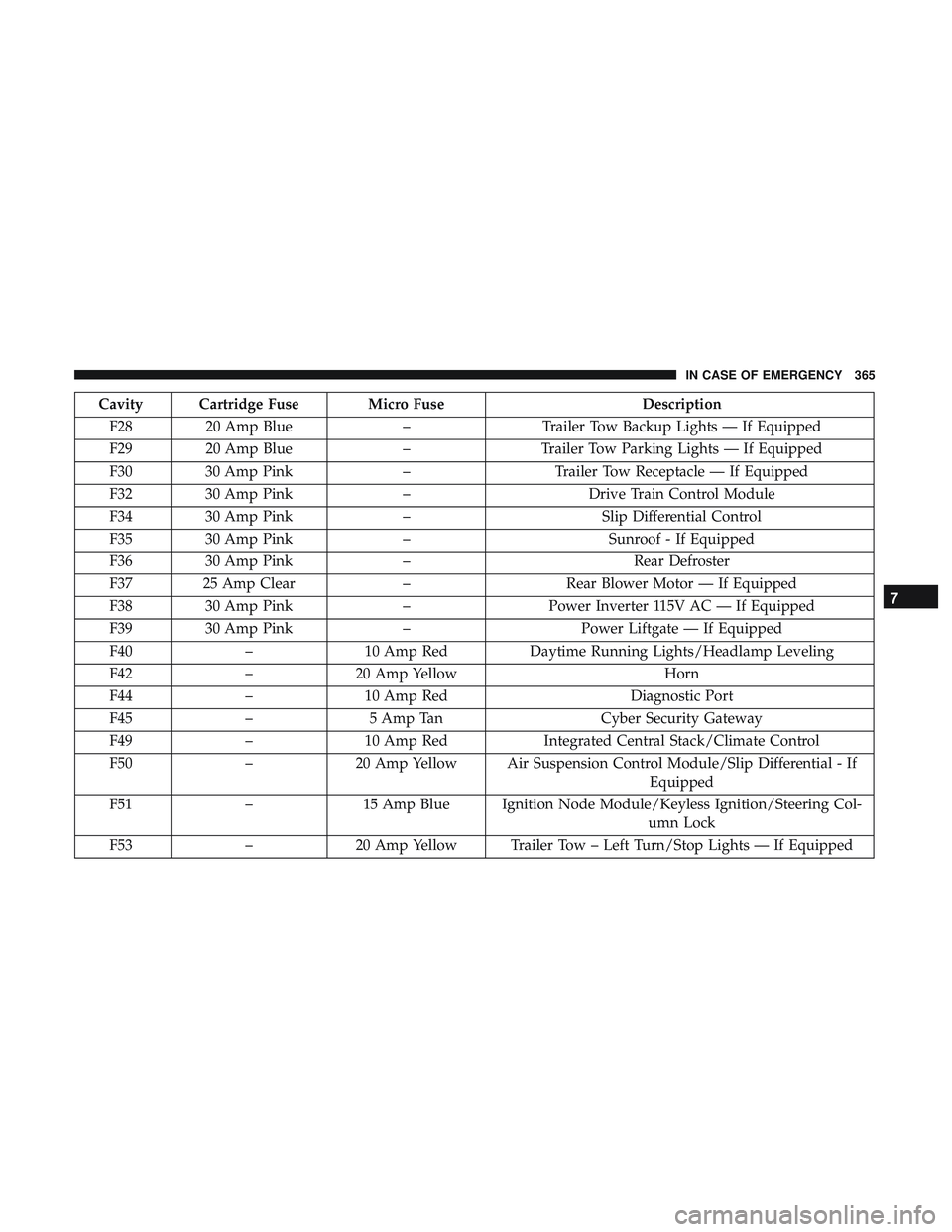
Cavity Cartridge Fuse Micro FuseDescription
F28 20 Amp Blue –Trailer Tow Backup Lights — If Equipped
F29 20 Amp Blue –Trailer Tow Parking Lights — If Equipped
F30 30 Amp Pink –Trailer Tow Receptacle — If Equipped
F32 30 Amp Pink –Drive Train Control Module
F34 30 Amp Pink –Slip Differential Control
F35 30 Amp Pink –Sunroof - If Equipped
F36 30 Amp Pink –Rear Defroster
F37 25 Amp Clear –Rear Blower Motor — If Equipped
F38 30 Amp Pink –Power Inverter 115V AC — If Equipped
F39 30 Amp Pink –Power Liftgate — If Equipped
F40 –10 Amp Red Daytime Running Lights/Headlamp Leveling
F42 –20 Amp Yellow Horn
F44 –10 Amp Red Diagnostic Port
F45 –5 Amp Tan Cyber Security Gateway
F49 –10 Amp Red Integrated Central Stack/Climate Control
F50 –20 Amp Yellow Air Suspension Control Module/Slip Differential - If
Equipped
F51 –15 Amp Blue Ignition Node Module/Keyless Ignition/Steering Col-
umn Lock
F53 –20 Amp Yellow Trailer Tow – Left Turn/Stop Lights — If Equipped
7
IN CASE OF EMERGENCY 365
Page 368 of 568
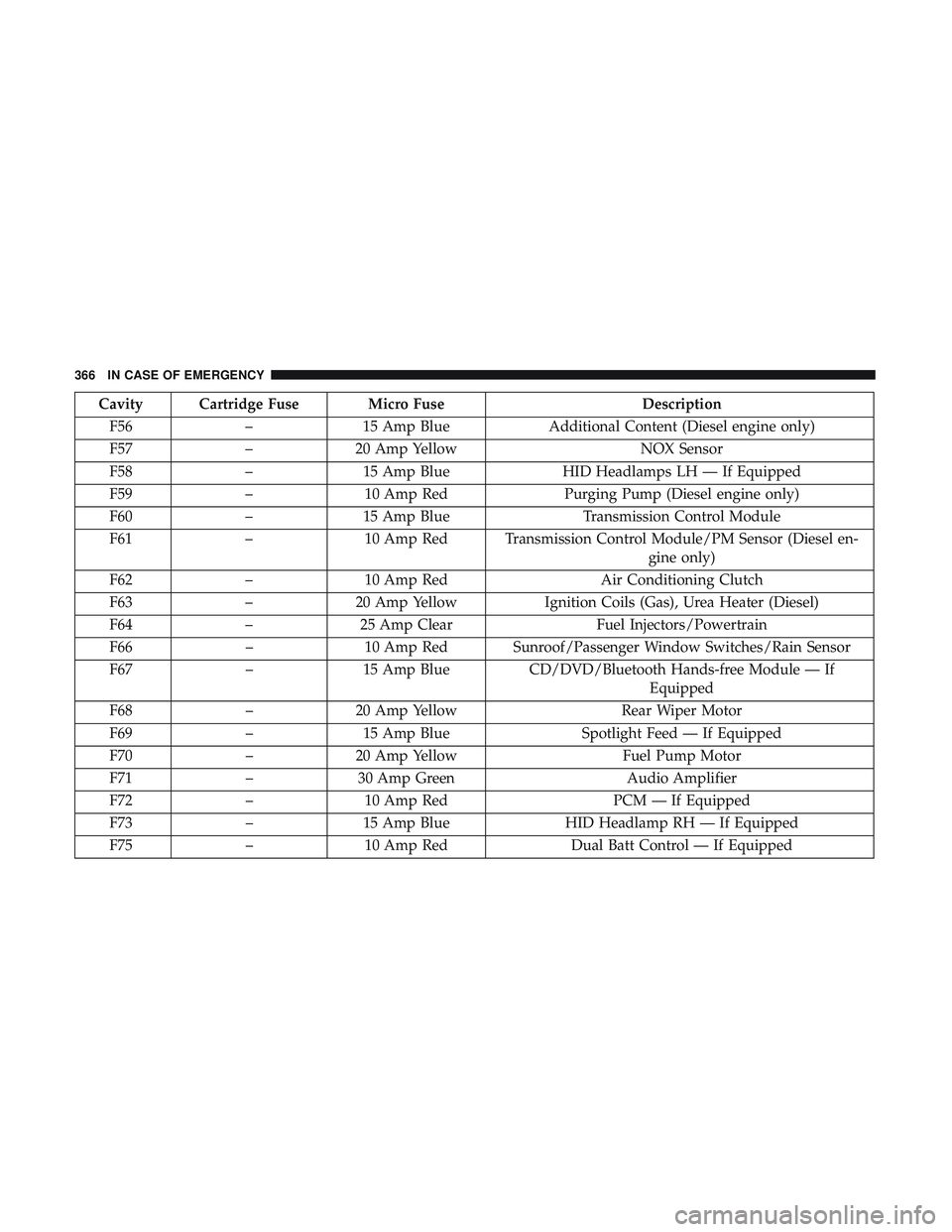
Cavity Cartridge Fuse Micro FuseDescription
F56 –15 Amp Blue Additional Content (Diesel engine only)
F57 –20 Amp Yellow NOX Sensor
F58 –15 Amp Blue HID Headlamps LH — If Equipped
F59 –10 Amp Red Purging Pump (Diesel engine only)
F60 –15 Amp Blue Transmission Control Module
F61 –10 Amp Red Transmission Control Module/PM Sensor (Diesel en-
gine only)
F62 –10 Amp Red Air Conditioning Clutch
F63 –20 Amp Yellow Ignition Coils (Gas), Urea Heater (Diesel)
F64 –25 Amp Clear Fuel Injectors/Powertrain
F66 –10 Amp Red Sunroof/Passenger Window Switches/Rain Sensor
F67 –15 Amp Blue CD/DVD/Bluetooth Hands-free Module — If
Equipped
F68 –20 Amp Yellow Rear Wiper Motor
F69 –15 Amp Blue Spotlight Feed — If Equipped
F70 –20 Amp Yellow Fuel Pump Motor
F71 –30 Amp Green Audio Amplifier
F72 –10 Amp Red PCM — If Equipped
F73 –15 Amp Blue HID Headlamp RH — If Equipped
F75 –10 Amp Red Dual Batt Control — If Equipped
366 IN CASE OF EMERGENCY
Page 480 of 568
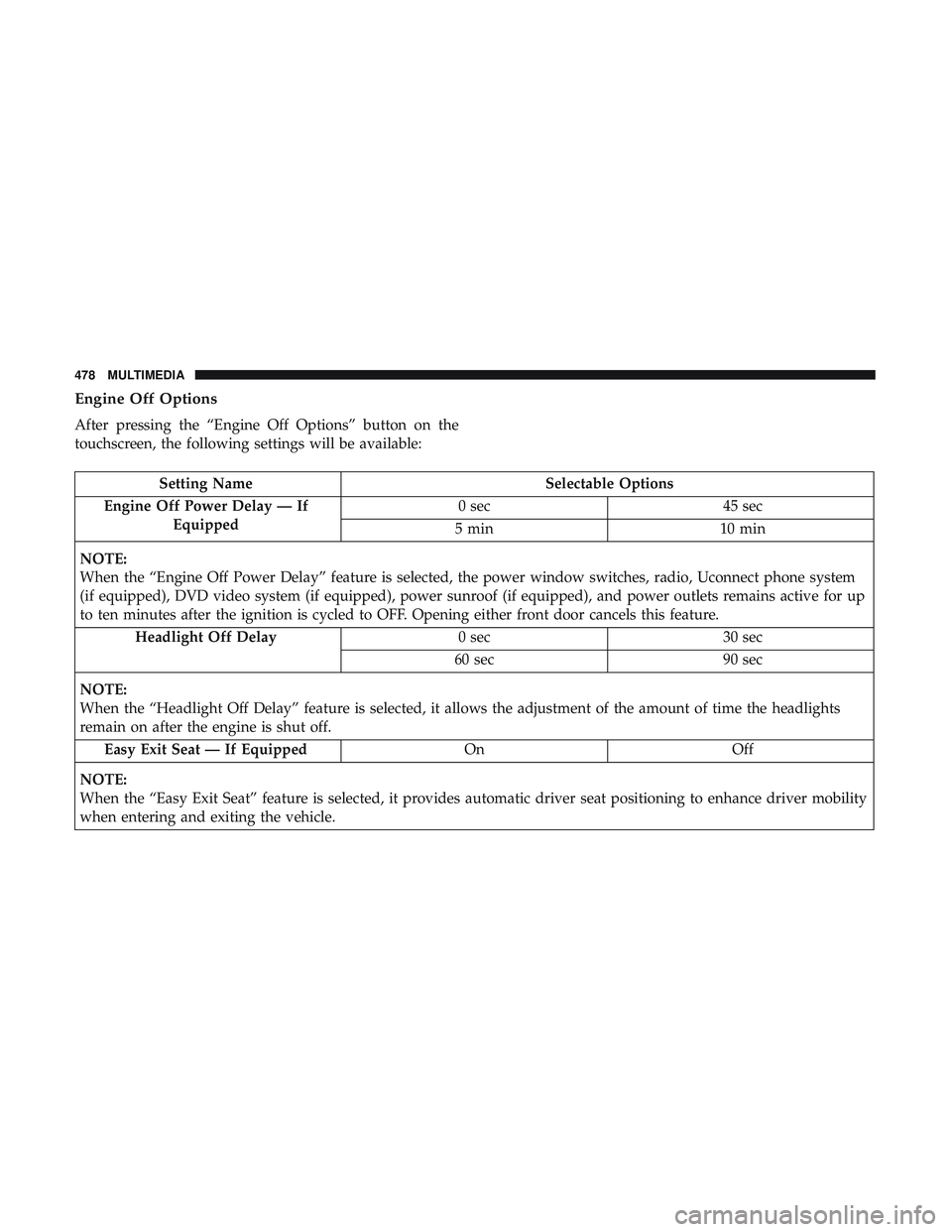
Engine Off Options
After pressing the “Engine Off Options” button on the
touchscreen, the following settings will be available:
Setting NameSelectable Options
Engine Off Power Delay — If Equipped 0 sec
45 sec
5 min 10 min
NOTE:
When the “Engine Off Power Delay” feature is selected, the power window switches, radio, Uconnect phone system
(if equipped), DVD video system (if equipped), power sunroof (if equipped), and power outlets remains active for up
to ten minutes after the ignition is cycled to OFF. Opening either front door cancels this feature. Headlight Off Delay 0 sec30 sec
60 sec 90 sec
NOTE:
When the “Headlight Off Delay” feature is selected, it allows the adjustment of the amount of time the headlights
remain on after the engine is shut off. Easy Exit Seat — If Equipped OnOff
NOTE:
When the “Easy Exit Seat” feature is selected, it provides automatic driver seat positioning to enhance driver mobility
when entering and exiting the vehicle.
478 MULTIMEDIA
Page 561 of 568
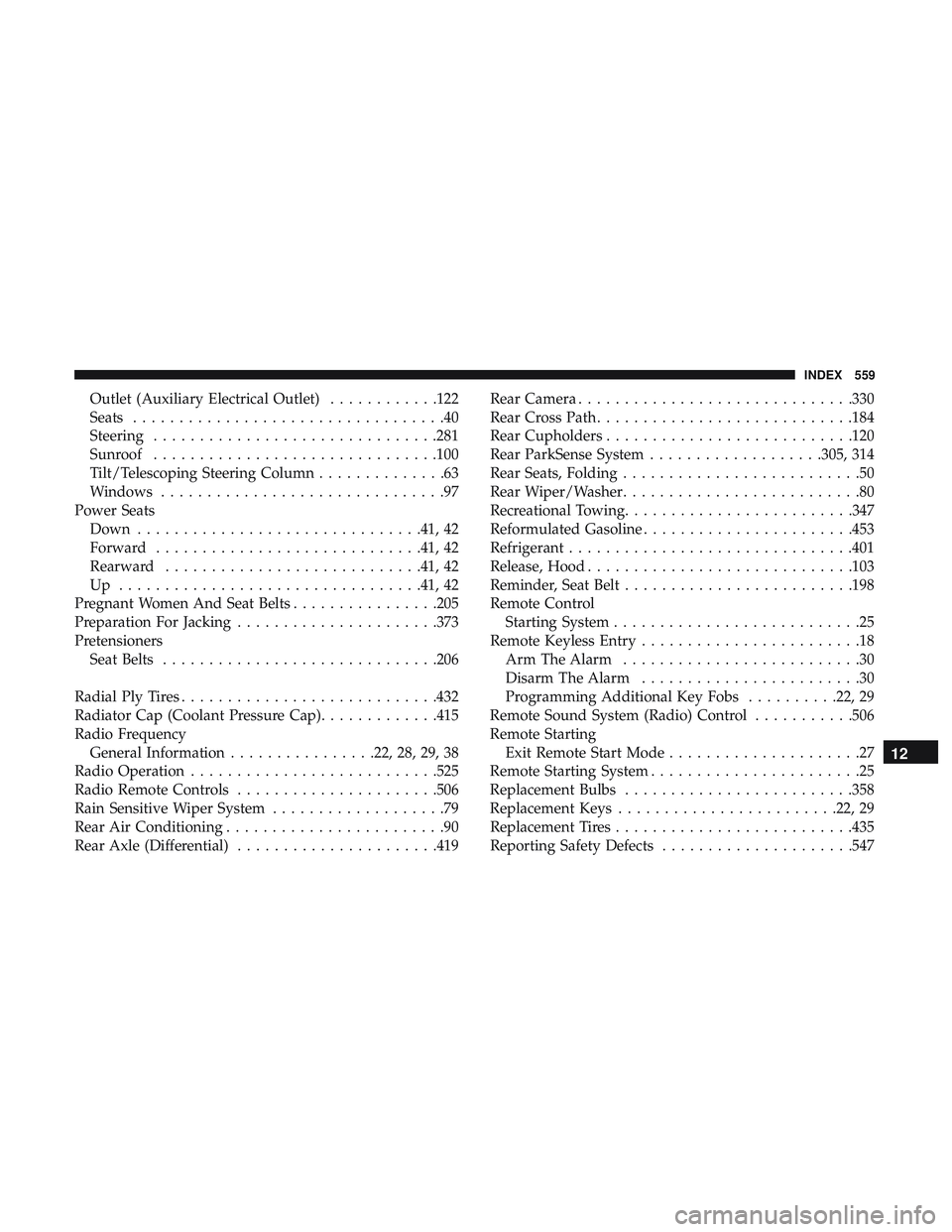
Outlet (Auxiliary Electrical Outlet)............122
Seats ..................................40
Steering ...............................281
Sunroof ...............................100
Tilt/Telescoping Steering Column ..............63
Windows ...............................97
Power Seats Down ...............................41, 42
Forward ............................ .41, 42
Rearward ............................41, 42
Up .................................41, 42
Pregnant Women And Seat Belts ................205
Preparation For Jacking ..................... .373
Pretensioners Seat Belts ............................. .206
Radial Ply Tires ............................432
Radiator Cap (Coolant Pressure Cap) .............415
Radio Frequency General Information ................22, 28, 29, 38
Radio Operation .......................... .525
Radio Remote Controls ..................... .506
Rain Sensitive Wiper System ...................79
Rear Air Conditioning ........................90
Rear Axle (Differential) ..................... .419Rear Camera
............................. .330
Rear Cross Path ............................184
Rear Cupholders .......................... .120
Rear ParkSense System ...................305, 314
Rear Seats, Folding ..........................50
Rear Wiper/Washer ..........................80
Recreational Towing ........................ .347
Reformulated Gasoline .......................453
Refrigerant ...............................401
Release, Hood ............................ .103
Reminder, Seat Belt ........................ .198
Remote Control Starting System ...........................25
Remote Keyless Entry ........................18
Arm The Alarm ..........................30
Disarm The Alarm ........................30
Programming Additional Key Fobs ..........22,29
Remote
Sound System (Radio) Control ...........506
Remote Starting Exit Remote Start Mode .....................27
Remote Starting System .......................25
Replacement Bulbs ........................ .358
Replacement Keys ........................22, 29
Replacement Tires ..........................435
Reporting Safety Defects .....................547
12
INDEX 559