check light DODGE GRAND CARAVAN 2004 User Guide
[x] Cancel search | Manufacturer: DODGE, Model Year: 2004, Model line: GRAND CARAVAN, Model: DODGE GRAND CARAVAN 2004Pages: 397, PDF Size: 7.59 MB
Page 204 of 397
² If your air conditioning performance seems lower than
expected, check the A/C air filter and the front of the
A/C condenser for an accumulation of dirt or insects.
The A/C condenser is located in front of the radiator.
The A/C air filter is located under the instrument
panel on the passenger side.
² Fabric type fascia protectors tend to block the amount
of air to the condenser and may reduce air condition-
ing performance.
Economy Mode
If economy mode is desired, press the A/C button to turn
off the indicator light, and the A/C compressor. Move the
temperature control lever to the desired temperature.
Recirculation Control
Press the recirculation button to recirculate the
air inside the vehicle. This is located next to the
A/C button. An indicator light on the button
shows that air is being recirculated. Use the recirculation mode to rapidly cool the inside of the
vehicle. The recirculation mode can also be used to
temporarily block out outside odors, smoke, and dust.
NOTE:
² When the ignition switch is turned OFF, the recircula-
tion feature will be cancelled.
² In cold weather, use of the Recirculation mode may
lead to excessive window fogging. The Recirculation
mode is not allowed in the Mix and Defrost modes to
improve window clearing operation. Recirculation
will be disabled automatically if these modes are
selected.
² If the recirculation button is pressed while in the Mix
or Defrost mode, the indicator light in the recirculation
button will flash 3 times indicating that recirculation is
not allowed.204 UNDERSTANDING YOUR INSTRUMENT PANEL
Page 221 of 397
Rear Washer Operation Ð Automatic
Temperature Control Only
Press and hold the button as long as spray is
desired. If the switch is depressed while the wipers
are on, the wipers will operate for a few seconds
after the switch is released then resume the previously set
mode of intermittent wiper or continuous wipe. If the
switch is depressed when the wipers are off, the wipers
will operate for two cycles, then turn off.
NOTE: The washers will stop spraying if the switch is
pressed longer than 10 seconds.
Adding Washer Fluid
The fluid reservoir for the windshield washers and the
rear window washer is shared. It is located in the front of
the engine compartment on the passenger side and
should be checked for fluid level at regular intervals. Fill the reservoir with windshield washer solvent (not radia-
tor antifreeze) and operate the system for a few seconds
to flush out the residual water.
The washer fluid reservoir will hold a full gallon of fluid
when the Low Washer Fluid Light illuminates. UNDERSTANDING YOUR INSTRUMENT PANEL 221
4
Page 238 of 397
The ABS light monitors the Anti-Lock Brake Sys-
tem. The light will come on when the ignition
switch is turned to the ON position and may stay on for
as long as four seconds.
If the ABS light remains on or comes on while driving, it
indicates that the Anti-Lock portion of the brake system
is not functioning and that service is required. However,
the conventional brake system will continue to operate
normally if the BRAKE warning light is not on.
If the ABS light is on, the brake system should be serviced
as soon as possible to restore the benefits of Anti-Lock
brakes. If the ABS light does not come on when the
Ignition switch is turned to the ON position, have the
bulb repaired as soon as possible.
If both the Brake Warning Light and the ABS Light
remain on, the Anti-Lock brakes (ABS) and Electronic
Brake Force Distribution (EBD) systems are not function-
ing. Immediate repair to the ABS system is required. When the vehicle is driven over approximately 15 mph
(25 km/h), you may also hear a slight clicking sound as
well as some related motor noises. These noises are the
system performing its self check cycle to ensure that the
ABS system is working properly. This self check occurs
each time the vehicle is started and accelerated past
approximately 15 mph (25 km/h).
ABS is activated during braking under certain road or
stopping conditions. ABS-inducing conditions can in-
clude ice, snow, gravel, bumps, railroad tracks, loose
debris, or panic stops.
You also may experience the following when the brake
system goes into Anti-lock:
² The ABS motor running (it may continue to run for a
short time after the stop),
² the clicking sound of solenoid valves,
² brake pedal pulsations,238 STARTING AND OPERATING
Page 276 of 397
² The trailer tongue load must be considered as part of
the combined weight of occupants and cargo, and
should never exceed the weight referenced on the Tire
and Loading Information placard. Refer to the Tire±
Safety Information Section in this manual.
² The ªDº range can be selected when towing. However,
if frequent shifting occurs while in this range, the ª3º
range must be selected.
NOTE: Using the ª3º range while operating the vehicle
under heavy operating conditions will improve perfor-
mance and extend transaxle life by reducing excessive
shifting and heat build up.
WARNING!Connecting trailer brakes to your vehicle's hydraulic
brake lines can overload your brake system and
cause it to fail. You might not have brakes when you
need them and could have an accident. ² Do not attempt to tow a trailer while using a compact
spare tire.
² Whenever you pull a trailer, regardless of the trailer
size, stop lights and turn signals on the trailer are
recommended for motoring safety.
² The automatic transaxle fluid and filter should be
changed if you REGULARLY tow a trailer for more
than 45 minutes of continuous operation. See Schedule
ªBº in section 8 of this manual for transaxle fluid
change intervals.
NOTE: Check the automatic transaxle fluid level before
towing. Fluid discoloration, or a burnt odor, shows the
need for a transmission fluid and filter change.276 STARTING AND OPERATING
Page 296 of 397
N Front Suspension Ball Joints ..............314
N Steering Shaft Seal ....................314
N Steering Linkage ......................315
N Drive Shaft Universal Joints ..............315
N Body Lubrication .....................315
N Windshield Wiper Blades ................316
N Windshield And Rear Window Washers .....316
N Exhaust System ......................317
N Cooling System .......................318
N Hoses And Vacuum/Vapor Harnesses .......322
N Brakes .............................323
N Master Cylinder Ð ABS Brakes Brake Fluid
Level Check .........................324 N Fuel System Hoses ....................326
N Automatic Transmission ................326
N All Wheel Drive (AWD) .................329
N Front And Rear Wheel Bearings ...........330
N Appearance Care And Protection From
Corrosion ...........................330
N Cleaning The Instrument Panel And
Underseat Cup Holders .................334
m Integrated Power Module (IPM) ............336
m Vehicle Storage ........................337
m Replacement Light Bulbs .................338
m Bulb Replacement ......................339
N Headlights ..........................339296 MAINTAINING YOUR VEHICLE
Page 316 of 397
Windshield Wiper Blades
The rubber edges of the wiper blades and the windshield
should be cleaned periodically with a sponge or soft cloth
and a mild nonabrasive cleaner. This will remove accu-
mulations of salt or road film.
Operation of the wipers on dry glass for long periods
may cause deterioration of the wiper blades. Always use
washer fluid when using the wipers to remove salt or dirt
from a dry windshield.
Avoid using the wiper blades to remove frost or ice from
the windshield. Keep the blade rubber out of contact with
petroleum products such as engine oil, gasoline, etc.
Windshield and Rear Window Washers
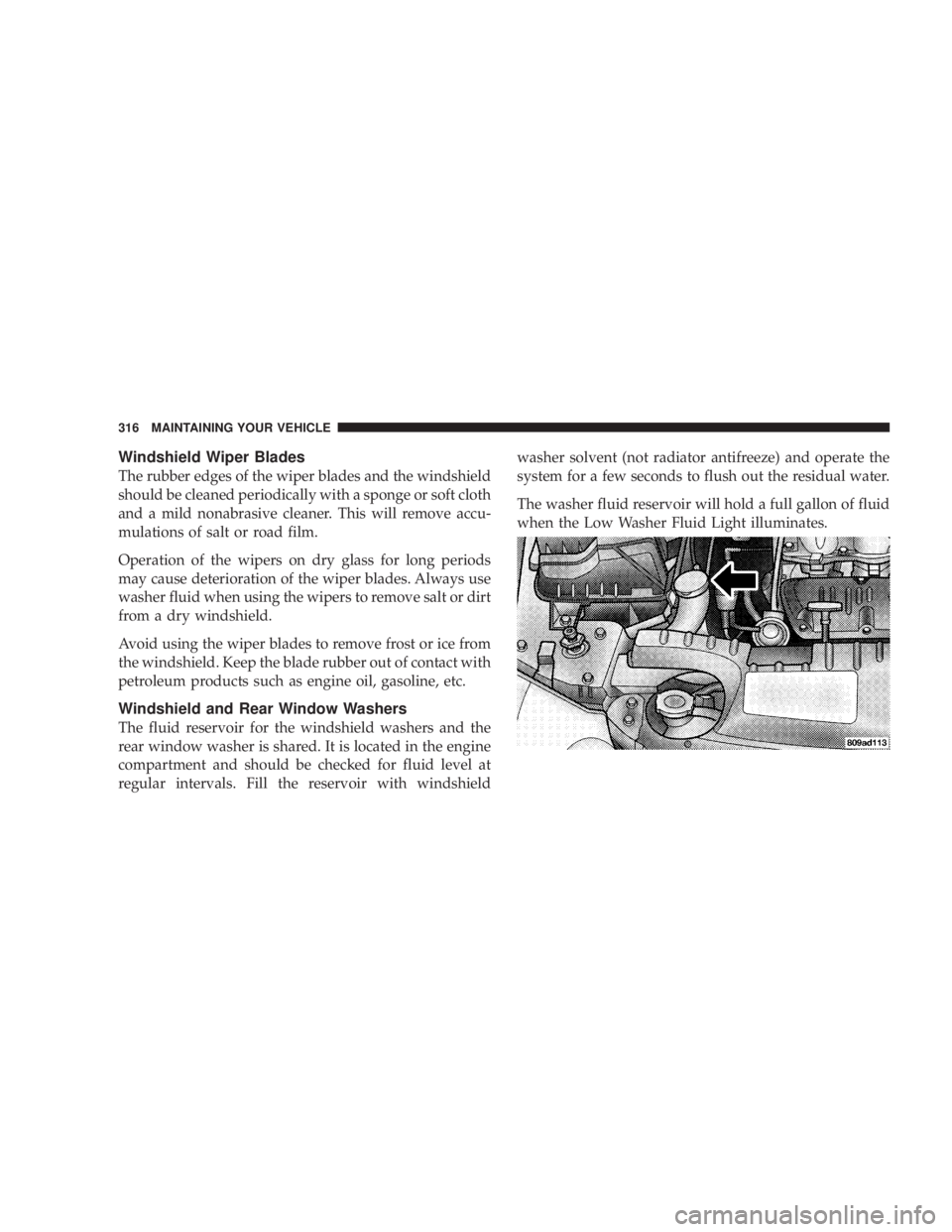
The fluid reservoir for the windshield washers and the
rear window washer is shared. It is located in the engine
compartment and should be checked for fluid level at
regular intervals. Fill the reservoir with windshield washer solvent (not radiator antifreeze) and operate the
system for a few seconds to flush out the residual water.
The washer fluid reservoir will hold a full gallon of fluid
when the Low Washer Fluid Light illuminates.316 MAINTAINING YOUR VEHICLE
Page 324 of 397
Insure nylon tubing in these areas has not melted or
collapsed.
Inspect all hose connections such as clamps and cou-
plings to make sure they are secure and no leaks are
present.
NOTE: Often, fluid such as oil, power steering fluid,
and brake fluid are used during assembly plant opera-
tions to facilitate the assembly of hoses to couplings.
Therefore, oil wetness at the hose-coupling area is not
necessarily an indication of leakage. Actual dripping of
hot fluid when systems are under pressure (during
vehicle operation), should be noted before hose is re-
placed based on leakage.
NOTE: Inspection of brake hoses should be performed
whenever the brake system is serviced and every engine
oil change. Inspect hydraulic brake hoses for surface
cracking, scuffing, or worn spots. If there is any evidence
of cracking, scuffing, or worn spots, the hose should be replaced immediately! Eventual deterioration of the hose
can take place resulting in a possibility of a burst failure.
WARNING!Worn brake hoses can burst and cause brake failure.
You could have an accident. If you see any signs of
cracking, scuffing, or worn spots, have the brake
hoses replaced immediately.
Master Cylinder Ð ABS Brakes Brake Fluid Level
Check
The fluid level in the master cylinder should be checked
when performing underhood services, or immediately if
the brake system warning light indicates system failure.
Clean the top of the master cylinder area before removing
the cap. Add fluid to bring the level up to the top of the
ªFULLº mark on the side of the master cylinder reservoir.324 MAINTAINING YOUR VEHICLE
Page 349 of 397
² Taxi, police, or delivery service (commercial ser-
vice). L
² Off-road or desert operation.
NOTE: Most vehicles are operated under the conditions
listed for Schedule 9 B 9 .
Second is Schedule ªAº . It is for vehicles that are not
operated under any of the conditions listed under Sched-
ule 9 B 9 .
Use the schedule that best describes your driving condi-
tions. Where time and mileage are listed, follow the
interval that occurs first.
CAUTION!Failure to perform the required maintenance items
may result in damage to the vehicle. At Each Stop for Fuel
² Check the engine oil level about 5 minutes after a fully
warmed engine is shut off. Checking the oil level while
the vehicle is on level ground will improve the accu-
racy of the oil level reading. Add oil only when the
level is at or below the ADD or MIN mark.
² Check the windshield washer solvent and add if
required.
Once a Month
² Check tire pressure and look for unusual wear or
damage.
² Inspect the battery and clean and tighten the terminals
as required.
² Check the fluid levels of coolant reservoir, brake
master cylinder and transmission; add as needed.
² Check all lights and all other electrical items for correct
operation. MAINTENANCE SCHEDULES 349
8 M
A
I
N
T
E
N
A
N
C
E
S
C
H
E
D
U
L
E
S
Page 383 of 397
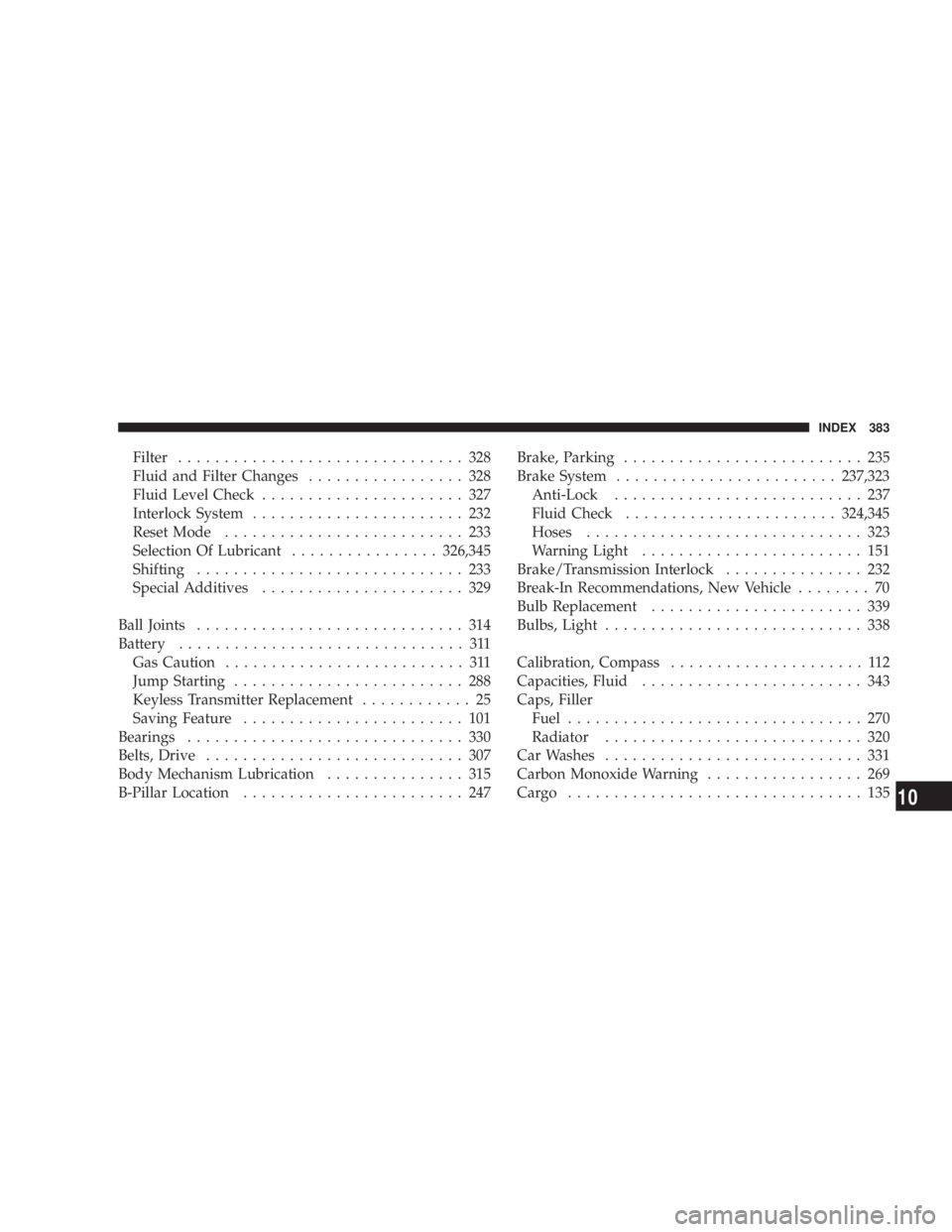
Filter ............................... 328
Fluid and Filter Changes ................. 328
Fluid Level Check ...................... 327
Interlock System ....................... 232
Reset Mode .......................... 233
Selection Of Lubricant ................ 326,345
Shifting ............................. 233
Special Additives ...................... 329
Ball Joints ............................. 314
Battery ............................... 311
Gas Caution .......................... 311
Jump Starting ......................... 288
Keyless Transmitter Replacement ............ 25
Saving Feature ........................ 101
Bearings .............................. 330
Belts, Drive ............................ 307
Body Mechanism Lubrication ............... 315
B-Pillar Location ........................ 247 Brake, Parking .......................... 235
Brake System ........................ 237,323
Anti-Lock ........................... 237
Fluid Check ....................... 324,345
Hoses .............................. 323
Warning Light ........................ 151
Brake/Transmission Interlock ............... 232
Break-In Recommendations, New Vehicle ........ 70
Bulb Replacement ....................... 339
Bulbs, Light ............................ 338
Calibration, Compass ..................... 112
Capacities, Fluid ........................ 343
Caps, Filler
Fuel ................................ 270
Radiator ............................ 320
Car Washes ............................ 331
Carbon Monoxide Warning ................. 269
Cargo ................................ 135 INDEX 383
10
Page 386 of 397
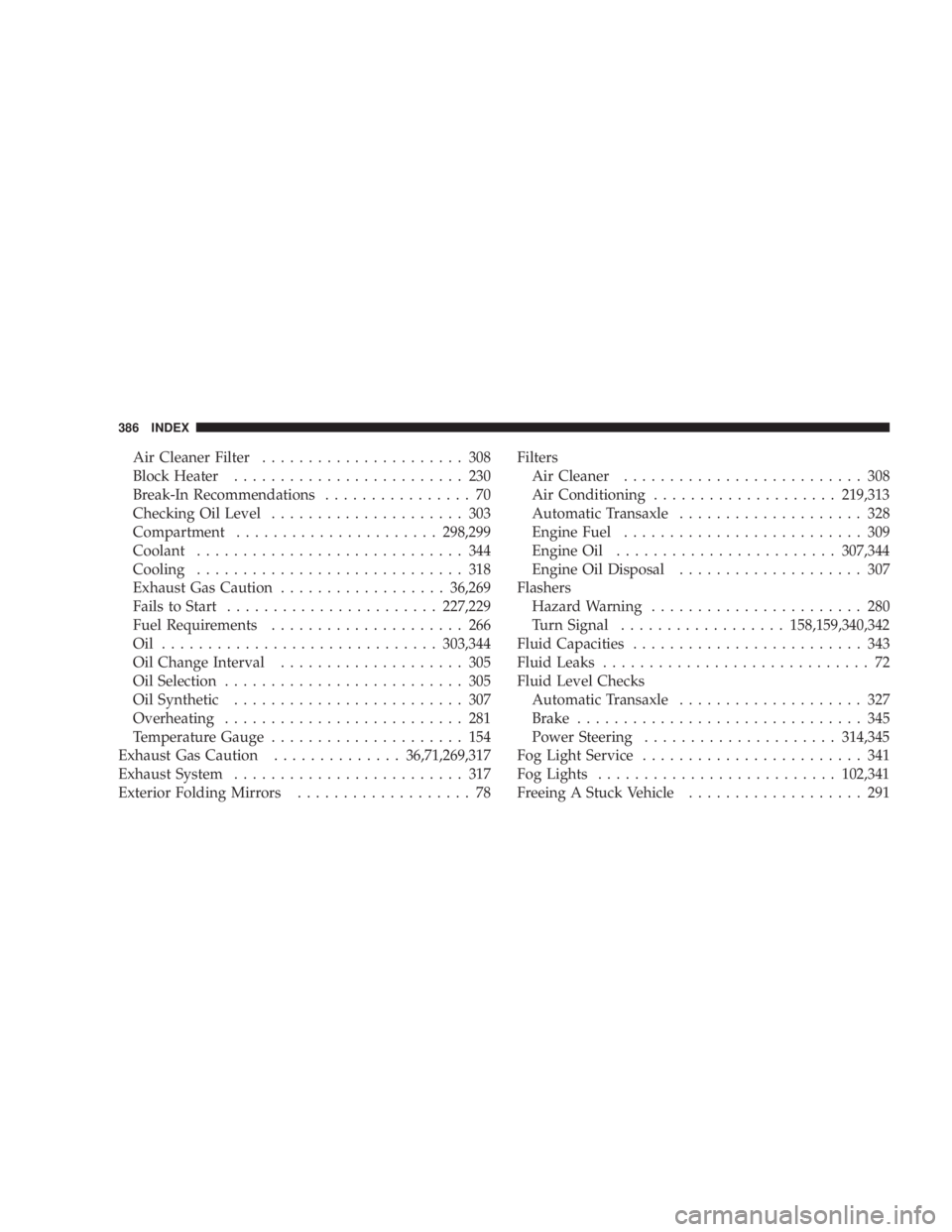
Air Cleaner Filter ...................... 308
Block Heater ......................... 230
Break-In Recommendations ................ 70
Checking Oil Level ..................... 303
Compartment ...................... 298,299
Coolant ............................. 344
Cooling ............................. 318
Exhaust Gas Caution .................. 36,269
Fails to Start ....................... 227,229
Fuel Requirements ..................... 266
Oil .............................. 303,344
Oil Change Interval .................... 305
Oil Selection .......................... 305
Oil Synthetic ......................... 307
Overheating .......................... 281
Temperature Gauge ..................... 154
Exhaust Gas Caution .............. 36,71,269,317
Exhaust System ......................... 317
Exterior Folding Mirrors ................... 78 Filters
Air Cleaner .......................... 308
Air Conditioning .................... 219,313
Automatic Transaxle .................... 328
Engine Fuel .......................... 309
Engine Oil ........................ 307,344
Engine Oil Disposal .................... 307
Flashers
Hazard Warning ....................... 280
Turn Signal .................. 158,159,340,342
Fluid Capacities ......................... 343
Fluid Leaks ............................. 72
Fluid Level Checks
Automatic Transaxle .................... 327
Brake ............................... 345
Power Steering ..................... 314,345
Fog Light Service ........................ 341
Fog Lights .......................... 102,341
Freeing A Stuck Vehicle ................... 291386 INDEX