Control panel DODGE GRAND CARAVAN 2004 Owners Manual
[x] Cancel search | Manufacturer: DODGE, Model Year: 2004, Model line: GRAND CARAVAN, Model: DODGE GRAND CARAVAN 2004Pages: 397, PDF Size: 7.59 MB
Page 17 of 397
NOTE:
² The front courtesy overhead console, door courtesy
and liftgate lights do not turn on if the dimmer control
is in the interior lights ON position (extreme top
position).
² The illuminated entry system will not operate if the
dimmer control is in the ªdefeatº position (extreme
downward position).
DOOR LOCKS
Manual Door Locks
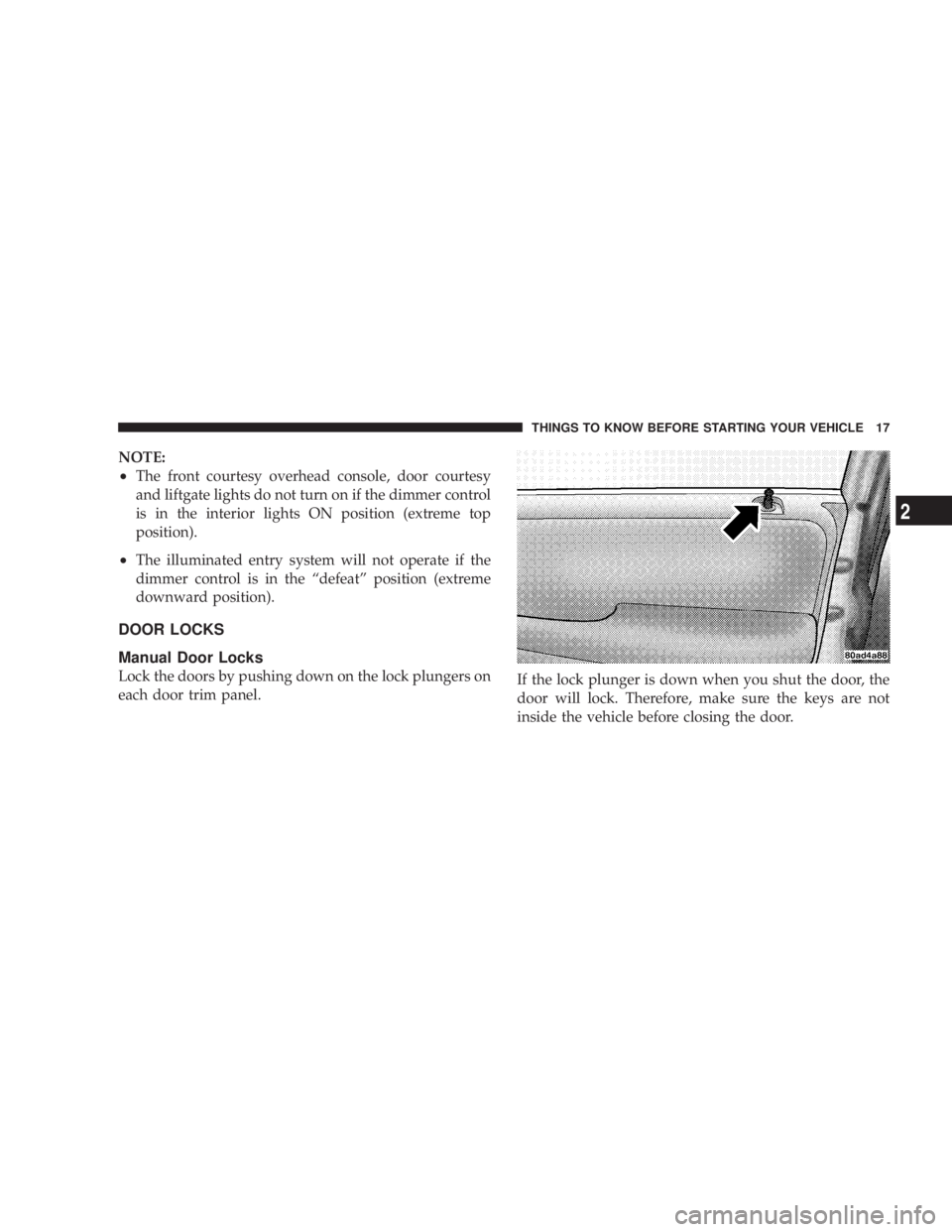
Lock the doors by pushing down on the lock plungers on
each door trim panel. If the lock plunger is down when you shut the door, the
door will lock. Therefore, make sure the keys are not
inside the vehicle before closing the door. THINGS TO KNOW BEFORE STARTING YOUR VEHICLE 17
2
Page 32 of 397
Child Protection Door Lock
To provide a safer environment for small children riding
in the rear seats, the sliding doors are equipped with a
child protection door lock system.
WARNING!To avoid trapping anyone in the vehicle in a colli-
sion. Remember that the sliding doors can only be
opened from the outside door handle or the switches
located on the trim panel just in front of the power
sliding door when the child protection locks are
engaged.
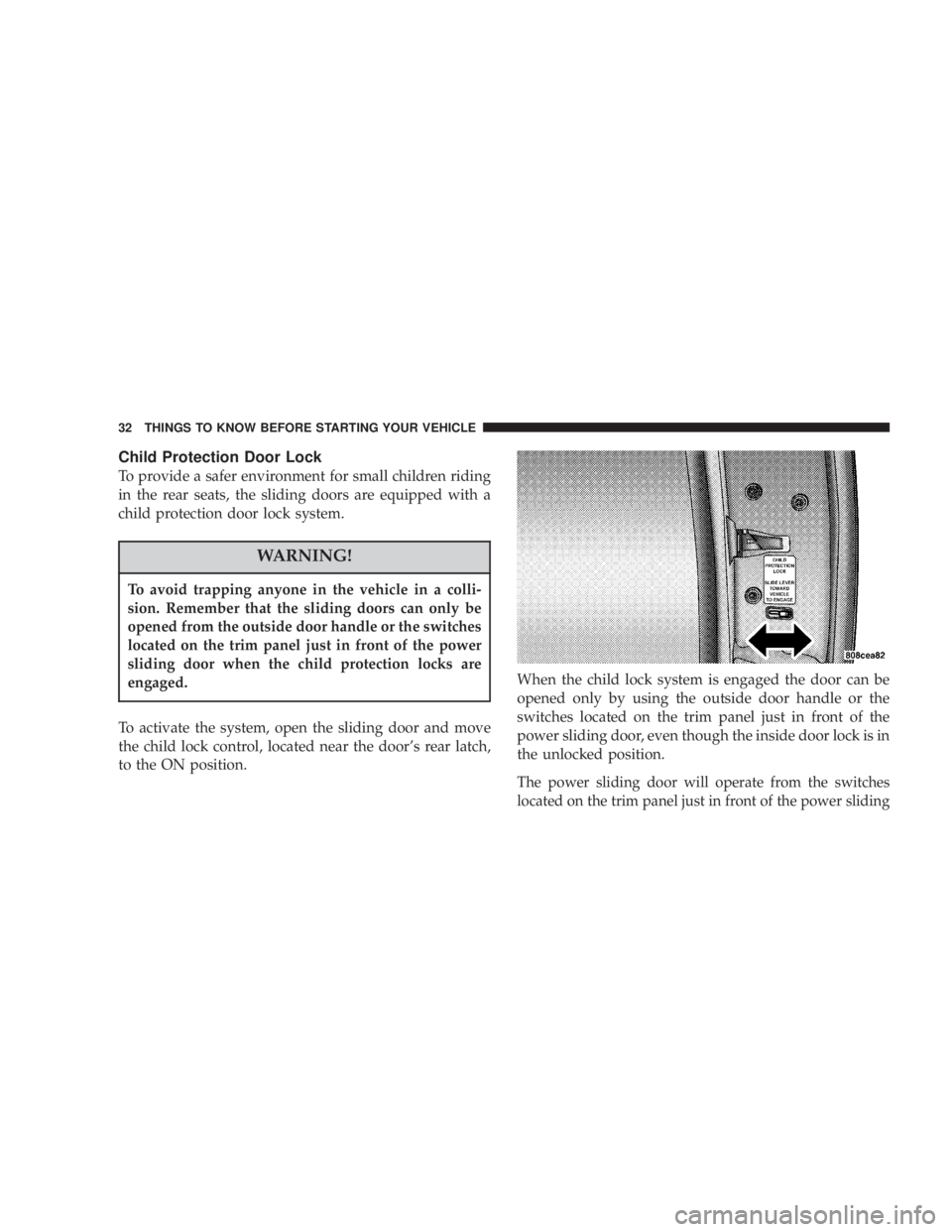
To activate the system, open the sliding door and move
the child lock control, located near the door's rear latch,
to the ON position. When the child lock system is engaged the door can be
opened only by using the outside door handle or the
switches located on the trim panel just in front of the
power sliding door, even though the inside door lock is in
the unlocked position.
The power sliding door will operate from the switches
located on the trim panel just in front of the power sliding32 THINGS TO KNOW BEFORE STARTING YOUR VEHICLE
Page 36 of 397
² If the power liftgate encounters multiple obstructions
within the same cycle, the system will automatically
stop and must be opened or closed manually.
WARNING!² Driving with the liftgate open can allow poison-
ous exhaust gases into your vehicle. You and your
passengers could be injured by these fumes. Keep
the liftgate closed when you are operating the
vehicle.
² If you are required to drive with the liftgate open,
make sure that all windows are closed, and the
climate control blower switch is set at high speed.
DO NOT use the recirculation mode. Gas props support the liftgate in the open position.
However, because the gas pressure drops with tempera-
ture, it may be necessary to assist the props when
opening the liftgate in cold weather.
WINDOWS
Manual Rear Vent Windows
A lever at the rear of each window releases the window
so that it can be pushed out for ventilation.
Power Vent Windows Ð If Equipped
Switches on the driver's door trim panel let the driver
operate the two vent windows from the front seat.36 THINGS TO KNOW BEFORE STARTING YOUR VEHICLE
Page 37 of 397
Power Windows Ð If Equipped
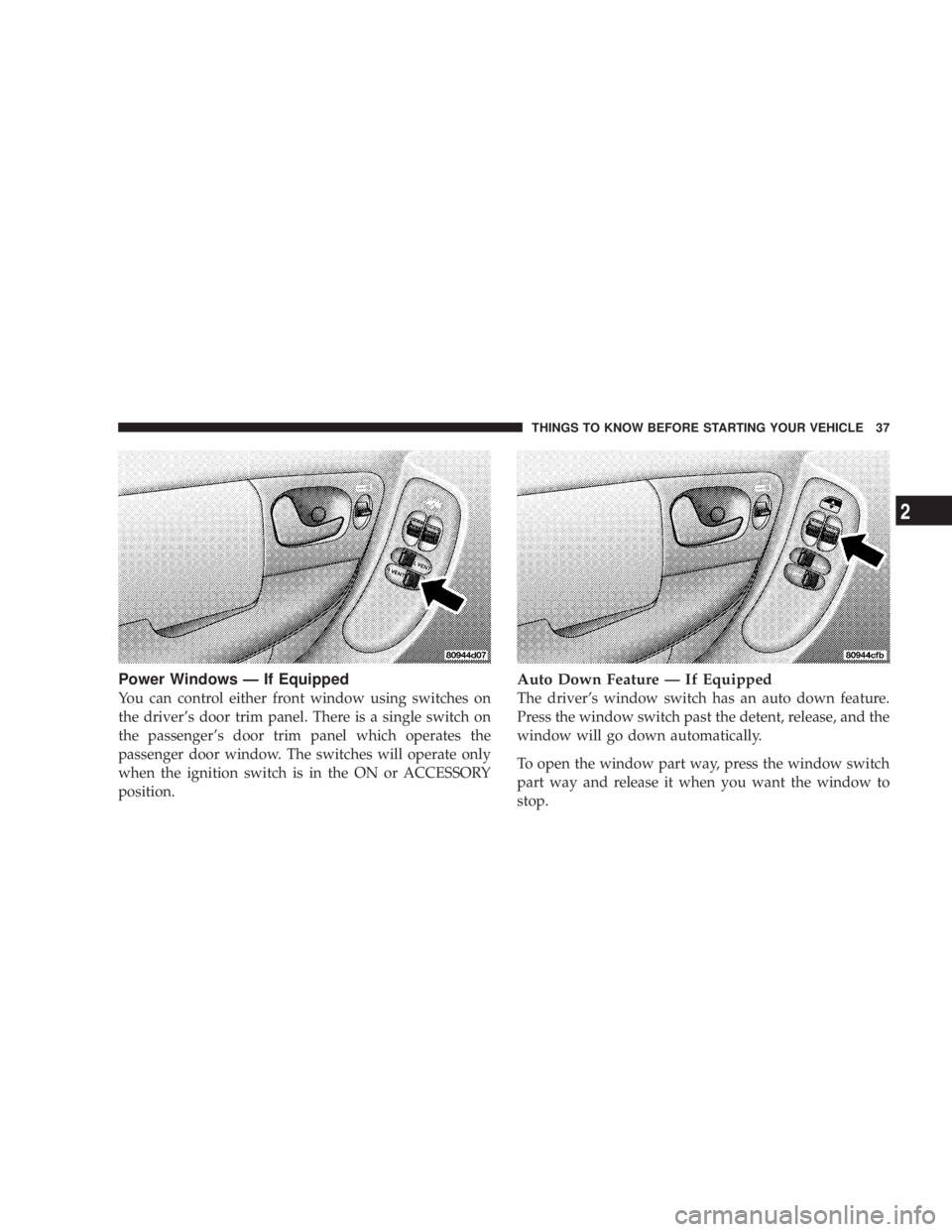
You can control either front window using switches on
the driver's door trim panel. There is a single switch on
the passenger's door trim panel which operates the
passenger door window. The switches will operate only
when the ignition switch is in the ON or ACCESSORY
position. Auto Down Feature Ð If Equipped
The driver's window switch has an auto down feature.
Press the window switch past the detent, release, and the
window will go down automatically.
To open the window part way, press the window switch
part way and release it when you want the window to
stop. THINGS TO KNOW BEFORE STARTING YOUR VEHICLE 37
2
Page 52 of 397
WARNING!² Relying on the airbags alone could lead to more
severe injuries in a collision. The airbags work
with your seat belt to restrain you properly. In
some collisions the airbags won't deploy at all.
Always wear your seat belts even though you
have airbags.
² Being too close to the steering wheel or instru-
ment panel during front airbag deployment could
cause serious injury. Airbags need room to inflate.
Sit back, comfortably extending your arms to
reach the steering wheel or instrument panel.
² If the vehicle has side airbags, they also need
room to inflate. Do not lean against the door. Sit
upright in the center of the seat. The Front Airbag System consists of the following:
² Front Airbag Control Module (with integrated side
impact sensor - if equipped)
² AIRBAG Readiness Light
² Driver Airbag
² Front Passenger Airbag
² Steering Wheel and Column
² Instrument Panel
² Seat Belt Readiness Light
² Front Seat Belt Pretensioners
² Interconnecting Wiring
² Knee Impact Bolster52 THINGS TO KNOW BEFORE STARTING YOUR VEHICLE
Page 53 of 397
How The Front Airbag System Works
² The front airbag control module determines if a frontal
impact is severe enough to require the front airbags to
inflate. Based on the level of collision severity, the front
airbag control module determines the proper rate of
inflation. The front airbag inflators are designed to
provide different rates of airbag inflation. The front
airbag control module will not detect roll over, or rear
collisions.
The front airbag control module also monitors the
readiness of the electronic parts of the system when-
ever the ignition switch is in the START or ON
positions. These include all of the items listed above
except the knee bolster, instrument panel and the
steering wheel and column. If the key is in the OFF
position, in the ACC position, or not in the ignition
switch, the front airbags are not on and will not inflate. The front airbag control module sends a
message to the instrument cluster to turn on
the AIRBAG light in the instrument panel
for 6 to 8 seconds when the ignition switch is
first turned ON, then turns the light off. If the front
control module detects a malfunction in any part of the
system, the airbag light will turn on either momen-
tarily or continuously.
WARNING!Ignoring the AIRBAG light in your instrument panel
could mean you won't have the airbags to protect
you in a collision. If the light does not come on, stays
on after you start the vehicle, or if it comes on as you
drive, have the airbag system checked right away. THINGS TO KNOW BEFORE STARTING YOUR VEHICLE 53
2
Page 54 of 397
² When the front airbag control module detects a colli-
sion requiring the front airbags, it signals the inflator
units. A large quantity of nontoxic gas is generated to
inflate the front airbags. Different front airbag inflation
rates are possible, these rates are determined by the
front airbag control module based on collision severity.
The front airbag covers separate and fold out of the
way as the airbags inflate to their full size. The front
airbags fully inflate in about 50 milliseconds. This is
only about half of the time it takes you to blink your
eyes. The front airbags then quickly deflate while
helping to restrain the driver and front passenger. The
driver's and passenger's front airbag gas is vented
through the airbag material towards the instrument
panel. In this way the front airbags do not interfere
with your control of the vehicle.
² The Knee Impact Bolsters help protect the knees and
position you for the best interaction with the front
airbags. Side Airbags Supplemental Restraint System
(SRS) Ð If Equipped
The Side Airbag System, if equipped, consists of the
following:
² AIRBAG Readiness Light (shared with the front airbag
system)
² Side Airbag in the driver's seat
² Side Airbag in the passenger's seat
² Front Airbag Control Module (with integrated side
impact sensor - if equipped)
² Interconnecting Wiring
How The Side Airbag System Works
The front airbag control modules determine if a side
collision is severe enough to require the side airbags to
inflate. The front airbag control modules will not detect
roll over, or rear collisions.54 THINGS TO KNOW BEFORE STARTING YOUR VEHICLE
Page 55 of 397
The front airbag control module also monitors the readi-
ness of the electronic parts of the system whenever the
ignition switch is in the START or ON positions. These
include all of the items listed above except the knee
bolster, instrument panel and the steering wheel and
column. If the key is in the OFF position, in the ACC
position, or not in the ignition switch, the side airbags are
not on and will not inflate.
In moderate to severe side collisions, the side airbag
inflator on the crash side of the vehicle is triggered,
releasing a quantity of nontoxic gas. The inflating side
airbag exits through the seat seam into the space between
the occupant and the door. The side airbag moves at a
very high speed and with such a high force that it could
injure you if you are not seated properly, or if items are
positioned in the area where the side airbag inflates. This
especially applies to children. If An Airbag Deployment Occurs
The airbag systems are designed to deploy when the
airbag control modules detect a moderate-to-severe col-
lision, to help restrain the driver and front passenger, and
then immediately deflate.
NOTE: A collision that is not severe enough to need
airbag protection will not activate the system. This does
not mean something is wrong with the airbag system.
If you do have a collision which deploys the airbag, any
or all of the following may occur:
² The airbag material may sometimes cause abrasions
and/or skin reddening to the driver and front passen-
ger as the airbags deploy and unfold. The abrasions
are similar to friction rope burns or those you might
get sliding along a carpet or gymnasium floor. They
are not caused by contact with chemicals. They are not
permanent and normally heal quickly. However, if you THINGS TO KNOW BEFORE STARTING YOUR VEHICLE 55
2
Page 72 of 397
Airbag Light
The light should come on and remain on for 6 to 8
seconds as a bulb check when the ignition switch is first
turned ON. If the LED is not lit during starting, have it
checked. If the light stays on or comes on while driving,
have the system checked by an authorized dealer.
Defroster
Check operation by selecting the defrost mode and place
the blower control on high speed. You should be able to
feel the air directed against the windshield.
Periodic Safety Checks You Should Make Outside
The Vehicle
Tires
Examine tires for excessive tread wear or uneven wear
patterns. Check for stones, nails, glass, or other objects
lodged in the tread. Inspect tread and sidewall for cuts or
cracks. Check wheel nuts for tightness, and tires (includ-
ing spare) for proper pressure. Lights
Have someone observe the operation of exterior lights
while you work the controls. Check turn signal and high
beam indicator lights on the instrument panel.
Fluid Leaks
Check area under vehicle after overnight parking for fuel,
engine coolant, oil or other fluid leaks. Also, if gasoline
fumes are detected or fuel, power steering fluid or brake
fluid leaks are suspected, the cause should be located and
corrected immediately.72 THINGS TO KNOW BEFORE STARTING YOUR VEHICLE
Page 79 of 397
WARNING!Vehicles and other objects seen in the right side
convex mirror will look smaller and farther away
than they really are. Relying too much on your right
side mirror could cause you to collide with another
vehicle or other object.
Use your inside mirror when judging the size or
distance of a vehicle seen in this convex mirror.
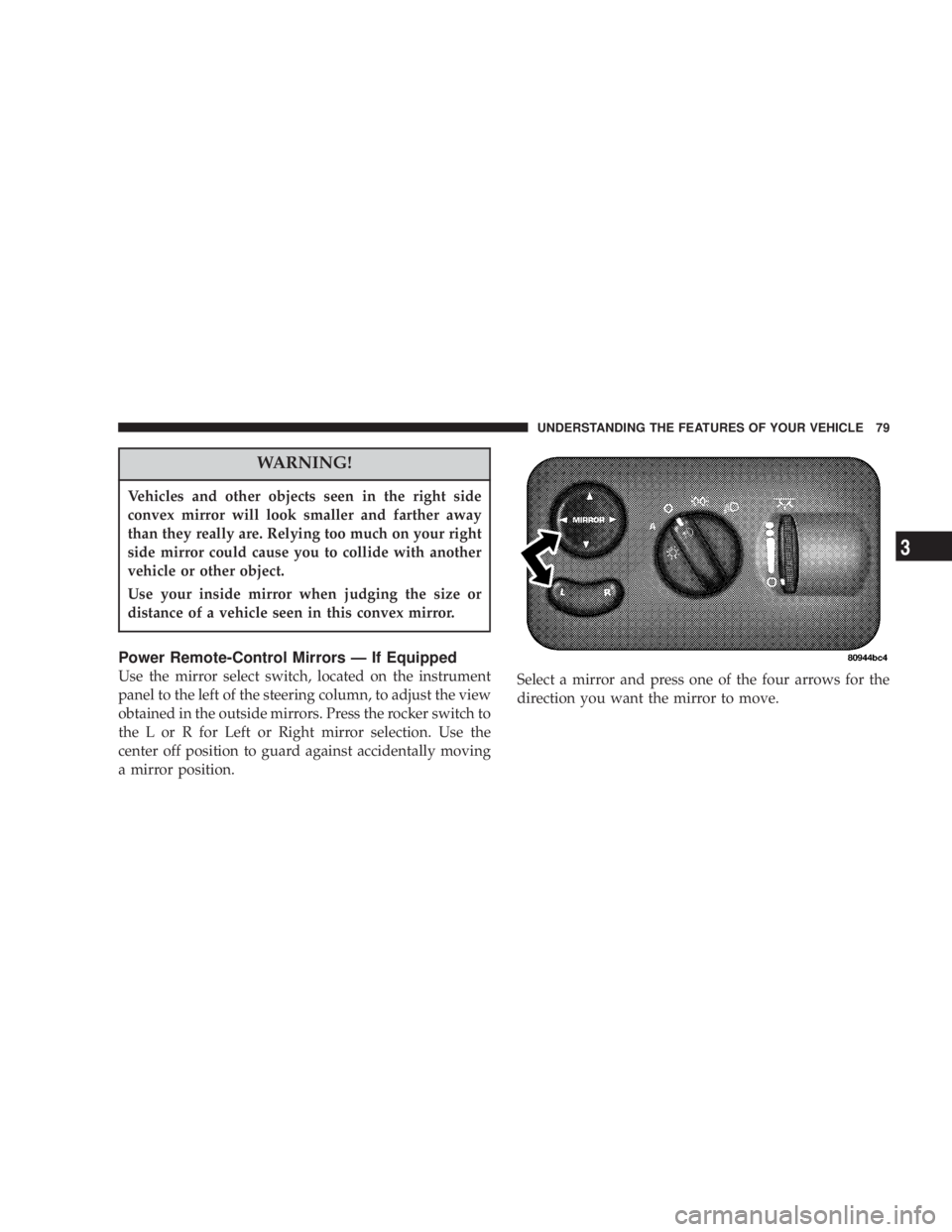
Power Remote-Control Mirrors Ð If Equipped
Use the mirror select switch, located on the instrument
panel to the left of the steering column, to adjust the view
obtained in the outside mirrors. Press the rocker switch to
the L or R for Left or Right mirror selection. Use the
center off position to guard against accidentally moving
a mirror position. Select a mirror and press one of the four arrows for the
direction you want the mirror to move. UNDERSTANDING THE FEATURES OF YOUR VEHICLE 79
3