fuel DODGE GRAND CARAVAN 2005 User Guide
[x] Cancel search | Manufacturer: DODGE, Model Year: 2005, Model line: GRAND CARAVAN, Model: DODGE GRAND CARAVAN 2005Pages: 480, PDF Size: 15.54 MB
Page 295 of 480
WARNING!Do not attempt to push or tow your vehicle to get it
started. Vehicles equipped with an automatic trans-
mission cannot be started this way. Unburned fuel
could enter the catalytic converter and once the
engine has started, ignite and damage the converter
and vehicle. If the vehicle has a discharged battery,
booster cables may be used to obtain a start from a
booster battery or the battery in another vehicle. This
type of start can be dangerous if done improperly.
See section 6 of this manual for the proper jump
starting procedures and follow them carefully. WARNING!Never pour fuel or other flammable liquid into the
throttle body air inlet opening in an attempt to start
the vehicle. This could result in flash fire causing
serious personal injury.
If Engine Fails to Start
If the engine fails to start after you have followed the
“ NORMAL STARTING ” procedure, it may be flooded.
Push the accelerator pedal all the way to the floor and
hold it there while cranking the engine. This should clear
any excess fuel in case the engine is flooded. STARTING AND OPERATING 295
5
Page 300 of 480
Apply parking brake when leaving vehicle in this range.
• “ R ” Reverse
Shift into this range only after the vehicle has come to a
complete stop.
• “ N ” Neutral
Engine may be started in this range.
• “ D ” Overdrive
For most city and highway driving, it provides smoothest
upshifts and downshifts and best fuel economy. When
frequent transmission shifting occurs while using the
“ D ” Overdrive position, such as when operating the
vehicle under heavy loading conditions, (i.e. in hilly
terrain, traveling into strong head winds or while towing
heavy trailers), using the “ 3 ” position will improve
performance and extend transmission life by reducing
excessive shifting and heat build-up. • “ 3 ” Drive
This range eliminates shifts into Overdrive. The transmis-
sion will operate normally in First, Second and Third
while in this range. The “ 3 ” position should also be used
when descending steep grades to prevent brake system
distress.
NOTE: Using the “ 3 ” range while operating the vehicle
under heavy operating conditions will improve perfor-
mance and extend transmission life by reducing exces-
sive shifting and heat build up.
• “ L ” Low
This range should be used for engine braking when
descending very steep grades. In this range, upshifts will
occur only to prevent engine overspeed while downshifts
occur earlier than other gear range selections.
NOTE: The vehicle computer will over ride Overdrive
and “ 3 ” Drive ranges by changing shift points if the300 STARTING AND OPERATING
Page 317 of 480
2. Economy —
Improper inflation pressures can cause uneven wear
patterns to develop across the tire tread. These abnormal
wear patterns will reduce tread life resulting in a need for
earlier tire replacement. Underinflation also increases tire
rolling resistance and results in higher fuel consumption.
3. Ride Comfort and Vehicle Stability —
Proper tire inflation contributes to a comfortable ride.
Overinflation produces a jarring and uncomfortable ride.
Tire Inflation Pressures
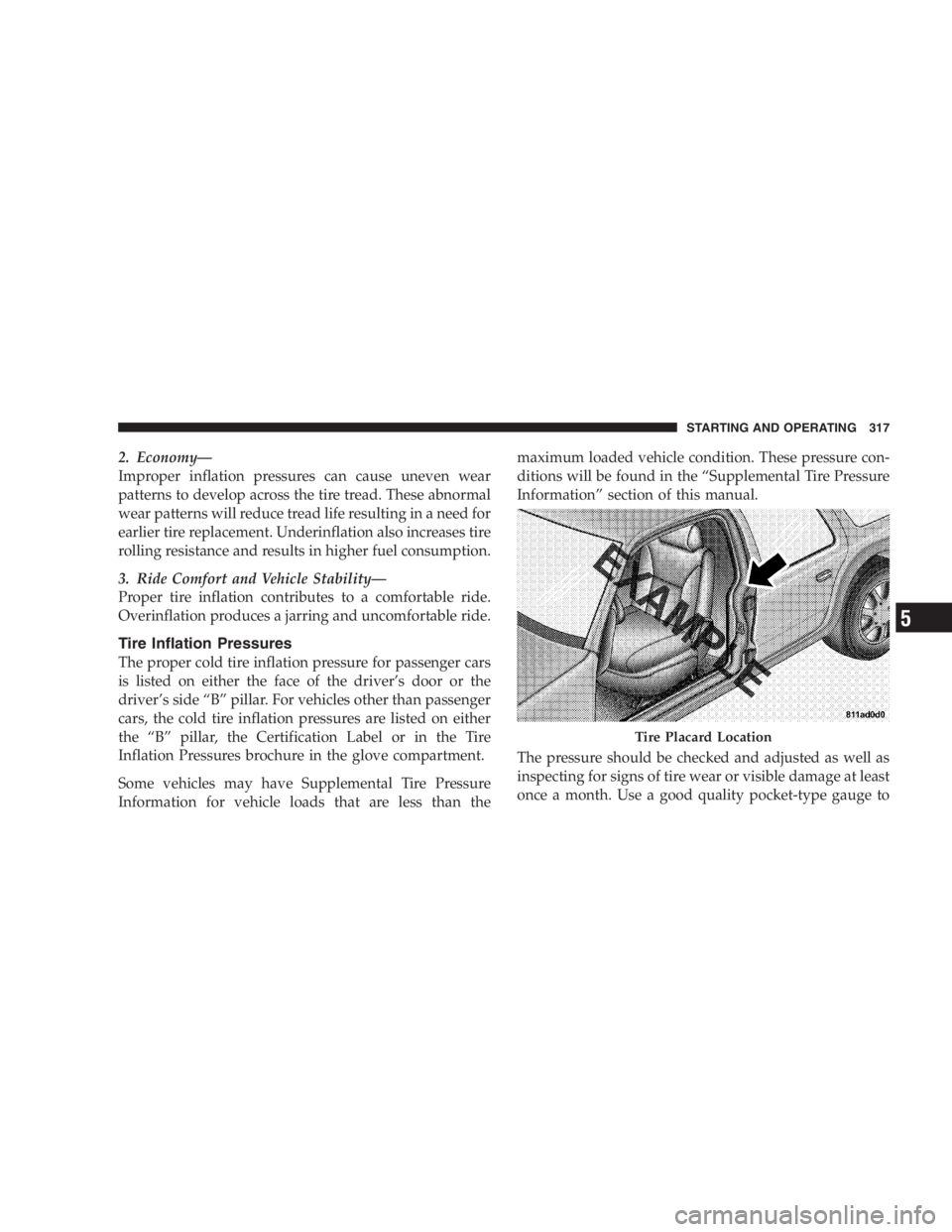
The proper cold tire inflation pressure for passenger cars
is listed on either the face of the driver ’ s door or the
driver ’ s side “ B ” pillar. For vehicles other than passenger
cars, the cold tire inflation pressures are listed on either
the “ B ” pillar, the Certification Label or in the Tire
Inflation Pressures brochure in the glove compartment.
Some vehicles may have Supplemental Tire Pressure
Information for vehicle loads that are less than the maximum loaded vehicle condition. These pressure con-
ditions will be found in the “ Supplemental Tire Pressure
Information ” section of this manual.
The pressure should be checked and adjusted as well as
inspecting for signs of tire wear or visible damage at least
once a month. Use a good quality pocket-type gauge to Tire Placard Location STARTING AND OPERATING 317
5
Page 330 of 480
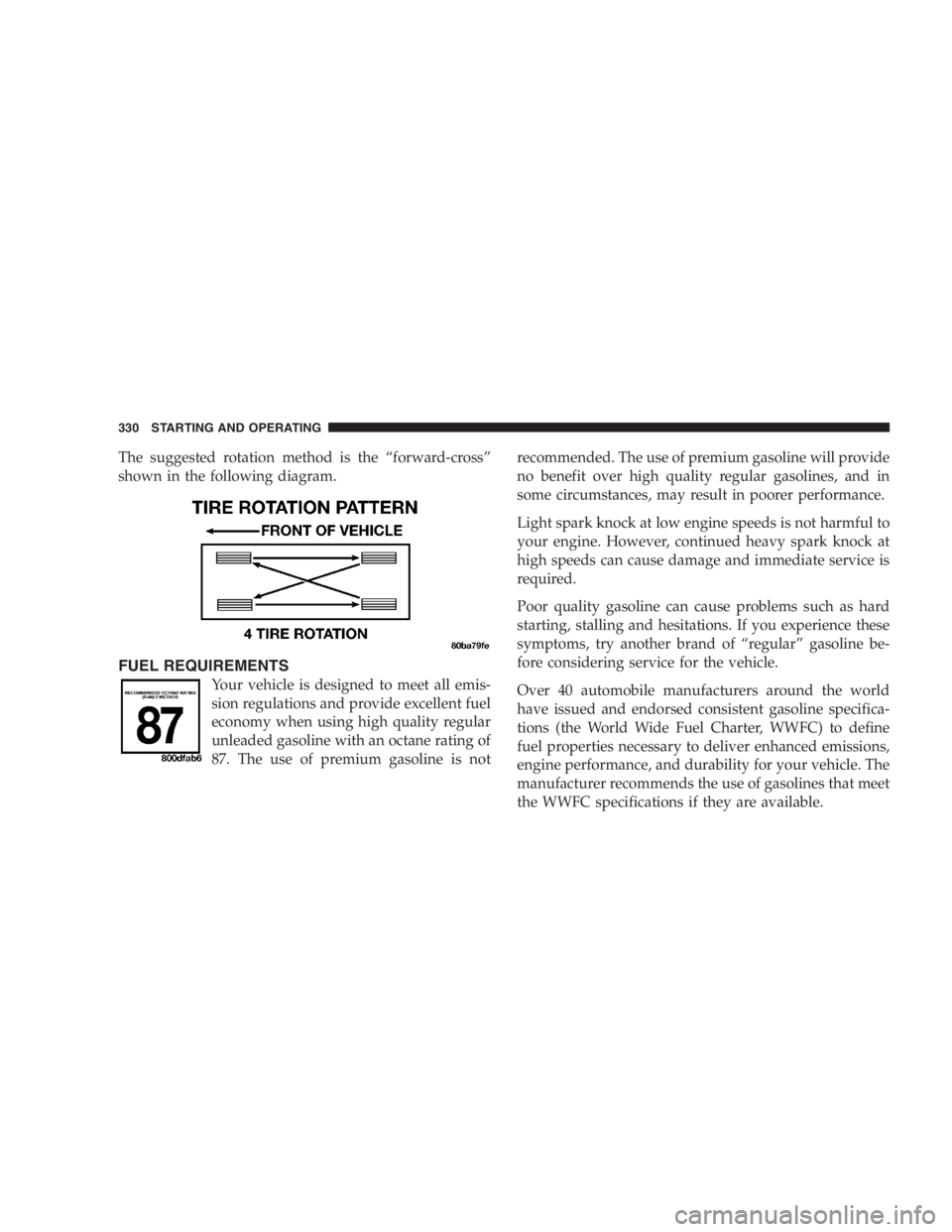
The suggested rotation method is the “ forward-cross ”
shown in the following diagram.
FUEL REQUIREMENTS
Your vehicle is designed to meet all emis-
sion regulations and provide excellent fuel
economy when using high quality regular
unleaded gasoline with an octane rating of
87. The use of premium gasoline is not recommended. The use of premium gasoline will provide
no benefit over high quality regular gasolines, and in
some circumstances, may result in poorer performance.
Light spark knock at low engine speeds is not harmful to
your engine. However, continued heavy spark knock at
high speeds can cause damage and immediate service is
required.
Poor quality gasoline can cause problems such as hard
starting, stalling and hesitations. If you experience these
symptoms, try another brand of “ regular ” gasoline be-
fore considering service for the vehicle.
Over 40 automobile manufacturers around the world
have issued and endorsed consistent gasoline specifica-
tions (the World Wide Fuel Charter, WWFC) to define
fuel properties necessary to deliver enhanced emissions,
engine performance, and durability for your vehicle. The
manufacturer recommends the use of gasolines that meet
the WWFC specifications if they are available.330 STARTING AND OPERATING
Page 331 of 480
Reformulated Gasoline
Many areas of the country require the use of cleaner
burning gasoline referred to as “ Reformulated Gasoline ” .
Reformulated gasolines contain oxygenates, and are spe-
cifically blended to reduce vehicle emissions and im-
prove air quality.
The manufacturer supports the use of reformulated gaso-
lines. Properly blended reformulated gasolines will pro-
vide excellent performance and durability of engine and
fuel system components.
Gasoline/Oxygenate Blends
Some fuel suppliers blend unleaded gasoline with oxy-
genates such as 10% ethanol, MTBE, and ETBE. Oxygen-
ates are required in some areas of the country during the
winter months to reduce carbon monoxide emissions.
Fuels blended with these oxygenates may be used in
your vehicle. CAUTION!DO NOT use gasolines containing Methanol. Use of
these blends may result in starting and driveability
problems and may damage critical fuel system com-
ponents.
Problems that result from using methanol/gasoline
blends are not the responsibility of the manufacturer.
While MTBE is an oxygenate made from Methanol, it
does not have the negative effects of Methanol.
MMT In Gasoline
MMT is a manganese containing metallic additive that is
blended into some gasoline to increase the octane num-
ber. Gasolines blended with MMT offer no performance
advantage beyond gasolines of the same octane number
without MMT. Gasolines blended with MMT have shown
to reduce spark plug life and reduce emission system STARTING AND OPERATING 331
5
Page 332 of 480
performance in some vehicles. The manufacturer recom-
mends using gasolines without MMT. Since the MMT
content of gasoline may not be indicated on the pump,
you should ask your gasoline retailer whether or not
his/her gasoline contains MMT.
It is even more important to look for gasolines without
MMT in Canada, because MMT can be used at levels
higher than those allowed in the United States.
MMT is prohibited in Federal and California reformu-
lated gasolines.
Materials Added to Fuel
All gasoline sold in the United States is required to
contain effective detergent additives. Use of additional
detergents or other additives are not needed under
normal conditions and would result in additional cost.
Therefore you should not have to add anything to the
fuel. Fuel System Cautions
CAUTION!Follow these guidelines to maintain your vehicle ’ s
performance:
• The use of leaded gas is prohibited by Federal law.
Using leaded gasoline can impair engine performance,
damage the emission control system.
• An out-of-tune engine, or certain fuel or ignition
malfunctions, can cause the catalytic converter to
overheat. If you notice a pungent burning odor or
some light smoke, your engine may be out of tune or
malfunctioning and may require immediate service.
Contact your dealer for service assistance.
• The use of fuel additives which are now being sold as
octane enhancers is not recommended. Most of these332 STARTING AND OPERATING
Page 333 of 480
products contain high concentrations of methanol.
Fuel system damage or vehicle performance problems
resulting from the use of such fuels or additives is not
the responsibility of the manufacturer.
NOTE: Intentional tampering with emissions control
systems can result in civil penalties being assessed
against you.
Carbon Monoxide Warnings
WARNING!Carbon monoxide (CO) in exhaust gases is deadly.
Follow the precautions below to prevent carbon
monoxide poisoning:
• Do not inhale exhaust gases. They contain carbon
monoxide, a colorless and odorless gas which can kill.
Never run the engine in a closed area, such as a garage, and never sit in a parked vehicle with the
engine running for an extended period. If the vehicle is
stopped in an open area with the engine running for
more than a short period, adjust the ventilation system
to force fresh, outside air into the vehicle.
• Guard against carbon monoxide with proper mainte-
nance. Have the exhaust system inspected every time
the vehicle is raised. Have any abnormal conditions
repaired promptly. Until repaired, drive with all side
windows fully open.
• Keep the liftgate closed when driving your vehicle to
prevent carbon monoxide and other poisonous ex-
haust gases from entering the vehicle. STARTING AND OPERATING 333
5
Page 334 of 480
ADDING FUEL
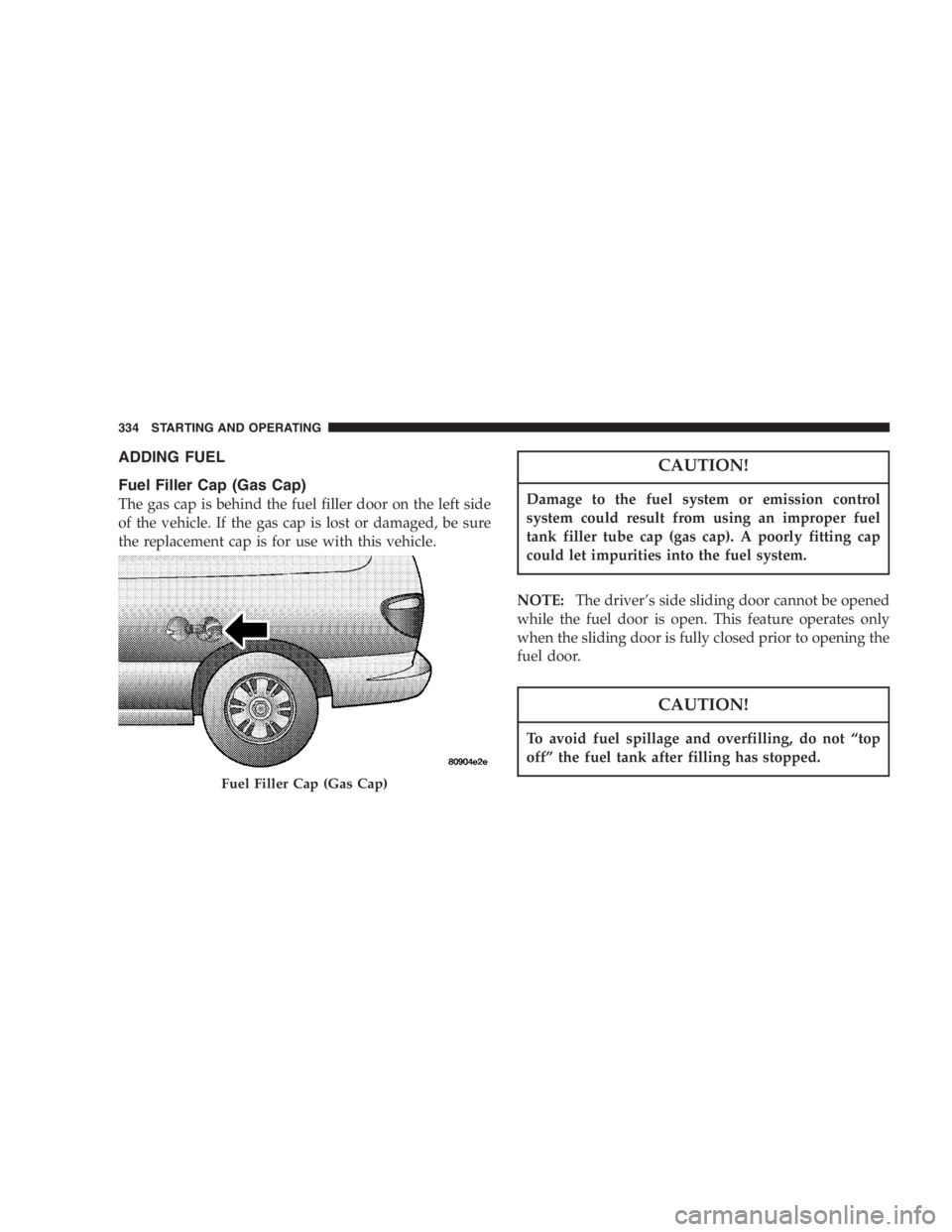
Fuel Filler Cap (Gas Cap)
The gas cap is behind the fuel filler door on the left side
of the vehicle. If the gas cap is lost or damaged, be sure
the replacement cap is for use with this vehicle. CAUTION!Damage to the fuel system or emission control
system could result from using an improper fuel
tank filler tube cap (gas cap). A poorly fitting cap
could let impurities into the fuel system.
NOTE: The driver ’ s side sliding door cannot be opened
while the fuel door is open. This feature operates only
when the sliding door is fully closed prior to opening the
fuel door.
CAUTION!To avoid fuel spillage and overfilling, do not “ top
off ” the fuel tank after filling has stopped.Fuel Filler Cap (Gas Cap)334 STARTING AND OPERATING
Page 335 of 480
NOTE:
• Tighten the gas cap until you hear a “ clicking ” sound.
This is an indication that the gas cap is properly
tightened. If the gas cap is not secured properly the
Malfunction Indicator Light will turn on. Make sure
that the gas cap is tightened each time the vehicle is
refueled.
• When the fuel nozzle “ clicks ” or shuts off, the fuel
tank is full. WARNING!• Never have any smoking materials lit in or near
the vehicle when the gas cap is removed or the
tank filled.
• Never add fuel to the vehicle when the engine is
running.
• A fire may result if gasoline is pumped into a
portable container that is inside of a vehicle. You
could be burned. Always place gas containers on
the ground while filling. STARTING AND OPERATING 335
5
Page 366 of 480
WARNING!• Do not attempt to push or tow your vehicle to get it
started. Vehicles equipped with an automatic transmis-
sion cannot be started this way. Unburned fuel could
enter the catalytic converter and once the engine has
started, ignite and damage the converter and vehicle. If
the vehicle has a discharged battery, booster cables may
be used to obtain a start from another vehicle. This type
of start can be dangerous if done improperly, so follow
this procedure carefully.
• Battery fluid is a corrosive acid solution; do not allow
battery fluid to contact eyes, skin or clothing. Don ’ t lean
over battery when attaching clamps or allow the clamps
to touch each other. If acid splashes in eyes or on skin,
flush contaminated area immediately with large quan-
tities of water.
• A battery generates hydrogen gas which is flammable
and explosive. Keep flame or spark away from the vent
holes. Do not use a booster battery or any other booster
source with an output that exceeds 12 volts. 1. Wear eye protection and remove any metal jewelry
such as watch bands or bracelets that might make an
inadvertent electrical contact.
2. When boost is provided by a battery in another
vehicle, park that vehicle within booster cable reach and
without letting the vehicles touch. Set the parking brake,
place the automatic transmission in PARK and turn the
ignition switch to the OFF position for both vehicles.
3. Turn off the heater, radio and all unnecessary electrical
loads.
4. Connect one end of a jumper cable to the positive
terminal of the discharged battery. Connect the other end
of the same cable to the positive terminal of the booster
battery.366 WHAT TO DO IN EMERGENCIES