weight DODGE GRAND CARAVAN 2005 User Guide
[x] Cancel search | Manufacturer: DODGE, Model Year: 2005, Model line: GRAND CARAVAN, Model: DODGE GRAND CARAVAN 2005Pages: 480, PDF Size: 15.54 MB
Page 314 of 480
combined weight of occupants, cargo/luggage and
trailer tongue weight (if applicable) should never exceed
the weight referenced here.
Steps for Determining Correct Load Limit
1. Locate the statement “ The combined weight of occu-
pants and cargo should never exceed XXX pounds ” on
your vehicle ’ s placard.
2. Determine the combined weight of the driver and
passengers that will be riding in your vehicle.
3. Subtract the combined weight of the driver and pas-
sengers from XXX kilograms or XXX pounds.
4. The resulting figure equals the available amount of
cargo and luggage load capacity. For example, if “ XXX ”
amount equals 1400 lbs. and there will be five 150 lb.
passengers in your vehicle, the amount of available cargo
and luggage load capacity is 650 lb. (since 5 x 150 = 750,
and 1400 – 750 = 650 lb.) 5. Determine the combined weight of luggage and cargo
being loaded on the vehicle. That weight may not safely
exceed the available cargo and luggage load capacity
calculated in step 4.
6. If your vehicle will be towing a trailer, load from your
trailer will be transferred to your vehicle. Consult this
manual to determine how this reduces the available
cargo and luggage load capacity of your vehicle.
NOTE: The following table shows examples on how to
calculate total load, cargo/luggage and towing capacities
of your vehicle with varying seating configurations and
number and size of occupants. This table is for illustra-
tion purposes only and may not be accurate for the
seating and load carry capacity of your vehicle.
NOTE: For the following example the combined weight
of occupants and cargo should never exceed 865 lbs. (392
Kg).314 STARTING AND OPERATING
Page 336 of 480
VEHICLE LOADING
The load carrying capacity of your vehicle is shown in the
charts that follow. This information should be used for
passenger and luggage loading as indicated.
If seats are removed for carrying cargo, do not exceed the
specified GVWR and GAWR.
Vehicle Certification Label
Your vehicle has a certification label attached to the
driver ’ s door pillar.
The label contains the following information:
• Name of manufacturer
• Month and year of manufacture
• Gross Vehicle Weight Rating (GVWR)
• Gross Axle Weight Rating (GAWR) front
• Gross Axle Weight Rating (GAWR) rear • Vehicle Identification Number (VIN)
• Type of Vehicle
• Month Day and Hour of Manufacture (MDH)
The bar code allows a computer scanner to read the
Vehicle Identification Number (VIN).
Gross Vehicle Weight Rating (GVWR)
The GVWR is the total allowable weight of your vehicle.
This includes driver, passengers, and cargo. The total
load must be limited so that you do not exceed the
GVWR.
Gross Axle Weight Rating (GAWR)
The GAWR is the maximum capacity of the front and rear
axles. Distribute the load over the front and rear axles
evenly. Make sure that you do not exceed either front or
rear GAWR.336 STARTING AND OPERATING
Page 337 of 480
WARNING!Because the front wheels drive and steer the vehicle,
it is important that you do not exceed the maximum
front or rear GAWR. A dangerous driving condition
can result if either rating is exceeded. You could lose
control of the vehicle and have an accident.
Overloading
The load carrying components (axle, springs, tires,
wheels, etc.) of your vehicle will provide satisfactory
service as long as you do not exceed the GVWR and front
and rear GAWR.
The best way to figure out the total weight of your
vehicle is to weigh it when it is fully loaded and ready for
operation. Weigh it on a commercial scale to insure that it
is not over the GVWR. Figure out the weight on the front and rear of the vehicle
separately. It is important that you distribute the load
evenly over the front and rear axles.
Overloading can cause potential safety hazards and
shorten useful service life. Heavier axles or suspension
components do not necessarily increase the vehicle ’ s
GVWR.
Loading
To load your vehicle properly, first figure out its empty
weight, axle by axle and side by side. Store heavier items
down low and be sure you distribute their weight as
evenly as possible. Stow all loose items securely before
driving. If weighing the loaded vehicle shows that you
have exceeded either GAWR, but the total load is within
the specified GVWR, you must redistribute the weight.
Improper weight distribution can have an adverse effect
on the way your vehicle steers and handles and the way
the brakes operate. STARTING AND OPERATING 337
5
Page 338 of 480
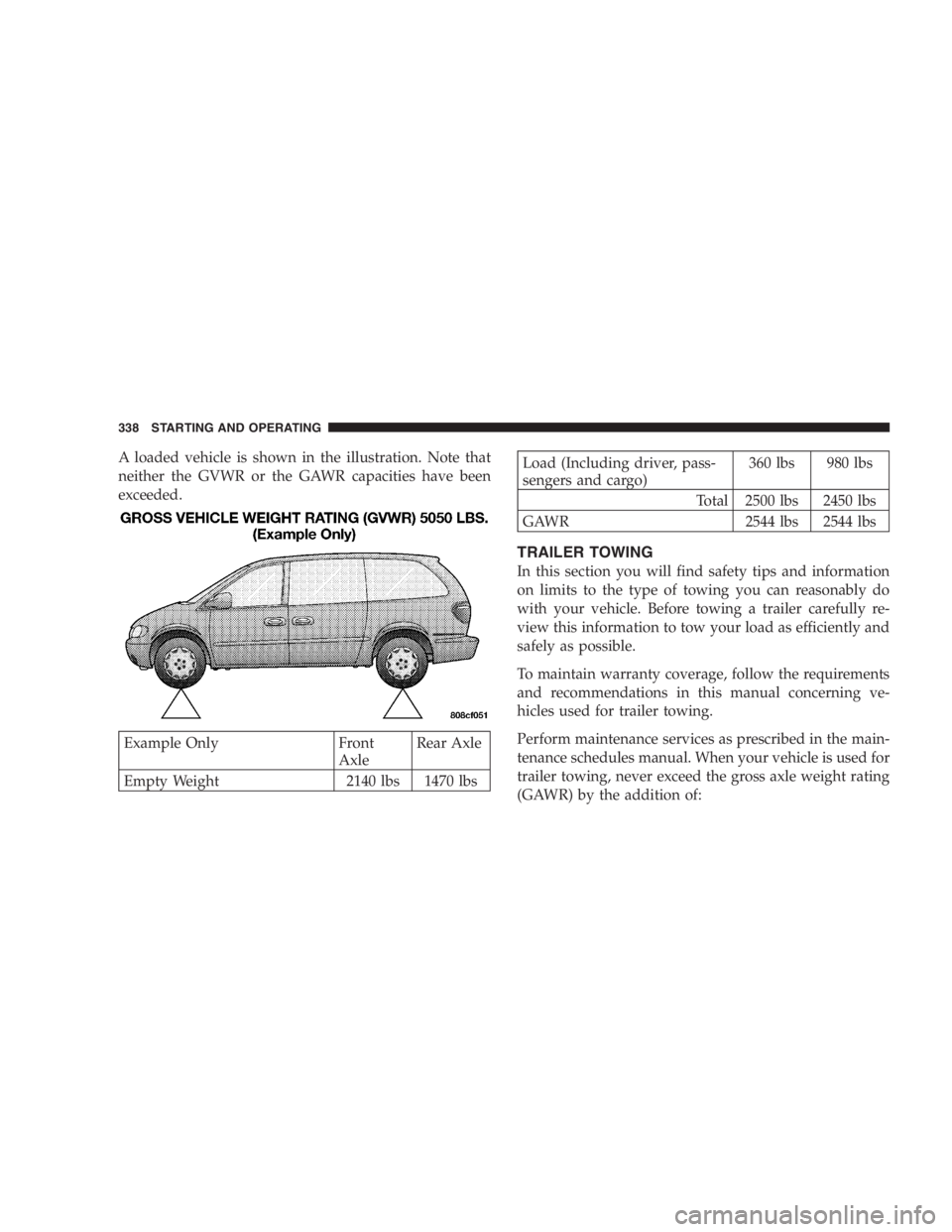
A loaded vehicle is shown in the illustration. Note that
neither the GVWR or the GAWR capacities have been
exceeded.
Example Only Front
Axle Rear Axle
Empty Weight 2140 lbs 1470 lbs Load (Including driver, pass-
sengers and cargo) 360 lbs 980 lbs
Total 2500 lbs 2450 lbs
GAWR 2544 lbs 2544 lbs
TRAILER TOWING
In this section you will find safety tips and information
on limits to the type of towing you can reasonably do
with your vehicle. Before towing a trailer carefully re-
view this information to tow your load as efficiently and
safely as possible.
To maintain warranty coverage, follow the requirements
and recommendations in this manual concerning ve-
hicles used for trailer towing.
Perform maintenance services as prescribed in the main-
tenance schedules manual. When your vehicle is used for
trailer towing, never exceed the gross axle weight rating
(GAWR) by the addition of:338 STARTING AND OPERATING
Page 339 of 480
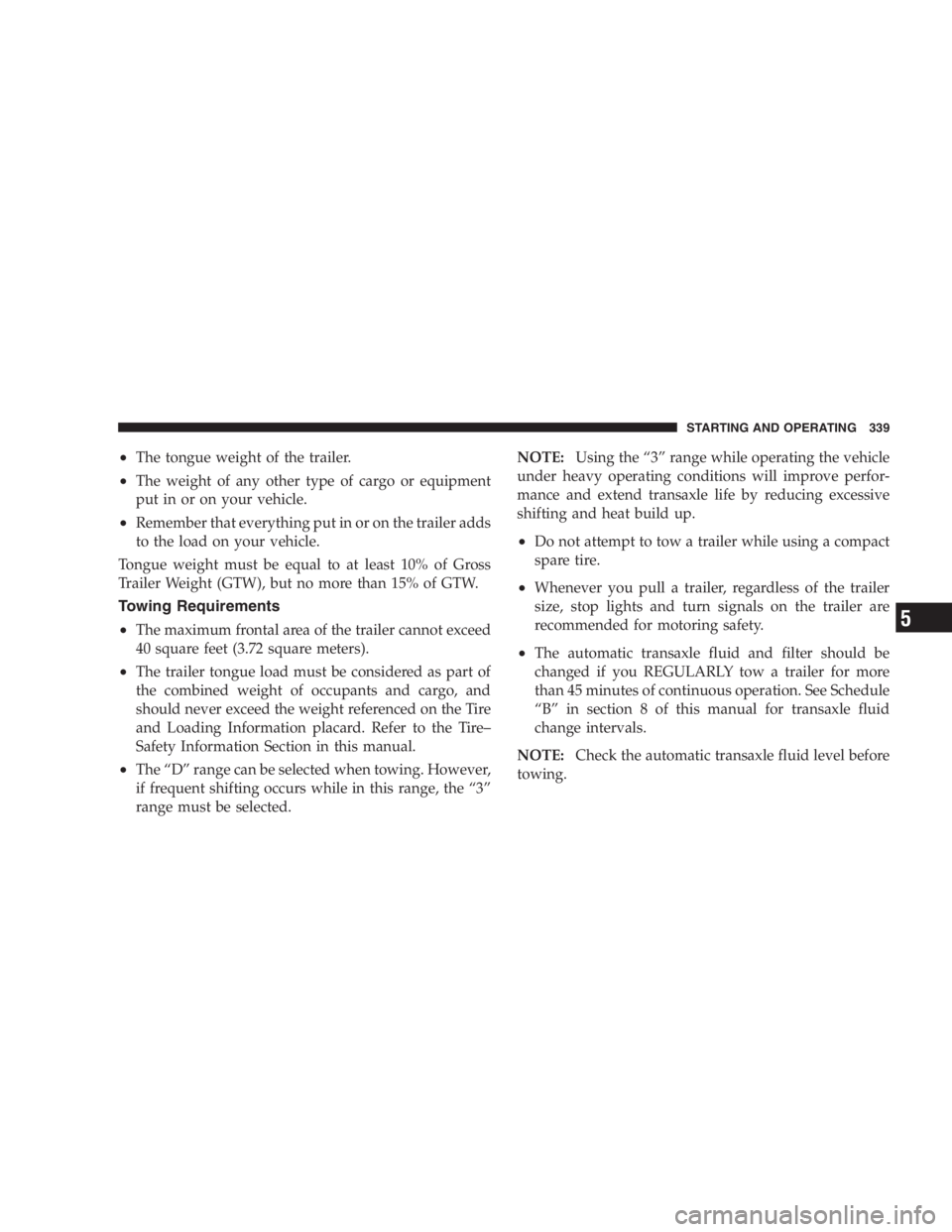
• The tongue weight of the trailer.
• The weight of any other type of cargo or equipment
put in or on your vehicle.
• Remember that everything put in or on the trailer adds
to the load on your vehicle.
Tongue weight must be equal to at least 10% of Gross
Trailer Weight (GTW), but no more than 15% of GTW.
Towing Requirements
• The maximum frontal area of the trailer cannot exceed
40 square feet (3.72 square meters).
• The trailer tongue load must be considered as part of
the combined weight of occupants and cargo, and
should never exceed the weight referenced on the Tire
and Loading Information placard. Refer to the Tire –
Safety Information Section in this manual.
• The “ D ” range can be selected when towing. However,
if frequent shifting occurs while in this range, the “ 3 ”
range must be selected. NOTE: Using the “ 3 ” range while operating the vehicle
under heavy operating conditions will improve perfor-
mance and extend transaxle life by reducing excessive
shifting and heat build up.
• Do not attempt to tow a trailer while using a compact
spare tire.
• Whenever you pull a trailer, regardless of the trailer
size, stop lights and turn signals on the trailer are
recommended for motoring safety.
• The automatic transaxle fluid and filter should be
changed if you REGULARLY tow a trailer for more
than 45 minutes of continuous operation. See Schedule
“ B ” in section 8 of this manual for transaxle fluid
change intervals.
NOTE: Check the automatic transaxle fluid level before
towing. STARTING AND OPERATING 339
5
Page 340 of 480
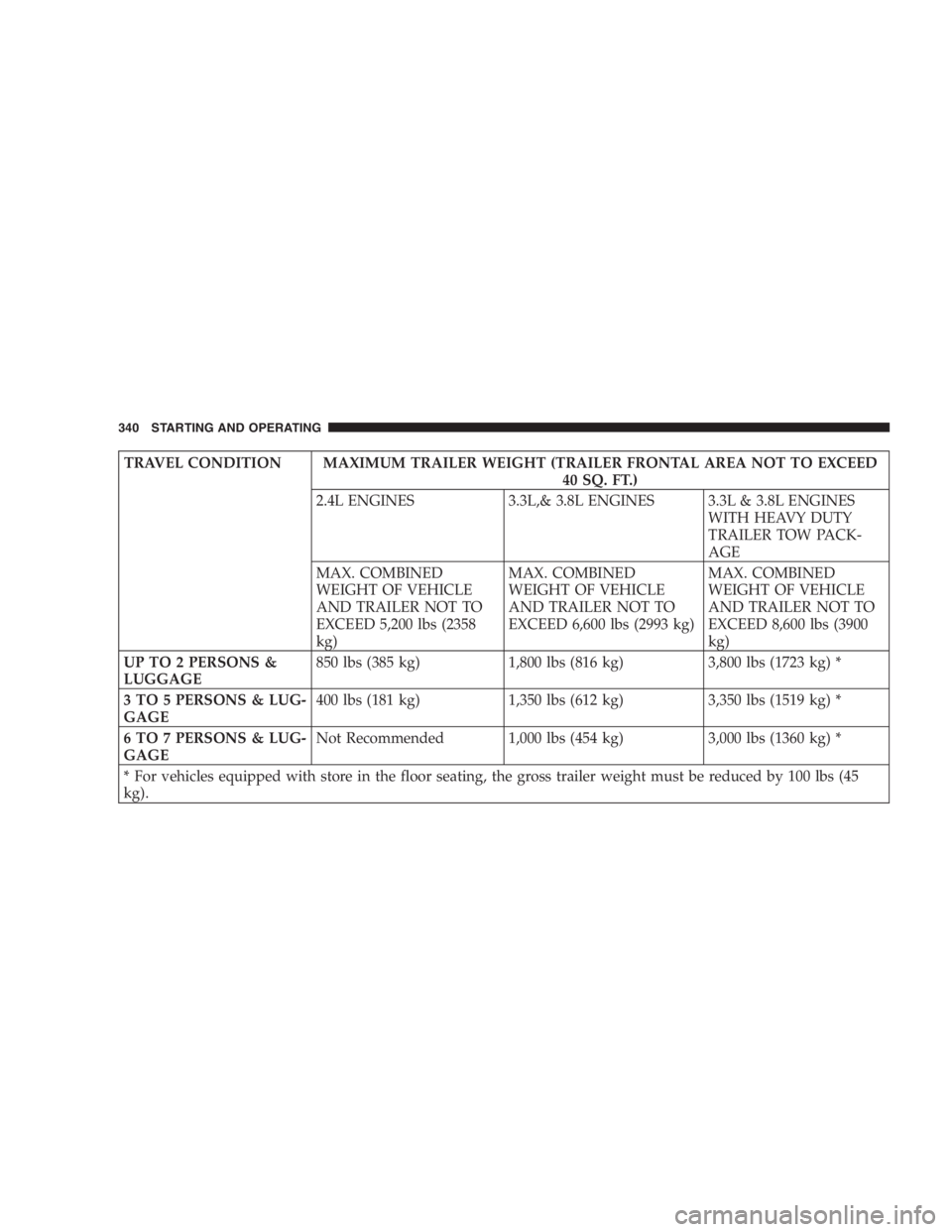
TRAVEL CONDITION MAXIMUM TRAILER WEIGHT (TRAILER FRONTAL AREA NOT TO EXCEED
40 SQ. FT.)
2.4L ENGINES 3.3L,& 3.8L ENGINES 3.3L & 3.8L ENGINES
WITH HEAVY DUTY
TRAILER TOW PACK-
AGE
MAX. COMBINED
WEIGHT OF VEHICLE
AND TRAILER NOT TO
EXCEED 5,200 lbs (2358
kg) MAX. COMBINED
WEIGHT OF VEHICLE
AND TRAILER NOT TO
EXCEED 6,600 lbs (2993 kg) MAX. COMBINED
WEIGHT OF VEHICLE
AND TRAILER NOT TO
EXCEED 8,600 lbs (3900
kg)
UP TO 2 PERSONS &
LUGGAGE 850 lbs (385 kg) 1,800 lbs (816 kg) 3,800 lbs (1723 kg) *
3 TO 5 PERSONS & LUG-
GAGE 400 lbs (181 kg) 1,350 lbs (612 kg) 3,350 lbs (1519 kg) *
6 TO 7 PERSONS & LUG-
GAGE Not Recommended 1,000 lbs (454 kg) 3,000 lbs (1360 kg) *
* For vehicles equipped with store in the floor seating, the gross trailer weight must be reduced by 100 lbs (45
kg). 340 STARTING AND OPERATING
Page 341 of 480
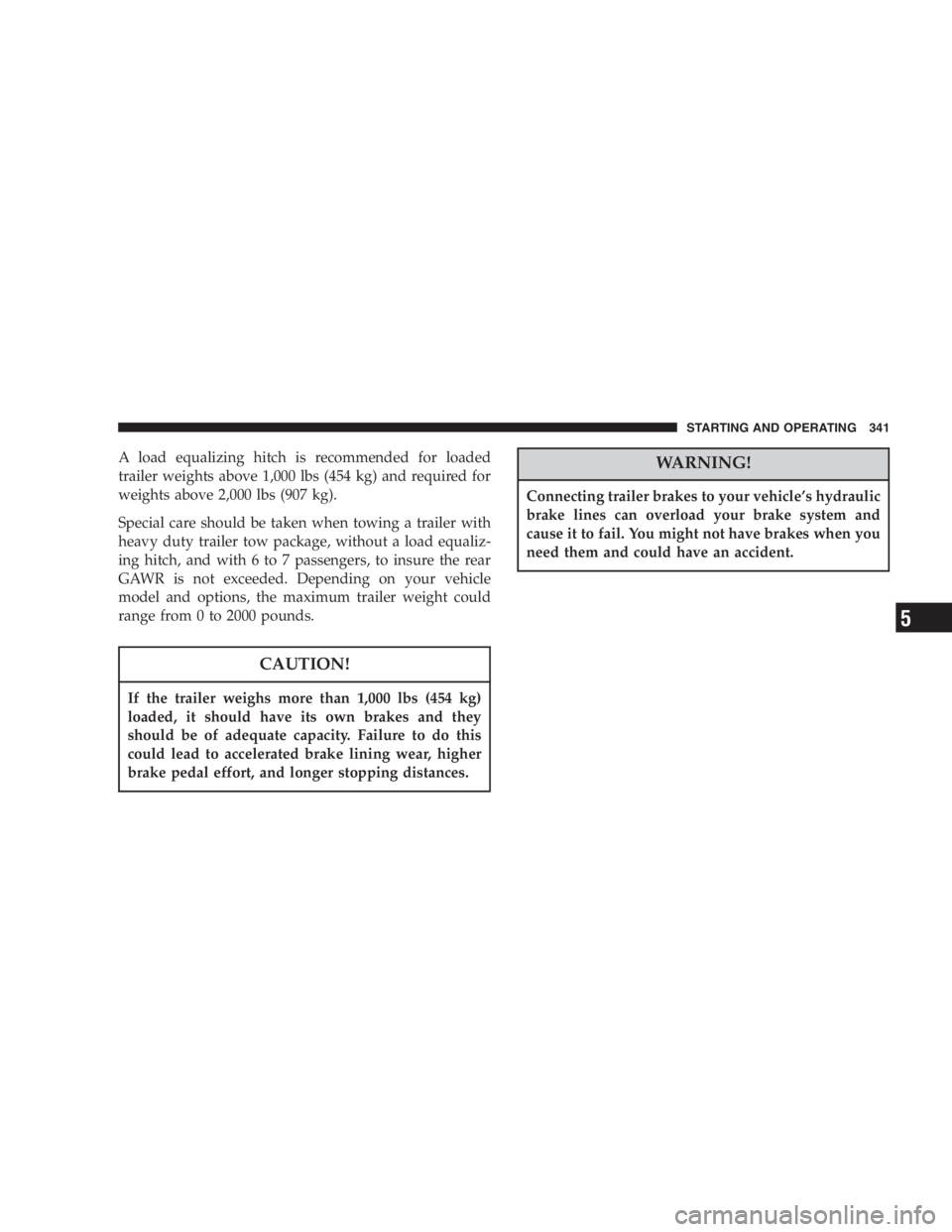
A load equalizing hitch is recommended for loaded
trailer weights above 1,000 lbs (454 kg) and required for
weights above 2,000 lbs (907 kg).
Special care should be taken when towing a trailer with
heavy duty trailer tow package, without a load equaliz-
ing hitch, and with 6 to 7 passengers, to insure the rear
GAWR is not exceeded. Depending on your vehicle
model and options, the maximum trailer weight could
range from 0 to 2000 pounds.
CAUTION!If the trailer weighs more than 1,000 lbs (454 kg)
loaded, it should have its own brakes and they
should be of adequate capacity. Failure to do this
could lead to accelerated brake lining wear, higher
brake pedal effort, and longer stopping distances. WARNING!Connecting trailer brakes to your vehicle ’ s hydraulic
brake lines can overload your brake system and
cause it to fail. You might not have brakes when you
need them and could have an accident. STARTING AND OPERATING 341
5
Page 464 of 480
Fuel System Caution ..................... 332
Fueling ............................... 334
Fuses ................................ 412
Garage Door Opener ..................... 159
GasCap .............................. 334
Gasoline .............................. 330
Gasoline, Clean Air ...................... 331
Gasoline, Reformulated ................... 331
Gauges
Coolant Temperature .................... 200
Fuel ................................ 196
Speedometer ......................... 197
Tachometer .......................... 199
Gearshift .............................. 299
General Information .................. 16,25,327
Glass Cleaning .......................... 409
Grocery Bag Retainer ..................... 127
Gross Axle Weight Rating .................. 336 Gross Vehicle Weight Rating ................ 336
Hands-Free Phone ........................ 96
Hazard Warning Flasher ................... 344
Head Phones ........................... 252
Head Restraints ......................... 109
Headlights ............................ 135
Bulb Replacement ...................... 416
High Beam/Low Beam Select Switch ........ 139
Lights On Reminder .................... 137
Replacing ............................ 416
Time Delay .......................... 138
Heated Seats ........................... 110
Heater ............................... 262
Heater, Engine Block ..................... 296
Homelink Transmitter .................... 159
Hood Release .......................... 132
Hoses ............................. 399,402464 INDEX
Page 473 of 480

Compact Spare ........................ 320
Flat Changing ........................ 355
General Information .................... 316
High Speed .......................... 319
Inflation Pressures ..................... 317
Jacking ........................ 346,347,359
Load Capacity ..................... 312,313
Pressure Monitor System ................. 325
Quality Grading ....................... 455
Radial .............................. 320
Replacement ......................... 323
Rotation ............................. 329
Safety ........................... 308,316
Sizes ............................... 309
Snow Tires ........................... 329
Spare Tire ......................... 349,360
Spinning ............................ 322
Tread Wear Indicators ................... 322 Towing ............................... 338
Disabled Vehicle ....................... 369
Trailering ............................ 338
Traction Control ................... 143,203,306
Traction Control Switch ................. 143,306
Trailer Towing .......................... 338
Minimum Requirements ................. 339
Trailer and Tongue Weight ................ 339
Transaxle ............................. 297
Automatic ........................... 297
Operation ........................... 297
Overdrive ........................... 300
Selection of Lubricant ................ 403,423
Transmission ........................... 402
Automatic ........................... 402
Filter ............................... 405
Fluid ............................ 403,423
Transmitter Battery Service .................. 26 INDEX 473
10