tire size DODGE GRAND CARAVAN 2009 5.G User Guide
[x] Cancel search | Manufacturer: DODGE, Model Year: 2009, Model line: GRAND CARAVAN, Model: DODGE GRAND CARAVAN 2009 5.GPages: 535, PDF Size: 18.61 MB
Page 369 of 535
WARNING!
Do not use a tire, wheel size or rating other than
that specified for your vehicle. Some combinations
of unapproved tires and wheels may change sus-
pension dimensions and performance characteris-
tics, resulting in changes to steering, handling, and
braking of your vehicle. This can cause unpredict-
able handling and stress to steering and suspen-
sion components. You could lose control and have
an accident resulting in serious injury or death.
Use only the tire and wheel sizes with load ratings
approved for your vehicle.
Never use a tire with a smaller load index or
capacity, than what was originally equipped on
your vehicle. Using a tire with a smaller load index
could result in tire overloading and failure. You
could lose control and have an accident.
(Continued) WARNING! (Continued)
Failure to equip your vehicle with tires having
adequate speed capability can result in sudden tire
failure and loss of vehicle control. CAUTION!
Replacing original tires with tires of a different size
may result in false speedometer and odometer read-
ings.
TIRE CHAINS
Use only compact chains, or other traction aids that meet
SAE type “Class S” specifications. Chains must be the
proper size for the vehicle, as recommended by the chain
manufacturer.
NOTE:
Do not use tire chains on a compact spare tire.
STARTING AND OPERATING 367 5
Page 371 of 535
SNOW TIRESSome areas of the country require the use of snow tires
during Winter. Standard tires are of the all-season type
and satisfy this requirement as indicated by the M+S
designation on the tire sidewall.
If you need snow tires, select tires equivalent in size and
type to the original equipment tires. Use snow tires only
in sets of four; failure to do so may adversely affect the
safety and handling of your vehicle.
Snow tires generally have lower speed ratings than what
was originally equipped with your vehicle and should
not be operated at sustained speeds over 75 mph
(120 km/h).
TIRE ROTATION
Tires on the front and rear axles of vehicles operate at
different loads and perform different steering, driving,
and braking functions. For these reasons, they wear at
unequal rates, and tend to develop irregular wear pat-
terns.
These effects can be reduced by timely rotation of tires.
The benefits of rotation are especially worthwhile with
aggressive tread designs such as those on All-Season type
tires. Rotation will increase tread life, help to maintain
mud, snow, and wet traction levels, and contribute to a
smooth, quiet ride.
Refer to the “Maintenance Schedule” in Section 8 for the
proper maintenance intervals. More frequent rotation is
permissible if desired. The reasons for any rapid or
unusual wear should be corrected prior to rotation being
performed.
STARTING AND OPERATING 369
5
Page 373 of 535
The TPMS will continue to warn the driver of low tire
pressure as long as the condition exists, and will not turn
off until the tire pressure is at or above recommended
cold tire placard pressure. Once the low tire pressure
warning has been illuminated, the tire pressure must be
increased to the recommended cold tire placard pressure
in order for the “TPMS Warning Lamp” to be turned off.
The system will automatically update and the “TPMS
Warning Lamp” will extinguish once the updated tire
pressures have been received. The vehicle may need to be
driven for up to 20 minutes above 15 mph (25 km/h) to
receive this information.
For example, your vehicle may have a recommended
cold (parked for more than three hours) tire pressure of
35 psi (241 kPa). If the ambient temperature is 68°F (20°C)
and the measured tire pressure is 30 psi (207 kPa), a
temperature drop to 20°F (-7°C) will decrease the tire
pressure to approximately 26 psi (179 kPa). This tire
pressure is sufficiently low enough to turn on the “TPMSWarning Light.” Driving the vehicle may cause the tire
pressure to rise to approximately 30 psi (207 kPa), but the
“TPMS Warning Light” will still be on. In this situation,
the “TPMS Warning Light” will turn off only after the
tires have been inflated to the vehicle’s recommended
cold tire pressure value. CAUTION!
The TPMS has been optimized for the original
equipment tires and wheels. TPMS pressures have
been established for the tire size equipped on your
vehicle. Undesirable system operation or sensor
damage may result when using replacement
equipment that is not of the same size, type, and/or
style. Aftermarket wheels can cause sensor dam-
age. Do not use aftermarket sealants or balance
beads if your vehicle is equipped with a TPMS, as
damage to the sensors may result. (Continued)
STARTING AND OPERATING 371 5
Page 392 of 535
Gross Axle Weight Rating (GAWR)The GAWR is the maximum capacity of the front and rear
axles. Distribute the load over the front and rear axles
evenly. Make sure that you do not exceed either front or
rear GAWR.
WARNING!
Because the front wheels drive and steer the vehicle,
it is important that you do not exceed the maximum
front or rear GAWR. A dangerous driving condition
can result if either rating is exceeded. You could lose
control of the vehicle and have an accident.
Tire Size
The tire size on the Vehicle Certification Label represents
the actual tire size on your vehicle. Replacement tires
must be equal to the load capacity of this tire size.
Rim Size
This is the rim size that is appropriate for the tire size
listed.
Inflation Pressure
This is the cold tire inflation pressure for your vehicle, for
all loading conditions up to full GAWR.
Curb Weight
The curb weight of a vehicle is defined as the total weight
of the vehicle with all fluids, including vehicle fuel, at full
capacity conditions, and with no occupants or cargo
loaded into the vehicle. The front and rear curb weight
values are determined by weighing your vehicle on a
commercial scale before any occupants or cargo are
added.
390 STARTING AND OPERATING
Page 423 of 535
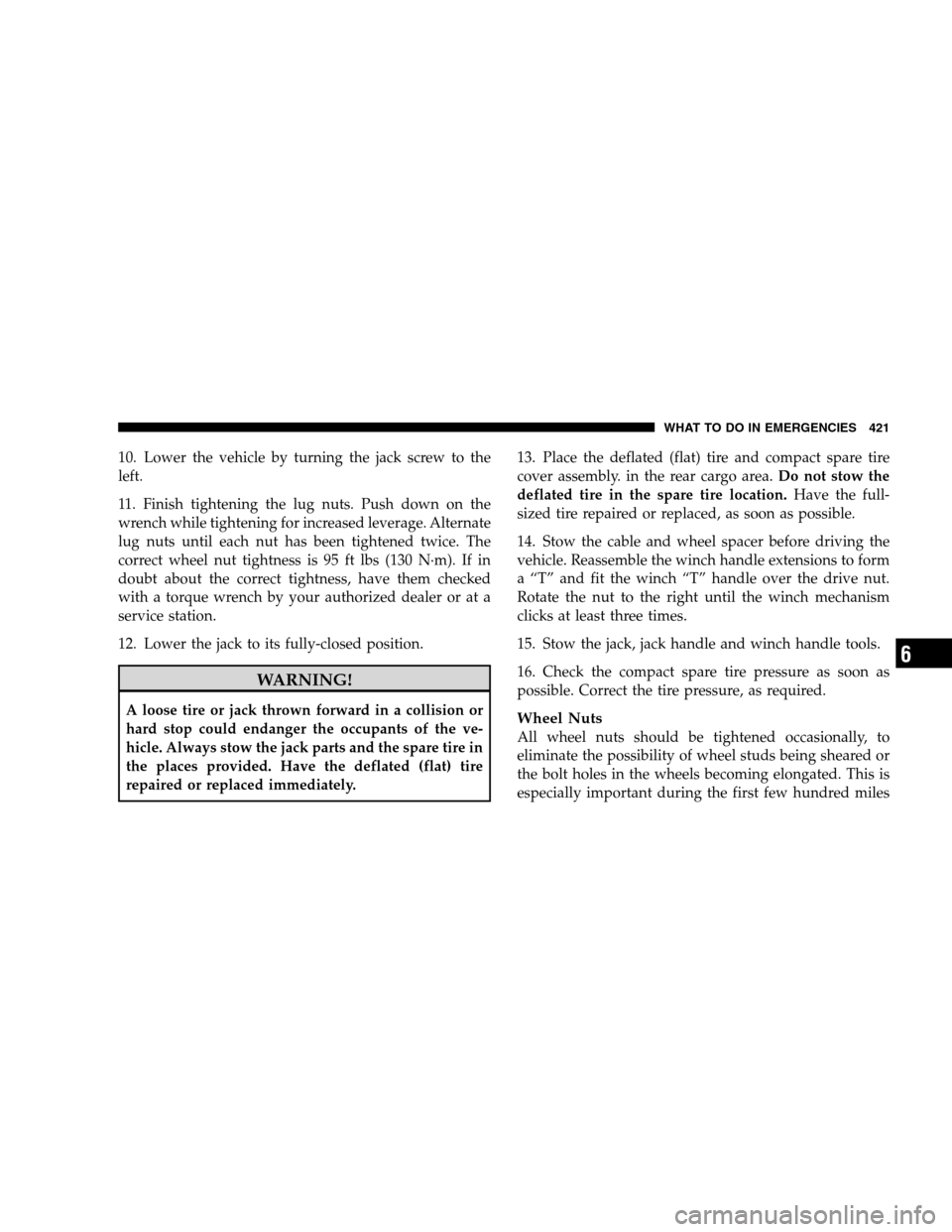
10. Lower the vehicle by turning the jack screw to the
left.
11. Finish tightening the lug nuts. Push down on the
wrench while tightening for increased leverage. Alternate
lug nuts until each nut has been tightened twice. The
correct wheel nut tightness is 95 ft lbs (130 N·m). If in
doubt about the correct tightness, have them checked
with a torque wrench by your authorized dealer or at a
service station.
12. Lower the jack to its fully-closed position.WARNING!
A loose tire or jack thrown forward in a collision or
hard stop could endanger the occupants of the ve-
hicle. Always stow the jack parts and the spare tire in
the places provided. Have the deflated (flat) tire
repaired or replaced immediately.
13. Place the deflated (flat) tire and compact spare tire
cover assembly. in the rear cargo area.
Do not stow the
deflated tire in the spare tire location. Have the full-
sized tire repaired or replaced, as soon as possible.
14. Stow the cable and wheel spacer before driving the
vehicle. Reassemble the winch handle extensions to form
a “T” and fit the winch “T” handle over the drive nut.
Rotate the nut to the right until the winch mechanism
clicks at least three times.
15. Stow the jack, jack handle and winch handle tools.
16. Check the compact spare tire pressure as soon as
possible. Correct the tire pressure, as required.Wheel Nuts
All wheel nuts should be tightened occasionally, to
eliminate the possibility of wheel studs being sheared or
the bolt holes in the wheels becoming elongated. This is
especially important during the first few hundred miles
WHAT TO DO IN EMERGENCIES 421 6
Page 426 of 535
CAUTION!For vehicles equipped with Stow ’n Got
seating, the
winch mechanism is designed specifically to stow a
compact spare tire only. Do not attempt to use the
winch to stow the full size flat tire, or any other
full-size tire. Vehicle damage may result.
JUMP-STARTING PROCEDURE WARNING!
Do not attempt to push or tow the vehicle to get it
started. Vehicles equipped with an automatic
transmission cannot be started this way. Unburned
fuel could enter the catalytic converter and once
the engine has started, ignite and damage the
converter and vehicle.
(Continued) WARNING! (Continued)
If the vehicle has a discharged battery, booster
cables may be used to obtain a start from another
vehicle. This type of start can be dangerous if done
improperly, so follow this procedure carefully.
Battery fluid is a corrosive acid solution; do not
allow battery fluid to contact eyes, skin or cloth-
ing. Do not lean over a battery when attaching
clamps, or allow the clamps to touch each other. If
acid splashes in eyes or on skin, flush the contami-
nated area immediately with large quantities of
water.
A battery generates hydrogen gas, which is flam-
mable and explosive. Keep all flames and sparks
away from the vent holes. Do not use a booster
battery or any other booster source with an output
that exceeds 12-Volts.
(Continued)
424 WHAT TO DO IN EMERGENCIES
Page 530 of 535
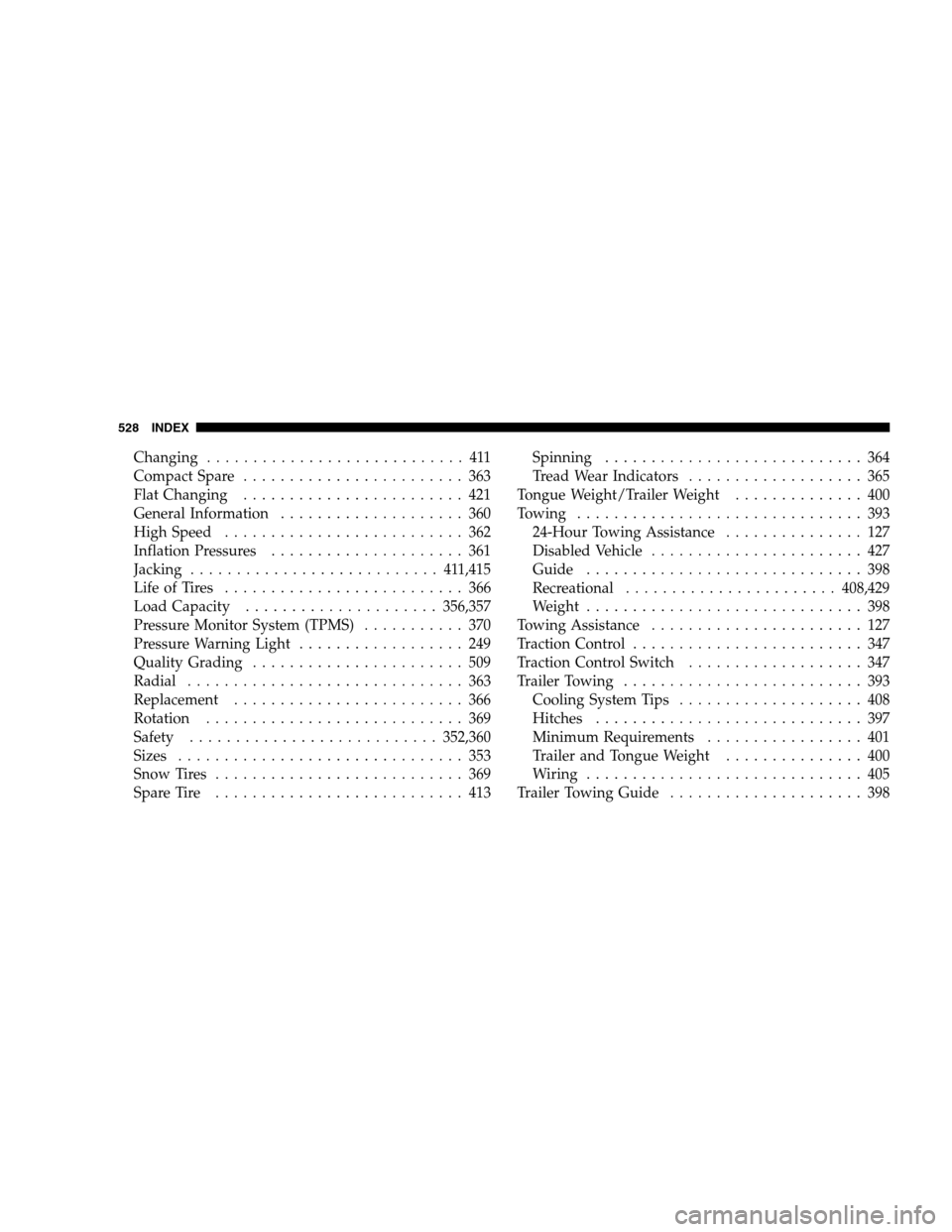
Changing . . . . . . . . . . . . . . . . . . . . . . . . . . . . 411
Compact Spare . . . . . . . . . . . . . . . . . . . . . . . . 363
Flat Changing . . . . . . . . . . . . . . . . . . . . . . . . 421
General Information . . . . . . . . . . . . . . . . . . . . 360
High Speed . . . . . . . . . . . . . . . . . . . . . . . . . . 362
Inflation Pressures . . . . . . . . . . . . . . . . . . . . . 361
Jacking . . . . . . . . . . . . . . . . . . . . . . . . . . . 411,415
Life of Tires . . . . . . . . . . . . . . . . . . . . . . . . . . 366
Load Capacity . . . . . . . . . . . . . . . . . . . . . 356,357
Pressure Monitor System (TPMS) . . . . . . . . . . . 370
Pressure Warning Light . . . . . . . . . . . . . . . . . . 249
Quality Grading . . . . . . . . . . . . . . . . . . . . . . . 509
Radial . . . . . . . . . . . . . . . . . . . . . . . . . . . . . . 363
Replacement . . . . . . . . . . . . . . . . . . . . . . . . . 366
Rotation . . . . . . . . . . . . . . . . . . . . . . . . . . . . 369
Safety . . . . . . . . . . . . . . . . . . . . . . . . . . . 352,360
Sizes . . . . . . . . . . . . . . . . . . . . . . . . . . . . . . . 353
Snow Tires . . . . . . . . . . . . . . . . . . . . . . . . . . . 369
Spare Tire . . . . . . . . . . . . . . . . . . . . . . . . . . . 413Spinning . . . . . . . . . . . . . . . . . . . . . . . . . . . . 364
Tread Wear Indicators . . . . . . . . . . . . . . . . . . . 365
Tongue Weight/Trailer Weight . . . . . . . . . . . . . . 400
Towing . . . . . . . . . . . . . . . . . . . . . . . . . . . . . . . 393
24-Hour Towing Assistance . . . . . . . . . . . . . . . 127
Disabled Vehicle . . . . . . . . . . . . . . . . . . . . . . . 427
Guide . . . . . . . . . . . . . . . . . . . . . . . . . . . . . . 398
Recreational . . . . . . . . . . . . . . . . . . . . . . . 408,429
Weight . . . . . . . . . . . . . . . . . . . . . . . . . . . . . . 398
Towing Assistance . . . . . . . . . . . . . . . . . . . . . . . 127
Traction Control . . . . . . . . . . . . . . . . . . . . . . . . . 347
Traction Control Switch . . . . . . . . . . . . . . . . . . . 347
Trailer Towing . . . . . . . . . . . . . . . . . . . . . . . . . . 393 Cooling System Tips . . . . . . . . . . . . . . . . . . . . 408
Hitches . . . . . . . . . . . . . . . . . . . . . . . . . . . . . 397
Minimum Requirements . . . . . . . . . . . . . . . . . 401
Trailer and Tongue Weight . . . . . . . . . . . . . . . 400
Wiring . . . . . . . . . . . . . . . . . . . . . . . . . . . . . . 405
Trailer Towing Guide . . . . . . . . . . . . . . . . . . . . . 398
528 INDEX