towing DODGE GRAND CARAVAN 2009 5.G Owner's Manual
[x] Cancel search | Manufacturer: DODGE, Model Year: 2009, Model line: GRAND CARAVAN, Model: DODGE GRAND CARAVAN 2009 5.GPages: 535, PDF Size: 18.61 MB
Page 405 of 535
Towing Requirements — Tires
Do not attempt to tow a trailer while using a compact
spare tire.
Proper tire inflation pressures are essential to the safe
and satisfactory operation of your vehicle. Refer to
“Tires–General Information” in this section for proper
tire inflation procedures.
Check the trailer tires for proper tire inflation pres-
sures before trailer usage.
Check for signs of tire wear or visible tire damage
before towing a trailer. Refer to “Tires–General Infor-
mation” in this section for the proper inspection
procedure.
When replacing tires, refer to “Tires–General Informa-
tion” in this section for proper tire replacement proce-
dures. Replacing tires with a higher load carrying
capacity will not increase the vehicle’s GVWR and
GAWR limits.
Towing Requirements — Trailer Brakes
Do
not interconnect the hydraulic brake system or
vacuum system of your vehicle with that of the trailer.
This could cause inadequate braking and possible
personal injury.
An electronically actuated trailer brake controller is
required when towing a trailer with electronically
actuated brakes. When towing a trailer equipped with
a hydraulic surge actuated brake system, an electronic
brake controller is not required.
Trailer brakes are recommended for trailers over
1,000 lbs (454 kg) and required for trailers in excess of
2,000 lbs (907 kg).
STARTING AND OPERATING 403 5
Page 406 of 535
CAUTION!If the trailer weighs more than 1,000 lbs (454 kg)
loaded, it should have its own brakes and they
should be of adequate capacity. Failure to do this
could lead to accelerated brake lining wear, higher
brake pedal effort, and longer stopping distances. WARNING!
Do not connect trailer brakes to your vehicle’s
hydraulic brake lines. It can overload your brake
system and cause it to fail. You might not have
brakes when you need them and could have an
accident.
Towing any trailer will increase your stopping
distance. When towing you should allow for addi-
tional space between your vehicle and the vehicle
in front of you. Failure to do so could result in an
accident.
404 STARTING AND OPERATING
Page 407 of 535
Towing Requirements — Trailer Lights and WiringWhenever you pull a trailer, regardless of the trailer size,
stop lights and turn signals on the trailer are required for
motoring safety.
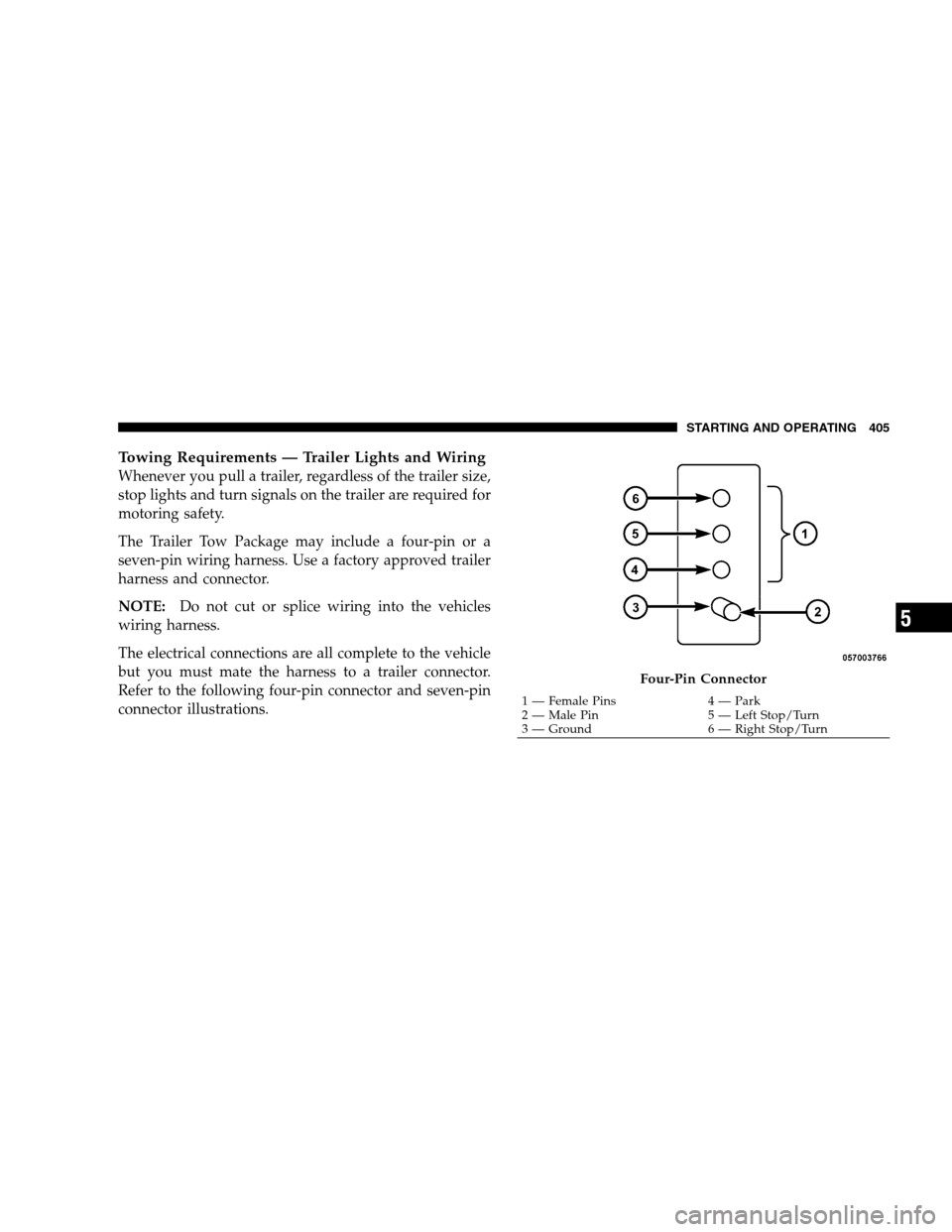
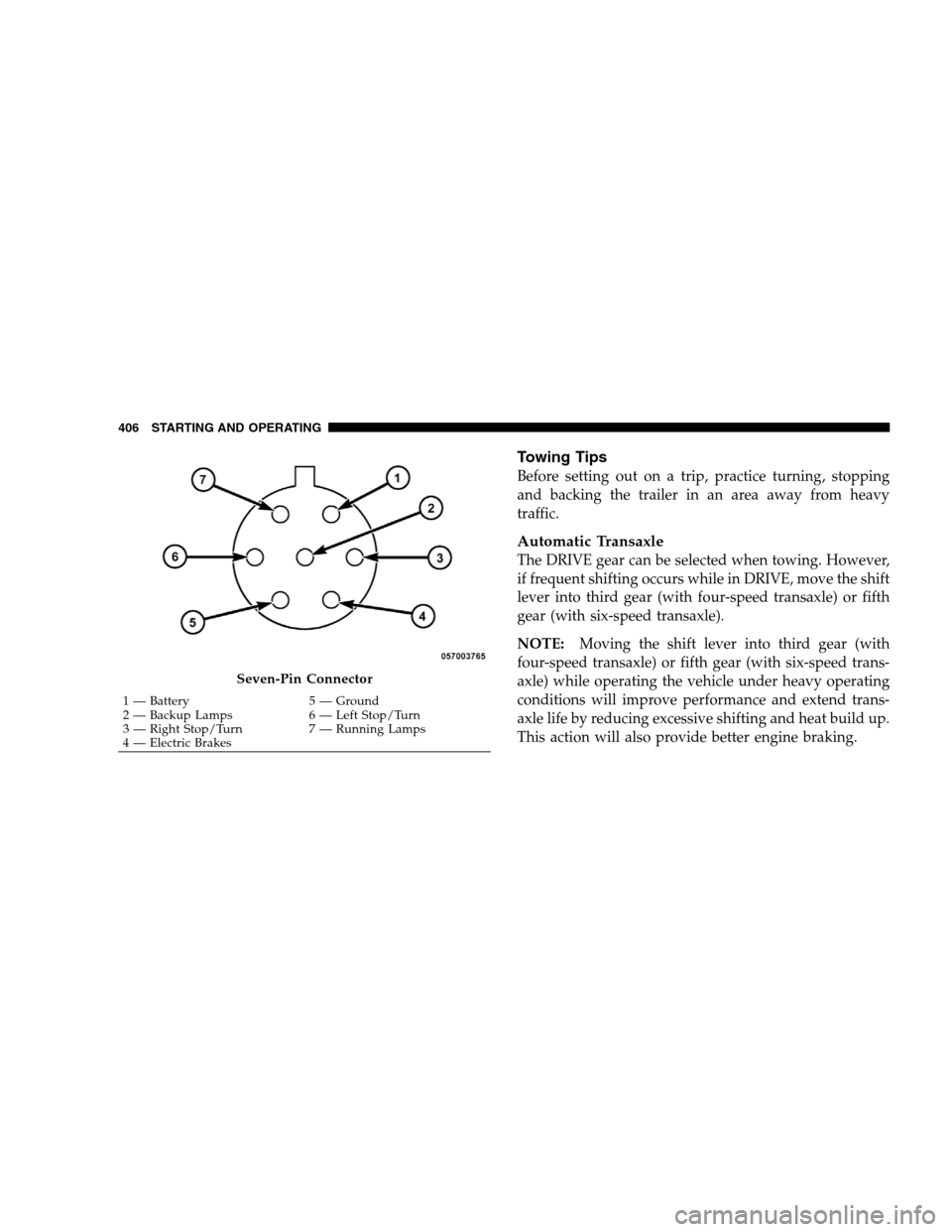
The Trailer Tow Package may include a four-pin or a
seven-pin wiring harness. Use a factory approved trailer
harness and connector.
NOTE:
Do not cut or splice wiring into the vehicles
wiring harness.
The electrical connections are all complete to the vehicle
but you must mate the harness to a trailer connector.
Refer to the following four-pin connector and seven-pin
connector illustrations. Four-Pin Connector
1 — Female Pins
4 — Park
2 —
Male Pin 5 — Left Stop/Turn
3 — Ground 6 — Right Stop/Turn
STARTING AND OPERATING 405 5
Page 408 of 535
Towing TipsBefore setting out on a trip, practice turning, stopping
and backing the trailer in an area away from heavy
traffic.
Automatic Transaxle
The DRIVE gear can be selected when towing. However,
if frequent shifting occurs while in DRIVE, move the shift
lever into third gear (with four-speed transaxle) or fifth
gear (with six-speed transaxle).
NOTE:
Moving the shift lever into third gear (with
four-speed transaxle) or fifth gear (with six-speed trans-
axle) while operating the vehicle under heavy operating
conditions will improve performance and extend trans-
axle life by reducing excessive shifting and heat build up.
This action will also provide better engine braking. Seven-Pin Connector
1 — Battery
5 — Ground
2 —
Backup Lamps 6 — Left Stop/Turn
3 — Right Stop/Turn 7 — Running Lamps
4 — Electric Brakes
406 STARTING AND OPERATING
Page 410 of 535
Cooling SystemTo reduce potential for engine and transaxle overheating,
take the following actions:
City Driving
When stopped for short periods of time, put the shift
lever in NEUTRAL but do not increase engine idle speed.
Highway Driving
Reduce speed.
Air Conditioning
Turn off temporarily.
RECREATIONAL TOWING (BEHIND
MOTORHOME, ETC.) CAUTION!
Towing this vehicle behind another vehicle (flat-
towing with all four wheels on the ground) is not
recommended.
NOTE: If the vehicle requires towing, make sure all four
wheels are off the ground.
408 STARTING AND OPERATING
Page 411 of 535
WHAT TO DO IN EMERGENCIESCONTENTS
m
Hazard Warning Flasher . . . . . . . . . . . . . . . 410
m If Your Engine Overheats . . . . . . . . . . . . . . . 410
m Jacking And Tire Changing . . . . . . . . . . . . . . 411
▫ Jack Location . . . . . . . . . . . . . . . . . . . . . . 412 m
Jump-Starting Procedure . . . . . . . . . . . . . . . 424
m Freeing A Stuck Vehicle . . . . . . . . . . . . . . . . 427
m Towing A Disabled Vehicle . . . . . . . . . . . . . . 427
▫ Towing With The Ignition Key . . . . . . . . . . 427 6
Page 429 of 535
FREEING A STUCK VEHICLEIf your vehicle becomes stuck in mud, sand or snow, it
can often be moved by a rocking motion. Turn your
steering wheel right and left to clear the area around the
front wheels. Then move the shift lever back and forth
between REVERSE and DRIVE. Using minimal accelera-
tor pedal pressure to maintain the rocking motion, with-
out spinning the wheels, is most effective.
WARNING!
Fast spinning tires can be dangerous. Forces gener-
ated by excessive wheel speeds may cause tire dam-
age or failure. A tire could explode and injure some-
one. Do not spin your vehicle’s wheels faster than
35 mph (55 km/h) when you are stuck. Do not let
anyone near a spinning wheel, no matter what the
speed. CAUTION!
Revving the engine or spinning the wheels too fast
may lead to transmission overheating and failure. It
can also damage the tires. Do not spin the wheels
above 35 mph (55 km/h).
TOWING A DISABLED VEHICLE
Towing With The Ignition Key
Your vehicle may be towed under the following condi-
tions:
The shift lever must be in NEUTRAL.
The distance to be traveled must not exceed 100 miles
(160 km).
The towing speed must not exceed 44 mph (72 km/h).
WHAT TO DO IN EMERGENCIES 427
6
Page 430 of 535
CAUTION!Exceeding these towing limits may cause a transmis-
sion gear failure.
If the transmission is inoperative, or if the vehicle is to be
towed more than 100 miles (160 km), the vehicle must be
towed with the front wheels off the ground. CAUTION!
Do not attempt to tow this vehicle from the front
with sling-type towing equipment. Damage to the
front fascia will result.
(Continued) CAUTION! (Continued)
Always use wheel lift equipment when towing
from the front. The only other approved method of
towing is with a flatbed truck.
Do not tow the vehicle from the rear. Damage to
the rear sheet metal, liftgate and fascia will occur.
Do not push or tow this vehicle with another
vehicle as damage to the bumper fascia and trans-
mission may result.
If the vehicle being towed requires steering, the
ignition switch must be in the OFF position, not in
the LOCK or ACC positions.
428 WHAT TO DO IN EMERGENCIES
Page 431 of 535
If it is necessary to use the accessories while being towed
(wipers, defrosters, etc.), the key must be in the ON
position, not the ACC position. Make certain the trans-
mission remains in NEUTRAL.
Towing Without The Ignition Key
Special care must be taken when the vehicle is towed
with the ignition in the OFF position. The only approved
method of towing without the ignition key is with a
flatbed truck. Proper towing equipment is necessary to
prevent damage to the vehicle.
Towing This Vehicle Behind Another Vehicle (Flat
Towing With All Four Wheels On The Ground)
Flat towing of vehicles equipped with an automatic
transmission, is only permitted within the limitations
described in this section.
Towing This Vehicle Behind Another Vehicle With
A Tow Dolly
The manufacturerdoes not recommend that you tow a
front wheel drive vehicle on a tow dolly. Vehicle damage
may occur.
WHAT TO DO IN EMERGENCIES 429 6
Page 437 of 535

ONBOARD DIAGNOSTIC SYSTEM — OBD IIYour vehicle is equipped with a sophisticated onboard
diagnostic system called OBD II. This system monitors
the performance of the emissions, engine, and automatic
transmission control systems. When these systems are
operating properly, your vehicle will provide excellent
performance and fuel economy, as well as engine emis-
sions well within current government regulations.
If any of these systems require service, the OBD II system
will turn on the “Malfunction Indicator Light.” It will
also store diagnostic codes and other information to
assist your service technician in making repairs. Al-
though your vehicle will usually be drivable and not
need towing, see your authorized dealer for service as
soon as possible.
CAUTION!
Prolonged driving with the “Malfunction Indica-
tor Light” on could cause further damage to the
emission control system. It could also affect fuel
economy and driveability. The vehicle must be
serviced before any emissions tests can be per-
formed.
If the “Malfunction Indicator Light” is flashing
while the engine is running, severe catalytic con-
verter damage and power loss will soon occur.
Immediate service is required.
Loose Fuel Filler Cap Message — gASCAP
Should the “Loose Fuel Filler Cap” or “gASCAP” mes-
sage appear, there may be a problem in the evaporative
system. Before taking the vehicle into an authorized
dealer, check first to see if the fuel filler cap is possibly
loose, improperly installed, or damaged. A loose fuel
MAINTAINING YOUR VEHICLE 435 7