clock DODGE GRAND CARAVAN 2013 5.G User Guide
[x] Cancel search | Manufacturer: DODGE, Model Year: 2013, Model line: GRAND CARAVAN, Model: DODGE GRAND CARAVAN 2013 5.GPages: 683, PDF Size: 5.5 MB
Page 431 of 683
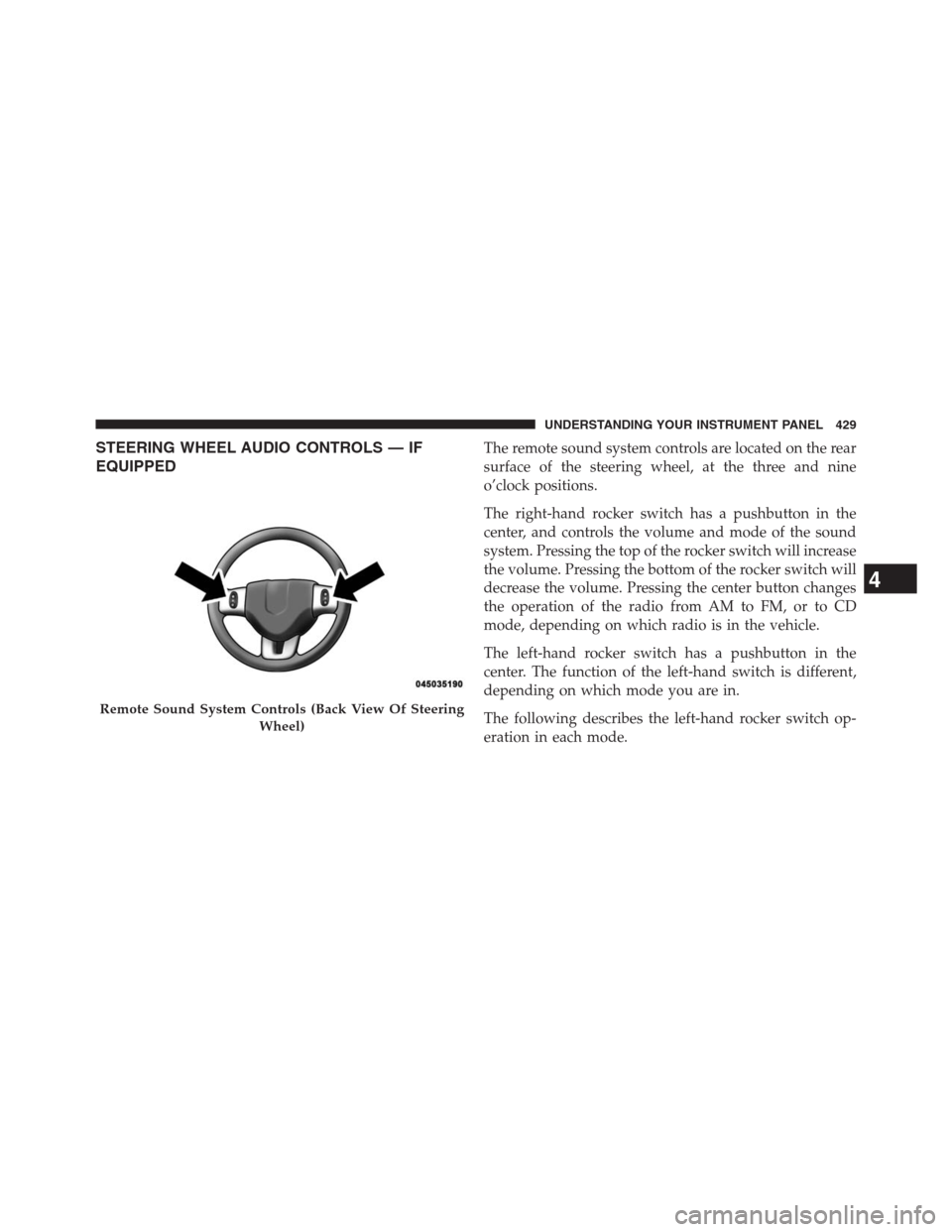
STEERING WHEEL AUDIO CONTROLS — IF
EQUIPPEDThe remote sound system controls are located on the rear
surface of the steering wheel, at the three and nine
o’clock positions.
The right-hand rocker switch has a pushbutton in the
center, and controls the volume and mode of the sound
system. Pressing the top of the rocker switch will increase
the volume. Pressing the bottom of the rocker switch will
decrease the volume. Pressing the center button changes
the operation of the radio from AM to FM, or to CD
mode, depending on which radio is in the vehicle.
The left-hand rocker switch has a pushbutton in the
center. The function of the left-hand switch is different,
depending on which mode you are in.
The following describes the left-hand rocker switch op-
eration in each mode.
Remote Sound System Controls (Back View Of Steering
Wheel)
4
UNDERSTANDING YOUR INSTRUMENT PANEL 429
Page 441 of 683
Rear Temperature Control
The rear mode selectionREAR,allows the settings to be
controlled by the rear mode control knob.
To change the temperature in the rear of the vehicle,
rotate the temperature control knob counterclockwise for
cold air, and clockwise for heated air.
When rear controls are locked by the front system, the
lock symbol on the temperature knob is illuminated, and
the rear overhead adjustments are inoperable.
Rear Mode Control
Headliner Mode
Air comes from the outlets in the headliner. Each
of these outlets can be individually adjusted to
direct the flow of air. Moving the air vanes of the outlets
to one side will shut off the airflow.Bi-Level Mode
Air comes from both the headliner outlets and the
floor outlets.
NOTE:In many temperature positions, the Bi-Level
mode is designed to provide cooler air out of the head-
liner outlets and warmer air from the floor outlets.
Floor Mode
Air comes from the floor outlets.
4
UNDERSTANDING YOUR INSTRUMENT PANEL 439
Page 448 of 683
selected. Push the button a second time to turn off the
Recirculation mode LED and allow outside air into the
vehicle.
NOTE:In cold weather, use of the Recirculation mode
may lead to excessive window fogging. The Recirculation
mode is not allowed in Defrost mode to improve window
clearing operation. Recirculation will be disabled auto-
matically if this mode is selected.
Manual Operation
This system offers a full complement of manual override
features. The AUTO symbol in the front ATC display will
be turned off when the system is being used in the
manual mode.
NOTE:Each of these features operate independently
from each other. If any one feature is controlled manually,
the temperature doors will continue to operate automati-
cally.Blower Control
There are seven fixed blower speeds.
Use the outer dial control to regulate the
amount of air forced through the system
in any mode you select. The blower
speed increases as you move the control
clockwise and decreases when you move
the control counter-clockwise.
The blower fan speed can be set to any fixed speed by
adjusting the blower control outer dial. The fan will now
operate at a fixed speed until additional speeds are
selected. This allows the front occupants to control the
volume of air circulated in the vehicle and cancel the
Auto mode.
The operator can also select the direction of the airflow
by selecting one of the following positions.
446 UNDERSTANDING YOUR INSTRUMENT PANEL
Page 451 of 683
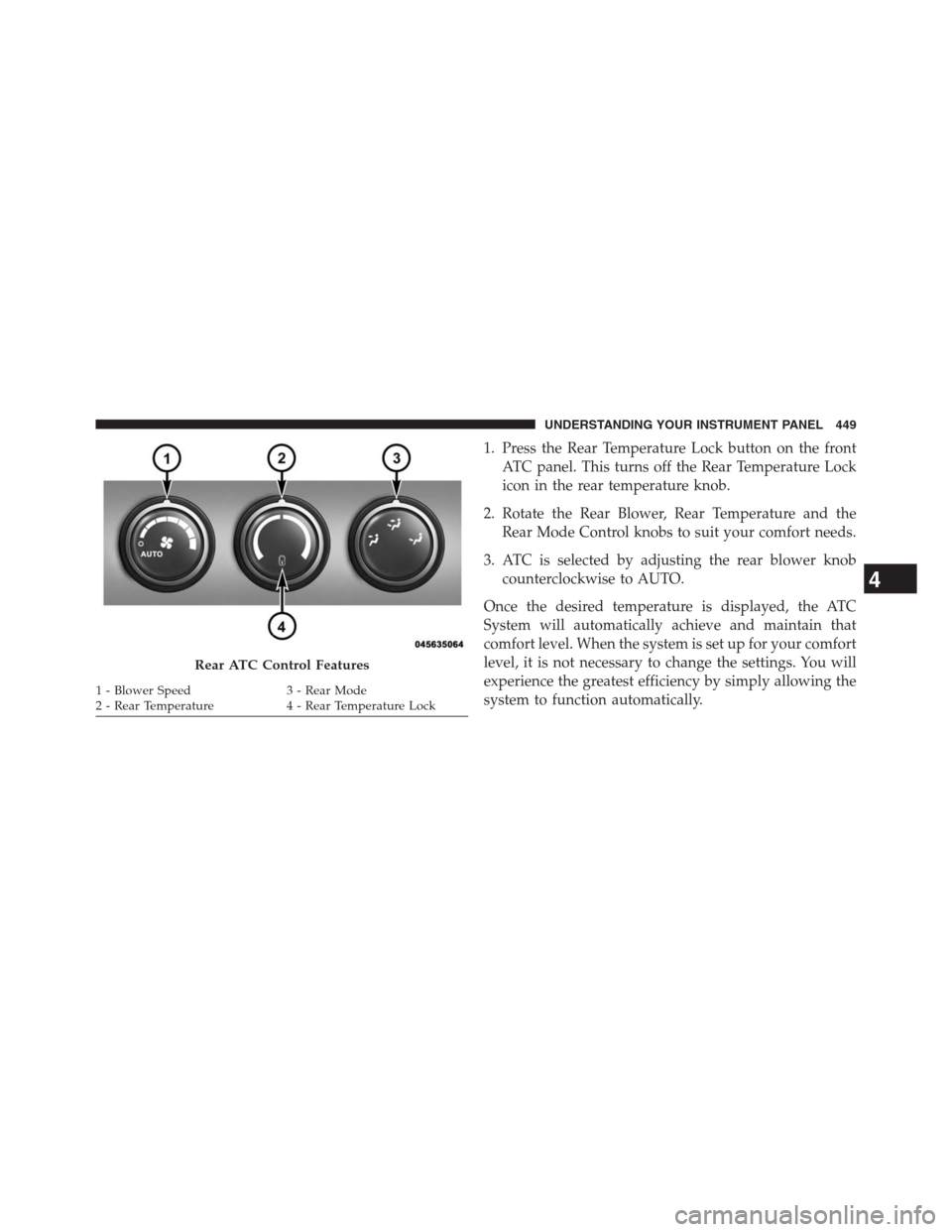
1. Press the Rear Temperature Lock button on the front
ATC panel. This turns off the Rear Temperature Lock
icon in the rear temperature knob.
2. Rotate the Rear Blower, Rear Temperature and the
Rear Mode Control knobs to suit your comfort needs.
3. ATC is selected by adjusting the rear blower knob
counterclockwise to AUTO.
Once the desired temperature is displayed, the ATC
System will automatically achieve and maintain that
comfort level. When the system is set up for your comfort
level, it is not necessary to change the settings. You will
experience the greatest efficiency by simply allowing the
system to function automatically.
Rear ATC Control Features
1 - Blower Speed 3 - Rear Mode
2 - Rear Temperature 4 - Rear Temperature Lock
4
UNDERSTANDING YOUR INSTRUMENT PANEL 449
Page 453 of 683
Rear Temperature Control
To change the temperature in the rear of the vehicle,
rotate the temperature knob counterclockwise to lower
the temperature, and clockwise to increase the tempera-
ture. The rear temperature settings are displayed in the
front ATC panel.
When rear controls are locked by the front system, the
Rear Temperature Lock symbol on the temperature knob
is illuminated and any rear overhead adjustments are
ignored.
Rear Mode Control
Auto Mode
•
The rear system automatically maintains the correct mode
and comfort level desired by the rear seat occupants.
Headliner Mode
Air comes from the outlets in the headliner. Each
of these outlets can be individually adjusted to
direct the flow of air. Moving the air vanes of the outlets
to one side will shut off the airflow.
Bi-Level Mode
Air comes from both the headliner outlets and the
floor outlets.
NOTE:In many temperature positions, the Bi-Level
mode is designed to provide cooler air out of the head-
liner outlets and warmer air from the floor outlets.
Floor Mode
Air comes from the floor outlets.
4
UNDERSTANDING YOUR INSTRUMENT PANEL 451
Page 580 of 683
3. Align the valve notch in the wheel cover with the
valve stem on the wheel. Install the cover by hand,
snapping the cover over the two lug nuts. Do not use
a hammer or excessive force to install the cover.
4. Install the remaining lug nuts with the cone shaped
end of the nut toward the wheel. Lightly tighten the
lug nuts.
WARNING!
To avoid the risk of forcing the vehicle off the jack,
do not tighten the wheel nuts fully until the vehicle
has been lowered. Failure to follow this warning may
result in personal injury.
5. Lower the vehicle to the ground by turning the jack
handle counterclockwise.6. Finish tightening the lug nuts. Push down on the
wrench while at the end of the handle for increased
leverage. Tighten the lug nuts in a star pattern until
each nut has been tightened twice. The correct tight-
ness of each lug nut is 100 ft/lbs (135 N·m). If in doubt
about the correct tightness, have them checked with a
torque wrench by your authorized dealer or service
station.
7. After 25 miles (40 km) check the lug nut torque with a
torque wrench to ensure that all lug nuts are properly
seated against the wheel.
Vehicles Without Wheel Covers
1. Mount the road tire on the axle.
2. Install the remaining lug nuts with the cone shaped
end of the nut toward the wheel. Lightly tighten the
lug nuts.
578 WHAT TO DO IN EMERGENCIES
Page 581 of 683
WARNING!
To avoid the risk of forcing the vehicle off the jack,
do not tighten the wheel nuts fully until the vehicle
has been lowered. Failure to follow this warning may
result in personal injury.
3. Lower the vehicle to the ground by turning the jack
handle counterclockwise.
4.
Finish tightening the lug nuts. Push down on the
wrench while at the end of the handle for increased
leverage. Tighten the lug nuts in a star pattern until each
nut has been tightened twice. The correct tightness of
each lug nut is 100 ft/lbs (135 N·m). If in doubt about
the correct tightness, have them checked with a torque
wrench by your authorized dealer or service station.
5. After 25 miles (40 km) check the lug nut torque with a
torque wrench to ensure that all lug nuts are properly
seated against the wheel.
JUMP-STARTING
If your vehicle has a discharged battery it can be jump-
started using a set of jumper cables and a battery in
another vehicle or by using a portable battery booster
pack. Jump-starting can be dangerous if done improperly
so please follow the procedures in this section carefully.
NOTE:When using a portable battery booster pack
follow the manufacturer ’s operating instructions and
precautions.
CAUTION!
Do not use a portable battery booster pack or any
other booster source with a system voltage greater
than 12 Volts or damage to the battery, starter motor,
alternator or electrical system may occur.
6
WHAT TO DO IN EMERGENCIES 579
Page 632 of 683
Cav-
ityCar-
tridge
FuseMini-
FuseDescription
M10 — 15 Amp
BlueIgnition Off Draw —
Video System, Satellite
Radio, DVD, Hands-
Free Module, Univer-
sal Garage Door
Opener, Vanity Lamp,
Streaming Video Mod-
ule – If Equipped
M11 — 10 Amp
RedClimate Control
System
M12 — 30 Amp
GreenAmplifier/RadioCav-
ityCar-
tridge
FuseMini-
FuseDescription
M13 — 20 Amp
YellowInstrument Cluster,
SIREN, Clock Module,
Multi-Function
Control Switch – If
Equipped
M14 — 20 Amp
YellowTrailer Tow – If
Equipped
M15 — 20 Amp
YellowRear View Mirror,
Instrument Cluster,
Multi-Function
Control Switch, Tire
Pressure Monitor,
Glow Plug Module –
If Equipped
630 MAINTAINING YOUR VEHICLE
Page 666 of 683
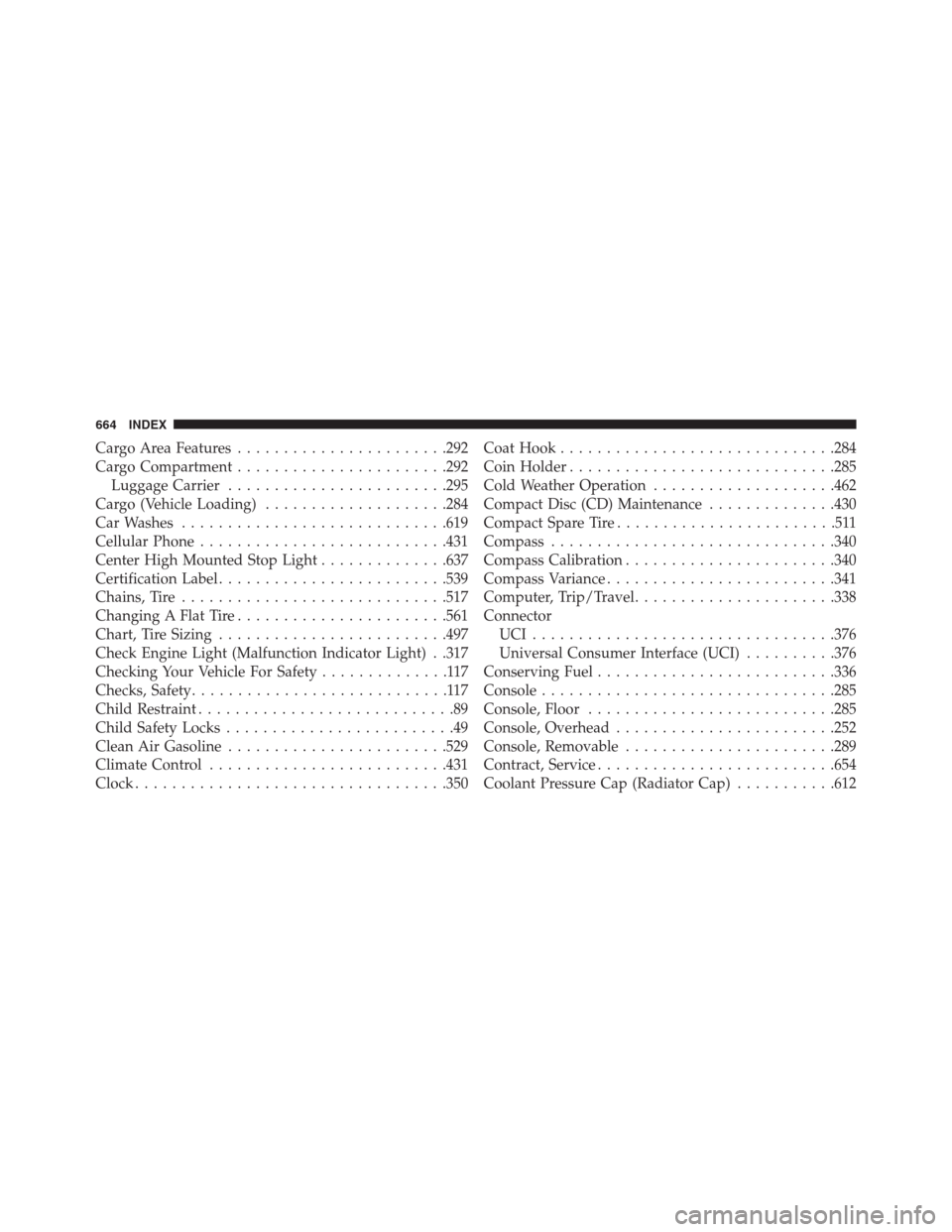
Cargo Area Features.......................292
Cargo Compartment.......................292
Luggage Carrier........................295
Cargo (Vehicle Loading)....................284
Car Washes.............................619
Cellular Phone...........................431
Center High Mounted Stop Light..............637
Certification Label.........................539
Chains, Tire.............................517
Changing A Flat Tire.......................561
Chart, Tire Sizing.........................497
Check Engine Light (Malfunction Indicator Light) . .317
Checking Your Vehicle For Safety..............117
Checks, Safety............................117
Child Restraint............................89
Child Safety Locks.........................49
Clean Air Gasoline........................529
Climate Control..........................431
Clock..................................350Coat Hook..............................284
Coin Holder.............................285
Cold Weather Operation....................462
Compact Disc (CD) Maintenance..............430
Compact Spare Tire........................511
Compass...............................340
Compass Calibration.......................340
Compass Variance.........................341
Computer, Trip/Travel......................338
Connector
UCI.................................376
Universal Consumer Interface (UCI)..........376
Conserving Fuel..........................336
Console................................285
Console, Floor...........................285
Console, Overhead........................252
Console, Removable.......................289
Contract, Service..........................654
Coolant Pressure Cap (Radiator Cap)
...........612
664 INDEX
Page 678 of 683
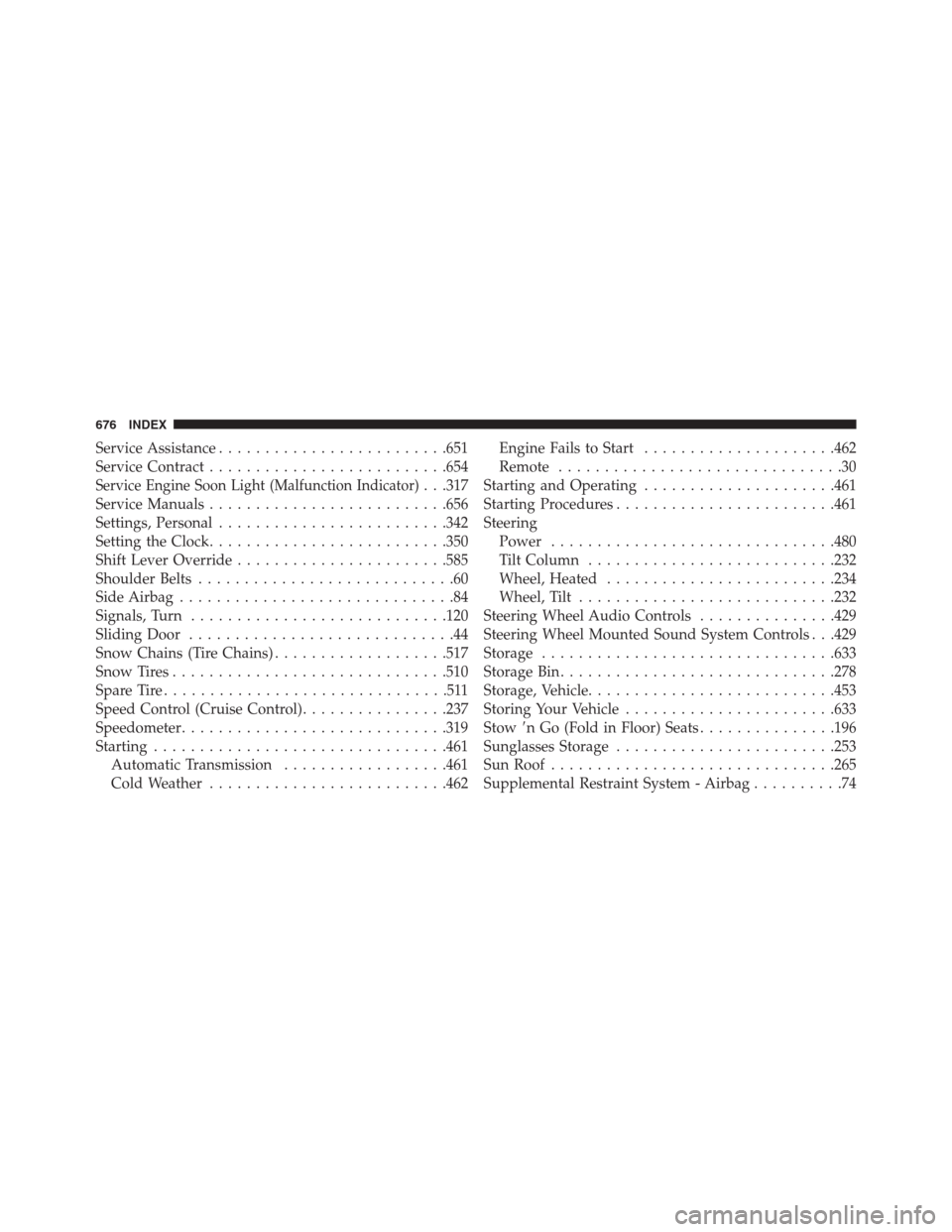
Service Assistance.........................651
Service Contract..........................654
Service Engine Soon Light (Malfunction Indicator). . .317
Service Manuals..........................656
Settings, Personal.........................342
Setting the Clock..........................350
Shift Lever Override.......................585
Shoulder Belts............................60
Side Airbag..............................84
Signals, Turn............................120
Sliding Door.............................44
Snow Chains (Tire Chains)...................517
Snow Tires..............................510
Spare Tire...............................511
Speed Control (Cruise Control)................237
Speedometer.............................319
Starting................................461
Automatic Transmission..................461
Cold Weather..........................462Engine Fails to Start.....................462
Remote...............................30
Starting and Operating.....................461
Starting Procedures........................461
Steering
Power...............................480
Tilt Column...........................232
Wheel, Heated.........................234
Wheel, Tilt............................232
Steering Wheel Audio Controls...............429
Steering Wheel Mounted Sound System Controls . . .429
Storage................................633
Storage Bin..............................278
Storage, Vehicle...........................453
Storing Your Vehicle.......................633
Stow n Go (Fold in Floor) Seats...............196
Sunglasses Storage........................253
Sun Roof...............................265
Supplemental Restraint System - Airbag..........74
676 INDEX