cooling DODGE GRAND CARAVAN 2013 5.G User Guide
[x] Cancel search | Manufacturer: DODGE, Model Year: 2013, Model line: GRAND CARAVAN, Model: DODGE GRAND CARAVAN 2013 5.GPages: 683, PDF Size: 5.5 MB
Page 610 of 683
Adding Washer Fluid
The fluid reservoir for the windshield washers and the
rear window washer is shared. It is located in the engine
compartment and should be checked at regular intervals.
Fill the reservoir with windshield washer solvent (not
radiator antifreeze) and operate the system for a few
seconds to flush out any residual water.
The washer fluid reservoir will hold a full gallon of fluid
when the Low Washer Fluid Light illuminates.
WARNING!
Commercially available windshield washer solvents
are flammable. They could ignite and burn you. Care
must be exercised when filling or working around
the washer solution.After the engine has warmed, operate the defroster for a
few minutes to reduce the possibility of smearing or
freezing the fluid on the cold windshield. MOPAR® All
Weather Windshield Washer Solution or equivalent, used
with water as directed on the container, aids cleaning
action, reduces the freezing point to avoid line clogging,
and is not harmful to paint or trim.
Cooling System
WARNING!
•When working near the radiator cooling fan,
disconnect the fan motor lead or turn the ignition
switch to the OFF position. The fan is temperature
controlled and can start at anytime the ignition
switch is in the ON position.
(Continued)
608 MAINTAINING YOUR VEHICLE
Page 611 of 683
WARNING!(Continued)
•You or others can be badly burned by hot engine
coolant (antifreeze) or steam from your radiator. If
you see or hear steam coming from under the hood,
do not open the hood until the radiator has had
time to cool. Never try to open a cooling system
pressure cap when the radiator is hot.
Coolant Checks
Check the engine coolant (antifreeze) protection every
12 months (before the onset of freezing weather, where
applicable). If the engine coolant (antifreeze) is dirty, the
system should be drained, flushed, and refilled with
fresh OAT coolant (conforming to MS-12106) only by an
authorized dealer. Check the front of the A/C condenserfor any accumulation of bugs, leaves, etc. If dirty, clean by
gently spraying water from a garden hose vertically
down the face of the condenser.
Check the coolant recovery bottle tubing for brittle rubber,
cracking , tears, cuts and tightness of the connection at the
bottle and radiator. Inspect the entire system for leaks.
With the engine at normal operating temperature (but
not running), check the cooling system pressure cap for
proper vacuum sealing by draining a small amount of
engine coolant (antifreeze) from the radiator drain cock.
If the cap is sealing properly, the engine coolant (anti-
freeze) will begin to drain from the coolant recovery
bottle. DO NOT REMOVE THE COOLANT PRESSURE
CAP WHEN THE COOLING SYSTEM IS HOT.
7
MAINTAINING YOUR VEHICLE 609
Page 612 of 683
Cooling System – Drain, Flush, And Refill
If the engine coolant (antifreeze) is dirty or contains visible
sediment, clean and flush with OAT coolant (antifreeze)
that meets the requirements of Chrysler Material Standard
MS-12106.
Refer to the “Maintenance Schedule” for the proper
maintenance intervals.
Selection Of Coolant
Refer to “Fluids, Lubricants, and Genuine Parts” in “Main-
taining Your Vehicle” for further information.
CAUTION!
•Mixing of engine coolant (antifreeze) other than
specified Organic Additive Technology (OAT) en-
gine coolant (antifreeze), may result in engine
(Continued)
CAUTION!(Continued)
damage and may decrease corrosion protection.
Organic Additive Technology (OAT) engine cool-
ant is different and should not be mixed with
Hybrid Organic Additive Technology (HOAT) en-
gine coolant (antifreeze) or any “globally compat-
ible” coolant (antifreeze). If a non-OAT engine
coolant (antifreeze) is introduced into the cooling
system in an emergency, it should be flushed with
OAT coolant and replaced with the specified OAT
engine coolant (antifreeze) as soon as possible.
•Do not use water alone or alcohol-based engine
coolant (antifreeze) products. Do not use additional
rust inhibitors or antirust products, as they may not
be compatible with the radiator engine coolant and
may plug the radiator.
(Continued)
610 MAINTAINING YOUR VEHICLE
Page 613 of 683
CAUTION!(Continued)
•This vehicle has not been designed for use with
propylene glycol-based engine coolant (antifreeze).
Use of propylene glycol-based engine coolant (an-
tifreeze) is not recommended.
Adding Coolant
Your vehicle has been built with an improved engine
coolant (OAT coolant conforming to MS-12106) that allows
extended maintenance intervals. This engine coolant (anti-
freeze) can be used up to ten years or 150,000 miles
(240,000 km) before replacement. To prevent reducing this
extended maintenance period, it is important that you use
the same engine coolant (OAT coolant conforming to
MS-12106) throughout the life of your vehicle.
Please review these recommendations for using Organic
Additive Technology (OAT) engine coolant (antifreeze)
that meets the requirements of Chrysler Material Stan-
dard MS-12106. When adding engine coolant (antifreeze):
•We recommend using MOPAR® Antifreeze/Coolant
10 Year/150,000 Mile Formula OAT (Organic Additive
Technology) that meets the requirements of Chrysler
Material Standard MS-12106.
•Mix a minimum solution of 50% OAT engine coolant
that meets the requirements of Chrysler Material Stan-
dard MS-12106 and distilled water. Use higher concen-
trations (not to exceed 70%) if temperatures below
34° F (37° C) are anticipated.
•Use only high purity water such as distilled or deion-
ized water when mixing the water/engine coolant
(antifreeze) solution. The use of lower quality water
will reduce the amount of corrosion protection in the
engine cooling system.
7
MAINTAINING YOUR VEHICLE 611
Page 614 of 683
Please note that it is the owner’s responsibility to main-
tain the proper level of protection against freezing ac-
cording to the temperatures occurring in the area where
the vehicle is operated.
NOTE:Mixing engine coolant (antifreeze) types is not
recommended and can result in cooling system damage.
Drain, flush, and refill as soon as possible to avoid
damage if coolant types are mixed in an emergency.
Cooling System Pressure Cap
The cap must be fully tightened to prevent loss of engine
coolant (antifreeze), and to ensure that engine coolant
(antifreeze) will return to the radiator from the coolant
recovery tank.
The cap should be inspected and cleaned if there is any
accumulation of foreign material on the sealing surfaces.
WARNING!
•The warning words “DO NOT OPEN HOT” on the
cooling system pressure cap are a safety precaution.
Never add engine coolant (antifreeze) when the
engine is overheated. Do not loosen or remove the
cap to cool an overheated engine. Heat causes
pressure to build up in the cooling system. To
prevent scalding or injury, do not remove the
pressure cap while the system is hot or under
pressure.
•Do not use a pressure cap other than the one
specified for your vehicle. Personal injury or en-
gine damage may result.
612 MAINTAINING YOUR VEHICLE
Page 616 of 683
If an examination of your engine compartment shows no
evidence of radiator or hose leaks, the vehicle may be
safely driven. The vapor will soon dissipate.
•Do not overfill the coolant expansion bottle.
•
Check the coolant freeze point in the radiator and in the
coolant expansion bottle. If engine coolant (antifreeze)
needs to be added, the contents of the coolant expansion
bottle must also be protected against freezing.
•If frequent engine coolant (antifreeze) additions are
required, the cooling system should be pressure tested
for leaks.
•
Maintain engine coolant (antifreeze) concentration at a
minimum of 50% OAT coolant (conforming to MS-12106)
and distilled water for proper corrosion protection of
your engine which contains aluminum components.
•Make sure that the coolant expansion bottle overflow
hoses are not kinked or obstructed.
•Keep the front of the radiator clean. If your vehicle is
equipped with air conditioning, keep the front of the
condenser clean.
•
Do not change the thermostat for Summer or Winter
operation. If replacement is ever necessary, install ONLY
the correct type thermostat. Other designs may result in
unsatisfactory engine coolant (antifreeze) performance,
poor gas mileage, and increased emissions.
614 MAINTAINING YOUR VEHICLE
Page 640 of 683
3. Push the bulb into the socket, twist the socket into the
lamp assembly and reinstall the lamp assembly into
place ensuring the locking tab is secure.
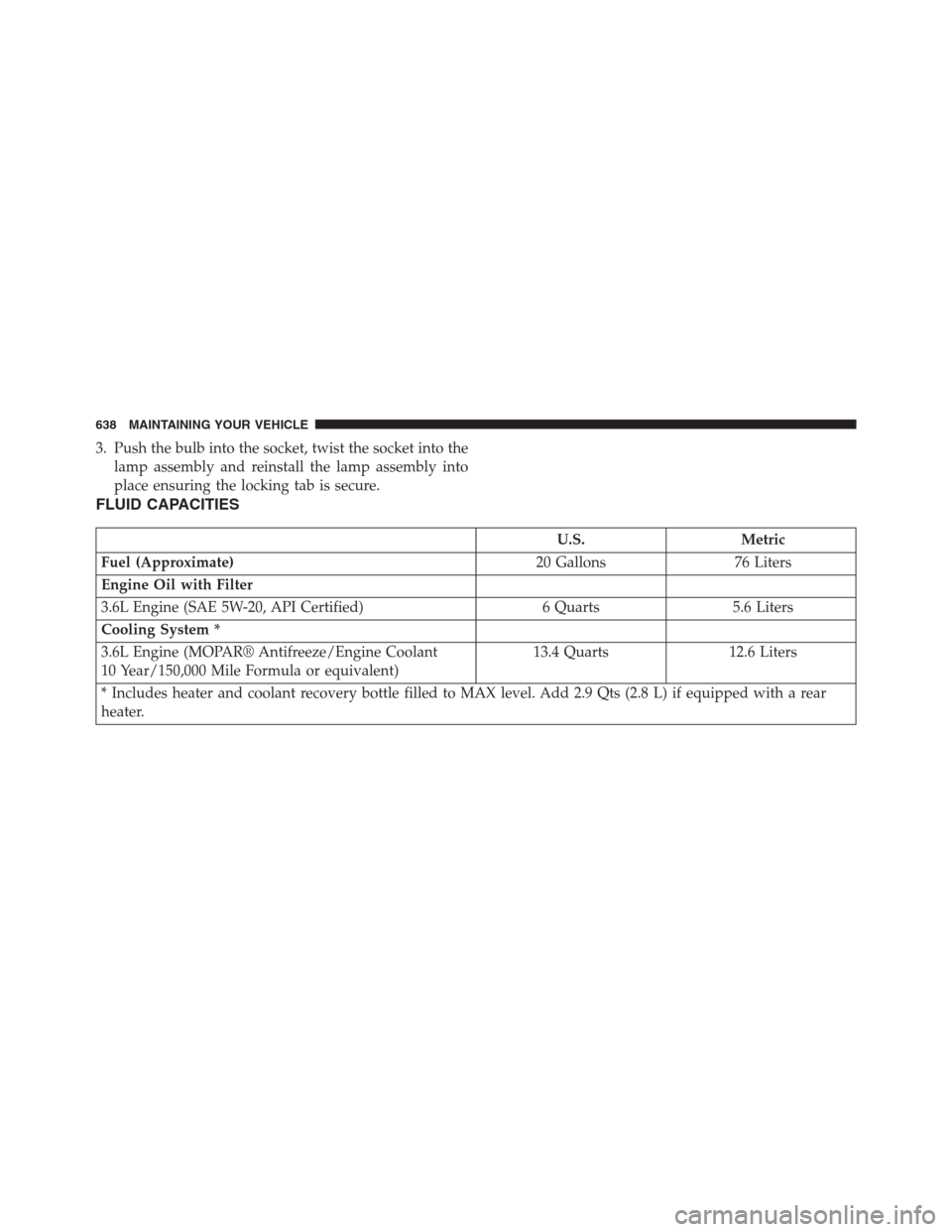
FLUID CAPACITIES
U.S. Metric
Fuel (Approximate)20 Gallons 76 Liters
Engine Oil with Filter
3.6L Engine (SAE 5W-20, API Certified) 6 Quarts 5.6 Liters
Cooling System *
3.6L Engine (MOPAR® Antifreeze/Engine Coolant
10 Year/150,000 Mile Formula or equivalent)13.4 Quarts 12.6 Liters
* Includes heater and coolant recovery bottle filled to MAX level. Add 2.9 Qts (2.8 L) if equipped with a rear
heater.
638 MAINTAINING YOUR VEHICLE
Page 645 of 683
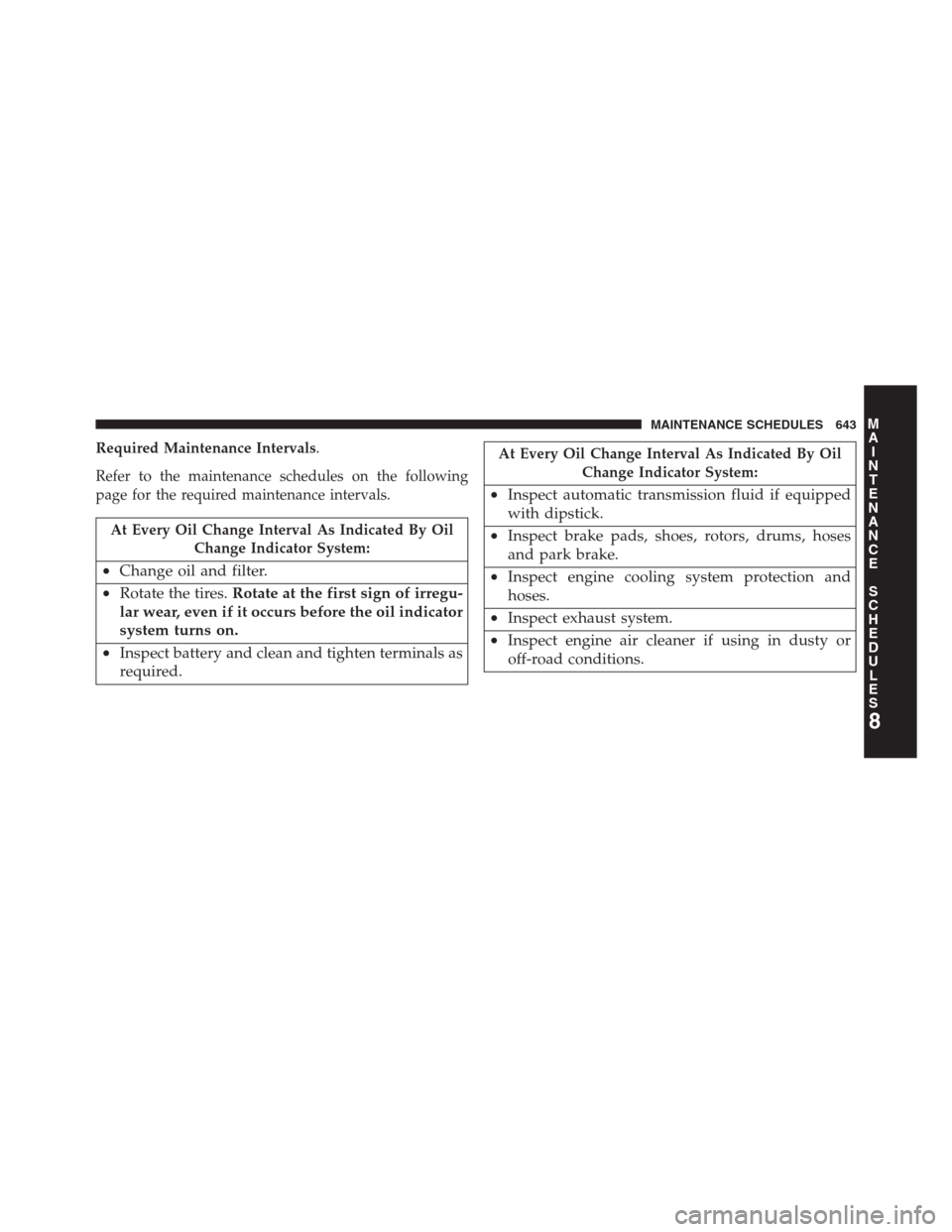
Required Maintenance Intervals.
Refer to the maintenance schedules on the following
page for the required maintenance intervals.
At Every Oil Change Interval As Indicated By Oil
Change Indicator System:
•Change oil and filter.
•Rotate the tires.Rotate at the first sign of irregu-
lar wear, even if it occurs before the oil indicator
system turns on.
•Inspect battery and clean and tighten terminals as
required.
At Every Oil Change Interval As Indicated By Oil
Change Indicator System:
•Inspect automatic transmission fluid if equipped
with dipstick.
•Inspect brake pads, shoes, rotors, drums, hoses
and park brake.
•Inspect engine cooling system protection and
hoses.
•Inspect exhaust system.
•Inspect engine air cleaner if using in dusty or
off-road conditions.
8
M
A
I
N
T
E
N
A
N
C
E
S
C
H
E
D
U
L
E
SMAINTENANCE SCHEDULES 643
Page 667 of 683
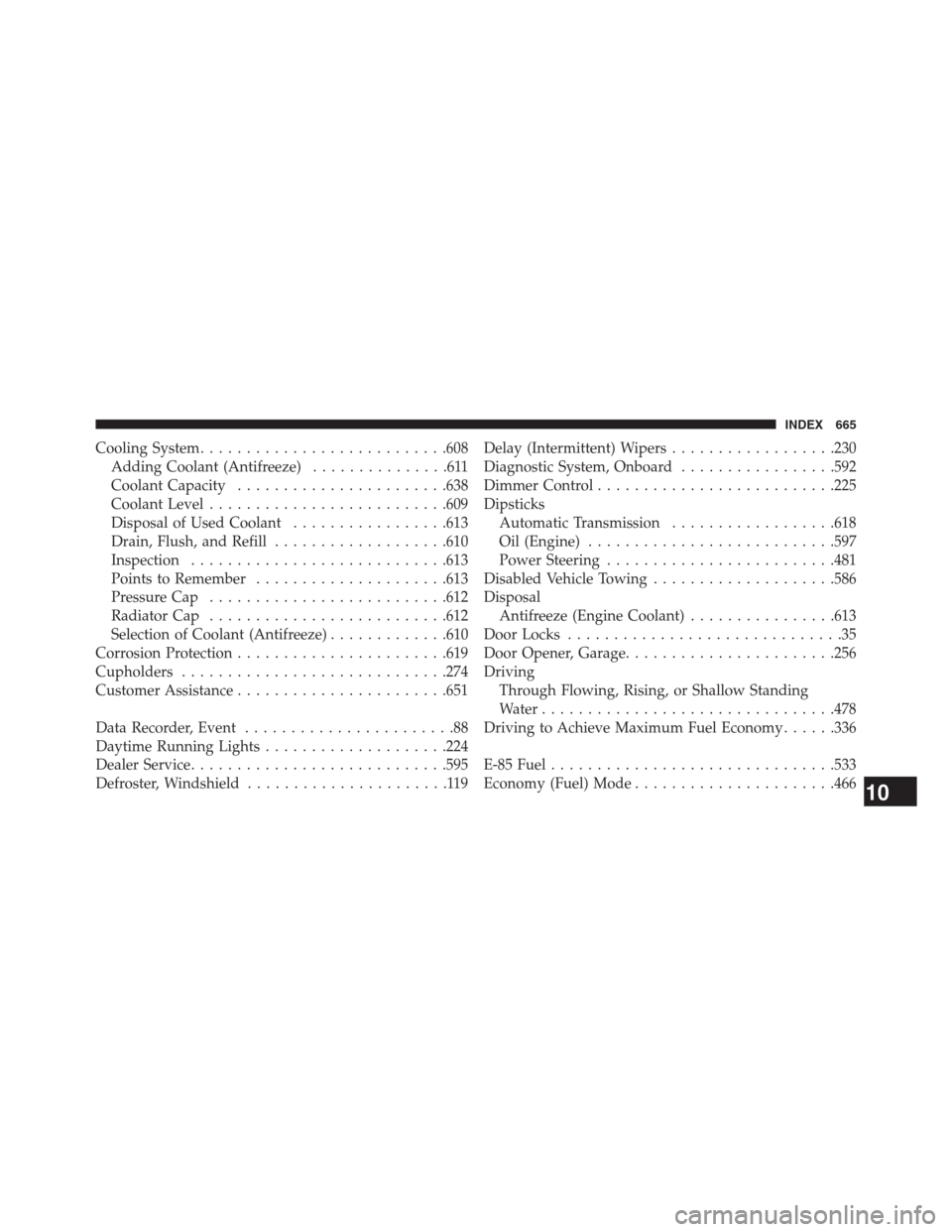
Cooling System...........................608
Adding Coolant (Antifreeze)...............611
Coolant Capacity.......................638
Coolant Level..........................609
Disposal of Used Coolant.................613
Drain, Flush, and Refill...................610
Inspection............................613
Points to Remember.....................613
Pressure Cap..........................612
Radiator Cap..........................612
Selection of Coolant (Antifreeze).............610
Corrosion Protection.......................619
Cupholders.............................274
Customer Assistance.......................651
Data Recorder, Event.......................88
Daytime Running Lights....................224
Dealer Service............................595
Defroster, Windshield......................119Delay (Intermittent) Wipers..................230
Diagnostic System, Onboard.................592
Dimmer Control..........................225
Dipsticks
Automatic Transmission..................618
Oil (Engine)...........................597
Power Steering.........................481
Disabled Vehicle Towing....................586
Disposal
Antifreeze (Engine Coolant)................613
Door Locks..............................35
Door Opener, Garage.......................256
Driving
Through Flowing, Rising, or Shallow Standing
Water................................478
Driving to Achieve Maximum Fuel Economy......336
E-85 Fuel...............................533
Economy (Fuel) Mode......................466
10
INDEX 665
Page 668 of 683
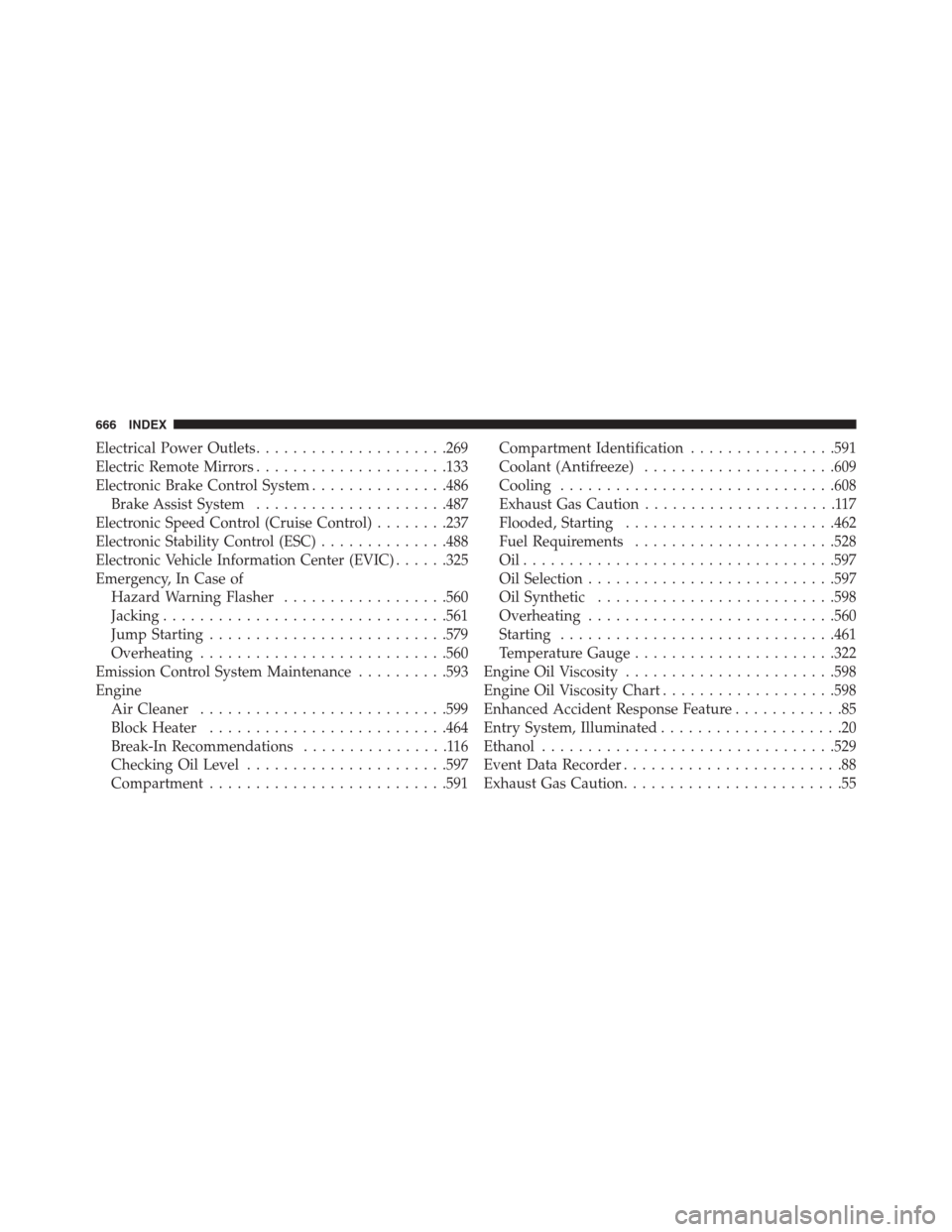
Electrical Power Outlets.....................269
Electric Remote Mirrors.....................133
Electronic Brake Control System...............486
Brake Assist System.....................487
Electronic Speed Control (Cruise Control)........237
Electronic Stability Control (ESC)..............488
Electronic Vehicle Information Center (EVIC)......325
Emergency, In Case of
Hazard Warning Flasher..................560
Jacking...............................561
Jump Starting..........................579
Overheating...........................560
Emission Control System Maintenance..........593
Engine
Air Cleaner...........................599
Block Heater..........................464
Break-In Recommendations................116
Checking Oil Level......................597
Compartment..........................591Compartment Identification................591
Coolant (Antifreeze).....................609
Cooling..............................608
Exhaust Gas Caution.....................117
Flooded, Starting.......................462
Fuel Requirements......................528
Oil..................................597
Oil Selection...........................597
Oil Synthetic..........................598
Overheating...........................560
Starting..............................461
Temperature Gauge......................322
Engine Oil Viscosity.......................598
Engine Oil Viscosity Chart...................598
Enhanced Accident Response Feature............85
Entry System, Illuminated....................20
Ethanol................................529
Event Data Recorder........................88
Exhaust Gas Caution........................55
666 INDEX