rear DODGE GRAND CARAVAN 2013 5.G Owner's Guide
[x] Cancel search | Manufacturer: DODGE, Model Year: 2013, Model line: GRAND CARAVAN, Model: DODGE GRAND CARAVAN 2013 5.GPages: 683, PDF Size: 5.5 MB
Page 96 of 683
Children Too Large For Booster Seats
Children who are large enough to wear the shoulder belt
comfortably, and whose legs are long enough to bend
over the front of the seat when their back is against the
seatback, should use the seat belt in a rear seat. Use this
simple 5-step test to decide whether the child can use the
vehicle’s seat belt alone:
1. Can the child sit all the way back against the back of
the vehicle seat?
2. Do the child’s knees bend comfortably over the front
of the vehicle seat – while they are still sitting all the
way back?
3. Does the shoulder belt cross the child’s shoulder
between their neck and arm?4. Is the lap part of the belt as low as possible, touching
the child’s thighs and not their stomach?
5. Can the child stay seated like this for the whole trip?
If the answer to any of these questions was “no,” then the
child still needs to use a booster seat in this vehicle. If the
child is using the lap/shoulder belt, check belt fit peri-
odically. A child’s squirming or slouching can move the
belt out of position. If the shoulder belt contacts the face
or neck, move the child closer to the center of the vehicle.
Never allow a child to put the shoulder belt under an arm
or behind their back.
94 THINGS TO KNOW BEFORE STARTING YOUR VEHICLE
Page 97 of 683
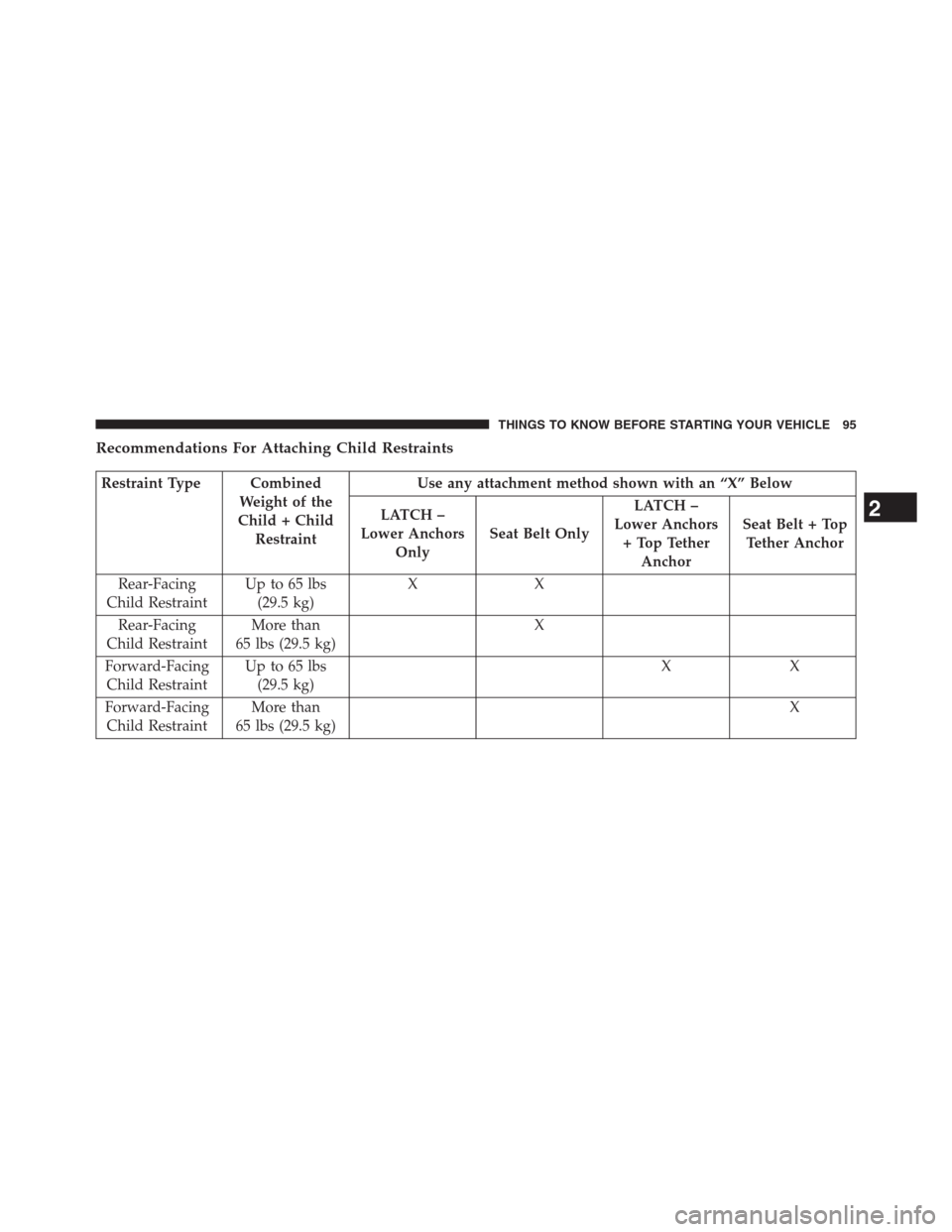
Recommendations For Attaching Child Restraints
Restraint Type Combined
Weight of the
Child + Child
RestraintUse any attachment method shown with an “X” Below
LATCH –
Lower Anchors
OnlySeat Belt OnlyLATCH –
Lower Anchors
+ Top Tether
AnchorSeat Belt + Top
Tether Anchor
Rear-Facing
Child RestraintUp to 65 lbs
(29.5 kg)XX
Rear-Facing
Child RestraintMore than
65 lbs (29.5 kg)X
Forward-Facing
Child RestraintUp to 65 lbs
(29.5 kg)XX
Forward-Facing
Child RestraintMore than
65 lbs (29.5 kg)X
2
THINGS TO KNOW BEFORE STARTING YOUR VEHICLE 95
Page 100 of 683
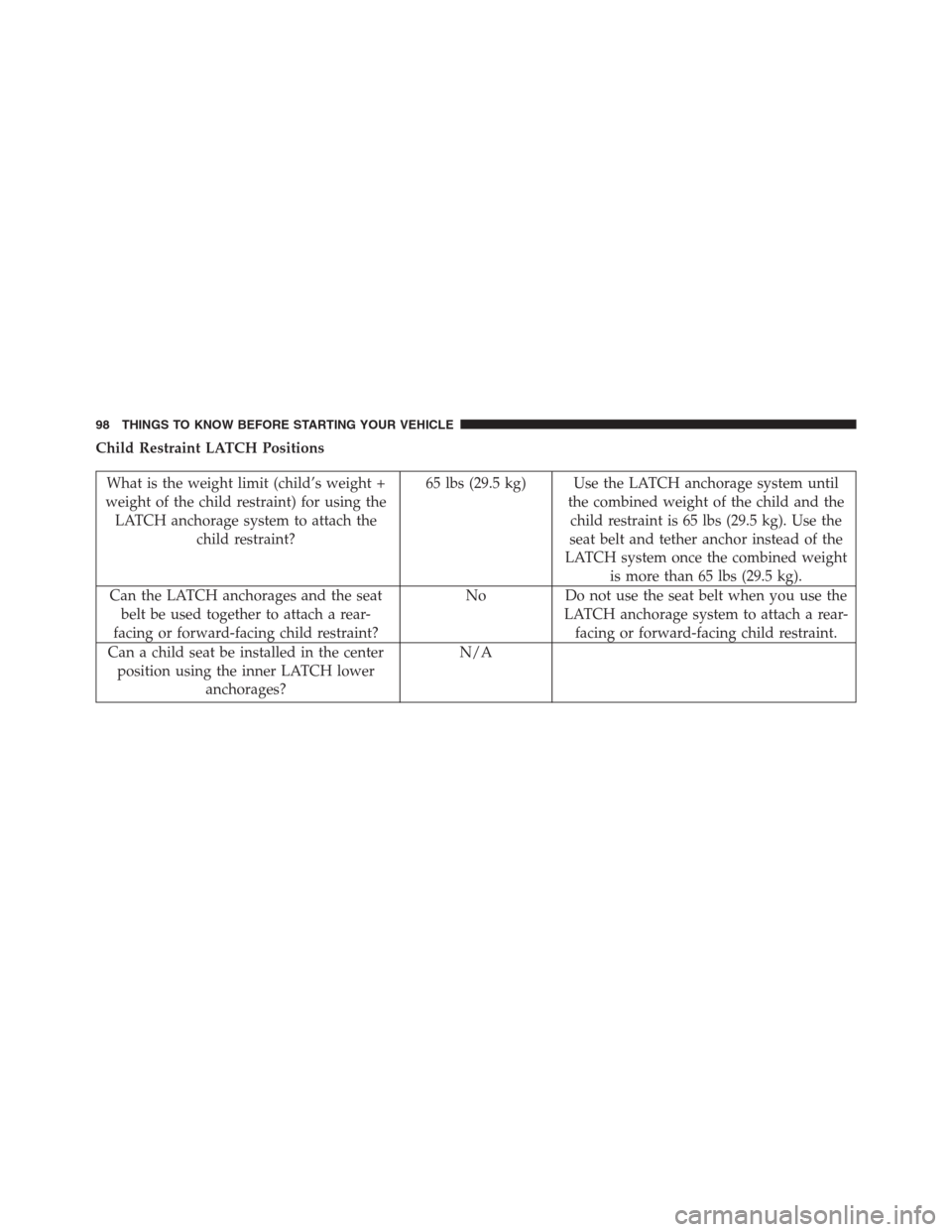
Child Restraint LATCH Positions
What is the weight limit (child’s weight +
weight of the child restraint) for using the
LATCH anchorage system to attach the
child restraint?65 lbs (29.5 kg) Use the LATCH anchorage system until
the combined weight of the child and the
child restraint is 65 lbs (29.5 kg). Use the
seat belt and tether anchor instead of the
LATCH system once the combined weight
is more than 65 lbs (29.5 kg).
Can the LATCH anchorages and the seat
belt be used together to attach a rear-
facing or forward-facing child restraint?No Do not use the seat belt when you use the
LATCH anchorage system to attach a rear-
facing or forward-facing child restraint.
Can a child seat be installed in the center
position using the inner LATCH lower
anchorages?N/A
98 THINGS TO KNOW BEFORE STARTING YOUR VEHICLE
Page 101 of 683
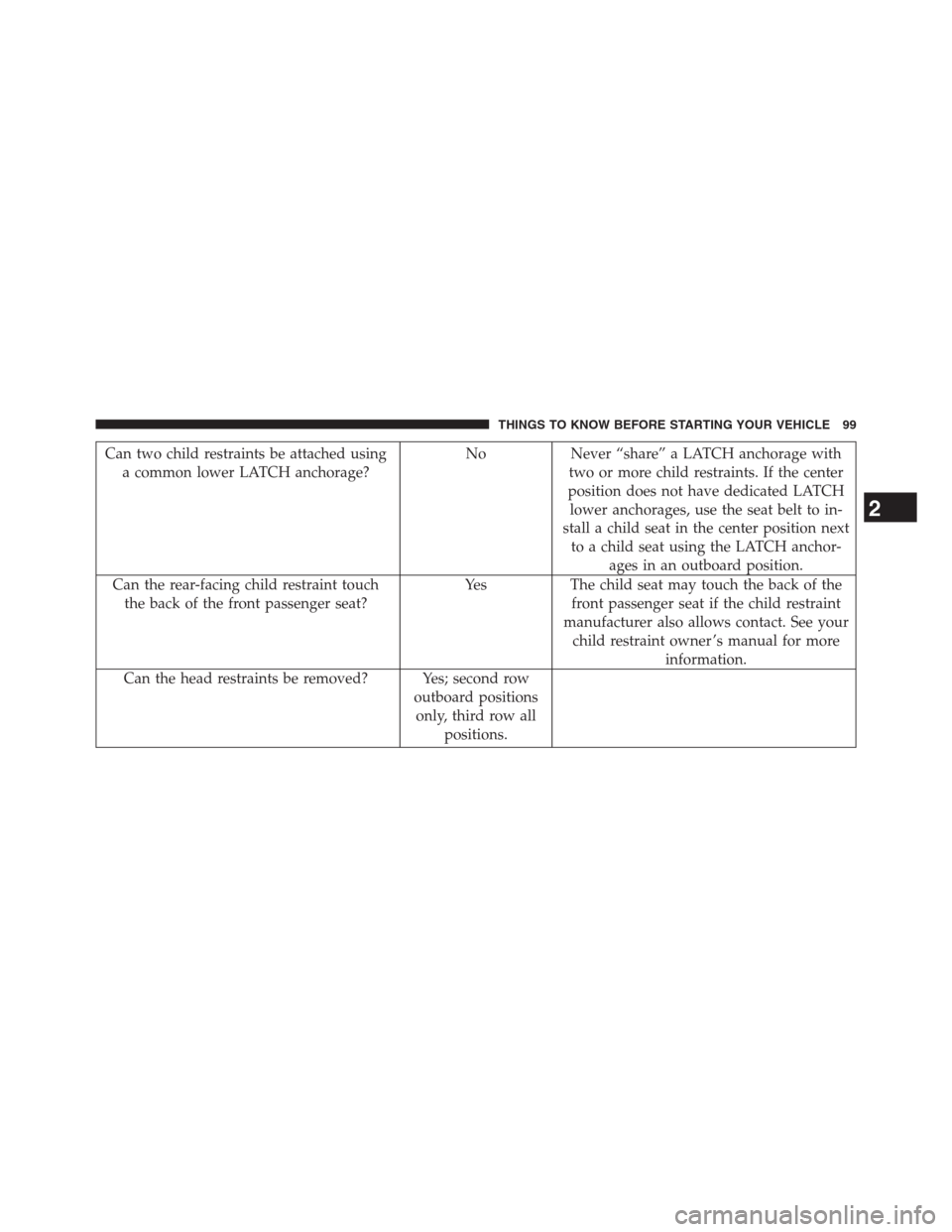
Can two child restraints be attached using
a common lower LATCH anchorage?No Never “share” a LATCH anchorage with
two or more child restraints. If the center
position does not have dedicated LATCH
lower anchorages, use the seat belt to in-
stall a child seat in the center position next
to a child seat using the LATCH anchor-
ages in an outboard position.
Can the rear-facing child restraint touch
the back of the front passenger seat?Yes The child seat may touch the back of the
front passenger seat if the child restraint
manufacturer also allows contact. See your
child restraint owner ’s manual for more
information.
Can the head restraints be removed? Yes; second row
outboard positions
only, third row all
positions.
2
THINGS TO KNOW BEFORE STARTING YOUR VEHICLE 99
Page 102 of 683
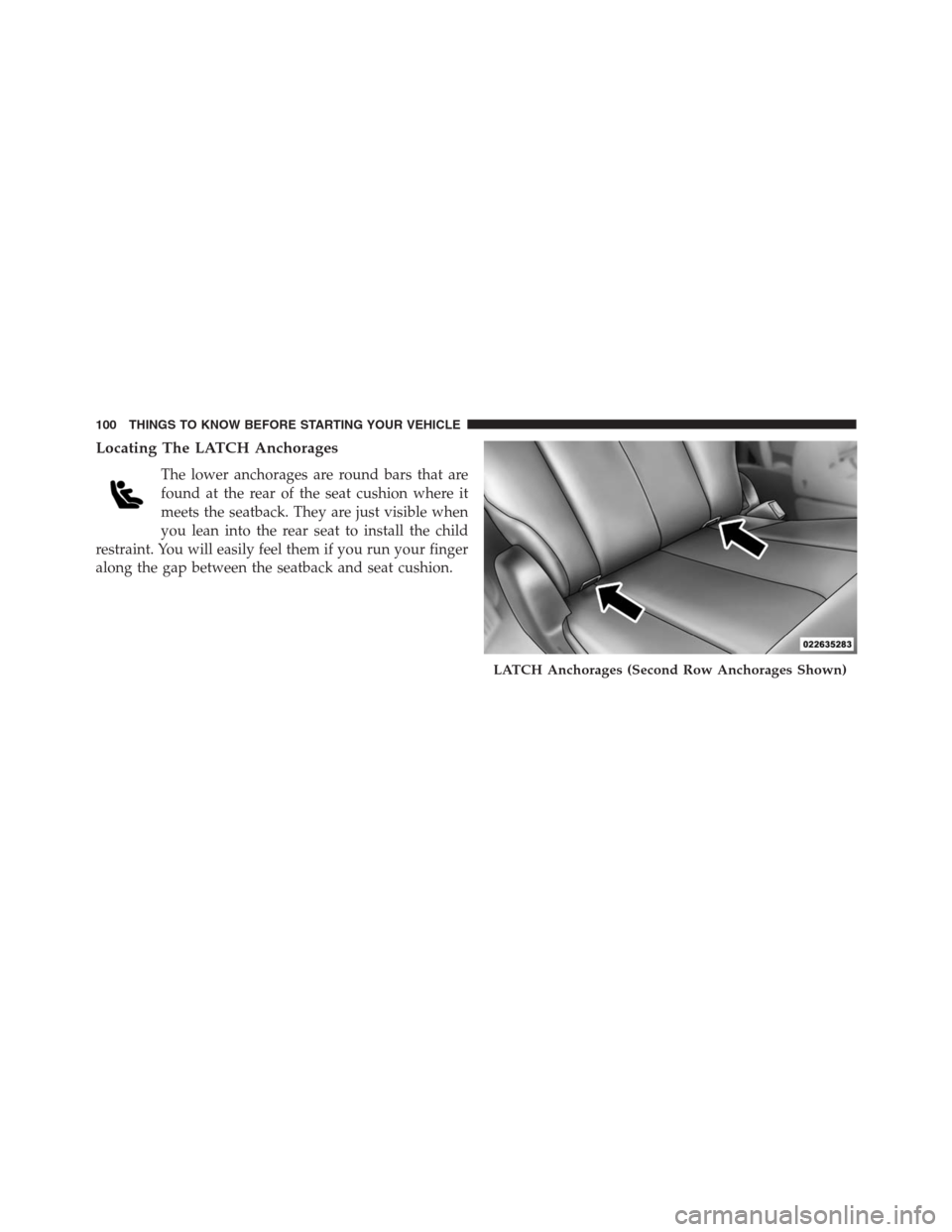
Locating The LATCH Anchorages
The lower anchorages are round bars that are
found at the rear of the seat cushion where it
meets the seatback. They are just visible when
you lean into the rear seat to install the child
restraint. You will easily feel them if you run your finger
along the gap between the seatback and seat cushion.
LATCH Anchorages (Second Row Anchorages Shown)
100 THINGS TO KNOW BEFORE STARTING YOUR VEHICLE
Page 103 of 683
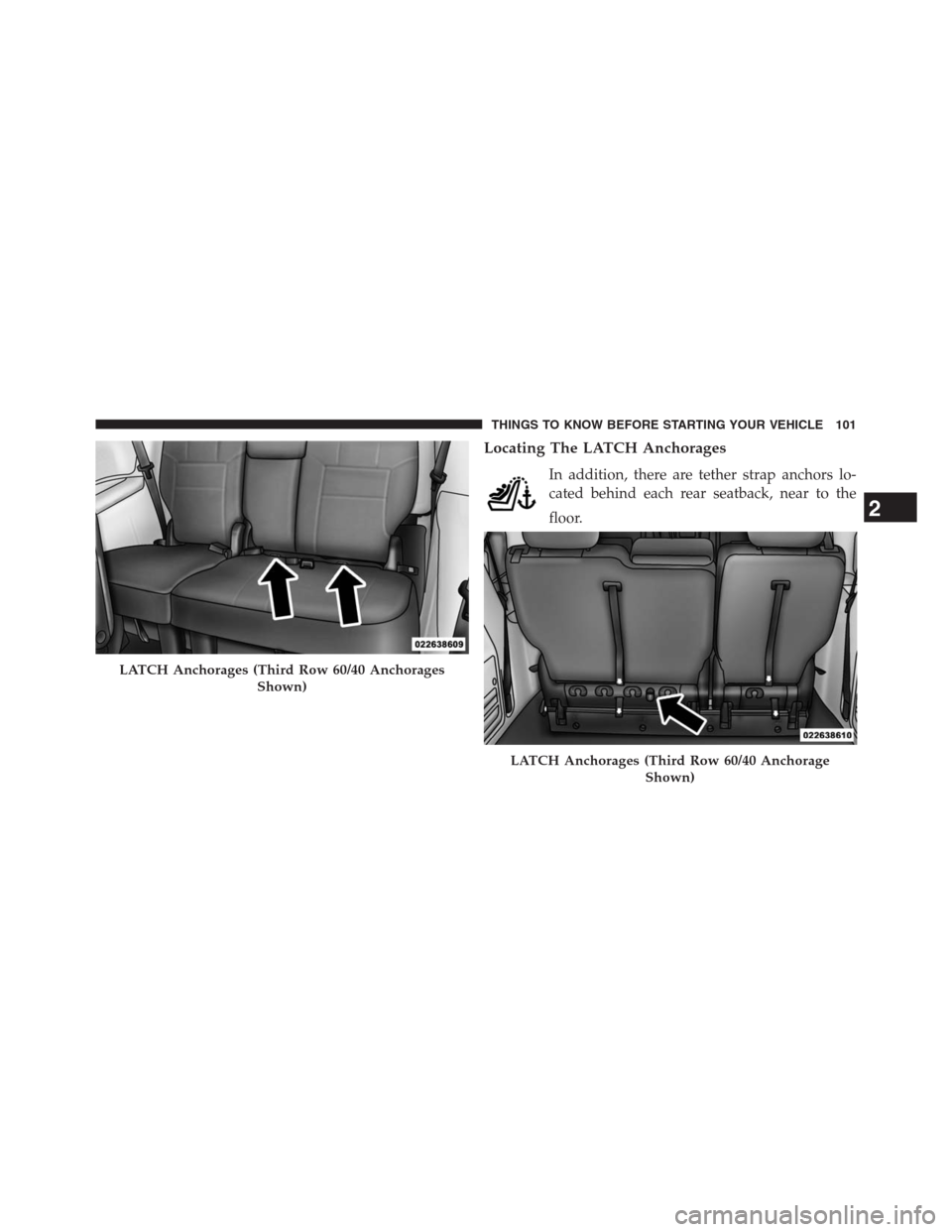
Locating The LATCH Anchorages
In addition, there are tether strap anchors lo-
cated behind each rear seatback, near to the
floor.
LATCH Anchorages (Third Row 60/40 Anchorages
Shown)
LATCH Anchorages (Third Row 60/40 Anchorage
Shown)
2
THINGS TO KNOW BEFORE STARTING YOUR VEHICLE 101
Page 104 of 683
LATCH-compatible child restraint systems will be
equipped with a rigid bar or a flexible strap on each side.
Each will have a hook or connector to attach to the lower
anchorage and a way to tighten the connection to the
anchorage. Forward-facing child restraints and some
rear-facing infant restraints will also be equipped with a
tether strap. The tether strap will have a hook at the end
to attach to the top tether anchorage and a way to tighten
the strap after it is attached to the anchorage.Center Seat LATCH – Commercial Cargo Vehicles
(No Factory Installed Rear Seats) — If Equipped
WARNING!
This vehicle does not have a center seating position.
Do not use the center lower LATCH anchorages to
install a child seat in the center of the back seat.
Always follow the directions of the child restraint manu-
facturer when installing your child restraint. Not all child
restraint systems will be installed as described here.
102 THINGS TO KNOW BEFORE STARTING YOUR VEHICLE
Page 106 of 683
4. Attach the lower hooks or connectors of the child
restraint to the lower anchorages in the selected seat-
ing position.
5. If the child restraint has a tether strap, connect it to the
top tether anchorage. See the section “Installing Child
Restraints Using the Top Tether Anchorage” for direc-
tions to attach a tether anchor.
6. Tighten all of the straps as you push the child restraint
rearward and downward into the seat. Remove slack
in the straps according to the child restraint manufac-
turer ’s instructions.
7. Test that the child restraint is installed tightly by
pulling back and forth on the child seat at the belt
path. It should not move more than 1 inch (25.4 mm)
in any direction.How To Stow An Unused ALR Seatbelt
When using the LATCH attaching system to install a child
restraint, stow all ALR seat belts that are not being used by
other occupants or being used to secure child restraints. An
unused belt could injure a child if they play with it and
accidentally lock the seatbelt retractor. Before installing a
child restraint using the LATCH system, buckle the seat
belt behind the child restraint and out of the child’s reach.
If the buckled seat belt interferes with the child restraint
installation, instead of buckling it behind the child re-
straint, route the seat belt through the child restraint belt
path and then buckle it. Do not lock the seatbelt. Remind
all children in the vehicle that the seat belts are not toys and
that they should not play with them.
104 THINGS TO KNOW BEFORE STARTING YOUR VEHICLE
Page 109 of 683
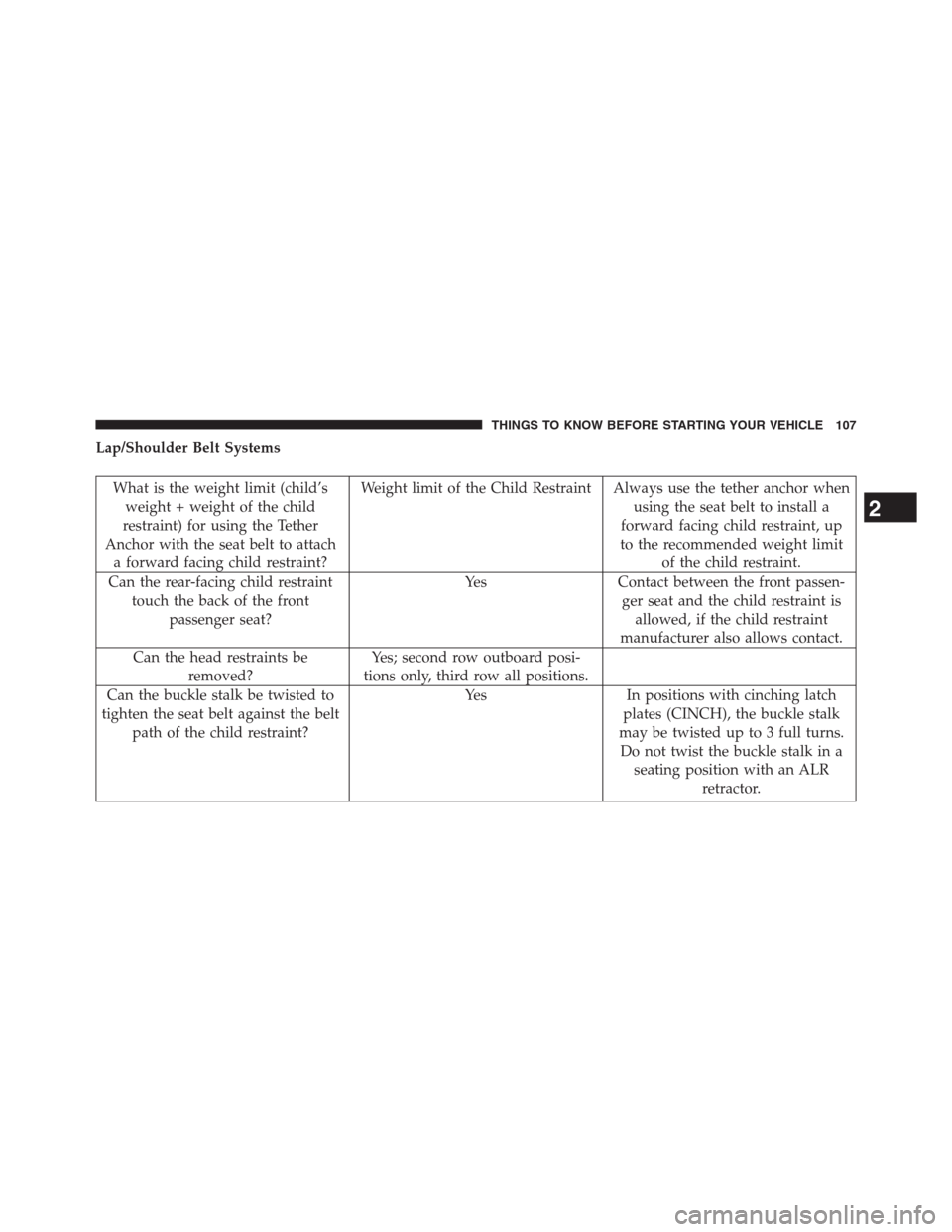
Lap/Shoulder Belt Systems
What is the weight limit (child’s
weight + weight of the child
restraint) for using the Tether
Anchor with the seat belt to attach
a forward facing child restraint?Weight limit of the Child Restraint Always use the tether anchor when
using the seat belt to install a
forward facing child restraint, up
to the recommended weight limit
of the child restraint.
Can the rear-facing child restraint
touch the back of the front
passenger seat?Yes Contact between the front passen-
ger seat and the child restraint is
allowed, if the child restraint
manufacturer also allows contact.
Can the head restraints be
removed?Yes; second row outboard posi-
tions only, third row all positions.
Can the buckle stalk be twisted to
tighten the seat belt against the belt
path of the child restraint?Yes In positions with cinching latch
plates (CINCH), the buckle stalk
may be twisted up to 3 full turns.
Do not twist the buckle stalk in a
seating position with an ALR
retractor.
2
THINGS TO KNOW BEFORE STARTING YOUR VEHICLE 107
Page 110 of 683
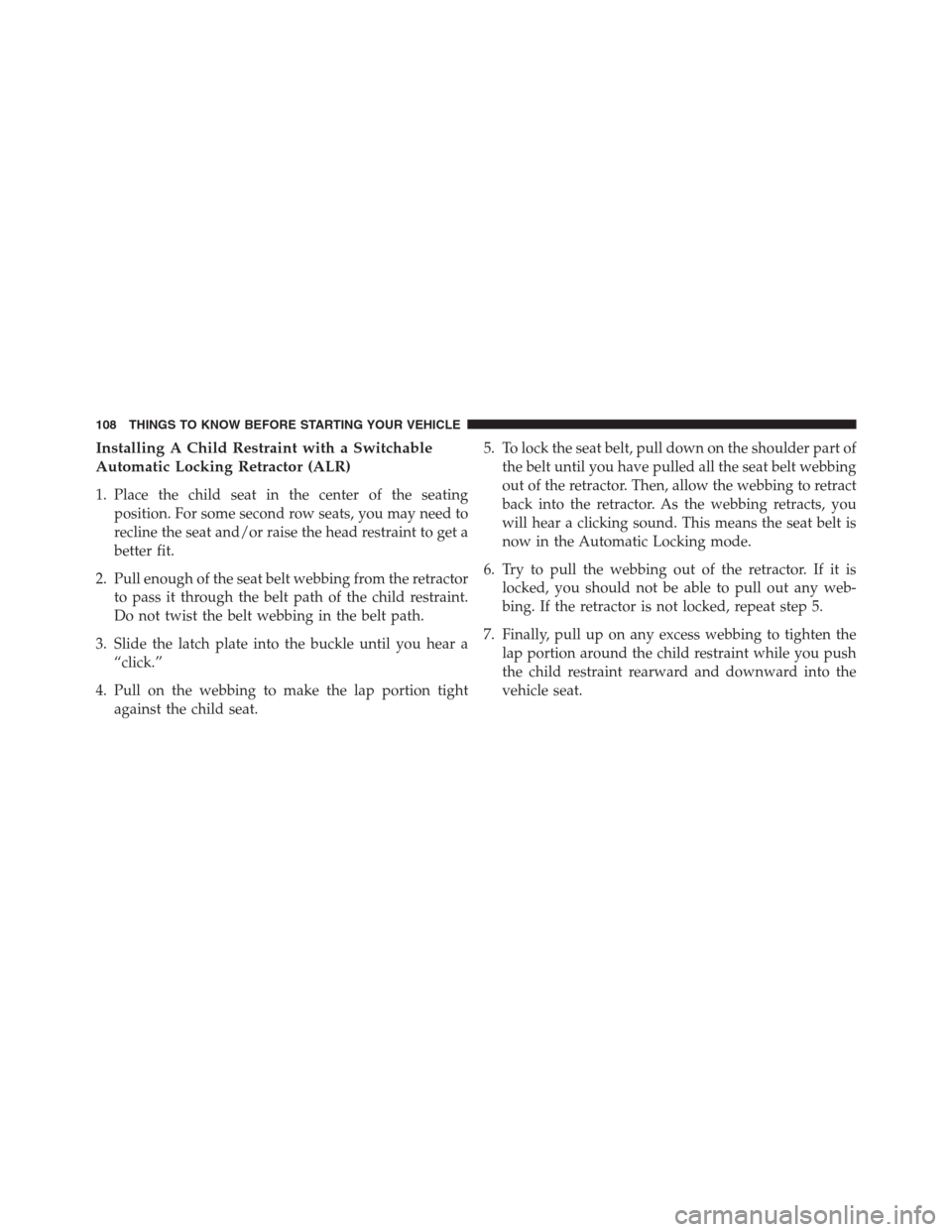
Installing A Child Restraint with a Switchable
Automatic Locking Retractor (ALR)
1. Place the child seat in the center of the seating
position. For some second row seats, you may need to
recline the seat and/or raise the head restraint to get a
better fit.
2. Pull enough of the seat belt webbing from the retractor
to pass it through the belt path of the child restraint.
Do not twist the belt webbing in the belt path.
3. Slide the latch plate into the buckle until you hear a
“click.”
4. Pull on the webbing to make the lap portion tight
against the child seat.5. To lock the seat belt, pull down on the shoulder part of
the belt until you have pulled all the seat belt webbing
out of the retractor. Then, allow the webbing to retract
back into the retractor. As the webbing retracts, you
will hear a clicking sound. This means the seat belt is
now in the Automatic Locking mode.
6. Try to pull the webbing out of the retractor. If it is
locked, you should not be able to pull out any web-
bing. If the retractor is not locked, repeat step 5.
7. Finally, pull up on any excess webbing to tighten the
lap portion around the child restraint while you push
the child restraint rearward and downward into the
vehicle seat.
108 THINGS TO KNOW BEFORE STARTING YOUR VEHICLE