warning light DODGE GRAND CARAVAN 2013 5.G Workshop Manual
[x] Cancel search | Manufacturer: DODGE, Model Year: 2013, Model line: GRAND CARAVAN, Model: DODGE GRAND CARAVAN 2013 5.GPages: 683, PDF Size: 5.5 MB
Page 526 of 683
Vehicles With Compact Spare
1. The compact spare tire (if equipped) does not have a
TPMS sensor. Therefore the TPMS will not monitor the
pressure in the compact spare tire.
2. If you install the compact spare tire in place of a road
tire that has a pressure below the low-pressure warn-
ing limit, upon the next ignition switch cycle, a chime
will sound, a “LOW TIRE PRESSURE” message will
be displayed and the “Tire Pressure Monitoring Tell-
tale Light” will turn on.
3. After driving for up to 20 minutes above 15 mph
(24 km/h), the “Tire Pressure Monitoring Telltale
Light” will flash on and off for 75 seconds and then
remain on solid.
4.
For each subsequent ignition switch cycle, a chime will
sound, the “Tire Pressure Monitoring Telltale Light” will
flash on and off for 75 seconds and then remain on solid.
5. Once you repair or replace the original road tire and
reinstall it on the vehicle in place of the compact spare
tire, the TPMS will automatically update, and the “Tire
Pressure Monitoring Telltale Light” will turn off as
long as no tire pressure is below the low-pressure
warning limit in any of the four active road tires.
NOTE:The vehicle may need to be driven for up to
20 minutes above 15 mph (24 km/h) for the TPMS to
receive this information.
Premium System – If Equipped
The TPMS uses wireless technology with wheel rim-
mounted electronic sensors to monitor tire pressure lev-
els. Sensors mounted to each wheel as part of the valve
stem transmit tire pressure readings to the Receiver
Module.
NOTE:It is particularly important to regularly check
and maintain proper tire pressure in all the tires.
524 STARTING AND OPERATING
Page 527 of 683
The Premium TPMS consists of the following compo-
nents:
•Receiver Module
•Four TPMS Sensors
•Various TPMS messages, which display in the Elec-
tronic Vehicle Information Center (EVIC), and graphics
displaying tire pressures
•TPMS Telltale Warning Light
TPMS Low Pressure Warnings
The “Tire Pressure Monitoring Telltale Light” will illumi-
nate in the instrument cluster, and an audible chime will
be activated when one or more of the four active road tire
pressures are low. In addition, the EVIC will display a“LOW TIRE PRESSURE” message for a minimum of
five seconds and a graphic display of the pressure
value(s) with the low tire(s) flashing.
Should a low tire condition occur on any of the four
active road tire(s), you should stop as soon as possible,
and inflate the low tire(s) that is flashing on the graphic
display to the vehicle’s recommended cold tire pressure
value. The system will automatically update, the graphic
display of the pressure value(s) will stop flashing, and
the “Tire Pressure Monitoring Telltale Light” will extin-
guish once the updated tire pressure(s) have been re-
ceived.
NOTE:The vehicle may need to be driven for up to
20 minutes above 15 mph (24 km/h) to receive this
information.
5
STARTING AND OPERATING 525
Page 529 of 683
Vehicles With Compact Spare
1. The compact spare tire (if equipped) does not have a
TPMS. Therefore, the TPMS will not monitor the
pressure in the compact spare tire.
2. If you install the compact spare tire in place of a road
tire that has a pressure below the low-pressure warn-
ing limit, upon the next ignition switch cycle, the “Tire
Pressure Monitoring Telltale Light” will remain on, the
“LOW TIRE PRESSURE” message will be displayed, a
chime will sound, and the EVIC will still display a
flashing pressure value in the graphic display.
3. After driving the vehicle for up to 20 minutes above
15 mph (24 km/h), the “Tire Pressure Monitoring
Telltale Light” will flash on and off for 75 seconds and
then remain on solid. In addition, the EVIC will
display a “SERVICE TPM SYSTEM” message for a
minimum of five seconds and then display dashes (- -)
in place of the pressure value.4. For each subsequent ignition switch cycle, a chime will
sound, the “Tire Pressure Monitoring Telltale Light”
will flash on and off for 75 seconds and then remain on
solid, and the EVIC will display a “SERVICE TPM
SYSTEM” message for a minimum of five seconds and
then display dashes (- -) in place of the pressure value.
5. Once you repair or replace the original road tire, and
reinstall it on the vehicle in place of the compact spare,
the TPMS will update automatically. In addition, the
“Tire Pressure Monitoring Telltale Light” will turn off
and the graphic in the EVIC will display a new
pressure value instead of dashes (- -), as long no tire
pressure is below the low pressure warning limit in
any of the four active road tires.
NOTE:The vehicle may need to be driven for up to
20 minutes above 15 mph (24 km/h) in order for the
TPMS to receive this information.
5
STARTING AND OPERATING 527
Page 555 of 683

WARNING!(Continued)
•Towing any trailer will increase your stopping dis-
tance. When towing you should allow for additional
space between your vehicle and the vehicle in front of
you. Failure to do so could result in a collision.
Towing Requirements – Trailer Lights And Wiring
Whenever you pull a trailer, regardless of the trailer size,
stoplights and turn signals on the trailer are required for
motoring safety.
The Trailer Tow Package may include a four- and seven-
pin wiring harness. Use a factory approved trailer har-
ness and connector.
NOTE:Do not cut or splice wiring into the vehicles
wiring harness.
The electrical connections are all complete to the vehicle
but you must mate the harness to a trailer connector.
Refer to the following illustrations.
Four-Pin Connector
1 — Female Pins 4 — Park
2 — Male Pin 5 — Left Stop/Turn
3 — Ground 6 — Right Stop/Turn
5
STARTING AND OPERATING 553
Page 575 of 683
4. Raise the vehicle by turning the jack screw to the right,
using the swivel wrench. Raise the vehicle only until
the tire just clears the surface and enough clearance is
obtained to install the spare tire. Minimum tire lift
provides maximum stability.
WARNING!
Raising the vehicle higher than necessary can make
the vehicle less stable. It could slip off the jack and
hurt someone near it. Raise the vehicle only enough
to remove the tire.
5.
Remove the wheel lug nuts, for vehicles with wheel
covers, remove the cover from the wheel by hand. Do not
pry the wheel cover off. Then pull the wheel off the hub.
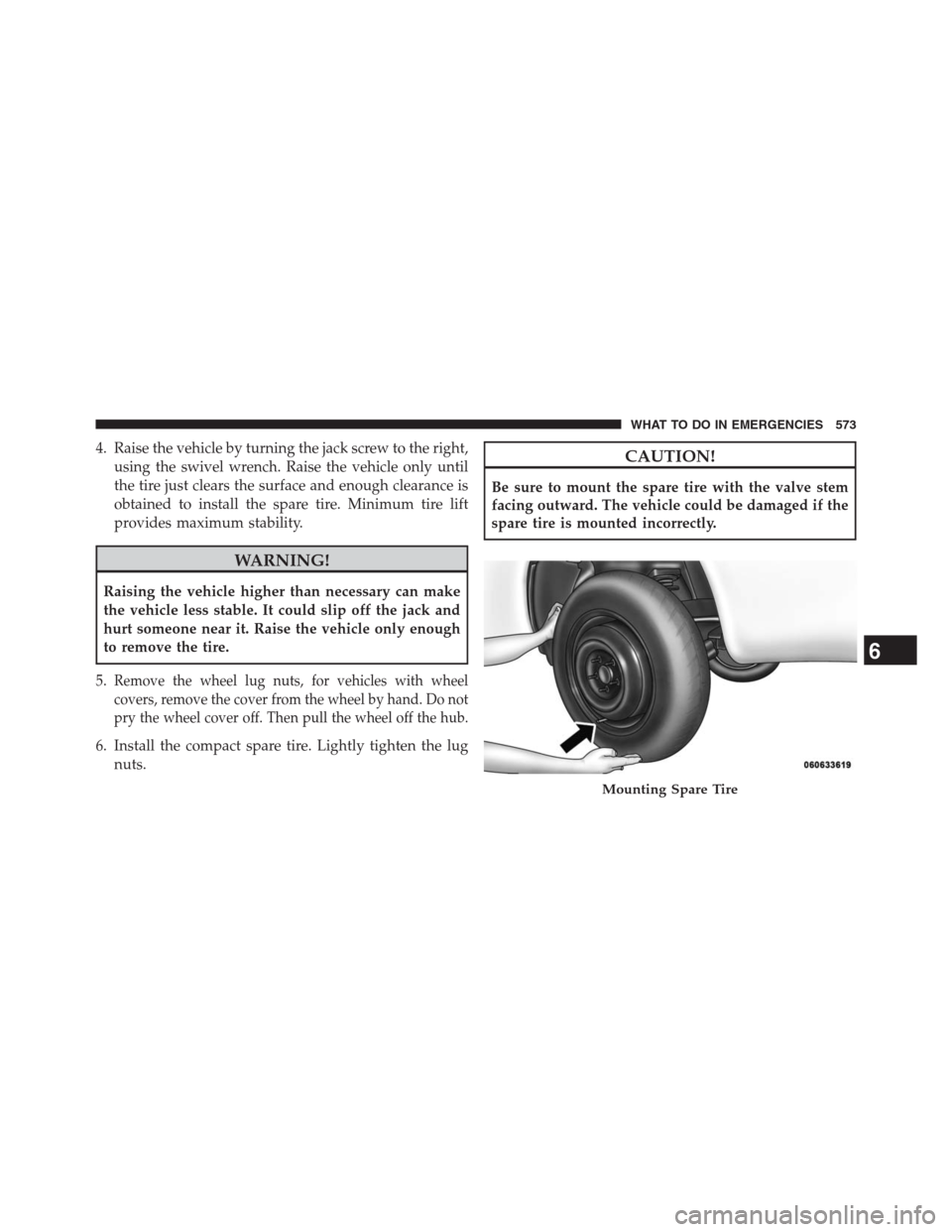
6. Install the compact spare tire. Lightly tighten the lug
nuts.
CAUTION!
Be sure to mount the spare tire with the valve stem
facing outward. The vehicle could be damaged if the
spare tire is mounted incorrectly.
Mounting Spare Tire
6
WHAT TO DO IN EMERGENCIES 573
Page 580 of 683
3. Align the valve notch in the wheel cover with the
valve stem on the wheel. Install the cover by hand,
snapping the cover over the two lug nuts. Do not use
a hammer or excessive force to install the cover.
4. Install the remaining lug nuts with the cone shaped
end of the nut toward the wheel. Lightly tighten the
lug nuts.
WARNING!
To avoid the risk of forcing the vehicle off the jack,
do not tighten the wheel nuts fully until the vehicle
has been lowered. Failure to follow this warning may
result in personal injury.
5. Lower the vehicle to the ground by turning the jack
handle counterclockwise.6. Finish tightening the lug nuts. Push down on the
wrench while at the end of the handle for increased
leverage. Tighten the lug nuts in a star pattern until
each nut has been tightened twice. The correct tight-
ness of each lug nut is 100 ft/lbs (135 N·m). If in doubt
about the correct tightness, have them checked with a
torque wrench by your authorized dealer or service
station.
7. After 25 miles (40 km) check the lug nut torque with a
torque wrench to ensure that all lug nuts are properly
seated against the wheel.
Vehicles Without Wheel Covers
1. Mount the road tire on the axle.
2. Install the remaining lug nuts with the cone shaped
end of the nut toward the wheel. Lightly tighten the
lug nuts.
578 WHAT TO DO IN EMERGENCIES
Page 610 of 683
Adding Washer Fluid
The fluid reservoir for the windshield washers and the
rear window washer is shared. It is located in the engine
compartment and should be checked at regular intervals.
Fill the reservoir with windshield washer solvent (not
radiator antifreeze) and operate the system for a few
seconds to flush out any residual water.
The washer fluid reservoir will hold a full gallon of fluid
when the Low Washer Fluid Light illuminates.
WARNING!
Commercially available windshield washer solvents
are flammable. They could ignite and burn you. Care
must be exercised when filling or working around
the washer solution.After the engine has warmed, operate the defroster for a
few minutes to reduce the possibility of smearing or
freezing the fluid on the cold windshield. MOPAR® All
Weather Windshield Washer Solution or equivalent, used
with water as directed on the container, aids cleaning
action, reduces the freezing point to avoid line clogging,
and is not harmful to paint or trim.
Cooling System
WARNING!
•When working near the radiator cooling fan,
disconnect the fan motor lead or turn the ignition
switch to the OFF position. The fan is temperature
controlled and can start at anytime the ignition
switch is in the ON position.
(Continued)
608 MAINTAINING YOUR VEHICLE
Page 617 of 683
Brake System
In order to assure brake system performance, all brake
system components should be inspected periodically.
Refer to the “Maintenance Schedule” for the proper
maintenance intervals.
WARNING!
Riding the brakes can lead to brake failure and
possibly a collision. Driving with your foot resting or
riding on the brake pedal can result in abnormally
high brake temperatures, excessive lining wear, and
possible brake damage. You would not have your full
braking capacity in an emergency.
Master Cylinder – Brake Fluid Level Check
The fluid level in the master cylinder should be checked
when performing underhood services, or immediately if
the “Brake System Warning Light” indicates system
failure.
Clean the top of the master cylinder area before removing
the cap. Add fluid to bring the level up to the top of the
“FULL” mark on the side of the master cylinder reservoir.
Overfilling of fluid is not recommended because it may
cause leaking in the system.
Add enough fluid to bring the level up to the require-
ments described on the brake fluid reservoir. With disc
brakes, fluid level can be expected to fall as the brake
pads wear. However, low fluid level may be caused by a
leak and a checkup may be needed.
7
MAINTAINING YOUR VEHICLE 615
Page 625 of 683
Cleaning Leather Upholstery
MOPAR® Total Clean or equivalent is specifically recom-
mended for leather upholstery.
Your leather upholstery can be best preserved by regular
cleaning with a damp soft cloth. Small particles of dirt can
act as an abrasive and damage the leather upholstery and
should be removed promptly with a damp cloth. Stubborn
soils can be removed easily with a soft cloth and MOPAR®
Total Clean or equivalent. Care should be taken to avoid
soaking your leather upholstery with any liquid. Please do
not use polishes, oils, cleaning fluids, solvents, detergents, or
ammonia-based cleaners to clean your leather upholstery.
Application of a leather conditioner is not required to
maintain the original condition.
WARNING!
Do not use volatile solvents for cleaning purposes.
Many are potentially flammable, and if used in
closed areas they may cause respiratory harm.
Cleaning Headlights
Your vehicle is equipped with plastic headlights and fog
lights (if equipped) that are lighter and less susceptible to
stone breakage than glass headlights.
Plastic is not as scratch resistant as glass and therefore
different lens cleaning procedures must be followed.
7
MAINTAINING YOUR VEHICLE 623
Page 664 of 683
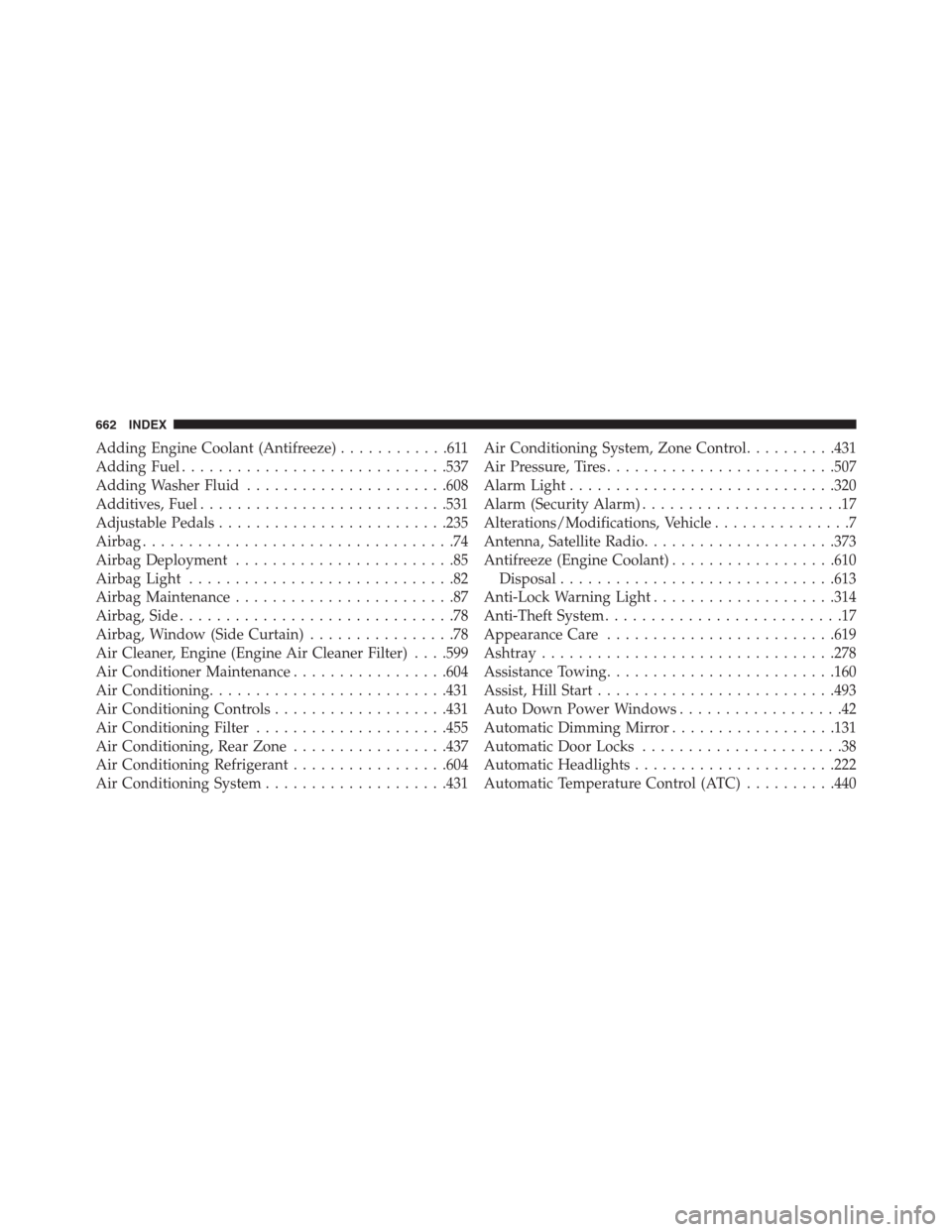
Adding Engine Coolant (Antifreeze)............611
Adding Fuel.............................537
Adding Washer Fluid......................608
Additives, Fuel...........................531
Adjustable Pedals.........................235
Airbag..................................74
Airbag Deployment........................85
Airbag Light.............................82
Airbag Maintenance........................87
Airbag, Side..............................78
Airbag, Window (Side Curtain)................78
Air Cleaner, Engine (Engine Air Cleaner Filter). . . .599
Air Conditioner Maintenance.................604
Air Conditioning..........................431
Air Conditioning Controls...................431
Air Conditioning Filter.....................455
Air Conditioning, Rear Zone.................437
Air Conditioning Refrigerant.................604
Air Conditioning System....................431Air Conditioning System, Zone Control..........431
Air Pressure, Tires.........................507
Alarm Light.............................320
Alarm (Security Alarm)......................17
Alterations/Modifications, Vehicle...............7
Antenna, Satellite Radio.....................373
Antifreeze (Engine Coolant)..................610
Disposal..............................613
Anti-Lock Warning Light....................314
Anti-Theft System..........................17
Appearance Care.........................619
Ashtray................................278
Assistance Towing.........................160
Assist, Hill Start..........................493
Auto Down Power Windows..................42
Automatic Dimming Mirror..................131
Automatic Door Locks......................38
Automatic Headlights......................222
Automatic Temperature Control (ATC)..........440
662 INDEX