brake DODGE GRAND CARAVAN 2017 5.G Repair Manual
[x] Cancel search | Manufacturer: DODGE, Model Year: 2017, Model line: GRAND CARAVAN, Model: DODGE GRAND CARAVAN 2017 5.GPages: 530, PDF Size: 5.01 MB
Page 483 of 530
•If your vehicle is damaged due to a collision or similar
cause that destroys the paint and protective coating,
have your vehicle repaired as soon as possible. The cost
of such repairs is considered the responsibility of the
owner.
• If you carry special cargo such as chemicals, fertilizers,
de-icer salt, etc., be sure that such materials are well
packaged and sealed.
• If a lot of driving is done on gravel roads, consider mud
or stone shields behind each wheel.
• Use MOPAR Touch Up Paint on scratches as soon as
possible. Your authorized dealer has touch up paint to
match the color of your vehicle.
Wheel And Wheel Trim Care
All wheels and wheel trim, especially aluminum and
chrome plated wheels, should be cleaned regularly with a
mild soap and water to prevent corrosion.
To remove heavy soil and/or excessive brake dust, use
MOPAR Wheel Cleaner or equivalent or select a non-
abrasive, non-acidic cleaner.
•For chrome wheels, use MOPAR Chrome Cleaner or
equivalent. •
For aluminum wheels, use MOPAR Wheel Cleaner or
equivalent.
CAUTION!
Do not use scouring pads, steel wool, a bristle brush, or
metal polishes. Do not use oven cleaner. These prod-
ucts may damage the wheel’s protective finish. Avoid
automatic car washes that use acidic solutions or harsh
brushes that may damage the wheel’s protective finish.
Only MOPAR Wheel Cleaner or equivalent is recom-
mended.
Stain Repel Fabric Cleaning Procedure — If
Equipped
Stain Repel seats may be cleaned in the following manner:
•Remove as much of the stain as possible by blotting with
a clean, dry towel.
• Blot any remaining stain with a clean, damp towel.
• For tough stains, apply MOPAR Total Clean, or a mild
soap solution to a clean, damp cloth and remove stain.
Use a fresh, damp towel to remove soap residue.
7
MAINTAINING YOUR VEHICLE 481
Page 488 of 530
CAUTION!(Continued)
•When replacing a blown fuse, it is important to use
only a fuse having the correct amperage rating. The
use of a fuse with a rating other than indicated may
result in a dangerous electrical system overload. If a
properly rated fuse continues to blow, it indicates a
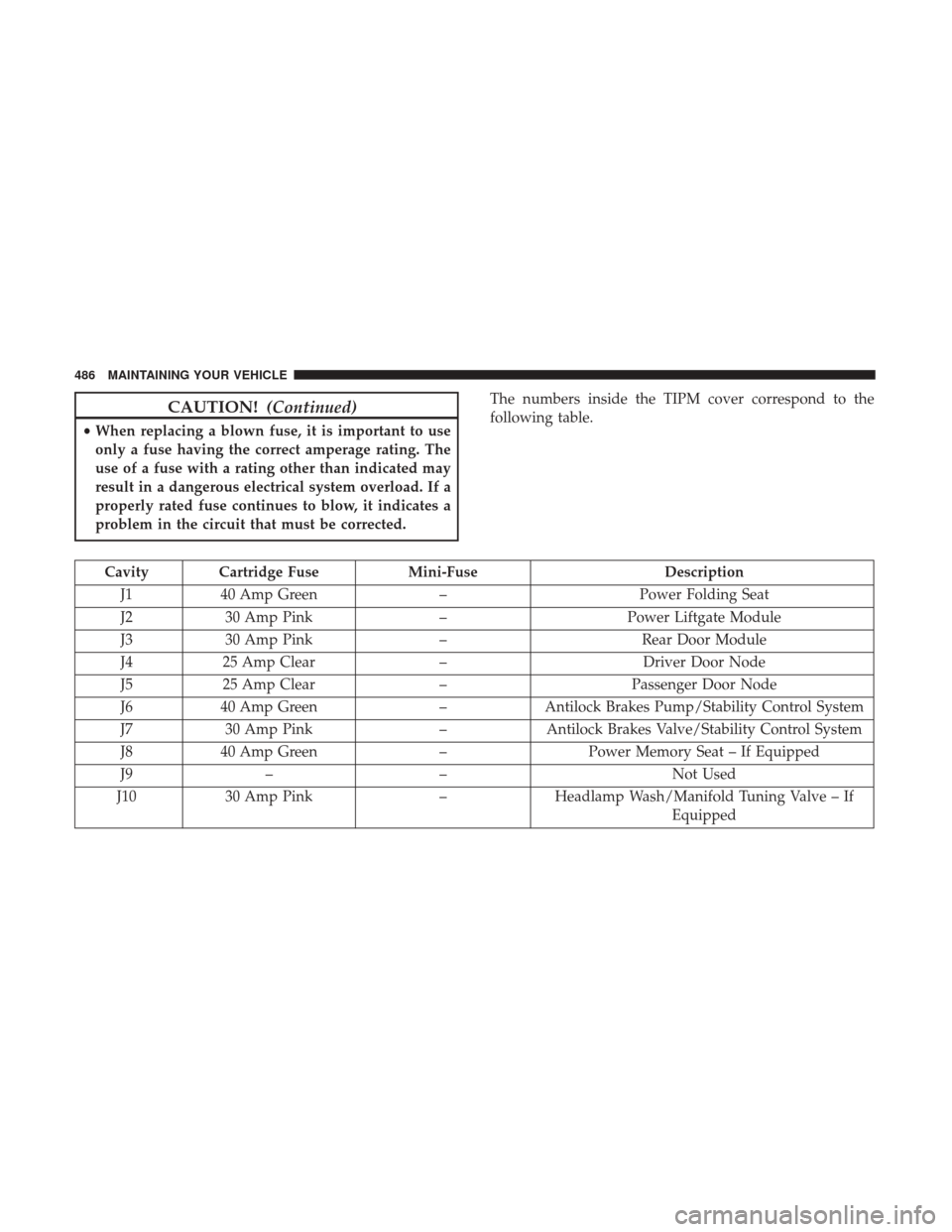
problem in the circuit that must be corrected. The numbers inside the TIPM cover correspond to the
following table.
Cavity Cartridge Fuse
Mini-FuseDescription
J1 40 Amp Green –Power Folding Seat
J2 30 Amp Pink –Power Liftgate Module
J3 30 Amp Pink –Rear Door Module
J4 25 Amp Clear –Driver Door Node
J5 25 Amp Clear –Passenger Door Node
J6 40 Amp Green –Antilock Brakes Pump/Stability Control System
J7 30 Amp Pink –Antilock Brakes Valve/Stability Control System
J8 40 Amp Green –Power Memory Seat – If Equipped
J9 – – Not Used
J10 30 Amp Pink –Headlamp Wash/Manifold Tuning Valve – If
Equipped
486 MAINTAINING YOUR VEHICLE
Page 489 of 530
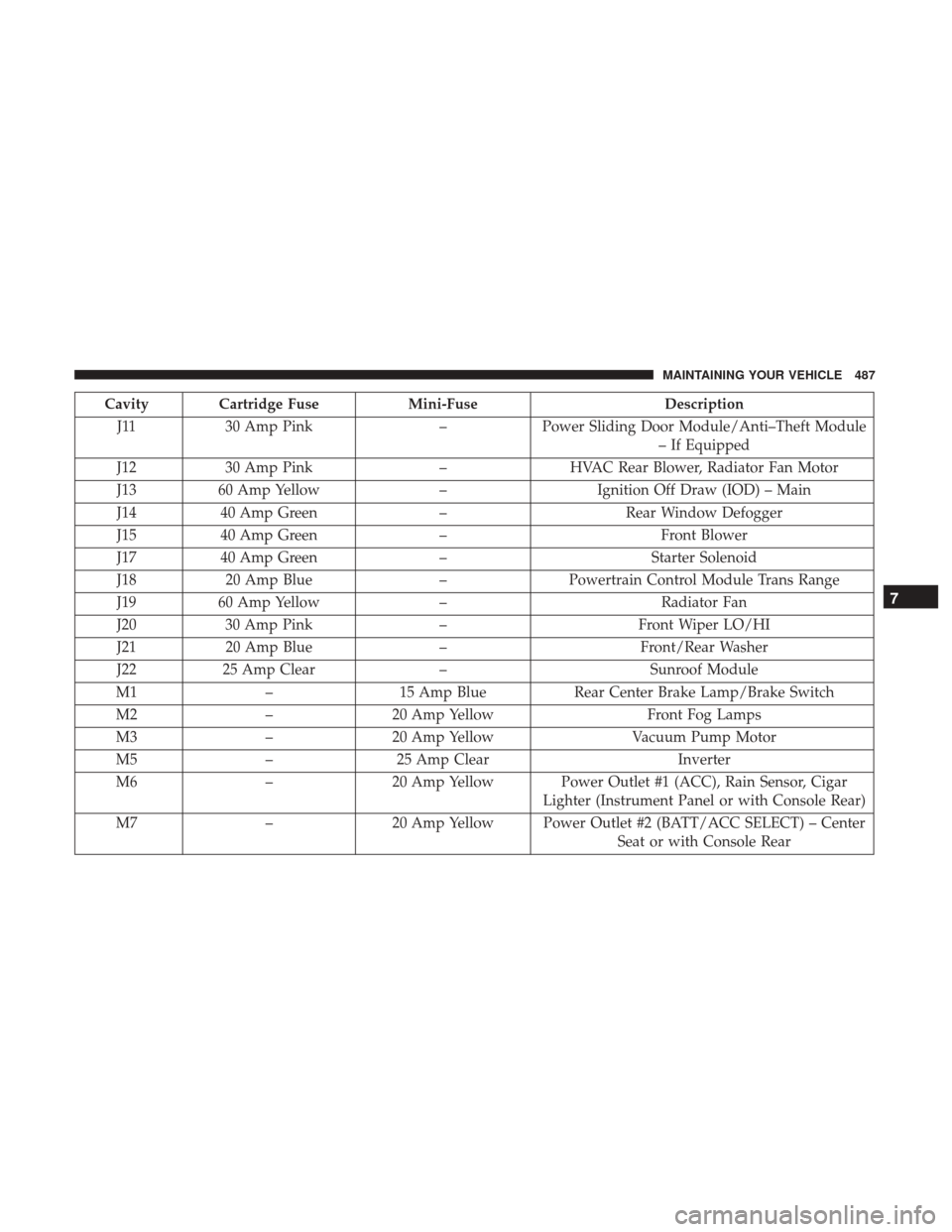
Cavity Cartridge FuseMini-FuseDescription
J11 30 Amp Pink –Power Sliding Door Module/Anti–Theft Module
– If Equipped
J12 30 Amp Pink –HVAC Rear Blower, Radiator Fan Motor
J13 60 Amp Yellow –Ignition Off Draw (IOD) – Main
J14 40 Amp Green –Rear Window Defogger
J15 40 Amp Green – Front Blower
J17 40 Amp Green –Starter Solenoid
J18 20 Amp Blue –Powertrain Control Module Trans Range
J19 60 Amp Yellow – Radiator Fan
J20 30 Amp Pink –Front Wiper LO/HI
J21 20 Amp Blue –Front/Rear Washer
J22 25 Amp Clear –Sunroof Module
M1 –15 Amp Blue Rear Center Brake Lamp/Brake Switch
M2 –20 Amp Yellow Front Fog Lamps
M3 –20 Amp Yellow Vacuum Pump Motor
M5 –25 Amp Clear Inverter
M6 –20 Amp Yellow Power Outlet #1 (ACC), Rain Sensor, Cigar
Lighter (Instrument Panel or with Console Rear)
M7 –20 Amp Yellow Power Outlet #2 (BATT/ACC SELECT) – Center
Seat or with Console Rear
7
MAINTAINING YOUR VEHICLE 487
Page 492 of 530
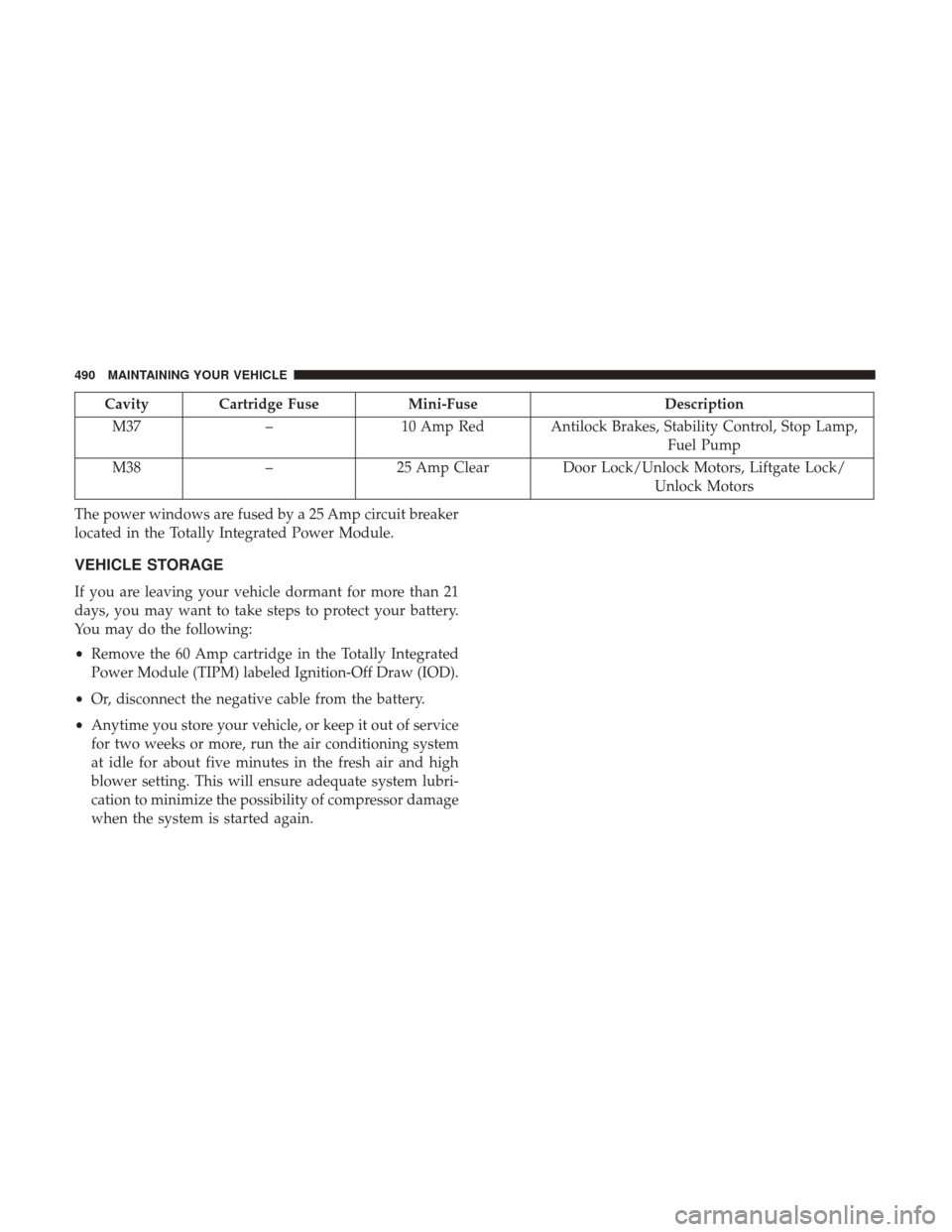
Cavity Cartridge FuseMini-FuseDescription
M37 –10 Amp Red Antilock Brakes, Stability Control, Stop Lamp,
Fuel Pump
M38 –25 Amp Clear Door Lock/Unlock Motors, Liftgate Lock/
Unlock Motors
The power windows are fused by a 25 Amp circuit breaker
located in the Totally Integrated Power Module.
VEHICLE STORAGE
If you are leaving your vehicle dormant for more than 21
days, you may want to take steps to protect your battery.
You may do the following:
• Remove the 60 Amp cartridge in the Totally Integrated
Power Module (TIPM) labeled Ignition-Off Draw (IOD).
• Or, disconnect the negative cable from the battery.
• Anytime you store your vehicle, or keep it out of service
for two weeks or more, run the air conditioning system
at idle for about five minutes in the fresh air and high
blower setting. This will ensure adequate system lubri-
cation to minimize the possibility of compressor damage
when the system is started again.
490 MAINTAINING YOUR VEHICLE
Page 500 of 530
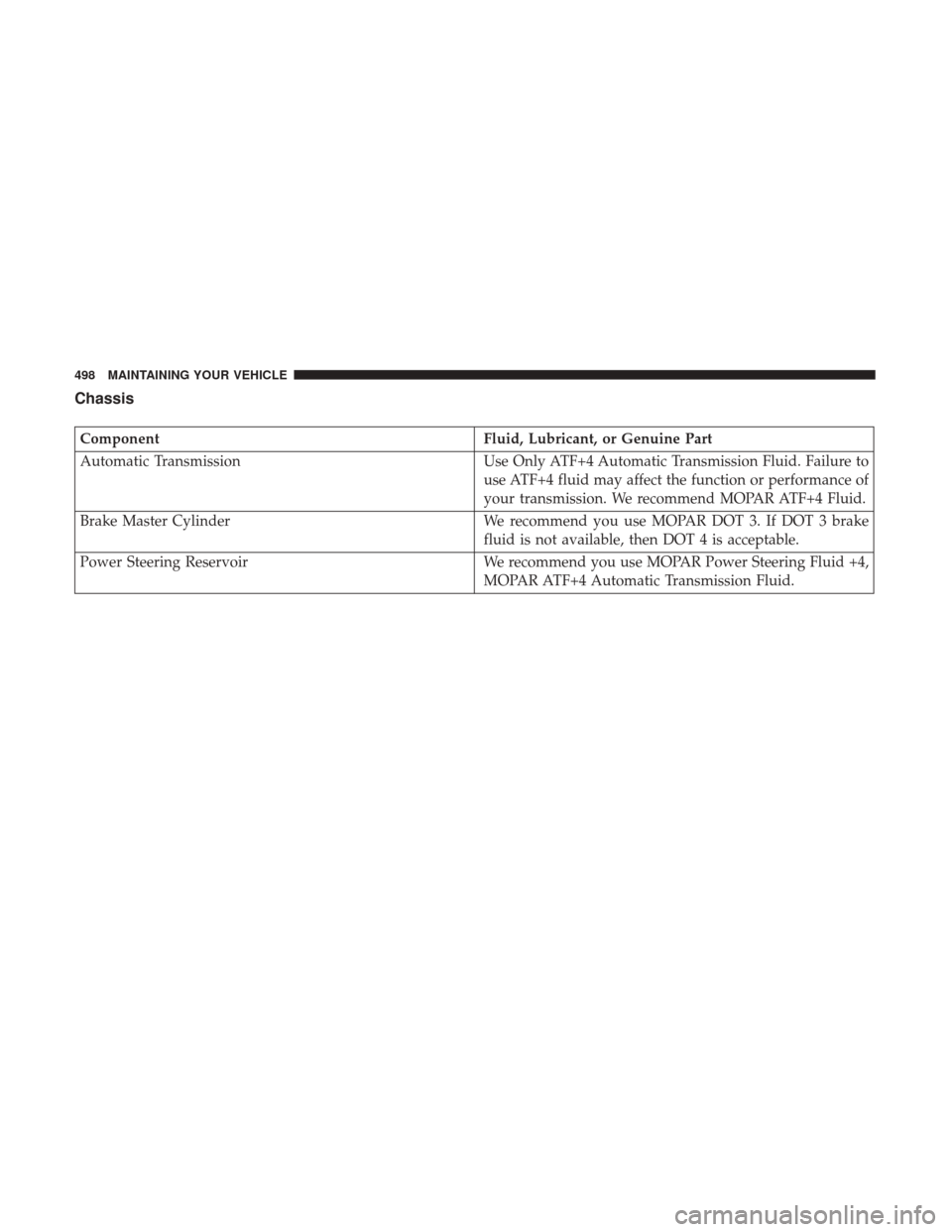
Chassis
ComponentFluid, Lubricant, or Genuine Part
Automatic Transmission Use Only ATF+4 Automatic Transmission Fluid. Failure to
use ATF+4 fluid may affect the function or performance of
your transmission. We recommend MOPAR ATF+4 Fluid.
Brake Master Cylinder We recommend you use MOPAR DOT 3. If DOT 3 brake
fluid is not available, then DOT 4 is acceptable.
Power Steering Reservoir We recommend you use MOPAR Power Steering Fluid +4,
MOPAR ATF+4 Automatic Transmission Fluid.
498 MAINTAINING YOUR VEHICLE
Page 502 of 530
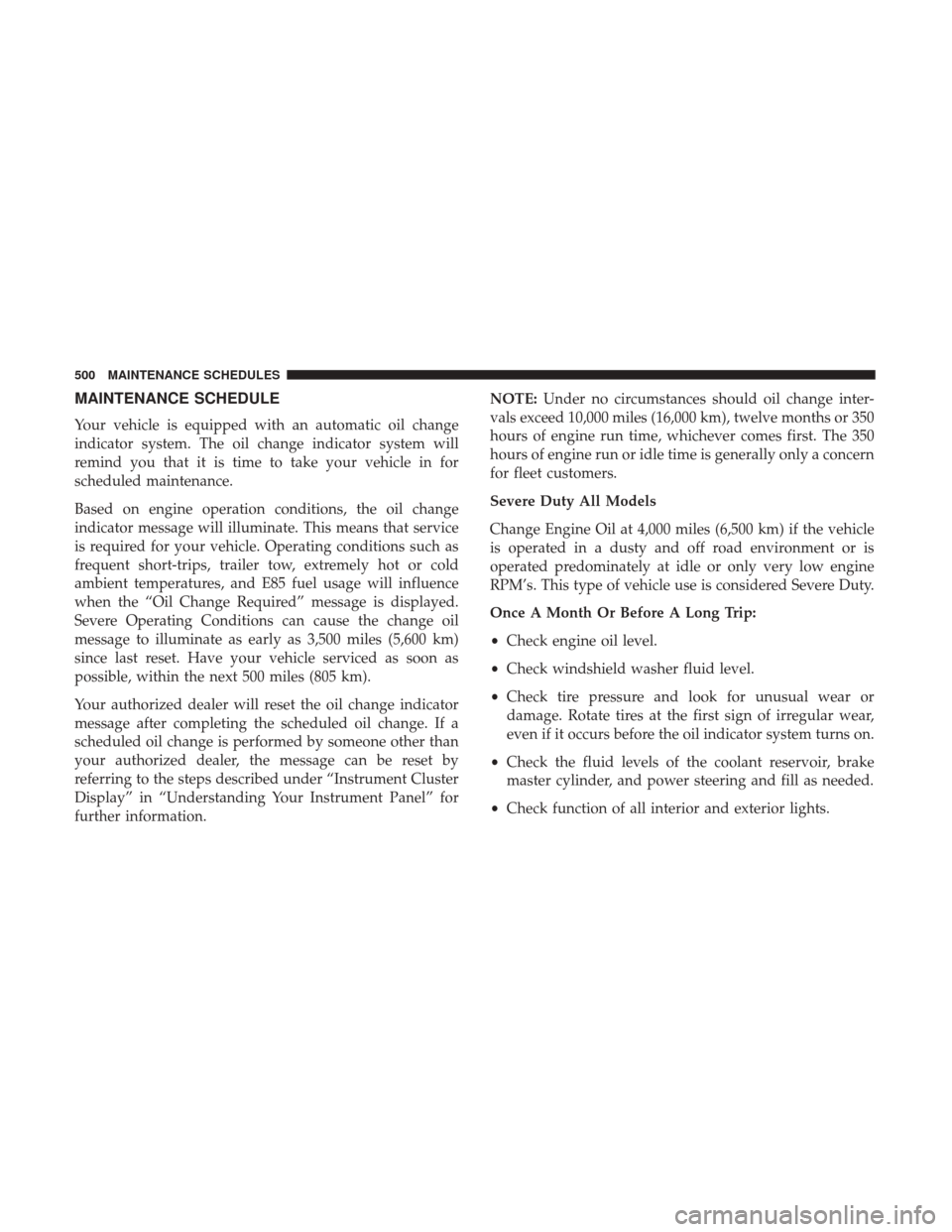
MAINTENANCE SCHEDULE
Your vehicle is equipped with an automatic oil change
indicator system. The oil change indicator system will
remind you that it is time to take your vehicle in for
scheduled maintenance.
Based on engine operation conditions, the oil change
indicator message will illuminate. This means that service
is required for your vehicle. Operating conditions such as
frequent short-trips, trailer tow, extremely hot or cold
ambient temperatures, and E85 fuel usage will influence
when the “Oil Change Required” message is displayed.
Severe Operating Conditions can cause the change oil
message to illuminate as early as 3,500 miles (5,600 km)
since last reset. Have your vehicle serviced as soon as
possible, within the next 500 miles (805 km).
Your authorized dealer will reset the oil change indicator
message after completing the scheduled oil change. If a
scheduled oil change is performed by someone other than
your authorized dealer, the message can be reset by
referring to the steps described under “Instrument Cluster
Display” in “Understanding Your Instrument Panel” for
further information.NOTE:
Under no circumstances should oil change inter-
vals exceed 10,000 miles (16,000 km), twelve months or 350
hours of engine run time, whichever comes first. The 350
hours of engine run or idle time is generally only a concern
for fleet customers.
Severe Duty All Models
Change Engine Oil at 4,000 miles (6,500 km) if the vehicle
is operated in a dusty and off road environment or is
operated predominately at idle or only very low engine
RPM’s. This type of vehicle use is considered Severe Duty.
Once A Month Or Before A Long Trip:
• Check engine oil level.
• Check windshield washer fluid level.
• Check tire pressure and look for unusual wear or
damage. Rotate tires at the first sign of irregular wear,
even if it occurs before the oil indicator system turns on.
• Check the fluid levels of the coolant reservoir, brake
master cylinder, and power steering and fill as needed.
• Check function of all interior and exterior lights.
500 MAINTENANCE SCHEDULES
Page 503 of 530
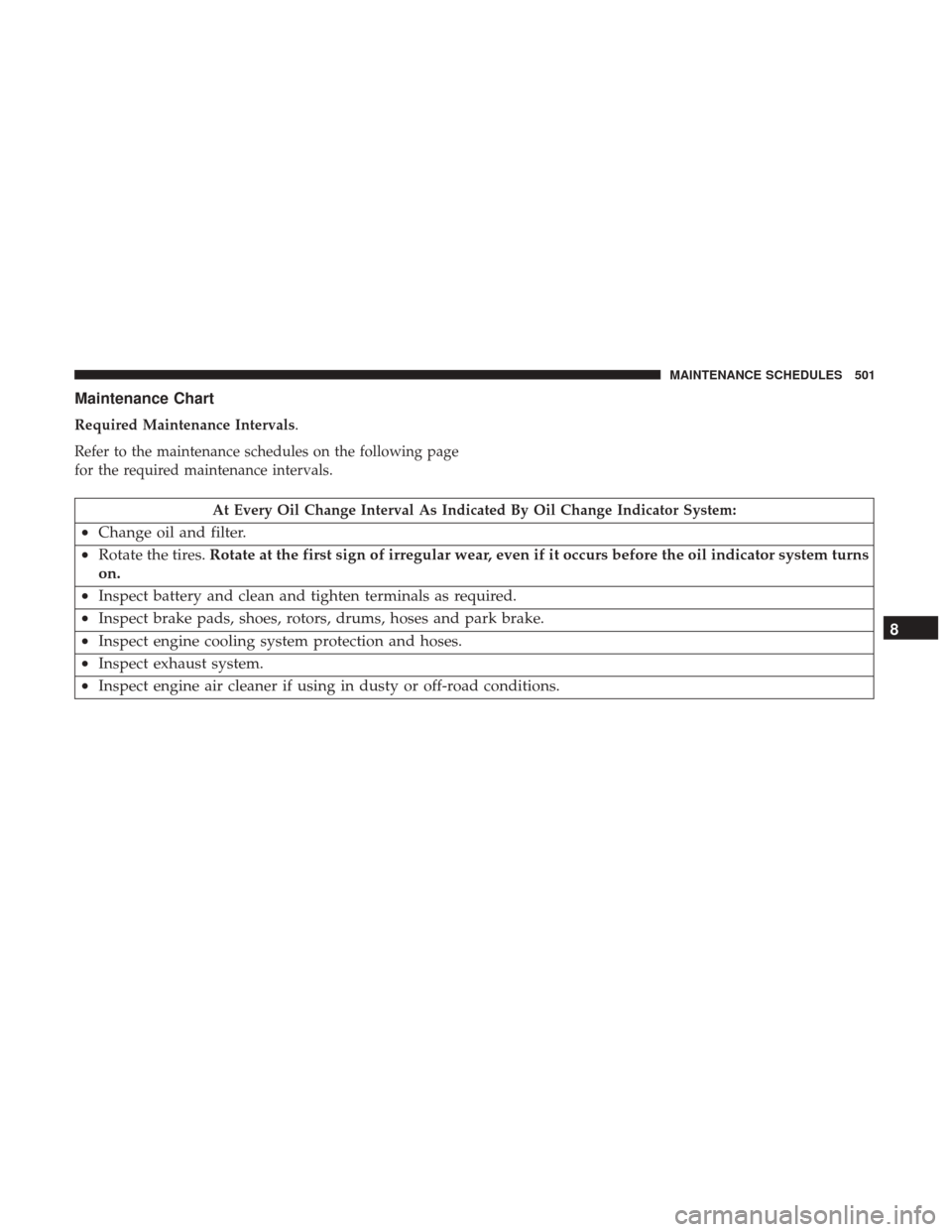
Maintenance Chart
Required Maintenance Intervals.
Refer to the maintenance schedules on the following page
for the required maintenance intervals.
At Every Oil Change Interval As Indicated By Oil Change Indicator System:
•Change oil and filter.
• Rotate the tires. Rotate at the first sign of irregular wear, even if it occurs before the oil indicator system turns
on.
• Inspect battery and clean and tighten terminals as required.
• Inspect brake pads, shoes, rotors, drums, hoses and park brake.
• Inspect engine cooling system protection and hoses.
• Inspect exhaust system.
• Inspect engine air cleaner if using in dusty or off-road conditions. 8
MAINTENANCE SCHEDULES 501
Page 504 of 530
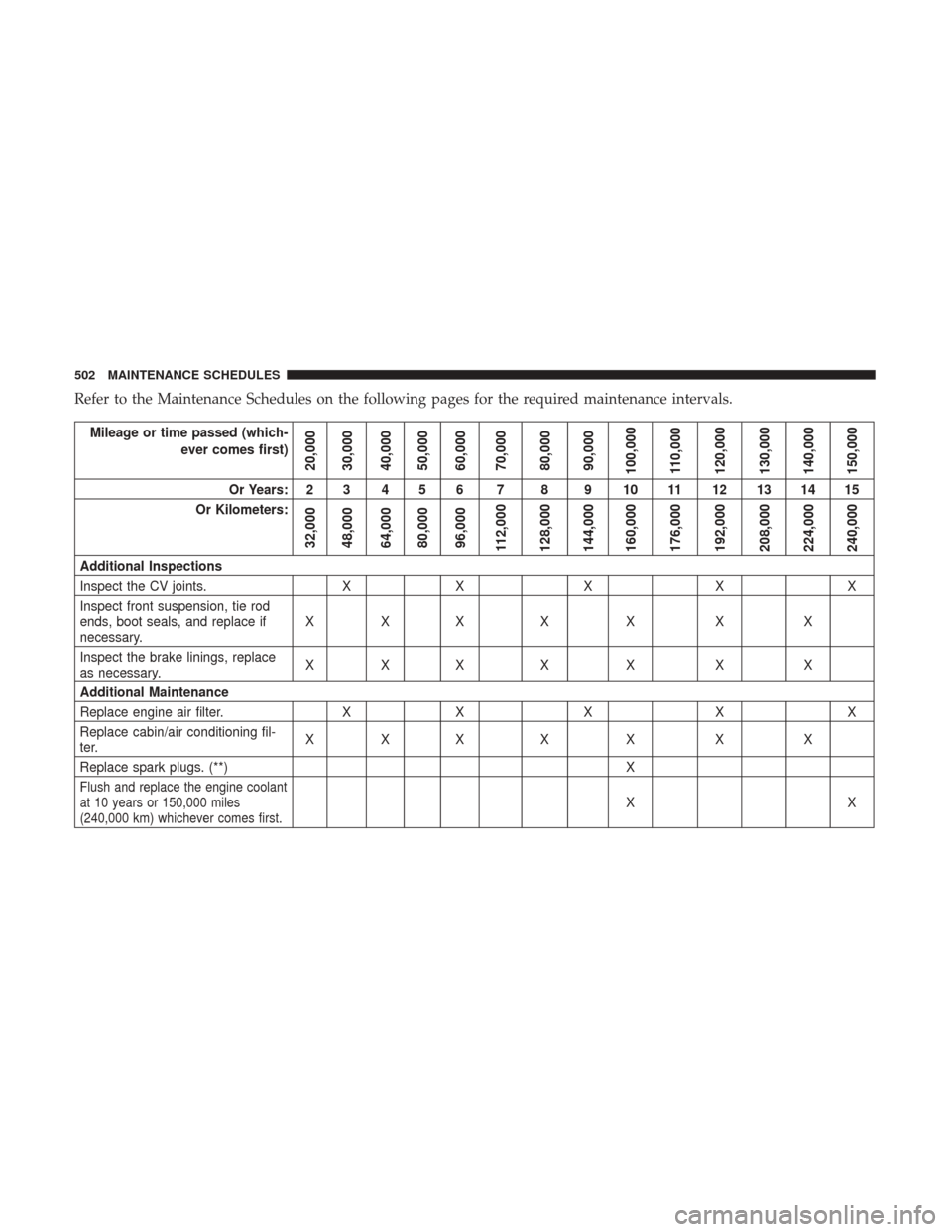
Refer to the Maintenance Schedules on the following pages for the required maintenance intervals.
Mileage or time passed (which-ever comes first)
20,000
30,000
40,000
50,000
60,000
70,000
80,000
90,000
100,000
110,000
120,000
130,000
140,000
150,000
Or Years: 2 3 4 5 6 7 8 9 10 11 12 13 14 15
Or Kilometers:
32,000
48,000
64,000
80,000
96,000
112,000
128,000
144,000
160,000
176,000
192,000
208,000
224,000
240,000
Additional Inspections
Inspect the CV joints. XX X X X
Inspect front suspension, tie rod
ends, boot seals, and replace if
necessary. XXX X X X X
Inspect the brake linings, replace
as necessary. XXX X X X X
Additional Maintenance
Replace engine air filter. XX X X X
Replace cabin/air conditioning fil-
ter. XXX X X X X
Replace spark plugs. (**) X
Flush and replace the engine coolant
at 10 years or 150,000 miles
(240,000 km) whichever comes first.XX
502 MAINTENANCE SCHEDULES
Page 514 of 530
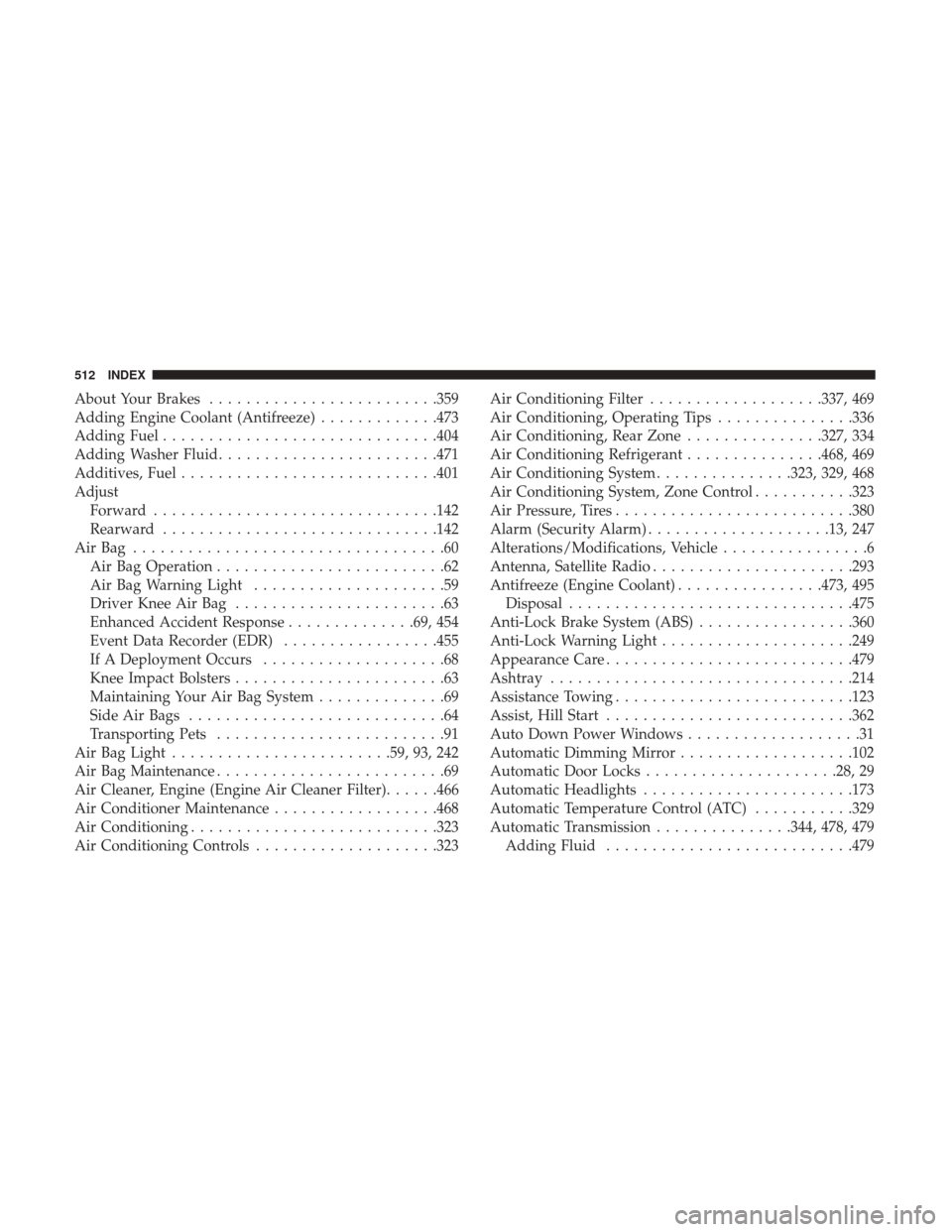
About Your Brakes........................ .359
Adding Engine Coolant (Antifreeze) .............473
Adding Fuel ............................. .404
Adding Washer Fluid ........................471
Additives, Fuel ............................401
Adjust Forward ...............................142
Rearward ............................. .142
AirBag ..................................60 Air Bag Operation .........................62
Air Bag Warning Light .....................59
Driver Knee Air Bag .......................63
Enhanced Accident Response ..............69, 454
Event Data Recorder (EDR) .................455
If A Deployment Occurs ....................68
Knee Impact Bolsters .......................63
Maintaining Your Air Bag System ..............69
Side Air Bags ............................64
Transporting Pets .........................91
Air Bag Light ........................59, 93, 242
Air Bag Maintenance .........................69
Air Cleaner, Engine (Engine Air Cleaner Filter) ......466
Air Conditioner Maintenance ..................468
Air Conditioning .......................... .323
Air Conditioning Controls ....................323 Air Conditioning Filter
...................337, 469
Air Conditioning, Operating Tips ...............336
Air Conditioning, Rear Zone ...............327, 334
Air Conditioning Refrigerant ...............468, 469
Air Conditioning System ...............323, 329, 468
Air Conditioning System, Zone Control ...........323
Air Pressure, Tires ..........................380
Alarm (Security Alarm) ....................13, 247
Alterations/Modifications, Vehicle ................6
Antenna, Satellite Radio ..................... .293
Antifreeze (Engine Coolant) ................473, 495
Disposal ...............................475
Anti-Lock Brake System (ABS) .................360
Anti-Lock Warning Light .....................249
Appearance Car
e .......................... .479
Ashtray .................................214
Assistance Towing ..........................123
Assist, Hill Start .......................... .362
Auto Down Power Windows ...................31
Automatic Dimming Mirror ...................102
Automatic Door Locks .....................28, 29
Automatic Headlights .......................173
Automatic Temperature Control (ATC) ...........329
Automatic Transmission ...............344, 478, 479
Adding Fluid .......................... .479
512 INDEX
Page 515 of 530
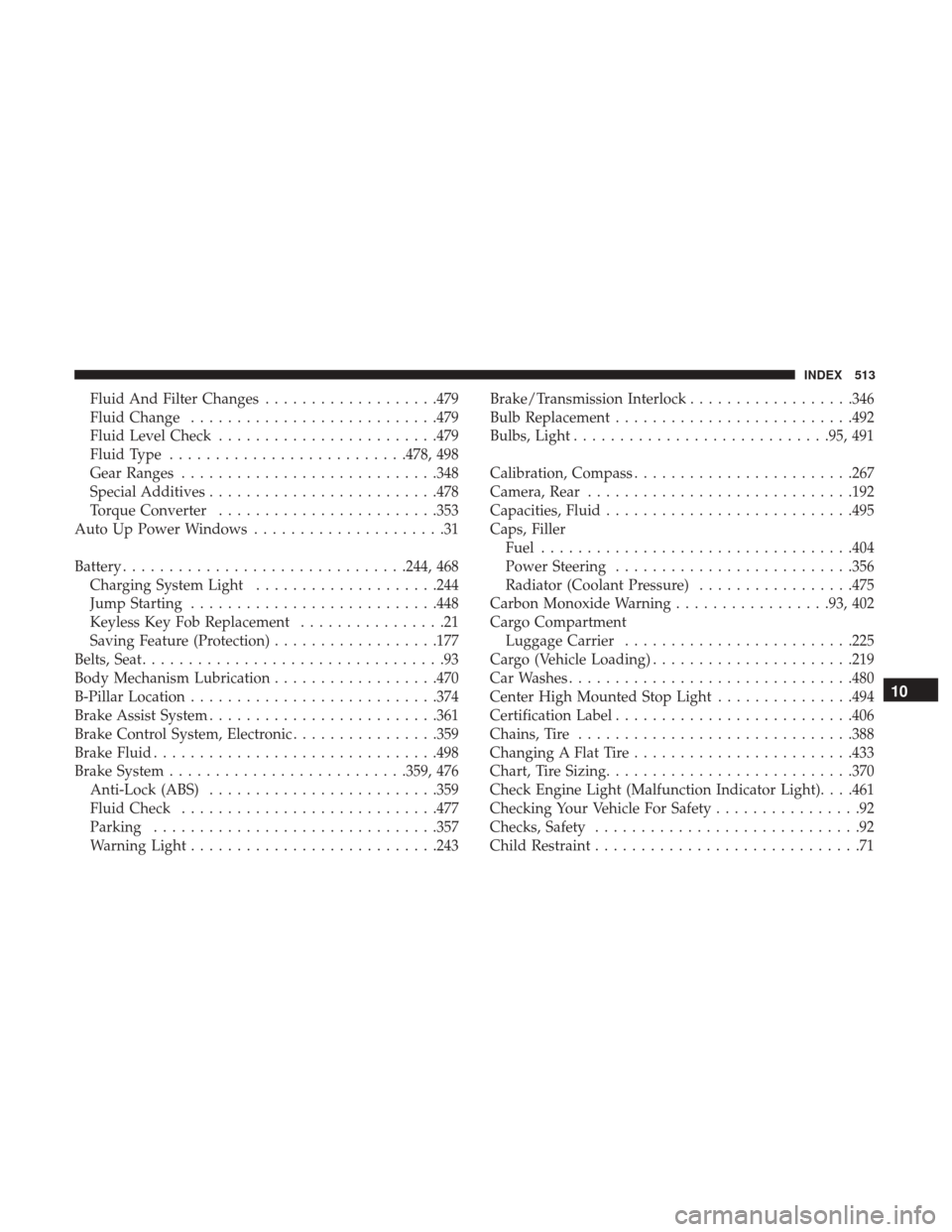
Fluid And Filter Changes...................479
Fluid Change .......................... .479
Fluid Level Check ........................479
Fluid Type ..........................478, 498
Gear Ranges ............................348
Special Additives ........................ .478
Torque Converter ........................353
Auto Up Power Windows .....................31
Battery ...............................244, 468
Charging System Light ....................244
Jump Starting .......................... .448
Keyless Key Fob Replacement ................21
Saving Feature (Protection) ..................177
Belts, Seat .................................93
Body Mechanism Lubrication ..................470
B-Pillar Location .......................... .374
Brake Assist System ........................ .361
Brake Control System, Electronic ................359
Brake Fluid ...............................498
Brake System ..........................359, 476
Anti-Lock (ABS) ........................ .359
Fluid Check ............................477
Parking ...............................357
Warning Light .......................... .243Brake/Transmission Interlock
..................346
Bulb Replacement ..........................492
Bulbs, Light ............................95, 491
Calibration, Compass ........................267
Camera, Rear ............................ .192
Capacities, Fluid .......................... .495
Caps, Filler Fuel ................................. .404
Power Steering ..........................356
Radiator (Coolant Pressure) .................475
Carbon Monoxide Warning .................93, 402
Cargo Compartment Luggage Carrier ........................ .225
Car go
(Vehicle Loading) ..................... .219
Car Washes ...............................480
Center High Mounted Stop Light ...............494
Certification Label ..........................406
Chains, Tire ............................. .388
Changing A Flat Tire ........................433
Chart, Tire Sizing .......................... .370
Check Engine Light (Malfunction Indicator Light). . . .461
Checking Your Vehicle For Safety ................92
Checks, Safety .............................92
Child Restraint .............................71
10
INDEX 513