check engine light DODGE GRAND CARAVAN 2019 User Guide
[x] Cancel search | Manufacturer: DODGE, Model Year: 2019, Model line: GRAND CARAVAN, Model: DODGE GRAND CARAVAN 2019Pages: 490, PDF Size: 3.84 MB
Page 238 of 490
Floor Mat Safety Information
Always use floor mats designed to fit your vehicle. Only
use a floor mat that does not interfere with the operation of
the accelerator, brake or clutch pedals. Only use a floor mat
that is securely attached using the floor mat fasteners so it
cannot slip out of position and interfere with the accelera-
tor, brake or clutch pedals or impair safe operation of your
vehicle in other ways.
WARNING!
An improperly attached, damaged, folded, or stacked
floor mat, or damaged floor mat fasteners may cause
your floor mat to interfere with the accelerator, brake,
or clutch pedals and cause a loss of vehicle control. To
prevent SERIOUS INJURY or DEATH:
•ALWAYS securely attach
your floor mat using the
floor mat fasteners. DO NOT install your floor mat
upside down or turn your floor mat over. Lightly pull
to confirm mat is secured using the floor mat fasten-
ers on a regular basis.
(Continued)
WARNING! (Continued)
•ALWAYS REMOVE THE EXISTING FLOOR MAT
FROM THE VEHICLE
before installing any other
floor mat. NEVER install or stack an additional floor
mat on top of an existing floor mat.
• ONLY install floor mats designed to fit your vehicle.
NEVER install a floor mat that cannot be properly
attached and secured to your vehicle. If a floor mat
needs to be replaced, only use a FCA approved floor
mat for the specific make, model, and year of your
vehicle.
• ONLY use the driver ’s side floor mat on the driver ’s
side floor area. To check for interference, with the
vehicle properly parked with the engine off, fully
depress the accelerator, the brake, and the clutch
pedal (if present) to check for interference. If your
floor mat interferes with the operation of any pedal,
or is not secure to the floor, remove the floor mat
from the vehicle and place the floor mat in your
trunk.
• ONLY use the passenger ’s side floor mat on the
passenger ’s side floor area.
(Continued)
236 SAFETY
Page 247 of 490
CAUTION!
If the Brake System Warning Light remains on with the
parking brake released, a brake system malfunction is
indicated. Have the brake system serviced by an au-
thorized dealer immediately.
AUTOMATIC TRANSMISSION
WARNING!
•It is dangerous to shift out of PARK or NEUTRAL if
the engine speed is higher than idle speed. If your
foot is not firmly pressing the brake pedal, the
vehicle could accelerate quickly forward or in re-
verse. You could lose control of the vehicle and hit
someone or something. Only shift into gear when the
engine is idling normally and your foot is firmly
pressing the brake pedal.
(Continued)
WARNING! (Continued)
•Unintended movement of a vehicle could injure
those in or near the vehicle. As with all vehicles, you
should never exit a vehicle while the engine is
running. Before exiting a vehicle, always come to a
complete stop, then apply the parking brake, shift
the transmission into PARK, turn the engine OFF,
and remove the key fob. When the ignition is in the
LOCK/OFF (key removal) position, the transmission
is locked in PARK, securing the vehicle against
unwanted movement.
• When leaving the vehicle, always make sure the
ignition is in the OFF mode, remove the key fob from
the vehicle, and lock the vehicle.
• Never use the PARK position as a substitute for the
parking brake. Always apply the parking brake fully
when exiting the vehicle to guard against vehicle
movement and possible injury or damage.
• Your vehicle could move and injure you and others if
it is not in PARK. Check by trying to move the gear
selector out of PARK with the brake pedal released.
Make sure the transmission is in PARK before exit-
ing the vehicle.
(Continued)
6
STARTING AND OPERATING 245
Page 337 of 490
SCHEDULED SERVICING
Your vehicle is equipped with an automatic oil change
indicator system. The oil change indicator system will
remind you that it is time to take your vehicle in for
scheduled maintenance.
Based on engine operation conditions, the oil change
indicator message will illuminate. This means that service
is required for your vehicle. Operating conditions such as
frequent short-trips, trailer tow, extremely hot or cold
ambient temperatures, and E85 fuel usage will influence
when the “Oil Change Required” message is displayed.
Severe Operating Conditions can cause the change oil
message to illuminate as early as 3,500 miles (5,600 km)
since last reset. Have your vehicle serviced as soon as
possible, within the next 500 miles (805 km).
Your authorized dealer will reset the oil change indicator
message after completing the scheduled oil change. If a
scheduled oil change is performed by someone other than
your authorized dealer, the message can be reset by
referring to the steps described under “Instrument Cluster
Display” in “Getting To Know Your Instrument Panel” for
further information.NOTE:
Under no circumstances should oil change inter-
vals exceed 10,000 miles (16,000 km), 12 months or 350
hours of engine run time, whichever comes first. The 350
hours of engine run or idle time is generally only a concern
for fleet customers.
Severe Duty All Models
Change engine oil at 4,000 miles (6,500 km) if the vehicle is
operated in a dusty and off road environment or is
operated predominately at idle or only very low engine
RPM’s. This type of vehicle use is considered Severe Duty.
Once A Month Or Before A Long Trip:
• Check engine oil level.
• Check windshield washer fluid level.
• Check tire pressure and look for unusual wear or
damage. Rotate tires at the first sign of irregular wear,
even if it occurs before the oil indicator system turns on.
• Check the fluid levels of the coolant reservoir, brake
master cylinder, and power steering and fill as needed.
• Check function of all interior and exterior lights.
8
SERVICING AND MAINTENANCE 335
Page 342 of 490
Checking Oil Level
To assure proper engine lubrication, the engine oil must be
maintained at the correct level. Check the oil level at
regular intervals, such as every fuel stop. The best time to
check the engine oil level is about five minutes after a fully
warmed engine is shut OFF.
Checking the oil while the vehicle is on level ground will
improve the accuracy of the oil level readings. Maintain the
oil level within the SAFE crosshatch marking on the
dipstick. Adding one quart of oil when the reading is at the
bottom of the mark will result in reading the top of the
mark on these engines.
CAUTION!
Overfilling or underfilling will cause oil aeration, or
loss of oil pressure. This could damage your engine.
Adding Washer Fluid
The fluid reservoir for the windshield washers and the rear
window washer is shared. It is located in the engine
compartment and should be checked at regular intervals.
Fill the reservoir with windshield washer solvent (not
radiator antifreeze) and operate the system for a few
seconds to flush out any residual water.The washer fluid reservoir will hold a full gallon of fluid
when the Low Washer Fluid Light illuminates.
WARNING!
Commercially available windshield washer solvents
are flammable. They could ignite and burn you. Care
must be exercised when filling or working around the
washer solution.
After the engine has warmed, operate the defroster for a
few minutes to reduce the possibility of smearing or
freezing the fluid on the cold windshield. Mopar All
Weather Windshield Washer Solution or equivalent, used
with water as directed on the container, aids cleaning
action, reduces the freezing point to avoid line clogging,
and is not harmful to paint or trim.
Maintenance-Free Battery
Your vehicle is equipped with a maintenance-free battery.
You will never have to add water, nor is periodic mainte-
nance required.
340 SERVICING AND MAINTENANCE
Page 357 of 490
Master Cylinder — Brake Fluid Level Check
The fluid level in the master cylinder should be checked
when performing underhood services, or immediately if
the “Brake System Warning Light” indicates system failure.
Clean the top of the master cylinder area before removing
the cap. Add fluid to bring the level up to the top of the
“FULL” mark on the side of the master cylinder reservoir.
Overfilling of fluid is not recommended because it may
cause leaking in the system.
Add enough fluid to bring the level up to the requirements
described on the brake fluid reservoir. With disc brakes,
fluid level can be expected to fall as the brake pads wear.
However, low fluid level may be caused by a leak and a
checkup may be needed.
Use only manufacturer’s recommended brake fluid. Refer
to “Fluids And Lubricants” in “Technical Specifications”
for further information.
WARNING!
•Use only manufacturer’s recommended brake fluid.
Refer to “Fluids And Lubricants” in “Technical
Specifications” for further information. Using the
wrong type of brake fluid can severely damage your
brake system and/or impair its performance. The
proper type of brake fluid for your vehicle is also
identified on the original factory installed hydraulic
master cylinder reservoir.
• To avoid contamination from foreign matter or mois-
ture, use only new brake fluid or fluid that has been
in a tightly closed container. Keep the master cylin-
der reservoir cap secured at all times. Brake fluid in
a open container absorbs moisture from the air
resulting in a lower boiling point. This may cause it
to boil unexpectedly during hard or prolonged brak-
ing, resulting in sudden brake failure. This could
result in a collision.
• Overfilling the brake fluid reservoir can result in
spilling brake fluid on hot engine parts, causing the
brake fluid to catch fire. Brake fluid can also damage
painted and vinyl surfaces, care should be taken to
avoid its contact with these surfaces.
(Continued)
8
SERVICING AND MAINTENANCE 355
Page 392 of 490
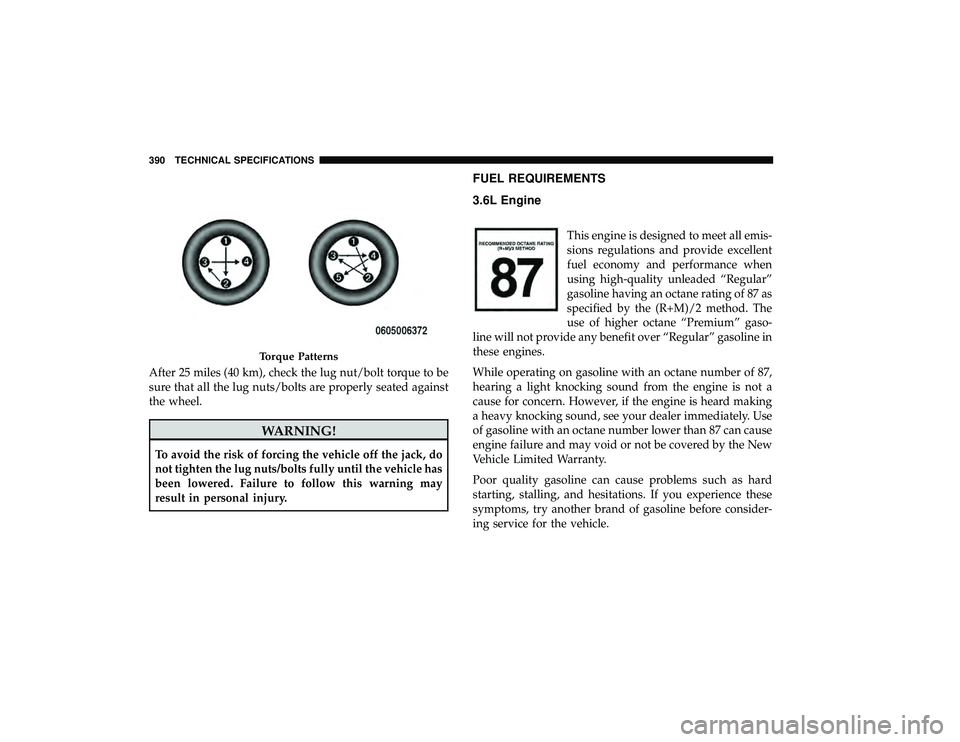
After 25 miles (40 km), check the lug nut/bolt torque to be
sure that all the lug nuts/bolts are properly seated against
the wheel.
WARNING!
To avoid the risk of forcing the vehicle off the jack, do
not tighten the lug nuts/bolts fully until the vehicle has
been lowered. Failure to follow this warning may
result in personal injury.
FUEL REQUIREMENTS
3.6L Engine
This engine is designed to meet all emis-
sions regulations and provide excellent
fuel economy and performance when
using high-quality unleaded “Regular”
gasoline having an octane rating of 87 as
specified by the (R+M)/2 method. The
use of higher octane “Premium” gaso-
line will not provide any benefit over “Regular” gasoline in
these engines.
While operating on gasoline with an octane number of 87,
hearing a light knocking sound from the engine is not a
cause for concern. However, if the engine is heard making
a heavy knocking sound, see your dealer immediately. Use
of gasoline with an octane number lower than 87 can cause
engine failure and may void or not be covered by the New
Vehicle Limited Warranty.
Poor quality gasoline can cause problems such as hard
starting, stalling, and hesitations. If you experience these
symptoms, try another brand of gasoline before consider-
ing service for the vehicle.
Torque Patterns
390 TECHNICAL SPECIFICATIONS
Page 475 of 490
Automatic Headlights........................62
Automatic Transmission ..................245, 357
Adding Fluid ....................... .357, 400
Fluid And Filter Change ...................357
Fluid Change .......................... .357
Fluid Level Check .................... .356, 357
Fluid Type ......................... .356, 400
Gear Ranges ........................... .248
Special Additives ........................ .356
Torque Converter ....................... .253
Axle Fluid .............................. .400
Axle Lubrication .......................... .400
Battery .............................. .146, 340
Charging System Light ................... .146
Jump Starting .......................... .324
Keyless Key Fob Replacement ................18
Battery Saver Feature .........................64
Belts, Seat ............................... .235
Body Mechanism Lubrication ..................347
B-Pillar Location .......................... .363
Brake Assist System ........................ .160
Brake Control System, Electronic ................159
Brake Fluid .............................. .400
Brake System ......................... .354, 388Anti-Lock (ABS)
........................ .388
Fluid Check ........................ .355, 400
Parking .............................. .243
Warning Light .......................... .145
Brake/Transmission Interlock ..................246
Bulb Replacement ......................... .287
Bulbs, Light .......................... .237, 287
Calibration Compass ............................. .138
Camera, Rear ............................ .265
Capacities, Fluid .......................... .397
Caps, Filler Oil (Engine) ........................... .339
Power
Steering ......................... .254
Radiator (Coolant Pressure) .................353
Carbon Monoxide Warning ................234, 393
Cargo Vehicle Loading ..........................97
Cargo Area Cover ...........................97
Cargo Compartment .........................97
Luggage Carrier ........................ .122
Car Washes .............................. .382
Cellular Phone ........................ .432, 456
Center High Mounted Stop Light ...............290
12
INDEX 473
Page 476 of 490
Certification Label......................... .268
Chains, Tire ............................. .378
Change Oil Indicator ....................... .135
Changing A Flat Tire .................... .297, 357
Chart, Tire Sizing .......................... .359
Check Engine Light (Malfunction Indicator Light). . . .154
Checking Your Vehicle For Safety ...............234
Checks, Safety ............................ .234
Child Restraint ........................... .210
Child Restraints Booster Seats ........................... .214
Child Seat Installation ................. .226, 228
How To Stow An unused ALR Seat Belt ........224
Infant And Child Restraints .................212
Locating The LATCH Anchorages .............220
Lower Anchors And Tethers For Children .......216
Older Children And Child Restraints ...........213
Seating Positions ........................ .215
Using The Top Tether Anchorage .............231
Clean Air Gasoline ........................ .391
Cleaning Wheels ............................... .377
Climate Control ............................68
Automatic ..............................76
Manual ................................68 Coat Hook
...............................112
Cold Weather Operation ..................... .241
Compact Disc (CD) Maintenance ................463
Compact Spare Tire ........................ .375
Compass ................................ .137
Calibration ............................ .138
Variance .............................. .138
Computer, Trip/Travel ................... .136, 144
Console ................................ .105
Floor ................................ .105
Console, Overhead ........................ .108
Contract, Service .......................... .468
Cooling
Pressure Cap (Radiator Cap) ............353
Cooling System ........................... .350
Adding Coolant (Antifreeze) .................352
Cooling Capacity ........................ .397
Disposal Of Used Coolant ..................353
Drain, Flush, And Refill ................... .351
Inspection ............................. .350
Points To Remember ..................... .353
Pressure Cap ........................... .353
Radiator Cap .......................... .353
Selection Of Coolant (Antifreeze) .......351, 397, 398
Corrosion Protection ....................... .381
Cruise Light ............................. .152
474 INDEX
Page 478 of 490
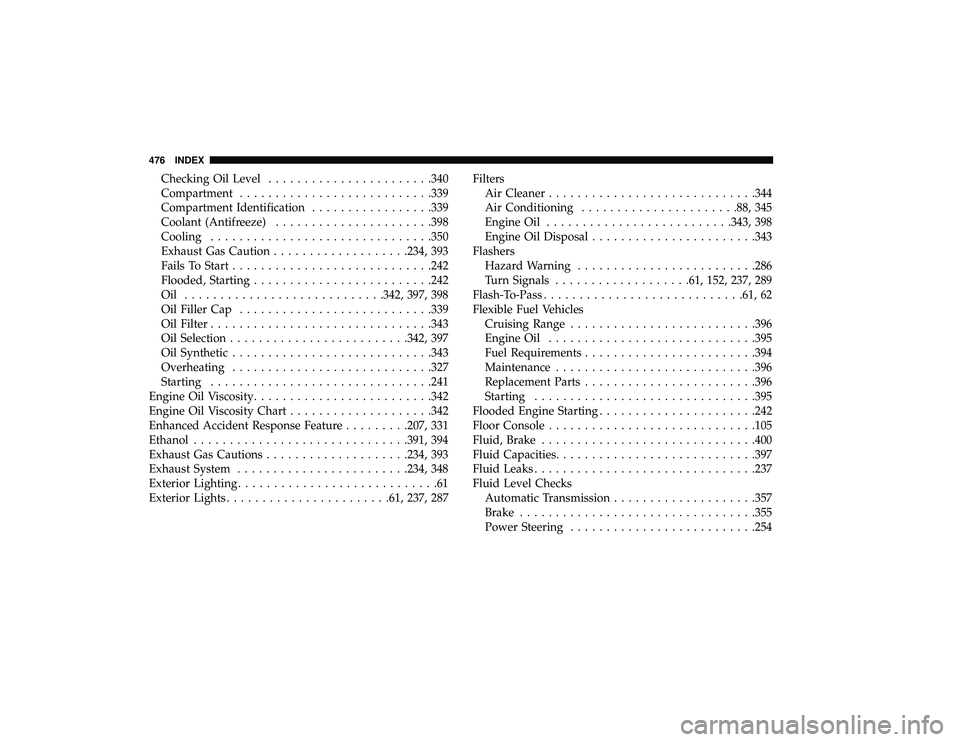
Checking Oil Level...................... .340
Compartment .......................... .339
Compartment Identification .................339
Coolant (Antifreeze) ..................... .398
Cooling .............................. .350
Exhaust Gas Caution .................. .234, 393
Fails To Start ........................... .242
Flooded, Starting ........................ .242
Oil ........................... .342, 397, 398
Oil Filler Cap .......................... .339
Oil Filter .............................. .343
Oil Selection ........................ .342, 397
Oil Synthetic ........................... .343
Overheating ........................... .327
Starting .............................. .241
Engine Oil Viscosity ........................ .342
Engine Oil Viscosity Chart ....................342
Enhanced Accident Response Feature .........207, 331
Ethanol ............................. .391, 394
Exhaust Gas Cautions ................... .234, 393
Exhaust System ....................... .234, 348
Exterior Lighting ............................61
Exterior Lights ...................... .61, 237, 287Filters
Air Cleaner ............................ .344
Air Conditioning ..................... .88, 345
Engine Oil ......................... .343, 398
Engine Oil Disposal ...................... .343
Flashers Hazard Warning ........................ .286
Turn Signals .................. .61, 152, 237, 289
Flash-To-Pass ........................... .61, 62
Flexible Fuel Vehicles Cruising Range ......................... .396
Engine Oil ............................ .395
Fuel Requirements ....................... .394
Maintenance ........................... .396
Replacement
Parts ....................... .396
Starting .............................. .395
Flooded Engine Starting ..................... .242
Floor Console ............................ .105
Fluid, Brake ............................. .400
Fluid Capacities ........................... .397
Fluid Leaks .............................. .237
Fluid Level Checks Automatic Transmission ................... .357
Brake ................................ .355
Power Steering ......................... .254
476 INDEX
Page 481 of 490
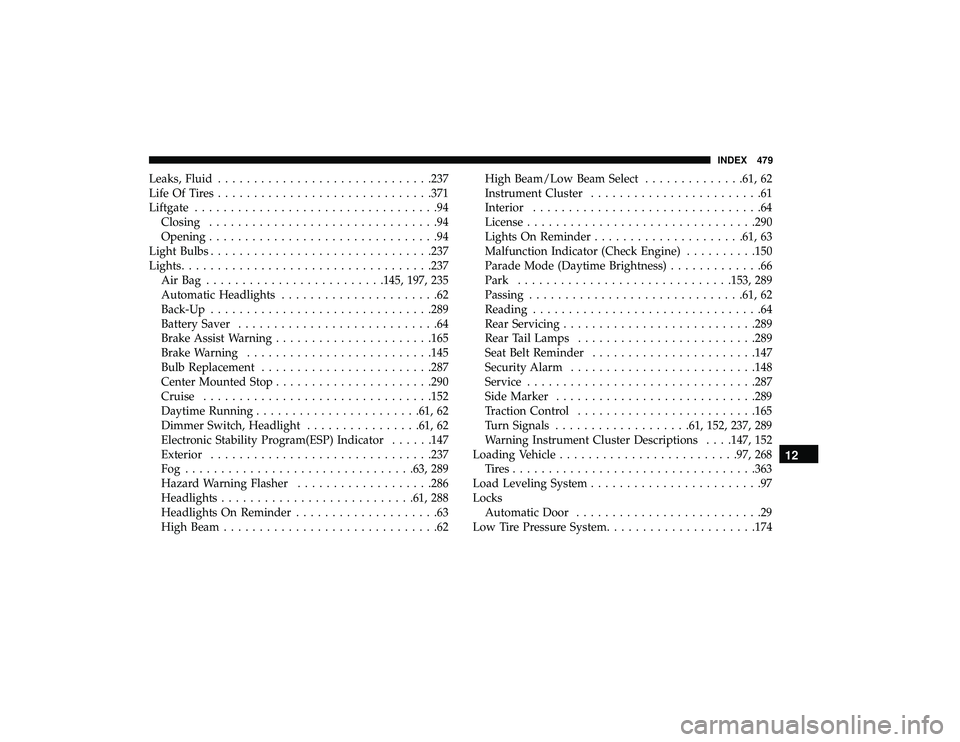
Leaks, Fluid............................. .237
Life Of Tires ............................. .371
Liftgate ..................................94
Closing ................................94
Opening ................................94
Light Bulbs .............................. .237
Lights .................................. .237
AirBag ........................ .145, 197, 235
Automatic Headlights ......................62
Back-Up .............................. .289
Battery Saver ............................64
Brake Assist Warning ..................... .165
Brake Warning ......................... .145
Bulb Replacement ....................... .287
Center Mounted Stop ..................... .290
Cruise ............................... .152
Daytime Running ...................... .61, 62
Dimmer Switch, Headlight ................61, 62
Electronic Stability Program(ESP) Indicator ......147
Exterior .............................. .237
Fog ............................... .63, 289
Hazard Warning Flasher ...................286
Headlights .......................... .61, 288
Headlights On Reminder ....................63
High Beam ..............................62 High Beam/Low Beam Select
..............61, 62
Instrument Cluster ........................61
Interior ................................64
License ............................... .290
Lights On Reminder .................... .61, 63
Malfunction Indicator (Check Engine) ..........150
Parade Mode (Daytime Brightness) .............66
Park ............................. .153, 289
Passing ............................. .61, 62
Reading ................................64
Rear Servicing .......................... .289
Rear Tail Lamps ........................ .289
Seat Belt Reminder ...................... .147
Security Alarm ......................... .148
Service ............................... .287
Side
Marker ........................... .289
Traction Control ........................ .165
Turn Signals .................. .61, 152, 237, 289
Warning Instrument Cluster Descriptions . . . .147, 152
Loading Vehicle ........................ .97, 268
Tires................................. .363
Load Leveling System ........................97
Locks Automatic Door ..........................29
Low Tire Pressure System .................... .174
12
INDEX 479