Power steering fluid level DODGE GRAND CARAVAN 2019 Owners Manual
[x] Cancel search | Manufacturer: DODGE, Model Year: 2019, Model line: GRAND CARAVAN, Model: DODGE GRAND CARAVAN 2019Pages: 490, PDF Size: 3.84 MB
Page 256 of 490
feeling or response during normal operation in the upper
gears. When the vehicle speed drops or during some
accelerations, the clutch automatically disengages.
NOTE:The torque converter clutch will not engage until
the transmission fluid and engine coolant are warm [usu-
ally after 1 to 3 miles (2 to 5 km) of driving]. Because the
engine speed is higher when the torque converter clutch is
not engaged, it may seem as if the transmission is not
shifting into Overdrive when cold. This is normal. Using
the Electronic Range Select (ERS) shift control, when the
transmission is sufficiently warm, will demonstrate that
the transmission is able to shift into and out of Overdrive.
POWER STEERING
The standard power steering system will give you good
vehicle response and increased ease of maneuverability in
tight spaces. The system will provide mechanical steering
capability if power assist is lost.
If for some reason the power assist is interrupted, it will
still be possible to steer your vehicle. Under these condi-
tions, you will observe a substantial increase in steering
effort, especially at very low vehicle speeds and during
parking maneuvers. NOTE:
•
Increased noise levels at the end of the steering wheel
travel are considered normal and do not indicate that
there is a problem with the power steering system.
• Upon initial start-up in cold weather, the power steering
pump may make noise for a short amount of time. This
is due to the cold, thick fluid in the steering system. This
noise should be considered normal, and it does not in
any way damage the steering system.
CAUTION!
Prolonged operation of the steering system at the end
of the steering wheel travel will increase the steering
fluid temperature and it should be avoided when
possible. Damage to the power steering pump may
occur.
Power Steering Fluid Check
Checking the power steering fluid level at a defined service
interval is not required. The fluid should only be checked
if a leak is suspected, abnormal noises are apparent,
and/or the system is not functioning as anticipated. Coor-
dinate inspection efforts through an authorized dealer.
254 STARTING AND OPERATING
Page 257 of 490
WARNING!
Fluid level should be checked on a level surface and
with the engine off to prevent injury from moving
parts and to ensure accurate fluid level reading. Do not
overfill. Use only manufacturer’s recommended power
steering fluid.
CAUTION!
Do not use chemical flushes in your power steering
system as the chemicals can damage your power steer-
ing components. Such damage is not covered by the
New Vehicle Limited Warranty.
If necessary, add fluid to restore to the proper indicated
level. With a clean cloth, wipe any spilled fluid from all
surfaces. Refer to “Fluids And Lubricants” in “Technical
Specifications” for the correct fluid type.
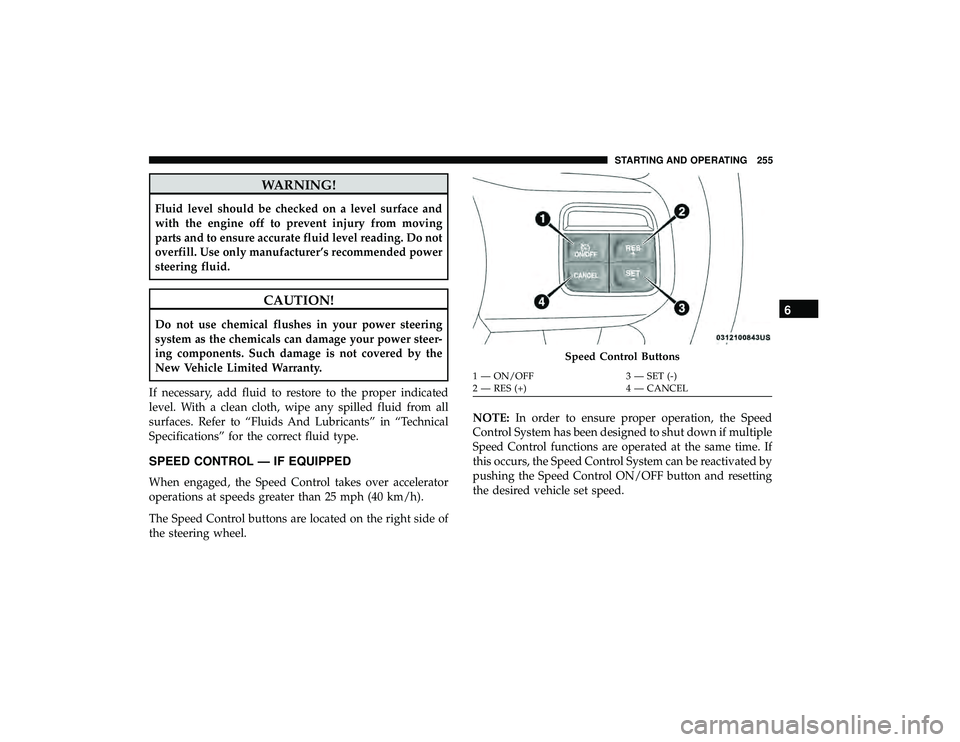
SPEED CONTROL — IF EQUIPPED
When engaged, the Speed Control takes over accelerator
operations at speeds greater than 25 mph (40 km/h).
The Speed Control buttons are located on the right side of
the steering wheel. NOTE:
In order to ensure proper operation, the Speed
Control System has been designed to shut down if multiple
Speed Control functions are operated at the same time. If
this occurs, the Speed Control System can be reactivated by
pushing the Speed Control ON/OFF button and resetting
the desired vehicle set speed.
Speed Control Buttons
1 — ON/OFF 3 — SET (-)
2 — RES (+) 4 — CANCEL
6
STARTING AND OPERATING 255
Page 337 of 490
SCHEDULED SERVICING
Your vehicle is equipped with an automatic oil change
indicator system. The oil change indicator system will
remind you that it is time to take your vehicle in for
scheduled maintenance.
Based on engine operation conditions, the oil change
indicator message will illuminate. This means that service
is required for your vehicle. Operating conditions such as
frequent short-trips, trailer tow, extremely hot or cold
ambient temperatures, and E85 fuel usage will influence
when the “Oil Change Required” message is displayed.
Severe Operating Conditions can cause the change oil
message to illuminate as early as 3,500 miles (5,600 km)
since last reset. Have your vehicle serviced as soon as
possible, within the next 500 miles (805 km).
Your authorized dealer will reset the oil change indicator
message after completing the scheduled oil change. If a
scheduled oil change is performed by someone other than
your authorized dealer, the message can be reset by
referring to the steps described under “Instrument Cluster
Display” in “Getting To Know Your Instrument Panel” for
further information.NOTE:
Under no circumstances should oil change inter-
vals exceed 10,000 miles (16,000 km), 12 months or 350
hours of engine run time, whichever comes first. The 350
hours of engine run or idle time is generally only a concern
for fleet customers.
Severe Duty All Models
Change engine oil at 4,000 miles (6,500 km) if the vehicle is
operated in a dusty and off road environment or is
operated predominately at idle or only very low engine
RPM’s. This type of vehicle use is considered Severe Duty.
Once A Month Or Before A Long Trip:
• Check engine oil level.
• Check windshield washer fluid level.
• Check tire pressure and look for unusual wear or
damage. Rotate tires at the first sign of irregular wear,
even if it occurs before the oil indicator system turns on.
• Check the fluid levels of the coolant reservoir, brake
master cylinder, and power steering and fill as needed.
• Check function of all interior and exterior lights.
8
SERVICING AND MAINTENANCE 335
Page 475 of 490
Automatic Headlights........................62
Automatic Transmission ..................245, 357
Adding Fluid ....................... .357, 400
Fluid And Filter Change ...................357
Fluid Change .......................... .357
Fluid Level Check .................... .356, 357
Fluid Type ......................... .356, 400
Gear Ranges ........................... .248
Special Additives ........................ .356
Torque Converter ....................... .253
Axle Fluid .............................. .400
Axle Lubrication .......................... .400
Battery .............................. .146, 340
Charging System Light ................... .146
Jump Starting .......................... .324
Keyless Key Fob Replacement ................18
Battery Saver Feature .........................64
Belts, Seat ............................... .235
Body Mechanism Lubrication ..................347
B-Pillar Location .......................... .363
Brake Assist System ........................ .160
Brake Control System, Electronic ................159
Brake Fluid .............................. .400
Brake System ......................... .354, 388Anti-Lock (ABS)
........................ .388
Fluid Check ........................ .355, 400
Parking .............................. .243
Warning Light .......................... .145
Brake/Transmission Interlock ..................246
Bulb Replacement ......................... .287
Bulbs, Light .......................... .237, 287
Calibration Compass ............................. .138
Camera, Rear ............................ .265
Capacities, Fluid .......................... .397
Caps, Filler Oil (Engine) ........................... .339
Power
Steering ......................... .254
Radiator (Coolant Pressure) .................353
Carbon Monoxide Warning ................234, 393
Cargo Vehicle Loading ..........................97
Cargo Area Cover ...........................97
Cargo Compartment .........................97
Luggage Carrier ........................ .122
Car Washes .............................. .382
Cellular Phone ........................ .432, 456
Center High Mounted Stop Light ...............290
12
INDEX 473
Page 478 of 490
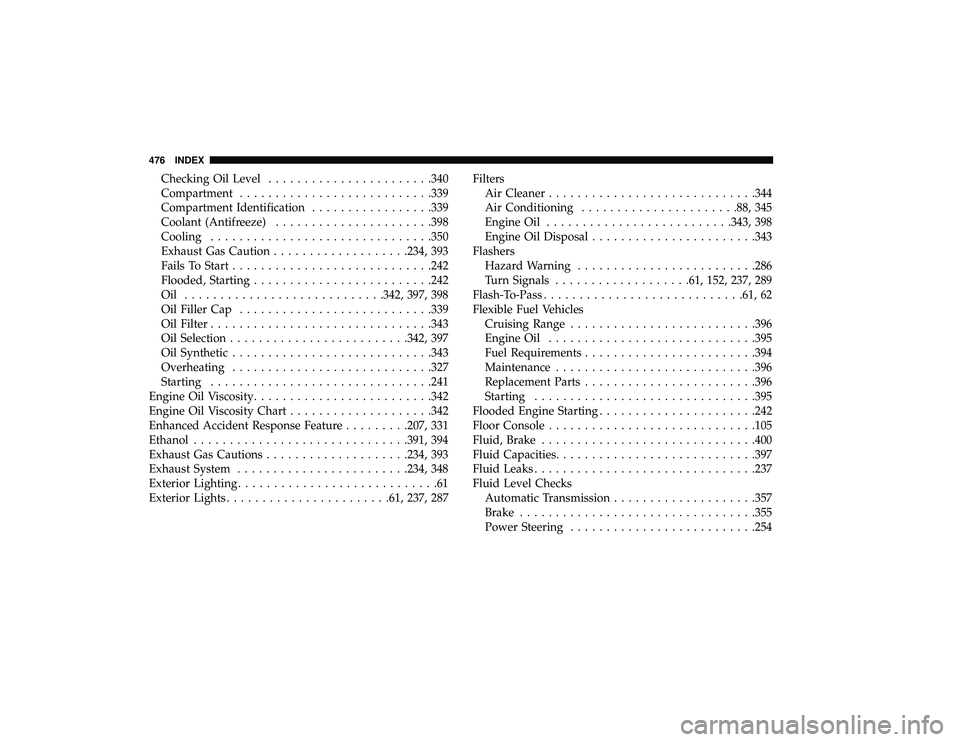
Checking Oil Level...................... .340
Compartment .......................... .339
Compartment Identification .................339
Coolant (Antifreeze) ..................... .398
Cooling .............................. .350
Exhaust Gas Caution .................. .234, 393
Fails To Start ........................... .242
Flooded, Starting ........................ .242
Oil ........................... .342, 397, 398
Oil Filler Cap .......................... .339
Oil Filter .............................. .343
Oil Selection ........................ .342, 397
Oil Synthetic ........................... .343
Overheating ........................... .327
Starting .............................. .241
Engine Oil Viscosity ........................ .342
Engine Oil Viscosity Chart ....................342
Enhanced Accident Response Feature .........207, 331
Ethanol ............................. .391, 394
Exhaust Gas Cautions ................... .234, 393
Exhaust System ....................... .234, 348
Exterior Lighting ............................61
Exterior Lights ...................... .61, 237, 287Filters
Air Cleaner ............................ .344
Air Conditioning ..................... .88, 345
Engine Oil ......................... .343, 398
Engine Oil Disposal ...................... .343
Flashers Hazard Warning ........................ .286
Turn Signals .................. .61, 152, 237, 289
Flash-To-Pass ........................... .61, 62
Flexible Fuel Vehicles Cruising Range ......................... .396
Engine Oil ............................ .395
Fuel Requirements ....................... .394
Maintenance ........................... .396
Replacement
Parts ....................... .396
Starting .............................. .395
Flooded Engine Starting ..................... .242
Floor Console ............................ .105
Fluid, Brake ............................. .400
Fluid Capacities ........................... .397
Fluid Leaks .............................. .237
Fluid Level Checks Automatic Transmission ................... .357
Brake ................................ .355
Power Steering ......................... .254
476 INDEX