towing capacity DODGE GRAND CARAVAN 2019 Owners Manual
[x] Cancel search | Manufacturer: DODGE, Model Year: 2019, Model line: GRAND CARAVAN, Model: DODGE GRAND CARAVAN 2019Pages: 490, PDF Size: 3.84 MB
Page 128 of 490
Stowing The Crossbars
Reverse the procedure to stow the crossbars, again, taking
care to keep hand clear of pivoting joint. Crossbars are
identical and can be stowed in either rail nest. Once the
crossbars are stowed, tighten the thumb screws completely.
NOTE:Load should always be secured to crossbars first,
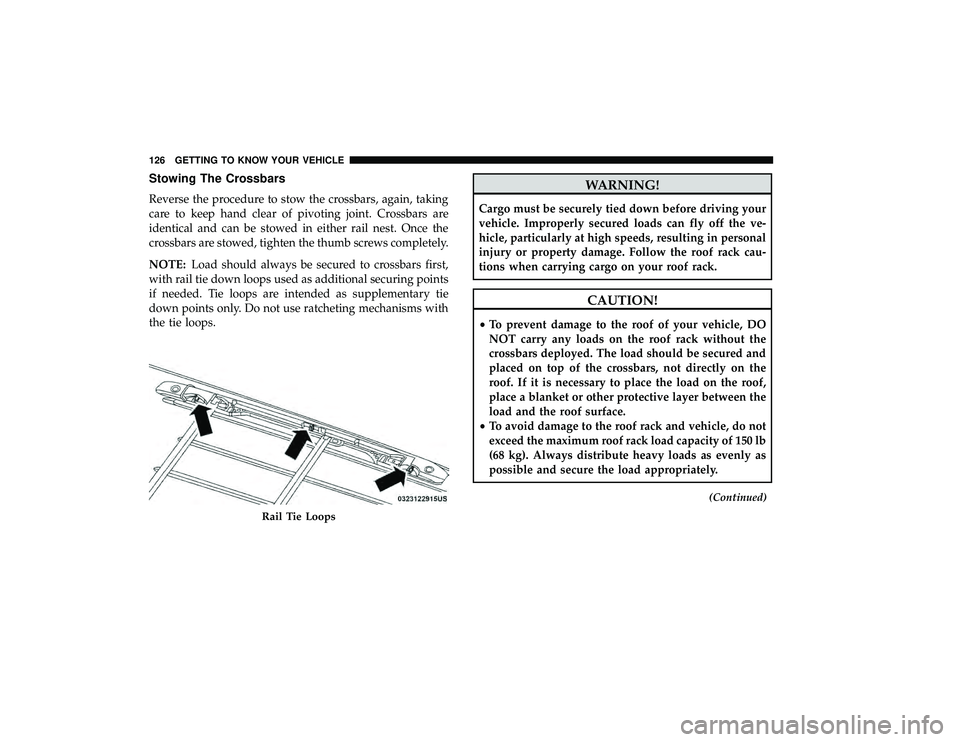
with rail tie down loops used as additional securing points
if needed. Tie loops are intended as supplementary tie
down points only. Do not use ratcheting mechanisms with
the tie loops.
WARNING!
Cargo must be securely tied down before driving your
vehicle. Improperly secured loads can fly off the ve-
hicle, particularly at high speeds, resulting in personal
injury or property damage. Follow the roof rack cau-
tions when carrying cargo on your roof rack.
CAUTION!
• To prevent damage to the roof of your vehicle, DO
NOT carry any loads on the roof rack without the
crossbars deployed. The load should be secured and
placed on top of the crossbars, not directly on the
roof. If it is necessary to place the load on the roof,
place a blanket or other protective layer between the
load and the roof surface.
• To avoid damage to the roof rack and vehicle, do not
exceed the maximum roof rack load capacity of 150 lb
(68 kg). Always distribute heavy loads as evenly as
possible and secure the load appropriately.
(Continued)
Rail Tie Loops
126 GETTING TO KNOW YOUR VEHICLE
Page 280 of 490
Towing Requirements — Trailer Brakes
•Do not interconnect the hydraulic brake system or
vacuum system of your vehicle with that of the trailer.
This could cause inadequate braking and possible per-
sonal injury.
• An electronically actuated trailer brake controller is
required when towing a trailer with electronically actu-
ated brakes. When towing a trailer equipped with a
hydraulic surge actuated brake system, an electronic
brake controller is not required.
• Trailer brakes are recommended for trailers over
1,000 lbs (453 kg) and required for trailers in excess of
2,000 lbs (907 kg).
WARNING!
• Do not connect trailer brakes to your vehicle’s hy-
draulic brake lines. It can overload your brake sys-
tem and cause it to fail. You might not have brakes
when you need them and could have an accident.
• Towing any trailer will increase your stopping dis-
tance. When towing, you should allow for additional
space between your vehicle and the vehicle in front
of you. Failure to do so could result in an accident.
CAUTION!
If the trailer weighs more than 1,000 lbs (453 kg)
loaded, it should have its own brakes and they should
be of adequate capacity. Failure to do this could lead to
accelerated brake lining wear, higher brake pedal
effort, and longer stopping distances.
Towing Requirements — Trailer Lights And Wiring
Whenever you pull a trailer, regardless of the trailer size,
stoplights and turn signals on the trailer are required for
motoring safety.
The Trailer Tow Package may include a four- and seven-pin
wiring harness. Use a factory approved trailer harness and
connector.
NOTE: Do not cut or splice wiring into the vehicle’s wiring
harness.
The electrical connections are all complete to the vehicle
but you must mate the harness to a trailer connector. Refer
to the following illustrations.
278 STARTING AND OPERATING
Page 366 of 490
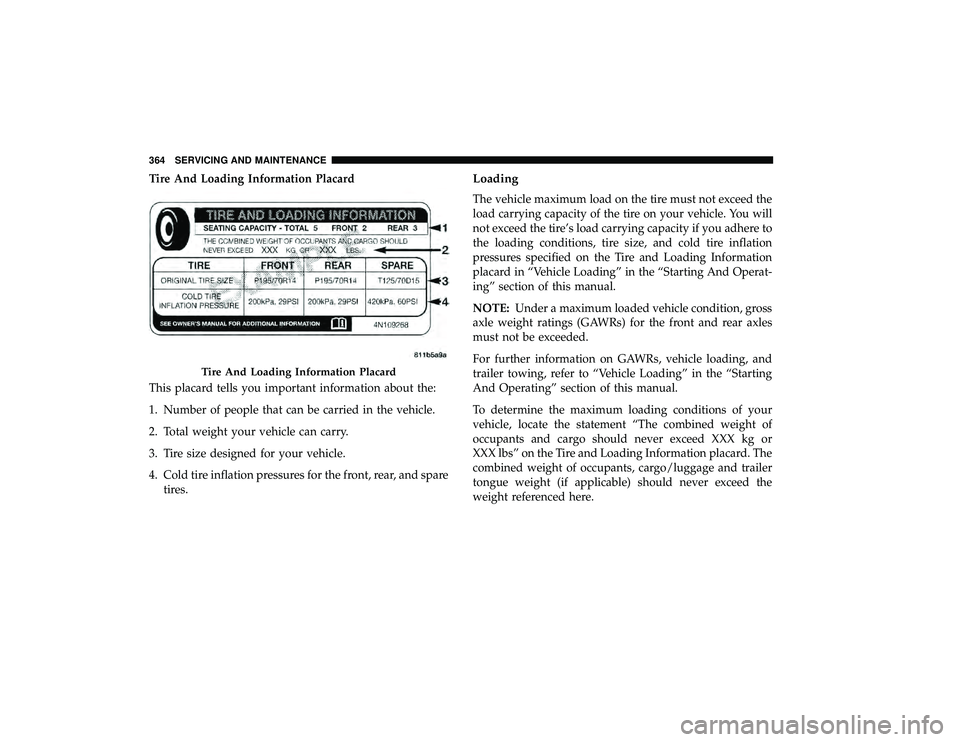
Tire And Loading Information Placard
This placard tells you important information about the:
1. Number of people that can be carried in the vehicle.
2. Total weight your vehicle can carry.
3. Tire size designed for your vehicle.
4. Cold tire inflation pressures for the front, rear, and sparetires.Loading
The vehicle maximum load on the tire must not exceed the
load carrying capacity of the tire on your vehicle. You will
not exceed the tire’s load carrying capacity if you adhere to
the loading conditions, tire size, and cold tire inflation
pressures specified on the Tire and Loading Information
placard in “Vehicle Loading” in the “Starting And Operat-
ing” section of this manual.
NOTE: Under a maximum loaded vehicle condition, gross
axle weight ratings (GAWRs) for the front and rear axles
must not be exceeded.
For further information on GAWRs, vehicle loading, and
trailer towing, refer to “Vehicle Loading” in the “Starting
And Operating” section of this manual.
To determine the maximum loading conditions of your
vehicle, locate the statement “The combined weight of
occupants and cargo should never exceed XXX kg or
XXX lbs” on the Tire and Loading Information placard. The
combined weight of occupants, cargo/luggage and trailer
tongue weight (if applicable) should never exceed the
weight referenced here.
Tire And Loading Information Placard
364 SERVICING AND MAINTENANCE
Page 367 of 490
Steps For Determining Correct Load Limit—
(1) Locate the statement “The combined weight of
occupants and cargo should never exceed XXX kg or
XXX lbs.” on your vehicle’s placard.
(2) Determine the combined weight of the driver and
passengers that will be riding in your vehicle.
(3) Subtract the combined weight of the driver and
passengers from XXX kg or XXX lbs.
(4) The resulting figure equals the available amount of
cargo and luggage load capacity. For example, if “XXX”
amount equals 1400 lbs. and there will be five 150 lb
passengers in your vehicle, the amount of available
cargo and luggage load capacity is 650 lbs. (1400-750
(5x150) = 650 lbs.)
(5) Determine the combined weight of luggage and
cargo being loaded on the vehicle. That weight may not
safely exceed the available cargo and luggage load
capacity calculated in Step 4.
(6) If your vehicle will be towing a trailer, load from
your trailer will be transferred to your vehicle. Consultthis manual to determine how this reduces the available
cargo and luggage load capacity of your vehicle.
Metric Example For Load Limit
For example, if “XXX” amount equals 635 kg and there will
be five 68 kg passengers in your vehicle, the amount of
available cargo and luggage load capacity is 295 kg (635-
340 (5x68) = 295 kg) as shown in step 4.
NOTE:
•
If your vehicle will be towing a trailer, load from your
trailer will be transferred to your vehicle. The following
table shows examples on how to calculate total load,
cargo/luggage, and towing capacities of your vehicle
with varying seating configurations and number and
size of occupants. This table is for illustration purposes
only and may not be accurate for the seating and load
carry capacity of your vehicle.
• For the following example, the combined weight of
occupants and cargo should never exceed 865 lbs
(392 kg).
8
SERVICING AND MAINTENANCE 365
Page 486 of 490
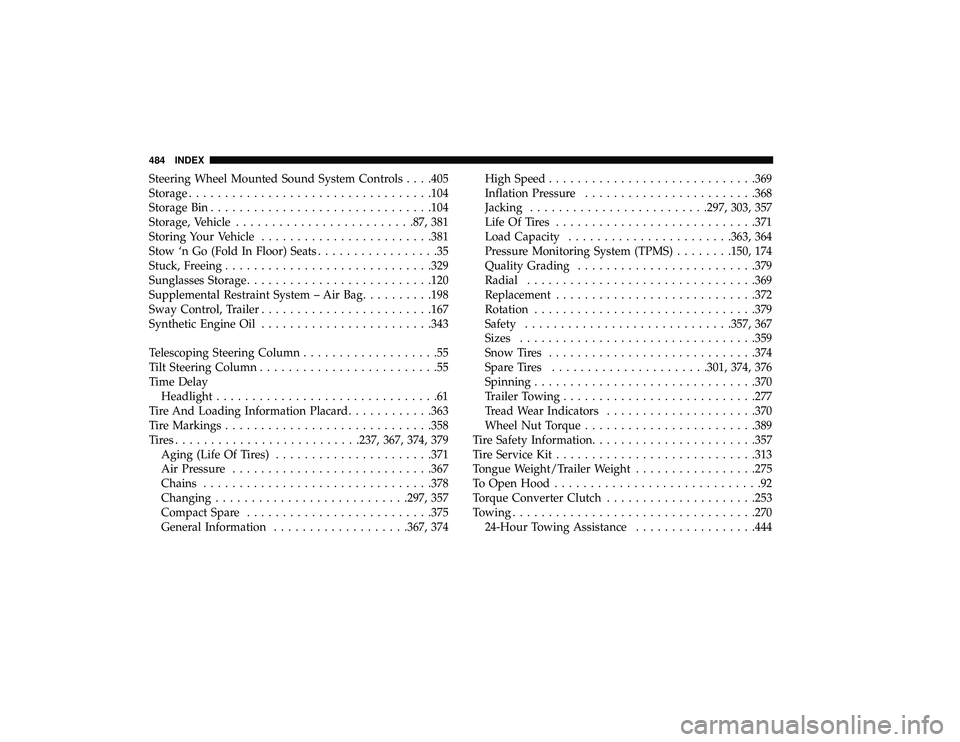
Steering Wheel Mounted Sound System Controls . . . .405
Storage................................. .104
Storage Bin .............................. .104
Storage, Vehicle ........................ .87, 381
Storing Your Vehicle ....................... .381
Stow ‘n Go (Fold In Floor) Seats .................35
Stuck, Freeing ............................ .329
Sunglasses Storage ......................... .120
Supplemental Restraint System – Air Bag ..........198
Sway Control, Trailer ....................... .167
Synthetic Engine Oil ....................... .343
Telescoping Steering Column ...................55
Tilt Steering Column .........................55
Time Delay Headlight ...............................61
Tire And Loading Information Placard ............363
Tire Markings ............................ .358
Tires......................... .237, 367, 374, 379
Aging (Life Of Tires) ..................... .371
Air Pressure ........................... .367
Chains ............................... .378
Changing .......................... .297, 357
Compact Spare ......................... .375
General Information .................. .367, 374High Speed
............................ .369
Inflation Pressure ....................... .368
Jacking ........................ .297, 303, 357
Life Of Tires ........................... .371
Load Capacity ...................... .363, 364
Pressure Monitoring System (TPMS) ........150, 174
Quality Grading ........................ .379
Radial ............................... .369
Replacement ........................... .372
Rotation .............................. .379
Safety ............................ .357, 367
Sizes ................................ .359
Snow Tires ............................ .374
Spar
e Tires ..................... .301, 374, 376
Spinning .............................. .370
Trailer Towing .......................... .277
Tread Wear Indicators .................... .370
Wheel Nut Torque ....................... .389
Tire Safety Information ...................... .357
Tire Service Kit ........................... .313
Tongue Weight/Trailer Weight .................275
To Open Hood .............................92
Torque Converter Clutch .................... .253
Towing ................................. .270
24-Hour Towing Assistance .................444
484 INDEX