back seat DODGE GRAND CARAVAN 2020 User Guide
[x] Cancel search | Manufacturer: DODGE, Model Year: 2020, Model line: GRAND CARAVAN, Model: DODGE GRAND CARAVAN 2020Pages: 380, PDF Size: 14.92 MB
Page 32 of 380

30GETTING TO KNOW YOUR VEHICLE
Plastic Grocery Bag Retainer Hooks
Retainer hooks which will hold plastic grocery
bag handles are built into the seatbacks of all
rear seats and some front seats. The floor
supports the partial weight of the bagged
goods.
HEAD RESTRAINTS
Head restraints are designed to reduce the risk
of injury by restricting head movement in the
event of a rear impact. Head restraints should
be adjusted so that the top of the head restraint
is located above the top of your ear.
Supplemental Active Head Restraints —
Front Seats
Active Head Restraints are passive, deployable
components, and vehicles with this equipment
cannot be readily identified by any markings,
only through visual inspection of the head
restraint. The Active Head Restraints (AHR) will
be split in two halves, with the front half being
soft foam and trim, the back half being
decorative plastic.
When AHRs deploy during a rear impact, the
front half of the head restraint extends forward
to reduce the gap between the back of the
occupant’s head and the AHR. This system is
design to reduce the risk of injury to the driver
or front passenger in certain types of rear
impacts. Refer to “Occupant Restraints” in
“Safety” for further information.
To raise the head restraint, pull upward on the
head restraint. To lower the head restraint,
push the adjustment button, located at the
base of the head restraint, and push downward
on the head restraint.
Adjustment Button
For comfort, the Active Head Restraints can be
tilted forward and rearward. To tilt the head
restraint closer to the back of your head, pull
forward on the bottom of the head restraint.
Push rearward on the bottom of the head
restraint to move the head restraint away from
your head.
Active Head Restraint (Normal Position)
WARNING!
All occupants, including the driver, should
not operate a vehicle or sit in a vehicle’s
seat until the head restraints are placed in
their proper positions in order to minimize
the risk of neck injury in the event of a
crash.
Head restraints should never be adjusted
while the vehicle is in motion. Driving a
vehicle with the head restraints improperly
adjusted or removed could cause serious
injury or death in the event of a collision.
20_RT_OM_EN_USC_t.book Page 30
Page 34 of 380
32GETTING TO KNOW YOUR VEHICLE
Head Restraints — Second Row Bench
The second row bench seat is equipped with
adjustable head restraints.
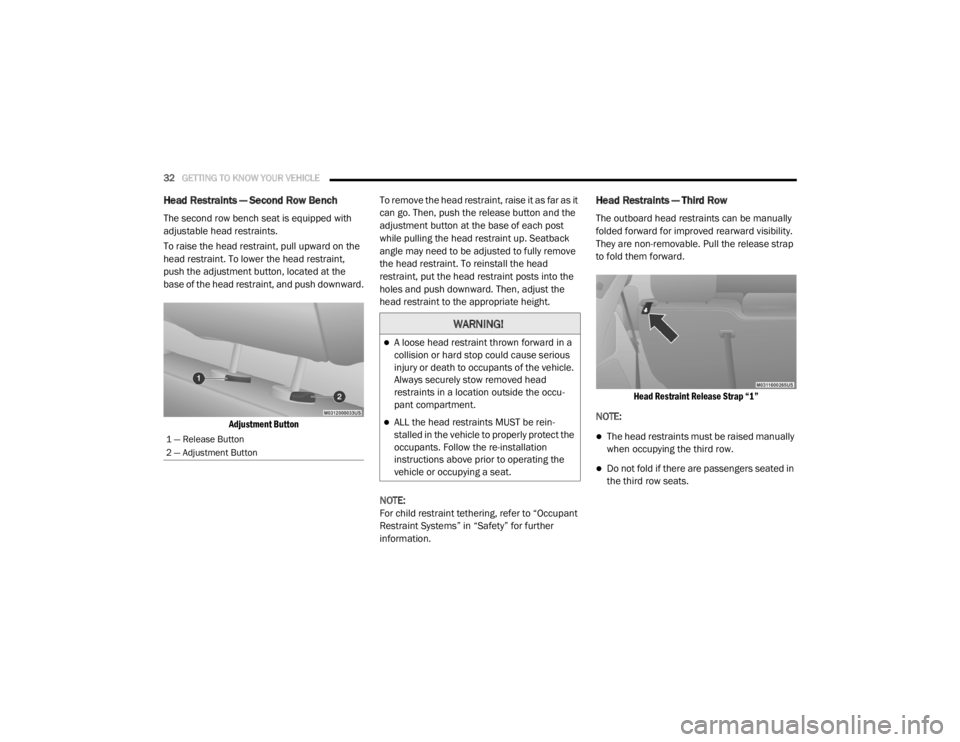
To raise the head restraint, pull upward on the
head restraint. To lower the head restraint,
push the adjustment button, located at the
base of the head restraint, and push downward.
Adjustment Button
To remove the head restraint, raise it as far as it
can go. Then, push the release button and the
adjustment button at the base of each post
while pulling the head restraint up. Seatback
angle may need to be adjusted to fully remove
the head restraint. To reinstall the head
restraint, put the head restraint posts into the
holes and push downward. Then, adjust the
head restraint to the appropriate height.
NOTE:
For child restraint tethering, refer to “Occupant
Restraint Systems” in “Safety” for further
information.
Head Restraints — Third Row
The outboard head restraints can be manually
folded forward for improved rearward visibility.
They are non-removable. Pull the release strap
to fold them forward.
Head Restraint Release Strap “1”
NOTE:
The head restraints must be raised manually
when occupying the third row.
Do not fold if there are passengers seated in
the third row seats.
1 — Release Button
2 — Adjustment Button
WARNING!
A loose head restraint thrown forward in a
collision or hard stop could cause serious
injury or death to occupants of the vehicle.
Always securely stow removed head
restraints in a location outside the occu -
pant compartment.
ALL the head restraints MUST be rein -
stalled in the vehicle to properly protect the
occupants. Follow the re-installation
instructions above prior to operating the
vehicle or occupying a seat.
20_RT_OM_EN_USC_t.book Page 32
Page 73 of 380
GETTING TO KNOW YOUR VEHICLE71
Front And Rear Overhead Consoles
Front Overhead Console
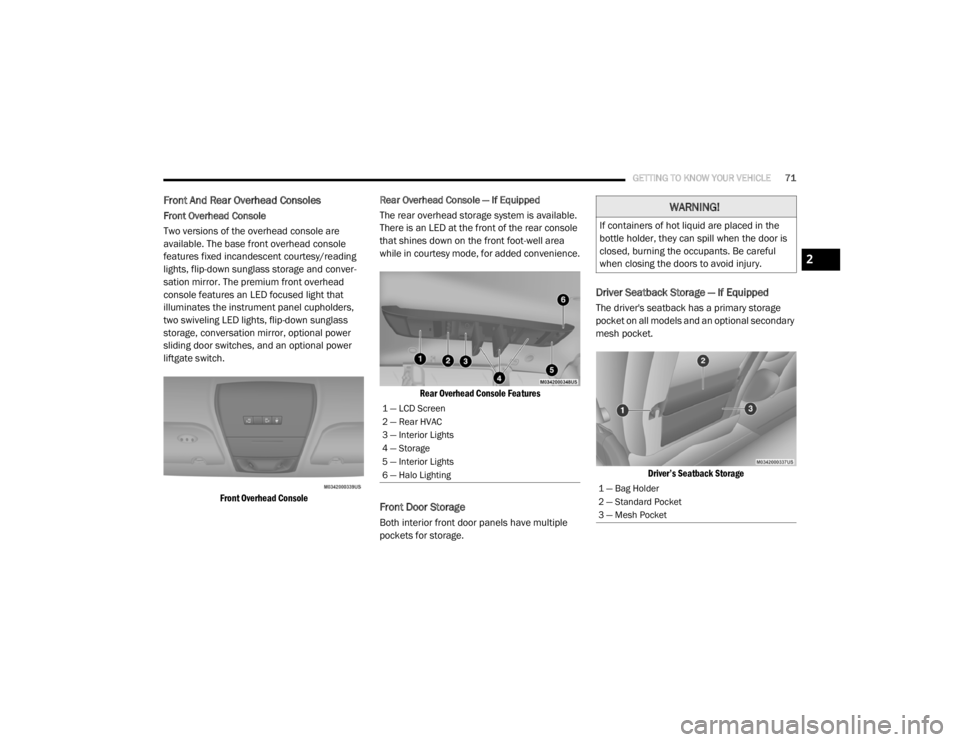
Two versions of the overhead console are
available. The base front overhead console
features fixed incandescent courtesy/reading
lights, flip-down sunglass storage and conver -
sation mirror. The premium front overhead
console features an LED focused light that
illuminates the instrument panel cupholders,
two swiveling LED lights, flip-down sunglass
storage, conversation mirror, optional power
sliding door switches, and an optional power
liftgate switch.
Front Overhead Console
Rear Overhead Console — If Equipped
The rear overhead storage system is available.
There is an LED at the front of the rear console
that shines down on the front foot-well area
while in courtesy mode, for added convenience.
Rear Overhead Console Features
Front Door Storage
Both interior front door panels have multiple
pockets for storage.
Driver Seatback Storage — If Equipped
The driver's seatback has a primary storage
pocket on all models and an optional secondary
mesh pocket.
Driver’s Seatback Storage
1 — LCD Screen
2 — Rear HVAC
3 — Interior Lights
4 — Storage
5 — Interior Lights
6 — Halo Lighting
WARNING!
If containers of hot liquid are placed in the
bottle holder, they can spill when the door is
closed, burning the occupants. Be careful
when closing the doors to avoid injury.
1 — Bag Holder
2 — Standard Pocket
3 — Mesh Pocket
2
20_RT_OM_EN_USC_t.book Page 71
Page 76 of 380
74GETTING TO KNOW YOUR VEHICLE
Super Console — If Equipped
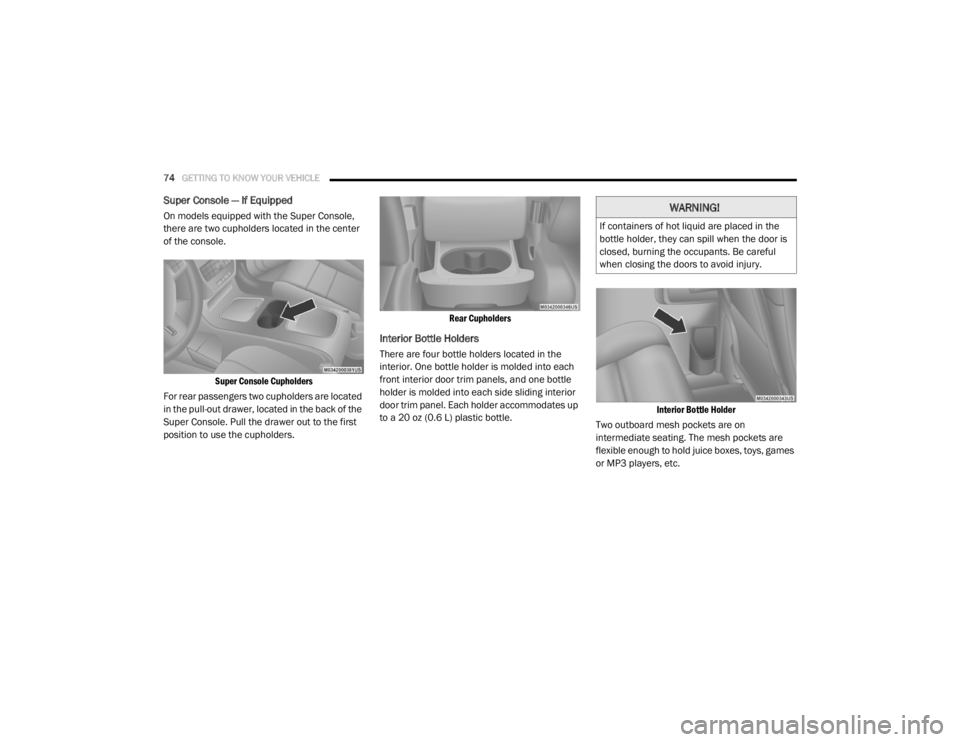
On models equipped with the Super Console,
there are two cupholders located in the center
of the console.
Super Console Cupholders
For rear passengers two cupholders are located
in the pull-out drawer, located in the back of the
Super Console. Pull the drawer out to the first
position to use the cupholders.
Rear Cupholders
Interior Bottle Holders
There are four bottle holders located in the
interior. One bottle holder is molded into each
front interior door trim panels, and one bottle
holder is molded into each side sliding interior
door trim panel. Each holder accommodates up
to a 20 oz (0.6 L) plastic bottle.
Interior Bottle Holder
Two outboard mesh pockets are on
intermediate seating. The mesh pockets are
flexible enough to hold juice boxes, toys, games
or MP3 players, etc.
WARNING!
If containers of hot liquid are placed in the
bottle holder, they can spill when the door is
closed, burning the occupants. Be careful
when closing the doors to avoid injury.
20_RT_OM_EN_USC_t.book Page 74
Page 77 of 380
GETTING TO KNOW YOUR VEHICLE75
Sun Screens — If Equipped
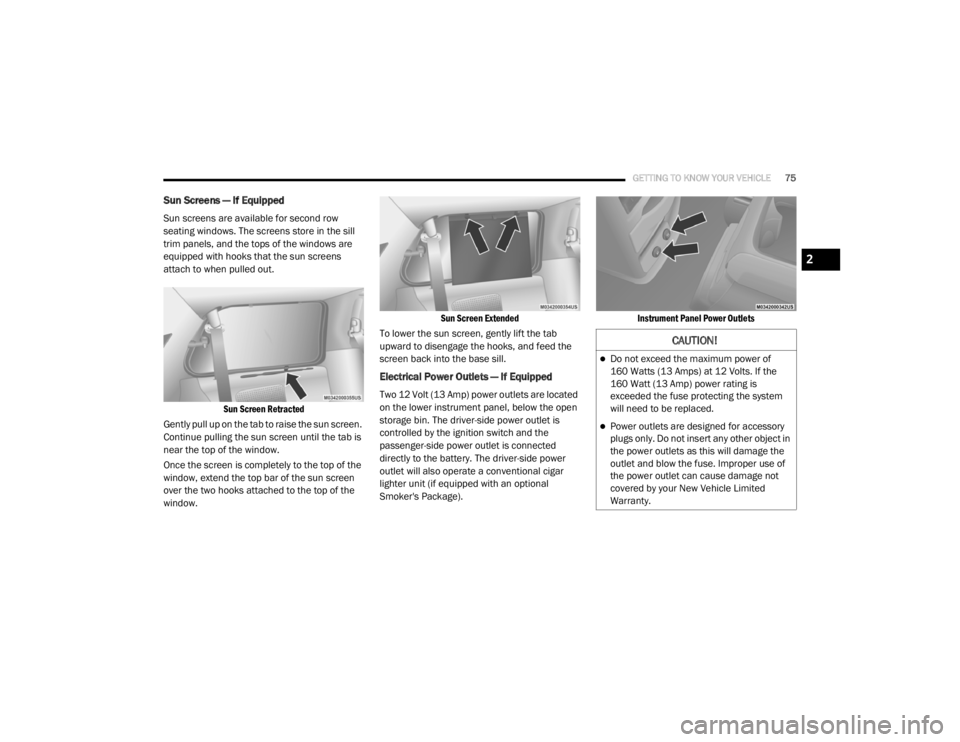
Sun screens are available for second row
seating windows. The screens store in the sill
trim panels, and the tops of the windows are
equipped with hooks that the sun screens
attach to when pulled out.
Sun Screen Retracted
Gently pull up on the tab to raise the sun screen.
Continue pulling the sun screen until the tab is
near the top of the window.
Once the screen is completely to the top of the
window, extend the top bar of the sun screen
over the two hooks attached to the top of the
window.
Sun Screen Extended
To lower the sun screen, gently lift the tab
upward to disengage the hooks, and feed the
screen back into the base sill.
Electrical Power Outlets — If Equipped
Two 12 Volt (13 Amp) power outlets are located
on the lower instrument panel, below the open
storage bin. The driver-side power outlet is
controlled by the ignition switch and the
passenger-side power outlet is connected
directly to the battery. The driver-side power
outlet will also operate a conventional cigar
lighter unit (if equipped with an optional
Smoker's Package).
Instrument Panel Power Outlets
CAUTION!
Do not exceed the maximum power of
160 Watts (13 Amps) at 12 Volts. If the
160 Watt (13 Amp) power rating is
exceeded the fuse protecting the system
will need to be replaced.
Power outlets are designed for accessory
plugs only. Do not insert any other object in
the power outlets as this will damage the
outlet and blow the fuse. Improper use of
the power outlet can cause damage not
covered by your New Vehicle Limited
Warranty.
2
20_RT_OM_EN_USC_t.book Page 75
Page 121 of 380
SAFETY119
(Continued)
OCCUPANT RESTRAINT SYSTEMS
Some of the most important safety features in
your vehicle are the restraint systems:
Occupant Restraint Systems Features
Seat Belt Systems
Supplemental Restraint Systems (SRS) Air
Bags
Supplemental Active Head Restraints
Child Restraints
Some of the safety features described in this
section may be standard equipment on some
models, or may be optional equipment on
others. If you are not sure, ask an authorized
dealer.
Important Safety Precautions
Please pay close attention to the information in
this section. It tells you how to use your restraint
system properly, to keep you and your
passengers as safe as possible.
Here are some simple steps you can take to
minimize the risk of harm from a deploying air
bag:
1. Children 12 years old and under should
always ride buckled up in the rear seat of a
vehicle with a rear seat.
2. A child who is not big enough to wear the vehicle seat belt properly (Refer to “Child
Restraints” in this section for further
information) must be secured in the
appropriate child restraint or
belt-positioning booster seat in a rear
seating position.
3. If a child from 2 to 12 years old (not in a rear-facing child restraint) must ride in the
front passenger seat, move the seat as far
back as possible and use the proper child
restraint (Refer to “Child Restraints” in this
section for further information).
4. Never allow children to slide the shoulder belt behind them or under their arm.
5. You should read the instructions provided with your child restraint to make sure that
you are using it properly.
6. All occupants should always wear their lap and shoulder belts properly. 7. The driver and front passenger seats should
be moved back as far as practical to allow
the front air bags room to inflate.
8. Do not lean against the door or window. If your vehicle has side air bags, and
deployment occurs, the side air bags will
inflate forcefully into the space between
occupants and the door and occupants
could be injured.
9. If the air bag system in this vehicle needs to be modified to accommodate a disabled
person, refer to the “Customer Assistance”
section for customer service contact
information.
WARNING!
Never place a rear-facing child restraint in
front of an air bag. A deploying passenger
front air bag can cause death or serious
injury to a child 12 years or younger,
including a child in a rear-facing child
restraint.
4
20_RT_OM_EN_USC_t.book Page 119
Page 124 of 380
122SAFETY
(Continued)
Lap/Shoulder Belt Operating Instructions
1. Enter the vehicle and close the door. Sit back and adjust the seat.
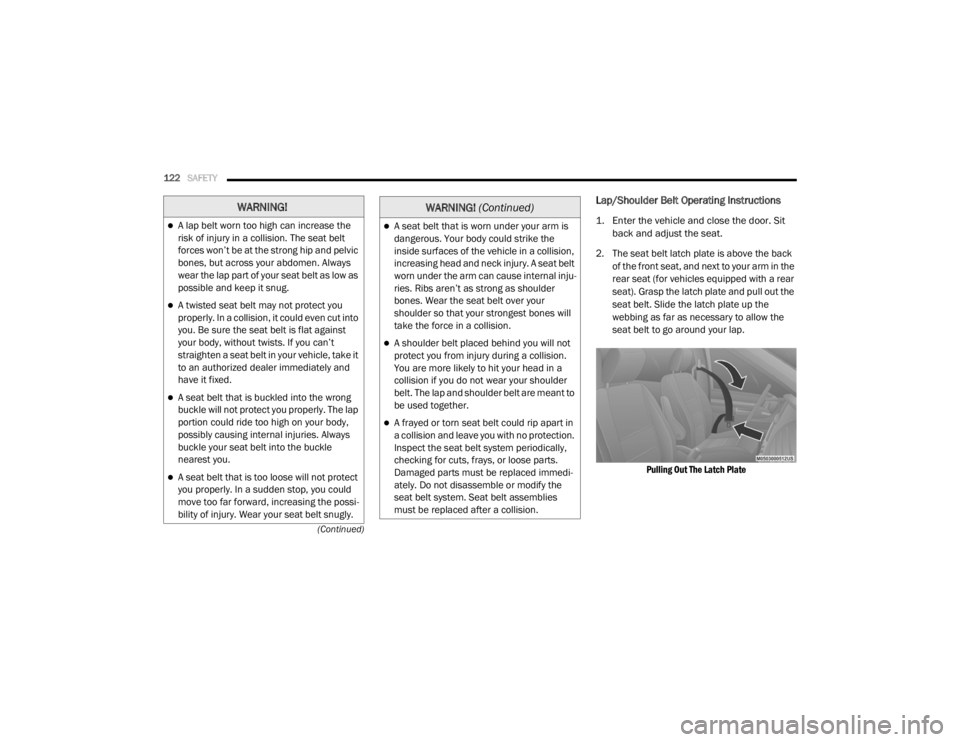
2. The seat belt latch plate is above the back of the front seat, and next to your arm in the
rear seat (for vehicles equipped with a rear
seat). Grasp the latch plate and pull out the
seat belt. Slide the latch plate up the
webbing as far as necessary to allow the
seat belt to go around your lap.
Pulling Out The Latch Plate
WARNING!
A lap belt worn too high can increase the
risk of injury in a collision. The seat belt
forces won’t be at the strong hip and pelvic
bones, but across your abdomen. Always
wear the lap part of your seat belt as low as
possible and keep it snug.
A twisted seat belt may not protect you
properly. In a collision, it could even cut into
you. Be sure the seat belt is flat against
your body, without twists. If you can’t
straighten a seat belt in your vehicle, take it
to an authorized dealer immediately and
have it fixed.
A seat belt that is buckled into the wrong
buckle will not protect you properly. The lap
portion could ride too high on your body,
possibly causing internal injuries. Always
buckle your seat belt into the buckle
nearest you.
A seat belt that is too loose will not protect
you properly. In a sudden stop, you could
move too far forward, increasing the possi -
bility of injury. Wear your seat belt snugly.
A seat belt that is worn under your arm is
dangerous. Your body could strike the
inside surfaces of the vehicle in a collision,
increasing head and neck injury. A seat belt
worn under the arm can cause internal inju -
ries. Ribs aren’t as strong as shoulder
bones. Wear the seat belt over your
shoulder so that your strongest bones will
take the force in a collision.
A shoulder belt placed behind you will not
protect you from injury during a collision.
You are more likely to hit your head in a
collision if you do not wear your shoulder
belt. The lap and shoulder belt are meant to
be used together.
A frayed or torn seat belt could rip apart in
a collision and leave you with no protection.
Inspect the seat belt system periodically,
checking for cuts, frays, or loose parts.
Damaged parts must be replaced immedi-
ately. Do not disassemble or modify the
seat belt system. Seat belt assemblies
must be replaced after a collision.
WARNING! (Continued)
20_RT_OM_EN_USC_t.book Page 122
Page 127 of 380
SAFETY125
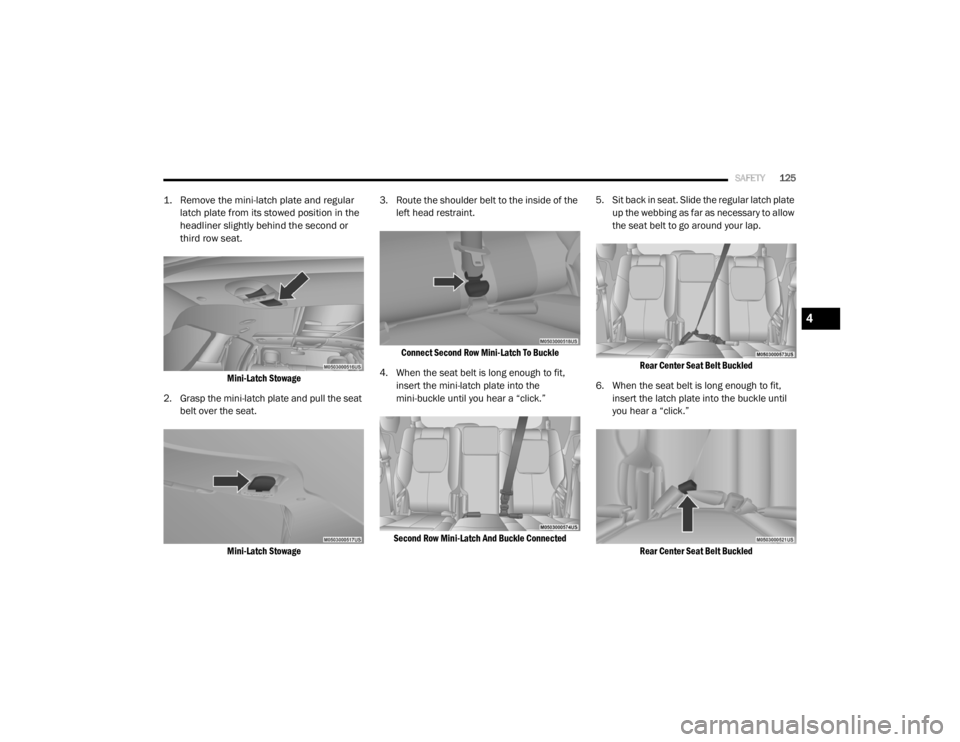
1. Remove the mini-latch plate and regular
latch plate from its stowed position in the
headliner slightly behind the second or
third row seat.
Mini-Latch Stowage
2. Grasp the mini-latch plate and pull the seat belt over the seat.
Mini-Latch Stowage
3. Route the shoulder belt to the inside of the
left head restraint.
Connect Second Row Mini-Latch To Buckle
4. When the seat belt is long enough to fit, insert the mini-latch plate into the
mini-buckle until you hear a “click.”
Second Row Mini-Latch And Buckle Connected
5. Sit back in seat. Slide the regular latch plate
up the webbing as far as necessary to allow
the seat belt to go around your lap.
Rear Center Seat Belt Buckled
6. When the seat belt is long enough to fit, insert the latch plate into the buckle until
you hear a “click.”
Rear Center Seat Belt Buckled
4
20_RT_OM_EN_USC_t.book Page 125
Page 129 of 380
SAFETY127
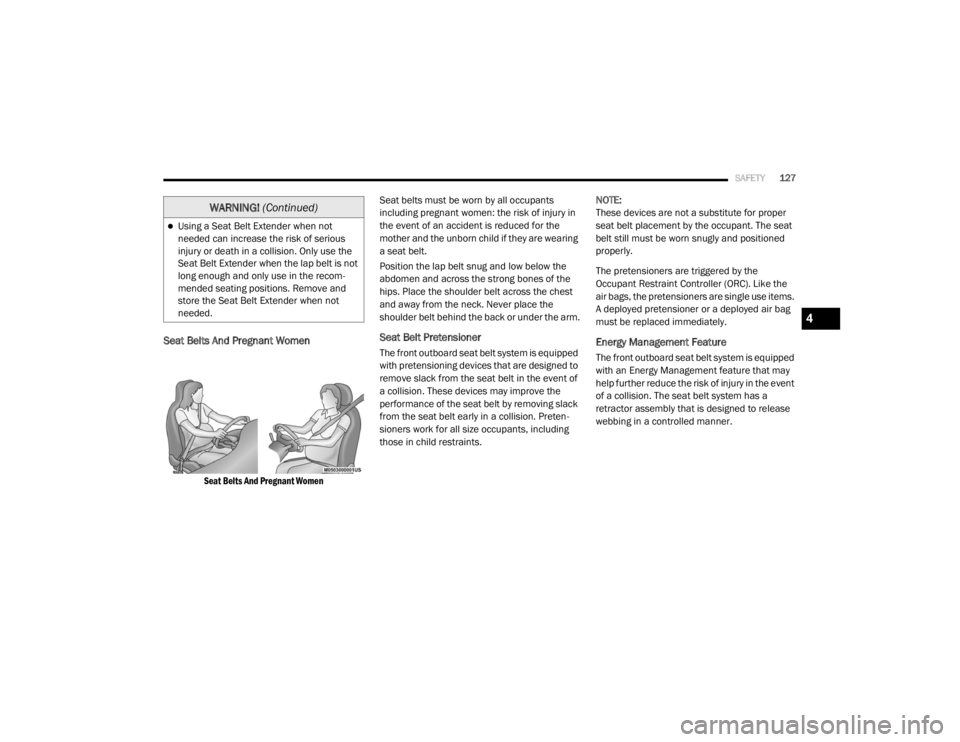
Seat Belts And Pregnant Women
Seat Belts And Pregnant Women
Seat belts must be worn by all occupants
including pregnant women: the risk of injury in
the event of an accident is reduced for the
mother and the unborn child if they are wearing
a seat belt.
Position the lap belt snug and low below the
abdomen and across the strong bones of the
hips. Place the shoulder belt across the chest
and away from the neck. Never place the
shoulder belt behind the back or under the arm.
Seat Belt Pretensioner
The front outboard seat belt system is equipped
with pretensioning devices that are designed to
remove slack from the seat belt in the event of
a collision. These devices may improve the
performance of the seat belt by removing slack
from the seat belt early in a collision. Preten
-
sioners work for all size occupants, including
those in child restraints. NOTE:
These devices are not a substitute for proper
seat belt placement by the occupant. The seat
belt still must be worn snugly and positioned
properly.
The pretensioners are triggered by the
Occupant Restraint Controller (ORC). Like the
air bags, the pretensioners are single use items.
A deployed pretensioner or a deployed air bag
must be replaced immediately.Energy Management Feature
The front outboard seat belt system is equipped
with an Energy Management feature that may
help further reduce the risk of injury in the event
of a collision. The seat belt system has a
retractor assembly that is designed to release
webbing in a controlled manner.
Using a Seat Belt Extender when not
needed can increase the risk of serious
injury or death in a collision. Only use the
Seat Belt Extender when the lap belt is not
long enough and only use in the recom
-
mended seating positions. Remove and
store the Seat Belt Extender when not
needed.
WARNING! (Continued)
4
20_RT_OM_EN_USC_t.book Page 127
Page 131 of 380
SAFETY129
(Continued)
How To Engage The Automatic Locking Mode
1. Buckle the combination lap and shoulder belt.
2. Grasp the shoulder portion and pull downward until the entire seat belt is
extracted.
3. Allow the seat belt to retract. As the seat belt retracts, you will hear a clicking sound.
This indicates the seat belt is now in the
Automatic Locking Mode.
How To Disengage The Automatic Locking Mode
Unbuckle the combination lap/shoulder belt
and allow it to retract completely to disengage
the Automatic Locking Mode and activate the
vehicle sensitive (emergency) locking mode.
Supplemental Active Head Restraints (AHR)
These head restraints are passive, deployable
components, and vehicles with this equipment
cannot be readily identified by any markings,
only through visual inspection of the head
restraint. The head restraint will be split in two
halves, with the front half being soft foam and
trim, the back half being decorative plastic. How The Active Head Restraints (AHR) Work
The Occupant Restraint Controller (ORC)
determines whether the severity or type of rear
impact will require the Active Head Restraints
(AHR) to deploy. If a rear impact requires
deployment, both the driver and front
passenger seat AHRs will be deployed.
When AHRs deploy during a rear impact, the
front half of the head restraint extends forward
to minimize the gap between the back of the
occupant’s head and the AHR. This system is
designed to help prevent or reduce the extent of
injuries to the driver and front passenger in
certain types of rear impacts.
NOTE:
The Active Head Restraints (AHR) may or may
not deploy in the event of a front or side impact.
However, if during a front impact, a secondary
rear impact occurs, the AHR may deploy based
on the severity and type of the impact.
WARNING!
The seat belt assembly must be replaced if
the switchable Automatic Locking Retractor
(ALR) feature or any other seat belt function
is not working properly when checked
according to the procedures in the Service
Manual.
Failure to replace the seat belt assembly
could increase the risk of injury in
collisions.
Do not use the Automatic Locking Mode to
restrain occupants who are wearing the
seat belt or children who are using booster
seats. The locked mode is only used to
install rear-facing or forward-facing child
restraints that have a harness for
restraining the child.
WARNING!
(Continued)
4
20_RT_OM_EN_USC_t.book Page 129