oil DODGE HORNET 2023 Owner's Manual
[x] Cancel search | Manufacturer: DODGE, Model Year: 2023, Model line: HORNET, Model: DODGE HORNET 2023Pages: 288, PDF Size: 14.2 MB
Page 234 of 288
232SERVICING AND MAINTENANCE
Rear Wiper Blade Removal/Installation
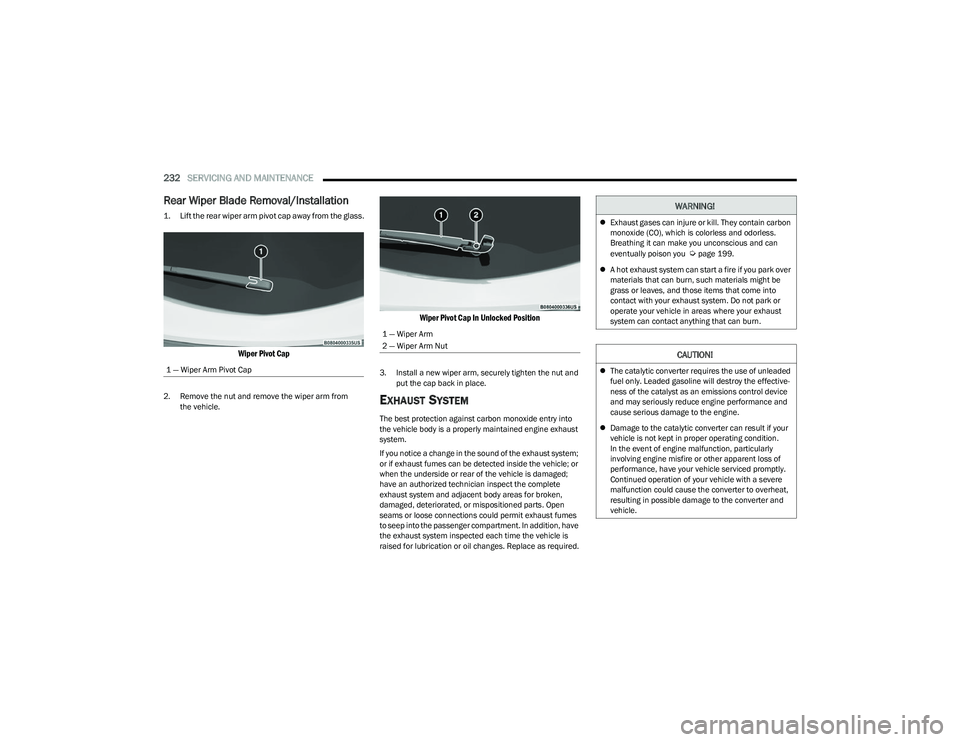
1. Lift the rear wiper arm pivot cap away from the glass.
Wiper Pivot Cap
2. Remove the nut and remove the wiper arm from
the vehicle.
Wiper Pivot Cap In Unlocked Position
3. Install a new wiper arm, securely tighten the nut and put the cap back in place.
EXHAUST SYSTEM
The best protection against carbon monoxide entry into
the vehicle body is a properly maintained engine exhaust
system.
If you notice a change in the sound of the exhaust system;
or if exhaust fumes can be detected inside the vehicle; or
when the underside or rear of the vehicle is damaged;
have an authorized technician inspect the complete
exhaust system and adjacent body areas for broken,
damaged, deteriorated, or mispositioned parts. Open
seams or loose connections could permit exhaust fumes
to seep into the passenger compartment. In addition, have
the exhaust system inspected each time the vehicle is
raised for lubrication or oil changes. Replace as required.
1 — Wiper Arm Pivot Cap
1 — Wiper Arm
2 — Wiper Arm Nut
WARNING!
Exhaust gases can injure or kill. They contain carbon
monoxide (CO), which is colorless and odorless.
Breathing it can make you unconscious and can
eventually poison you
Úpage 199.
A hot exhaust system can start a fire if you park over
materials that can burn, such materials might be
grass or leaves, and those items that come into
contact with your exhaust system. Do not park or
operate your vehicle in areas where your exhaust
system can contact anything that can burn.
CAUTION!
The catalytic converter requires the use of unleaded
fuel only. Leaded gasoline will destroy the effective -
ness of the catalyst as an emissions control device
and may seriously reduce engine performance and
cause serious damage to the engine.
Damage to the catalytic converter can result if your
vehicle is not kept in proper operating condition.
In the event of engine malfunction, particularly
involving engine misfire or other apparent loss of
performance, have your vehicle serviced promptly.
Continued operation of your vehicle with a severe
malfunction could cause the converter to overheat,
resulting in possible damage to the converter and
vehicle.
23_GG_OM_EN_USC_t.book Page 232
Page 238 of 288
236SERVICING AND MAINTENANCE
BRAKE SYSTEM
In order to ensure brake system performance, all brake
system components should be inspected periodically.
For the proper maintenance intervals
Úpage 224.
Brake Master Cylinder
The fluid in the master cylinder should be checked when
performing under hood services or immediately if the
Brake Warning Light is illuminated.
Be sure to clean the top of the master cylinder area before
removing the cap. If necessary, add fluid to bring the fluid
level up to the requirements described on the brake fluid
reservoir. With disc brakes, fluid level can be expected to
fall as the brake pads wear. Brake fluid level should be
checked when pads are replaced. However, low fluid level
may be caused by a leak and a checkup may be needed.
Use only the manufacturer recommended brake fluid
Úpage 269.
AUTOMATIC TRANSMISSION —
I
F EQUIPPED
Special Additives
It is strongly recommended against using any special
additives in the transmission. Automatic Transmission
Fluid (ATF) is an engineered product and its performance
may be impaired by supplemental additives. Therefore, do
not add any fluid additives to the transmission. Avoid
using transmission sealers as they may adversely affect
seals.
Fluid Level Check
The fluid level is preset at the factory and does not require
adjustment under normal operating conditions. Routine
fluid level checks are not required; therefore the
transmission has no dipstick. An authorized dealer can
check your transmission fluid level using special service
tools. If you notice fluid leakage or transmission
malfunction, visit an authorized dealer immediately to
have the transmission fluid level checked. Operating the
vehicle with an improper fluid level can cause severe
transmission damage.
WARNING!
Riding the brakes can lead to brake failure and possibly
a collision. Driving with your foot resting or riding on the
brake pedal can result in abnormally high brake
temperatures, excessive lining wear, and possible brake
damage. You would not have your full braking capacity
in an emergency.
WARNING!
Use only the manufacturer recommended brake fluid Úpage 269. Using the wrong type of brake fluid can
severely damage your brake system and/or impair its
performance. The proper type of brake fluid for your
vehicle is also identified on the original factory
installed hydraulic master cylinder reservoir.
To avoid contamination from foreign matter or
moisture, use only new brake fluid or fluid that has
been in a tightly closed container. Keep the master
cylinder reservoir cap secured at all times. Brake
fluid in an open container absorbs moisture from the
air resulting in a lower boiling point. This may cause
it to boil unexpectedly during hard or prolonged
braking, resulting in sudden brake failure.
This could result in a collision.
Overfilling the brake fluid reservoir can result in
spilling brake fluid on hot engine parts, causing the
brake fluid to catch fire. Brake fluid can also damage
painted and vinyl surfaces, care should be taken to
avoid its contact with these surfaces.
Do not allow petroleum-based fluid to contaminate
the brake fluid. Brake seal components could be
damaged, causing partial or complete brake failure.
This could result in a collision.
CAUTION!
Do not use chemical flushes in your transmission as the
chemicals can damage your transmission components.
Such damage is not covered by the New Vehicle Limited
Warranty.
23_GG_OM_EN_USC_t.book Page 236
Page 244 of 288
242SERVICING AND MAINTENANCE
Interior Fuses
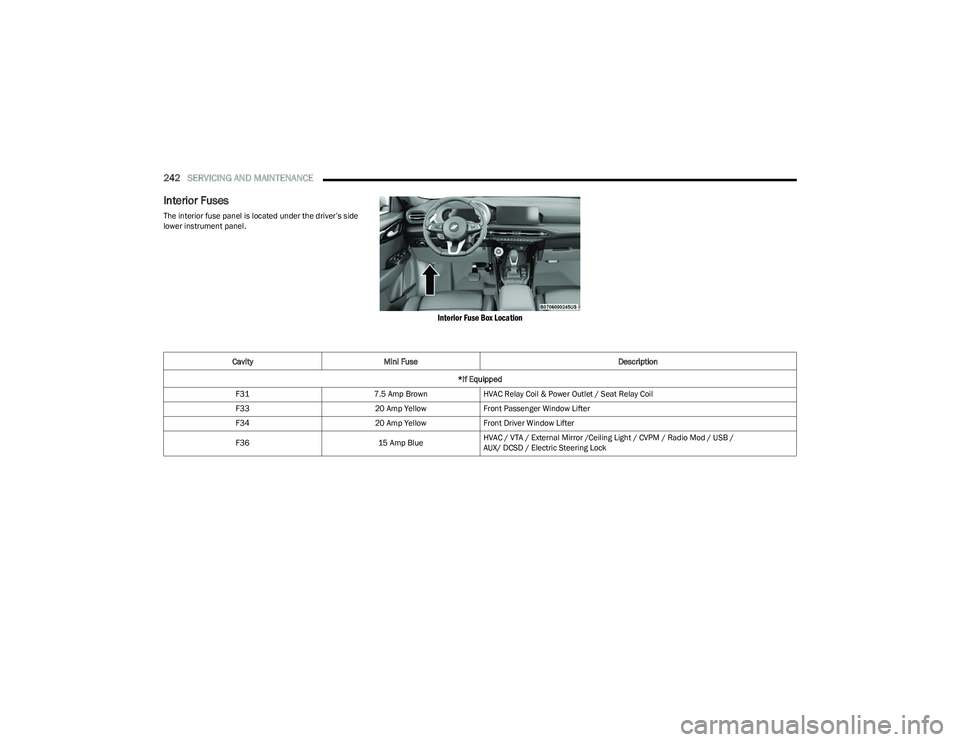
The interior fuse panel is located under the driver’s side
lower instrument panel.
Interior Fuse Box Location
Cavity Mini Fuse Description
*If Equipped
F31 7.5 Amp BrownHVAC Relay Coil & Power Outlet / Seat Relay Coil
F33 20 Amp YellowFront Passenger Window Lifter
F34 20 Amp YellowFront Driver Window Lifter
F36 15 Amp BlueHVAC / VTA / External Mirror /Ceiling Light / CVPM / Radio Mod / USB /
AUX/ DCSD / Electric Steering Lock
23_GG_OM_EN_USC_t.book Page 242
Page 258 of 288
256SERVICING AND MAINTENANCE
Tread Wear Indicators
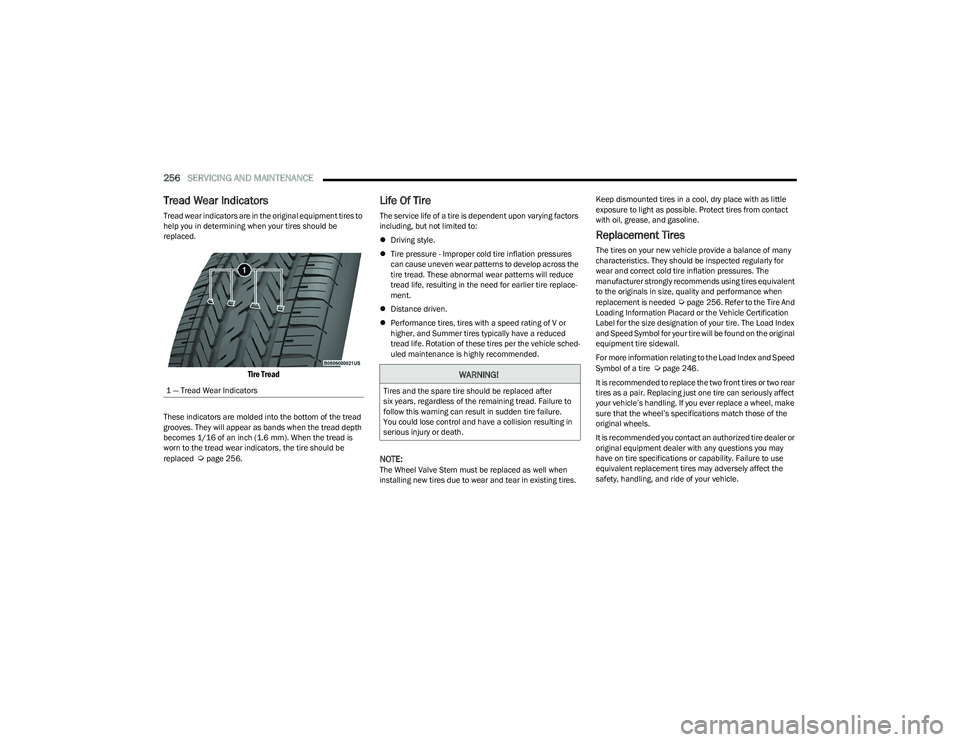
Tread wear indicators are in the original equipment tires to
help you in determining when your tires should be
replaced.
Tire Tread
These indicators are molded into the bottom of the tread
grooves. They will appear as bands when the tread depth
becomes 1/16 of an inch (1.6 mm). When the tread is
worn to the tread wear indicators, the tire should be
replaced
Úpage 256.
Life Of Tire
The service life of a tire is dependent upon varying factors
including, but not limited to:
Driving style.
Tire pressure - Improper cold tire inflation pressures
can cause uneven wear patterns to develop across the
tire tread. These abnormal wear patterns will reduce
tread life, resulting in the need for earlier tire replace -
ment.
Distance driven.
Performance tires, tires with a speed rating of V or
higher, and Summer tires typically have a reduced
tread life. Rotation of these tires per the vehicle sched-
uled maintenance is highly recommended.
NOTE:The Wheel Valve Stem must be replaced as well when
installing new tires due to wear and tear in existing tires. Keep dismounted tires in a cool, dry place with as little
exposure to light as possible. Protect tires from contact
with oil, grease, and gasoline.
Replacement Tires
The tires on your new vehicle provide a balance of many
characteristics. They should be inspected regularly for
wear and correct cold tire inflation pressures. The
manufacturer strongly recommends using tires equivalent
to the originals in size, quality and performance when
replacement is needed
Úpage 256. Refer to the Tire And
Loading Information Placard or the Vehicle Certification
Label for the size designation of your tire. The Load Index
and Speed Symbol for your tire will be found on the original
equipment tire sidewall.
For more information relating to the Load Index and Speed
Symbol of a tire
Úpage 246.
It is recommended to replace the two front tires or two rear
tires as a pair. Replacing just one tire can seriously affect
your vehicle’s handling. If you ever replace a wheel, make
sure that the wheel’s specifications match those of the
original wheels.
It is recommended you contact an authorized tire dealer or
original equipment dealer with any questions you may
have on tire specifications or capability. Failure to use
equivalent replacement tires may adversely affect the
safety, handling, and ride of your vehicle.
1 — Tread Wear IndicatorsWARNING!
Tires and the spare tire should be replaced after
six years, regardless of the remaining tread. Failure to
follow this warning can result in sudden tire failure.
You could lose control and have a collision resulting in
serious injury or death.
23_GG_OM_EN_USC_t.book Page 256
Page 266 of 288
264SERVICING AND MAINTENANCE
Seat Belt Maintenance
Do not bleach, dye or clean the belts with chemical
solvents or abrasive cleaners. This will weaken the fabric.
If the belts need cleaning, use a mild soap solution or
lukewarm water. Do not remove the belts from the vehicle
to wash them. Dry with a soft cloth.
Sun damage can also weaken the fabric. Replace the belts
if they appear frayed or worn or if the buckles do not work
properly.
PLASTIC AND COATED PARTS
Use Mopar® Total Clean to clean vinyl upholstery.
Cleaning Plastic Instrument Cluster
Lenses
The lenses in front of the instruments in this vehicle are
molded in clear plastic. When cleaning the lenses, care
must be taken to avoid scratching the plastic.
Clean with a wet soft cloth. A mild soap solution may be
used, but do not use high alcohol content or abrasive
cleaners. If soap is used, wipe clean with a clean damp
cloth. Dry with a soft cloth.
LEATHER SURFACES
Mopar® Total Clean is specifically recommended for
leather upholstery.
Your leather upholstery can be best preserved by regular
cleaning with a damp soft cloth. Small particles of dirt can
act as an abrasive and damage the leather upholstery and
should be removed promptly with a damp cloth. Stubborn
soils can be removed easily with a soft cloth and Mopar® Total Clean. Care should be taken to avoid soaking your
leather upholstery with any liquid. Please do not use
polishes, oils, cleaning fluids, solvents, detergents, or
ammonia-based cleaners to clean your leather upholstery.
NOTE:If equipped with light colored leather, it tends to show any
foreign material, dirt, and fabric dye transfer more so than
darker colors. The leather is designed for easy cleaning,
and the manufacturer recommends Mopar® total care
leather cleaner applied on a cloth to clean the leather
seats as needed.
GLASS SURFACES
All glass surfaces should be cleaned on a regular basis
with Mopar® Glass Cleaner, or any commercial
household-type glass cleaner. Never use an abrasive type
cleaner. Use caution when cleaning the inside rear
window equipped with electric defrosters or windows
equipped with radio antennas. Do not use scrapers or
other sharp instruments that may scratch the elements.
When cleaning the rearview mirror, spray cleaner on the
towel or cloth that you are using. Do not spray cleaner
directly on the mirror.
WARNING!
A frayed or torn seat belt could rip apart in a collision
and leave you with no protection. Inspect the seat belt
system periodically, checking for cuts, frays, or loose
parts. Damaged parts must be replaced immediately.
Do not disassemble or modify the seat belt system.
If your vehicle is involved in a collision, or if you have
questions regarding seat belt or retractor conditions,
take your vehicle to an authorized FCA dealer or
authorized FCA Certified Collision Care Program facility
for inspection.
CAUTION!
Direct contact of air fresheners, insect repellents,
suntan lotions, or hand sanitizers to the plastic,
painted, or decorated surfaces of the interior may
cause permanent damage. Wipe away immediately.
Damage caused by these type of products may not
be covered by your New Vehicle Limited Warranty.
CAUTION!
Do not use alcohol and alcohol-based and/or
ketone-based cleaning products to clean leather
upholstery, as damage to the upholstery may result.
23_GG_OM_EN_USC_t.book Page 264
Page 267 of 288
265
TECHNICAL SPECIFICATIONS
VEHICLE IDENTIFICATION NUMBER (VIN)
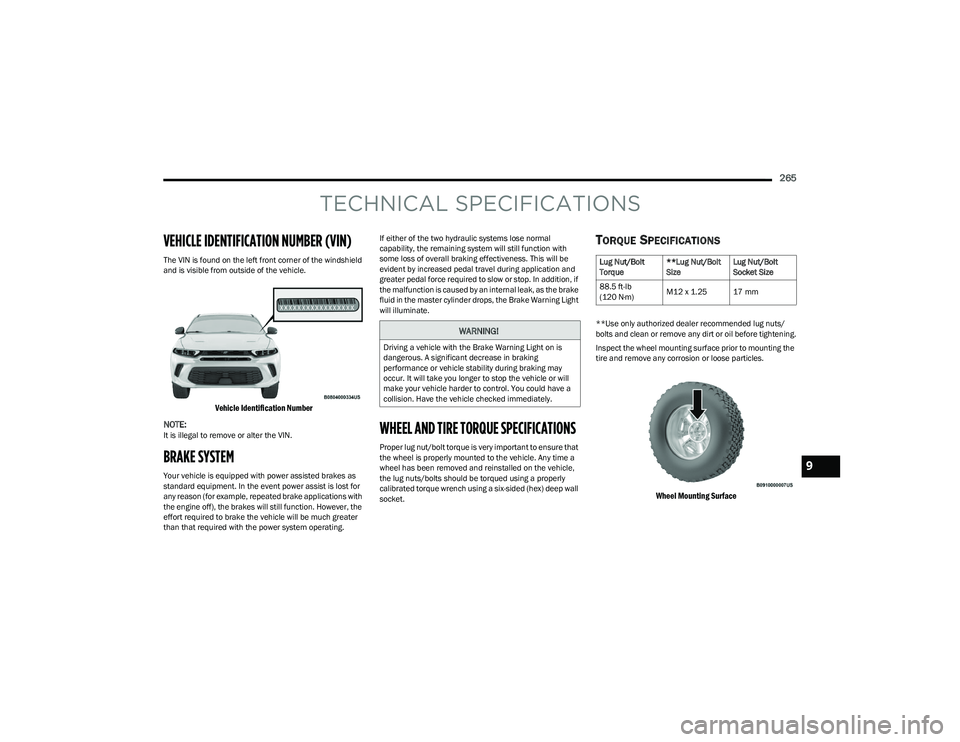
The VIN is found on the left front corner of the windshield
and is visible from outside of the vehicle.
Vehicle Identification Number
NOTE:
It is illegal to remove or alter the VIN.
BRAKE SYSTEM
Your vehicle is equipped with power assisted brakes as
standard equipment. In the event power assist is lost for
any reason (for example, repeated brake applications with
the engine off), the brakes will still function. However, the
effort required to brake the vehicle will be much greater
than that required with the power system operating. If either of the two hydraulic systems lose normal
capability, the remaining system will still function with
some loss of overall braking effectiveness. This will be
evident by increased pedal travel during application and
greater pedal force required to slow or stop. In addition, if
the malfunction is caused by an internal leak, as the brake
fluid in the master cylinder drops, the Brake Warning Light
will illuminate.
WHEEL AND TIRE TORQUE SPECIFICATIONS
Proper lug nut/bolt torque is very important to ensure that
the wheel is properly mounted to the vehicle. Any time a
wheel has been removed and reinstalled on the vehicle,
the lug nuts/bolts should be torqued using a properly
calibrated torque wrench using a six-sided (hex) deep wall
socket.
TORQUE SPECIFICATIONS
**Use only authorized dealer recommended lug nuts/
bolts and clean or remove any dirt or oil before tightening.
Inspect the wheel mounting surface prior to mounting the
tire and remove any corrosion or loose particles.
Wheel Mounting Surface
WARNING!
Driving a vehicle with the Brake Warning Light on is
dangerous. A significant decrease in braking
performance or vehicle stability during braking may
occur. It will take you longer to stop the vehicle or will
make your vehicle harder to control. You could have a
collision. Have the vehicle checked immediately.
Lug Nut/Bolt
Torque
**Lug Nut/Bolt
SizeLug Nut/Bolt
Socket Size
88.5 ft-lb
(120 N·m) M12 x 1.25 17 mm
9
23_GG_OM_EN_USC_t.book Page 265
Page 270 of 288
268TECHNICAL SPECIFICATIONS
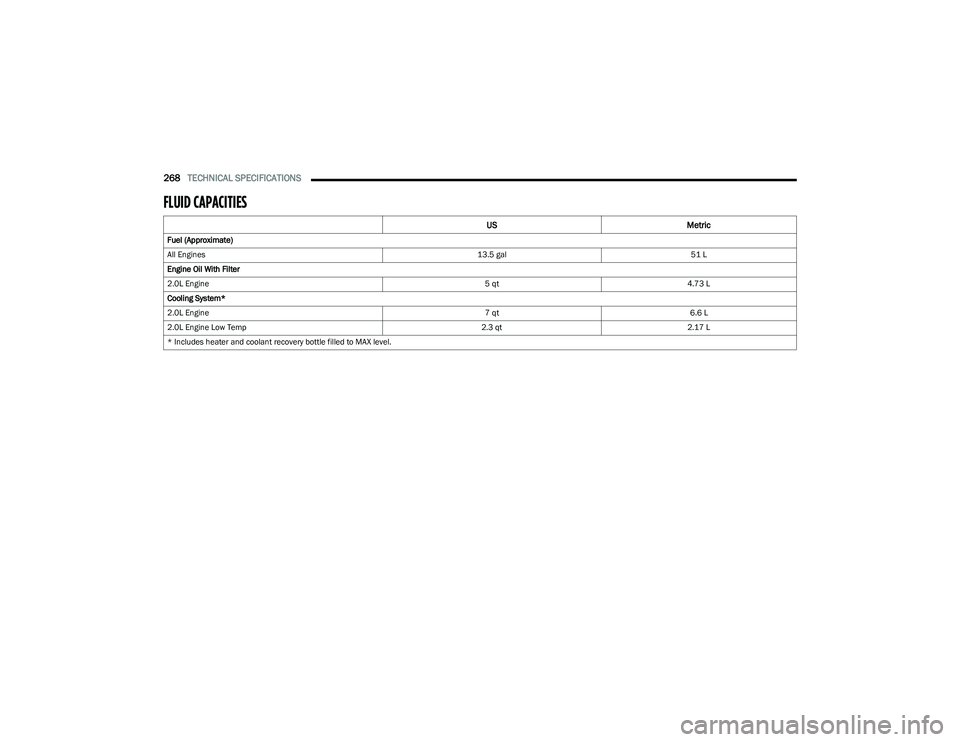
FLUID CAPACITIES
US Metric
Fuel (Approximate)
All Engines 13.5 gal51 L
Engine Oil With Filter
2.0L Engine 5 qt4.73 L
Cooling System*
2.0L Engine 7 qt6.6 L
2.0L Engine Low Temp 2.3 qt2.17 L
* Includes heater and coolant recovery bottle filled to MAX level.
23_GG_OM_EN_USC_t.book Page 268
Page 271 of 288
TECHNICAL SPECIFICATIONS269
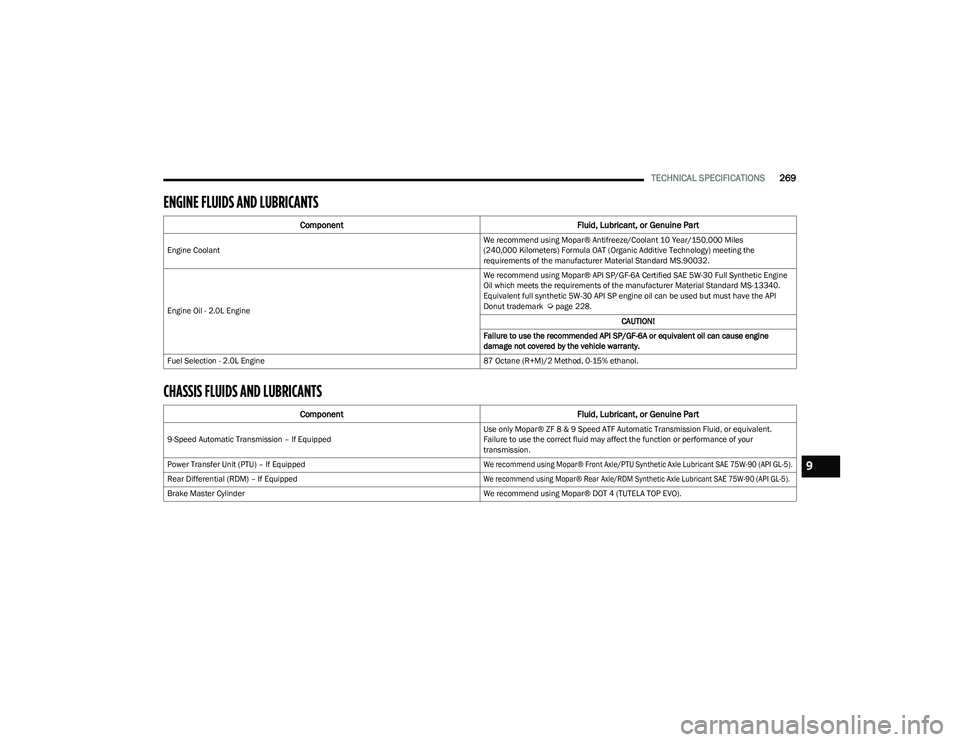
ENGINE FLUIDS AND LUBRICANTS
CHASSIS FLUIDS AND LUBRICANTS
Component Fluid, Lubricant, or Genuine Part
Engine Coolant We recommend using Mopar® Antifreeze/Coolant 10 Year/150,000 Miles
(240,000 Kilometers) Formula OAT (Organic Additive Technology) meeting the
requirements of the manufacturer Material Standard MS.90032.
Engine Oil - 2.0L Engine We recommend using Mopar® API SP/GF-6A Certified SAE 5W-30 Full Synthetic Engine
Oil which meets the requirements of the manufacturer Material Standard MS-13340.
Equivalent full synthetic 5W-30 API SP engine oil can be used but must have the API
Donut trademark
Úpage 228.
CAUTION!
Failure to use the recommended API SP/GF-6A or equivalent oil can cause engine
damage not covered by the vehicle warranty.
Fuel Selection - 2.0L Engine 87 Octane (R+M)/2 Method, 0-15% ethanol.
ComponentFluid, Lubricant, or Genuine Part
9-Speed Automatic Transmission – If Equipped Use only Mopar® ZF 8 & 9 Speed ATF Automatic Transmission Fluid, or equivalent.
Failure to use the correct fluid may affect the function or performance of your
transmission.
Power Transfer Unit (PTU) – If Equipped
We recommend using Mopar® Front Axle/PTU Synthetic Axle Lubricant SAE 75W-90 (API GL-5).
Rear Differential (RDM) – If Equipped
We recommend using Mopar® Rear Axle/RDM Synthetic Axle Lubricant SAE 75W-90 (API GL-5).
Brake Master Cylinder We recommend using Mopar® DOT 4 (TUTELA TOP EVO).
9
23_GG_OM_EN_USC_t.book Page 269
Page 280 of 288
278
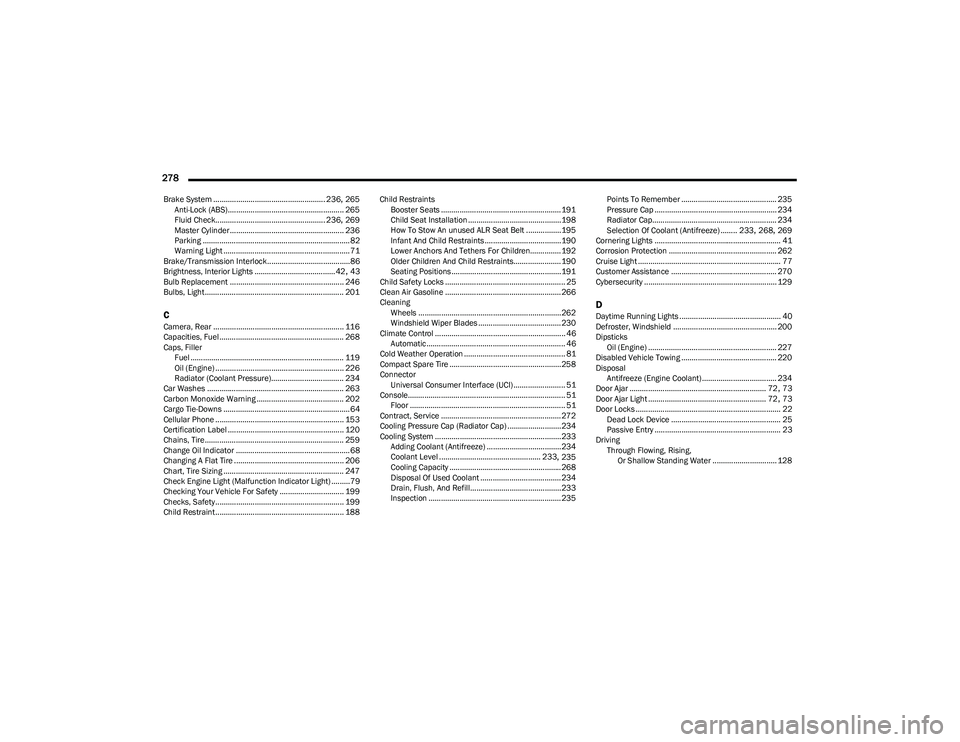
Brake System ...................................................... 236, 265
Anti-Lock (ABS)........................................................ 265 Fluid Check..................................................... 236
, 269
Master Cylinder ....................................................... 236
Parking ....................................................................... 82
Warning Light ............................................................. 71
Brake/Transmission Interlock........................................86
Brightness, Interior Lights ....................................... 42
, 43
Bulb Replacement ....................................................... 246
Bulbs, Light................................................................... 201
CCamera, Rear ............................................................... 116
Capacities, Fuel............................................................ 268
Caps, Filler Fuel .......................................................................... 119
Oil (Engine) .............................................................. 226
Radiator (Coolant Pressure)................................... 234
Car Washes .................................................................. 263
Carbon Monoxide Warning .......................................... 202
Cargo Tie-Downs ............................................................. 64
Cellular Phone .............................................................. 153
Certification Label ........................................................ 120
Chains, Tire................................................................... 259
Change Oil Indicator ....................................................... 68
Changing A Flat Tire ..................................................... 206
Chart, Tire Sizing .......................................................... 247
Check Engine Light (Malfunction Indicator Light) .........79
Checking Your Vehicle For Safety ............................... 199
Checks, Safety.............................................................. 199
Child Restraint.............................................................. 188 Child Restraints
Booster Seats .......................................................... 191
Child Seat Installation ............................................. 198How To Stow An unused ALR Seat Belt .................195Infant And Child Restraints ..................................... 190
Lower Anchors And Tethers For Children............... 192
Older Children And Child Restraints....................... 190
Seating Positions ..................................................... 191
Child Safety Locks .......................................................... 25
Clean Air Gasoline ........................................................ 266
Cleaning Wheels .....................................................................262
Windshield Wiper Blades ........................................ 230
Climate Control ............................................................... 46 Automatic ................................................................... 46
Cold Weather Operation ................................................. 81
Compact Spare Tire ...................................................... 258
Connector Universal Consumer Interface (UCI) ......................... 51
Console............................................................................ 51 Floor ........................................................................... 51
Contract, Service .......................................................... 272
Cooling Pressure Cap (Radiator Cap) ..........................234
Cooling System ............................................................. 233 Adding Coolant (Antifreeze) ....................................234
Coolant Level ................................................. 233
, 235
Cooling Capacity ...................................................... 268
Disposal Of Used Coolant ....................................... 234 Drain, Flush, And Refill............................................233
Inspection ................................................................ 235 Points To Remember .............................................. 235
Pressure Cap ........................................................... 234
Radiator Cap............................................................ 234
Selection Of Coolant (Antifreeze) ........ 233
, 268, 269
Cornering Lights ............................................................. 41
Corrosion Protection .................................................... 262
Cruise Light ..................................................................... 77 Customer Assistance ................................................... 270
Cybersecurity ................................................................ 129
DDaytime Running Lights ................................................. 40Defroster, Windshield .................................................. 200
Dipsticks Oil (Engine) .............................................................. 227
Disabled Vehicle Towing .............................................. 220
Disposal Antifreeze (Engine Coolant) .................................... 234
Door Ajar .................................................................. 72
, 73
Door Ajar Light ......................................................... 72, 73
Door Locks ...................................................................... 22 Dead Lock Device ..................................................... 25
Passive Entry ............................................................. 23
Driving Through Flowing, Rising, Or Shallow Standing Water ............................... 128
23_GG_OM_EN_USC_t.book Page 278
Page 281 of 288
279
E
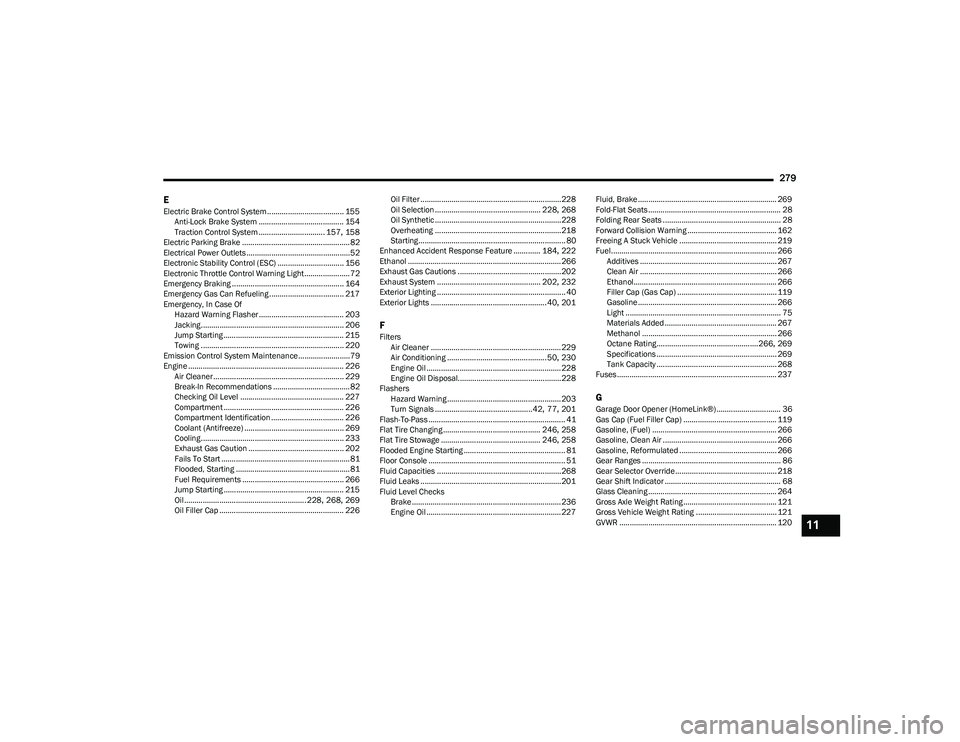
Electric Brake Control System..................................... 155 Anti-Lock Brake System ......................................... 154
Traction Control System ................................ 157
, 158
Electric Parking Brake ....................................................82
Electrical Power Outlets..................................................52 Electronic Stability Control (ESC) ................................ 156
Electronic Throttle Control Warning Light...................... 72Emergency Braking ...................................................... 164
Emergency Gas Can Refueling .................................... 217
Emergency, In Case Of Hazard Warning Flasher ......................................... 203
Jacking..................................................................... 206
Jump Starting .......................................................... 215
Towing ..................................................................... 220
Emission Control System Maintenance.........................79
Engine ........................................................................... 226 Air Cleaner ............................................................... 229Break-In Recommendations ..................................... 82
Checking Oil Level .................................................. 227Compartment .......................................................... 226
Compartment Identification ................................... 226Coolant (Antifreeze) ................................................ 269
Cooling..................................................................... 233
Exhaust Gas Caution .............................................. 202
Fails To Start .............................................................. 81
Flooded, Starting ....................................................... 81
Fuel Requirements ................................................. 266 Jump Starting .......................................................... 215
Oil ...........................................................228
, 268, 269
Oil Filler Cap ............................................................ 226 Oil Filter ....................................................................228
Oil Selection ................................................... 228
, 268
Oil Synthetic ............................................................. 228
Overheating ............................................................. 218
Starting....................................................................... 80
Enhanced Accident Response Feature ............. 184
, 222
Ethanol .......................................................................... 266
Exhaust Gas Cautions ..................................................202
Exhaust System .................................................. 202
, 232
Exterior Lighting .............................................................. 40
Exterior Lights ........................................................40
, 201
FFilters Air Cleaner ............................................................... 229
Air Conditioning ................................................50
, 230
Engine Oil ................................................................. 228
Engine Oil Disposal..................................................228
Flashers Hazard Warning ....................................................... 203
Turn Signals ...............................................42
, 77, 201
Flash-To-Pass .................................................................. 41
Flat Tire Changing ............................................... 246
, 258
Flat Tire Stowage ................................................ 246, 258
Flooded Engine Starting ................................................. 81
Floor Console .................................................................. 51
Fluid Capacities ............................................................268
Fluid Leaks ....................................................................201
Fluid Level Checks Brake ........................................................................ 236
Engine Oil ................................................................. 227 Fluid, Brake................................................................... 269
Fold-Flat Seats ................................................................ 28
Folding Rear Seats ......................................................... 28
Forward Collision Warning ........................................... 162
Freeing A Stuck Vehicle ............................................... 219
Fuel................................................................................ 266
Additives .................................................................. 267
Clean Air .................................................................. 266
Ethanol..................................................................... 266Filler Cap (Gas Cap) ................................................ 119Gasoline ................................................................... 266
Light ........................................................................... 75
Materials Added ...................................................... 267
Methanol ................................................................. 266
Octane Rating.................................................266
, 269
Specifications .......................................................... 269
Tank Capacity .......................................................... 268
Fuses ............................................................................. 237
GGarage Door Opener (HomeLink®)............................... 36
Gas Cap (Fuel Filler Cap) ............................................. 119
Gasoline, (Fuel) ............................................................ 266
Gasoline, Clean Air ....................................................... 266
Gasoline, Reformulated ............................................... 266
Gear Ranges ................................................................... 86
Gear Selector Override................................................. 218
Gear Shift Indicator ........................................................ 68 Glass Cleaning .............................................................. 264
Gross Axle Weight Rating ............................................. 121
Gross Vehicle Weight Rating ....................................... 121
GVWR ............................................................................ 120
11
23_GG_OM_EN_USC_t.book Page 279