ECU DODGE HORNET 2023 Service Manual
[x] Cancel search | Manufacturer: DODGE, Model Year: 2023, Model line: HORNET, Model: DODGE HORNET 2023Pages: 288, PDF Size: 14.2 MB
Page 209 of 288
IN CASE OF EMERGENCY207
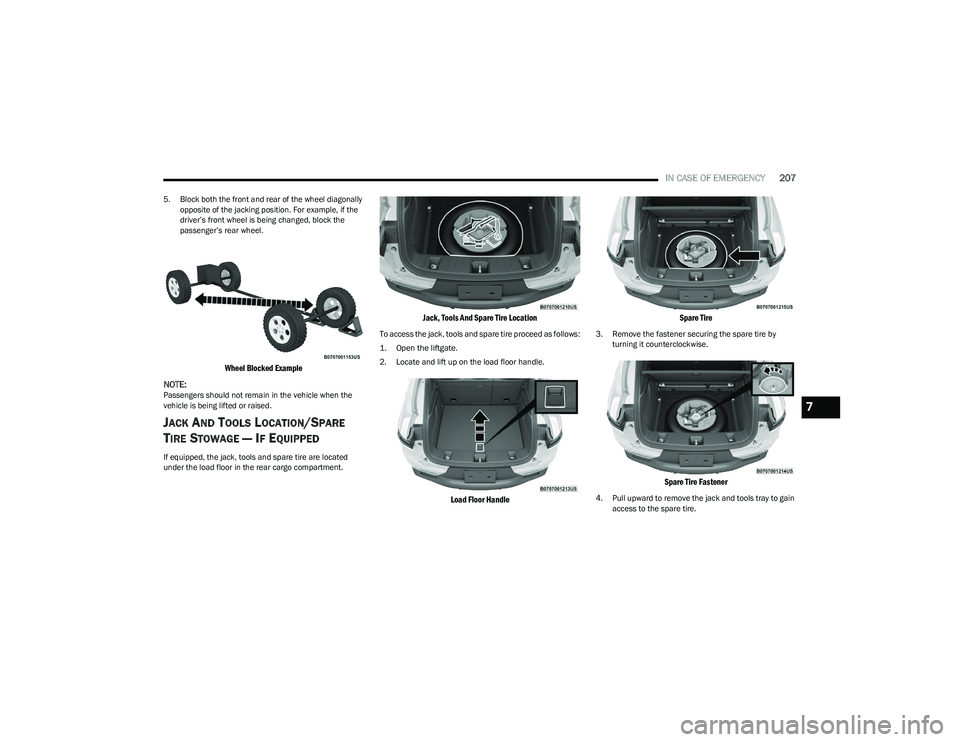
5. Block both the front and rear of the wheel diagonally
opposite of the jacking position. For example, if the
driver’s front wheel is being changed, block the
passenger’s rear wheel.
Wheel Blocked Example
NOTE:
Passengers should not remain in the vehicle when the
vehicle is being lifted or raised.
JACK AND TOOLS LOCATION/SPARE
T
IRE STOWAGE — IF EQUIPPED
If equipped, the jack, tools and spare tire are located
under the load floor in the rear cargo compartment.
Jack, Tools And Spare Tire Location
To access the jack, tools and spare tire proceed as follows:
1. Open the liftgate.
2. Locate and lift up on the load floor handle.
Load Floor Handle Spare Tire
3. Remove the fastener securing the spare tire by
turning it counterclockwise.
Spare Tire Fastener
4. Pull upward to remove the jack and tools tray to gain access to the spare tire.
7
23_GG_OM_EN_USC_t.book Page 207
Page 210 of 288
208IN CASE OF EMERGENCY
(Continued)
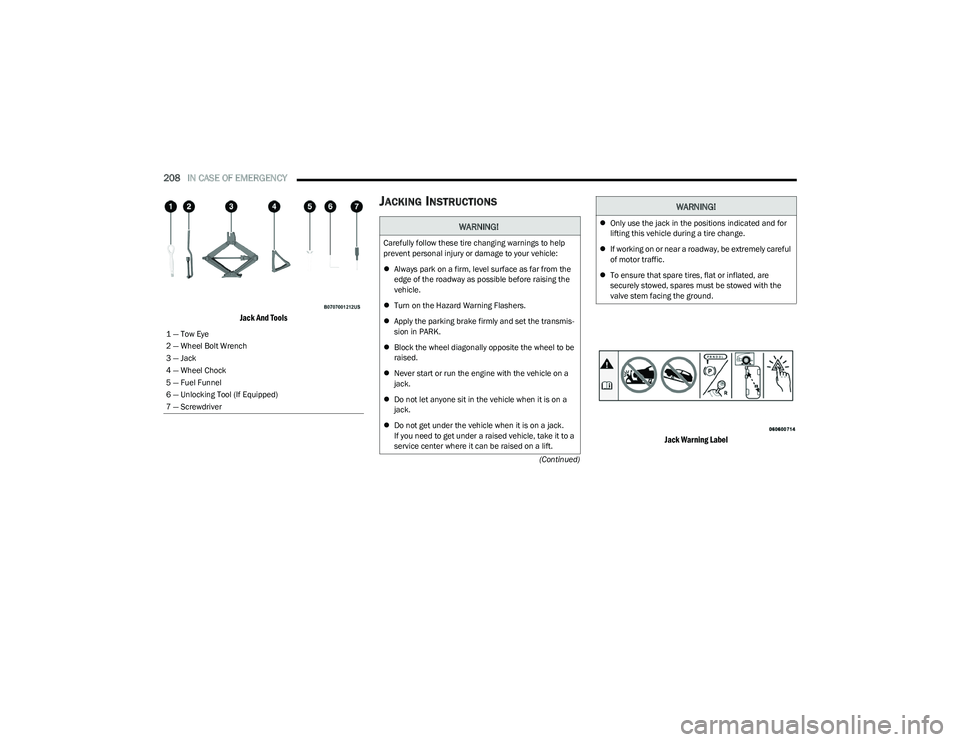
Jack And Tools
JACKING INSTRUCTIONS
Jack Warning Label
1 — Tow Eye
2 — Wheel Bolt Wrench
3 — Jack
4 — Wheel Chock
5 — Fuel Funnel
6 — Unlocking Tool (If Equipped)
7 — Screwdriver
WARNING!
Carefully follow these tire changing warnings to help
prevent personal injury or damage to your vehicle:
Always park on a firm, level surface as far from the
edge of the roadway as possible before raising the
vehicle.
Turn on the Hazard Warning Flashers.
Apply the parking brake firmly and set the transmis -
sion in PARK.
Block the wheel diagonally opposite the wheel to be
raised.
Never start or run the engine with the vehicle on a
jack.
Do not let anyone sit in the vehicle when it is on a
jack.
Do not get under the vehicle when it is on a jack.
If you need to get under a raised vehicle, take it to a
service center where it can be raised on a lift.
Only use the jack in the positions indicated and for
lifting this vehicle during a tire change.
If working on or near a roadway, be extremely careful
of motor traffic.
To ensure that spare tires, flat or inflated, are
securely stowed, spares must be stowed with the
valve stem facing the ground.
WARNING!
23_GG_OM_EN_USC_t.book Page 208
Page 211 of 288
IN CASE OF EMERGENCY209
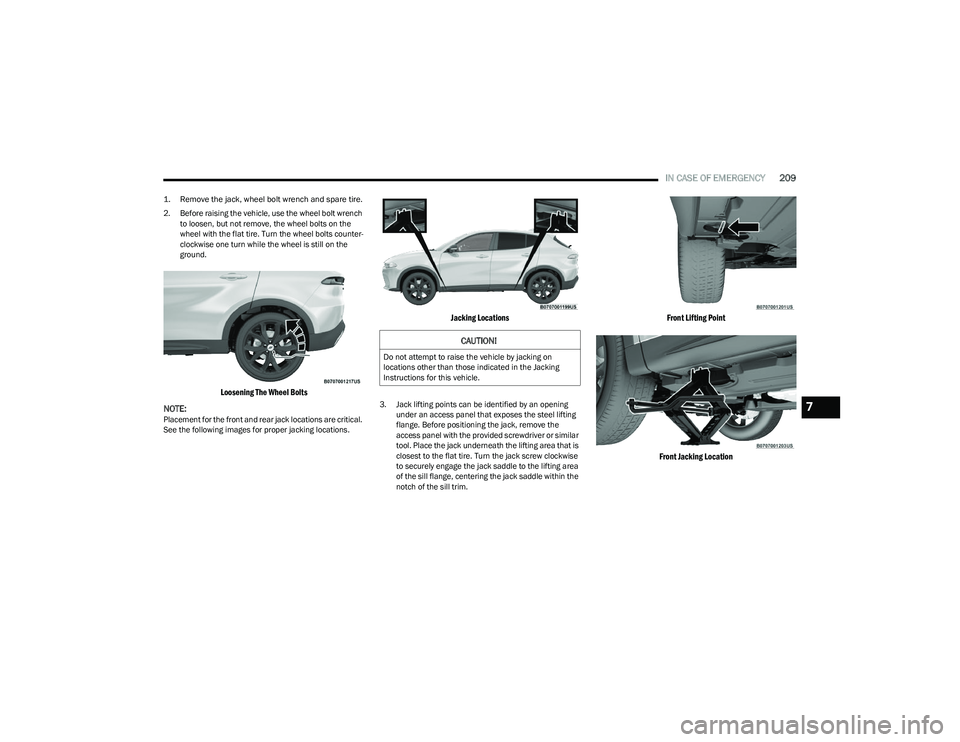
1. Remove the jack, wheel bolt wrench and spare tire.
2. Before raising the vehicle, use the wheel bolt wrench
to loosen, but not remove, the wheel bolts on the
wheel with the flat tire. Turn the wheel bolts counter -
clockwise one turn while the wheel is still on the
ground.
Loosening The Wheel Bolts
NOTE:
Placement for the front and rear jack locations are critical.
See the following images for proper jacking locations.
Jacking Locations
3. Jack lifting points can be identified by an opening under an access panel that exposes the steel lifting
flange. Before positioning the jack, remove the
access panel with the provided screwdriver or similar
tool. Place the jack underneath the lifting area that is
closest to the flat tire. Turn the jack screw clockwise
to securely engage the jack saddle to the lifting area
of the sill flange, centering the jack saddle within the
notch of the sill trim.
Front Lifting Point
Front Jacking Location
CAUTION!
Do not attempt to raise the vehicle by jacking on
locations other than those indicated in the Jacking
Instructions for this vehicle.
7
23_GG_OM_EN_USC_t.book Page 209
Page 213 of 288
IN CASE OF EMERGENCY211
10. Lower the jack until it is free. Remove the wheel
blocks. Stow the wheel bolt wrench, jack assembly
and wheel blocks in the provided storage. Secure the
assembly using the means provided. Release the
parking brake before driving the vehicle.
Damaged Tire Stowage
11. After 25 miles (40 km), check the wheel bolt torque with a torque wrench to ensure that all wheel bolts
are properly seated against the wheel.
TIRE INFLATOR KIT — IF EQUIPPED
Use this QR code to access your digital
experience.
DESCRIPTION
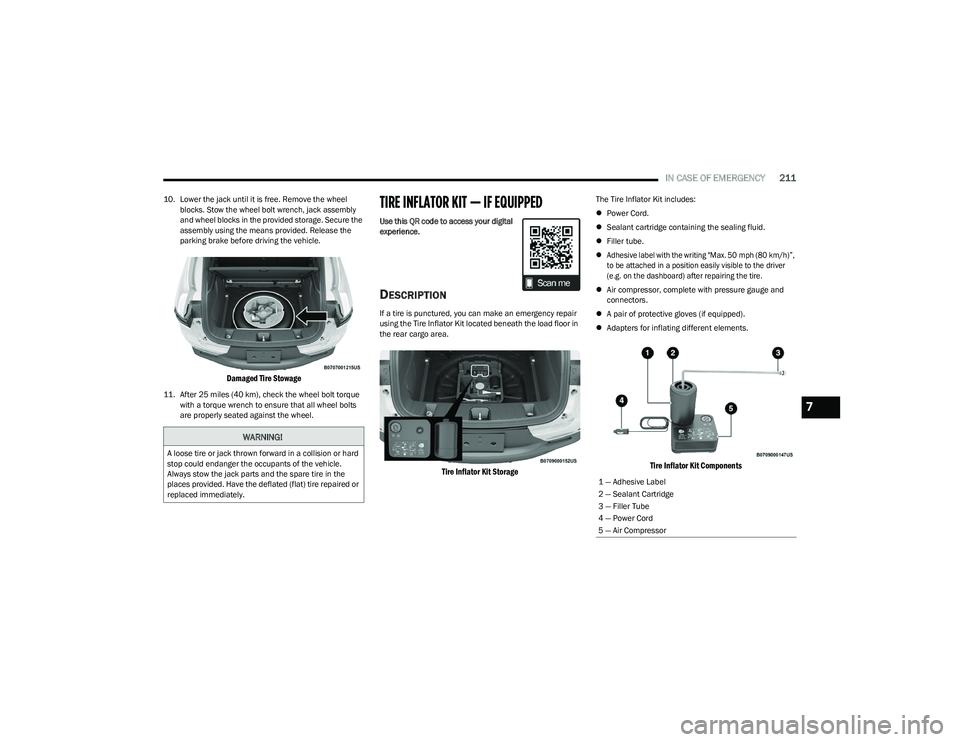
If a tire is punctured, you can make an emergency repair
using the Tire Inflator Kit located beneath the load floor in
the rear cargo area.
Tire Inflator Kit Storage
The Tire Inflator Kit includes:
Power Cord.
Sealant cartridge containing the sealing fluid.
Filler tube.
Adhesive label with the writing "Max. 50 mph (80 km/h)”,
to be attached in a position easily visible to the driver
(e.g. on the dashboard) after repairing the tire.
Air compressor, complete with pressure gauge and
connectors.
A pair of protective gloves (if equipped).
Adapters for inflating different elements.
Tire Inflator Kit Components
WARNING!
A loose tire or jack thrown forward in a collision or hard
stop could endanger the occupants of the vehicle.
Always stow the jack parts and the spare tire in the
places provided. Have the deflated (flat) tire repaired or
replaced immediately.
1 — Adhesive Label
2 — Sealant Cartridge
3 — Filler Tube
4 — Power Cord
5 — Air Compressor
7
23_GG_OM_EN_USC_t.book Page 211
Page 222 of 288
220IN CASE OF EMERGENCY
TOWING A DISABLED VEHICLE
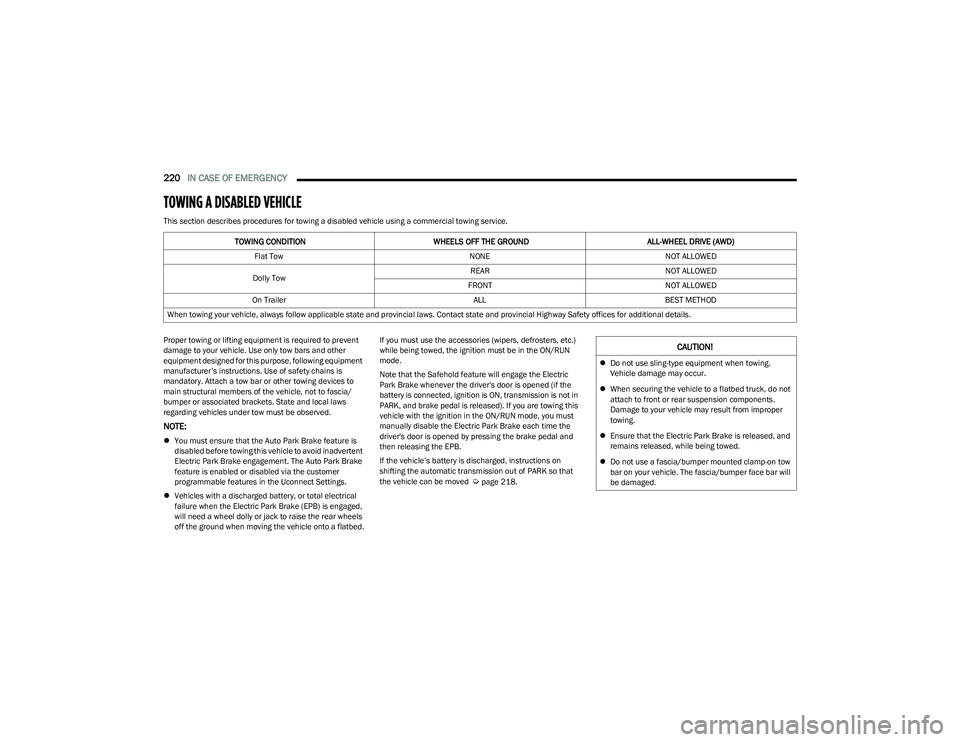
This section describes procedures for towing a disabled vehicle using a commercial towing service.
Proper towing or lifting equipment is required to prevent
damage to your vehicle. Use only tow bars and other
equipment designed for this purpose, following equipment
manufacturer’s instructions. Use of safety chains is
mandatory. Attach a tow bar or other towing devices to
main structural members of the vehicle, not to fascia/
bumper or associated brackets. State and local laws
regarding vehicles under tow must be observed.
NOTE:
You must ensure that the Auto Park Brake feature is
disabled before towing this vehicle to avoid inadvertent
Electric Park Brake engagement. The Auto Park Brake
feature is enabled or disabled via the customer
programmable features in the Uconnect Settings.
Vehicles with a discharged battery, or total electrical
failure when the Electric Park Brake (EPB) is engaged,
will need a wheel dolly or jack to raise the rear wheels
off the ground when moving the vehicle onto a flatbed. If you must use the accessories (wipers, defrosters, etc.)
while being towed, the ignition must be in the ON/RUN
mode.
Note that the Safehold feature will engage the Electric
Park Brake whenever the driver's door is opened (if the
battery is connected, ignition is ON, transmission is not in
PARK, and brake pedal is released). If you are towing this
vehicle with the ignition in the ON/RUN mode, you must
manually disable the Electric Park Brake each time the
driver's door is opened by pressing the brake pedal and
then releasing the EPB.
If the vehicle’s battery is discharged, instructions on
shifting the automatic transmission out of PARK so that
the vehicle can be moved
Úpage 218.
TOWING CONDITION WHEELS OFF THE GROUND
ALL-WHEEL DRIVE (AWD)
Flat Tow NONENOT ALLOWED
Dolly Tow REAR
NOT ALLOWED
FRONT NOT ALLOWED
On Trailer ALLBEST METHOD
When towing your vehicle, always follow applicable state and provincial laws. Contact state and provincial Highway Safety offices for additional details.
CAUTION!
Do not use sling-type equipment when towing.
Vehicle damage may occur.
When securing the vehicle to a flatbed truck, do not
attach to front or rear suspension components.
Damage to your vehicle may result from improper
towing.
Ensure that the Electric Park Brake is released, and
remains released, while being towed.
Do not use a fascia/bumper mounted clamp-on tow
bar on your vehicle. The fascia/bumper face bar will
be damaged.
23_GG_OM_EN_USC_t.book Page 220
Page 224 of 288
222IN CASE OF EMERGENCY
Tow Eye Installation
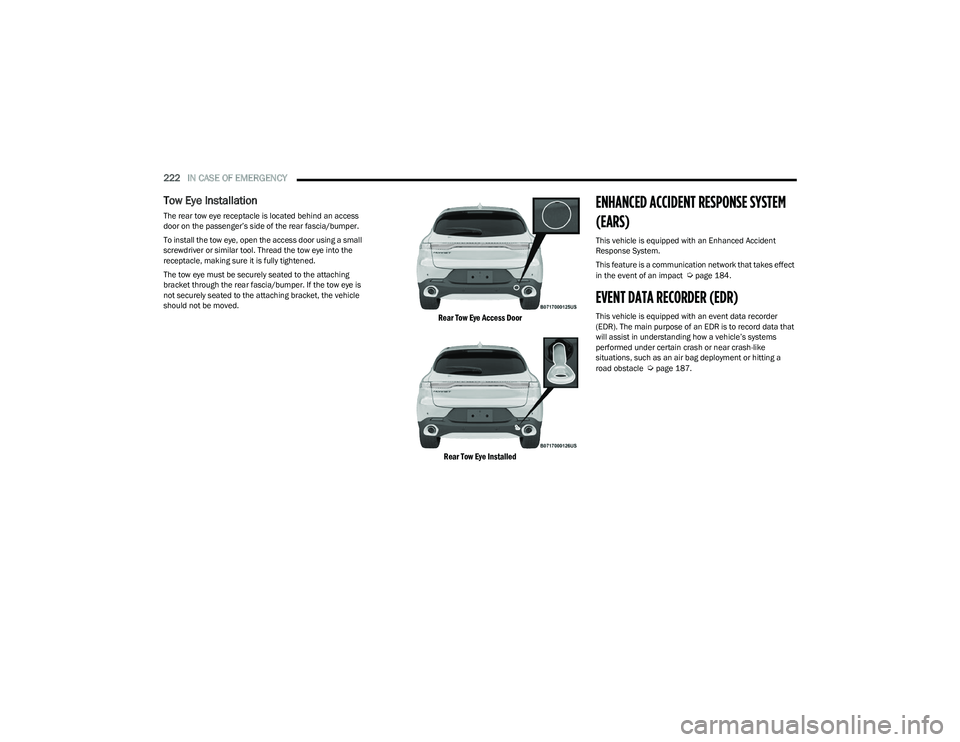
The rear tow eye receptacle is located behind an access
door on the passenger’s side of the rear fascia/bumper.
To install the tow eye, open the access door using a small
screwdriver or similar tool. Thread the tow eye into the
receptacle, making sure it is fully tightened.
The tow eye must be securely seated to the attaching
bracket through the rear fascia/bumper. If the tow eye is
not securely seated to the attaching bracket, the vehicle
should not be moved.
Rear Tow Eye Access Door
Rear Tow Eye Installed
ENHANCED ACCIDENT RESPONSE SYSTEM
(EARS)
This vehicle is equipped with an Enhanced Accident
Response System.
This feature is a communication network that takes effect
in the event of an impact
Úpage 184.
EVENT DATA RECORDER (EDR)
This vehicle is equipped with an event data recorder
(EDR). The main purpose of an EDR is to record data that
will assist in understanding how a vehicle’s systems
performed under certain crash or near crash-like
situations, such as an air bag deployment or hitting a
road obstacle
Úpage 187.
23_GG_OM_EN_USC_t.book Page 222
Page 234 of 288
232SERVICING AND MAINTENANCE
Rear Wiper Blade Removal/Installation
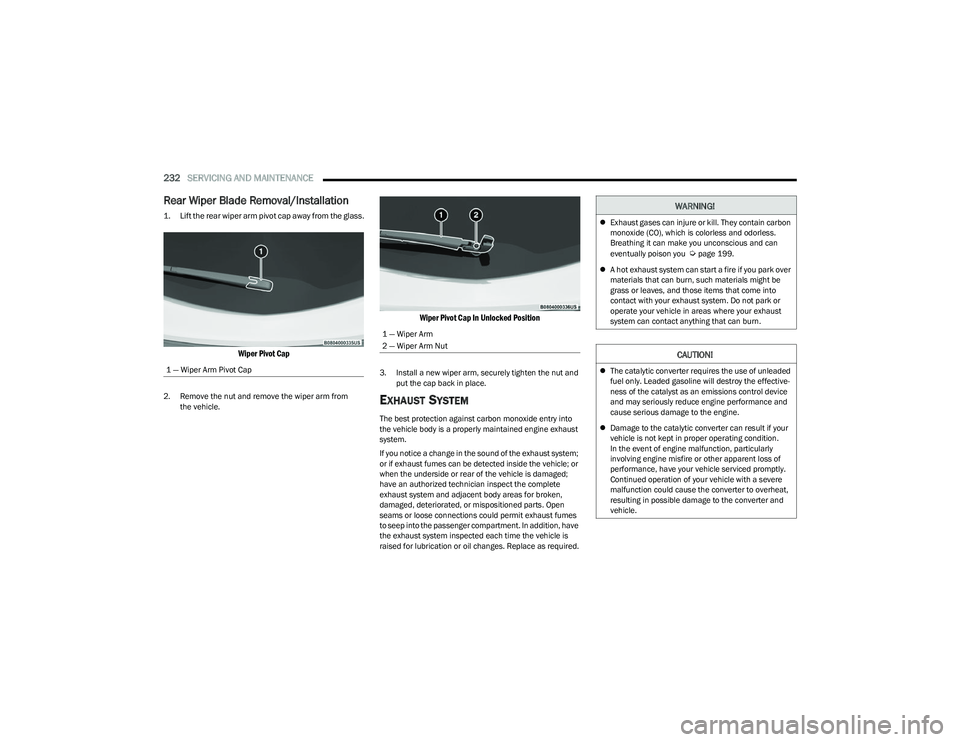
1. Lift the rear wiper arm pivot cap away from the glass.
Wiper Pivot Cap
2. Remove the nut and remove the wiper arm from
the vehicle.
Wiper Pivot Cap In Unlocked Position
3. Install a new wiper arm, securely tighten the nut and put the cap back in place.
EXHAUST SYSTEM
The best protection against carbon monoxide entry into
the vehicle body is a properly maintained engine exhaust
system.
If you notice a change in the sound of the exhaust system;
or if exhaust fumes can be detected inside the vehicle; or
when the underside or rear of the vehicle is damaged;
have an authorized technician inspect the complete
exhaust system and adjacent body areas for broken,
damaged, deteriorated, or mispositioned parts. Open
seams or loose connections could permit exhaust fumes
to seep into the passenger compartment. In addition, have
the exhaust system inspected each time the vehicle is
raised for lubrication or oil changes. Replace as required.
1 — Wiper Arm Pivot Cap
1 — Wiper Arm
2 — Wiper Arm Nut
WARNING!
Exhaust gases can injure or kill. They contain carbon
monoxide (CO), which is colorless and odorless.
Breathing it can make you unconscious and can
eventually poison you
Úpage 199.
A hot exhaust system can start a fire if you park over
materials that can burn, such materials might be
grass or leaves, and those items that come into
contact with your exhaust system. Do not park or
operate your vehicle in areas where your exhaust
system can contact anything that can burn.
CAUTION!
The catalytic converter requires the use of unleaded
fuel only. Leaded gasoline will destroy the effective -
ness of the catalyst as an emissions control device
and may seriously reduce engine performance and
cause serious damage to the engine.
Damage to the catalytic converter can result if your
vehicle is not kept in proper operating condition.
In the event of engine malfunction, particularly
involving engine misfire or other apparent loss of
performance, have your vehicle serviced promptly.
Continued operation of your vehicle with a severe
malfunction could cause the converter to overheat,
resulting in possible damage to the converter and
vehicle.
23_GG_OM_EN_USC_t.book Page 232
Page 238 of 288
236SERVICING AND MAINTENANCE
BRAKE SYSTEM
In order to ensure brake system performance, all brake
system components should be inspected periodically.
For the proper maintenance intervals
Úpage 224.
Brake Master Cylinder
The fluid in the master cylinder should be checked when
performing under hood services or immediately if the
Brake Warning Light is illuminated.
Be sure to clean the top of the master cylinder area before
removing the cap. If necessary, add fluid to bring the fluid
level up to the requirements described on the brake fluid
reservoir. With disc brakes, fluid level can be expected to
fall as the brake pads wear. Brake fluid level should be
checked when pads are replaced. However, low fluid level
may be caused by a leak and a checkup may be needed.
Use only the manufacturer recommended brake fluid
Úpage 269.
AUTOMATIC TRANSMISSION —
I
F EQUIPPED
Special Additives
It is strongly recommended against using any special
additives in the transmission. Automatic Transmission
Fluid (ATF) is an engineered product and its performance
may be impaired by supplemental additives. Therefore, do
not add any fluid additives to the transmission. Avoid
using transmission sealers as they may adversely affect
seals.
Fluid Level Check
The fluid level is preset at the factory and does not require
adjustment under normal operating conditions. Routine
fluid level checks are not required; therefore the
transmission has no dipstick. An authorized dealer can
check your transmission fluid level using special service
tools. If you notice fluid leakage or transmission
malfunction, visit an authorized dealer immediately to
have the transmission fluid level checked. Operating the
vehicle with an improper fluid level can cause severe
transmission damage.
WARNING!
Riding the brakes can lead to brake failure and possibly
a collision. Driving with your foot resting or riding on the
brake pedal can result in abnormally high brake
temperatures, excessive lining wear, and possible brake
damage. You would not have your full braking capacity
in an emergency.
WARNING!
Use only the manufacturer recommended brake fluid Úpage 269. Using the wrong type of brake fluid can
severely damage your brake system and/or impair its
performance. The proper type of brake fluid for your
vehicle is also identified on the original factory
installed hydraulic master cylinder reservoir.
To avoid contamination from foreign matter or
moisture, use only new brake fluid or fluid that has
been in a tightly closed container. Keep the master
cylinder reservoir cap secured at all times. Brake
fluid in an open container absorbs moisture from the
air resulting in a lower boiling point. This may cause
it to boil unexpectedly during hard or prolonged
braking, resulting in sudden brake failure.
This could result in a collision.
Overfilling the brake fluid reservoir can result in
spilling brake fluid on hot engine parts, causing the
brake fluid to catch fire. Brake fluid can also damage
painted and vinyl surfaces, care should be taken to
avoid its contact with these surfaces.
Do not allow petroleum-based fluid to contaminate
the brake fluid. Brake seal components could be
damaged, causing partial or complete brake failure.
This could result in a collision.
CAUTION!
Do not use chemical flushes in your transmission as the
chemicals can damage your transmission components.
Such damage is not covered by the New Vehicle Limited
Warranty.
23_GG_OM_EN_USC_t.book Page 236
Page 279 of 288
277
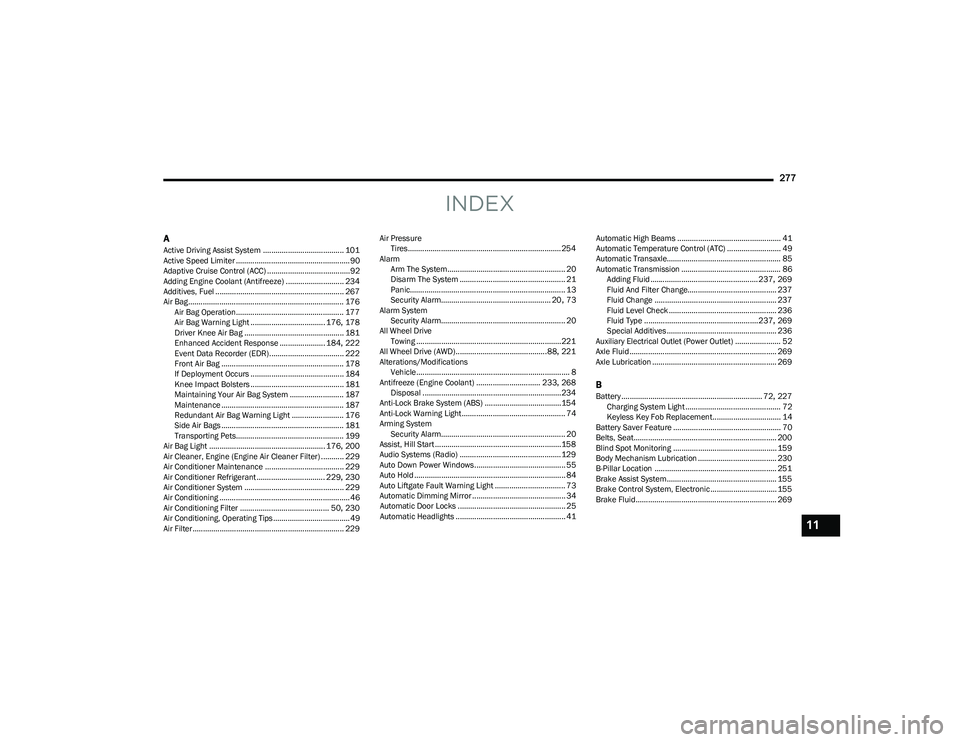
INDEX
AActive Driving Assist System ....................................... 101
Active Speed Limiter ....................................................... 90
Adaptive Cruise Control (ACC) ........................................92
Adding Engine Coolant (Antifreeze) ............................ 234
Additives, Fuel .............................................................. 267
Air Bag........................................................................... 176Air Bag Operation.................................................... 177
Air Bag Warning Light .................................... 176
, 178
Driver Knee Air Bag ................................................ 181
Enhanced Accident Response ...................... 184
, 222
Event Data Recorder (EDR).................................... 222 Front Air Bag ........................................................... 178
If Deployment Occurs ............................................. 184
Knee Impact Bolsters ............................................. 181
Maintaining Your Air Bag System .......................... 187
Maintenance ........................................................... 187
Redundant Air Bag Warning Light ......................... 176
Side Air Bags ........................................................... 181
Transporting Pets.................................................... 199
Air Bag Light ........................................................ 176
, 200
Air Cleaner, Engine (Engine Air Cleaner Filter) ........... 229
Air Conditioner Maintenance ...................................... 229
Air Conditioner Refrigerant ................................. 229
, 230
Air Conditioner System ................................................ 229
Air Conditioning ............................................................... 46
Air Conditioning Filter ........................................... 50
, 230
Air Conditioning, Operating Tips ..................................... 49 Air Filter......................................................................... 229 Air Pressure
Tires.......................................................................... 254
Alarm Arm The System......................................................... 20
Disarm The System ................................................... 21
Panic........................................................................... 13
Security Alarm..................................................... 20
, 73
Alarm System Security Alarm............................................................ 20
All Wheel Drive Towing ...................................................................... 221
All Wheel Drive (AWD)............................................88
, 221
Alterations/Modifications Vehicle.......................................................................... 8
Antifreeze (Engine Coolant) ............................... 233
, 268
Disposal ...................................................................234
Anti-Lock Brake System (ABS) ..................................... 154
Anti-Lock Warning Light.................................................. 74
Arming System Security Alarm............................................................ 20
Assist, Hill Start ............................................................. 158
Audio Systems (Radio) ................................................. 129
Auto Down Power Windows............................................ 55
Auto Hold ......................................................................... 84
Auto Liftgate Fault Warning Light .................................. 73
Automatic Dimming Mirror ............................................. 34 Automatic Door Locks .................................................... 25Automatic Headlights ..................................................... 41 Automatic High Beams .................................................. 41
Automatic Temperature Control (ATC) .......................... 49
Automatic Transaxle....................................................... 85
Automatic Transmission ................................................ 86 Adding Fluid .................................................... 237
, 269
Fluid And Filter Change........................................... 237
Fluid Change ........................................................... 237
Fluid Level Check .................................................... 236
Fluid Type .......................................................237
, 269
Special Additives ..................................................... 236
Auxiliary Electrical Outlet (Power Outlet) ...................... 52
Axle Fluid....................................................................... 269
Axle Lubrication ............................................................ 269
BBattery.................................................................... 72, 227
Charging System Light .............................................. 72
Keyless Key Fob Replacement................................. 14
Battery Saver Feature .................................................... 70
Belts, Seat..................................................................... 200
Blind Spot Monitoring .................................................. 159
Body Mechanism Lubrication ...................................... 230
B-Pillar Location ........................................................... 251
Brake Assist System..................................................... 155
Brake Control System, Electronic................................ 155
Brake Fluid.................................................................... 269
11
23_GG_OM_EN_USC_t.book Page 277
Page 280 of 288
278
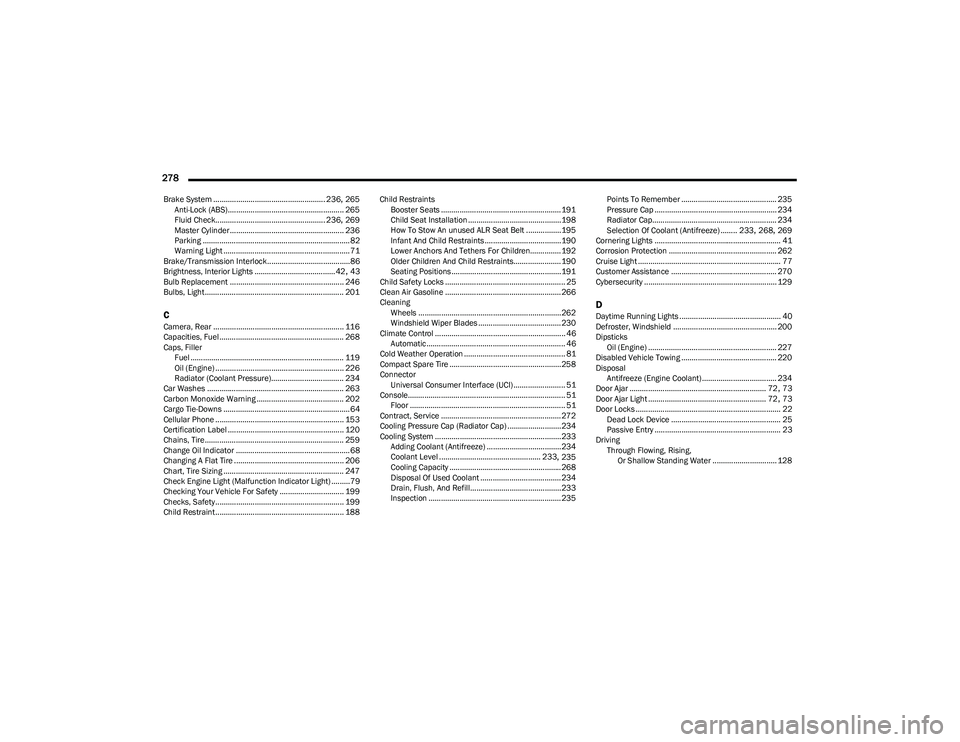
Brake System ...................................................... 236, 265
Anti-Lock (ABS)........................................................ 265 Fluid Check..................................................... 236
, 269
Master Cylinder ....................................................... 236
Parking ....................................................................... 82
Warning Light ............................................................. 71
Brake/Transmission Interlock........................................86
Brightness, Interior Lights ....................................... 42
, 43
Bulb Replacement ....................................................... 246
Bulbs, Light................................................................... 201
CCamera, Rear ............................................................... 116
Capacities, Fuel............................................................ 268
Caps, Filler Fuel .......................................................................... 119
Oil (Engine) .............................................................. 226
Radiator (Coolant Pressure)................................... 234
Car Washes .................................................................. 263
Carbon Monoxide Warning .......................................... 202
Cargo Tie-Downs ............................................................. 64
Cellular Phone .............................................................. 153
Certification Label ........................................................ 120
Chains, Tire................................................................... 259
Change Oil Indicator ....................................................... 68
Changing A Flat Tire ..................................................... 206
Chart, Tire Sizing .......................................................... 247
Check Engine Light (Malfunction Indicator Light) .........79
Checking Your Vehicle For Safety ............................... 199
Checks, Safety.............................................................. 199
Child Restraint.............................................................. 188 Child Restraints
Booster Seats .......................................................... 191
Child Seat Installation ............................................. 198How To Stow An unused ALR Seat Belt .................195Infant And Child Restraints ..................................... 190
Lower Anchors And Tethers For Children............... 192
Older Children And Child Restraints....................... 190
Seating Positions ..................................................... 191
Child Safety Locks .......................................................... 25
Clean Air Gasoline ........................................................ 266
Cleaning Wheels .....................................................................262
Windshield Wiper Blades ........................................ 230
Climate Control ............................................................... 46 Automatic ................................................................... 46
Cold Weather Operation ................................................. 81
Compact Spare Tire ...................................................... 258
Connector Universal Consumer Interface (UCI) ......................... 51
Console............................................................................ 51 Floor ........................................................................... 51
Contract, Service .......................................................... 272
Cooling Pressure Cap (Radiator Cap) ..........................234
Cooling System ............................................................. 233 Adding Coolant (Antifreeze) ....................................234
Coolant Level ................................................. 233
, 235
Cooling Capacity ...................................................... 268
Disposal Of Used Coolant ....................................... 234 Drain, Flush, And Refill............................................233
Inspection ................................................................ 235 Points To Remember .............................................. 235
Pressure Cap ........................................................... 234
Radiator Cap............................................................ 234
Selection Of Coolant (Antifreeze) ........ 233
, 268, 269
Cornering Lights ............................................................. 41
Corrosion Protection .................................................... 262
Cruise Light ..................................................................... 77 Customer Assistance ................................................... 270
Cybersecurity ................................................................ 129
DDaytime Running Lights ................................................. 40Defroster, Windshield .................................................. 200
Dipsticks Oil (Engine) .............................................................. 227
Disabled Vehicle Towing .............................................. 220
Disposal Antifreeze (Engine Coolant) .................................... 234
Door Ajar .................................................................. 72
, 73
Door Ajar Light ......................................................... 72, 73
Door Locks ...................................................................... 22 Dead Lock Device ..................................................... 25
Passive Entry ............................................................. 23
Driving Through Flowing, Rising, Or Shallow Standing Water ............................... 128
23_GG_OM_EN_USC_t.book Page 278