wheel DODGE INTREPID 2004 2.G Owner's Manual
[x] Cancel search | Manufacturer: DODGE, Model Year: 2004, Model line: INTREPID, Model: DODGE INTREPID 2004 2.GPages: 249, PDF Size: 4.87 MB
Page 159 of 249
WARNING!
Battery fluid is a corrosive acid solution; do not
allow battery fluid to contact eyes, skin or clothing.
Don’t lean over battery when attaching clamps or
allow the clamps to touch each other. If acid splashes
in eyes or on skin, flush the contaminated area
immediately with large quantities of water.
A battery generates hydrogen gas which is flam-
mable and explosive. Keep flame or spark away
from the vent holes. Do not use a booster battery or
any other booster source with an output that exceeds
12 volts.
NOTE:The battery is stored in a compartment in front
of the tire in the right front fender and is accessible
through the engine compartment. The tire and wheel
need not be removed to gain access to the battery.
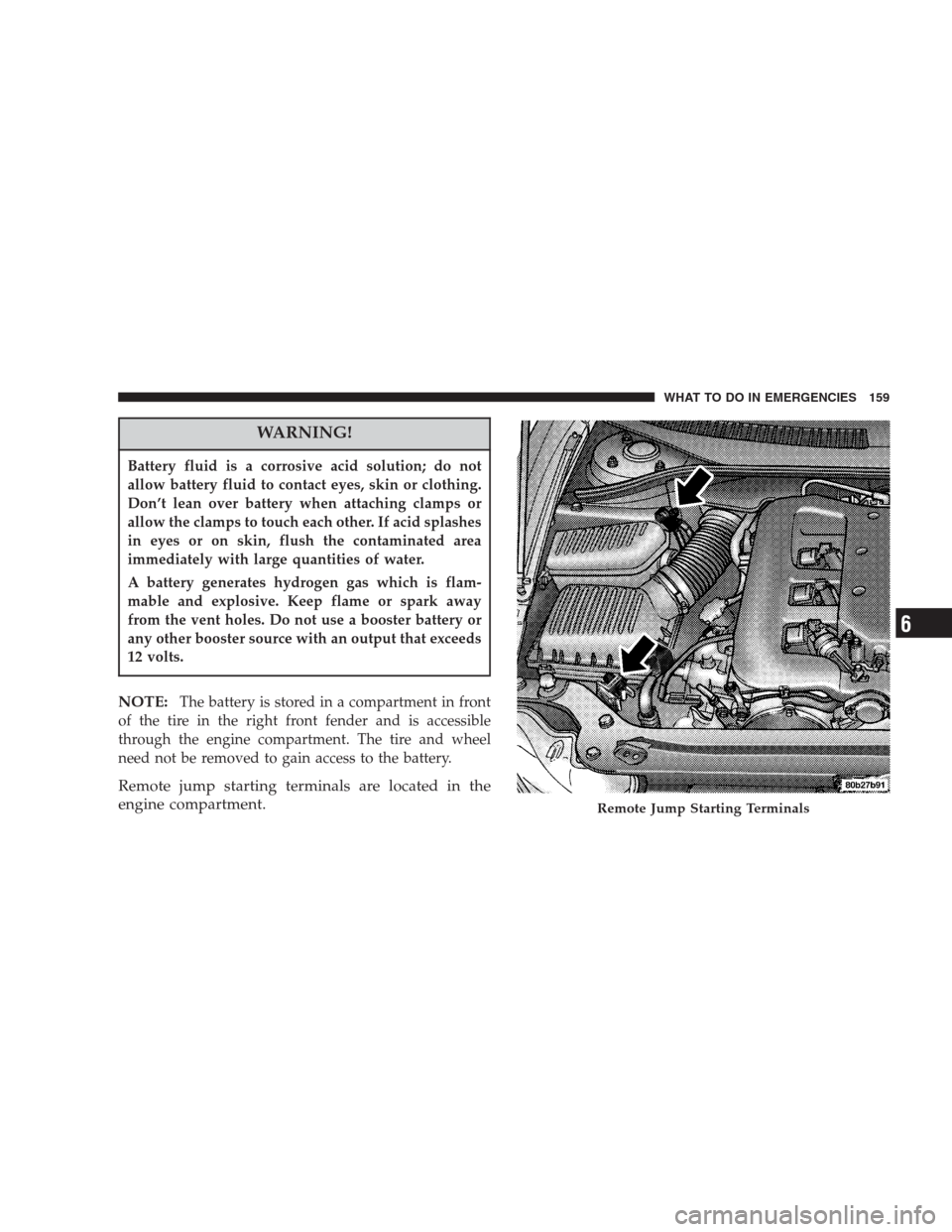
Remote jump starting terminals are located in the
engine compartment.
Remote Jump Starting Terminals
WHAT TO DO IN EMERGENCIES 159
6
Page 161 of 249
5. Connect the other cable, first to the negative jump start
attachment of the booster battery and then to the engine
of the vehicle with the discharged battery. Make sure you
have a good contact on the engine.
6. Start the engine in the vehicle which has the booster
battery, let the engine idle a few minutes, then start the
engine in the vehicle with the discharged battery.
7. When removing the jumper cables, reverse the above
sequence exactly. Be careful of the moving belts and fan.
DRIVING ON SLIPPERY SURFACES
Acceleration
Rapid acceleration on snow covered, wet, or other slip-
pery surfaces may cause the front wheels to pull errati-
cally to the right or left. This phenomenon occurs when
there is a difference in the surface traction under the front
(driving) wheels.
WARNING!
Rapid acceleration on slippery surfaces is danger-
ous. Unequal traction can cause sudden pulling of
the front wheels. You could lose control of the
vehicle and possibly have an accident. Accelerate
slowly and carefully whenever there is likely to be
poor traction (ice, snow, wet, mud, loose sand, etc.).
Traction
When driving on wet or slushy roads, it is possible for a
wedge of water to build up between the tire and road
surface. This is known as hydroplaning and may cause
partial or complete loss of vehicle control and stopping
ability. To reduce this possibility, the following precau-
tions should be observed:
WHAT TO DO IN EMERGENCIES 161
6
Page 162 of 249
1. Slow down during rainstorms or when roads are
slushy.
2. Slow down if road has standing water or puddles.
3. Replace tires when tread wear indicators first become
visible.
4. Keep tires properly inflated.
5. Maintain sufficient distance between your vehicle and
the vehicle in front of you to avoid a collision in a sudden
stop.
NOTE:If so equipped, turn on the Traction Control
System to accelerate on slippery surfaces.
FREEING A STUCK VEHICLE
If your vehicle is equipped with Traction Control, turn
the system off before attempting to “rock” the vehicle.
If your vehicle becomes stuck in mud, sand or snow, it
can often be moved by a rocking motion. Turn your
steering wheel right and left to clear the area around the
front wheels. Then shift back and forth between Reverse
and Drive. Usually the least accelerator pedal pressure to
maintain the rocking motion without spinning the
wheels is most effective.
CAUTION!
Racing the engine or spinning the wheels too fast
may lead to transmission overheating and failure. It
can also damage the tires. Do not spin the wheels
above 30 mph (48 km/h).
162 WHAT TO DO IN EMERGENCIES
Page 163 of 249
TOWING A DISABLED VEHICLE
Only two ways of towing are approved; front towing and
flat bed towing.
CAUTION!
•Do not attempt to tow this vehicle from the front
with sling type towing equipment. Damage to the
front fascia will result.
•Always use wheel lift equipment when towing
from the front. The only other approved method
of towing is with a flat bed truck.
•Do not tow the vehicle from the rear. Damage to
the rear sheet metal and fascia will occur.
•Do not push or tow this vehicle with another
vehicle as damage to the bumper fascia and trans-
axle may result.
If damage to the vehicle prevents towing from the front,
move the vehicle onto a flat bed tow truck.
WHAT TO DO IN EMERGENCIES 163
6
Page 181 of 249
Maintenance-Free Battery
The top of the MAINTENANCE-FREE battery is perma-
nently sealed. You will never have to add water, nor is
periodic maintenance required.
NOTE:The battery is stored in a compartment in front
of the tire in the right front fender and is accessible
through the engine compartment. The tire and wheel
need not be removed to access the battery.
To access the battery:
1. Turn the steering wheel fully to the right.
2. Remove the battery access panel from the inner fender
shield.
3. Remove the air cleaner.
4. Move the battery into the opening and lift it out.
WARNING!
Battery fluid is a corrosive acid solution and can
burn or even blind you. Don’t allow battery fluid to
contact your eyes, skin or clothing. Don’t lean over a
battery when attaching clamps. If acid splashes in
eyes or on skin, flush the area immediately with
large amounts of water. Battery gas is flammable and
explosive. Keep flame or sparks away from the
battery. Don’t use a booster battery or any other
booster source with an output greater than 12 volts.
Don’t allow cable clamps to touch each other.
WARNING!
Battery posts, terminals and related accessories con-
tain lead and lead compounds. Wash hands after
handling.
MAINTAINING YOUR VEHICLE 181
7
Page 194 of 249
WARNING!
Use of a brake fluid that may have a lower initial
boiling point or unidentified as to specification, may
result in sudden brake failure during hard pro-
longed braking. You could have an accident.
Use only brake fluid that has been in a tightly closed
container to avoid contamination from foreign matter.
Do not allow petroleum base fluid to contaminate the
brake fluid as seal damage will result!
Fuel System Hoses
Electronic Fuel Injection high pressure fuel systems are
designed with hoses and clamps which have unique
material characteristics to provide adequate sealing and
resist attack by deteriorated gasoline.You are urged to use only manufacturer specified hoses
and clamps, or their equivalent in material and specifi-
cation, in any fuel system servicing. It is mandatory to
replace all clamps that have been loosened or removed
during service. Care should be taken in installing new
clamps to insure they are properly torqued.
Automatic Transaxle
All front wheel drive vehicles have a transaxle and
differential assembly contained within a single housing.
Selection of Lubricant
It is important that the proper lubricant is used in the
transaxle to assure optimum transaxle performance. Use
only the manufacturer’s recommended transmission
fluid. Refer to the Recommended Fluids, Lubricants and
Genuine Parts section for correct fluid type. It is impor-
tant that the transmission fluid be maintained at the
prescribed level using the recommended fluid.
194 MAINTAINING YOUR VEHICLE
Page 199 of 249
•It is important that the drain holes in the lower edges
of the doors, rocker panels and rear deck lid be kept
clear and open.
•If you detect any stone chips or scratches in the paint,
touch them up immediately. The cost of such repairs is
considered the responsibility of the owner.
•Use Mopar touch up paint on scratches or chips as
soon as possible. Your dealer has touch up paint to
match the color of your vehicle.
•If your vehicle is damaged due to an accident or
similar cause which destroys the paint and protective
coating have your vehicle repaired as soon as possible.
The cost of such repairs is considered the responsibil-
ity of the owner.
•Aluminum wheels should be cleaned regularly with
mild soap and water to prevent corrosion. To remove
heavy soil, select a non abrasive, non-acidic cleaner.
Do not use scouring pads or metal polishes. Avoid
automatic car washes that use acidic solutions or harsh
brushes that may damage the wheels’ protective fin-
ish.
•If you carry special cargo such as chemicals, fertilizers,
deicer salt, etc., be sure that such materials are well
packaged and sealed.
•If a lot of driving is done on gravel roads, consider
mud or stone shields behind each wheel.
Interior Care
Use Mopar Fabric Cleaner to clean fabric upholstery and
carpeting.
Use a mild soap and warm water solution to clean vinyl
or leather upholstery. For stubborn stains, use Mopar
Vinyl Cleaner.
Mopar Vinyl Cleaner is specifically recommended for
vinyl trim.
WARNING!
Do not use volatile solvents for cleaning purposes.
Many are potentially flammable, and if used in
closed areas they may cause respiratory harm.
MAINTAINING YOUR VEHICLE 199
7
Page 236 of 249
Temperature Grades
The temperature grades are A (highest), B, and C, repre-
senting the tire’s resistance to the generation of heat and
its ability to dissipate heat when tested under controlled
conditions on a specified indoor laboratory test wheel.
Sustained high temperature can cause the material of the
tire to degenerate and reduce tire life, and excessive
temperature can lead to sudden tire failure. The grade C
corresponds to a level of performance which all passen-
ger car tires must meet under the Federal Motor Vehicle
Safety Standard No. 109. Grades B and A represent
higher levels of performance on the laboratory test wheel
than the minimum required by law.WARNING!
The temperature grade is established for a tire that is
properly inflated and not overloaded. Excessive
speed, underinflation, or excessive loading, either
separately or in combination, can cause heat buildup
and possible tire failure.
236 IF YOU NEED CONSUMER ASSISTANCE
Page 240 of 249
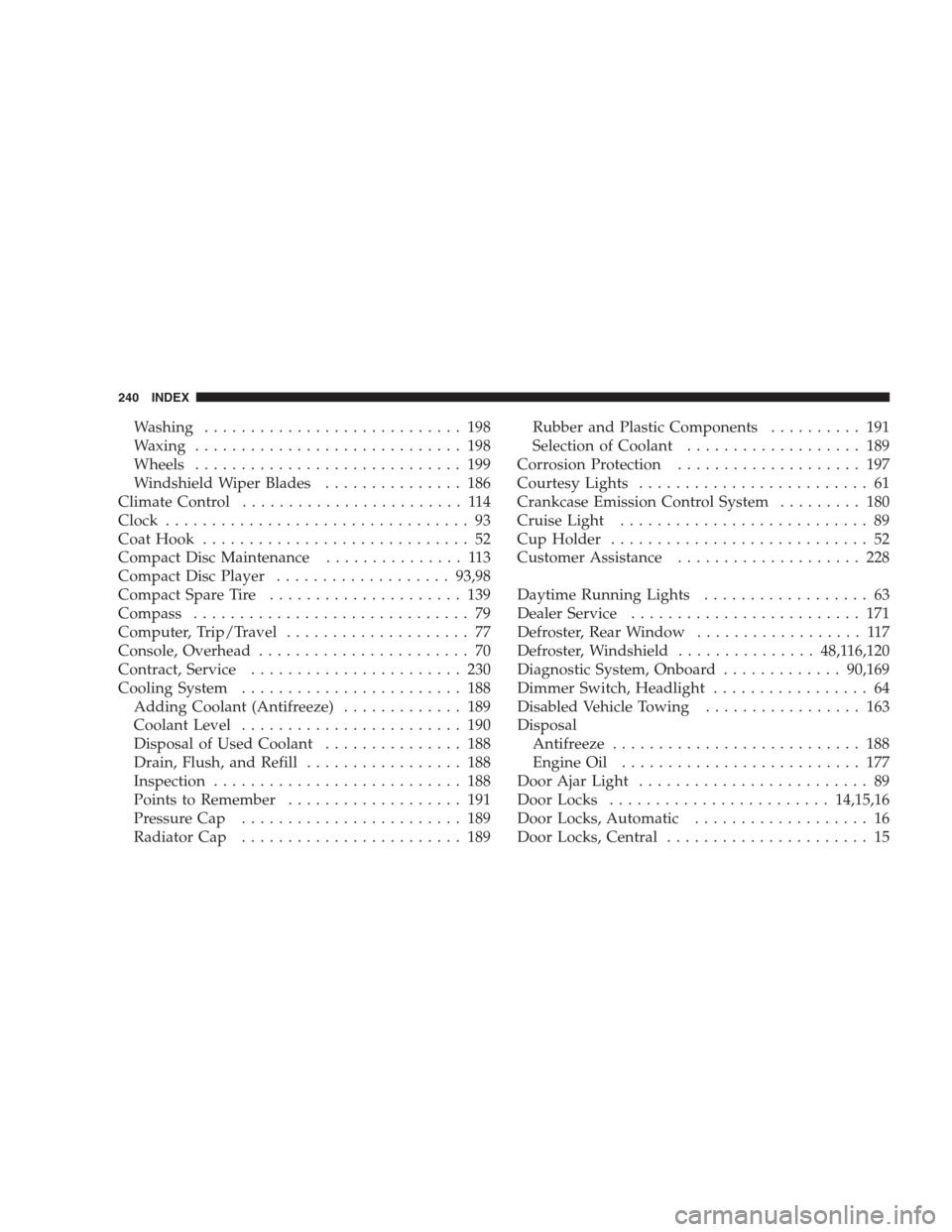
Washing............................ 198
Waxing............................. 198
Wheels............................. 199
Windshield Wiper Blades............... 186
Climate Control........................ 114
Clock................................. 93
Coat Hook............................. 52
Compact Disc Maintenance............... 113
Compact Disc Player...................93,98
Compact Spare Tire..................... 139
Compass.............................. 79
Computer, Trip/Travel.................... 77
Console, Overhead....................... 70
Contract, Service....................... 230
Cooling System........................ 188
Adding Coolant (Antifreeze)............. 189
Coolant Level........................ 190
Disposal of Used Coolant............... 188
Drain, Flush, and Refill................. 188
Inspection........................... 188
Points to Remember................... 191
Pressure Cap........................ 189
Radiator Cap........................ 189Rubber and Plastic Components.......... 191
Selection of Coolant................... 189
Corrosion Protection.................... 197
Courtesy Lights......................... 61
Crankcase Emission Control System......... 180
Cruise Light........................... 89
Cup Holder............................ 52
Customer Assistance.................... 228
Daytime Running Lights.................. 63
Dealer Service......................... 171
Defroster, Rear Window.................. 117
Defroster, Windshield...............48,116,120
Diagnostic System, Onboard.............90,169
Dimmer Switch, Headlight................. 64
Disabled Vehicle Towing................. 163
Disposal
Antifreeze........................... 188
Engine Oil.......................... 177
Door Ajar Light......................... 89
Door Locks........................14,15,16
Door Locks, Automatic................... 16
Door Locks, Central...................... 15
240 INDEX