warning DODGE JOURNEY 2009 1.G Owners Manual
[x] Cancel search | Manufacturer: DODGE, Model Year: 2009, Model line: JOURNEY, Model: DODGE JOURNEY 2009 1.GPages: 523
Page 403 of 523
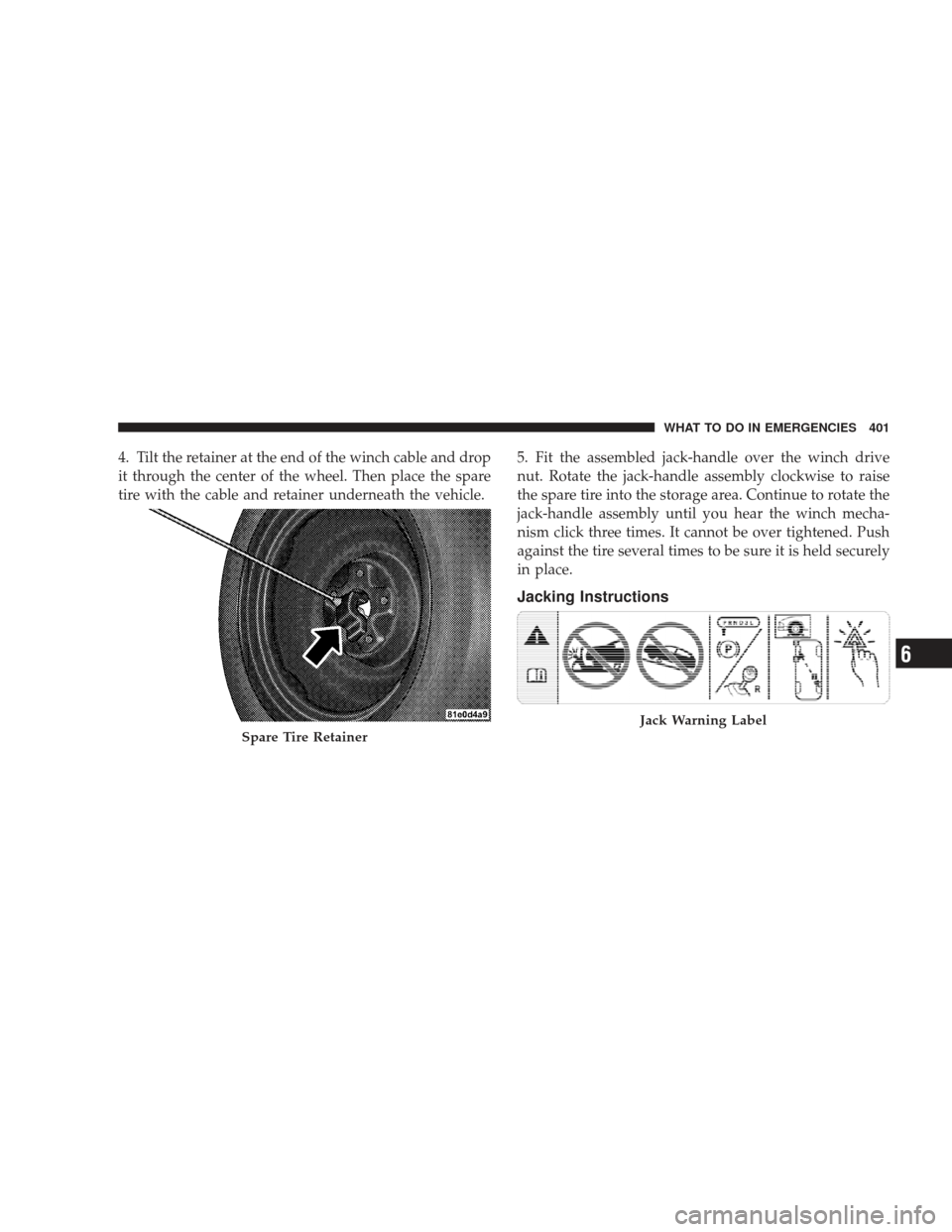
4. Tilt the retainer at the end of the winch cable and drop
it through the center of the wheel. Then place the spare
tire with the cable and retainer underneath the vehicle.5. Fit the assembled jack-handle over the winch drive
nut. Rotate the jack-handle assembly clockwise to raise
the spare tire into the storage area. Continue to rotate the
jack-handle assembly until you hear the winch mecha-
nism click three times. It cannot be over tightened. Push
against the tire several times to be sure it is held securely
in place.
Jacking Instructions
Spare Tire Retainer
Jack Warning Label
WHAT TO DO IN EMERGENCIES 401
6
Page 404 of 523
WARNING!
Carefully follow these tire changing warnings to help prevent
personal injury or damage to your vehicle:
•Always park on a firm, level surface as far from the edge of
the roadway as possible before raising the vehicle.
• Block the wheel diagonally opposite the wheel to be raised.
• Set the parking brake firmly and set an automatic transaxle
in PARK; a manual transaxle in REVERSE.
• Never start or run the engine with the vehicle on a jack.
• Do not let anyone sit in the vehicle when it is on a jack.
• Do not get under the vehicle when it is on a jack.
• Only use the jack in the positions indicated and for lifting
this vehicle during a tire change.
• If working on or near a roadway, be extremely careful of
motor traffic.
• To assure that spare tires, flat or inflated are securely stowed,
spares must be stowed with the valve stem facing the
ground.
• Turn on the Hazard warning flasher.
1. Remove the spare tire, jack, and jack-handle from
stowage.
2. Loosen, but do not remove, the wheel nuts on the
wheel with the flat tire. Turn the wheel nuts counter-
clockwise one turn while the wheel is still on the ground.
3. Place the jack underneath the lift area that is closest to
the flat tire. Turn the jack screw clockwise to firmly
engage the jack saddle with the lift area of the sill flange.
402 WHAT TO DO IN EMERGENCIES
Page 406 of 523
4. Raise the vehicle by turning the jack screw clockwise
with the jack handle. Raise the vehicle until the tire just
clears the road surface and enough clearance is obtained
to install the spare tire. Minimum tire lift provides
maximum stability.
WARNING!
Raising the vehicle higher than necessary can make
the vehicle less stable. It could slip off the jack and
hurt someone near it. Raise the vehicle only enough
to remove the tire.
5. Remove the wheel nuts. For vehicles so equipped,
remove the wheel cover from the wheel by hand. Do not
pry the wheel cover off. Then pull the wheel off the hub.
WARNING!
To avoid possible personal injury, handle the wheel
covers with care to avoid contact with any sharp
edges.
NOTE: For vehicles so equipped, the wheel cover is
held on the wheel by the wheel nuts. When reinstalling
the original wheel, properly align the wheel cover to the
valve stem, place the wheel cover onto the wheel, and
then install the wheel nuts.
6. Install the spare tire.
NOTE:
•For vehicles so equipped, do not attempt to install a
center cap or wheel cover on the compact spare.
404 WHAT TO DO IN EMERGENCIES
Page 407 of 523
•Refer to “Compact Spare Tire” and to “Limited-Use
Spare” under “Tires — General Information” in Sec-
tion 5 for additional warnings, cautions, and informa-
tion about the spare tire, its use, and operation.
7. Install the wheel nuts with the cone shaped end of the
nut toward the wheel. Lightly tighten the wheel nuts.
WARNING!
To avoid the risk of forcing the vehicle off the jack,
do not tighten the wheel nuts fully until the vehicle
has been lowered. Failure to follow this warning may
result in personal injury or death.
8. Lower the vehicle by turning the jack screw counter-
clockwise with the jack handle. 9. Finish tightening the wheel nuts. Push down on the
wrench while tightening for increased leverage. Alternate
wheel nuts until each nut has been tightened twice.
Correct wheel nut tightness is 95 ft lbs (130 N·m). If in
doubt about the correct tightness, have them checked
with a torque wrench by your authorized dealer or at a
service station.
10. Lower the jack to its fully closed position.WARNING!
A loose tire or jack, thrown forward in a collision or
hard stop could endanger the occupants of the ve-
hicle. Always stow the jack parts and the spare tire in
the places provided. Have the deflated (flat) tire
repaired or replaced immediately.
WHAT TO DO IN EMERGENCIES 405
6
Page 409 of 523
JUMP-STARTING PROCEDURES
WARNING!
•Take care to avoid the radiator cooling fan when-
ever the hood is raised. It can start anytime the
ignition switch is ON. You can be hurt by the fan.
•Do not attempt to push or tow your vehicle to get
it started. Vehicles equipped with an automatic
transaxle cannot be started this way. Unburned
fuel could enter the catalytic converter and once
the engine has started, ignite and damage the
converter and vehicle. If the vehicle has a dis-
charged battery, booster cables may be used to
obtain a start from another vehicle. This type of
start can be dangerous if done improperly, so
follow this procedure carefully.
•Do not use a booster battery or any other booster
source with an output that exceeds 12 Volts.
WARNING!
•Battery fluid is a corrosive acid solution; do not
allow battery fluid to contact eyes, skin, or cloth-
ing. Don’t lean over battery when attaching
clamps or allow the clamps to touch each other. If
acid splashes in eyes or on skin, flush contami-
nated area immediately with large quantities of
water.
•A battery generates hydrogen gas, which is flam-
mable and explosive. Keep flame or spark away
from the vent holes.
The battery is stored in a compartment that is located
behind the left front fender and is accessible through the
wheel well. Remote jump-start terminals are located in
the engine compartment.
WHAT TO DO IN EMERGENCIES 407
6
Page 410 of 523
1. Wear eye protection and remove any metal jewelry
such as watchbands or bracelets that might make an
inadvertent electrical contact.
2. When boosting from a battery in another vehicle, park
that vehicle within booster cable reach, but without
allowing the vehicles to touch. Set parking brake, place
automatic transaxle in PARK, and turn ignition to LOCK
for both vehicles.
WARNING!
Do not permit vehicles to touch each other as this
could establish a ground connection and personal
injury could result.3. Turn off the heater, radio, and all unnecessary electri-
cal loads.
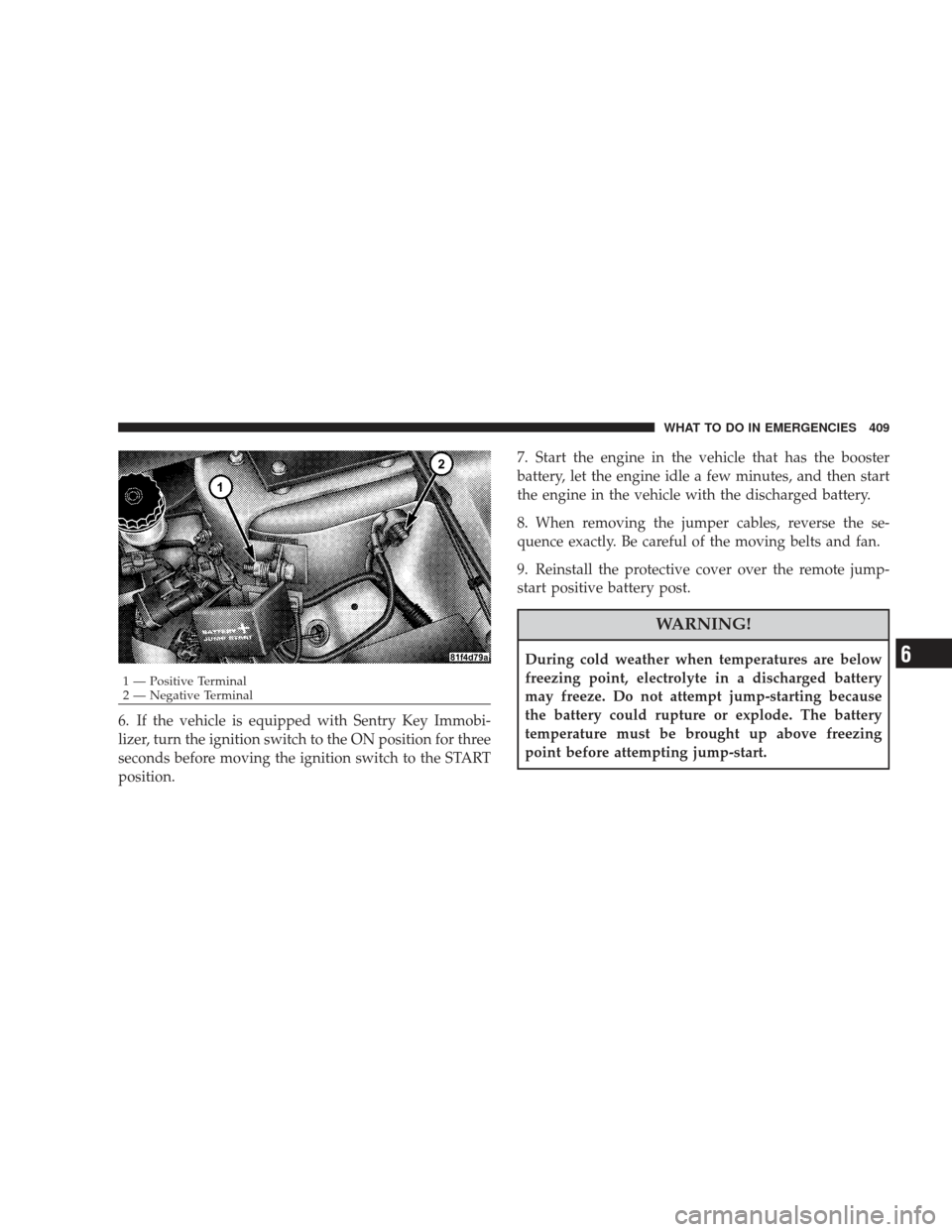
4. Remove the protective cover over the remote jump-
start positive battery post
(+)in the engine compartment.
Connect one end of the jumper cable to the positive
battery post. Connect the other end of the same cable to
the positive terminal of the booster battery. Refer to the
following illustration for jump-starting connections.
5. Connect the other cable, first to the negative terminal
of the booster battery and then to the engine ground (-)
of the vehicle with the discharged battery. Make sure
you have a good contact on the engine ground. Refer to
the following illustration for jump-starting connections.
408 WHAT TO DO IN EMERGENCIES
Page 411 of 523
6. If the vehicle is equipped with Sentry Key Immobi-
lizer, turn the ignition switch to the ON position for three
seconds before moving the ignition switch to the START
position.7. Start the engine in the vehicle that has the booster
battery, let the engine idle a few minutes, and then start
the engine in the vehicle with the discharged battery.
8. When removing the jumper cables, reverse the se-
quence exactly. Be careful of the moving belts and fan.
9. Reinstall the protective cover over the remote jump-
start positive battery post.
WARNING!
During cold weather when temperatures are below
freezing point, electrolyte in a discharged battery
may freeze. Do not attempt jump-starting because
the battery could rupture or explode. The battery
temperature must be brought up above freezing
point before attempting jump-start.
1 — Positive Terminal
2 — Negative Terminal WHAT TO DO IN EMERGENCIES 409
6
Page 412 of 523
NOTE:Refer to “Maintenance Procedures” in Section 7
for information on accessing the battery for service or
replacement.
WARNING!
Any procedure other than above could result in:
1. Personal injury caused by electrolyte squirting out
the battery vent;
2. Personal injury or property damage due to battery
explosion;
3. Damage to charging system of booster vehicle or
of immobilized vehicle.
FREEING A STUCK VEHICLE
If your vehicle becomes stuck in mud, sand, or snow, it
can often be moved by a rocking motion. Turn your
steering wheel right and left to clear the area around the
front wheels. Then shift back and forth between RE-
VERSE and 1st gear. Usually the least accelerator pedal
pressure to maintain the rocking motion without spin-
ning the wheels is most effective.
NOTE:
If your vehicle is equipped with Traction Con-
trol, turn the system OFF before attempting to
“rock” the vehicle. Refer to “Partial Off Mode”
under “Electronic Stability Program (ESP)” in
Section 5.
410 WHAT TO DO IN EMERGENCIES
Page 413 of 523
WARNING!
Fast spinning tires can be dangerous. Forces gener-
ated by excessive wheel speeds may cause axle and
tire damage or failure. A tire could explode and
injure someone. Do not spin your vehicle’s wheels
faster than 30 mph (48 km/h) or for longer than 30
seconds continuously without stopping when you
are stuck, and don’t let anyone near a spinning
wheel, no matter what the speed.
CAUTION!
Racing the engine or spinning the wheels too fast
may lead to transaxle overheating and failure. It can
also damage the tires. Do not spin the wheels above
30 mph (48 km/h). Do not spin the wheels continu-
ously for more than 30 seconds.
WHAT TO DO IN EMERGENCIES 411
6
Page 426 of 523
AUTHORIZED DEALER SERVICE
Your authorized dealer has the qualified service person-
nel, special tools, and equipment to perform all service
operations in an expert manner. Service manuals are
available which include detailed service information for
your vehicle. Refer to these service manuals before
attempting any procedure yourself.
NOTE:Intentional tampering with emissions control
systems can result in civil penalties being assessed
against you.
WARNING!
You can be badly injured working on or around a
motor vehicle. Only do service work for which you
have the knowledge and the proper equipment. If you
have any doubt about your ability to perform a service
job, take your vehicle to a competent mechanic.
MAINTENANCE PROCEDURES
The pages that follow contain the requiredmaintenance
services determined by the engineers who designed your
vehicle.
Besides the maintenance items for which there are fixed
maintenance intervals, there are other items that should
operate satisfactorily without periodic maintenance.
However, if a malfunction of these items does occur, it
could adversely affect the engine or vehicle performance.
These items should be inspected if a malfunction is
observed or suspected.
Engine Oil
Checking Oil Level
To assure proper engine lubrication, the engine oil must
be maintained at the correct level. Check the oil level at
regular intervals, such as every fuel stop.
424 MAINTAINING YOUR VEHICLE